R E S E A R C H
Open Access
3GPP QoS-based scheduling framework
for LTE
Pablo Ameigeiras
1*, Jorge Navarro-Ortiz
1, Pilar Andres-Maldonado
1, Juan M. Lopez-Soler
1,
Javier Lorca
2, Quiliano Perez-Tarrero
3and Raquel Garcia-Perez
3Abstract
This paper proposes the design of a scheduling framework for the downlink of the Long Term Evolution (LTE) system with the objective of meeting the Quality of Service (QoS) requirements as defined by the QoS architecture of the 3G Partnership Project (3GPP) specifications. We carry out a thorough review of 3GPP specifications analyzing the requirements of the 3GPP QoS architecture. LTE bearers may be associated with a Guaranteed Bit Rate (i.e., GBR bearers) or not (i.e., non-GBR bearers). Additionally, the specifications establish a Packet Delay Budget (PDB) to limit the maximum packet transfer delay. To achieve our goal, we design a channel-aware service discipline for GBR bearers which is able to fulfill not only the GBR but also the PDB. Additionally, we also design an algorithm for prioritizing GBR and non-GBR bearers from different QoS Class Identifiers (QCIs) following 3GPP QoS rules. We compare the proposed framework with two reference schedulers by means of network-level simulations. The results will show the ability of the proposed framework to address the QoS requirements from 3GPP specifications while providing an interesting performance from a spectral efficiency viewpoint.
Keywords: LTE, Scheduling, GBR, Non-GBR, QoS Class Identifier, PDB
1 Introduction
Numerous operators worldwide have commercially launched Long Term Evolution (LTE) and LTE-Advanced (LTE-A) networks in recent years. The 3G Partnership Project (3GPP) has defined these radio access technolo-gies with the objective of providing improved network capacity, coverage, and latency. LTE is based on Orthogo-nal Frequency Division Multiple Access (OFDMA) where the resource blocks are assigned by an eNodeB scheduler, which therefore plays a key role in the system perfor-mance. LTE-A also includes various features that enhance LTE performance.
3GPP specifications have also standardized a Quality of Service (QoS) architecture [1] different from the one defined for previous 3G radio access networks. This archi-tecture is based on the fundamental concept of the bearer, which is assigned to one predefined QoS class. This class-based association determines the final QoS attributes of
*Correspondence: [email protected]
1Department of Signal Theory, Telematics and Communications, University of Granada, Periodista Daniel Saucedo Aranda s/n, 18071 Granada, Spain Full list of author information is available at the end of the article
the provided services to the subscriber groups. The archi-tecture defines relative priorities for the QoS classes, and depending on its class, the bearer is associated with a Guaranteed Bit Rate (i.e., GBR bearer) or not (i.e., non-GBR bearer).
The objective of our investigation is the design of a scheduling framework for the downlink of the LTE sys-tem which satisfies the QoS requirements defined by the QoS architecture of 3GPP specifications [1, 2]. To the best of the authors’ knowledge, no previous work has achieved that objective. For that purpose, we will review the QoS concept in 3GPP specifications. We will show that 3GPP specifications establish a per-QoS-class upper bound for the delay of the data packets transferred by a bearer. This bound is named Packet Delay Budget (PDB) by the 3GPP specifications, and they establish it as the primary goal of the scheduling framework. We will review the terms indi-cated in 3GPP specifications regarding the satisfaction of the PDB for GBR and non-GBR bearers.
For these reasons, we propose in this paper an innova-tive scheduling framework for the downlink of LTE. The novelty of our design is that it aims at globally addressing the QoS requirements as defined by 3GPP specifications.
For this, we carry out the following contributions: (i) a thorough review of 3GPP specifications analyzing the QoS requirements imposed by the 3GPP QoS architec-ture and their implications on the scheduling design. From this review, we identify the Packet Delay Budget as a key requirement to be fulfilled. Additionally, we identify that if the PDB cannot be fulfilled for all bearers then priori-tization between bearers of different QoS classes should be triggered. (ii) The design of a channel-aware service discipline for GBR bearers that is able to fulfill not only the Guaranteed Bit Rate but also the Packet Delay Bud-get. The discipline incorporates a delay-dependent factor based on a sigmoid function. The benefit of this delay-dependent factor is that a parameter controls its upper bound. This facilitates the prioritization of bearers of different QoS classes compared to other service disci-plines.(iii) The design of an algorithm for prioritizing GBR and non-GBR bearers from different QoS Class Identifiers (QCIs) following 3GPP QoS rules when the PDB cannot be met for all bearers.
We have evaluated the proposed framework by means of network-level simulations and compared it with two reference schedulers. For the evaluation, we have consid-ered scenarios with different load levels and traffic mixes of real-time, progressive video, and elastic traffic. The results will show the ability of the proposed framework to satisfy the QoS requirements from 3GPP specifica-tions while providing an interesting performance from a spectral efficiency viewpoint.
The rest of the paper is organized as follows: Section 2 provides an overview of related works. Section 3 presents the system model. Section 4 describes the QoS concept in 3GPP and discusses its implications on the scheduling design. Section 5 presents the proposed QoS scheduling design and Section 6 its performance results by means of simulations. Section 7 finally draws the main conclusions.
2 Related works
The literature on downlink scheduling for LTE and OFDMA systems is extensive. Sadiq et al. [3], Capozzi et al. [4], and Dardouri and Bouallegue [5] provide inter-esting overviews of related prior work.
2.1 QoS-aware strategies for real-time traffic
Concentrating on QoS-aware scheduling algorithms, the Modified-Largest Weighted Delay First (M-LWDF) [6], the Exponential/Proportional Fair (EXP/PF), the Exp rule, and the Log rule are relevant proposals described in those overviews. Despite these scheduling algorithms provid-ing very interestprovid-ing performance benefits [3–5], they are not well suited to fulfilling the QoS requirements of 3GPP specifications. They were originally designed for a sce-nario with real-time traffic only. Therefore, they require to be extended to support non-real-time traffic and a
strategy to provide relative prioritization between traffic classes. Moreover, although these strategies increase the user’s priority when the Head of Line (HOL) packet delay increases, they may be enhanced by emphati-cally increasing the user’s priority when the HOL packet delay approaches its upper bound. The urgency of the HOL packet delay is addressed in the Delay-Prioritized Scheduling (DPS) algorithm [7] by prioritizing a user according toδ=D−w, wherewdenotes the user’s HOL packet delay andDthe packet delay upper bound. How-ever, DPS has also been designed for a real-time traffic scenario only.
2.2 QoS-aware strategies for heterogeneous traffic Some other algorithms have been developed for a sce-nario with a mix of real-time and non-real-time traffic. The Rate-Level-Based Scheduling (RLBS) [8] algorithm prioritizes a user according to theirδ, their spectral effi-ciency, and a GBR-related factor if the user supports a GBR bearer. However, it is not appropriate to apply a packet delay upper bound to non-real-time traffic that is delay tolerant (see Section 4.3). In [9], Ai et al. pro-pose to compute the service order of real-time users based on the factor D− β ·w, where β is an adaptive delay adjustment. In the last step, the algorithm assigns the remaining resource blocks to the non-real-time users. In [10], Iturralde et al. propose to implement a virtual token mechanism along with either the M-LWDF or the EXP/PF scheduling algorithms for real-time traffic. Their strategy provides very interesting performance for real-time flows, but it penalizes non-real-time flows. In [11], Nasralla and Martini suggest a modification to Iturralde’s proposal by incorporating the queue size and the HOL packet delay in the priority computation for both real-time and non-real-time traffic. Their results show a balanced performance between the flows of the different traffic clases. In [12], Capozzi et al. propose the Frame Label Scheduler (FLS), which is composed of two levels. At the highest level, FLS calculates every frame (i.e., 10 ms) the total amount of data that real-time flows should transmit in the following frame in order to satisfy their delay constraints. At the lowest level, every Transmission Time Interval (TTI) (i.e., 1 ms) FLS assigns resource blocks to each real-time flow following a Maximum Throughput policy. Then, Propor-tional Fair is used to share the spare spectrum among best effort users.
2.3 QoS-aware strategies for bit rate guarantees
prioritization between the bearers of the different QoS classes. Mongha’s and Zaki’s proposals do not increase the user’s priority when the HOL packet delay approaches its upper bound, and therefore, they are not well suited to sat-isfy the PDB. In [15], Gora proposes a QoS-aware resource management for LTE-A-based relay networks. Although his proposal concentrates on multi-hop relays, it presents valuable utility functions to satisfy the GBR and/or the PDB for real-time traffic. However, his proposal has been neither designed nor evaluated in a traffic mix scenario with several QCIs.
All these proposals presented in Sections 2.2 and 2.3 are not well suited to fulfilling the QoS requirements of 3GPP specifications. They either do not provide relative prioritization between QoS classes or they provide rela-tive prioritization without following the rules imposed by 3GPP specifications. Furthermore, the large majority of these related works do not include users’ birth and death processes in their evaluation models, which may strongly impact their obtained results (see [16]).
3 System model
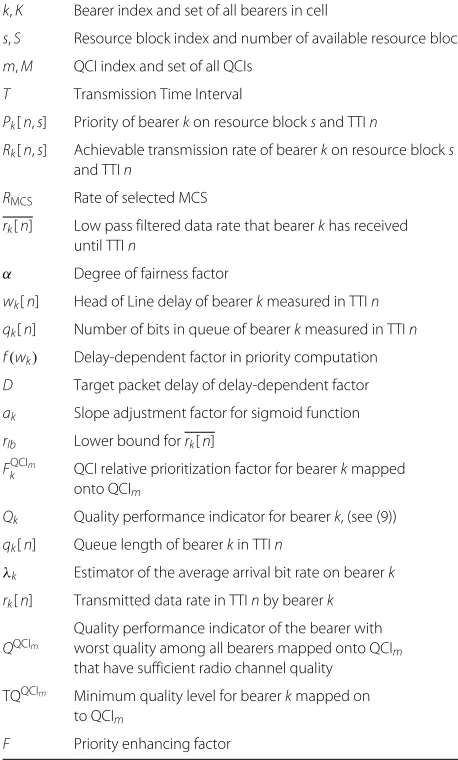
Let us consider the OFDMA downlink transmission of an LTE cell where a base station transmits data to a set of users. LetK={1, .,k, ..,K}represent both the set of users and its cardinality at an arbitrary epoch in time. The nota-tion used in the paper is given in Table 1. The base stanota-tion carries out the transmission towards theKusers in TTIs of fixed durationT = 1 ms. The total available bandwidth for transmission is divided inSresource blocks of fixed size. Each resource block is composed of 12 consecutive subcarriers with a subcarrier spacing of 15 kHz.
The base station transmission power is assumed to be constant across all subcarriers. The channel model assumes small-scale fading, shadow fading, and path loss. The signal received by each user is corrupted with AWGN noise and intercell interference. The resulting signal-to-interference ratio SINRk[n,s] of userkon resource block sand TTInis used to compute its achievable transmis-sion rateRk[n,s] based on a finite set of Modulations and Coding Schemes (MCSs). The base station is assumed to have instantaneous and perfect knowledge of the achiev-able transmission rateRk[n,s] of all the users based on the Channel Quality Indicator (CQI) reports. The schedul-ing algorithm uses this information to assign bandwidth resources to the users. The granularity of the bandwidth assignment equals one resource block:
k[n,s]=
1 resource blocksis assigned to userkin TTIn 0 otherwise
(1) The base station applies link adaptation, and it employs a single MCS for all resource blocks assigned to user k in TTI n. If userksuccessfully decodes the radio block
Table 1Notation used in this paper
k,K Bearer index and set of all bearers in cell
s,S Resource block index and number of available resource blocks m,M QCI index and set of all QCIs
T Transmission Time Interval
Pk[n,s] Priority of bearerkon resource blocksand TTIn
Rk[n,s] Achievable transmission rate of bearerkon resource blocks
and TTIn
RMCS Rate of selected MCS
rk[n] Low pass filtered data rate that bearerkhas received
until TTIn
α Degree of fairness factor
wk[n] Head of Line delay of bearerkmeasured in TTIn
qk[n] Number of bits in queue of bearerkmeasured in TTIn
f(wk) Delay-dependent factor in priority computation
D Target packet delay of delay-dependent factor ak Slope adjustment factor for sigmoid function
rlb Lower bound forrk[n]
FQCIm
k QCI relative prioritization factor for bearerkmapped
onto QCIm
Qk Quality performance indicator for bearerk, (see (9))
qk[n] Queue length of bearerkin TTIn
λk Estimator of the average arrival bit rate on bearerk
rk[n] Transmitted data rate in TTInby bearerk
Quality performance indicator of the bearer with QQCIm worst quality among all bearers mapped onto QCI
m
that have sufficient radio channel quality TQQCIm Minimum quality level for bearerkmapped on
to QCIm
F Priority enhancing factor
in TTI n, he is assumed to correctly receive RMCS ·T bits of data for each resource blocksof the radio block. RMCSdenotes the rate of the selected MCS. The base sta-tion has one queue buffer for each user. Letqk[n] denote the number of bits of all packets stored in the queue of userk. Whenever the base station receives a packet des-tined for userk, it stores the packet in the user’s queue buffer and it updatesqk[n]. Additionally, it starts a timer for the received packet. This timer is used obtain the HOL packet delaywk[n] when the packet reaches the front of the queue. If userksuccessfully decodes the radio block in TTI n, the queue qk[n] corresponding to the flow of user k is decremented according to the transmitted bits:
but also the index of its assigned bearer. Let us also denote M={1, .,m, ..,M}to represent both the set of QCIs and its cardinality. The assignment of bearerkto QCImwill be denoted askQCIm.
4 QoS concept in 3GPP
4.1 The EPS bearer concept
The Evolved Packet System (EPS) bearer is the basis of the QoS in LTE [1]. It provides a logical channel between the user entity (UE) and a Packet Data Network (PDN) for transporting IP traffic [17]. The EPS bearer is the degree of granularity for bearer-level QoS control. All packets transferred by an EPS bearer are equally treated by for-warding functionalities (e.g., scheduling policy and queue management policy) [1]. EPS bearers can be classified as GBR or non-GBR bearers. An EPS bearer is named a GBR bearer if the EPS permanently allocates dedicated network resources (more specifically, a GBR value) to it. Otherwise, it is named a non-GBR bearer.
The 3GPP QoS concept includes four per-EPS-bearer parameters, three of which are relevant for scheduling purposes [1]:
• QoS Class Identifier (QCI ): is a reference scalar used to specify node-specific parameters that control bearer-level packet forwarding treatment.
• Guaranteed Bit Rate (GBR ): is the bit rate the GBR bearer is expected to provide.
• Maximum Bit Rate (MBR ): is the maximum bit rate a GBR bearer can provide (e.g., a traffic shaper may discard the traffic excess). In Release 8, the MBR of a GBR bearer shall be set equal to the GBR [1].
The last two parameters are applicable only to GBR bearers.
4.2 Standardized QCI characteristics
The QCI determines the packet forwarding treatment that the EPS have to apply to the traffic conveyed by the bearer. The 3GPP specification [2] defines a set of standardized QCI characteristics associated with the QCI values. Three of these characteristics are relevant for scheduling:
• Resource type (GBR or non-GBR ): determines if the bearers associated to a given QCI are GBR or not. • Priority: via its QCI, a bearer is associated with a
priority level, which can be used to prioritize between bearers. Note that a QCI with lower priority
parameter has preference over a QCI with higher priority parameter.
• Packet Delay Budget (PDB ): it defines the upper limit of the delay suffered by a packet between the UE and the Policy and Charging Enforcement Function (PCEF).
Table 2 captures the mapping of standardized QCI values and its corresponding characteristics as well as example services for each QCI.
It is relevant to note that according to [1] these standard-ized characteristics are simply criteria for the configura-tion of parameters in each node for each QCI. However, they are not signaled on any interface. Additionally, it is also worth mentioning that the PDB limits the total delay between the PCEF and the UE, and therefore, to calcu-late the budget applicable to the radio access network, the delay between the PCEF and the eNodeB must be sub-tracted. Hereafter, we will refer to the PDB assuming that the delay between the PCEF and the eNodeB has already been subtracted.
4.3 Implications of the bearer QoS profile on the scheduling framework
Let us further analyze the implications of the 3GPP QoS concept on the scheduling solution.
Regarding GBR bearers, a 3GPP-QoS-compliant
scheduling framework must be able to guarantee the GBR for the bearers with QCIs 1–4. As for Release 8, the MBR shall be set equal to the GBR and the bearer must be able to guarantee the bit rate up to the limit imposed by the MBR. As stated in [2], services mapped onto these QCIs “can assume that congestion related packet drops will not occur, and 98 percent of the packets shall not experience a delay exceeding the QCI’s PDB” (except in the case of transient link outages). Therefore, we conclude that, for a GBR bearer, the scheduling framework must guarantee that the packet delay does not exceed the PDB for all incoming traffic up to the limit of the GBR (for at least 98 % of the packets).
Table 2Standardized QCI values to standardized characteristic mapping [2]
QCI Resourcetype Priority PacketDelay Packeterror Example services
Budget (ms) loss rate
1
GBR
2 100 10−2 Conversational voice
2 4 150 10−3 Conversational video (live streaming)
3 3 50 10−3 Real-time gaming
4 5 300 10−6 Non-conversational video (buffered streaming)
5
Non-GBR
1 100 10−6 IMS signalling
Video (buffered streaming), TCP-based (e.g.,
6 6 300 10−6 www, e-mail, chat, ftp, p2p file sharing,
and progressive video)
7 7 100 10−3 Voice, video (live streaming), interactive
gaming
8 8
300 10−6
Video (buffered streaming), TCP-based (e.g., www, e-mail, chat, ftp, p2p file sharing,
9 9 and progressive video)
supporting elastic traffic) are expected to suffer packet drops due to congestion and (ii) the delay of packets that are not dropped should not exceed the PDB, but this delay limit is not as strict as for GBR bearers.
Regarding the relative priority between bearers of dif-ferent QCIs, the 3GPP specification [2] indicates that the scheduling between different bearers “shall primarily be based on the PDB.” However, if the PDB cannot be met for all bearers with sufficient radio channel quality then Pri-ority shall be used as follows [2]: “in this case a scheduler shall meet the PDB of a bearer on Priority level N in pref-erence to meeting the PDB of a bearer on Priority level N+1.” Therefore, we conclude that a 3GPP-based schedul-ing framework has to be able to detect if the PDB cannot be fulfilled for all bearers (e.g., in case of heavy load) and, in that case, prioritize between bearers of different QCIs.
Additionally, it is relevant to observe that [2] states that the prioritization should not be triggered if the PDB is not fulfilled by a UE with insufficient radio channel quality. Although [2] does not define any criterion to determine if a UE has sufficient channel quality, it is pos-sible to use UE measurements to establish a radio channel criterion.
5 QoS scheduling framework
This section presents the scheduling framework based on the 3GPP guidelines and EPS bearer QoS attributes described above. First, for non-GBR bearers, this pro-posal includes a utility maximization scheduling discipline (based on [16]). Second, for GBR bearers, the proposal includes a delay-dependent scheduling discipline com-bined with a rate shaping function. Third, the proposal includes a novel algorithm that establishes relative prece-dence between QCIs when the PDB can no longer be met for all bearers.
5.1 Scheduling for non-GBR bearers
As it can be seen in Table 2, the TCP elastic traffic is to be mapped onto non-GBR bearers. The literature on scheduling for elastic traffic in OFDMA systems is extensive. Some of these works have designed scheduling disciplines aiming at maximizing the sum (over flows) of the average rate of the flows under power and/or mini-mum rate constraints [19–23]. Other works have concen-trated on maximizing the sum of a utility function instead [24, 25]. However, it is not possible for a scheduling dis-cipline to guarantee a target delay for elastic traffic unless a restrictive rate shaping function (e.g., leaky bucket) is applied [18].
On the other hand, the quality of TCP-based services is typically determined by the throughput of the flow. For example, for interactive or background services, the qual-ity typically depends on the service response time, which is ultimately determined by the throughput of the flow (see, for example, [26] for web browsing). For progressive video, the quality primarily depends on the rebuffering events [27], which are also determined by the throughput of the flow [28, 29].
that controls the degree of fairness. Results presented in [16] have shown that by settingα ≈ 0.6 it is possible to achieve a user throughput at 5 % outage similar to the Pro-portional Fair algorithm but an average user throughput gain of approximately 60 %. Therefore, hereafter, it will be assumed thatαis set to 0.6.
5.2 Scheduling for GBR bearers
As described in Section 4.3, the eNodeB has to ensure for GBR bearers that 98 % of the packets shall not suffer a delay that exceeds the QCI’s PDB. This requires a tight control of the delay suffered by the packets in the eNodeB queues. Interesting QoS schedulers are the M-LWDF, Exp rule, and Log rule [3]. As example, the Exp rule scheduler computes the user’s priority as:
Pk[n,s]=bk·Rk[n,s]·exp delay of userkmeasured in TTIn. The parameterbkcan be set equal to 1/rk[n] . This way, the priority is computed as in the Proportional Fair discipline and then multiplied by a delay-dependent factor. Additionally, the HOL packet delaywk[n] can be substituted by the queue length, which yields its queue-length-driven version.
While the Exp rule and Log rule scheduling algorithms provide interesting performance benefits [3–5], they are not well suited for fulfilling the QoS requirements of GBR bearers exposed in Section 4.3. Firstly, although these strategies increase the user’s priority when the HOL packet delay increases, they may be enhanced by emphat-ically increasing the user’s priority when the HOL packet delay approaches its PDB. Secondly, and more impor-tantly, the upper bound of the delay-dependent factor in these strategies cannot be easily controlled. This upper bound is reached whenwk[n] approaches the PDB (e.g., due to a temporary load increase). For example, in (4), this upper bound depends on the PDB of bearer k and the average HOL packet delay of all bearers. This makes it difficult to eventually prioritize bearers of a given QCI at the expense of bearers mapped onto QCIs with a higher priority parameter if the latter bearers suffer a large HOL packet delay.
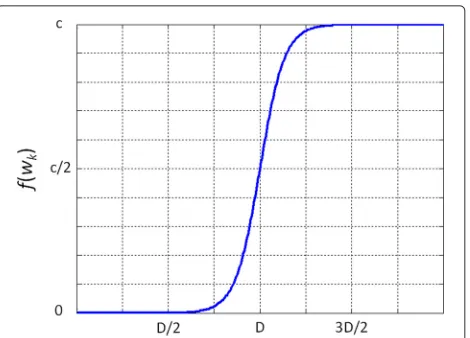
For these reasons, we propose to implement the delay-dependent factor based on a sigmoid function [30] instead of the exponential or logarithmic functions. The proposed delay dependent factor is as follows:
f(wk)=
c
1+e−ak(wk−D) (5)
The parameterakadjusts the slope of the sigmoid func-tion, the parameter c establishes its upper bound, and the parameterDcan be used to control the target packet
Fig. 1Delay-dependent factorf(wk)withak= 75
delay. Although the sigmoid utility function is applied with respect to the bandwidth resource in [30], we apply it with respect to the packet delay to implement the delay-dependent factor. Figure 1 depicts f(wk) for the case ak =75.
Our scheduling proposal for GBR bearers computes the priority of bearerkby combining the delay-dependent fac-torf(wk)with the scheduling metric for non-GBR bearers of (3) as follows: non-GBR bearers (see Section 5.1) when the Head of Line delaywk → 0, but it increases when the Head of Line delaywk approaches D. Hence, by appropriately setting the parameters ak, D, andc, (6) is able to emphatically increase the priority Pk[n,s] of GBR users when their Head of Line delays approach their respective PDB. With this proposal, if the Head of Line delaywkapproaches the PDB (e.g., due to a temporary load increase), the delay-dependent factor will be upper bounded by parameterc, and therefore, it will cause a controlled increase of the priority Pk[n,s]. Furthermore, to avoid that an excessive reduction ofrk[n] caused by the starvation of a user also leads to an uncontrollable increase ofPk[n,s], the metric rk[n] will be lower bounded by a parameterrlb.
5.3 QCI prioritization
In this subsection, we present an algorithm for integrat-ing the above described schedulintegrat-ing disciplines for GBR and non-GBR bearers. Additionally, the algorithm imple-ments the relative prioritization between QCIs described in Section 4.3.
The integration mechanism modifies the priority of a bearerkthat is mapped onto QCImby multiplying it by a factorFkQCI. The new priority of the bearerkis given by:
PQCIm
k [n,s]=Pk[n,s]·F QCIm
k (7)
Then, the scheduler algorithm assigns resource block s in TTI n to the user k with the highest priority PQCIm
k [n,s]:
k[n,s]=argmax kK
PQCIm
k [n,s]
(8)
The factorFQCIm
k implements the relative prioritization between QCIs. It is computed in every TTI and∀k ∈ K. The calculation ofFQCIm
k is described next.
As described in Section 4.3, the scheduling has to detect if all bearers fulfill their target quality. For this purpose, we
Fig. 2Computation of factorFQCIm
define a quality performance indicatorQkfor each bearer. For bearers mapped onto GBR QCIs,Qkis an estimator of the average packet delay of bearerk. For bearers mapped onto non-GBR QCIs, Qk is an estimator of the average data rate of bearerk.Qkis then defined as follows:
Qk[n]= bearer kin TTIn andλk is an estimator of the average arrival bit rate on bearerk. Accordingly,rk[n] represents the transmitted data rate in TTInby bearerk.ρdandρr are time averaging constants.
Let us additionally define a target quality TQQCIm that
establishes the minimum quality level that should be expe-rienced by a bearer mapped onto QCIm:
• For GBR QCIs: TQQCImis a delay threshold for QCI
m. • For non-GBR QCIs: TQQCIm is a data rate threshold
for QCIm.
Then, we define condition (10) that is fulfilled if bearer ksatisfies
A bearer k fulfills condition (10) if its quality perfor-mance indicatorQk[n] does not reach the target quality level. If there exists a bearerk ∈ Kthat fulfills condition (10), then CQI prioritization must be triggered.
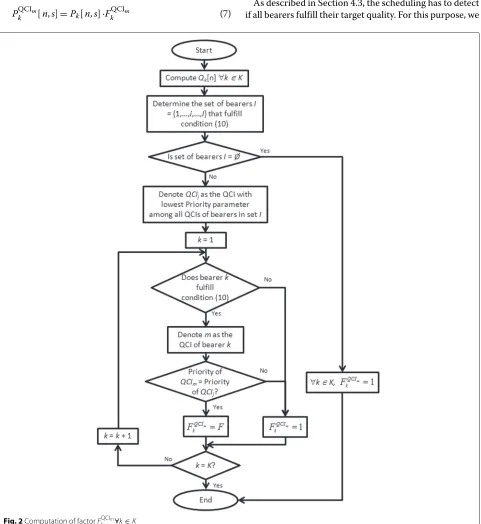
Figure 2 depicts the algorithm proposed to compute the factorFQCIm
k ∀k∈K. The algorithm is based on condition (10), and it has the following steps:
1. The algorithm determines the setI= {1, ..,i, ..I}of bearers that fulfill condition (10).
2. If setI is empty, CQI prioritization is not required. Then,FQCIm
k =1∀k, and the algorithm is finished. If setI is not empty, CQI prioritization is triggered. Then, the algorithm starts to compute factorFQCIm
k fork = 1.
3. The algorithm sets factorFQCIm
k for bearerk mapped on to QCImequal to a constant factorF if the following two conditions hold: (i) bearerk fulfills condition (10) and (ii) QCImis the QCI with the lowest priority parameter among the QCIs of all the bearers∈I.
4. The algorithm repeats step 3 untilk is the last bearer ∈K.
In summary, factor FQCIm
k is set equal to a priority enhancing factorFif bearerkfulfills condition (10) and its QCI is the one with the lowest priority parameter among all bearers that fulfill (10). Bearers with insufficient radio channel quality are not considered in the prioritization algorithm and are assumed to setFQCIm
k =1.
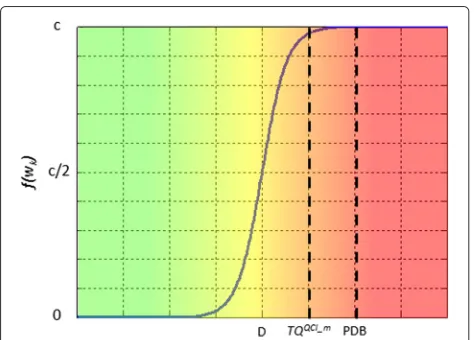
We further propose to provide a certain guard margin to this reactive mechanism before the quality target limit is exceeded. For example, for QCIs = 1, 2, 3, 4, if the PDB of a given QCI equals 300 ms, then we setTQQCImto a lower
value (e.g., 250 ms), thereby providing a certain operation margin (50 ms) before the PDB is exceeded. See Fig. 3 for the relation between parameters D, TQQCIm, and PDB.
Accordingly, for QCIs = 5, 6, 7, 8, 9, if UEs are consid-ered to incur outage at a given throughput threshold (e.g., 512 kbps), we establishTQQCIm (e.g., 600 kbps) including
a certain guard interval.
The complexity of the overall scheduling solution is sim-ilar to that of the Exp rule scheduler. It has a complexity ofO(KS)due to a search for the maximum ofK metrics on each of theSresource blocks. The CQI Prioritization algorithm has a low complexity as it only requires the eval-uation of condition (10) for each of the K bearers and determining which bearers in setIhave the lowest priority parameter.
6 Performance results
This section presents the performance evaluation of the proposed scheduling framework in a quasi-dynamic sys-tem level simulator. We compare the results with the Proportional Fair and Exp rule scheduling algorithms.
6.1 Simulation setup and parameters
We consider a hexagonal network of 13 cells. We simu-late users only in the central cell of the grid, whereas the remaining cells are a source of interference. Users main-tain their geographical location during their lifetime, and
consequently, their deterministic path loss and shadow fading do not vary. However, users suffer a fast fading process that is updated in each TTI. We use the ITU Typical Urban (TU) power delay profile as the multi-path model. The Geometry Factor distribution provided by the simulation model precisely matches the results for a macro-cell outdoor scenario presented in [31]. We use the Exponential Effective SIR Metric (EESM) to model the link-to-system-level mapping.
Four different services are considered: live video stream-ing, buffered video streamstream-ing, web browsstream-ing, and ftp. These services are mapped onto QCIs 2, 4, 8, and 9, respectively (see Table 2). The user’s birth process fol-lows a Poisson process. We control the mean offered cell load with a simulation parameter. Unless otherwise stated, the mean offered cell load is set to 11.5 Mbps, which is a heavy load setting for the considered network
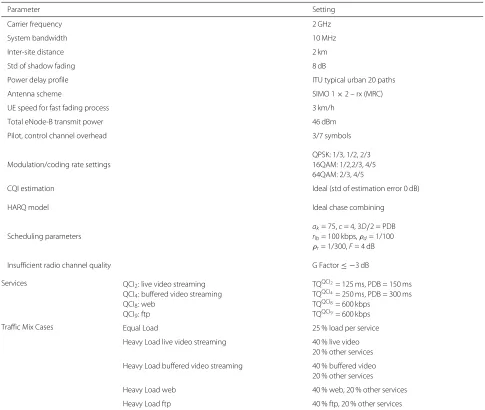
configuration. Live video streaming and buffered video streaming services are modeled as CBR sources with bit rates 240 and 440 kbps, respectively. We consider a sim-plified web browsing and ftp models: each user downloads just one web page (of size 250 kB) or ftp file (of size 1 MB) in every session, and when the download is completed, the session is finished. Five different cases of traffic mix shares are considered (see Table 3). Users with G Factor≤ −3 dB are assumed to have insufficient radio channel quality, and therefore, they are not considered in the prioritization algorithm (see Section 5.3). The remaining parameters of the simulated LTE model are included in Table 3.
6.2 Simulation results
6.2.1 Sensitivity to prioritization factor F
We commence the results section by analyzing the sensitivity of the prioritization mechanism between QCIs
Table 33G LTE network model
Parameter Setting
Carrier frequency 2 GHz
System bandwidth 10 MHz
Inter-site distance 2 km
Std of shadow fading 8 dB
Power delay profile ITU typical urban 20 paths
Antenna scheme SIMO 1×2 – rx (MRC)
UE speed for fast fading process 3 km/h
Total eNode-B transmit power 46 dBm
Pilot, control channel overhead 3/7 symbols
QPSK: 1/3, 1/2, 2/3
Modulation/coding rate settings 16QAM: 1/2,2/3, 4/5
64QAM: 2/3, 4/5
CQI estimation Ideal (std of estimation error 0 dB)
HARQ model Ideal chase combining
ak= 75,c= 4, 3D/2 = PDB
Scheduling parameters rlb= 100 kbps,ρd= 1/100
ρr= 1/300,F= 4 dB
Insufficient radio channel quality G Factor≤ −3 dB
Services QCI2: live video streaming TQQCI2= 125 ms, PDB = 150 ms
QCI4: buffered video streaming TQQCI4= 250 ms, PDB = 300 ms
QCI8: web TQQCI8= 600 kbps
QCI9: ftp TQQCI9= 600 kbps
Traffic Mix Cases Equal Load 25 % load per service
Heavy Load live video streaming 40 % live video
20 % other services Heavy Load buffered video streaming 40 % buffered video
20 % other services
Heavy Load web 40 % web, 20 % other services
to the factorF. As described in Section 5.3, factorFQCIm
k is set equal to the priority enhancing factorF if bearerk fulfills condition (10) and its QCI is the one with the low-est priority parameter among all bearers that fulfill (10).
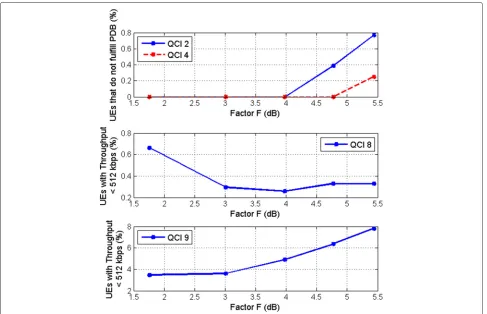
Figure 4 depicts key performance indicators for the pro-posed QoS scheduler and for the traffic mix case Equal Load. For QCI2and QCI4, the figure represents the per-centage of user entities (UEs) with sufficient channel quality for which at least 2 % of the packets suffer a delay exceeding the QCI’s PDB. For QCI8 and QCI9, Fig. 4 represents the percentage of UEs with sufficient channel quality that have a throughput below 512 kbps.
When the factorFincreases, the relative prioritization between QCIs is more aggressive. Therefore, the percent-age of users of QCI9in outage increases (see Fig. 4). On the other hand, a low factorFis unable to prioritize QCIs. This can be observed for QCI8, in which the percentage of users that suffer a throughput below 512 kbps increases whenF decreases below 3–4 dB. Additionally, whenFis higher than 4–5 dB, the percentage of users of QCI2and QCI4that incur outage increases. A very highFpenalizes the efficiency of the scheduling algorithm to serve users in the fading tops. For these reasons, we select a factorF= 3–4 dB for the design.
6.2.2 Evaluation with different traffic mixes
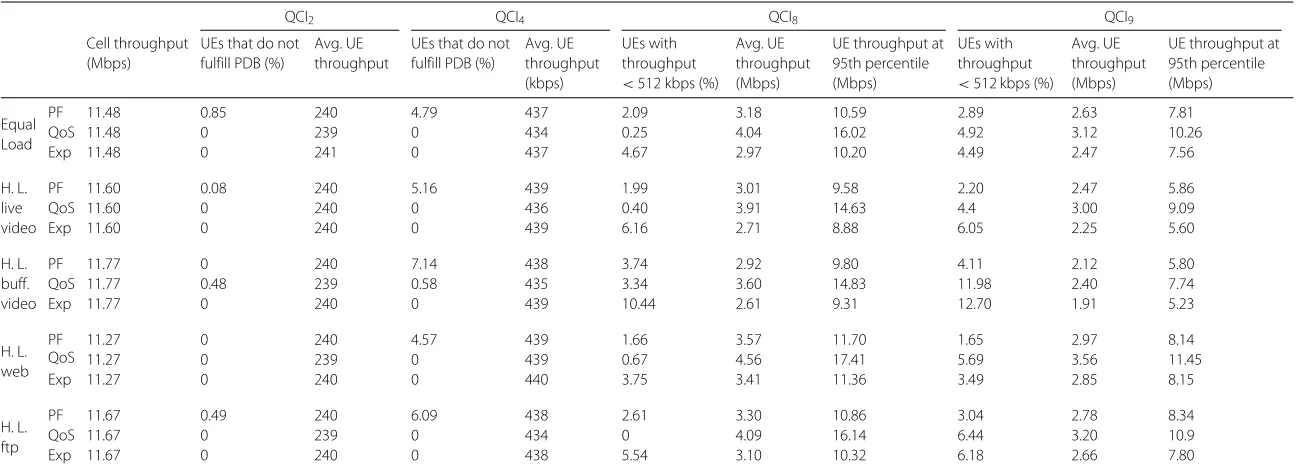
Table 4 compares key performance indicators between the Proportional Fair, the Exp rule scheduler, and the proposed QoS scheduler for all considered traffic mix cases (H.L. stands for Heavy Load). The implementa-tion of the Exp scheduler assumes that the priority of GBR flows is computed using (4),whereas the priority of non-GBR flows is computed using Proportional Fair. The parameters used in (4) are extracted from [3].
The results show that more than 99 % of the users of QCI2fulfill the PDB for the considered traffic mix cases and for the three schedulers due to the low input rate of the considered live streaming service. However, for QCI4 the percentage of users that do not fulfill the PDB varies in the different traffic mix cases from approximately 4.5 to 7.1 % with Proportional Fair. With the Exp rule and the QoS scheduler, this outage is almost eliminated.
Regarding QCI8, the proposed QoS scheduler consider-ably reduces the percentage of users that suffer a through-put below 512 kbps compared to both the Proportional Fair and especially the Exp rule scheduler. On the other hand, for QCI9, the proposed QoS scheduler increases the percentage of users in outage for all traffic mix cases. As QCI9has the highest priority parameter, when the target
al.
EURASIP
Journal
o
n
W
ireless
C
ommunications
and
Networking
(2016) 2016:78
Page
11
of
14
Table 4Performance indicators of simulation results
QCI2 QCI4 QCI8 QCI9
Cell throughput UEs that do not Avg. UE UEs that do not Avg. UE UEs with Avg. UE UE throughput at UEs with Avg. UE UE throughput at
(Mbps) fulfill PDB (%) throughput fulfill PDB (%) throughput throughput throughput 95th percentile throughput throughput 95th percentile
(kbps) <512 kbps (%) (Mbps) (Mbps) <512 kbps (%) (Mbps) (Mbps)
Equal PF 11.48 0.85 240 4.79 437 2.09 3.18 10.59 2.89 2.63 7.81
Load QoS 11.48Exp 11.48 00 241239 00 434437 0.254.67 4.042.97 16.0210.20 4.924.49 3.122.47 10.267.56
H. L. PF 11.60 0.08 240 5.16 439 1.99 3.01 9.58 2.20 2.47 5.86
live QoS 11.60 0 240 0 436 0.40 3.91 14.63 4.4 3.00 9.09
video Exp 11.60 0 240 0 439 6.16 2.71 8.88 6.05 2.25 5.60
H. L. PF 11.77 0 240 7.14 438 3.74 2.92 9.80 4.11 2.12 5.80
buff. QoS 11.77 0.48 239 0.58 435 3.34 3.60 14.83 11.98 2.40 7.74
video Exp 11.77 0 240 0 439 10.44 2.61 9.31 12.70 1.91 5.23
H. L. PF 11.27 0 240 4.57 439 1.66 3.57 11.70 1.65 2.97 8.14
web QoS 11.27Exp 11.27 00 240239 00 439440 0.673.75 4.563.41 17.4111.36 5.693.49 3.562.85 11.458.15
H. L. PF 11.67 0.49 240 6.09 438 2.61 3.30 10.86 3.04 2.78 8.34
qualityTQQCIm cannot be fulfilled for all users, the
fac-torFQCIm
k of the QoS scheduler prioritizes users mapped onto QCI2, QCI4, and QCI8. This occurs at the expenses of users mapped onto QCI9.
Additionally, Table 4 shows that the proposed QoS scheduler increases the average and the 95th percentile of the user throughput for QCI8and QCI9.
Let us define a metric QQCIm[n] that measures the
performance of the user with the worst quality among all users mapped on to QCIm that have sufficient radio channel quality:
QQCIm[n]= max ∀kQCIm
Qk[n] QCIm=1, 2, 3, 4. (11)
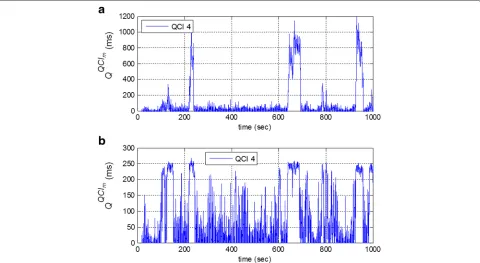
Figure 5 plots a realization of the evolution ofQQCIm[n]
for QCI4in the Equal Load case for the Proportional Fair and the proposed QoS scheduling algorithms. For QCI4, QQCIm measures the filtered packet delay of the bearer
with minimumQk[n] quality among all bearers of QCIm. It can be observed how the QoS scheduling algorithm is able to keep the filtered packet delay of all users of QCI4 below their PDB.
6.2.3 Evaluation under different offered loads
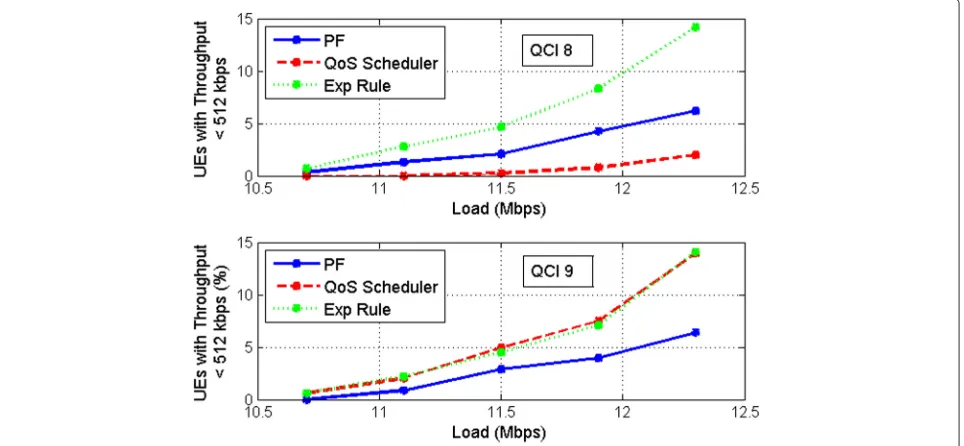
Here we analyze the performance of the proposed scheduling framework for different offered loads. For the evaluation, we consider the traffic mix case Equal Load. For QCI2and QCI4, Fig. 6 depicts the percentage of users with sufficient channel quality for which at least 2 % of the
packets suffer a delay exceeding the QCI’s PDB. For QCI8 and QCI9, Fig. 7 represents the percentage of users with sufficient channel quality that suffer a throughput below 512 kbps. The results show that under a wide range of load conditions the proposed scheduler is able to eliminate or significantly reduce the outages of QCI2, QCI4, and QCI8. This occurs at the expenses of increasing the outage of QCI9. The results also show that the Exp rule is also robust with the outage of GBR users, but it degrades considerably the performance of users in QCI8and QCI9. This is not in line with 3GPP QoS that states that users of QCI8should be prioritized over users of QCI9.
7 Conclusions
In this paper, we present a scheduling framework with the objective of globally addressing the QoS requirements as defined by 3GPP specifications. For this, we have ana-lyzed the implications of the 3GPP QoS architecture on the downlink scheduling at the eNodeBs of an LTE net-work. For GBR bearers, the scheduler has to guarantee a packet delay below the QCI’s PDB for all incoming traffic up to the limit of the GBR parameter. For non-GBR bear-ers, 3GPP specifications admit that congestion-related packet drops may occur and only the packets that have not been dropped due to congestion should not experience a delay exceeding the QCI’s PDB, although this delay limit is not as strict as for GBR bearers. Additionally, if the PDB cannot be fulfilled for all bearers, the scheduler should prioritize between bearers of different QCIs.
Fig. 5Time evolution of maximum packet delay (QQCIm) for QCI
Fig. 6Percentage of UEs for which at least 2 % of the packets suffer a delay exceeding the QCI’s PDB. QCI2and QCI4
Based on the analysis of the 3GPP specifications, we have proposed a scheduling design to address the afore-mentioned QoS requirements. For GBR bearers, we have proposed a scheduling discipline that incorporates a delay-dependent factor based on a sigmoid function that emphatically increases the bearers’ priority when the Head of Line delay approaches the PDB and that can be combined with the relative prioritization between QCIs. For non-GBR bearers, we have proposed to use a classical
channel-aware scheduling policy that aims at maximizing the sum of the concave (α-fair) utility function. Addition-ally, we have designed a mechanism that integrates the scheduling disciplines and triggers the relative prioritiza-tion between QCIs when all bearers do not fulfill their target quality.
The simulation results have shown how the proposed scheduler is able to fulfill the PDB for GBR bearers and provides a spectrally efficient performance for non-GBR
bearers (average user throughput gain in the range 15– 25 % over Proportional Fair). The results have also shown the ability of the proposed scheduler to prioritize bearers according to the QCI’s priority if the target quality cannot be met for all bearers.
As future work, we propose a theoretical evaluation of the proposed solution.
Competing interests
The authors declare that they have applied for a patent relating to the content of the manuscript.
Acknowledgements
This work is partially supported by the Spanish Ministry of Economy and Competitiveness and the European Regional Development Fund (project TIN2013-46223-P). Additionally, the authors would like to express their gratitude to the Supercomputing and Bioinnovation Center (SCBI) of the University of Malaga (Spain) for their support and resources.
Author details
1Department of Signal Theory, Telematics and Communications, University of Granada, Periodista Daniel Saucedo Aranda s/n, 18071 Granada, Spain. 2Telefonica R&D - GCTO, C/ Zurbarán 12, 28010 Madrid, (Spain).3Telefonica R&D - GCTO, Ronda de la Comunicación s/n, 28050 Madrid, (Spain).
Received: 15 August 2015 Accepted: 24 February 2016
References
1. TS 23.401 V8.12.0. 3rd Generation Partnership Project; Technical Specification Group Services and System Aspects; General Packet Radio Service (GPRS) Enhancements for Evolved Universal Terrestrial Radio Access Network (E-UTRAN) access (Release 8) (2010). http://www.3gpp. org/ftp/Specs/archive/23_series/23.401/23401-8c0.zip
2. TS 23.203 V8.11.0. 3rd Generation Partnership Project; Technical Specification Group Services and System Aspects; Policy and Charging Control architecture (Rel. 8) (2010). http://www.3gpp.org/ftp/Specs/ archive/23_series/23.203/23203-8b0.zip
3. B Sadiq, R Madan, A Sampath, Downlink scheduling for multiclass traffic in LTE. EURASIP Journal on Wireless Communications and Networking.
2009, 1–18 (2009)
4. F Capozzi, G Piro, LA Grieco, G Boggia, P Camarda, Downlink packet scheduling in LTE cellular networks: key design issues and a survey. Commun. Surv. Tutor. IEEE.15(2), 678–700 (2013)
5. S Dardouri, R Bouallegue, Comparative study of downlink packet scheduling for LTE networks. Wireless Personal Commun.82(3), 1405–1418 (2015)
6. P Ameigeiras, J Wigard, P Mogensen, inVehicular Technology Conference, 2004. VTC2004-Fall. 2004 IEEE 60th. Performance of the M-LWDF scheduling algorithm for streaming services in HSDPA, vol. 2, (2004), pp. 999–10032. doi:10.1109/VETECF.2004.1400171
7. K Sandrasegaran, HAM Ramli, R Basukala, inWireless Communications and Networking Conference (WCNC), 2010 IEEE. Delay-prioritized scheduling (DPS) for real time traffic in 3GPP LTE system, (2010), pp. 1–6 8. X Wu, X Han, X Lin, inCommunications (ICC), 2015 IEEE International
Conference On. QoS oriented heterogeneous traffic scheduling in LTE downlink, (2015), pp. 3088–3093
9. Q Ai, P Wang, F Liu, Y Wang, F Yang, J Xu,QoS-guaranteed cross-layer resource allocation algorithm for multiclass services in downlink LTE system. (Wireless Communications and Signal Processing (WCSP), 2010 International Conference on, Suzhou, 2010), pp. 1–4. doi:10.1109/WCSP.2010.5633846
10. M Iturralde, T Ali Yahiya, A Wei, A-L Beylot, inVehicular Technology Conference (VTC Fall), 2011 IEEE. Performance study of multimedia services using virtual token mechanism for resource allocation in LTE networks, (2011), pp. 1–5
11. MM Nasralla, MG Martini, inPersonal Indoor and Mobile Radio Communications (PIMRC), 2013 IEEE 24th International Symposium On. A
downlink scheduling approach for balancing QoS in LTE wireless networks, (2013), pp. 1571–1575
12. G Piro, LA Grieco, G Boggia, R Fortuna, P Camarda, Two-level downlink scheduling for real-time multimedia services in LTE networks. Multimedia IEEE Trans.13(5), 1052–1065 (2011)
13. G Mongha, K Pedersen, I Kovacs, P Mogensen, inProceedings of the IEEE Vehicular Technology Conference, VTC Spring 2008. QoS oriented time and frequency domain packet schedulers for the UTRAN long term evolution, (2008)
14. Y Zaki, T Weerawardane, C Gorg, A Timm-Giel, inProceedings of the IEEE Vehicular Technology Conference, VTC Spring 2011. Multi-QoS-aware fair scheduling for LTE, (2011)
15. J Góra, QoS-aware resource management for LTE-Advanced relay-enhanced network. EURASIP J. Wireless Commun. Netw.2014, 178 (2014)
16. P Ameigeiras, Y Wang, J Navarro-Ortiz, P Mogensen, JM Lopez-Soler, Traffic models impact on OFDMA systems design. EURASIP J. Wireless Commun. Netw.2012, 61 (2012)
17. M Olson, S Sultana, S Rommer, L Frid, C Mulligan,SAE and the evolved packet core. (Elsevier, Burlington, 2009)
18. NR Figueira, J Pasquale, An upper bound delay for the virtual-clock service discipline. IEEE/ACM Trans. Netw.3(4), 399–408 (1995) 19. J Jang, KB Lee, Transmit power adaptation for multiuser OFDM systems.
IEEE J. Selected Areas Commun.21(2), 71–178 (2003)
20. LMC Hoo, B Halder, J Tellado, JM Cioffi, Multiuser transmit optimization for multicarrier broadcast channels: asymptotic FDMA capacity region and algorithms. IEEE Trans. Commun.52(6), 922–930 (2004)
21. YJ Zhang, KB Letaief, inIEEE Transactions on Wireless Communications. Multiuser adaptive subcarrier-and-bit allocation with adaptive cell selection for OFDM systems, vol. 3, (2004), pp. 1566–1575. doi:10.1109/TWC.2004.833501
22. H Yin, H Liu, An efficient multiuser loading algorithm for OFDM-based broadband wireless systems. Proceedings of the IEEE Global Communications Conference 2000 (GLOBECOM’00).1, 103–107 (2000) 23. K Seong, M Mohseni, JM Cioffi, inProceedings of the IEEE International
Symposium on Information Theory (ISIT ’06). Optimal resource allocation for OFDMA downlink systems, (2006), pp. 1394–1398
24. G Song, Y Li, Utility-based resource allocation and scheduling in OFDM-based wireless broadband networks. IEEE Commun. Mag.43(12), 127–134 (2005)
25. P Svedman, SK Wilson, LJ Cimini, B Ottersten, Opportunistic beamforming and scheduling for OFDMA systems. IEEE Trans. Commun.55(5), 941–952 (2007)
26. P Ameigeiras, JJ Ramos-Munoz, J Navarro-Ortiz, P Mogensen, JM Lopez-Soler, QoE oriented cross-layer design of a resource allocation algorithm in beyond 3G systems. Comput. Commun. J.33, 571–582 (2010) 27. RKP Mok, EWW Chan, RKC Chang, inIFIP/IEEE International Symposium on
Integrated Network Management (IM). Measuring the quality of experience of HTTP video streaming, (2011), pp. 485–492
28. P Ameigeiras, JJ Ramos-Munoz, J Navarro-Ortiz, JM Lopez-Soler, Analysis and modeling of YouTube traffic. Transactions on Emerging
Telecommunications Technologies, John Wiley & Sons.23(4), 360–377 (2012)
29. JJ Ramos-Munoz, J Prados-Garzon, P Ameigeiras, J Navarro-Ortiz, JM Lopez-Soler, Characteristics of mobile youtube traffic. IEEE Wireless Commun. Mag.21(1), 18–25 (2014)
![Table 2 Standardized QCI values to standardized characteristic mapping [2]](https://thumb-us.123doks.com/thumbv2/123dok_us/941016.1114602/5.595.60.539.97.295/table-standardized-qci-values-standardized-characteristic-mapping.webp)