R E S E A R C H
Open Access
Waveform domain framework for capacity
analysis of uplink WCDMA systems
Tan Tai Do
1, Su Min Kim
2*, Tobias J. Oechtering
1, Mikael Skoglund
1and Gunnar Peters
3Abstract
This paper investigates the capacity limit of an uplink WCDMA system considering a continuous-time waveform signal. Various realistic assumptions are incorporated into the problem, which make the study valuable for performance assessment of real cellular networks to identify potentials for performance improvements in practical receiver designs. An equivalent discrete-time channel model is derived based on sufficient statistics for optimal decoding of the transmitted messages. The capacity regions are then characterized using the equivalent channel considering both finite constellation and Gaussian distributed input signals. The capacity with sampling at the receiver is also provided to exemplify the performance loss due to a typical post-processing at the receiver. Moreover, we analyze the asymptotic capacity when the signal-to-noise ratio goes to infinity. The conditions to simultaneously achieve the individual capacities are derived, which reveal the impacts of signature waveform space, channel frequency selectivity and signal constellation on the system performance.
Keywords: Uplink WCDMA, Capacity analysis, Continuous-time, Waveform domain, Time-variant spreading, Sampling, Finite constellation
1 Introduction
Code division multiple access (CDMA) has become stan-dard in several wireless communication systems from IS-95, UMTS wideband CDMA (WCDMA) to HSPA, and so on [1–3]. Although being introduced more than 50 years ago, CDMA is still largely employed and developed nowadays due to its various advantages such as enabling universal frequency reuse, improving handover perfor-mance by soft-handover, and mitigating the effects of interference and fading. The performance assessment of such networks is of significant importance. In addition, the architecture of WCDMA systems still has room for improvement, especially at the uplink receiver side (base station) [4, 5].
In the literature, most studies on fundamental limits of multiuser CDMA systems have been done under the assumptions of synchronous, time-invariant (each user
*Correspondence: [email protected]
This work was partly presented at the 80th IEEE Vehicular Technology Conference (VTC2014-Fall), Vancouver, Canada, September 2014.
2Department of Electronics Engineering, Korea Polytechnic University, 15073 237 Sangidaehak-ro, Gyeonggi-do, Korea
Full list of author information is available at the end of the article
uses the same spreading sequence for all data symbols), and/or random spreading sequences [6–11]. In [6–8], the optimal spreading sequences and capacity limits for synchronous CDMA have been studied with a discrete-time signal model. A more theoretical approach on CDMA capacity analysis has been pursued in [9–11] by modeling the spreading sequences with random sequences. However, the assumption of perfect synchro-nization between users is not realistic, especially for a cellular CDMA uplink. Moreover, in practice, time-variant-spreading sequences based on Gold or Kasami codes [1–3] are often used rather than time-invariant or random spreading sequences.
The capacity limit for a CDMA system with symbol-asynchronous transmission (the symbol epochs of the signal are not aligned at the receiver) has also been studied in [12–15]. In [12], Verdú studied the capacity region of an uplink time-invariant CDMA system with inter-symbol interference (ISI) by exploiting the asymptotic properties of Toeplitz matrices. In [13, 14], the authors studied user and sum capacities of a symbol-asynchronous CDMA sys-tem but with chip-synchronous transmission (the timing of the chip epochs are aligned) assumption, which made
the analysis tractable using a discrete-time model. In [15], the spectral efficiency of an asynchronous CDMA system has been considered while neglecting the ISI by assuming a large spreading factor.
There have been several studies trying to deal with the continuous-time asynchronous CDMA system setup. However, most of them focus on other performance metrics than capacity (e.g., error probability considering different detection algorithms) [16–20]: time-invariant CDMA [21] or asynchronous CDMA but with an ISI-free assumption [22]. The capacity analysis for a real cellular network with continuous-time waveform, time-variant-spreading, asynchronous CDMA is difficult due to the following reasons. First, an equivalent discrete-time signal model is complicated to be expressed due to the asynchronization between symbols and chips. Next, for a time-variant spreading CDMA system, the approach based on the asymptotic properties of a Toeplitz form [23], which is crucial for the capacity analysis with ISI channel [12, 24], cannot be employed since the variation of spread-ing sequence destroys the Toeplitz structure of the equiv-alent channel matrix.
1.1 Contributions of this work
Motivated by the fact that most existing research on mul-tiuser CDMA capacity have focused on theoretical anal-ysis with simplified system assumptions, in this work, we present a framework for capacity analysis of a WCDMA system with more realistic assumptions, which make the framework and results more valuable for the performance assessment of real cellular networks. Our main contribu-tions are summarized as follows:
−We provide a precise channel model reflecting prac-tical operations of the uplink WCDMA physical (PHY) layer based on the 3GPP release 11 specification [1]. Var-ious realistic assumptions are included into the system such as: continuous-time waveform-transmitted signal and time-variant spreading and an asynchronous multi-code CDMA system with ISI over frequency-selective channels. It is worth noting that although the signal model is constructed based on a WCDMA system, the approach and framework can be extended or transferred to other wireless standards.
−We derive sufficient statistics for decoding the trans-mitted symbols based on the continuous-time-received signal, which provides us an equivalent discrete-time sig-nal model. A matrix representation of channel model is provided for which the equivalent additional noise is shown to be a Gaussian distributed random vector.
− Since sufficient statistics preserve the mutual infor-mation ([25], Chap. 2), the capacity is then derived using the equivalent discrete-time signal model. In particular, we characterize the capacity region when the input signal
is fixed to finite constellations, e.g., PSK, QAM, and so on, with a uniform input distribution, which are widely used in current real cellular networks. Additionally, we provide the capacity region when the input signal follows a Gaussian distribution, which is the optimal input distri-bution for additive Gaussian noise channels. Accordingly, the Gaussian capacity offers a capacity outer bound for the real WCDMA cellular networks using finite constellation input.
−Due to the data-processing inequality ([25], Chap. 2), the mutual information between input and output can-not increase through any post-processing at the receiver. Given the capacity bounds measured directly at the receive antenna of a real system, we can now assess the capacity loss due to a specific post-processing at the receiver. Therewith, we investigate the capacity loss due to sampling, which is a traditional discretization approach in practical systems. Note that in the real cellular networks, since the sampling window is finite, perfect reconstruc-tion of a band-limited signal is not guaranteed even if the sampling rate is equal to Nyquist rate ([26], Chap. 8). The assessment of such impact on the capacity is also considered in this work.
− We analyze the asymptotic sum-capacity when the
signal-to-noise ratio (SNR) goes to infinity, for which we derive the conditions on the signature waveform space so that on every link to the base station, the individual capacities are achieved simultaneously. To this end, we first derive the sufficient condition, which holds for all kinds of input signals including signals based on finite and infinite constellations. Next, once again, we moti-vate our study from a practical perspective by focusing on the finite constellation input signal. Accordingly, a necessary condition to simultaneously achieve the indi-vidual capacities with a finite constellation input sig-nal, which takes the signal constellation structure into account, is derived. Those results are particularly useful for spreading sequence design in a real WCDMA cellular network.
The rest of the paper is organized as follows: Section 2 presents the signal model where sufficient statistics and an equivalent matrix representation are derived. In Section 3, the capacity analysis is provided considering finite con-stellations and Gaussian-distributed input signals. The capacity employing sampling is also investigated in this section. The asymptotic capacity when the SNR goes to infinity is analyzed and discussed in Section 4. Finally, Section 5 concludes the paper.
2 Signal model
WCDMA PHY layer based on the 3GPP release 11 speci-fication [1].
2.1 Waveform signal model
Let us consider a K-user multi-code WCDMA system
with M codes for each I/Q branch and spreading
fac-tor Nsf. Then, the transmitted signal for user k can be expressed as
where Ek denotes the transmitted power of user k, N denotes the number of symbols, smki(t) = √1 thechip waveformwith unit power and finite bandwidth W1,Tcis the chip duration andTs = NsfTcis the sym-bol duration, andcmki[n] denotes thespreading sequence
which satisfiesNn=sf0−1|cmki[n]|2 = Nsf. In a time-variant CDMA system, a different spreading sequencecmki[n]n is used for each transmitted symboldmki. This corresponds to a real cellular CDMA network with long scrambling codes, in which the effective spreading sequence will vary between symbols.
In this study, we assume a tapped-delay line channel model2withLmulti-paths ([27] Chap. 2), i.e.,
hk(t)= L
l=1
gklδ(t−τkl),k=1,. . .,K,
wheregkl andτkl denote the channel coefficient and the propagation delay for thel-th path of the channel for user k, respectively. Then the received signal is given by
r(t) =
whereλkdenotes the time delay of the transmitted signal from userk, the symbol∗denotes the convolution opera-tion, andn(t)represents the additive white Gaussian noise with a two-sided power spectral density (PSD)N0/2=σ2.
2.2 Sufficient statistic and equivalent channel
Since a sufficient statistic for decoding the transmitted messages preserves the capacity of the system, the capac-ity of a continuous-time channel can be computed using a sufficient statistic ([25], Chap. 2), ([28], Chap. 8). To this end, let us define the transmitted symbol vectors
dki := denotes the transpose operation. Further, let us define μ(t;d)as the received signal without noise, i.e.,
The problem of optimal decoding d is similar to the detection problem in ([27], Proposition 3.2) (see [18] for a similar approach based on the Cameron-Martin formula [29], Chap. VI). Accordingly, the optimal decision3can be made using the following decision variables
(d)=2
where{·}denotes the real part of a complex value and (·)∗ denotes the complex conjugate operation. Since the
second term of (3) does not depend on the received signal r(t), we can drop it. Therewith, the sufficient statistic is based on the first term of (3), which can be rewritten as
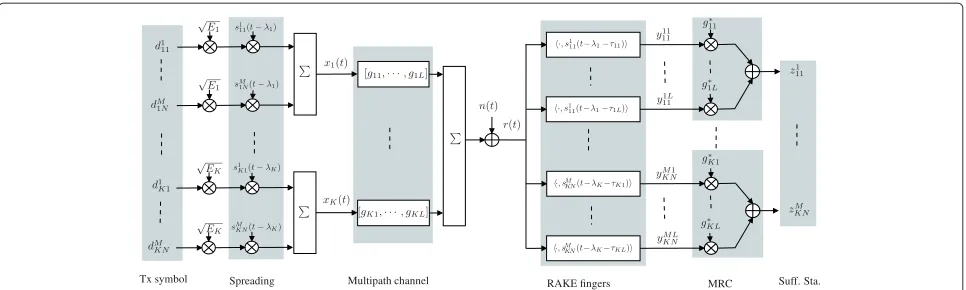
2 received signal passing through a bank of matched filters, where the received signal is matched to the delayed ver-sions of the signature waveforms, results in a sufficient statistic for decoding d based on r(t). Figure 1 illus-trates an implementation to obtain the sufficient statis-tic from the continuous-time received signal. This has a RAKE receiver structure ([30], Chap. 14), including RAKE-matched fingers followed by maximal ratio com-bining (MRC).
Moreover, letρ((kimlkim)l)be the cross-correlation function between the signature waveforms defined as
ρ(kiml)
tion function of the chip waveform. Then the sufficient statistics can be expressed as
Fig. 1Diagram of the implementation to obtain the sufficient statistic from the continuous-time received signal of aK-user uplink WCDMA system withMcodes for each I/Q branch over anL-tap frequency-selective channel
wherenmki:=Ll=1gkl∗ ∞
−∞n(t)smki(t−λk−τkl)∗dtis the equivalent noise term associated with zmki after matched filtering.
A matrix canonical form is useful to characterize the capacity from a sufficient statistic. Hence, we express the sufficient statisticszmkik,i,m derived in (4) as an equiva-lent matrix equation. By following the similar steps as in [31], the matrix representation of the equivalent channel can be obtained from (4) as
z=
K
k=1
EkHkdk+n, (5)
where z := z111,· · ·,zKNM T ∈ CKNM×1, dk :=
dk11,· · ·,dkNMT ∈ CNM×1, andn := n111,· · ·,nMKNT ∈ CKNM×1. The equivalent channel channelH
kis given by
Hk = ⎡ ⎢ ⎣
G†1R1kGk .. .
G†KRKkGk ⎤ ⎥
⎦∈CKNM×NM,
where the channel gain matrixGk is block diagonal and given by
Gk=blkdiag ⎛
⎝g k,· · ·,gk MNvectors ⎞
⎠∈CLNM×NM
with gk = [gk1,· · ·,gkL]T∈ CL×1, and the correlation matrix is defined as
Rkk=
⎡ ⎢ ⎢ ⎢ ⎢ ⎢ ⎣
ρ(k111)
(k111) · · ·ρ(k
11L)
(k111) · · · ρ(k
NML)
(k111)
ρ(k111) (k112) · · ·ρ
(ki1L) (ki12) · · · ρ
(kNML) (k112) ..
. ... ... ... ...
ρ(k111)
(kNML)· · ·ρ(k
11L)
(kNML)· · ·ρ(k
NML)
(kNML)
⎤ ⎥ ⎥ ⎥ ⎥ ⎥ ⎦∈C
NML×NML.
(6)
Moreover, it is shown in Appendix 1 that the equiva-lent noise vectornis a complex Gaussian random vector
with zero mean and covariance matrix σ2H with H =
[H1,. . .,HK]∈CKNM×KNM.
Remark 1. In this work, the signal model is constructed based on the practical operation of an uplink WCDMA PHY layer. However, the approach and framework can be extended or transferred to other wireless standards. Indeed, the signal model in (1) can be used to describe the continuous-time-transmitted signal of a general system, in which smki(t) are the waveforms used for the modula-tion at the transmitter. For example, in a OFDM system, smki(t) can be replaced by the corresponding orthogonal waveforms. Moreover, the resulting equivalent channel in (5) corresponds to a traditional discrete-time MIMO multiple-access channel (MAC), which are used in various research literature.
3 Capacity analysis
In this section, we analyze the capacity of the continuous-time uplink WCDMA channel. Recalling thatzis a suffi-cient statistic for optimal (i.e., capacity preserving) decod-ingd based onr(t). Any coding scheme which achieves the capacity of the channel with inputd and outputr(t) can also be employed to the channel with input d and decoding based on outputzinstead ofr(t). Therefore, the channel capacity is preserved when the continuous-time outputr(t)is replaced by the sufficient statisticz. Thus, we can focus on the capacity of the equivalent discrete-time channel in (5), which is given by the capacity region of a discrete memoryless MAC [32].
rate vectors (R1,R2,. . .,RK) satisfying [32], ([25],
We now characterize the uplink WCDMA capacity region considering two specific input signals: finite con-stellation with uniformly distributed input and Gaussian-distributed input.
3.1 Finite constellation input
When the input signal vector dk at each user is inde-pendently taken from a finite constellation set MNM,
|M| = Mc, with equal probability, i.e., p(dk) = M1NM
zJ is a Gaussian mixture random vector with probability density function (pdf )
fzJ(¯z)= the pdf of a complex Gaussian random vector with mean
EJHJd¯and covariance matrixσ2H, i.e., Typically, the capacity region of a channel with finite constellation input is numerically characterized via Monte Carlo simulation because a closed-form expression does not exist. It is worth noting that in order to calculate the first term of (8), one has to average overall possible Mc|J|NMinput symbols (up toMKNMc for sum-rate) accord-ing to (9). However, whenMcand/orNare too large, this task becomes intractable due to prohibitive computational complexity. In MIMO channels with finite constellation input, a similar problem occurs when the input alphabet set or the number of antennas is too large, e.g., 64-QAM or
8×8 MIMO [33]. In order to tackle this problem, we have proposed an effective approximation algorithm based on sphere-decoding approach to find the approximate capac-ity for large MIMO system with finite constellation input in [34]. The algorithm to compute the entropy is out of the scope of this work. However, we use it in the numerical results section (Section 3.4) to compute approximations on the capacity curves for large N. The specific details about the algorithm can be found in [34].
3.2 Gaussian input
If the input signal vector dk of each user follows a zero mean complex Gaussian distribution with unit input power constraint, i.e.,dk ∼ CN(0,INM),∀k = 1,. . .,K, then the capacity region is characterized by the rate vec-tors(R1,R2,. . .,RK)satisfying input is the optimal input for a given mean power con-straint, (10) serves as an outer bound for the capacity region with a practically motivated input, i.e., finite con-stellation input as discussed in Section 3.1.
3.3 Sampling
Since the matched filtering at the receiver yields a suf-ficient statistic, the uplink WCDMA capacity achieved by any other receiver structures is upper bounded by the capacity achieved by the sufficient statistic using matched filtering. Regarding the capacity upper bounds in Sections 3.1–3.2 as benchmarks for the performance assessment, we now analyze the capacity achieved by sam-pling to evaluate the capacity performance loss due to specific post-processing at the receiver.
For sampling at the receiver, we assume that out-of-band noise is first suppressed by an ideal low-pass filter (LPF)
with bandwidth W, which has the same bandwidth as
waveform bys¯mki(t) := Ll=1gklsmki(t−λk −τkl), then the sampled received signal can be expressed as
rn=
Next, let us denote the sampling signature waveform matrix corresponding to userkby
¯
and the sampled received signal and sampled noise vectors by
rsp = [r1,r2,· · ·,rNsp]T∈CNsp×1,
nsp = [nlp(t1),nlp(t2),. . .,nlp(tNsp)]
T∈CNsp×1.
Then the sampled received signal can be written in an equivalent matrix form as
rsp=
Since n(t) is a complex Gaussian random process with
zero mean and PSD N0/2 = σ2 over the whole
fre-quency band, after passing through the ideal LPF with bandwidthW, the noise processnlp(t)becomes a station-ary zero mean Gaussian process ([35], Chap. 3) with the auto-correlation function
Rlp(τ)=N0Wsinc(2Wτ),
where sinc(·)is the normalized sinc function. Therefore, the sampled additive noise vector nsp is a zero mean complex Gaussian random vector with covariance matrix
Rsp=[rij]{i,j},i,j=1, 2,. . .,Nsp,
rij=Rlp(ti−tj), i,j=1, 2,. . .,Nsp. (12)
The capacities with sampling are then similarly obtained as in (8) and (10) with some small modifications; the equivalent matrix Hk needs to be replaced by S¯k, the noise covariance matrixσ2Hneeds to be replaced byRsp. Accordingly, let us define Rsp1,Rsp2,. . .,RspK as the maxi-mum number of bits that can be reliably transmitted from user 1, user 2,. . ., userKper block ofN symbols assum-ing samplassum-ing is employed at the receiver. The samplassum-ing capacity is then characterized by4
for a Gaussian input signal and
for a finite constellation input signal, where rspJ
k∈J √EkS¯kdk + nsp is a Gaussian mixture random vector.
3.4 Numerical characterization
In this subsection, we numerically characterize the capac-ity for a two-user uplink WCDMA example. For numer-ical experiments, we set the parameters which are close to those in a real uplink UMTS system as specified in [1]: time-variant CDMA with orthogonal variable spreading factor (OVSF) codes and Gold sequences, spreading fac-torNsf =4, SRRC chip waveformp(t)with roll-off factor 0.22, and uniform power allocation E1/σ2 = E2/σ2 = SNR. In the simulations, we employ a time-invariant mul-tipath channel withL=3 taps, a relative path-amplitude vector a =[ 0,−1.5,−3] dB, a relative path-phase vector θ = 0,π3,23π, and path-delay vector τ = 0,Tc
2,Tc
. Thus, thel-th element of the path-coefficient vectorg1is given byal·ejθl/awherealis thel-th element ofa,θlis thel-th element of vectorθ, andg2=
√
2g1. In addition, we use fixed user delays which are randomly drawn within a symbol time once at the beginning of simulations, i.e., λk ∼U(0,Ts).
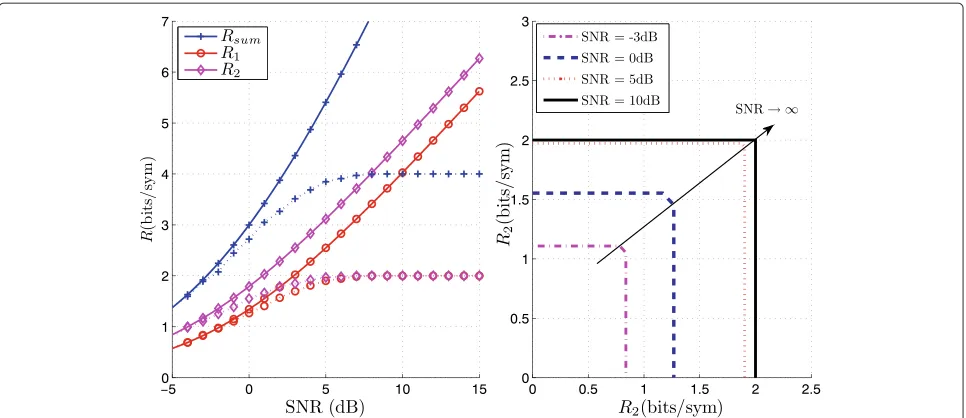
Figure 2 illustrates the capacity of a two-user uplink
UMTS system with N = 2 and M = 1 for
Gaussian-distributed input (from Section 3.1) and 4-QAM (QPSK) input (from Section 3.2) signals. The left-hand side sub-figure presents the sum- and individual capacities for Gaussian and 4-QAM input signals. The individual capac-itiesR2are larger thanR1since we setg2 =
√
2g1. The right-hand side sub-figure shows the capacity regions with 4-QAM input for several values of SNR. As expected, the capacity region enlarges with increasing SNR. Moreover, as the SNR tends to infinity, the capacity region converges to the corresponding source entropy outer bound (i.e., 2 bits/symbol individual rates and 4 bits/symbol sum-rate for the two-user channel with 4-QAM input). It is interest-ing that the maximal individual rates (2 bits/symbol) can be achieved simultaneously, i.e., the sum-rate constraint is asymptotically inactive in the high-SNR regime. A deeper analysis on this asymptotic behavior will be given in the next section.
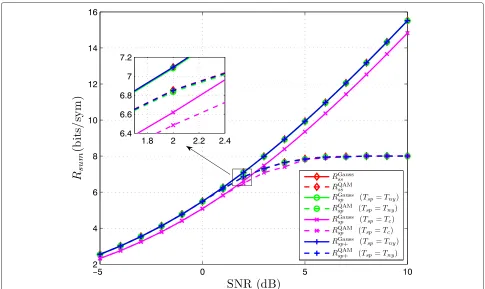
Figure 3 shows the achievable sum-rates for larger block
length (N = 32) and two codes (M = 2) in each
sum-Fig. 2Capacity curves and capacity regions for a two-user set-up withN=2 andM=1. On the left-hand side, thesolid linesrepresent the capacities with Gaussian input and thedotted linesrepresent the capacities with 4-QAM input. All the capacities are normalized by 1/N
rates achieved by sampling (RGausssp (Tsp = Tny) and RQAMsp (Tsp = Tny))and the sum-capacities achieved with matched filtering/sufficient statistic (RGaussss and RQAMss ). These losses are due to the finite time limit of our sam-pling window as the Nyquist samsam-pling theorem states that a infinite sample sequence is required to be able to perfectly recover a finite energy and band-limited signal ([26], Theorem 8.4.3). Fortunately, by extending the sam-pling window by only two symbol durations on each side $
forRGausssp+ andRQAMsp+ %
, these losses can be significantly reduced.
4 Asymptotic analysis
Recalling (7) withJ = {1,. . .,K}, we haveKk=1Rk ≤ I(d;z) ≤ kK=1H(dk), i.e., the sum-capacity is upper bounded by the sum of the sources entropies. However, the results in Fig. 2 show that when SNR→ ∞, the indi-vidual capacities can be simultaneously achieved, i.e., the sum-capacity approaches the sum of the individual source entropies. In this section, we provide a deeper analysis on this observation by characterizing the asymptotic behav-ior of the sum-capacity. For convenience, we begin with a simple MAC model then extend the result to the uplink WCDMA system in the following.
4.1 SimpleK-user MAC model
Firstly, we start from the asymptotic sum-capacity of a
simple K-user MAC, where each user transmits only
one data stream. This setup corresponds to our uplink
WCDMA system withM=1 andN= 1 in a
frequency-non-selective channel. The results are mainly based on the following lemma.
Lemma 1.Consider the received signal model of a K-user MAC
y(t)= K
k=1
dksk(t)+n(t), (15)
where d1,. . .,dK are the unit power transmitted sym-bols, which are independent and transmitted using K-normalized signature waveforms s1(t),. . .,sK(t)and n(t) denotes the Gaussian noise process with PSD SNR1 . When SNR → ∞, the asymptotic sum-capacity of channel (15), Csumas = Kk=1H(dk), is achieved if the vector space SK = span{s1(t),. . .,sK(t)} has the dimension K.
The proof of Lemma 1 is given in Appendix 2. The idea for the proof is that we first show that the received signal passing through a bank of matched filters, which are matched to the signature waveforms, yields a suffi-cient statistic for decoding d = [d1,· · ·,dK] based on y(t). Then, we show that d can be uniquely decoded, i.e., the decoder is able to decode the messages cor-rectly from this sufficient statistic when SNR → ∞ if dim(SK) = K. Based on the uniquely decodable prop-erty, we then prove that the asymptotic sum-capacityCsumas approaches the sum of source entropies if the signature waveforms are linearly independent of each other, i.e., dim(SK)=K.
4.2 Uplink WCDMA system
Fig. 3Achievable sum-rates for different inputs and receiver structures withN=32 andM=2.RGauss
ss andRQAMss denote the sum-rates achieved by the sufficient statistic with Gaussian input and 4-QAM input, respectively.RGauss
sp andRQAMsp denote the sum-rates achieved by sampling with the sampling window equal to the block lengthtn∈[ 0NTs].RGausssp+ andRQAMsp+ denote the sum-rates achieved by sampling with the sampling window extended by two symbol durations on each side, i.e.,tn∈[−2Ts (N+2)Ts]. All the sum-rates are normalized by 1/N
WCDMA system. Let us recall the transmitted signal from userkof the uplink WCDMA system in (1), and take into account allKusers. The transmitted signal can be consid-ered as one of equivalentKNM-user MACs in (15) using KNMsignature waveformssmki(t−λk),k = 1,. . .,K,i = 1,. . .,N, and m = 1,. . .,M. The following proposi-tions, which can be derived from Lemma 1, specify the asymptotic sum-capacity of the uplink WCDMA system in different channel environments considering frequency-non-selective (L = 1) and frequency-selective (L ≥ 2) channels.
Proposition 1. The asymptotic sum-capacity of the frequency-non-selective uplink WCDMA channel as described in (2) with L = 1is Cas
sum,nsec = K
k=1H(dk) if the dimension of the signature waveforms space ST =spans111(t−λ1),. . .,sMKN(t−λK)
is KNM.
The proof for Proposition 1 is given in Appendix 3. The intuition behind Proposition 1 can be expressed as:
K users transmit KNM symbols and the receiver
per-forms matched filtering withKNMfingers. Although the
uplink WCDMA multiuser channel impliesK-user SISO
MACs, the matching process virtually converts this to an
equivalentKNM×KNMMIMO channel. Thus, by
appro-priately choosing the signature waveforms and matched fingers, which yield a full-rank equivalent channel matrix
H, the transmitted symbols,d1,. . .,dK, can be perfectly (i.e., error-free) recovered fromz as SNR goes to
infin-ity. In other words, a K-user uplink WCDMA channel
can asymptotically achieve the capacity ofKNMparallel channels as long as dim(ST)=KNM.
Proposition 2. The asymptotic sum-capacity of the frequency-selective uplink WCDMA channel as described in (2) is Cassum,sec =Kk=1H(dk)if dim(S)=KNM, where S =span¯s111(t),· · ·,¯sMKN(t)is the vector space spanned by the effective signature waveform ¯smki(t) = Ll=1gklsmki (t−λk−τkl).
equivalent channel matrix H to achieve full-rank. For instance, if dim(ST) < KNM, H is obviously singular whenL = 1, whileHcan be still invertible whenL > 1 since dim(S) is possible to be equal toKNM according to the channel selectivity and the potential offset in the multi-path environment5. This is particularly helpful in an overloaded CDMA system [8, 21], where the number of users exceed the spreading factor.
4.3 Necessary condition
Propositions 1 and 2 state sufficient conditions that the transmitted messages can be uniquely decoded when SNR → ∞, which holds for all kinds of input signals including both finite and infinite constellation signals. However, the conditions in Propositions 1 and 2 can be relaxed in certain scenarios with finite constellation inputs. In this subsection, we first consider a simple exam-ple where such conditions can be relaxed. The necessary condition for the unique decoding with finite constellation input is then studied in the following.
For instance, let us consider an example with two dif-ferent set-ups of channel (15) with K = 2 and binary transmitted signalsda=[da1 da2]Tanddb=[db1 db2]T, i.e.,
ya(t) = da1s1(t)+da2s2(t)+na(t), yb(t) = db1s1(t)+db2s2(t)+nb(t),
where na(t) and nb(t) denote additive Gaussian noise processes. We assume that the same signature waveform space S2 : = span{s1(t),s2(t)} is used in both set-ups. However, the transmitted symbols are uniformly and ran-domly picked up from different input constellation sets: da1,da2 ∈ {0, 1}anddb1 ∈ {−1/
√
2, 1/√2},db2 ∈ {0, 1}. The corresponding sufficient statistic models are then given by
Ya = da1+da1+Na, Yb = db1+db2+Nb,
where Ya and Yb denote the sufficient statistics andNa andNbare the equivalent noises. We can see that when the noise power becomes zero (or SNR → ∞),da(and so da1 and da2)) cannot be uniquely decoded from Ya since the conditional entropyH(da1,da2|Ya) = 0.5 > 0 when SNR→ ∞. However, (db1anddb2) can be uniquely decoded fromYbsinceH(db1,db2|Yb) =0 when SNR →
∞even though dim(S2) = 1< 2. It shows that the con-dition dim(SK) = K can be relaxed for certain signal constellation structures. Therefore, it is expected that nec-essary conditions for achieving the unique decoding with finite constellation input have to take both the signature waveforms and the structure of the signal constellation into account.
Let us assume thatd ∈ MKNM, where Mis a set of
constellation points and is finite. In order to derive the sufficient condition for the unique decoding, we refer the equivalent channel in (C.2) in Appendix 3
z=HEd+n. (16)
When SNR → ∞, the transmitted vector d can be
uniquely decoded fromzif and only if the mapping f :MKNM →CKNM
d →HEd
is an one-to-one mapping. In particular, for any pair of
di,dj∈MKNManddi =dj, the conditionHEdi=HEdj
is needed for the unique decoding. Therefore, by defin-ingvij = di−dj, the condition for the unique decoding becomes
HEvij=0,∀i=j. (17) In other words, the necessary condition for the unique decoding is that any vectorvijwithi=jis not in the null space of matrixHE. This necessary condition includes the impact of signal constellation reflected viavij.
Remark 2.This result is consistent with the sufficient conditions in Propositions 1 and 2. Indeed, when the (effective) signature waveform space has dimensionKNM andHis invertible, the null space ofHEis empty. Thus, the condition in (17) holds for any set of vectorvij, and the unique decoding is achieved for any kind of input signal.
5 Conclusions
WCDMA channel can be decoupled so that each user achieves a point-to-point channel capacity when SNR goes to infinity. The presented framework and results provide valuable insights for the design and further devel-opment of not only WCDMA but also other wireless standard networks.
Appendices
Appendix 1 Derivation of equivalent noise statistic Since n(t) is a zero mean complex Gaussian random process, the equivalent noises after a bank of linear fil-ters (matched filfil-ters),nmlki =−∞∞ n(t)smki(t−λk−τkl)∗dt,
∀k,i,m,l, are zero mean joint Gaussian random variables ([28], Chap. 8) with the correlation coefficient given by
E &nmlkinmkil∗
∀k,i,m are zero mean joint Gaussian random variables with correlation coefficient
where the indices are given by
a = (k−1)NM+(i−1)M+m, b = (k−1)NM+(i−1)M+m.
As a result,nis a complex Gaussian random vector with zero mean and covariance matrixσ2H.
Appendix 2 Proof of Lemma 1
The proof of Lemma 1 consists of two parts:
• Part 1: We first show that the received signal passed through a bank of matched filters, which match to the signature waveforms, yields a sufficient statistic for decodingd=[d1,· · ·,dK]Tbased ony(t).
Moreover, when SNR→ ∞,dcan be uniquely
decoded if dim(SK)=K.
• Part 2: Based on the uniquely decodable property, we then derive the asymptotic sum-capacity.
Part 1: Part 1 is a result of the following claim
Claim. Let the received signal y(t) in (15) passed through a bank of matched filters, wherey(t)is matched with each signature waveformsk(t), i.e.,
yk = y(t),sk(t) = uniquely decoded from the sufficient statisticyas SNR→
∞.
Proof. Following similar steps as in Section 2.2, it can be shown thatyis a sufficient statistic for decodingdbased ony(t).
It remains to show thatdcan be uniquely decoded from
y when SNR → ∞. Let us denote Rs as the
correla-tion matrix of the signature waveforms {sk(t)}k, where
Rs[i,j]= si(t),sj(t). Therewith, we have the equivalent matrix expression
y=Rsd+*n,
where*nis the equivalent noise vector.
Since dim(SK)=K, we can rewrite{s1(t),· · ·,sK(t)}as
Consider the correlation matrixRewhere
Therefore, when dim(SK) = K,Rs is invertible andd
can be uniquely decoded fromywhen SNR → ∞since
lim SNR→∞R
−1 s y=d.
Part 2: We next derive the asymptotic sum-capacity based on the sufficient statistic from Part 1.
The sum-capacity of the channel (15) is given by
Csum=I(d;y(t)). (B.1)
From Part 1, we know thatyis a sufficient statistic for decodingdbased ony(t). Thus,
Let us define the asymptotic sum-capacity asCsumas = lim
This completes the proof for Lemma 1.
Appendix 3 Proof of Proposition 1 Proposition 1 is proved in three steps:
• Step 1 : We first re-formulate (5) by an equivalent input-output model, in whichHis decomposed into a multiplication of multiple matrices including a matrix that depends only on the signature waveform correlation coefficients. To this end, we rewrite the equivalent channelHas follows:
H = [H1,. . .,HK]
Therefore, the equivalent channelHcan be expressed as
Thus, we have the equivalent input-output model as
z=HEd+n, (C.2)
Following the same arguments as for the proof of Lemma 1, we haveRas full rank since
dim(ST)=KNM. SinceH=G†RG, whereG,Rare the square matrices with full rank, it follows thatHis invertible.
• Step 3 : Lastly, we can conclude on the asymptotic capacity of the channel (5). Sincezin (C.2) is a sufficient statistic for decodingdbased ony(t)(from Section 2.2) andHis invertible, similarly to the proof in Part 2 of Lemma 1, it follows that
Cassum,nsec=H(d)=
K
k=1
H(dk). (C.3)
This completes the proof for Proposition 1.
Appendix 4 Proof of Proposition 2
Let us defineρ¯kimkim as the inner product betweens¯mki(t)
DefineRsas the correlation matrix ofS, where
Rs[a,b]= ¯ρk im
kim , (D.2)
and the coefficient indices are given by
a=(k−1)NM+(i−1)M+m, b=(k−1)NM+(i−1)M+m.
Moreover, combining (A.1) with (D.1) and (D.2), we have
H=Rs.
Thus, rank(H)=KNMandHis invertible.
Finally, similar to the proof in Part 2 of Lemma 1, given
His invertible, the asymptotic sum-capacity is given by
Csum,secas =H(d)=
K
k=1
H(dk). (D.3)
This completes the proof for Proposition 2.
Endnotes
1In theory, a band-limited signal requires infinite time
to transmit. However, in practical WCDMA systems, the chip waveforms with fast decaying sidelobes (e.g., root raised cosine (RRC) and squared-root raised cosine (SRRC) pulses) are used and truncated by the length of several chip intervals.
2It is worth noting that even though the channel
impulse response is assumed to be time-invariant as similar to [12, 24], the Toeplitz structure of the
equivalent channel matrix is not maintained because of the variation of the spreading sequences over symbols in a time-variant CDMA system.
3In [27], [Proposition 3.2], the hypotheses are
equiprobable and the optimal decision is based on maximum of(d)(ML criterion). In general, the optimal decision is based on MAP criterion, which includes log(p(d))intoμ(t;d). However, this additional term is independent ofr(t). Therefore, we do not have to include it in the sufficient statistic.
4Similarly to the capacity achieved by sufficient
statistic, the quantities in the right-hand sides of (13) and (14) describe the number of bits that can be reliably transmitted per block ofNsymbols. One can express the capacity in bit/second by normalizing with 1/T,
T =NTs, or in bit/second/Hertz by normalizing with 1/TW.
5WhenL>1, the channel gain matrixGis not a square matrix anymore. The invertible property ofH
does not depend only on rank of the correlation matrixR
but also onG.
Competing interests
The authors declare that they have no competing interests.
Author details
1School of Electrical Engineering, KTH Royal Institute of Technology, Stockholm, Sweden.2Department of Electronics Engineering, Korea Polytechnic University, 15073 237 Sangidaehak-ro, Gyeonggi-do, Korea.3R&D Center, Huawei Technologies Sweden AB, Stockholm, Sweden.
Received: 23 June 2015 Accepted: 10 November 2015
References
1. 3GPP, 3GPP Specification series: 25-series 3GPP TSG RAN (Release 11) (2012). [Online]: http://www.3gpp.org/DynaReport/25-series.htm 2. H Holma, A Toskala,WCDMA for UMTS. (John Wiley & Sons, New York,
USA, 2004)
3. J Hämäläinen, K Pajukoski, E Tiirola, R Wichman, J Ylitalo, On the performance of multiuser MIMO in UTRA FDD uplink. EURASIP J. Wirel. Commun. Netw.2004(2), 297–308 (2004)
4. JW Park, B Razavi, inPaper presented at the 2014 IEEE International Solid-State Circuits Conference (ISSCC). 20.8 A 20mW GSM/WCDMA receiver with RF channel selection (San Francisco, CA, USA, 2014), pp. 356–357 5. MT Nguyen, C Jabbour, M Homayouni, D Duperrayy, P Triairey, VT
Nguyen, inPaper presented at the 12th IEEE New Circuits and Systems Conference (NEWCAS). A flexible direct delta-sigma receiver for GSM/WCDMA/LTE (IEEE Canada, 2014), pp. 357–360
6. M Rupf, J Massey, Optimum sequence multisets for synchronous code-division multiple-access channels. IEEE Trans. Inf. Theory.40(4), 1261–1266 (1994)
7. P Viswanath, V Anantharam, Optimal sequences and sum capacity of synchronous CDMA systems. IEEE Trans. Inf. Theory.45(6), 1984–1991 (1999)
8. O Mashayekhi, F Marvasti, Uniquely decodable codes with fast decoder for overloaded synchronous CDMA systems. IEEE Trans. Commun.60(11), 3145–3149 (2012)
9. S Verdú, S Shamai, Spectral efficiency of CDMA with random spreading. IEEE Trans. Inf. Theory.45(2), 622–640 (1999)
10. D Tse, S Hanly, Linear multiuser receivers: effective interference, effective bandwidth and user capacity. IEEE Trans. Inf. Theory.45(2), 641–657 (1999) 11. P Pan, Y Zhang, Y Sun, LL Yang, On the asymptotic spectral efficiency of
uplink MIMO CDMA systems over Rayleigh fading channels with arbitrary spatial correlation. IEEE Trans. Veh. Technol.62(2), 679–691 (2013) 12. S Verdú, The capacity region of the symbol-asynchronous Gaussian
multiple-access channel. IEEE Trans. Inf. Theory.35(4), 733–751 (1989) 13. S Ulukus, R Yates, User capacity of asynchronous CDMA systems with
matched filter receivers and optimum signature sequences. IEEE Trans. Inf. Theory.50(5), 903–909 (2004)
14. J Luo, S Ulukus, A Ephremides, Optimal sequences and sum capacity of symbol asynchronous CDMA systems. IEEE Trans. Inf. Theory.51(8), 2760–2769 (2005)
15. L Cottatellucci, R Muller, M Debbah, Asynchronous CDMA systems with random spreading—Part I: fundamental limits. IEEE Trans. Inf. Theory.
56(4), 1477–1497 (2010)
16. X Wang, HV Poor, Space-time multiuser detection in multipath CDMA channels. IEEE Trans. Signal Process.47(9), 2356–2374 (1999) 17. A Yener, RD Yates, S Ulukus, CDMA multiuser detection: a nonlinear
programming approach. IEEE Trans. Commun.50(6) (2002)
18. Q Li, CN Georghiades, X Wang, Blind multiuser detection in uplink CDMA with multipath fading: a sequential EM approach. IEEE Trans. Commun.
52(1) (2004)
19. T Fulghum, D Cairns, C Cozzo, YP Wang, G Bottomley, Adaptive generalized rake reception in DS-CDMA systems. IEEE Trans. Wirel. Commun.8(7), 3464–3474 (2009)
20. Y Cai, RD Lamare, Space-time adaptive MMSE multiuser decision feedback detectors with multiple-feedback interference cancellation for CDMA systems. IEEE Trans. Veh. Technol.58(8), 4129–4140 (2009) 21. YH Yun, JH Cho, On sum capacity of continuous-time overloaded CDMA
systems. Paper presented at Inf. Theory and Appl. Workshop (ITA), San Diego, CA, USA, 1–10 (2010)
22. J Ahmed, K Hamdi, Spectral efficiency of asynchronous MC-CDMA with frequency offset over correlated fading. IEEE Trans. Veh. Technol.62(7), 3423–3429 (2013)
23. R Gray, On the asymptotic eigenvalue distribution of Toeplitz matrices. IEEE Trans. Inf. Theory.18(6), 725–730 (1972)
24. W Hirt, J Massey, Capacity of the discrete-time Gaussian channel with intersymbol interference. IEEE Trans. Inf. Theory.34(3), 38–38 (1988) 25. TM Cover, JA Thomas,Elements of Information Theory. (Wiley-Interscience,
Hoboken, NJ, USA, 2006)
26. A Lapidoth,A Foundation in Digital Communication. (Cambridge University Press, UK, 2009)
28. RG Gallager,Information theory and reliable communication. (John Wiley & Sons, New York, USA, 1968)
29. HV Poor,An Introduction to Signal Detection and Estimation. (Springer-Verlag, New York, 1994)
30. JG Proakis,Digital communications. (McGraw-Hill, New York, 1995) 31. TT Do, TJ Oechtering, SM Kim, P Gunnar, inPaper presented at 80th IEEE
Veh. Technol. Conf. Capacity analysis of continuous-time timevariant asynchronous uplink wideband CDMA system (Vancouver Canada, 2014), pp. 1–5
32. R Ahlswede, inProc. of the 2nd. Int. Symp. Infor. Theory (ISIT). Multi-way communication channels (Armenia, USSR, 1971), pp. 23–51
33. BM Hochwald, ST Brink, Achieving near-capacity on a multiple-antenna channel. IEEE Trans. Commun.51(3), 389–399 (2003)
34. SM Kim, TT Do, TJ Oechtering, P Gunnar, On the Entropy Computation of Large Complex Gaussian Mixture Distributions. IEEE Trans. Signal Process.
63(17) (2015)
35. JM Wozencraft, IM Jacobs,Principles of communication engineering. (Wiley, New York, 1965)
Submit your manuscript to a
journal and benefi t from:
7Convenient online submission
7Rigorous peer review
7Immediate publication on acceptance
7Open access: articles freely available online
7High visibility within the fi eld
7Retaining the copyright to your article