Volume 2010, Article ID 282465,15pages doi:10.1155/2010/282465
Research Article
Efficient Uplink Modeling for Dynamic System-Level Simulations
of Cellular and Mobile Networks
Ingo Viering,
1Andreas Lobinger,
2and Szymon Stefanski
31Nomor Research GmbH, 81541 Munich, Germany 2Nokia Siemens Networks, 81541 Munich, Germany 3Nokia Siemens Networks, 53-611 Wroclaw, Poland
Correspondence should be addressed to Andreas Lobinger,[email protected]
Received 11 February 2010; Accepted 23 July 2010
Academic Editor: Christian Hartmann
Copyright © 2010 Ingo Viering et al. This is an open access article distributed under the Creative Commons Attribution License, which permits unrestricted use, distribution, and reproduction in any medium, provided the original work is properly cited.
A novel theoretical framework for uplink simulations is proposed. It allows investigations which have to cover a very long (real-) time and which at the same time require a certain level of accuracy in terms of radio resource management, quality of service, and mobility. This is of particular importance for simulations of self-organizing networks. For this purpose, conventional system level simulators are not suitable due to slow simulation speeds far beyond real-time. Simpler, snapshot-based tools are lacking the aforementioned accuracy. The runtime improvements are achieved by deriving abstract theoretical models for the MAC layer behavior. The focus in this work is long term e volution, and the most important uplink effects such as fluctuating interference, power control, power limitation, adaptive transmission bandwidth, and control channel limitations are considered. Limitations of the abstract models will be discussed as well. Exemplary results are given at the end to demonstrate the capability of the derived framework.
1. Introduction
The requirements for simulation tools are changing with the introduction of novel advanced methods. In particular,
investigation of self-organizing networks (SONs) [1–5] have
to cover extremely long time intervals; however, they require
a sufficient level of accuracy in terms of radio resource
man-agement (RRM), quality of service (QoS), and mobility at the same time. For instance, self-optimization of the downtilt
angle [6] is a process which may cover at least several days,
since the network has to make sure that meaningful statistics on user locations and signal strengths have been collected. Furthermore, there are certainly interactions and collisions between SON and RRM, so that RRM cannot be entirely excluded from the simulations. For instance, if the downtilt angle is changed too fast, RRM measurements might get confused leading to an unstable system. Similar things hold
for other SON use cases such as load balancing [7], mobility
robustness optimization, and automatic neighbor relation
[5].
Typical system-level simulations [8] have a very exact
implementation of RRM and QoS by explicitly modeling all the fast decisions, typically on a millisecond time scale
or even below, for example [9]. This ends up in a very
large simulation runtime, far beyond real-time. Simulating several hours, days, or even more is impossible with this class of simulators. Those simulators are used to make accurate performance evaluations given a fixed parameter configuration according to specified reference scenarios.
Alternatively, the use of light,snapshot-based tools is
quite popular [10, 11]. Those allow for a rapid collection
of network statistics. However, accuracy of RRM and QoS is
lost to a wide extent. In particular, handover effects such as
hysteresis and time to trigger. can not be modeled without
having a true time axis implemented. Furthermore, traffic
simulators are used for network planning or for coarse studies to understand the interrelations of new features, for
example, heterogeneous networks [12].
In this work we will present the theoretical framework for a new class of simulators which is capable of making very long SON simulations with the necessary level of accuracy. It can be understood as a smart extension of snapshot-based tools with a time axis and with abstract, semianalytical models of RRM and QoS. It allows self-tuning of parameters during the simulations (which is a typical SON aspect) rather than using a fixed parameter configuration for every simulation. We are certainly not reaching the accuracy of full system-level simulations; however, this is not needed in many cases. For the downlink this work has already been started in
[13]. Unfortunately the uplink shows a lot of fundamental
differences compared with the downlink which complicates
mattersin the following way.
(i) Every terminal has its own individual power budget. (ii) The uplink typically has a power control (due to
near/far problem).
(iii) The intercell interference is heavily fluctuating. (iv) Control channel limitations are more critical.
(v) The access scheme might be different so that the
scheduling strategies are different.
Those aspects will be addressed in this work based on
the principles introduced in [13]. Although the focus of this
work is on the introduction of the simulation framework, we will also give some calibration results as well as some first SON results. The derivations are based on the 3GPP standard
long-term evolution (LTE) [14]. However the principles can
be applied to other systems such as HSPA and WiMAX as well.
We will start with definitions of the LTE uplink, the
uplink power control, and the uplink SINR. In Section 3
we will discuss the scheduling strategies. We will consider
different resource fair strategies, throughput fair strategies
and QoS strategies targeting a certain bit rate. All derivations
are done under the assumption of anadaptive transmission
bandwidthscheduler. Performance metrics are introduced in Section 4, in particular, dissatisfaction levels due to overload, power limitation, and control channel limitation. Results
with the new framework are given inSection 5, andSection 6
concludes this work. In the appendices important and interesting properties of fairness in the uplink in comparison to downlink fairness are discussed.
2. Definitions
We will discuss the LTE uplink, which is a Single Carrier
FDMA system. [14]. The whole system bandwidth is divided
into Mtotalsubbands which are called physical resource blocks
(PRBs). In every transmission time interval (TTI) a user can
be assigned a subset of those Mtotal PRBs which, however,
have to be adjacent. The user will spread the symbols to transmit over this group of PRBs. Note that this
so-called single carrier constraint is different to the OFDMA
downlink.
Due to the single carrier constraint a frequency selective scheduler for the LTE uplink may have a packing problem (“Tetris” problem), that is, it might not be able to fill the entire bandwidth in some cases. The more multiuser diversity the scheduler aims to exploit, the larger will be the packing problem. In this work we neglect those cutaways, that is, we assume that the scheduler can fill the entire bandwidth. Note that it is very easy to construct such a scheduler, but the frequency-selective multi-user gain will be poor.
Random variables will be written in bold letters, for
example,v or SINR. It is very important for this work to
distinguish between random and deterministic variables. All
variables refer to linear values, except the first equations (1)
to (4) that make use of the dB domain. For the sake of better
notation we are using the same symbols nevertheless.
2.1. General Definitions. We are assuming a network given
byUusersu=1. . . Ulocated at the coordinates−→qu, andC
cellsc=1. . . C. All propagation effects (comprising pathloss,
antenna patterns, and shadowing) between position−→q and
cellc are summarized in the propagation mapsLc(−→q,Θc).
Details on the included propagation effects are found in
[13]. Note that the propagation maps are deterministic for
our investigations even if the shadowing has been generated
randomly. Fast Fading is not considered in this work.Nis the
thermal noise on a single PRB.
Θc is thedowntiltangle of cellc. We assume that this is
the only propagation parameter which can be dynamically influenced, all others are either given by the environment (e.g., pathloss exponent, shadowing) or are configured statically (e.g., antenna height, azimuth orientation) and are therefore omitted. Please note that downtilt optimization is an important SON use case, and hence we leave the downtilt angle in the equations although we do not present results on that.
Furthermore, every cell c can adjust individual power
control settings given by the parametersP0candαcaccording
to [15]. We assume that useruis served by cellc = X(u),
where X(u) is the connection function, and every user is
connected exactly to a single cell. In this work, we assume
thatX(u) is given by the best serving cell on downlink, that
is, every user is connected to the strongest cell. This is a typical case; however we could in principle also optimize the connection function with the equations given in this work.
The number of users in cell c is abbreviated by Nc =
u|X(u)=c1, and the set of users connected to cell c is
abbreviated byUc= {u|X(u)=c}.
2.2. Power Control. Uplink Power Control is typically given
by the equation (cf. [15], neglecting the closed loop terms)
P(total)
PRBs allocated to user u. In the following we will use the
transmit power per PRBP(PRB)T,u instead of the total transmit
powerPT(total),u . Furthermore, we assume that the scheduler at
the serving cellX(u) is smart enough that it will not drive
users into power limitation through the choice ofMu, that
is it will limit the number of PRBs Mu such that the min
operator does not expire (the min operator can only expire
forMu = 1). This behavior will be elaborated later on in
Section 3.2. In this case we can define the transmit power per
PRB (actually power spectral density) as
P(PRB)
2.3. Signal-to-Noise and Interference Ratio. With this
def-inition, we can write the received power of user u at its
serving cellX(u) as (we are omitting the superscript(PRB)for
the following variables although we keep on using spectral densities/power per PRB)
Similarly, we define the interference produced by useru
at any other cellc /=X(u) as
Ic,u=PT(PRB),u −Lc −→
qu,Θc. (4)
Note that this interference is only produced if useruis
scheduled by its serving cell X(u) at the time and PRB of
interest. Let us define the random variablevcwhich specifies
the user which is scheduled by cellcat a particular time and
a particular PRB. We call the probability that cellcschedules
user v the scheduling probabilities pc(v). We assume that the scheduling probabilities are identically distributed over time and frequency but not independently. Correlations and
further details of the random variablesvcwill be discussed
later on. As a consequence, the interference produced from
cellito a target cellcis also a random variable:
Ic,i=Ic,vi. (5)
Furthermore the SINR for user u also gets a random
variable (although we ignore fast fading at all):
SINRu= PR,u
i /=X(u)IX(u),i+N (6) Note that whereas we have used power values in dB so far, any power and SINR variables in this and the following equations are linear values (using the same symbols). In the following we will look at the average of this random SINR (still on a per user basis):
SINRu=Exp{SINRu}
Let us make some important observations.
(i) The received powerPR,uis not a random variable.
(ii) The last expectation of (7) does not depend on user
u, only on the cellX(u), that is, it is the same for all
other users connected to cellX(u).
(iii) It is interesting to see that the more the interference
Ic,ifluctuates, the smaller gets the averageSINR. This
is easily derived from Jensen’s inequality (1/x is a
convex function).
Note that the random variable Ic,i is actually a
deter-ministic function of the random variablevi(cf. (5)),that is,
the interference is determined as soon as the scheduler has
selected a uservi.
2.4. Evaluation of the Expectation. Even if we already knew
the scheduling probabilitiespc(v), the expectation would be
very inconvenient to evaluate. In this section, we assume that the scheduling probabilities are well known (we will discuss later on how to calculate them), and we will focus on the evaluation of the expectation in the average SINR expression
(7). We have observed that this expectation is cell specific
and does not depend on the user, so we have replacedX(u)
directly by cellc:
Exp
Obviously, this expectation is multidimensional, since
C − 1 different (independent) random variables vi’s are
involved. We can give a closed-form expression:
Please note that cell X(u) does not contribute to the
interference on itself. However, for the sake of better illustration we have left the corresponding sum in the equation. Unfortunately, the nested sum can hardly be evaluated numerically. For instance, in a typical scenario
[16] with 57 cells and 10 users per cell we would have 1057
addends. Unfortunately, due to the nonlinearity of the 1/x
function, there is no way to separate the random variables and thereby the nested sums. Restricting the interference impact to only close neighbors (e.g., first and second ring around a cell) reduces the problem a bit; however it is still
hardly feasible. Note that we have used the abbreviationUc=
{u | X(u) = c}which is the set of users connected to cell
c.
A practical solution is a Monte Carlo integration.
We generate a large number S of random C-tuples
{v1,s,v2,s,. . .,vC,s} with s = 1. . . .S containing samples of
the random variablesv1,v2,. . .,vC. As long as the number
of samples S is sufficiently large, we can get a good
approximation of the expectation by
Our investigations have shown thatS≥1000 gives stable results and is still feasible from a complexity point of view. Note that for the Monte Carlo approach the generation of
the randomC-tuples certainly must follow the scheduling
probabilities p1(v1),. . .,pC(vC). Accuracy can be increased
by combining the two approaches: the first ring of interfering cells can be exactly evaluated whereas the rest of the cells is considered by the Monte Carlo approach. In this paper we have only used the Monte-Carlo approach.
2.5. Rate Function. Using the previously derived SINR (per
PRB) we define a rate functionR(SINR) to be the data rate
which a user can achieve on a single PRB with average SINR using an appropriate modulation and coding scheme. In the simplest case we could use Shannon’s capacity equation or an extension thereof. In this work, we will follow a more realistic approach using link level results. We are
using an abstract model presented in [17] which has been
shown to be very close to real simulations using the Turbo
codes defined in 3GPP [14]. The LTE uplink overhead
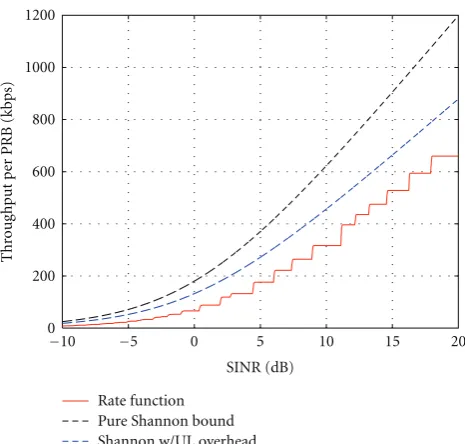
through reference signals has been taken into account. Figure 1 shows the employed rate function including the Shannon reference with and without considering the LTE overhead.
Note that the Shannon bounds inherently assume a per-fect selection of modulation and coding schemes. However in the uplink, due to fluctuating interference, this selection can not be perfect by definition, even not in static channel conditions. Furthermore imperfect channel estimation will also degrade the performance. The consequence is a loss of some dBs. On the other hand, the base stations typically have 2 receive antennas, which is also not considered in the Shannon bounds which will lead to a gain in the range of 3 dB. Furthermore, frequency selective scheduling (e.g., though proportional fair scheduling) will lead to multi-user
diversity gain [18,19].
In this work we will assume that those effects will
compensate each other such that the rate function used here (red solid curve) is rather close to the Shannon bound considering the overhead through cyclic prefix and
reference signals. Later on in Section 5.2 we will see that
this assumption leads to a good agreement with existing simulation results.
3. Scheduling Probabilities
Let us now have a closer look at the scheduling probabilities
pc(v). We will consider several scheduler strategies. Note that
the random variablevcis discrete; it can adopt valuesv∈Uc
with the probabilitypc(v). For mathematical correctness, we
need to define a kind of idle value, for example,v = −c,
with nonzero probability pc(−c) which represents the case
that no user is scheduled in cell c(at the considered time
and frequency, that is, a PRB is left empty). All other values
have the probabilitypc(v)=0. With these definitions, we can
write (just for comprehension)
∞
Figure1: Rate function for the uplink.
3.1. General Expression. Let us define the average number of
PRBsMuwhich is allocated to useru. Note that 0≤Mu ≤
We observe that the scheduling probabilities depend
purely on the average number of assigned PRBsMu’s. Hence,
we will investigate those elaborately in the following sections. We will be looking at individual cells; we assume that cells in general behave independently, that is, the random variables
vc’s are mutually independent, too.
3.2. Adaptive Transmission Bandwidth. The key difference compared with the downlink is the fact that every user has an individual power budget in the uplink. So we can shift PRBs from one user to another, but not power. As a direct consequence, the maximum number of PRBs which can be given to a user without driving it into power limitation
depends on the difference between transmit power per PRB
P(PRB)
T,u (given by (2)) and the maximum transmit powerPmax
which is typically called power headroom:
An uplink scheduler should never assign a user more
PRBs than this limit Mmax,u. Otherwise, looking at the
original power control equation (1), we observe that the
users would have to spread the same power over the assigned PRBs instead of increasing the power with every assigned
PRB (the min operator in the PC equation (1) expires). This
results in an SINR loss which would eat up at least part of the bandwidth gain. Furthermore, other (non-power-limited) users can make much better use of the bandwidth. Finally, spreading the maximum power over several PRBs would increase the dynamic range problems. Note that for the PC
equation per PRB (2) we have already inherently assumed
that the scheduler does not exceed the aforementioned
limit. This behavior is typically called adaptive transmission
bandwidth [20].
Obviously this limits the maximum average number of
PRBs as well, since every user can be scheduled at maximum in every time slot, hence we have
Mu≤Mmax,u. (14)
3.3. Strict Resource Fair. The straightforward definition of
the resource fair scheduler would be that the Nc users in
cellcshare the available resources, that is,Mu = Mtotal/Nc.
However, this may violate the power limitation of the UEs in
(14). If we require resource fairness, nevertheless, that is,Mu
should be the same for all users, then every user can only get as many PRBs as the worst user (using the highest transmit power). We can write
Mu=min
An important observation is that this solution is also
throughput fair in the case of αc = 1 (with the exception
that power limited users would have smaller throughput).
Otherwise (αc <1) close users get higher throughput since
the received power is higher and the interference is the same for all users in a cell.
3.4. Modified Resource Fair. The previous scheduler has the disadvantage that it may leave a lot of resources unused although close users would still be able to extend their bandwidth. Unfortunately, users at the cell edge with high propagation loss cannot make use of the spare bandwidth due to power limitation.
In another extreme solution we could try to always give
every useruits maximum allowed bandwidthMmax,u. If this
does not exceed the available resources, that is,u∈UcMu≤
Mtotal, this is a viable approach. However, this will be relatively unlikely in reality since already a single close user could have enough transmit power to occupy more than MtotalPRBs.
In this case we need to scale down the number of PRBs.
The simplest solution would scale down allMmax,u’s in the
same way. However this would leave too much unfairness in
the system. Instead we prefer scaling down largeMmax,u’s and
bring this new solution as close as possible to the resource fair
case. We will call this solution modified resource fairalthough
it is in general not resource fair. However, in annex A we will observe that this solution achieves the same fairness as the typical resource fair definition in the downlink.
We propose a simple iterative method which starts with the previous resource fair case. We define the indices wc,1,wc,2,. . .,wc,Nc such that they address all users uin cell
c in ascending order with respect to Mmax,u’s, that is, wc,1
addresses the worst user in cellc,wc,2addresses the second
worst user, and so forth. We will formulate our algorithm as follows:
In every iteration, we check whether the remaining
resource budget M equally shared among the remaining
N −i + 1 exceeds the PRB limit Mmax,u of the worst of
the remaining users u. If yes, the worst remaining user
gets its maximum number of PRBs Mmax,u, and we assign
the remaining budget in the next iteration. Otherwise the remaining budget is equally shared among the remaining users, and we exit the algorithm.
Note again that in this solution the worst user gets the
least amount of resources, but the maximum it can afford.
With a high number of users this case will converge against the previous “Resource Fair” case.
3.5. Throughput Fair. In this section we try to approximate a throughput fair solution. We have already mentioned that the number of PRBs is limited for the users. Since the interference is the same for all users the throughput achievable by all users is determined by the worst user (in
particular for α < 1). The true throughput fair solution
employs the rate function and writes as
Mu1
throughput fairness is required per cell. Unfortunately the
SINRs are not known so far; recall that theMu’s are needed
to calculated scheduling probabilities and thereby the SINRs.
Therefore we will give two different approximations in the
following.
As a first approximation, we will do the simplifying assumption that the throughput is proportional to the SINR,
that is, we assume linear rate function. From (7) we observe
−2 0 2 4 6 8 10 12 14
Reference user gets 3PRBs
Linear approximation
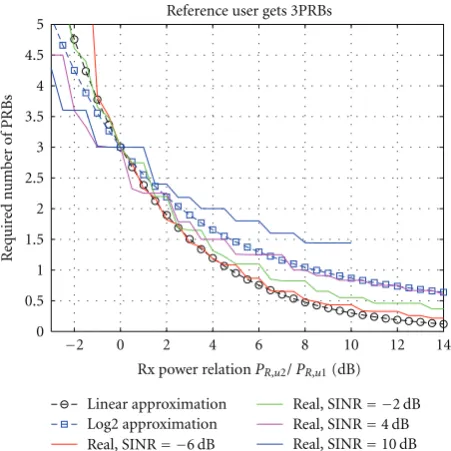
Figure2: Approximation of required PRBs for throughput fair case.
cell specific). In this case the throughput fair criterion of the previous equation degenerates to
Mu1
Another approximation which is derived from Shannon’s equation is
The comparison of the two approximations is shown in Figure 2 where we have usedMu1 = 3. The true relation obviously depends on the SINR range of the reference user (cf. legend). The linear approximation fits for very small
SINR ranges; the log2approximation fits better for medium
SINR ranges.
Both approximations have the very nice property that they only depend on the positions of the users within a cell and not on intercell interference or other cells in general. With those assumptions, we can formulate the throughput fair (approximated) solution in three steps.
First we assume that the worst user gets the maximum number of PRBs:
Mv=Mmax,v v=arg
u minu∈UcMmax,u. (19) Next we derive the number of PRBs for all the other users in
the cell by applying equation (17)
Mu=Mv·PPR,v
Finally we need to check whether we have exceeded the
resource limit. In this case, we have to scale down allMu’s
by the same factor in order to fit into the available resources whilst maintaining the throughput fairness:
Mu=Mu· Mtotal
maxMtotal,
u∈UcMu
. (22)
3.6. Quality of Service. A drawback of the previous methods is that we cannot define a target QoS or a user satisfaction
level. Inherently the methods were based on the best effort
and full buffer assumption. The users always have data to
transmit on one hand; on the other hand they do not have to meet a certain target, that is, they are satisfied with whatever
resourcesMuthey get.
For a variety of services a certain QoS target has to be met. For instance, users are only satisfied if they get a certain
bit rateDu. If they get less, they are unsatisfied. On the other
hand, they typically cannot transmit more thanDu, so the
system will assign only the resourcesMusuch that the target
rate is fulfilled, not more. Such a behavior is called constant
bit rate(CBR) service.
Initially, let us assume that the SINRs are already known. We will resolve this assumption in the subsequent section.
The approach is very similar to the approach in [13]. In
order to achieve the target rateDuwhilst observing the power
(and therefore resource) limitation in uplink, we write the
required average number of PRBs for useruas
M(req)
where R(SINRu) is the rate function introduced in
Section 2.5. It is important to observe that a user cannot be satisfied if the min operator expires, irrespective of the
traffic situation in the own cell (even if the user were alone).
The only way to improve those users is to decrease the intercell interference, which requires modifications in the
neighboring cell such as decreasing the P0 [21]. Note that
any of those modifications is likely to reduce the QoS level in the neighboring cell.
A cell can be defined in overload if the sum of the required resources exceeds the available resources,
u|X(u)=cM(req)u > Mtotal. In this case contention control would drop some users (or, equivalently, admission control would not even have admitted some users). We assume that those control mechanisms work arbitrarily, that is, they do not prefer some (e.g., close) users and discriminate others (e.g., far users). This case can be modeled by applying the
same scaling procedure as in (22):
Mu=M(req)u · Mtotal
This scaling procedure would basically make every user unsatisfied. However note that the scheduling probabilities here are needed to calculate SINRs. Performance metrics will
be discussed inSection 4. Alternatively, we could make use of
select a subsetUsub,c ∈ u | X(u)= c(and drops the other
users) such thatu∈Usub,cM(req)u > Mtotalis fulfilled.
We would like to emphasize again that we have assumed
that the SINRu’s are already known. However, we actually
need the scheduling probabilities to calculate the SINRu’s
based on (7). So in contrast to the strict resource fair,
modified resource fair and (approximated) throughput fair solutions of the previous sections, we unfortunately have not found a closed form solution for the QoS case. This problem
is very similar to the downlink problem as described in [13].
3.7. Comparison with Real-World Schedulers. In the fol-lowing we will discuss how real schedulers would map to the previously introduced strategies. The most popular
scheduler is a proportional fair (PF) scheduler. The pure
PF strategy is resource fair [18,19]. However, unfortunately
the PF definition in the uplink is not as straightforward as it is in the downlink due to power control and power limitation. Most of the uplink PF strategies in LTE will use adaptive transmission bandwidth and will be very close to the
modified resource fair definition introduced inSection 3.4,
when assuming full buffer/best effort traffic models (i.e.,
no further QoS constraints), compare, for example, [20].
Note that the scheduling gain, that is, the fact that the SINR conditioned on a user being scheduled gets better, goes into
the throughput mapping discussed in Section 2.5and not
into the scheduling probabilities. Hence, PF and round robin strategies are equivalent from the perspective of scheduling probabilities (both are resource fair).
Furthermore, the PF strategies typically have to be extended with QoS constraints such as a target bit rate, minimum bit rate, or delay constraints. Those extended PF versions will come closer to the QoS scheduler described in Section 3.6. Once again, the reduced scheduling gain (through more QoS constraints) is considered in the throughput mapping, rather than in the scheduling proba-bilities.
3.8. Initialization of the SINRs. In this section we will
propose 2 different solutions. Let us first recall the SINR
definition from (7)
SINRu=PR,u·Exp{· · · }. (25)
The first observation is that the abbreviated expectation
Exp{· · · }is only cell specific and not user specific. Hence,
for a first guess of theMu’s according to (23) and (24), we
only need to approximate a single value rather thanNc
user-specific SINRu’s, which seems to be a much simpler problem.
If we are applying the framework in this paper to a dynamic simulator with a continuous time axis, we can simply take the guess of the expectation from the previous time step.
Similarly, we can read that once we know the SINRu0of one
useru0 (e.g., the worst user), we know all the others by the
simple relation
SINRu=SINRu0·PPR,u
R,u0. (26)
The advantage is that it might be easier to make a guess on the SINR since it is a relative number rather than a guess on the expectation which is an absolute number. In particular the SINR of the worst user in a cell is rather likely to be very small. So the second proposal is to set the SINR of the worst
user in every cell to a predefined value SINRinit(e.g., 0 dB),
and the other user’s SINR in the same cell are derived from
that according to (26). This method has the advantage that it
also works with so-called snapshot-like simulators which do
not have a time axis. In a dynamic simulator, this approach is probably less accurate than the first one.
4. Performance Metrics
So far, we have an (almost) analytical expression SINRufor
the average SINR of every user in an LTE uplink network. Furthermore, we have already discussed the average number
Muof assigned PRBs for different scheduling strategies. Note
that in the QoS case theMu’s actually depend on the SINRs
which are not known when calculating the Mu’s. Hence,
before calculating performance metrics we should update the
Mu’s with the more accurate values of the SINRs.
From these SINRu’s andMu’s we now can start deriving
several capacity metrics such as average cell throughput, throughput percentiles, or number of (un)satisfied users.
4.1. Throughput Metrics. In the simplest case, we calculate the user throughputs as
Ru=Mu·R(SINRu). (27) From those rates we can calculate a total network through-put, throughputs per cell, or throughput percentiles. In principle we could also check whether users are satisfied by
comparing their data rates with the rate requirementsDu’s.
However recall that in (24) we have scaled down theMu’s of
all users in case of an overload. In this case, all userswould
fall below theirDu’s although in reality it might be sufficient
to drop very few users to make the rest satisfied again. Furthermore, it would be interesting to have a quantitative notion of how much overloaded a cell is and how many users are unsatisfied in fact. So for the QoS case, we will define more appropriate performance metric in the following.
4.2. Overload and Unsatisfied Users. Exactly as in [13] we
return to the required number of PRBs from (23) and define
a virtual cell load
which can exceed 1 thereby indicating the degree of overload.
For instance, ρc = 1.1 means a 10% overloaded cell, and
ρc = 2 means that the cell is double overloaded, that is,
half of the users will be unsatisfied. Again assuming that an admission/contention control would exclude arbitrary users (not preferably cell edge users), we can write the number of
unsatisfied users in cellcas
This number accounts for dissatisfaction through overload. In addition, we will also have unsatisfied users through power
limitation as already discussed in the context of (23), even if
the virtual load is very small. We simply count their number in cell
limitation on cell level is given by the fact that the number of users which can be scheduled at the same time is constrained by the available resources for control channels (physical downlink control channel PDCCH in LTE). Note that this can be a painful restriction in particular in the uplink, where the individual UE power budgets limit the ability of following an aggressive TDMA strategy. With our mathematical framework we can easily capture this limitation as well. Assume that the maximum number of
schedulable users in cellcper TTI is given byKtot,c. (This is a
simplification. In LTE this is not a hard limit, but it depends on the user positions.) The control channel consumption is minimized by a scheduling strategy which would always
assign the maximum number of resourcesMmax,uaccording
to (13) to a scheduled user. This maximized the number
of TTIs in which a user is not scheduled, that is, where it does not require any control resources. Hence, the (averaged) minimum number of required control channels required by
useruper TTI is
using the required number of PRBsM(req)u from (23). Note
thatKu ≤1. Obviously, the control channels will definitely
(even without any delay requirement) cause dissatisfaction in case
u∈Uc
Ku> Ktot,c. (32)
Equivalent to the load dissatisfaction we will again assume that admission/contention control would exclude arbitrary users and thus we can define the number of unsatisfied users due to control channel limitation as
Zctrl,c=max
Finally we have to combine the three metricsZload,c,Zpower,c,
andZctrl,c to a single number of unsatisfied users per cell. With our high level of abstraction this is quite challenging since the sets of load-, power-, and control-unsatisfied users might be overlapping. A heuristic approach would exclude users one by one (power-limited users first) and recalculate the metrics until dissatisfaction has disappeared. Another approach exploits the intuitive fact that the set of load- and control-limited users (i.e., the cell level metrics) are obviously fully overlapping. The set of power-limited users (user-level metric) will be rather disjoint. With those
assumptions we approximate the total number of unsatisfied
users in cellcas
A dynamic system level simulator has been implemented based on the derivations in the previous chapters. In this sec-tion we will present some results with standard assumpsec-tions
(such as full buffer traffic, proportional fair scheduler), and
we will show that those are very close to other simulation results which have been agreed for by several companies in
[9,22]. Furthermore, we will present results with CBR traffic,
and we will also look at an irregular network with SON adaptation of the power control parameters. Finally we will elaborate on the huge runtime performance.
5.1. Simulation Assumptions. We will use standard
assump-tions as proposed in [16], comprising a network of 19 LTE
base stations with an intersite distance of 500 m, serving 57 hexagonal cells (sectors). Pathloss law, shadowing model,
and horizontal beam pattern are also taken from [16], a
vertical pattern is not used. The users are moving with a speed of 3 km/h, and they are handover to another cell if the received signal strength (measured on downlink reference signals) with respect to the new cell is 3 dB better than that with respect to the serving cell (handover hysteresis). One simulation step is 100 ms, that is, the network performance is evaluated 10 times a second.
We are using homogeneousP0values ofP0= −52 dBm
or P0 = −58 dBm and a homogeneous α value of α =
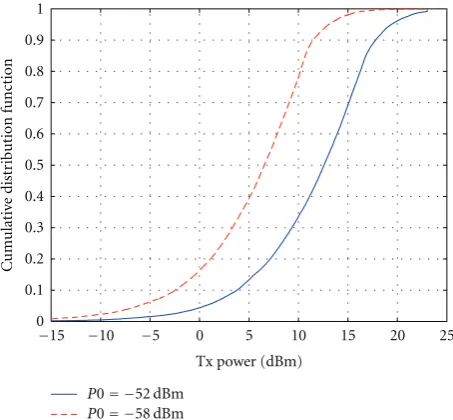
0.6. The resulting distribution of transmit power per PRB
is shown inFigure 3. Note that this distribution does not
depend on the scheduling mechanism or traffic model since
we record one power value for every user per simulation step.
It is obvious that the larger P0 setting of−52 dBm leads
to higher transmit powers. In this case we can also identify the maximum transmit power of 23 dBm.
5.2. Full Buffer Traffic. We will start with the simple
assump-tion of a full buffer traffic model and a modified resource fair
scheduler as presented in Section 3.4. Users are uniformly
dropped into the network area such that every cell serves an average of 10 users. The distribution of the user throughputs
according to (27) is given inFigure 4.
As expected we observe slightly higher user throughputs
with the larger P0 value. However, the difference between
the curves is smaller in the lower part of the plot, since the
power limitation is more critical with the smallerP0value.
The 5% percentiles (which is typically referred to as cell edge
throughput)are420kbps and503kbps whereas the average cell throughputs are 7.3 Mbps and 8.5 Mbps, respectively. This is in very good agreement with the simulations in
[9,22]. The results of different companies are compared in
[22] for the reference case which we have used as well. The
cell throughput results are in the range between 6.3 Mbps and 1.01 Mbps, with an average of 8.6 Mbps (which is also
−15 −10 −5 0 5 10 15 20 25
Figure3: Distribution of Tx Power per PRB.
0 200 400 600 800 1000 1200 1400
0
Figure4: Distribution of user throughput in modified resource fair case.
460 kbps with an average of 260 kbps. Obviously our results are a bit too optimistic in terms of cell edge throughput which could be a consequence of the neglected fast fading, and, even more important, of handover gain, which is included in our simulations with full mobility.
5.3. Constant Bit Rate Traffic. Next we will assume a constant
bit rate traffic model and a QoS scheduler as presented in
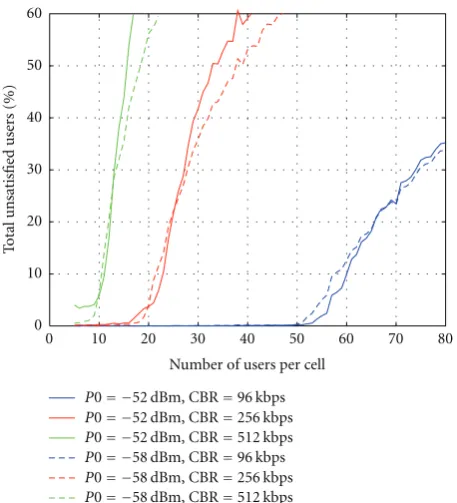
Section 3.6. Different target data rates are assumed, namely, 96 kbps, 256 kbps, and 512 kbps. Again, users are uniformly dropped into the network; however, the average number of users per cell is varied from 5 to 80. Let us first look at the
percentage of unsatisfied users due to power limitationZpower
as given by expression (30) inFigure 5.
We observe the following behavior.
(i) All curves reach a maximum and then do not grow any further. The reason is that the actual load is limited and cannot exceed 100%. So the interference will also not grow with the number of users, and the SINRs will not decrease.
(ii) The (power) dissatisfaction level is larger for higher data rates. This is quite obvious.
(iii) The (power) dissatisfaction level is larger for the
larger P0 = −52 dBm. With smaller P0, the users
can afford more PRBs, compare (14), whereas the
interference level goes down as well (note that the other cells will reduce P0 as well in our model). So the SINRs remain the same as long as we do not enter noise limited regimes.
(iv) With 512 kbps and P0 = −52 we even have a
“dissatisfaction floor,” that is, there will be power limited users even in an empty system. That is, high uplink data rates can only be supported with small
P0 values (or by relaxing the ATB power constraint
(14)).
Note that the previous figure did not take into account users which cannot be served due to the lack of bandwidth. Figure 6shows the total number of unsatisfied users
accord-ing to (34), that is, the sum of power- and load-unsatisfied
users. Control limitation is not considered, that is,Ktotalc =
∞.
Certainly we can recognize the aforementioned
dissatis-faction floor for 512 kbps andP0= −52 dBm in this figure.
Otherwise, the impact of the P0 value is almost negligible since adding users beyond 100% virtual load obviously means load-unsatisfied users hiding the aforementioned limit for the dissatisfaction level due to the power constraint. If we target a typical overall dissatisfaction level of 5%, the uplink can satisfy 10, 21, and 56 user with 512 kbps, 256 kbps, and 96 kbps, respectively. The cell throughput with the smaller rates is around 5.4 Mbps whereas the 512 kbps case is slightly worse with 5.4 Mbps due to the more critical power limitation.
As expected the CBR capacity is significantly below the
best effort capacity. However, the difference is smaller than
in the downlink, since the power control compensates for a part of the SINR loss of cell edge users.
5.4. Heterogeneous Scenario. Next we will leave the homoge-neous standard scenario and continue with a heterogehomoge-neous
scenario with different cell sizes and nonuniform user
concentrations.Figure 7 illustrated the scenario which has
been proposed in [23]. The eNBs are located on an irregular
grid, 8 users are dropped into every cell, and additional 42 users (i.e., 50 users in total) are dropped into cell no. 11 simulating a hot spot. All users use a CBR of 64 kbps. For
every cell can individual P0c is chosen such that the min
operator in the power control equation (2) expires in roughly
0 10 20 30 40 50 60 70 80
Number of users per cell
Po
Figure5: Number of unsatisfied users due to power limitation.
0 10 20 30 40 50 60 70 80
Number of users per cell
T
Figure6: Total number of unsatisfied users.
We will also look at load adaptive power control(LAPC)
as proposed in [24] where the P0cs are reduced in cells
which only carry a small load. In the CBR model reducing
P0c blows up the resource consumption since the resulting
SINR loss has to be compensated by bandwidth. We use a
very similar approach to [24] and update theP0c(t) at time
Figure7: Cell layout.
step t depending on the previous valueP0c(t−1) and the
where ρtarget is the virtual load which we are targeting. In
theory we may want to target 100%; however, experience has shown that a margin should be left for handover users
so that we will useρtarget = 80%. The rule means that we
increase the currentP0c(t) if the load is above target, and we
decrease it if the load is below the target; however, we will not
increase the initialP0cwhich has been defined above. Note
that this automatic adaptation of a cell parameter can already be considered as a SON mechanism.
Figure 8depicts the virtual loads in the overloaded cell no.11 and its neighbors over time where we have switched
on the LAPC att=42 sec. Before that, the virtual loads are
rather small (except the overloaded cell no.11) and different
in every cell depending on the exact position of the users and the cell shape/size. After switching on the LAPC the virtual
load in all low-loaded cells approaches the targetρtarget =
80%.
The time characteristics of the corresponding P0c(t)s
are shown inFigure 9. Without LAPC we can observe that
theP0s depend on the cell size. Large cells have smallP0s
and vice versa (due to the aforementioned 5% rule). After
switching on LAPC, the low-loaded cells reduce their P0s
whereas cell no.11 does not change it.
Now let us look at the impact of the LAPC on the
distribution of the interference over thermal (IoT) values.
Those are based on the S samples used for the Monte
Carlo approach defined in (10); the exact definition of the
(instantaneous) IoT is given by
IoTc,s=
i /=cIc,vi,s+N
0 20 40 60 80 100
Figure8: Virtual load in overloaded cells no.11 and neighbors.
leading toS·timestepsIoT samples per cell.Figure 10shows
the cumulative distribution function of the IoT values (in dB) in cell no.11 before and after switching on LAPC, and it also displays the linear and the harmonic averages of the IoT given by
With LAPC the CDF is steeper since the users spread their data rate over a larger bandwidth leaving less PRBs unused (without interference) and leading to a smoother interference. The interference of an individual user per PRB
certainly goes down significantly (with the P0 reduction);
however, it has to occupy more PRBs to reach its CBR. Still, the linear average of the IoT is smaller with LAPC since the rate function is concave over a wide area meaning that decreasing the power can be compensated by a smaller increase of the bandwidth. However, the harmonic average shows a surprising picture. The harmonic average decreases with LAPC which is a consequence of the larger variance
of the IoT. Note that we have clearly shown in Section 2.3
that the harmonic average is actually the relevant measure. This also manifests in the distribution of the average user
SINRs defined in (7) which are shown inFigure 11for the
overloaded cells.
The LAPC has degraded the SINR in the overloaded cell
even though the P0 has not been reduced there since the
more fluctuating interference obviously offers more potential
for the link adaptation (which is assumed to be ideal in our model). This is also visible in the virtual load of the
0 20 40 60 80 100
Figure9: P0 settings in overloaded cell no.11 and neighbors.
0 2 4 6 8 10 12 14 16 18
Linear average w/o LAPC
Harmonic average w/o LAPC IoT samples (dB)
Linear average w/ LAPC
Harmonic average w/ LAPC
C
Figure 10: IoT distribution in overloaded cell no.11 with and without LAPC.
overloaded cell no.11 in Figure 8 which has slightly been
increased by LAPC (as a result of the decreased SINRs). This
is a contrast to the results in [24] where LAPC helps to
improve the system. Fluctuating interference has a negative impact on link adaptation (i.e., selection of modulation and coding schemes, scheduling, etc.). In other words, smoothening the interference through LAPC will improve
−2 0 2 4 6 8 10 12 14 16 18 20
Figure 11: SINR distribution in overloaded cell no.11 with and without LAPC.
in our simplified model, where link adaptation is always assumed to be ideal. Hence, our model can exploit the
aforementioned potential offered by fluctuating interference,
which is not the case in reality.
Although we have gained important insights by this analysis, it also reveals a current limitation of the model.
A remedy could be based on the principles of [25],
where the rate function is elaborated by the introduction of a correlation between the SINR at the moment of choosing the modulation and coding scheme and the moment of applying it (where the interference might have changed). This correlation would increase through LAPC.
5.5. Simulation Runtime. Finally we will look at the
run-time performance of the simulation. Figure 12 shows the
simulation time for one simulation step versus the average number of users per cell. It turned out that the number
of samples used for the Monte Carlo integration in (10)
has significant impact. As already mentioned, convergence
is achieved for S > 1000. Fortunately we observe that
further reduction of this number does not bring additional runtime benefit. The increase is linear with respect to the number of users, which is not surprising. With 50 users per
cell and a simulation step of 1 sec, which is sufficient for
many applications, we are a factor 2 above real-time. Recall that we have a fully heterogeneous 57-cell network, and no homogeneous properties are exploited.
6. Conclusions
We have presented a very efficient modeling approach for
uplink investigations focussing on the LTE standard. QoS and radio resource management (which typically work on a millisecond time scale) are modeled in a very abstract but still
10 20 30 40 50 60 70 80 90 100
Average number users per cell
R
Figure12: Runtime in a 57-cell environment on a 2.4 GHz CPU.
accurate way such that the essential behavior is still included. By those means we can decrease simulation runtime far below real-time.
This is in particular helpful, even necessary, for simu-lations covering long time intervals. The most important applications are investigations on self-optimizing networks since SON mechanisms are typically very slow control loops and converge over hours or even days. Conventional system level simulators cannot serve this purpose. On the other hand, QoS and mobility issues are of utmost importance and can not be neglected when studying SON which makes static tools inappropriate as well. We are closing the gap between too slow but elaborate system level simulators with full mobility and QoS support on one side and rough static simulators which can lead to very fast results.
We have seen that uplink modeling is much more
com-plicated than downlink modeling. The key differences are
the uplink power control (including the associated individual UE power budgets) and the multiple-access structure of the uplink (leading to extremely fluctuating interference). We have derived an average uplink SINR which is equivalent to the downlink SINR which is typically intuitively used. We have observed that the uplink interference has to be averaged in a harmonic way.
Different traffic/scheduler assumptions have been
dis-cussed. Again in contrast to downlink, there is no unique
definition of a resource fair scheduler in the full buffer
Limitations of the abstract models have been addressed as well. In particular, RRM details such as the exact algorithms for MCS selection, multi-user diversity gains, and imperfect channel estimation are hidden behind the abstract models (although the essence of fairness issues is considered). Furthermore, the capability to consider more elaborate
traffic models (different from pure CBR and pure best effort)
is limited. We are giving an outlook on possible extensions in Appendix B.
We have given simulation results using the derived modeling approach. In the specified LTE test cases our results match very well the typical performance assumptions. We
have also given results for the CBR case using different
target bit rates and analyzed the impact of power limitation. Finally we were looking at a heterogeneous scenario with
different cell sizes and non-uniform user placement. We
have considered load-adaptive power control as an example for a SON mechanism. This scenario has revealed some limitations of our modeling approach which have to be improved in the future.
In this paper we have only looked at a small subset of the proposed SON use cases since the focus was on the introduction of the framework. Certainly the model can be used for all other SON use cases as well, such as load balancing, coverage and capacity optimization, or mobility robustness optimization.
Appendices
A. Discussion of Uplink Fairness
In this section we will compare the uplink fairness with the
downlink fairness. We will show that the modified resource
fairscheduler in the uplink achieves a comparable fairness as
a typical resource fair scheduler in downlink.
In downlink, the SINRs on a PRB degrade towards the cell edge more severe than the pathloss law, since the interference grows in addition. With a resource fair scheduler, the throughputs behave accordingly. However, we can improve cell edge users arbitrarily by assigning them more PRBs (nonresource fair scheduling).
In the uplink, the degradation towards the cell edge is
different. By purely looking at the power control equation
(2), bandwidth limitation (13), and SINR definition (7), we
make the following observations.
(1) The uplink interference is induced at the eNB antennas and therefore is the same for all users (as long as we do not assume intercell interference coordination).
(2) Assuming no power control α = 0 (resulting in
strict resource fairness, that is, one PRB per user), that is, each UE transmits with maximum power, the SINRs per PRB would degrade with the pathloss. Note that this is still “fairer” as in the downlink (where interference increases in addition).
(3) Assuming power control with full pathloss
compen-sationα=1 (and adaptive transmission bandwidth),
that is, all UEs are received with the same power
per PRB, the SINRs per PRB would be the same for all UEs, but the assigned bandwidth degrades with
the pathloss, copmared with (14) unless theP0s are
rather small. So the throughputs degrade with the pathloss (which is a little steeper than the upper case due to concavity of the rate function).
(4) Assuming power control with fractional pathloss
compensation 0< α < 1 (and adaptive transmission
bandwidth), the SINRs per PRB would degrade less severely than the pathloss; however, the assigned bandwidth degrades with the “rest” of the pathloss law. So in total the throughputs again will degrade with pathloss, with the slope being in between the upper two cases.
So in either case the throughputs will degrade with the
pathloss, either via SINR degradation (forα < 1) and / or
via the ATB scheduler. The degradation will be similar to the
downlink. All cases refer to the definition of the modified
resource fairscheduler.The strict resource fair solution will lead to more fairness, that is, less throughput degradation for α > 0. For the special case ofα= 1 strict resource fairness even leads to throughput fairness.
Despite similar fairness behavior, the uplink scheduler has much less degrees of freedom to trade throughput among the users (due to individual power budgets). The only way to extend the strict throughput limit of cell edge users is to reduce the intercell interference which unfortunately lies outside the responsibility of the serving cell. Even more severe, the neighbors can only decrease interference by degrading their own users. Hence, whereas in downlink we can trade throughputs between users, in uplink we need to trade throughputs between cells.
B. Traffic Assumptions
We have already observed that the individual power
limita-tion in the uplink results in a bandwidth limitalimita-tionMmax,u
(the number of PRBs for edge users is limited) and thereby
in a tight data rate limit. This is different from the downlink,
where basically each PRB comes along with its own power budget, so that assigning more PRBs automatically means assigning more power.
As a consequence, in the uplink we can only guarantee small data rates to cell edge users. So if we want to assume a common CBR model for all users, it has to be very small such that the edge users have a fair chance to achieve it. With such
a setting there are basically 3 different methods how capacity
limit could be achieved.
(1)Common CBR. The straightforward solution is to con-sider a large number of users. This would increase simulation runtime, and large data rates would not occur at all.
(2)Common CBR Extended with Full Buffer. With a smaller number of users we could think about distributing the excess
capacity (i.e., PRBs) among those users who still can afford
buffer model, which can be referred to as guaranteed bit rate
(GBR) model. The drawback is that we would need another metric (in addition to the satisfied users due to load and power) accounting for users with higher throughput (i.e., 95% percentile). Furthermore we have to set a rule how the excess capacity is distributed among the users.
(3) User-Specific CBR. Finally, we could set different bit
rate requirementsDufor the users, for example, depending
on the pathloss. Edge users would get small Du’s, and
close users would get higherDu’s. This might be the most
convenient solution and probably the most realistic one as well. However, we need to find an appropriate rule to set
the individual rate requirementsDu’s, which is absolutely not
straightforward. We will propose a simple mechanism with the following characteristics.
(a) We define a minimum data rateDmin which
lower-bounds all rate requirements, that is,Du≥Dmin.
(b) The rate requirement for the worst uservc(i.e., with
largest pathloss) in every cellcis set to the minimum
rate, that is,
Dvc=Dmin with vc=arg
u minu∈UcLc
−→
q,Θc. (B.1)
(c) The rate requirements for the other users are upscaled
according to the pathloss relation to the worst uservc
Du=Dmin·
The fairness parameterβcan be considered as “slope”
of the rate requirements.β=1 obviously means no
slope, that is, the same rateDminfor all users which
converges to the common CBR solution. There is an interesting relation to the power control parameter
α; setting β = α will lead approximately to a
resource fair behavior, since the rate increase would roughly be compensated by the increase in received power through fractional power control; this would be exactly true for a linear relation between SINR and throughput and if we neglect the power limitation.
β = 0 is the most aggressive setting which makes it
approximately equally tough for every user to achieve its target.
For this special case of user-specific CBR setting, we will now propose a special initialization for the SINRs. Recall that
the SINRs depend on the average number of PRBs Mu (or
scheduling probabilities, resp.); however, the performance metrics depend on the SINRs in turn. For 3 artificial cases
we have proposed simple ways to calculate theMu’s without
needing the SINRs in Sections3.3,3.4, and3.5. The proposal
is a slight modification of the idea for the TP-fair case in Section 3.5. In every cellcwe start with an initial guessGfor
the worst user’sMvc = G. From this guess we approximate
the resource consumption of
Mu=G·
if we neglect power limited users. As discussed before we observe
(i) the resource fair behaviorMu=Gforα=β,
(ii) smaller resource consumptionMu< Gfor close users
towards the throughput fair solutionα≤β≤1,
(iii) larger resource consumptionMu> Gfor close users
towards the aggressive solutions 0≤β≤α;with this
setting, we can initialize the SINR calculation for the user-specific CBR case depending only on a single
parameterG.
(4) Summary. We will now summarize the required hooks
for the traffic configuration with user-specific CBRs.
(i) The first is a minimum rate requirement Dmin. We
propose values between 64kbps and 96kbps. Higher values will already become critical for cell edge users.
(ii) The second is a slope β for the rate requirements.
β = 1 means throughput fair behavior; smaller
values increase the rate requirements for closer users depending on their pathloss relation to the worst user, thereby forcing more load in the system. We
propose a setting between 0 andα.
(iii) The third is a guessGfor SINR initialization. A first
proposal is G = 1; however, this requires further
study.
References
[1] SOCRATES, “Self-optimisation and self-configuration in wireless networks,” European Research Project,http://www .fp7-socrates.org.
[2] M. D¨ottling and I. Viering, “Challenges in mobile network operation: towards self-optimizing networks,” inProceedings of IEEE International Conference on Acoustics, Speech and Signal Processing (ICASSP ’09), pp. 3609–3612, Taipei, Taiwan, April 2009.
[3] M. Amirijoo, R. Litjens, K. Spaey et al., “Use cases, require-ments and assessment criteria for future self-organising radio access networks,” in Proceedings of the 3rd International Workshop on Self-Organizing Systems (IWSOS ’08), pp. 275– 280, December 2008.
[4] “Next Generation Mobile Networks, Use Cases related to Self Organising Network,” Overall Description,http://www .ngmn.org/.
[5] 3GPP, “Self-configuring and self-optimizing network use cases and solutions,” Tech. Rep. TR 36.902,http://www.3gpp.org/. [6] U. T¨urke and M. Koonert, “Advanced site configuration
techniques for automatic UMTS radio network design,” in
Proceedings of the 61st IEEE Vehicular Technology Conference, vol. 3, pp. 1960–1964, Stockholm, Sweden, May-June 2005. [7] A. Lobinger, S. Stefanski, T. Jansen, and I. Balan, “Load
balancing in downlink LTE self-optimizing networks,” in
Proceedings of the 71st IEEE Vehicular Technology Conference, Taipei, Taiwan, May 2010.
Symposium on Personal, Indoor and Mobile Radio Communi-cations (PIMRC ’05), vol. 4, pp. 2306–2311, Berlin, Germany, September 2005.
[9] M. Rinne, M. Kuusela, E. Tuomaala et al., “A performance summary of the evolved 3G (E-UTRA) for voice over internet and best effort traffic,”IEEE Transactions on Vehicular Technol-ogy, vol. 58, no. 7, pp. 3661–3673, 2009.
[10] A. Simonsson and A. Furusk¨ar, “Uplink power control in LTE—overview and performance,” inProceedings of the 68th IEEE Vehicular Technology Conference (VTC ’08), Calgary, Canada, September 2008.
[11] K. Majewski and M. Koonert, “Conservative cell load approx-imation for radio networks with shannon channels and its application to LTE network planning,” inProceedings of the 6th Advanced International Conference on Telecommunications, Barcelona, Spain, May 2010.
[12] 3GPP, “Simulation assumptions and parameters for FDD HeNB RF requirements,” TDoc R4-092042, RAN WG4 Meet-ing #51, San Francisco, Calif, USA, May 2009, http://www .3gpp.org/.
[13] I. Viering, M. D¨ottling, and A. Lobinger, “A mathematical perspective of self-optimizing wireless networks,” in Proceed-ings of IEEE International Conference on Communications (ICC ’09), Dresden, Germany, June 2009.
[14] 3GPP, “Stage 2 Description,” Technical Specification TS 36.300,http://www.3gpp.org/.
[15] 3GPP, “Physical layer procedures,” Technical Specification TS 36.213,http://www.3gpp.org/.
[16] 3GPP, “Physical layer aspects for evolved Universal Ter-restrial Radio Access (UTRA),” Tech. Rep. TR 25.814,
http://www.3gpp.org/.
[17] B. Zerlin, M. Ivrlaˇc, W. Utschick, J. Nossek, I. Viering, and A. Klein, “Joint optimization of radio parameters in HSDPA,” in
Proceedings of the 61st IEEE Vehicular Technology Conference (VTC ’05), vol. 1, pp. 295–299, Stockholm, Sweden, May 2005. [18] D. Tse and P. Viswanath,Fundamentals of Wireless Commu-nications, Cambridge University Press, Cambridge, UK, 1st edition, 2005.
[19] P. Viswanath, D. N. C. Tse, and R. Laroia, “Opportunistic beamforming using dumb antennas,”IEEE Transactions on Information Theory, vol. 48, no. 6, pp. 1277–1294, 2002. [20] F. D. Calabrese, C. Rosa, M. Anas, P. H. Michaelsen, K.
I. Pedersen, and P. E. Mogensen, “Adaptive transmission bandwidth based packet scheduling for LTE uplink,” in
Proceedings of the 68th IEEE Vehicular Technology Conference (VTC ’08), Calgary, Canada, September 2008.
[21] M. Boussif, N. Quintero, F. D. Calabrese, C. Rosa, and J. Wigard, “Interference based power control performance In LTE Uplink,” inProceedings of IEEE International Symposium on Wireless Communication Systems (ISWCS ’08), pp. 698–702, Reykjavik, Iceland, October 2008.
[22] “Next Generation Mobile Networks, Radio Performance Eval-uation,” available at,http://www.ngmn.org/.
[23] J. Turkka and A. Lobinger, “Non-regular layout for cellular network system simulations,” in Proceedings of the Inter-national Symposium on Personal, Indoor and Mobile Radio Communications (PIMRC ’10), Istanbul, Turkey, September 2010.
[24] M. Boussif, C. Rosa, and J. Wigard, “Load adaptive power control in LTE uplink,” inEuropean Wireless, Lucca, Italy, April 2010.
[25] M. Casta˜neda, M. T. Ivrlaˇc, J. A. Nossek, I. Viering, and A. Klein, “Outdated uplink adaptation due to changes in the scheduling decisions in interfering cells,” in Proceedings of