ULTRAVIOLET-HIGH PERFORMANCE LIQUID CHROMATOGRAPHIC METHOD DEVELOPMENT
AND VALIDATION FOR QUANTIFICATION OF BESIFLOXACIN HYDROCHLORIDE
BIJIT SAHA
1*, RAKESH P PATEL
1, TRIPTI HALDER
21Department of Pharmaceutical Sciences, Shree S. K. Patel College of Pharmaceutical Education & Research, Ganpat University, Kherva,
Gujarat, India. 2Institute of Pharmacy, Nirma University, Ahmedabad, Gujarat, India. Email: [email protected]
Received: 02 February 2017, Revised and Accepted: 21 February 2017 ABSTRACT
Objective: The objective of this investigation was to develop and validates a new, rapid, accurate high performance liquid chromatographic (HPLC) method for the quantification of besifloxacin hydrochloride.
Materials and Methods: Isocratic ultraviolet (UV)-HPLC separation was performed using a Zodiac C18 (150 mm × 4.6 mm) column, with 150 volume of acetonitrile and 350 ml of methanol in 500 ml buffer as mobile phase at a flow rate of 2 ml/min and UV detection at 295 nm.
Results: The sample found stable for 24 hrs in analyte solution and compatible with a nylon filter. The Beer’s law plots were found to be linear over the concentration range 70-130% with a correlation coefficient (r2) 0.9999 in diluent, phosphate buffer, and simulated tear media. The % relative
standard deviation was found <2% shows good precision, acceptable accuracy, and reproducibility of the new method for the determination of besifloxacin hydrochloride.
Conclusion: The method was validated as per the ICH guidelines. The method is accurate and can be applied for qualitative analysis of besifloxacin hydrochloride in bulk drug and in formulation.
Keywords: Besifloxacin hydrochloride, High performance liquid chromatographic, Stress testing, Validation, Linearity, Accuracy, Precision.
INTRODUCTION
Besifloxacin hydrochloride ((+)-7-[(3R)-3-aminohexahydro-1H-azepin-1-yl]-8-chloro-1- cyclopropyl-6-fluoro-4-oxo-1, 4-dihydroquinoline-3-carboxylic acid hydrochloride) (Fig. 1) is a fourth generation, 8-chloro fluoroquinolone type ophthalmic antibiotic used for the treatment of bacterial conjunctivitis. Besifloxacin hydrochloride is a white to pale yellowish-white powder. Besifloxacin hydrochloride ophthalmic suspension 0.6% (Besivance™; Bausch & Lomb, Rochester, NY, USA) was approved by the FDA in 2009 [1,2]. This drug and its formulation is not official in any pharmacopeia and no official method was available for the estimation of this drug in the pharmaceutical formulations. The purpose of this proposed work was to develop and validate the method using ultraviolet-high performance liquid chromatographic (UV-HPLC) for quantification of besifloxacin hydrochloride. In literature, other analytical methods described for the quantitative analysis of besifloxacin hydrochloride but no report found using UV-HPLC method [3-9]. The newly developed method was a unique advantage over the other available methods, as it is simple, accurate, precise, and specific for quantitative determination of besifloxacin hydrochloride in pharmaceutical dosage form. This newly developed method for quantification of besifloxacin hydrochloride was evaluated in simulated eye tears, in buffer solution, and in diluent. The method also validated after investigation of accuracy, reproducibility, stability, and compatibility of the working condition of HPLC method according to International Conference on Harmonization guidelines [10] and IUPAC technical report [11].
MATERIALS AND METHODS Materials
Inactive materials: Purified water obtained from a Milli-Q Gradient water purification system (Millipore, Barnstead). All solvents used of HPLC grade - acetonitrile, methanol (Source: Finar), triethylamine, orthophosphoric acid (Source: Spectrochem), and other chemicals used
of analytical grade - ammonium dihydrogen phosphate, hydrochloric acid, sodium chloride, sodium bicarbonate, calcium chloride, potassium chloride (Source: Merck), sodium hydroxide, hydrogen peroxide (30%) (Source: Rankem). Active material: Besifloxacin hydrochloride was received from Indoco Remedies Limited, Mumbai, India and was certified to contain 100.38% w/w. Besivance (besifloxacin hydrochloride ophthalmic suspension 0.6%) was obtained by the courtesy of Bausch & Lomb Incorporate. Other materials: Nylon filter of 25 mm diameter and 0.45 µ was procured from Axiva Sichem Biotech, New Delhi, India.
Equipment
Besifloxacin hydrochloride was analyzed using high pressure liquid chromatography (Agilent’s 1100 series HPLC system, USA) and equipped with very sensitive a diode array detector. An analytical balance from Mettler Toledo, USA, and an ultrasonic bath from Bandelin Sonorex, Germany were used in the study.
Column and chromatographic conditions
The chromatographic separation was tested on Zodiac C18 (150 mm × 4.6 mm), 5 µ column, Manufactured by Zodiac Life sciences. Using the C18 column, the mobile phase used was acetonitrile: methanol (3:7). The samples were monitored with UV detection at 295 nm at the flow rate of 2 mL/min. The injection volume was 10 µl for all samples. The column temperature was kept at 25°C.
Preparation of mobile phase and stock solutions
Buffer solution was prepared by mixing 3.45 g of ammonium dihydrogen phosphate and 1.0 ml triethylamine in 1000 ml water. The pH of solution adjusted to 3.0±0.05 with diluted orthophosphoric acid.
Mobile phase prepared by mixing 150 ml volume of acetonitrile and 350 ml of methanol. Diluent prepared by mixing 500 ml of water, 150 ml of acetonitrile, and 350 ml of methanol. Test sample prepared by mixing © 2017 The Authors. Published by Innovare Academic Sciences Pvt Ltd. This is an open access article under the CC BY license (http://creativecommons. org/licenses/by/4. 0/) DOI: http://dx.doi.org/10.22159/ajpcr.2017.v10i5.17456
diluent and 3.3 ml of besifloxacin hydrochloride ophthalmic suspension 0.6% and makeup volume to 100 ml with diluent.
Simulated tear was prepared by dissolving sodium chloride 0.68 g, sodium bicarbonate 0.22 g, calcium chloride 0.008 g, and potassium chloride 0.14 g in a volumetric flask to produce 100 ml with distilled deionized water [12].
Standard solution in diluent, simulated tear, and buffer solution were prepared by mixing 50 mg of besifloxacin hydrochloride and makeup volume to 250 ml with diluent, simulated tear, and buffer solution separately. The absorbance of each standard was measured at 295 nm against the respective medium as a blank.
Method validation
The development and validation for quantification method has been checked by studying specificity, linearity, accuracy, precision, filter compatibility, forced degradation and stability of the solution, followed by ICH guidelines [10] and IUPAC technical report [11]. The system suitability checked before testing all the validation parameters. It meets the acceptable criteria as relative standard deviation (RSD) for the area of replicate injections found not more than 1.00%, the tailing factor for the besifloxacin hydrochloride peak found not more than 2.00, and theoretical plates (by tangent method) for besifloxacin hydrochloride peak found not <1000.
Identification and peak purity of besifloxacin hydrochloride peak
The working condition for the HPLC method was established with besifloxacin hydrochloride standard preparation, a chromatogram obtained after injection 10 µl of working standard solution. Under the optimal experimental conditions, the retention time for besifloxacin hydrochloride was observed about 2.5 minutes for besifloxacin hydrochloride peak in 6 minutes run time.
Specificity
The specificity method [13,14] was checked by injecting stock solution prepared in different media such as diluent, simulated tear, and phosphate buffer to determine the retention time in different media. It can be helpful to specificity of the method by evaluating interaction study of standard drug or formulation different media.
Accuracy
Accuracy was analyzed by percentage recovery of 140.10-260.19 µg/ml drug solution. For standard stock solution, the accurately weighed amount of besifloxacin hydrochloride 200 mg was dissolved in a volumetric flask with 100 ml of diluent. From sample stock pipette out 7 ml, 10 ml, and 13 ml separately and mixed with 100 ml of diluent to get final concentration of 140.0, 200.0, and 260.0 µg/ml. Similarly, same concentration samples also prepared using simulated tears and phosphate buffer media. Triplicate sets of accuracy sample prepared for each media. The accuracy was reported as percentage recovery by the assay of known amount of sample in the standard solution with %RSD.
Linearity
The linearity method [13,14] was established across different
standard stock solution in different media such as diluent, simulated tear, and phosphate buffer. Linearity was determined in triplicate for each concentration for all the media by regression method.
Precision
Precision was calculated by analyzing six sets of known concentration of besifloxacin hydrochloride solution. The repeatability precision was expressed as %RSD.
Filter compatibility
The filter compatibility assessed by evaluation of unfiltered centrifuged supernatant sample and filtered samples (filtered through nylon filter). The test sample was prepared by mixing with diluent.
Forced degradation
The stressed samples of besifloxacin hydrochloride in diluent were prepared by forced degradation and analyzed in the chromatographic system. Unstressed sample was given no stress. Acid stress sample was prepared by mixing 20 mg of besifloxacin hydrochloride with 70 ml diluent, 2 ml of 2 M HCl and stored for 24 hrs at 60°C. Then, the solution cooled to ambient temperature, neutralized with 2 ml of 2 M NaOH and makeup the volume to 100 ml with diluent. Alkali stress sample was prepared by mixing 20 mg of besifloxacin hydrochloride with 70 ml diluent, 2 ml of 2 M NaOH and stored for 24 hrs at 60°C. Then, the solution cooled to ambient temperature, neutralized by mixing with 2 ml of 2 M HCl and makeup the volume to 100 ml with diluent. Oxidation stress sample was prepared by mixing 20 mg of besifloxacin hydrochloride with 70 ml of diluent and 1 ml of 3% H2O2 added. The
solution stored for 24 hrs at 25°C and makeup the volume to 100 ml with diluent. Thermal stress sample was prepared by storing 20 mg of besifloxacin hydrochloride in the oven at 80°C for 45 hrs. Cool down the contents to ambient temperature and makeup volume to 100 ml with diluent. Water stress sample was prepared mixing 20 mg of besifloxacin hydrochloride with 70 ml of diluent and 2 ml water. The solution stored for 24 hrs at 60°C, cooled to ambient temperature and makeup volume to 100 ml with diluent. The unstressed and stressed samples injected separately in a single into the liquid chromatographic system and evaluated.
Stability of the solution
The stability of the besifloxacin hydrochloride in diluent, phosphate buffer, and simulated tears was evaluated by analyzing at 0 hr, 12 hrs, and 24 hrs time intervals in the chromatographic system. The solution stored at 20-25°C temperature, room light condition throughout the study. The stability was expressed as amount recovered in %RSD.
RESULTS AND DISCUSSION
The method discussed in this analysis provides a simple and accurate for the analysis of besifloxacin hydrochloride by UV-HPLC method. The peak and retention time of besifloxacin hydrochloride in different media such as diluent, simulated tears, and phosphate buffer solution were found no significant difference. The proposed method was validated according to the ICH guidelines.
The absorbance spectra of besifloxacin hydrochloride presented in Fig. 2 and chromatograms of besifloxacin hydrochloride in diluent, phosphate buffer, and simulated tears were shown in Figs. 3-5, respectively.
The spectra, retention time and peak purity of besifloxacin hydrochloride peaks were matched for above three media. No interfering peaks were observed in the chromatograms. Thus, proposed method was found to be specific and selective.
The accuracy of the solution found within the specified range (Table 1).
The specified range tested at 140.0, 200.0, and 260.0 µg/ml (70%,
recovery with SD and %RSD in diluent, phosphate buffer, and simulated tear media. The range of recovery values obtained was 99.03-101.21% and %RSD at observed 0.07-1.46%. The % RSD within the range (<2%) proves the accuracy of the test.
In the developed method, linearity was observed in the concentration range of 140.0-260.0 µg/mL. The linear regression of the calibration
curve produced an equation of y=13.723x+4.384, y=13.447x+10.213, and y=13.473x−12.14 with a correlation coefficient (r2) of 0.999 for
diluent, phosphate buffer, and simulated tears, respectively (Fig. 6).
The above linear regression equation with a high correlation coefficients indicates good linearity between peak area and concentration in the range of 140.0-260.0 µg/mL.
Fig. 2: Absorption spectrum of besifloxacin hydrochloride
Fig. 3: Chromatogram of besifloxacin hydrochloride in diluent media
The precision of the chromatographic procedure was evaluated by analyzing known concentration of test preparation. The precision result (%RSD) for selected sample 140.0 µg/ml was found to be 0.76% in diluent, 0.73% in phosphate buffer, and 0.87% in simulated tears (Table 2). The % RSD (<2 %RSD) proves a high precision and acceptable of the method.
The unfiltered centrifuged sample and filtered samples assay were found 100.3% and 100.9%, respectively, it shows the nylon filter is compatible.
The assay results of unstressed sample, acid stress sample, alkali stress sample, oxidation stress sample, thermal stress sample, and water stress sample were found 101.3%, 100.4%, 88.2%, 24.4%, 100.4%, and 101.0%, respectively. It shows alkali and oxidation stress condition samples degrades significantly.
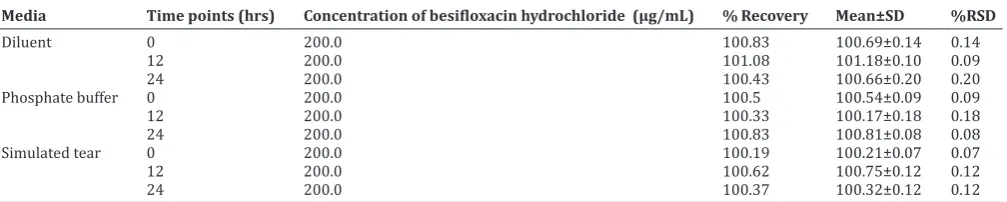
The stability results in Table 3 showed that besifloxacin hydrochloride is stable in diluent, phosphate buffer, and simulated tear for 24 hrs stored at 20-25°C temperature, room light condition.
The proposed UV-HPLC method developed and validated in this article is rapid, sensitive, and specific for the quantitative determination of besifloxacin hydrochloride in bulk and in finished dosage form.
The developed method is having short run time, and simple mobile phase can be used for routine analysis of many samples within a short period. The specificity, accuracy, linearity, precision, filter compatibility, forced degradation, and stability of the solution checked in the method and found within the acceptable range (ICH guideline). The method can be adapted as an accurate method to routine quantitative analysis of besifloxacin hydrochloride.
Fig. 5: Chromatogram of besifloxacin hydrochloride in simulated tear media
Table 1: Accuracy data of the developed method
Media Concentration of besifloxacin hydrochloride (µg/mL)
% Recovery Mean±SD % RSD
Diluent 140.0 101.21 100.46±0.86 0.85 200.0 99.95 100.00±0.07 0.07 260.0 99.94 100.19±0.21 0.21 Phosphate
buffer 140.0 101.17 101.21±0.48 0.48 200.0 99.95 99.77±0.19 0.19 260.0 100.58 100.46±0.27 0.27 Simulated
tear 140.0 99.57 100.54±1.07 1.03 200.0 99.03 100.71±1.47 1.46 260.0 99.81 100.58±0.67 0.66
The results are expressed as mean±SD is standard deviation for n=3 observations and RSD is Relative standard deviation.
Table 2: Precision data of the developed method
Media Concentration of besifloxacin hydrochloride (µg/mL)
% Recovery Mean±SD %RSD
Diluent 140.0 99.91 100.46±0.86 0.76 Phosphate
buffer 140.0 100.25 101.21±0.48 0.73 Simulated
tear 140.0 99.78 100.54±1.07 0.87
The results are expressed as mean±SD is standard deviation for n=3 observations and RSD is Relative standard deviation
Fig. 6: Linearity curves of besifloxacin hydrochloride in diluent, in phosphate buffer, in simulated tear media
CONCLUSION
These findings suggest that the new, rapid, accurate and stability indicating HPLC developed and validated method can be used for the simultaneous quantification of besifloxacin hydrochloride in the formulation as well as in bulk drug.
ACKNOWLEDGMENTS
REFERENCES
1. Besivance. Besifloxacin hydrochloride ophthalmic suspension, 0.6% prescribing information. Available from: http://www.bausch.com/ecp/ our-products/rx-pharmaceuticals/rx-pharmaceuticals/besivance-ecp. [Last accessed on 2016 Nov 11].
2. Besifloxacin hydrochloride. Available from: http://www.drugbank.ca/ drugs/DB06771.html. [Last accessed on 2016 Nov 11].
3. Arnold DR, Granvil CP, Ward KW, Proksch JW. Quantitative determination of besifloxacin hydrochloride, a novel fluoroquinolone antimicrobial agent, in human tears by liquid chromatography-tandem mass spectrometry. J Chromatogr B 2008;867:105-10.
4. Balzli CL, Caballero AR, Tang A, Weeks AC, O´Callaghan RJ. Penetration and effectiveness of prophylactic fluoroquinolones in experimental methicillin-sensitive or methicillin-resistant Staphylococcus aureus anterior chamber infections. J Cataract Refract Surg 2010;36:2160-7. 5. Donnenfeld ED, Comstock TL, Proksch JW. Human aqueous humor
concentrations of besifloxacin hydrochloride, moxifloxacin, and gatifloxacin after topical ocular application. J Cataract Refract Surg 2011;37:1082-9.
6. Kumar S, Kumar M, Majumdar DK, Sharma PK, Singh CL, Singh A. Development and validation of different ultraviolet-spectrophotometric methods for the estimation of besifloxacin hydrochloride in different simulated body fluids. Indian J Pharm Sci 2015;77(4):399-404. 7. Costa MC, Barden AT, Andrade JM, Oppe TP, Schapoval E. Quantitative
evaluation of besifloxacin hydrochloride ophthalmic suspension by
HPLC, application to bioassay method and cytotoxicity studies. Talanta 2014;119:367-74.
8. Torkildsen G, Proksch JW, Shapiro A, Lynch SK, Comstock TL. Concentrations of besifloxacin hydrochloride, gatifloxacin, and moxifloxacin in human conjunctiva after topical ocular administration. Clin Ophthalmol 2010;4:331-41.
9. Wang Z, Wang S, Zhu F, Chen Z, Zeng SL. Determination of enantiomeric impurity in besifloxacin hydrochloride by chiral high-performance liquid chromatography with precolumn derivatization. Chirality 2012;24:526-31.
10. ICH Harmonized Tripartite Guideline. Validation of Analytical Procedures: Text and Methodology Q2 (R1). Available from: http:// www.ich.org/home.html. [Last accessed on 2016 Nov 11].
11. Thompson M, Ellison SL, Wood R. Harmonised guidelines for single-laboratory validation of methods of analysis (IUPAC Technical report). Pure Appl Chem 2002;74(5):835-55.
12. Paulsson M, Hägerström H, Edsman K. Rheological studies of the gelation of deacetylated gellan gum (Gelrite) in physiological conditions. Eur J Pharm Sci 1999;9:99-105.
13. Ravichandran V, Shalini S, Sundram KM, Rajak H. Validation of analytical methods - strategies and importance. Int J Pharm Pharm Sci 2010;2 Suppl 3:18-22.
14. Supriyadi S, Siswandono S, Yuwono M. Method development and validation for the simultaneous determination of stevioside, rebaudioside a, rebaudioside c and dulcoside a contained in Stevia rebaudiana bertoni using HPLCELSD. Int J Pharm Pharm Sci 2016;8(9):1-5.
Table 3: Stability data of the developed method
Media Time points (hrs) Concentration of besifloxacin hydrochloride (µg/mL) % Recovery Mean±SD %RSD
Diluent 0 200.0 100.83 100.69±0.14 0.14
12 200.0 101.08 101.18±0.10 0.09
24 200.0 100.43 100.66±0.20 0.20
Phosphate buffer 0 200.0 100.5 100.54±0.09 0.09
12 200.0 100.33 100.17±0.18 0.18
24 200.0 100.83 100.81±0.08 0.08
Simulated tear 0 200.0 100.19 100.21±0.07 0.07
12 200.0 100.62 100.75±0.12 0.12
24 200.0 100.37 100.32±0.12 0.12