© 2015, IRJET.NET- All Rights Reserved
Page 425
A CASE STUDY ON VARIOUS DEFECTS FOUND IN A GEAR SYSTEM
V.S.Panwar
1, S.P.Mogal
21
PG Student, Design Engineering, N.D.M.V.P.’s K.B.T.COE, Nasik, Maharashtra, India
2Asst. Professor, Mechanical Department, N.D.M.V.P.’s K.B.T.COE, Nasik, Maharashtra, India
---***---Abstract
- Gears are amongst the frequentlyencountered components to be found in rotating machinery used in various applications. Even though inexpensive, its failure can disturb the complete production in a plant resulting in unscheduled techniques used to detect these failures.
Key Words:
Gear failure, misalignment, spalling,
pitting, time domain, frequency domain, fourier
transform, wavelet.
1. INTRODUCTION
The history of gears is probably as old as civilization itself. Even today, the importance of gears in the manufacturing industry is undiminished and continues to grow. Gears are wheel-like machine elements that have teeth uniformly spaced around the outer surface of the blank. They are always used in pairs and are a very valuable design tool. In any pair of gears, the smaller one is called pinion and the larger one is called gear immaterial of which is driving the other. Gears are mounted on rotatable shafts and the teeth are made to mesh (engage) with a gear on another shaft. Gears deliver force (torque) and motion (rpm) from one part of a machine to another.
This paper presents different types of defects found in different gears of various industries and the various detection techniques available to detect them. As we know from a simple car to giant cruises and aircrafts there is perhaps any machine which can operates without gears. There are many types of gears used today which are manufactured depending upon their functionality, system requirements and operating conditions. These consist spur gears, helical gears, bevel gear and worm gears. Many gear failures occur because of some design errors, manufacturing faults, maintenance problem, inspection method, inevitable repetitive stresses resulting in surface fatigue, wear and degrading of lubricant properties. The
failure of gearbox caused losses in terms of money(cost of gear), time(down time during replacement) and production losses. Gears can fail in many different ways but except for an increase in noise level and vibration, there is often no indication of difficulty level until total failure occurs.
Gearboxes are generally robust and reliable devices. However, problems do occur particularly due to application error. Application errors can be caused due to number of problems, like mounting and installation of gear system, vibration, cooling, lubrication, and maintenance also. Normally misalignment is probably the most common, single cause of failure. Due to misalignment, the meshing of pinion and gear is not proper during operation, and this lead to a high stress concentration at the surface of gears. The misalignment also leads to severe wear and excessive heat generation at the mating surface. In gears, it is exhibited as premature pitting at one end of the tooth. There are many causes of misalignment, both static (manufacturing or setting-up errors) as well as dynamic, due to elastic deflections of components under load, and also due to thermal expansion. Also failures of gears in gearbox can and do occur as a direct or indirect result of lubrication problems.
2. VARIOUS DEFECTS IN GEAR
© 2015, IRJET.NET- All Rights Reserved
Page 426
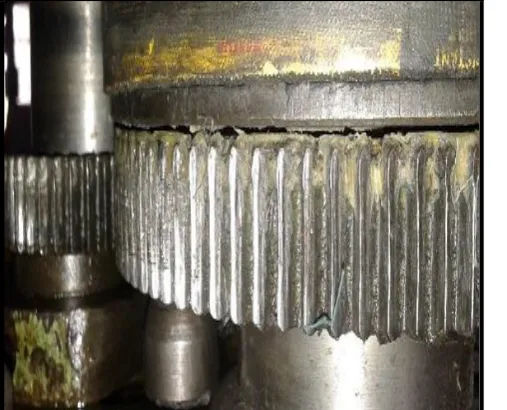
Fig -1: View of wear out gear pair
Fig -2: View of spur gear with wear
Whereas the gears shown in Fig. 3 and Fig. 4 are the rack & pinion components used in surface finishing machine. In this gear pair faults are generated due to misalignment in bearing of that machine. Due to this, rack has got highly worn out and the pinion is also worn as well as one tooth has got broken (tooth breakage).
Fig -3: View of rack with wear failure
Fig -4: View of pinion with tooth breakage
Generally, there are two types of surface contact fatigue, namely, pitting and spalling. The pitting of gear is characterised by occurrence of small pits on the contact surface [3]. Pitting arises from small, surface or subsurface very initial cracks, which advances under repeated contact loading. Pitting is a three-dimensional phenomenon and strongly depends on contact surface’s finish, material microstructure and operating conditions of the gears such as type of contact, type of loading, misalignment, lubrication issue, temperature, etc. Spalling, in general, is not considered an initial mode of failure but slightly a continuation or propagation of pitting and rolling contact fatigue. Despite pitting appears as shallow craters at contact surfaces, spalling appears as deeper cavities at contact surfaces.
© 2015, IRJET.NET- All Rights Reserved
Page 427
gear tooth exceeds the bending endurance strength of thegear tooth or we can say that when total load acting on the gear tooth exceeds the beam strength of the gear tooth. Gear shown below in Fig.5 is bevel gear used in milling machine. This gear have tooth breakage problem on one tooth as shown.
Fig -5: View of bevel gear with broken tooth
3. VARIOUS VIBRATION BASED ANALYSIS
TECHNIQUE
In general, each type of failure leaves characteristic clues on gear teeth, and detailed examination often yields enough information to establish the cause of failure. Due to the progress made in engineering and science of materials, rotating machines are becoming faster and lightweight. They’re also required to run at different loading and speed conditions. Detection, location and analysis of faults in such machines play a vital role in the quest for high reliable operations. Vibration analysis has been used as a predictive maintenance procedure and as a support for machinery maintenance decisions. As a general rule, machines don’t breakdown or fail without some form of warning, which is indicated by an increased vibration level. By measuring and analyzing the machine's vibration, it is possible to determine both the nature and severity of the defect, and hence predict the machine’s failure. most important components in gear vibration spectra are the gear meshing frequency (GMF) and its harmonics, together with side bands due to modulation phenomena. The increment in the number and amplitude of such side
bands may indicate a fault condition. Moreover, the spacing of the side bands is related to their source. Source identification and fault detection from vibration signals associated with items which involve rotational motion such as gears, rotors and shafts, rolling element bearings, journal bearings, flexible couplings, and electrical machines depend upon several factors as follows:
(i) The rotational speed of the items
(ii) The background noise and/or vibration level. (iii)The location of the monitoring transducer. (iv)The load sharing characteristics of the items, and (v) The dynamic interaction between the items and
other items in contact with it.
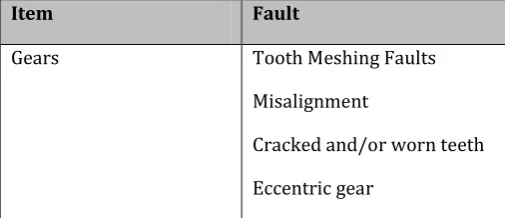
The main causes of mechanical vibration are unbalance, misalignment, looseness and distortion, defective bearings, gearing and coupling in accuracies, critical speeds, various form of resonance, bad drive belts, reciprocating forces, aerodynamic or hydrodynamic forces, oil whirl, friction whirl, rotor/stator misalignments, bent rotor shafts, defective rotor bars, and so on. Some of the most common faults that can be detected in gears using vibration analysis are summarized in Table 1.
Table 1: Some Typical Faults And Defects That Can Be Detected In Gears With Vibration Analysis
Item Fault
Gears Tooth Meshing Faults
Misalignment
Cracked and/or worn teeth
Eccentric gear
© 2015, IRJET.NET- All Rights Reserved
Page 428
successful technique in a number of cases. Timesynchronous average (TSA) is a signal averaging process over a large number of cycles, synchronous with the running speed of a specific shaft in the gearbox. Advanced gear tooth or bearing damage can often be identified readily by the direct inspection of the TSA trace. In addition, kurtosis of the phase modulation as well as its derivatives can also be used for gear and/or bearing fault diagnosis. Kurtosis of beta function is considered to emphasize transients generated by a tooth crack. They also proposed a statistical index to assess gear and bearing damage.
Spectral analysis is the classical gear/bearing diagnostic technique. By comparing the spectrum of a damaged gearbox with its reference spectrum in the healthy condition, some gear/bearing faults could be detected [8-9]. The frequency domain methods mainly apply numerical Fast Fourier Transform (FFT) to the vibration signals to obtain the frequency spectrum. Others use the difference of power spectral density of the signal due to the fault of gear and bearing to identify the damage of elements. Cepstrum is the inverse Fourier transform of the logarithmic power spectrum. It highlights periodicity in the spectrum; therefore, a periodic signature in the
The joint time-frequency analysis is becoming more and more an important approach to gear/bearing damage diagnosis [10-13]. It provides an interactive relationship between time and frequency during the period of the time data window, and detects the damage of elements. They include Short Time Fourier Transform (STFT), Wigner-Ville Distribution (WVD), and Wavelet Transform (WT), etc. The STFT is the classical time-frequency analysis technique, and some gear fault can be detected by inspecting the energy distribution of a signal over the time-frequency space. The WVD is obtained by signal self-correlation and Fourier Transform processes. It was used in signal processing in early 1990s, to identified the gear fault by using the WVD. That could easily show instantaneous information of vibration energy changes. It was recently developed to detect gear failures in a rotor transmission system. The WVD is used to demonstrate the severity of the gear fault in a transmission system. The WT uses narrow time windows at high frequencies and wide time windows at low frequencies; therefore it is suitable for the analysis of transient and non-stationary signals.
The above mentioned methods do not require a shut down of the rotating of gear rotor- bearing transmission machinery and can be used as an in-flight diagnostic and trend monitoring device. However, very little work has been accomplished on the detection of combined multi-gear tooth damage and bearing faults in a rotor transmission system.
4. CONCLUSION
From the above case study of various defects found in different types of gear, it is found that gear failure affects the functioning of any machine very critically and we need to take care about it. These failures can be avoided if they are detected at right time by using any of the above mentioned vibration analysis technique.
ACKNOWLEDGEMENT
I am pleased to say that this paper would not have been completed without the able guidance and complete support of Prof. S.P.Mogal, who helped me at each and every step in every possible way. He always provided me with access to the latest technology and facilities and encouragement at every point and took active participation in the achievement of my objective. I am grateful to all colleagues and my friends for giving me the helping hand.
REFERENCES
[1] V.B. Bhandari, “Design of Machine Elements (Third Edition : 2010)”, Mc Graw Hill. vibration-based techniques for helicopter transmission diagnostics”, Journal of Sound and Vibration 282 (2005) 475–508.
[5] Hongyu Yang, Joseph Mathew and Lin Ma, “Vibration Feature Extraction Techniques for Fault Diagnosis of Rotating Machinery -A Literature Survey”, Asia-Pacific Vibration Conference, 12-14 November 2003, Gold Coast, Australia.
[6] Saurabh Singh, Dr. Manish Vishwakarma, “A Review of Vibration Analysis Techniques for Rotating Machines”, IJERT, ISSN: 2278-0181 IJERTV4IS030823, Vol. 4 Issue 03, March-2015/757
© 2015, IRJET.NET- All Rights Reserved
Page 429
[8] Gary G. Yen, Wen Fung Leong, “Fault classification on vibration data with wavelet based feature selection scheme”, ISA Transactions® Volume 45, Number 2, April 2006, pages 141 -151
[9] A. Belsak, J. Flasker, “Method for detecting fatigue crack in gears”, Theoretical and Applied Fracture Mechanics 46 (2006) 105–113
[10] Andrew K.S. Jardine, Daming Lin, Dragan Banjevic, “A review on machinery diagnostics and prognostics implementing condition-based maintenance”, Mechanical Systems and Signal Processing 20 (2006) 1483–1510
[11] G. Dalpiaz, A. Rivola And R. Rubini, “Effectiveness And Sensitivity Of Vibration Processing Techniques For Local Fault Detection In Gears”, Mechanical Systems and Signal Processing (2000) 14(3), 387-412
[12] F. Klockea, C. Gorgelsa, A. Stuckenberga, “Investigations on Surface Defects in Gear Hobbing”, Procedia Engineering 19 (2011) 196 – 202
[13] Leila.Nacib, Komi Midzodzi.Pekpe and Saadi Sakhara, “Detecting Gear Tooth Cracks Using Cepstral Analysis In Gearbox Of Helicopters”, International Journal of Advances in Engineering & Technology, Jan. 2013. ISSN: 2231-1963
BIOGRAPHIES
V. S. Panwar received B.E. degree in Mechanical Engineering from Savitribai Phule Pune University, in 2011 and pursuing M.E. degree in Design Engineering from Savitribai Phule Pune University
Prof. S. P. Mogal received B.E. degree in Mechanical Engineering and M.Tech in Machine Design & Analysis. Pursuing PhD from S.V.N.I.T., Surat. He has experience of 10 years.