R E S E A R C H
Open Access
Collaborative neighbor discovery in
directional wireless sensor networks:
algorithm and analysis
Fernaz Narin Nur
1†, Selina Sharmin
1†, Md. Ahsan Habib
1†, Md. Abdur Razzaque
1* †,
Md. Shariful Islam
2, Ahmad Almogren
3, Mohammad Mehedi Hassan
3and Atif Alamri
3Abstract
In directional wireless sensor networks (DSNs), sensor nodes with directional antennas provide extended network lifetime and better coverage performance. However, one of the key challenges of directional nodes is to discover their neighbors due to difficulty in achieving synchronization among their directed transmissions and receptions. Existing solutions suffer from high discovery latency and poor percentage of neighbor discovery either due to lack of proper coordination or centralized management of the discovery operation. In this work, we develop a collaborative neighbor discovery (COND) mechanism for DSNs. Each COND node polls to directly discover its neighbors in a distributed way and collaborates with the already discovered nodes so as to allow indirect discovery. It helps to increase the neighbor discovery performance significantly. A Markov chain-based analytical model is developed to quantify theoretical performances of the proposed COND system. The performance of the COND system is evaluated in Network Simulator Version 3, and simulation results reveal that it greatly reduces the discovery latency and increases neighbor discovery ratio compared to state-of-the-art approaches.
Keywords: Directional sensor networks, Directional antenna, Synchronization, Indirect neighbor discovery, Discovery latency, Discovery ratio, Performance analysis
1 Introduction
In directional wireless sensor networks (DSNs), sensor devices with directional antennas sense data and deliver them in a multihop fashion toward the sink node. Nowa-days, DSNs are being used for the implementation of many real-time applications including infrastructure monitor-ing, health-care monitormonitor-ing, robotic exploration, battle-field surveillance, target tracking, and disaster response [1, 2]. The directional sensors have been proved to provide better energy efficiency, sensing quality, bandwidth uti-lization, etc. [3, 4]. However, the directional transmissions
*Correspondence: [email protected]
Special thanks to the Information and Communication Technology Department of the Ministry of Posts, Telecommunications and Information Technology, Peoples Republic of Bangladesh, for the student research fellowship.
†Equal contributors
1Green Networking Research (GNR) Group, Department of Computer Science and Engineering, University of Dhaka, Dhaka 1000, Bangladesh
Full list of author information is available at the end of the article
and receptions of the sensor nodes have made the devel-opment of data communication and networking protocols for DSNs more challenging.
Neighbor discovery is defined as the problem of iden-tifying all nodes within the communication range of a sensor device. The problem of neighbor discovery in directional sensor network not only is more challeng-ing than that in its omnidirectional counterpart but also requires complete redesign and implementation. The key fact behind this requirement is that the directional nodes have limited width of communication sectors, and thus, two nearby nodes must steer their communication sec-tors to each other for a successful communication [5–7]. Efficient strategies need to be employed so that a pair of neighbor nodes eventually beamform their antennas to each other at a certain time instance and can discover themselves. The primary challenge lies in increasing the number of nodes discovered in bounded delay through better coordination in a distributed way, when the nodes are not clock-synchronized.
In the literature, the problem of neighbor discovery with omnidirectional antenna has well been explored [1, 8]. Nevertheless, recently, a few neighbor discovery mecha-nisms are developed that are based on directional com-munications. A neighbor discovery algorithm based on contention-based and contention-free approaches have been developed in [8], where only the sink node uses directional antenna, whereas the other nodes use omni-directional one, resulting in asymmetry-in-gain problem [9, 10]. A scan-based asynchronous neighbor discovery algorithm (SBAN) is proposed in [11], where the neighbor discovery is based on fully directional transmissions and receptions. The probabilistic HELLO message broadcast-ing with fast reply mechanism reduces collisions among the sensors. A randomized two-way neighbor discovery algorithm has been developed in [12]. The authors have presented an asymptotic analysis of one-way and two-way directional neighbor discovery algorithms and have designed a two-way neighbor discovery mechanism with selective feedback that reduces the neighbor discovery time. However, both the works [11, 12] lack in guaran-teeing responder the reception of reply packets which increases the discovery latency for a dense network. A fully directional and centralized sectored antenna neigh-bor discovery (SAND) algorithm is developed in [13], where a token is passed among the nearby nodes to successfully learn each other. However, for token manage-ment, a central node is required that is not feasible for many applications of DSNs, especially in achieving scala-bility. Moreover, the rotational latency of a token affects the neighbor discovery accuracy and it increases the over-all neighbor discovery latency. None of these works have well-thought-out the directional coordination between two nodes.
In this paper, a collaborative neighbor discovery (COND) algorithm is proposed, where the directional sensors discover their neighboring nodes collaboratively by sharing the discovered neighborhood information with the surrounding nodes. The key idea behind the COND mechanism is that each directional node performs neigh-bor discovery in each sector using a contention-based polling mechanism. The goal of neighbor discovery mech-anism is to increase the number of discovered nodes with minimum delay using a two-way collaborative polling mechanism. The preliminary concept of this work has been published in [14]. In this paper, we augment the detail operation method of indirect neighbor discovery through collaboration. We carry out theoretical analy-sis using Markov chain model that quantifies expected number of discovered neighbors and the corresponding delay incurred. We also present performance analysis and results for average discovery latency per node, sensing wastage, and energy cost per neighbor discovery. The results show that the proposed COND mechanism greatly
outperforms the state-of-the-art systems—randomized two-way [12] and SAND [13].
The main contributions of this work are summarized as follows:
• A fully distributed novel neighbor discovery mechanism, collaborative neighbor discovery (COND) algorithm is developed for sensor nodes in DSNs.
• A two-way polling-based collaborative mechanism is designed to decrease the possibility of conflict and to speed up the handshaking process. In this
mechanism, each node learns about its neighbors collaboratively by direct and indirect neighbor discovery through sharing information of already discovered nodes to and from its neighbors.
• We develop a Markov chain model to analyze theoretically the expected number of neighbors discovered and the number of iterations required for discovery.
• Finally, the results of performance evaluations, carried out in Network Simulator Version 3 (NS-3) [15], show that our proposed COND mechanism outperforms SAND and randomized two-way mechanisms in terms of neighbor discovery latency and ratio, energy consumption, etc.
The rest of the paper is organized as follows. We give a detailed description of related state-of-the-art works in Section 2. In Section 3, we describe the network model and assumptions. The proposed algorithm for the neigh-bor discovery using directional antenna is discussed in detail in Section 4, and the theoretical analysis and per-formance studies for the given algorithm are discussed in Sections 5 and 6, respectively. Finally, we conclude the paper in Section 7.
2 Related work
Directional sensor networks (DSNs) are gaining much popularity in the recent years, due to their improved per-formance gains through directional antennas [7, 16–21]. Even though the problem of neighbor discovery was well investigated in the literature for omnidirectional and wire-less ad hoc networks, that for directional sensor networks kept less focused. However, in recent years, we find a few of neighbor discovery algorithms that are based on direc-tional antennas. The existing works can broadly be cate-gorized in two types: one-way broadcasting mechanisms [22–27] and two- or three-way handshaking mechanisms [11, 13, 14, 28–30].
neighbor discovery algorithm, namely I-SBA is proposed in [27], where nodes transmit, receive, and remain idle with certain probabilities. The mechanism decreases number of collisions among the neighboring nodes when the probabilities are selected properly. Nevertheless, with the growing number of nodes in the network, the pos-sibility of directional synchronizations among the nodes is gradually decreased. In [23], authors develop a direc-tional neighbor discovery mechanism where the number of slots for neighbor discovery is dependent on the order of the average number of nodes in the network. The base station sends a beacon signal toward all the nodes in the network to start the discovery process, and all the nodes are time-synchronized with each other. Their neighbor discovery mechanisms exploit hybrid usage of omnidirec-tional and direcomnidirec-tional antennas; hence, with the increasing number of nodes in the network, the mechanism ini-tiates extra overhead for the node synchronization. A directional neighbor discovery protocol was developed in [25], which is based on one-way broadcast mechanism. A HELLO message is broadcasted by each node, and after hearing the message, the neighboring nodes learn about information of that node.
In none of the above one-way broadcast-based neighbor discovery mechanisms, the sender nodes know whether the neighboring nodes receive their message successfully or not. Thus, the one-way neighbor discovery algorithms might be suitable for omnidirectional networks but not for directional sensor networks, because the later requires synchronization between the transmitting and receiv-ing nodes to make the communication a successful one. Therefore, two- or three-way handshaking protocols are more desirable for DSNs.
In two-way handshaking-based neighbor discovery mechanisms, a receiver node, after reception of a mes-sage, sends back a REPLY message toward the sender node, facilitating both nodes to discover each other in one event of communications. In directional transmission, a receiver node can only hear the message if it faces its antenna toward the sender and thus a feedback message is very important for neighbor discovery among the nodes. Hence, at least two-way handshaking is required for effective directional neighbor discovery as the nodes can agree on a future period for communication after the discovery. A fully directional scan-based asynchronous neighbor discovery algorithm is proposed in [11], where each node senses the medium and transmits HELLO message in a random direction and gathers location of the neighbor nodes, reducing the number of collisions among reply packets.
The urgent requirement of synchronization in between a transmitter and a receiver is kept unexplored in the above works. Moreover, nodes wait at each sector for a fixed period of time for neighbor discovery, which is
highly inefficient. In [29], a directional neighbor discov-ery mechanism has been developed, where only the sink node of the network uses directional antenna, whereas the other sensors use omnidirectional antennas. The sink node applies contention-based and cotention-free methods to medium access and sequentially scans all its sectors to discover its neighbors. To minimize the medium access delay, the authors presented an opti-mization method for selecting the beam width and the persistence probability of neighbor discovery. This mech-anism results asymmetry-in-gain problem [9] due to the difference between the antenna gain patterns of the sink node and other sensors. A randomized two-way neighbor discovery mechanism is proposed in [12], where the authors have presented an asymptotic analysis of one-way and two-way directional neighbor discovery algorithms. Their two-way neighbor discovery mechanism exploits selective feedback policy so as to reduce collisions among the reply packets and thus to decrease neighbor discovery time. However, the reception of a reply packet is not certain in the above works due to lack of synchronization between the sender and receiver nodes.
A fully directional and centralized three-way sectored antenna neighbor discovery (SAND) algorithm is pro-posed in [13], where a token is passed among network nodes sequentially to discover their surrounding neigh-bors. However, for token management, it requires a cen-tral node, which is not only often infeasible for many DSN applications but also limited by scalability. Further-more, the rotational latency of a token affects the neighbor discovery accuracy and increases the overall neighbor discovery latency. The SAND mechanism also has not considered the directional synchronization issue among the nodes, causing deafness problem, and as a central controller controls the whole mechanism, the discovery latency sharply increases.
Our work is different from the above studies in that we develop a fully distributed neighbor discovery mech-anism, where both the transmissions and receptions are directional and nodes collaborate with their (already discovered) neighbors to find other neighbors, reduc-ing neighbor discovery latency significantly. This indi-rect neighbor discovery and selective feedback policies jointly help our algorithm to decrease the collisions in the network. In addition to that, a COND node employs dynamic waiting time at different directions while discov-ering nodes in the neighbor that greatly helps to mitigate the deafness problem.
3 Network model and assumption
We assume a directional sensor network of an area A
ρ= |S|
A . (1)
Each node is designed withMsectored switched-beam directional antennas, as shown in Fig. 1. To cover the whole azimuth, fixed number of fixed beam width antenna elements is attached in each antenna of a sensor. Each node can activate one sector at a particular time. Nodes can switch from one sector to another by activating differ-ent antenna elemdiffer-ents, and each elemdiffer-ent has high antenna gain to a particular sector. Basically, they direct a major or almost their entire signal in just one direction instead of dispersing all around a 360◦circle. Typically, the switch-ing delay from one sector to another is 5×10⁻⁶μs for a traditional switched beam directional antenna [13, 31].
Each node has one transceiver and can form one directional beam in a sector at a given time. For the network nodes, all transmissions and receptions are direc-tional and they do not require any addidirec-tional omnidirec-tional antenna. Note that the usage of both direcomnidirec-tional and omnidirectional antennas causes additional hardware cost, complexity, and two other major problems. First, the transmission ranges of the omnidirectional antenna and directional antenna are different, which introduces asymmetry gain problem in communication links. Again, the spatial reuse benefits are greatly reduced since omni-directional communication inhibits more simultaneous transmissions.
The communication radius (r) of all nodes in the net-work is homogeneous. Nodes in the netnet-work are not clock-synchronized with each other. Each node inde-pendently discovers its neighbors. The success event of a transmission is probabilistic; however, our dynamic polling period and selected response REPLY to HELLO messages decrease the probability of collision and increase
Fig. 1Antenna model for each node
the number of successful transmission events. If the discovery message is exchanged between two nodes for at least half of a slot, two nodes can discover at the same time slot [7]. Subsequently, in a distributed system, without any clock synchronization, two sensor nodes can discover each other within a bounded delay.
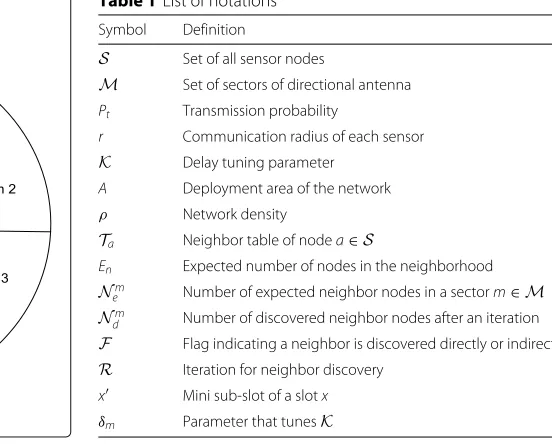
Initially, a node learns its position using a localiza-tion method [32]. We assume that the time is divided into contiguous slots and all nodes independently dis-cover their neighbors within a bounded time. The total time frame is logically separated into transmit and receive time slots. Each slot is further divided into multiple mini-slots. A node either transmitsHELLO message or listen to the medium for any message from its neighbor(s) in an individual slot. While communicating with each other, a node can identify the angular position of its neighbor by capturing its spatial signature vector [29]. After the deployment of the sensor nodes in the network, nodes discover their neighbors using COND mechanism, and during the neighbor discovery period, all the nodes will be active to discover most of the neighbors within short period of time. Later, the sensors collect sense data and start data transmission toward the sink node. An under-lying medium access control protocol (e.g., S-MAC [33], T-MAC [34], B-MAC [35], DMAC [36], SAMAC [18]) can determine and control the energy-saving states of a sensor node, which is beyond the scope of this work. The notations used in this paper are summarized in Table 1.
4 Collaborative neighbor discovery mechanism In this section, we present detail operation method of the proposed two-way collaborative neighbor discovery algorithm, COND, for DSNs. Each COND node tries
Table 1List of notations
Symbol Definition
S Set of all sensor nodes
M Set of sectors of directional antenna
Pt Transmission probability
r Communication radius of each sensor K Delay tuning parameter
A Deployment area of the network
ρ Network density
Ta Neighbor table of nodea∈S
En Expected number of nodes in the neighborhood
Nm
e Number of expected neighbor nodes in a sectorm∈M
Nm
d Number of discovered neighbor nodes after an iteration
F Flag indicating a neighbor is discovered directly or indirectly R Iteration for neighbor discovery
x Mini sub-slot of a slotx
to explore maximum number of neighboring nodes in different sectors. A COND node stays in each of its sec-tors for a particular time duration and performs direct and indirect neighbor discovery processes using polling mechanism. Unlike [11, 13, 30], we allow COND nodes to dynamically vary the time duration operating in a sector based on percentage of its neighbors already dis-covered. Furthermore, unlike in our previous work [14], we allow COND nodes to explicitly track the neighbors discovered indirectly and take actions differently, facili-tating to increase the neighbor discovery performance. In summary, the COND mechanism is condensed into the following three steps:
• Initialization of neighbor discovery with appropriate value of a delay tuning parameter (K)
• Discovery of neighbor nodes in different sectors using contention-based polling mechanism
• Maintaining and updating the neighbor tables of COND nodes in collaborative fashion
What follows next, we present the detail operations of the COND steps.
4.1 Initialization
Each node in the network first calculates the approximate number of neighbors around them after the deployment of the nodes in the network. The expected number of neighbors of each node can be calculated as
En=ρ×π×r2, (2)
where r is the communication radius of a sensor node andρis the node deployment density. Then, the expected number of neighbors in a particular sectorm ∈ Mof a node is given by
Nm e =
En
|M|. (3)
Initially, each sensor nodes∈Sstarts to explore neigh-bors in all of its sectorsm∈Mby switching its direction clockwise after a certain interval ofT seconds.T is the time interval for staying in a particular sector of each node. As we are assuming that each node switches its sector one by one for neighbor discovery, it is necessary to stay in a particular sector for a certain period so that two nodes can steer their antennas to each other in that period. Hence,T depends on the number of sectors of a node and the delay incurred for switching a direction, and it is determined as follows:
T =Tswitch×(|M| −1)×K, (4)
whereTswitch is the switching delay andMis the set of sectors. Furthermore, when a good number of nodes are discovered in a particular sector of a node, it must stay less period of time over there so as to reduce the discovery
overhead. On the other hand, when a node has discovered very less number of neighbors in a sector, it must stay longer period in that particular sector in order to reduce the discovery latency. Thus, for determining the value of time periodT, we introduce a delay tuning parameterK that is updated after each iteration depending on the num-ber of discovered neighbor nodes in a particular sector as follows:
K=δm×K, (5) where the value ofδm is chosen in such a way that the discovery latency in each sectorm ∈ Mis minimized. If a node discovers most of its neighbors in a given sec-torm ∈ M, then it is wise for the node to stay for less period of time there and vice-versa; otherwise, discovery overhead will unnecessarily be increased. Thus, the value ofδm helps us to dynamically control the staying period of a sensor node in a certain sectorm∈ Mfor neighbor discovery. LetNdmrepresents the percentage of nodes that are already discovered in sectorm∈M, then the value of
δmis determined as follows:
δm=
Note that the numerical values in Eq. (6) are not strict choices; rather, the values are depicted through numerous simulation experiments for a given network environment (stated in Section 6), and they are tunable by the net-work administrator. In the case the number of already discovered nodes in a certain sector crosses the expected number of neighbors, the node may stop staying in that sector. Hence, it may happen that a node misses a good number of neighbors to discover if the calculation of expected number of neighbors is incorrect (due to distor-tions in deployment). Therefore, we allow a COND node to continue the discovery process until it fails repeatedly (say, up to two iterations) to find a new neighbor in a particular sector.
4.2 Contention-based polling mechanism
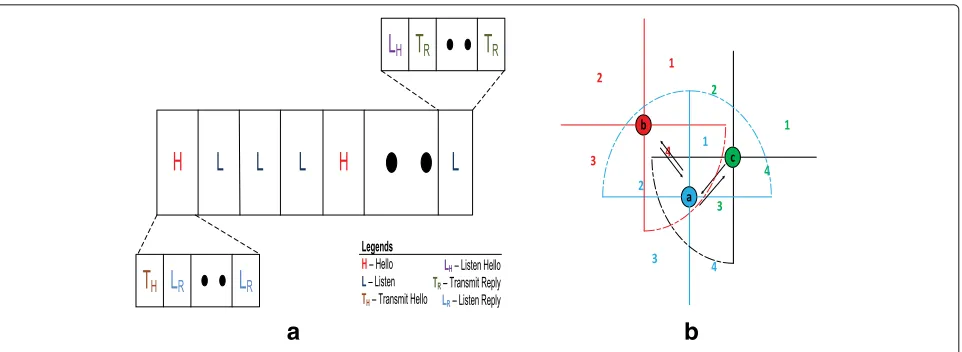
The COND nodes contend among them to poll their neighbors in different sectors so as to discover those. The frame structure followed by the polling mechanism con-tains ‘H’ (Hello) and ‘L’ (Listen) slots, as shown in Fig. 2a. In H slots, a node broadcasts HELLO messages in random time slots with persistent probability Pt. In the remain-ing slots, the node listens to the medium for any HELLO message from the neighboring nodes.
a
b
Fig. 2Frame structure and neighbor discovery in COND system.aFrame structure.bNeighbor discoverymessage in a slot, it does so in the first mini-slot and lis-tens to the channel for any REPLY message(s) from its neighboring node(s). The HELLO message contains the node’s ID, (x,y) coordinate, sector number, and neighbor table, i.e.,H = {ID, coord(x,y), m, T}. On reception of HELLO message, the surrounding nodes update their neighbor tables and relay back their information in a ran-domly chosen mini-slot. Thus, the nodes develop their neighbor tables for each sector with so far discovered nodes. The structure of the neighbor table is represented by the tuple,< ID, coord(x,y),m,F >, where the fourth field is a flag that contains 1 if the designated neighbor is discovered through direct exchange of messages and 0 if it is discovered indirectly. The details ofdirectandindirect
discovery processes are discussed in the following section.
4.3 Collaborative discovery of neighbor nodes
The key challenge in reducing neighbor discovery latency in DSNs is the synchronization of HELLO-REPLY trans-missions among the nodes in a neighborhood. Therefore, in addition to discover neighbors through direct exchange of messages, we allow COND nodes to share their neigh-bor tables with each other and to update their tables col-laboratively so as to further decrease the discovery latency. Thus, some neighbor nodes are discovered indirectly (via other nodes).
4.3.1 Direct discovery
When two nodes are beamformed to each other and suc-cessfully exchange HELLO and REPLY messages, they can directly discover each other. After the HELLO-REPLY handshaking, two nodes update their neighbor tables accordingly. Thus, it is highly dependent on the syn-chronization of corresponding sectors of two neighbors. In Fig. 2b, when the node a discovers a neighbor node
b through direct handshaking, the flag entry for b in
a’s neighbor table is set to 1. Unlike existing works in the literature that depend only on direct discovery,
we allow indirect discovery of neighbor nodes through collaboration among them.
4.3.2 Indirect discovery
In omnidirectional communication, only direct discovery is sufficient for neighbor discovery. For directional nodes, it is the most important that two nodes are beamforming their antennas to each other; otherwise, the handshaking between the nodes would never occur. So, it may hap-pen that when a node is broadcasting HELLO message in a particular sector, some of the neighbor nodes cannot receive the message because of the deafness problem [9]. Hence, the strict requirement of directional synchroniza-tion among nodes upsurges the discovery latency among the sensor nodes.
Consider a scenario in Fig. 2b, where pairsaandband
aandchave already discovered themselves in the present or previous time frame, but nodebhas not yet been dis-covered by c or vice-versa, as their antenna directions did not match during the direct neighbor discovery pro-cess. In order to ease the problem and to accelerate the discovery process, we allow COND nodes to share their neighbor tables with already discovered nodes. That is, nodeashares its table withbandcso that they can dis-cover each other as a neighbor of the respective sectors by checking their coordinates. We term this update of neigh-bor table asindirect discovery, and the flag entry for such discovered node is set to 0.
that node assuming that it has exchanged messages in the earlier slots with that node; otherwise, it updates the infor-mation in the neighbor table and sends a REPLY message in a random sub-slot to the direction of the sender node (lines 15–22). If the sender node receives a REPLY mes-sage (without any collision) from any neighbor, it adds the node in the neighbor table (lines 8–12). In this way, two nodes discover each other using two-way handshak-ing. In the case, a node cannot discover any new node
Algorithm 1Collaborative neighbor discovery (COND) at each nodea∈S
INPUT:ρ,En,M,δm
OUTPUT: Neighbor TableTfornodea
1: foreach sectorm∈Mdo 2: setRm←1
3: CalculateNm,TandKusing Eqs. 3 -6 4: foreach time slotx∈T do
5: ifxis a HELLO slotthen
6: abroadcastsHmessage in the first mini-slot 7: if areceivesRfrom any nodebthen
13: alistensthe medium
14: ifareceives aH from any neighborbthen 15: if(b∈/Ta)OR(b∈TaANDF=0)then 16: add b in neighbor table Ta andset flag
F←1 sectormduring current iteration
25: if
in a certain sector in consecutive two iterations, we stop COND process in that sector (lines 25–27).
The time complexity of Algorithm 1 for one iteration is quite straightforward to follow. The lines 1–31, enclosed in a loop, iterate|M|times having a complexity ofO(|M|) in the worst case. Again, the statements 4–23 iterate |T| times in a nested loop. The rest of the statements have constant unit time complexities. Therefore, the over-all time complexity of the proposed COND algorithm is
O(|M| × |T|).
5 Theoretical analysis of COND
At each iteration, a COND node performs neighbor dis-covery around its all sectors, and on completion of one iteration, the node gets an updated neighbor table with the newly discovered neighbors. In this section, we for-mulate a theoretical model for analyzing the neighbor discovery delay, average number of discovered nodes per iteration, and corresponding energy consumption of the COND system.
5.1 Discrete time Markov chain model
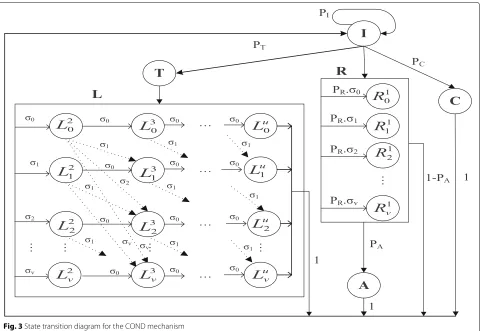
We have developed a discrete time Markov chain model for analyzing the performance of the proposed algorithm. In this model, a node can stay in one of the following six states:idle(I),Transmitting HELLO message(T), Lis-tening REPLY message(L),Receiving HELLO message(R),
Transmitting REPLY message(A), orCollided(C). Here,Lis the set of REPLY message listening states, i.e.,
L = L20, L21,. . ., L2
v. . .Lu0, Lu1,. . .,Luv and eachLuv ∈ L denotes that thevnumber of neighbor nodes is discovered in reply mini-slotu. Similarly,Ris the set of states after receiving a HELLO message, i.e.,R = R10, R11,. . ., R1v , where each state R1v represents that the v number of neighbors is discovered during the first mini-slot. The value of u is from 2 to the number of mini-slots (x) available in a slot and the maximum value of v can beNem, the expected number of neighbors in a certain sectorm.
Figure 3 shows the state transition diagram of the COND mechanism. Given that a node transmits HELLO message with probabilityPt, we can calculate theidlestate (i.e., listening for any HELLO message) probability for a node as follows:
PI=1−Pt, (7)
Fig. 3State transition diagram for the COND mechanism
etc. The joint probability that the two nodesaandbwill beamform to each other is thus calculated as follows:
P((b,m),(a,m))=P((a,m)×P((b,m)|(a,m))= 1 m2, (8) where the event(a,m) represents that the nodeabeam forms its antenna in sector m. Hence, in a given slot, a nodeachanges its state fromItoTwith probability,
PT =P((b,m),(a,m))×Pta×(1−Pbt)×(1−Pt)N
b,m e −1, (9)
where the last part(1−Pt)N
b,m
e −1denotes the probability
that no other nodes except ain the sector area of node
b is transmitting any HELLO message at that time slot. Similarly, the receiving nodebchanges its state fromIto
Rwith probability,
PR=P((a,m),(b,m))×Pta×(1−Pbt)×(1−Pt)N
b,m
e −1. (10)
Therefore, the probability of occurring a collision event is given by
PC =1−(PI+PT+PR). (11)
Note that, on successful reception of HELLO or REPLY messages, a node discovers neighbor(s)directlyor
indirectly in one of theLor Rstates. The probability of discoveringvnumber of nodes in a mini-slot is
σv=σd×σv−i 1+σvi, (12)
whereσd =μ×P
Ris the probability that the sender node is directly discovered;μis a binary variable representing whether the sender node is already discovered (μ = 0) or not (μ = 1). The receiver node indirectly discovers a neighbor with probability,σi=η×PR, where binary vari-ableη = 1 if there remains a node in the sender’s table that is not yet discovered and is located in the sector area of the receiver node. Thus, the probability that thek num-ber of neighbors are indirectly discovered in a mini-slot is given by
σi v=
Nm e
v
×σiv×1−σiNem−v. (13)
Now, the probability that no neighbor is discovered in a mini-slot is given by
σ0=1−
σd+σi. (14)
a REPLY message to the sender aif any of the follow-ing three conditions is met: (i) the information ofais not present inb’s neighbor table, (ii) the nodeais discovered indirectly, and (iii) the nodebfinds thatTb\Ta =φ. Let
PAdenotes the probability of occurring any of the above events. Thus, the receiver nodebtransmits a REPLY mes-sage with probabilityPA; otherwise, it returns to idle state. The probability distribution vector,S, at a given time slot
xat equilibrium is expressed as
S=SI ST Suv S1v SA SC
x
. (15)
We can find the distribution vector at equilibrium by solving the equationsPS=SandS=1.
The solution of the above two equations is given below,
s= 1
The performance of the proposed COND mechanism greatly depends on the number of discovered neighbors in a time frame. From the Markov chain analysis we find the total number of neighbors discovered per slot. Thus, the expected number of discovered neighbors by a particular node is
Now, the neighbor discovery rateζof a particular node is
ζ = Ev
T. (18)
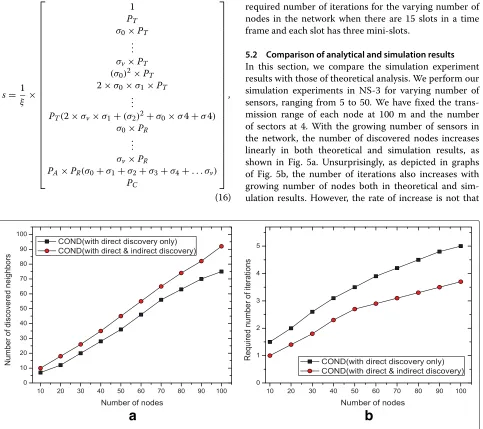
Figure 4a, b shows the number discovered nodes and required number of iterations for the varying number of nodes in the network when there are 15 slots in a time frame and each slot has three mini-slots.
5.2 Comparison of analytical and simulation results
In this section, we compare the simulation experiment results with those of theoretical analysis. We perform our simulation experiments in NS-3 for varying number of sensors, ranging from 5 to 50. We have fixed the trans-mission range of each node at 100 m and the number of sectors at 4. With the growing number of sensors in the network, the number of discovered nodes increases linearly in both theoretical and simulation results, as shown in Fig. 5a. Unsurprisingly, as depicted in graphs of Fig. 5b, the number of iterations also increases with growing number of nodes both in theoretical and sim-ulation results. However, the rate of increase is not that
b
a
b
a
Fig. 5Comparison of results from theoretical analysis and simulation experiments.aNeighbor discovery.bRequired iterations
much higher because of the incorporation of indirect dis-covery in COND. Finally, the graphs of Fig. 5a, b show that the analytical results are quite closer to simulation outcomes in estimating the number of discovered neigh-bors and the required number of iterations for neighbor discovery.
6 Performance evaluation
We have implemented our proposed COND system in NS-3 [15], a discrete-event network simulator to verify the effectiveness of proposed algorithm. We have done a comparative study of COND performances with those of two state-of-the-art algorithms—randomized two-way neighbor discovery mechanism [12] and SAND [13].
6.1 Simulation environment
We use wifiSimpleAdhocGrid model for sensor nodes and YansWifiPhy model to define the channel properties such as propagation and loss characteristics. Each node has the information about network density, and it calculates the expected number of neighbor nodes in each sector based on that information. The COND mechanism stops when no neighbor is discovered in two subsequent rounds. The simulation configuration parameters are shown in Table 2. We run the simulation experiments 30 times with differ-ent random seed values and take the average of the results for each graph data points.
6.2 Performance metrics
• Average discovery latency per node: A round of node discovery is completed when a node finishes the operation in all sectors (either clockwise or
anti-clockwise). Average discovery latency per node is the ratio of total discovery time to the number of discovered nodes.
• Sensing wastage is the count of wastage of time slots for neighbor discovery. A sensing time slot is regarded as wastage if no neighbor is discovered in it.
• Average discovery ratio is the ratio of the number of neighbor nodes successfully discovered to the total number of nodes in the network.
• Control byte overhead is the ratio of total number of control bytes (HELLO and REPLY messages) exchanged during the simulation period to the total number of neighbors discovered.
• Average energy cost per node discovery is the measure of average amount of energy consumed during the simulation period for discovering a single node in the network.
6.3 Simulation results
The comparative performance results are plotted for vary-ing number of sensors deployed in the network, number of sectors a node has, and the size of the sensing time frame.
Table 2Simulation parameters
Parameters Value
Area deployment 500 m×500 m
Type of deployment Uniform random
Number of nodes deployed 100∼1000
Number of sectors 2∼6
Transmission range 100 m
Slot duration 1 ms
Packet size 40 bytes
Initial energy 3 J
Data transmission rate 1 Mbps
Bandwidth 5 MHz
Routing protocol AODV
Channel model Yans WiFi model
Propagation model Friis propagation loss model
6.3.1 Impacts of varying number of nodes
We have varied the number of nodes from 100 to 1000 and compared the performances of the proposed COND mechanism with those of other systems. The number of sectors for each node is fixed at 4, and we call a round of sensing is completed when a node is switched to all of its sectors for neighbor discovery. Each time frame contains 25 slots and each slot has 4 mini-slots.
The graph of Fig. 6a shows that the discovery latency increases with the growing number of nodes in all the studied systems. However, the rate of increase in our proposed COND mechanism is significantly lower than those in other two systems. This is achieved because of incorporating indirect discovery in COND and reduction of transmission collisions through randomized and con-trolled accesses of medium by its nodes. The graphs also depict that the latency is increased linearly in SAND with growing number of nodes as a central node manages the neighbor discovery.
As we have fixed the number of slots in each time frame, the sensing wastage is very high for a low dense network in all the studied approaches, causing poor utilization of
time slots. The wastage of slots reduces with the growing number of nodes up to approximately 600 nodes in COND due to collision and conflicts of nodes in competing envi-ronment of node discovery. The COND has the minimum wastage of slots because of allowing indirect node discov-ery, whereas many slots are wasted in the other algorithms especially for the lack of sector synchronization, as shown in Fig. 6b.
The graphs in Fig. 6c depict the discovery ratio of the neighboring nodes during the simulation period. The dis-covery ratio is 100% for all the proposed algorithms when the network density is low. The discovery ratio decreases with the growing number of nodes. Our in-depth look into the simulation trace files depicts that the last 10% of nodes take the longer time to discover. The COND mechanism performs better than the other two mechanisms with higher network density as the indirect discovery of COND mechanism increases the neighbor discovery ratio. In the two-way randomized protocol and SAND, the overheads are higher than that of COND because of additional con-trol packet exchanges among nodes at random times due to collision and loss of token, as depicted in Fig. 6d. The SAND has higher overhead among all the algorithms as
a
c
b
d
it uses tokens to control and manage transmissions in the network.
6.3.2 Impacts of varying number of sectors
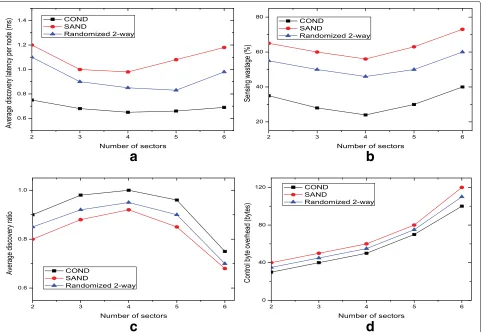
In this experiment, we allow each node to have two to six sectors. Here, the number of sensor nodes is fixed at 500 and the frame size at 25 time slots. The graphs of Fig. 7a depict that the discovery latencies of the evalu-ated algorithms decrease with growing number of sectors from two to four. This result is achieved due to increased spatial reusability with higher number of sectors. How-ever, our COND mechanism achieves minimum latency, and it becomes stable gradually. On the contrary, in other mechanisms, the latency increases again with beamform-ing angle less than 90◦. The reason is that, in this situation, nodes need longer period to discover their neighbors as synchronization of antenna beams is quite challenging for narrow beam widths. For the same reason, the wastage of time slots is also minimum in COND compared to the other mechanisms, as shown in Fig. 7b.
Directional antenna reduces the chance of collision among the neighboring nodes. The Fig. 7c shows that the
neighbor discovery ratio gradually increases with increas-ing sectors in all the mechanisms, which is as expected theoretically. Nevertheless, excessive reduction of sens-ing angle reduces the chance of direction synchronization among nodes, and thus, it decreases the neighbor discov-ery ratio. Yet again, higher number of sectors causes the nodes to switch from one sector to another frequently, resulting in transmission of more HELLO/REPLY mes-sages. Hence, the control byte overhead is increased with the growing number of sectors, as shown in Fig. 7d. Our COND mechanism outperforms the state-of-the-art mechanisms as it needs less control byte overheads.
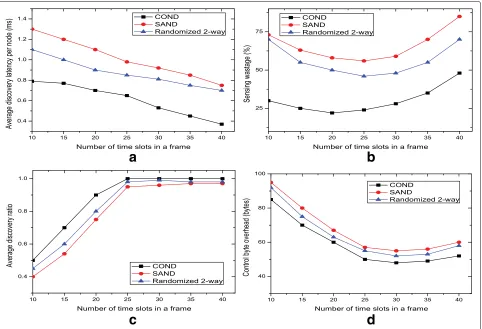
6.3.3 Impacts of varying number of time slots
The number of time slots per round are varied from 10 to 40 for the simulation. Here, we assume fixed number of 500 sensor nodes and each node has 4 sensing sectors.
The graphs of Fig. 8a show that the average latency for all the mechanisms decrease progressively with the growing number of time slots as each node gets longer time to discover its neighbors in each sector. The COND utilizes the time slots more efficiently and has the
a
c
b
d
a
c
b
d
Fig. 8Impacts of number of time slots in a frame on performances of the studied neighbor discovery algorithms.aAverage discovery latency.b Sensing wastage of discovery slots.cAverage discovery ration.dControl byte overhead
minimum latency by the way of indirect neighbor discov-ery. But unfortunately, with the growing number of slots, the sensing wastage increases as shown in Fig. 8b. As the number of nodes are fixed at 500 and there are many time slots for neighbor discovery, the wastage increases. For the same reason, the neighbor discovery ratio increases
with the growing number of time slots. However, when the number of slots are greater than 25, it becomes stable as large number of time slots are not required for neighbor discovery in a low dense network. The COND has max-imum discovery ratio compared to the other systems, as shown in Fig. 8c. The control byte overhead also decreases
b
a
with the growing number of slots as the discovery ratio increases, as shown in Fig. 8d. It increases slightly when the number of time slots crosses 30 since the possibility of using unnecessary slots is increased.
6.3.4 Average energy cost for neighbor discovery
In the last set of simulation experiments, we measure the energy consumption for varying number of nodes and sectors. The graphs of Fig. 9 show that the average energy cost per neighbor discovery increases with the growing number of nodes and sectors in all the studied systems. As the neighbor discovery rate decreases with the grow-ing number of nodes, the energy cost increases. However, the energy cost in our proposed COND mechanism is sig-nificantly lower than those in the other two systems. This result is achieved because of efficient neighbor discovery approach used in the proposed COND.
7 Conclusions
In this paper, we investigated distributed solutions to the problem of neighbor discovery in DSNs and intro-duced indirect neighbor discovery through collaboration among the already discovered nodes. We also introduced dynamic polling period in each sector following the num-ber of already discovered nodes in it. The joint employ-ment of the above strategies helped the proposed COND system to achieve excellent performances in neighbor discovery. Our in-depth look into the simulation trace files depicts that the collaboration-based indirect neigh-bor discovery helped to reduce the discovery latency significantly while the utilization of time slots in each frame was greatly enhanced due to the use of dynamic polling periods. The results from simulation experiments, carried out in NS-3, showed the achievements of as high as 80 and 75% performance gains in neighbor discov-ery latency and discovdiscov-ery ratio, respectively, compared to SAND, a leading work in the literature.
In the future, we shall concentrate on developing a the-oretical model for analyzing delay tuning parameter and study the effects of node mobility on performances of the proposed neighbor discovery mechanism.
Acknowledgements
This work was financially supported by the King Saud University through Vice Deanship of Research Chairs.
Competing interests
The authors declare that they have no competing interests.
Publisher’s Note
Springer Nature remains neutral with regard to jurisdictional claims in published maps and institutional affiliations.
Author details
1Green Networking Research (GNR) Group, Department of Computer Science and Engineering, University of Dhaka, Dhaka 1000, Bangladesh.2Institute of
Information Technology, University of Dhaka, Dhaka 1000, Bangladesh.3Chair of Pervasive and Mobile Computing, College of Computer and Information Sciences, King Saud University, Riyadh 11543, Saudi Arabia.
Received: 19 November 2016 Accepted: 12 June 2017
References
1. W Sun, Z Yang, X Zhang, Y Liu, Energy-efficient neighbor discovery in mobile ad hoc and wireless sensor networks: a survey. Commun. Surv. Tutorials IEEE.16(3), 1448–1459 (2014)
2. T Voigt, L Mottola, K Hewage, inEuropean Conference on Wireless Sensor Networks, Lecture Notes in Computer Science, vol 7772. Understanding link dynamics in wireless sensor networks with dynamically steerable directional antennas (Springer, Berlin, 2013), pp. 115–130
3. F Babich, M Comisso, Throughput and delay analysis of 802.11-based wireless networks using smart and directional antennas. Commun. IEEE Trans.57(5), 1413–1423 (2009)
4. FN Nur, S Sharmin, MA Razzaque, MS Islam, MM Hassan, A low duty cycle MAC protocol for directional wireless sensor networks. Wirel. Pers. Commun., 1–25 (2016). doi:10.1007/s11277-016-3728-4
5. S Sharmin, FN Nur, MA Razzaque, MM Rahman, inNetworking Systems and Security (NSysS), 2015 International Conference On. Network lifetime aware area coverage for clustered directional sensor networks, (Dhaka, 2015), pp. 1–9. doi:10.1109/NSysS.2015.7042949
6. M Islam, M Ahasanuzzaman, M Razzaque, MM Hassan, A Alamri,et al, in
Wireless and Mobile, 2014 IEEE Asia Pacific Conference On. A distributed clustering algorithm for target coverage in directional sensor networks (IEEE, Bali, 2014), pp. 42–47
7. L Chen, Y Li, AV Vasilakos, inIEEE INFOCOM 2016 - The 35th Annual IEEE International Conference on Computer Communications. Oblivious neighbor discovery for wireless devices with directional antennas, (San Francisco, 2016), pp. 1–9. doi:10.1109/INFOCOM.2016.7524570 8. MJ McGlynn, SA Borbash, inProceedings of the 2nd ACM International
Symposium on Mobile Ad Hoc Networking & Computing, (MobiHoc ’01). Birthday protocols for low energy deployment and flexible neighbor discovery in ad hoc wireless networks (ACM, New York, 2001), pp. 137–145 9. FN Nur, S Sharmin, MA Razzaque, MS Islam, inNetworking Systems and
Security (NSysS), 2015 International Conference On. A duty cycle directional MAC protocol for wireless sensor networks, (Dhaka, 2015), pp. 1–9. doi:10.1109/NSysS.2015.7042950
10. G Jakllari, I Broustis, T Korakis, SV Krishnamurthy, L Tassiulas, inPersonal, Indoor and Mobile Radio Communications, 2005. PIMRC 2005. IEEE 16th International Symposium on. Handling asymmetry in gain in directional antenna equipped ad hoc networks, vol. 2, (Berlin, 2005), pp. 1284–12882 11. Y Wang, B Liu, L Gui, inWireless Communications & Signal Processing
(WCSP), 2013 International Conference On. Adaptive scan-based asynchronous neighbor discovery in wireless networks using directional antennas (IEEE, Hangzhou, 2013), pp. 1–6
12. H Cai, T Wolf, inComputer Communications (INFOCOM), 2015 IEEE Conference On. On 2-way neighbor discovery in wireless networks with directional antennas (IEEE, Kowloon, 2015), pp. 702–710
13. R Murawski, E Felemban, E Ekici, S Park, S Yoo, K Lee, J Park, ZH Mir, Neighbor discovery in wireless networks with sectored antennas. Ad Hoc Netw.10(1), 1–18 (2012)
14. FN Nur, S Sharmin, MA Habib, MA Razzaque, MS Islam, in2016 IEEE Region 10 Conference (TENCON). Collaborative neighbor discovery in directional wireless sensor networks, (Singapore, 2016), pp. 1097–1100.
doi:10.1109/TENCON.2016.7848178
15. H Wu, S Nabar, R Poovendran, inProceedings of the 4th International ICST Conference on Simulation Tools and Techniques. An energy framework for the network simulator 3 (ns-3) (ICST, 2011), pp. 222–230. Network simulator version 3 (ns-3). https://www.nsnam.org/. Accessed 17 Mar 2017
16. B Liu, B Rong, R Hu, Y Qian, Neighbor discovery algorithms in directional antenna based synchronous and asynchronous wireless ad hoc networks. Wireless Commun. IEEE.20(6), 106–112 (2013)
18. E Felemban, S Vural, R Murawski, E Ekici, K Lee, Y Moon, S Park, SAMAC: A cross-layer communication protocol for sensor networks with sectored antennas. Mobile Comput. IEEE Trans.9(8), 1072–1088 (2010)
19. Q Wang, H-N Dai, Z Zheng, M Imran, AV Vasilakos, On connectivity of wireless sensor networks with directional antennas. Sensors.17(1), 134 (2017)
20. S Sharmin, FN Nur, MA Razzaque, MM Rahman, in2016 IEEE Region 10 Conference (TENCON). Network lifetime aware coverage quality maximization for heterogeneous targets in dsns, (Singapore, 2016), pp. 3030–3033. doi:10.1109/TENCON.2016.7848603
21. MA Habib, S Saha, FN Nur, MA Razzaque, in2016 IEEE Region 10 Conference (TENCON). Starfish routing for wireless sensor networks with a mobile sink, (Singapore, 2016), pp. 1093–1096. doi:10.1109/TENCON.2016.7848177 22. L Wei, B Zhou, X Ma, D Chen, J Zhang, J Peng, Q Luo, L Sun, D Li, L Chen,
Lightning: a high-efficient neighbor discovery protocol for low duty cycle WSNs. IEEE Commun. Lett.20(5), 966–969 (2016)
23. AS Tehrani, AF Molisch, G Caire, inGlobal Communications Conference (GLOBECOM). Directional zigzag: neighbor discovery with directional antennas (IEEE, San Diego, 2015), pp. 1–6
24. G Jakllari, W Luo, SV Krishnamurthy, An integrated neighbor discovery and mac protocol for ad hoc networks using directional antennas. Wireless Commun. IEEE Trans.6(3), 1114–1024 (2007)
25. J Du, E Kranakis, OM Ponce, S Rajsbaum, Neighbor discovery in a sensor network with directional antennae. Adhoc Sensor Wireless Netw.30(3/4), 261–286 (2016)
26. P Papadimitratos, M Poturalski, P Schaller, P Lafourcade, D Basin, S Capkun, J-P Hubaux, Secure neighborhood discovery: a fundamental element for mobile ad hoc networking. Commun. Mag. IEEE.46(2008). doi: 10.1109/MCOM.2008.4473095
27. H Cai, B Liu, L Gui, M-Y Wu, inCommunications (ICC), 2012 IEEE International Conference On. Neighbor discovery algorithms in wireless networks using directional antennas (IEEE, Ottawa, 2012), pp. 767–772 28. W Zhang, L Peng, R Xu, L Zhang, J Zhu, in2016 25th Wireless and Optical
Communication Conference (WOCC). Neighbor discovery in
three-dimensional mobile ad hoc networks with directional antennas, (2016), pp. 1–5. doi:10.1109/WOCC.2016.7506603
29. I Koutsopoulos, L Tassiulas, Fast neighbor positioning and medium access in wireless networks with directional antennas. Ad Hoc Netw.11(2), 614–624 (2013)
30. S Vasudevan, J Kurose, D Towsley, inINFOCOM 2005. 24th Annual Joint Conference of the IEEE Computer and Communications Societies. Proceedings IEEE. On neighbor discovery in wireless networks with directional antennas, vol. 4 (IEEE, 2005), pp. 2502–2512
31. Z Zhang, MF Iskander, Z Yun, A Host-Madsen, Hybrid smart antenna system using directional elements-performance analysis in flat rayleigh fading. IEEE Trans. Antennas Propag.51(10), 2926–2935 (2003) 32. B Zhang, F Yu, Z Zhang, in2009 11th IEEE International Conference on High
Performance Computing and Communications. A high energy efficient localization algorithm for wireless sensor networks using directional antenna, (Seoul, 2009), pp. 230–236
33. W Ye, J Heidemann, D Estrin, inProceedings. Twenty-First Annual Joint Conference of the IEEE Computer and Communications Societies. An energy-efficient mac protocol for wireless sensor networks, vol. 3, (New York, 2002), pp. 1567–15763. doi:10.1109/INFCOM.2002.1019408 34. T van Dam, K Langendoen, inProceedings of the 1st International
Conference on Embedded Networked Sensor Systems.SenSys ’03. An adaptive energy-efficient mac protocol for wireless sensor networks (ACM, New York, 2003), pp. 171–180. doi:10.1145/958491.958512 35. J Polastre, J Hill, D Culler, inProceedings of the 2Nd International Conference
on Embedded Networked Sensor Systems.SenSys ’04. Versatile low power media access for wireless sensor networks (ACM, New York, 2004), pp. 95–107. doi:10.1145/1031495.1031508