R E S E A R C H
Open Access
Mean-square heterogeneous
synchronization of interdependent networks
with stochastic disturbances
Tianjiao Guo
1,2, Lilan Tu
1,2*and Jiabo Chen
1,2*Correspondence: [email protected]
1Hubei Province Key Laboratory of
Systems Science in Metallurgical Process, Wuhan University of Science and Technology, Wuhan, China
2College of Science, Wuhan
University of Science and Technology, Wuhan, China
Abstract
In this paper, the mean-square asymptotical heterogeneous synchronization of interdependent networks with stochastic disturbances, which is a zero-mean real Wiener process, is investigated. The network discussed consists of two sub-networks, which are one-by-one inter-coupled. The unknown but bounded nonlinear coupling functions not only exist in the intra-coupling but also in the inter-coupling between two sub-networks. Based on the stochastic Lyapunov stability theory, adaptive control, Itô formula and the linear matrix inequality, several sufficient conditions are proposed to guarantee adaptive mean-square heterogeneous asymptotical synchronization of the interdependent networks. In order to better illustrate the feasibility and effectiveness of the synchronization conditions derived in this brief, numerical simulations are provided finally.
Keywords: Interdependent networks; Stochastic disturbances; Mean-square heterogeneous asymptotical synchronization; Itô formula
1 Introduction
Interdependent networks are a special form of complex networks which are coupled by two or more sub-networks. With the progress of science and technology, there are more and more dependencies in different infrastructures or systems. Most of the modern so-ciety infrastructures or systems are interdependent networks, such as electric-calculator networks [1], traffic-transportation networks [2], and so on. A typical example for interde-pendent networks is the Italian electrical destruction on Sept. 28th, 2003. The shutdown of power stations directly led to the failure of nodes in the computer networks, which in turn caused deeper breakdown of power stations [1,3]. Buldyrev et al. firstly proposed the interdependent networks in 2010, which opened the new chapter of complex networks [4]. They reveal that the failure of a node in one sub-network may cause the failure of in-terdependent nodes in other sub-networks. The investigation and growing understanding of the interdependent networks will enable us to make the infrastructures we use in every-day life more efficient and more robust. From then on, the investigation of interdependent networks became an issue of focus in the network science [5].
Recently, there have been some results for interdependent networks [6–12]. In Ref. [6], Zhang et al. extended the system’s robustness under different attack strategies. In Ref.
[7], Ji et al. improved the robustness of interdependent networks by adding connectivity. In Ref. [8], Xu et al. studied the generalized mutual synchronization between two con-trolled interdependent networks. In Ref. [9], the authors explored the local adaptive het-erogeneous synchronization for interdependent networks with delayed coupling consist-ing of two sub-networks. In Ref. [10], the author proposed new methods for improving the robustness of interdependent networks. In Ref. [12], the author studied the coevolution of strategy and network interdependence. When investigating interdependent networks, stochastic disturbances are inevitable and should be considered. They exist everywhere [13–15]. Interdependent networks usually are affected by stochastic disturbances. For ex-ample, information transmission is a noisy process, which may affect the accuracy of mes-sages. However, until now, there has been little research on interdependent networks with stochastic perturbations.
Synchronization is an interesting and meaningful issue in the research of complex net-works. The investigation of synchronization for dynamical systems was initiated in the early 1980s for deterministic chaos. At present, many scholars have explored the synchro-nization of complex networks [16–18]. Due to the disturbances of networks, there have been many works in the field of synchronization for complex networks with stochastic dis-turbances [19–25]. In Ref. [19], the finite-time stochastic synchronization of time-delay neural networks with noise was investigated. In Ref. [23], the author studied the finite-/fixed-time pinning synchronization of complex networks with stochastic disturbances. In Ref. [24], the synchronization between each node in the drive layer and its counter-part in the response layer of this sort of duplex networks with delayed nodes and noise perturbation is explored. Though there is increasing research relating to the synchroniza-tion of interdependent networks [8,9,26], few people have explored the synchronization problem of interdependent networks with stochastic disturbances.
Motivated by the above-mentioned issues, in this paper, we discuss the synchroniza-tion of interdependent networks with stochastic disturbances. The whole of the networks consists of two sub-networks with “one-by-one” interdependence. Based on the stochastic Lyapunov stability theory, adaptive control, the Itô formula and the linear matrix inequal-ity, some control schemes related to mean-square heterogeneous synchronization are ob-tained in this paper. In the end, some simulations verify the feasibility and effectiveness of our conclusions.
2 Preliminaries
Considering interdependent networks which have two sub-networksG1andG2, each sub-network consisting ofNidentical dynamical nodes with nonlinear couplings and stochas-tic disturbances. It can be characterized by
dxki(t)=
fkxki(t)+dk N
j=1
AkijHkxkj(t)+ 2
l=1
cklHkxli(t)
dt
+Bkt,xki(t) –sk(t)dW(t),
i= 1, . . . ,N,k= 1, 2,l= 1, 2, (1)
intra-coupling strength of thekth sub-network,cklis the inter-coupling strength between the kth sub-network and thelth sub-network, it satisfying
c11=c22= –c and c12=c21=c. (2)
Ak= (Ak
ij)N×N is the intra-coupling configuration matrix of thekth sub-network. If there
exists a connection from theith node to thejth node in thekth sub-network, thenAkij=
Ak
bounded function, andW(t) is a zero-mean real Wiener process satisfying
EdW(t)= 0, EdW(t)TdW(t)=dt.
Adding suitable controllersuk
i(t) to the interdependent networks (1), we get
Definition 1(Mean-square heterogeneous asymptotical synchronization) The interde-pendent networks (1) are said to achieve mean-square heterogeneous asymptotical syn-chronization if
Equation (6) can be rewritten as
˙
In order to better illustrate the results of this paper, the following assumptions and lem-mas are introduced.
Assumption 1 Suppose that there exists a constant matrixLrwith appropriate dimen-sions such that
Assumption 3 Suppose that there exists a constant matrixLrwith suitable dimensions
such that error system can be described as
⎧
Remark2 The mean-square heterogeneous asymptotical synchronization for interdepen-dent networks (1) also can be obtained if
lim
Therefore, in the following, we mainly discuss the mean-square heterogeneous asymp-totical stability at the origin for the system (8).
Remark3 LetIrepresent the identity matrix with the appropriate dimensions.
Lemma 1([27]) For any matrices X,Y∈Rn×n,the following matrix inequality holds:
XTY+YTX≤XTAX+YTA–1Y,
Lemma 2(Schur complement [28]) Assume Q(x) =Q(x)T,R(x) =R(x)Tand S(x)all the
functions of x,the following linear matrix inequality:
Q(x) S(x)
S(x)T R(x)
< 0,
is equivalent to any of the following conditions:
(1) R(x) < 0,Q(x) –S(x)R(x)–1S(x)T< 0,
(2) Q(x) < 0,R(x) –S(x)TQ(x)–1S(x) < 0.
3 Main results
In this section, according to stochastic Lyapunov stability theory, adaptive control method and the Itô formula, combined with the linear matrix inequality, with suitable adaptive controllers, adaptive mean-square heterogeneous asymptotical synchronization of the in-terdependent networks (1) is investigated.
Theorem 1 Suppose that Assumptions1–3hold,and there exist two positive matrices P
and Q,such that
Λ=
⎡ ⎢ ⎢ ⎢ ⎣
˜
T1
i Φ Θ1 0
ΦT T˜i2 0 Θ2 Θ1T 0 Ψ1 0
0 Θ2T 0 Ψ2
⎤ ⎥ ⎥ ⎥
⎦< 0, (10)
where
˜
Ti1=λ1LT0L0+P+d1
N
j=1
A1jiI+λ1LT2L2–cHˆTP–cPHˆ – 2dP,
˜
Ti2=λ2LT1L1+Q+d2
N
j=1
A2jiI+λ2LT3L3–cH˜TQ–cQH˜ – 2dQ,
Φ=cPHˆ +cH˜TQ, Θ1=PHˆ, Θ2=QH˜,
Ψ1= –1
d1N
j=1|A1ij|
I, Ψ2= –1
d2N
j=1|A2ij| I,
in which L0,L1,L2and L3are constant matrices with suitable dimensions,λ1andλ2are
the maximum eigenvalues of the matrix P and Q,respectively,then the interdependent net-works(1)can obtain adaptive mean-square heterogeneous asymptotical synchronization under the control law
⎧ ⎨ ⎩
u1
i(t) =cH1(s1(t)) –cH1(s2(t)) –di1e1i(t),
and the adaptive law
Proof According to control law (11) and adaptive law (12), we can rewrite the error system (8) in the following form:
Construct the following Lyapunov function:
+
With Assumption1and Lemma1, we have
N
Furthermore, using Assumption2and Lemma1, we have
Using the same method, we have
With Assumption3, we have
N
Therefore, according to the discussion mentioned above, equality (15) is
According to stochastic Lyapunov stability theory, we can guarantee the mean-square heterogeneous asymptotical synchronization of interdependent networks (1) under the adaptive control law (11) if
Ti1 Φ ΦT T2
i
< 0. (17)
At the same time, it should be noted that the inequality (17) is not the standard linear matrix inequality, it can be written equivalently as inequality (10) with Lemma2.
Thus, the proof is completed.
The discussions above tell us that if there exist two positive matricesPandQ satisfy-ing LMI (10), then the interdependent networks (1) with stochastic disturbances reach mean-square heterogeneous asymptotical synchronization. When there are no stochastic disturbances, with similar methods to the proof of Theorem1, Corollary1leads to the interdependent networks (1) to adaptive heterogeneous synchronization.
Corollary 1 Suppose Assumptions1–3hold.If there exist two positive matrices P and Q,
such that
Λ=
⎡ ⎢ ⎢ ⎢ ⎣
˜
Ti1 Φ Θ1 0
ΦT T˜2
i 0 Θ2
Θ1T 0 Ψ1 0 0 Θ2T 0 Ψ2
⎤ ⎥ ⎥ ⎥
⎦< 0, (18)
where
˜
Ti1=λ1LT0L0+P+d1
N
j=1
A1jiI–cHˆTP–cPHˆ – 2dP,
˜
Ti2=λ2LT1L1+Q+d2
N
j=1
A2jiI–cH˜TQ–cQH˜ – 2dQ,
Φ=cPHˆ +cH˜TQ, Θ1=PHˆ, Θ2=QH˜,
Ψ1= –1
d1N j=1|A1ij|
I, Ψ2= –1
d2N j=1|A2ij|
I,
then the interdependent networks(1)without stochastic disturbances reach adaptive het-erogeneous synchronization under the control law(11)and the adaptive law(12).
4 Simulations
system as the dynamical system of the nodes in the sub-networkG1and the sub-network
G2, separately. The Rössler system can be described by [29]
⎧ chaotic. At the same time, the Lü system can be described by [29]
⎧ Let the coupling functions be as follows:
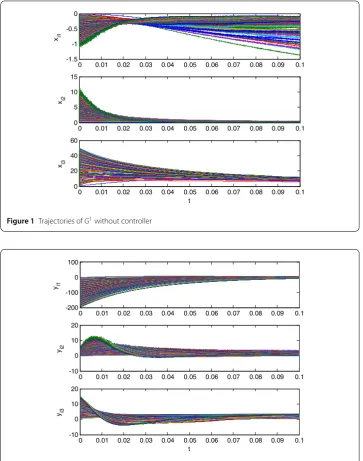
Hxi(t) Figures1and2display the trajectories of sub-networkG1and sub-networkG2without controllers. The trajectories of sub-networkG1and sub-networkG2nodes are chaotic or uncontrollable with time. According to LMI (10), using LMI Control Toolbox, there exist the following positive matricesPandQsatisfying the condition (10):
P=
Figure 1Trajectories ofG1without controller
Figure 2Trajectories ofG2without controller
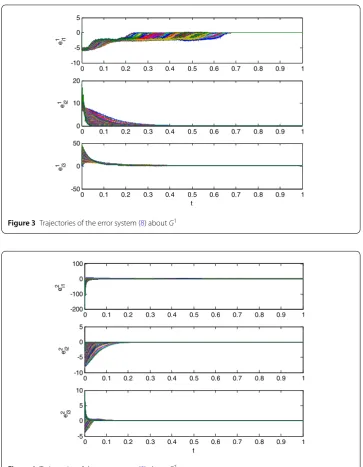
its mean-square heterogeneous asymptotical synchronization. It is worth noting that the adaptive law also reaches the stable values while the error systems are asymptotically stable at the origin (see Figs.5and6). They show the feasibility and effectiveness of the condi-tions provided in this paper.
5 Conclusions
net-Figure 3Trajectories of the error system (8) aboutG1
Figure 4Trajectories of the error system (8) aboutG2
Figure 5Trajectories of the adaptive law (12) aboutG1
Figure 6Trajectories of the adaptive law (12) aboutG2
Acknowledgements
The authors would like to thank the editors and the anonymous reviewers for their useful comments and suggestions.
Funding
This work is supported by the National Natural Science Foundation of China under Grant 61473338.
Competing interests
The authors declare that they have no competing interests.
Authors’ contributions
All authors contributed equally and significantly in this manuscript, and they read and approved the final manuscript.
Publisher’s Note
Springer Nature remains neutral with regard to jurisdictional claims in published maps and institutional affiliations.
References
1. Stasiuk, A.I., Hryshchuk, R.V., Goncharova, L.L.: A mathematical cybersecurity model of a computer network for the control of power supply of traction substations. Cybern. Syst.53(3), 476–484 (2017)
2. Cardillo, A., Zanin, M., Gomez-Gardenes, J., Romance, M., del Amo, A.J.G., Boccaletti, S.: Modeling the multi-layer nature of the European air transport network: resilience and passengers re-scheduling under random failures. Eur. Phys. J. Spec. Top.215(1), 23–33 (2013)
3. Rosato, V., Issacharoff, L., Tiriticco, F., Meloni, S., Porcellinis, S.D., Setola, R.: Modelling interdependent infrastructures using interacting dynamical models. Int. J. Crit. Infrastructures4(1), 63–79 (2008)
4. Buldyrev, S.V., Parshani, R., Paul, G., Stanley, H.E., Havlin, S.: Catastrophic cascade of failures in interdependent networks. Nature464(7291), 1025–1028 (2010)
5. Gao, J.X., Buldyrev, S.V., Stanley, H.E., Havlin, S.: Networks formed from interdependent networks. Nat. Phys.8(1), 40–48 (2011)
6. Zhang, P., Cheng, B.S., Zhao, Z., Li, D.Q., Lu, G.Q., Wang, Y.P., Xiao, J.H.: The robustness of interdependent transportation networks under targeted attack. EPL103, 68005 (2013)
7. Ji, X.P., Wang, B., Liu, D.C., Chen, G., Tang, F., Wei, D.Q., Tu, L.: Improving interdependent networks robustness by adding connectivity links. Physica A444, 9–19 (2016)
8. Xu, Q., Zhuang, S.X., Hu, D., Zeng, Y.F., Xiao, J.: Generalized mutual synchronization between two controlled interdependent networks. Abstr. Appl. Anal.2014, 453149 (2014)
9. Wang, Y.J., Tu, L.L., Li, K.Y., Song, S.: Local adaptive heterogeneous synchronization for interdependent networks with delayed coupling. Acta Phys. Sin.67(5), 050504 (2018)
10. Shen, A., Guo, J.L., Wang, Z.J.: Research on methods for improving robustness of cascading failures of interdependent networks. Wirel. Pers. Commun.95(3), 2111–2126 (2017)
11. Wang, Z., Szolnoki, A., Perc, M.: Interdependent network reciprocity in evolutionary games. Sci. Rep.3, 1183 (2013) 12. Wang, Z., Szolnoki, A., Perc, M.: Self-organization towards optimally interdependent networks by means of
coevolution. New J. Phys.16, 033041 (2014)
13. Wang, Z.Q., Xu, Y., Yang, H.: Levy noise induced stochastic resonance in an FHN model. Sci. China, Technol. Sci.59(3), 371–375 (2016)
14. Wang, Y., Lai, Y.C., Zheng, Z.G.: Route to noise-induced synchronization in an ensemble of uncoupled chaotic systems. Phys. Rev. E81(3), 036201 (2010)
15. Nagai, K.H., Hiroshi, K.: Noise-induced synchronization of a large population of globally coupled nonidentical oscillators. Phys. Rev. E81(6), 065202 (2010)
16. Liu, Y.J., Guo, B.Z., Park, J.H., Lee, S.M.: Nonfragile exponential synchronization of delayed complex dynamical networks with memory sampled-data control. IEEE Trans. Neural Netw. Learn. Syst.29(1), 118–128 (2018)
17. Yu, R., Zhang, H.G., Wang, Z.L., Liu, Y.: Synchronization criterion of complex networks with time-delay under mixed topologies. Neurocomputing295, 8–16 (2018)
18. Yang, X.S., Lam, J., Ho, D.W.C., Feng, Z.G.: Fixed-time synchronization of complex networks with impulsive effects via non-chattering control. IEEE Trans. Autom. Control62(11), 5511–5521 (2017)
19. Shi, X.R., Wang, Z.L., Han, L.X.: Finite-time stochastic synchronization of time-delay neural networks with noise disturbance. Nonlinear Dyn.88(4), 2747–2755 (2017)
20. Yang, X.S., Cao, J.D.: Finite-time stochastic synchronization of complex networks. Appl. Math. Model.34(11), 3631–3641 (2010)
21. Xu, Y.H., Zhou, W.N., Fang, J.A., Sun, W., Pan, L.: Adaptive synchronization of stochastic time-varying delay dynamical networks with complex-variable systems. Nonlinear Dyn.81(4), 1717–1726 (2015)
22. Li, L.L., Jian, J.G.: Finite-time synchronization of chaotic complex networks with stochastic disturbance. Entropy17(1), 39–51 (2015)
23. Liu, X., Ho, D.W.C., Song, Q., Gao, J.: Finite/fixed-time pinning synchronization of complex networks with stochastic disturbances. IEEE Trans. Cybern.492398–2403 (2018)
24. Wei, X., Wu, X.Q., Lu, J.A., Zhao, J.C.: Counterpart synchronization of duplex networks with delayed nodes and noise perturbation. J. Stat. Mech. Theory Exp.2015, 11021 (2015)
25. Zhao, X.Y., Zhou, J., Lu, J.A.: Pinning synchronization of multiplex delayed networks with stochastic perturbations. IEEE Trans. Cybern.2018, 2861822 (2018)
26. Um, J., Minnhagen, P., Kim, B.J.: Synchronization in interdependent networks. Chaos21(2), 025106 (2011) 27. Tu, L.L., Liu, H.F., Yu, L.: Local adaptive H infinity consistency of delayed complex networks with noise. Acta Phys. Sin.
62(14), 140506 (2013)
28. Boyd, S., Ghaoui, L.E., Feron, E., Balakrishnan, V.: Linear matrix inequalities in system and control theory, pp. 7–12. Society for Industrial and Applied Mathematics (1994)
29. Lu, J.A., Liu, H., Chen, J.: Synchronization in complex dynamical networks, pp. 31–35. Higher Education Press, Beijing (2016)