UP001
Influence of pH on the Cytotoxic Activity of Inositol Hexakisphosphate (IP6) on a Hormone Refractory Prostate Cancer Cell Line
Betton B1, Koumakpayi IH1, Gannon P1, Diallo J1, Mes-Masson A1,2,
Saad F1,3
1Institut du Cancer de Montréal, CRCHUM, Notre-Dame Hospital, Montréal,
QC; 2Department of Medicine, Université de Montréal, Montréal, QC; 3Department of Surgery and Urology, Université de Montréal, Fondation
René Malo, Fondation Sybilla Hess, Montréal, QC
Introduction and Objective: Inositol hexakisphosphate (IP6) is a
natu-rally occurring phytochemical abundant in soy, cereals and legumes. We have shown that IP6 may be a promising anti-cancer agent in prostate cancer (PCa). Definite mechanisms remain to be established as IP6 poten-tially acts by targeting several signaling pathways, as well as to cause cell cycle arrest and to induce cell death. When the IP6 salt is reconstituted in water, the solution has a pH of 12, which is not apt for consumption. The pH must thus be adjusted to 7 prior to use. Our objective was to eval-uate to biological activities of IP6 at various pH levels.
Methods: The hormone-refractory PC3 cell line was stimulated for up to
72 hours with IP6 at pH 5, pH 7 and pH 12. Several parameters, such as metabolic activity (WST1), cell cycle progression (FACS), cell prolifera-tion (cell counting) were measured to evaluate IP6 effects. The phospho-rylation status of several proteins documented to be activated following IP6 stimulation was evaluated by Western Blot. All experiments were compared to water at pH 5, 7 and 12, which had no effect on the vari-ous biological activities monitored.
Results: At the three pH studied, IP6 induced a significant reduction in
the metabolic activity and cellular proliferation of PC3 cells. Following a 24 hr stimulation with 5 mM of IP6, the IP6 at pH 12 reduced the meta-bolic rate by 89,3 % and IP6 at pH 5 by 78,9%, compared to only 39,6% with the IP6 at pH 7. As for cellular proliferation, following a 72 hr stim-ulation, IP6 at pH 12 significantly reduced cell number compared to con-trols by 60.4 % (p = 0.014, T-test) (46.9% for pH 5 and 46.6% at pH 7). There was no evidence of cell cycle arrest at the three pH studied, how-ever a sub-G1 peak was observed only with IP6 at pH 12. Finally, only IP6 at pH 12 induced significant reduction in AKT, phospho-PDK1 as well as PARP expression following a treatment at pH 12.
Conclusions: We are the first group to report on the effect of pH on the
biological activity of IP6. Our results demonstrate that pH modulation has a significant effect on the activity of this phytochemical agent.
UP002
Androgen-Regulated Expression of Arginase 1 and Arginase 2 in Human Prostate Cancer
Gannon P1, Godin-Ethier J1, Hassler M2, Aversa M1, Poisson A1, Péant
B1, Alam-Fahmy M1, Mes-Masson A3, Lapointe R3, Saad F4
1Université de Montréal, CRCHUM, Institut du Cancer de Montréal,
Montréal, QC; 2Department of Chemistry, McGill University, Montréal,
QC; 3Department of Medicine, Université de Montréal, CRCHUM – Institut
du Cancer de Montréal, Montréal, QC; 4Department of Surgery, Université
de Montréal, CRCHUM – Institut du Cancer de Montréal, Montréal, QC
Introduction and Objectives: The significant immunological boost
fol-lowing androgen depletion therapy (ADT) illustrates the immunosuppres-sive potential of androgens in prostate cancer (PCa). Since the expression
of arginases appears to be one of the mechanisms involved in this immuno-suppression, it is of interest to determine whether androgens regulate their expression. Our objectives are to evaluate the in vitro and in vivo expres-sion of arginase in PCa cell lines and primary tumours.
Methods: The expression of the two isoforms of arginase (ARG1 and ARG2)
was evaluated in vitro using LNCaP cells stimulated with 10 nM of R1881.
In vivo expression was evaluated by immunohistochemistry using tissue micro-arrays (TMAs) containing samples from 224 patients. The TMAs included prostate tissues that was normal, non-malignant adjacent to tumour, PIN, hormone sensitive and hormone refractory. One TMA also contained samples from 36 patients treated with ADT prior to surgery. Arginase activity was quantified using an enzymatic assay and HPLC measure-ments of L-arginine concentration. Cytokine production was determined by ELISA.
Results: LNCaP cells expressed the highest levels of ARG2, whereas no
ARG2 expression was detected in Du145 or PC3 cells. ARG1 expression was present in LNCaP, Du145 and PC3 cells. Androgen stimulation led to an overexpression of ARG1 and ARG2 in LNCaP cells. This overex-pression was accompanied by an increase in arginase activity and L-argi-nine metabolism. In vivo, ADT exposed patients expressed less ARG2 than control patients (p < 0.001, T-test). The androgen-stimulated expres-sion of ARG1 and ARG2 was independent of AR expresexpres-sion (siRNA stud-ies) and AR activity (bicalutamide treatment). IL-8, also overexpressed by androgens in LNCaP cells, was able to induce the expression of ARG1 and ARG2 independently of androgens.
Conclusions: Our results demonstrate that the presence of androgens favors
the expression of ARG1 and ARG2 both in vitro and in vivo. Our data supports the notion that the regulation of arginase expression may be independent of the androgen receptor and be partly regulated by IL-8. Further work is ongoing to characterize the immunosuppressive microen-vironment in PCa in order to improve the efficacy of immunotherapy.
UP003
Capsaicin and Lycopene Reduce Proliferation and Induce Apoptosis in Prostate Cancer Cells via A TRPV1 and TRPV6 Mediated Phenomenon
Venier N1, Colquhoun A1, Loblaw A1, Fleshner N2, Klotz L1, Venkateswaran V1 1Sunnybrook Health Sciences Centre, Toronto, ON; 2Princess Margaret
Hospital, Toronto, ON
Introduction and Objective: Prostate cancer (PCa) is the most common
internal malignancy and the second most frequent cause of cancer death in Canadian men. Capsaicin, the active compound in chilli peppers has been recently investigated for its protective effects on PCa. Well-estab-lished as a pain reliever, capsaicin acts mainly on the transient receptor potential vanilloid (TRPV)-1 and the TRPV6 receptor. These receptors are expressed in PCa cells and can facilitate the inflow of intracellular cal-cium. Lycopene is an antioxidant found in tomatoes intensely investigated in PCa research. Although the chemopreventive effects of lycopene as a single agent remains controversial, combination studies support its protec-tive properties. Our present study aims to investigate the chemoprevenprotec-tive effect of capsaicin in combination with lycopene. We have found that treating PCa cells with capsaicin and lycopene alone and combined, reduces proliferation and induces apoptosis. Mechanistic studies examining this relationship have not been well established. We hypothesize that cap-saicin and lycopene in combination reduce proliferation and induce apop-tosis via the TRPV6 and TRPV1 receptor in PCa cells in vitro.
Methods: Two human PCa cell lines (PC3 and LNCaP) were analyzed.
Cells were incubated for 72 hours with capsaicin alone or combined with lycopene. Using the MTS assay proliferation was measured. LNCaP cells were treated with capsaicin and lycopene and alterations in the expres-sion of TRPV6, TRPV1, androgen receptor (AR), PSA, cell-regulatory mol-ecules and apoptotic markers were assessed by Western Blot analysis.
Results: A significant decrease in proliferation was observed in LNCaP
and PC3 cells treated with capsaicin alone (P< 0.05) and combined with lycopene (p < 0.001). Western blot analysis revealed a reduction in AR and PSA expression and an up-regulation of p27 and cleaved PARP, indicating cell-cycle arrest and apoptosis. Correspondingly, an increase in TRPV6 and TRPV1 expression was found in cells treated with capsaicin and lycopene. A plausible mechanism of action for this combination of dietary agents is currently being investigated.
Conclusions: We have shown for the first time that the TRPV6 and TRPV1
receptors may play an important role in capsaicin and lycopene medi-ated cell-cycle arrest and apoptosis in human PCa cells. These studies may eventually help identify patients likely to benefit from the use of capsaicin in combination with lycopene. Understanding the mecha-nism of these dietary agents may help improve strategies for PCa patients reducing morbidities associated with conventional therapies.
UP004
Prostate Cancer Xenograft Growth is Inhibited by IKKe Knock-Down
Péant B1, Huon Y1, Leclerc-Desaulniers K1, Delvoye N1, Latour M2,
Mes-Masson A1,3, Saad F1,4
1Centre De Recherche Du CHUM, Institut Du Cancer De Montréal,
Montréal, QC; 2Département De Pathologie Du CHUM, Montréal, QC;, 3Département De Médecine Du L’Université De Montréal, Montréal, QC; 4Département De Chirurgie De L’Université De Montréal, Montréal, QC
Introduction and Objective: Inflammation is part of the host response
to stress induced by internal or external environmental stimuli. When inflammation becomes recurrent or chronic, it may contribute to the development of human cancers. Inflammation is controlled by the release of various mediators of the immune response. Elevated inflammatory cytokine levels in serum, such as interleukin (IL)-6, have been associ-ated with metastasis-relassoci-ated morbidity in prostate cancer (PCa) patients. We were the first to publish that high IKKe expression results in its nuclear translocation and an increase of IL-6 promoter stimulation. These novel observations suggest that IKKe nuclear translocation leads to the nuclear activation of several transcription factors that control inflammatory cytokine gene expression, particularly IL-6 which could act as a growth factor for PCa cells.
Methods: We developed a sub-cutaneous xenograft PCa models able to
control inducible IKKe expression. This model makes use of the doxycy-cline- (dox-) inducible PC-3-6TR-shIKKe cells, as well as shLacZ-inducible controls. The cells are mixed with matrigel prior to injection into the flank of SCID mice to limit their spread and to allow the formation of better defined tumours. Dox is delivered through dox-supplemented food (625 mg/kg) to minimize mouse stress. Mice were sacrificed when the tumour volume reached 2,500 mm3according to the CIPA recommendations.
Results: We performed a large-scale experiment (48 mice) to study the
effect of IKKe depletion on PC-3-6TR-shIKKe cell proliferation in vivo. No dehydratation or weight loss was observed in control or IKKe-depleted mice fed with the dox-supplemented diet. We observed an important decrease of the PC-3-6TR-shIKKe xenograft proliferation in SCID mice fed with the dox-supplemented diet. Moreover, PC-3-6TR-shIKKe mice fed with normal diet and all PC-3-6TR-shLacZ control mice reached the predefined tumour volume more than 20 days before PC-3-6TR-shIKKe mice fed with dox-diet.
Conclusion: These results provide solid evidences for a role of IKKe in
PCa cell proliferation and survival. We believe that a better understand-ing of IKKe involvement in PCa may advance our understandunderstand-ing of PCa progression and lead to novel therapeutics options.
UP005
Down-Regulation of Type I Interferon Receptor In Bladder Cancer Cells may Account for INF Refractory and Susceptibility to Vesicular Stomatitis Virus
So A1, Matsui Y1, Zhang K1, Hadaschik B1, Jia W2, Bell J3, Rennie P1 1The Prostate Centre, UBC, Vancouver, BC; 2Department of Surgery and
Brain Research Centre, UBC, Vancouver, BC; 3Centre For Cancer
Therapeutics, Ottawa Health Research Institute, Ottawa, ON
Introduction and Objective: The intrinsic oncolytic specificity of
vesic-ular stomatitis virus (VSV) is currently being exploited to develop alter-native therapeutic strategies for bladder cancer and other cancers. Previously, we reported that oncolytic VSV are potent agents for intrav-esical treatment of high risk bladder cancer. VSV preferentially targeted bladder cancer cells resistant to type I interferon (IFN) treatment. The goal of the current study was to further elucidate the nature of the molec-ular defect of IFN signaling by which bladder cancer cells become sus-ceptible to VSV infection.
Methods: Using a tissue microarray (TMA) composed of human
blad-der cancer cores, the expressions of IFN pathway-related proteins were examined. The expression of type I IFN receptor (IFNAR) were evalu-ated in superficial (RT4 and RT112) and invasive bladder cancer cell lines (KU7-luc and UMUC3), and then the association of IFNAR expres-sion levels with the susceptibility to IFN treatment or VSV-induced cell lysis were analyzed. To confirm the hypothesis that down-regulation of IFNAR in bladder cancer cells may be a molecular mechanism respon-sible for resistance to type I IFN treatment and sensitivity to VSV oncol-ysis, the effect of siRNA knockdown of IFNAR or blocking IFNAR with a neutralizing antibody in RT4 or KU7-luc cells was evaluated.
Results: The results of TMA showed that the expression of IFNAR was
decreased relative to normal bladder tissue. Advanced bladder cancers had even lower expression of IFNAR compared to superficial bladder cancers. Further, invasive bladder cancer cells susceptible to VSV-induced lysis (KU7-luc and UMUC3) had lower expression of IFNAR than resist-ant superficial cell lines (RT4 and RT112). SiRNA knockdown of IFNAR indeed facilitated replication of VSV in cells previously resistant to VSV treatment and promote VSV-induced cell lysis in those cell lines. Blocking IFNAR with a neutralizing antibody showed a similar effect.
Conclusions: Down-regulation of IFNAR in bladder cancer may be one
of the primary molecular mechanisms for clinical IFN resistance. However, this also facilitates VSV replication and oncolysis in high risk bladder cancers and provides a basis for selecting bladder cancer patients for oncolytic VSV therapy in future clinical trials.
UP006
Nitric Oxide Signalling Mediates Hypoxic Up-Regulation of Macrophage Inhibitory Factor in Prostate Cancer
Siemens D, Hu N, Yip J, Graham C
Queen’s University, Kingston, ON
Introduction and Objectives: Macrophage inhibitory factor (MIF) is an
important chemokine influencing progression of prostate cancer. We have demonstrated that tumour hypoxia mediates many factors leading to a malignant phenotype in prostate cancer, including invasion, metas-tases and drug-resistance. Such hypoxia-induced phenotypes can be attenuated by manipulating nitric oxide (NO) signaling through classic, cGMP mediated pathways. The aim of this study was to determine the role of NO signalling in hypoxia-induced upregulation of MIF in prostate carcinoma cells.
Methods: MIF production by DU-145 prostate cancer cells (as well as
the MDA breast cancer cell line) was determined by ELISA in different oxygen culture conditions (0.5–20% O2). The role of NO signalling in
hypoxia-mediated upregulation of MIF was determined by pharmaco-logic inhibitors and mimics of classic NO signalling with 10 nM GTN, 100 M L-NMMA as well as non-hydrolysable analogue of cGMP, 8-bromo-cGMP (10 nM).
Results: These studies demonstrate that exposure of DU145 (as well as
vs. 240 ± 46 ng/ml, p < 0.05). Incubation of the cell lines with the inhibitor of nitric oxide synthase L-NMMA in 20% oxygen resulted in a similar increase in MIF secretion (832 ± 66 ng/ml vs. 220 ± 33 ng/ml, p
< 0.029). Restoring classical NO signalling in these cells with low con-centrations of GTN or 8-bromo-cGMP was also able to significantly (p
<0.05) reverse the hypoxia-mediated increase in MIF.
Conclusions: These results contribute to our understanding of MIF
regu-lation, an important chemokine linked to cancer progression in numer-ous cancer sites. It appears that decreased NO signalling, as a result of microenvironmental hypoxia, is at least partially responsible for increased MIF secretion by cancer cells. These results justify further in vivo inves-tigations of the role of nitric oxide signalling and MIF action and may represent a novel target for pharmacologic therapy for prostate cancer.
UP007
In vitroInvestigations on Function and Differentiation of
Tissue-Engineered Human Urothelium with Regard to Legal Regulations Maurer S, Feil G, Krug J, Bock C, Stenzl A, Sievert K
Department of Urology, Eberhard Karls University, Tübingen, Germany
Introduction and Objective: Engineered autologous urothelium (EAU)
might be a treatment option for reconstructive urology. Clinical applica-tion requires compliance with legal regulaapplica-tions for media used for human urothelial cell (HUC) culture. The commonly used supplements cholera-toxin (CT), bovine pituitary extract (BPE), and fetal bovine serum (FBS) are not legally allowed. Native urothelium is a tight epithelium. The transepithelial resistance (TER) can therefore be used as indicator of epithe-lial differentiation and function in vitro. High TER is only reached in the presence of FBS. Aim of the study was to establish a cell culture medium for EAU suitable for an intended clinical application.introductory sen-tence or two indicating the objective of the study and its purpose.
Methods: Tested cell culture media were DMEM, DMEM/F12 (1:1),
ker-atinocyte medium (KM) supplemented with CT, BPE, and human recom-binant epidermal growth factor. TER measurements were performed in HUC cultures of 6 different cell lines at day 2, 7, and 9 after induction of stratification in the presence of 5% FBS. The expression of adherens junction protein E-Cadherin, tight junction protein ZO-1, and differenti-ation marker CK20 were analyzed immunologically.
Results: In general, high variations between the TER in different HUC
lines were observed. When DMEM and DMEM/F12 (1:1) were used as stratifying cell culture medium the mean values in the TER measure-ments revealed 3 to 4.5 times higher compared to the cultures when KM was used. The TER values within the DMEM group and the KM group were comparable. At day 2, 7, and 9 the DMEM group revealed mean values (Ohm·cm2) of 193 (±87), 2674 (±1977) and 3,638 (±3118),
respectively. In contrast, the KM group showed 65 (±20), 847 (±1592) and 1,067 (±1304), respectively. TER reached higher levels in KM when CT and BPE were omitted. Stratifying HUCs cultured in DMEM-based medium revealed a higher CK20 expression and a homogenous distri-bution pattern of ZO-1 compared to a reduced CK20 expression and inhomogenous distribution pattern of ZO-1 in the KM group. E-Cadherin distribution was consistent in all groups.
Conclusions: TER, regarded as a sign for epithelial integrity, gives good
evidence of tissue differentiation and function of bioartificial urothelial transplants when ZO-1 is homogenously distributed and TER is above 1000 Ohm·cm2. Furthermore, TER is an appropriate parameter for
inves-tigations on legally conform cell culture media for EAU. As the chemi-cally defined DMEM and DMEM/F12 demonstrated better TER com-pared to KM, still FBS has to be substituted for legal conformance.
UP008
Beta-Catenin Target Genes are Upregulated During Partial Bladder Outlet Obstruction and Inhibited by Rapamycin
Weber B, Leslie B, Aitken K, Moore K, Panchal T, Elkelini M, Sabha N,
Hassouna M, Tolg C, Bagli D
Hospital for Sick Children, Toronto, ON
Introduction and Objectives: Bladder outlet obstruction (BOO) leads to
overgrowth and remodeling of the detrusor. Strain, hypoxic injury and
diabetic bladder models induce MMP7 expression which correlates with proliferation in many cell types. Regulation of MMP7 and FGF9 occurs in part through beta-catenin, GSK3-beta and mTOR, the mammalian target of rapamycin. Our purpose is to investigate the expression of beta-catenin target genes, MMP7 and FGF9, and their mTOR dependence during in vivo and in vitro bladder strain and hypoxia.
Methods: Sprague-Dawley rat bladders were partially (BOO) or sham
(SHAM) obstructed for six-weeks (n = 4,3 respectively). In vitro, bladder smooth muscle cells (BSMC) were elongated 5% by slow ramping of static strain to mimic bladder distention in vivo. A humidified chamber was used at 1% or 3% O2with 5% CO2to simulate tissue hypoxia. BSMC
were pretreated with rapamycin (10 ng/ml) at T = -1 hour. Real time PCR of MMP7 and other beta-catenin targets was performed on cDNA from
in vivoand in vitro models by normalizing to gapdh or rpl32. Other MMPs (2,7,9,13) were examined by semi-quantitative PCR. Westerns for active beta-catenin were performed on the in vivo samples.
Results: Of the MMP studied, MMP7 was significantly upregulated,
58-fold, during partial BOO (p < 0.05). FGF9 was increased 3-fold (p < 0.05). Other targets of beta-catenin (CCND1, EPHB3) showed increas-ing trends durincreas-ing BOO. Active beta-catenin showed a trend towards increasing, two-fold in BOO vs. SHAM bladders. In vivo, 5% stretch plus 1%O2hypoxia increased MMP-7 expression, which was inhibited
significantly by rapamycin (p < 0.05).
Conclusions: Transcriptional upregulation of beta-catenin target genes
MMP-7 and FGF-9 implicates a role for this pathway during in vivo obstruction. Similar results in vitro suggest that application of stretch plus hypoxia mimics in vivo models. The ability of rapamycin to inhibit beta-catenin targeted growth-related genes provides another mecha-nism for the inhibition of growth of smooth muscle cells by this clini-cally approved drug.
UP009
Schedule-Specific Efficacy of Combined PPARy-Agonists with EGFR Inhibtion is Achieved via Induction of PPARy Expression
Kassouf W, Mansure J, Szymanski K, Nassim R, Rocha J, Aldousari S,
Chevalier S
McGill University, Montréal, QC
Introduction and Objective: The two signaling molecules that are
extremely attractive for targeted therapy are the epidermal growth fac-tor recepfac-tor (EGFR) and the peroxisome proliferafac-tor-activated recepfac-tor g
(PPARg). We evaluate the integration of combined drugs against these targets in the management of bladder cancer therapy.
Methods: The effect of EGFR inhibitor (Gefitinib) and PPARg-agonist C-DIM, on cell growth, were screened in a panel of 9 human urothelial carcinoma cell lines derived from well-differentiated superficial bladder tumours as well as from high-grade invasive tumours. Cell proliferation was determined with an MTT assay after incubation with varying con-centrations of the targeted agents (10-3 to 102 µM) for 72 hrs.
Antiproliferative effects of combined therapy (Gefitinib and C-DIM) com-pared to each drug alone were monitored in vitro, by MTT assays, and
in vivo, in nude mice inoculated with the more resistant cell lines (KU-7 and UM-UC13). Levels of expression of EGFR and PPARg were eval-uated by Western Blot analysis at baseline and after pre-treatment with EGFR inhibitor (Gefitinib). Immunofluorescence was then used to deter-mine PPARgnuclear accumulation mediated by Gefitinib. RT-PCR analy-sis was done to investigate expression of transcription factors involved in PPARginduction
Results: Gefitinib and C-DIM inhibit growth of bladder cancer cell lines
Conclusions: Preliminary results suggest that PPARg-agonist C-DIM can render bladder tumour sensitive to EGFR inhibition and combination efficacy might be achieved in a schedule-specific manner.
UP010
Randomized Control Trial of Transurethral Resection of the Prostate after Intraprostatic Injection of Local Anesthetic with Epinephrine: Interim Analysis
Wiesenthal J, Pace K, Stewart R, Ghiculete D, Weber B, Honey R
St. Michael’s Hospital, University of Toronto, Toronto, ON
Introduction and Objective: Epinephrine is used to reduce surgical
bleed-ing and improve visualization in various otolaryngological and neuro-surgical operations. Transurethral resection of the prostate (TURP) remains the gold standard therapy for obstructive benign prostatic hyperplasia; however, visualization can be impaired by bleeding during the proce-dure. As a result, we investigate the use of intraprostatic epinephrine injection prior to TURP to reduce peri- and intraoperative bleeding.
Methods: Patients were randomized to receive either 20 cc of
transurethrally injected intra-prostatic 1% lidocaine with 1:200,000 epi-nephrine or saline, in a double blind fashion. TURP followed immedi-ately, using the modified Nesbit technique. Total blood loss, number of arteries requiring spot coagulation, resection time, visibility and safety parameters were recorded. All surgeries were performed by three urol-ogists in a teaching environment. A priori total sample size was calcu-lated to be 30 patients.
Results: Fifteen (of a pre-planned sample size of 30) patients were
ran-domized to either treatment group A (n = 8) or treatment group B (n = 7). The groups were similar with regards to age, BMI, prostate volume, indication for treatment and preoperative 5-alpha-reductase inhibitor and alpha-blocker usage. Mean blood loss was greater for treatment group A (44.9 ± 35.8 g) than for treatment group B (28.4 ± 19.8), albeit not significant, p = 0.33. The mean number of arteries requiring focal coagulation was not significantly different, at 8.5 (SD 3.7) for treatment group A and 8.0 (SD 3.2) for treatment group B, p = 0.786. There were no differences in mean resection time between treatment groups A (40.9 ± 14.1 min) and B (40.3 ± 17.4 min), p = 0.943 nor in the quality of visibility during resection (p = 0.322). Complications were rare, with no significant differences in cardiac arrhythmias nor changes in blood pressure in either treatment group, p = 0.876.
Conclusions: This is the first randomized clinical trial investigating the
use of intraprostatic epinephrine pre-TURP. There is a trend to decreased blood loss for treatment group B, suggesting an emerging difference between treatment arms. This lack of statistical significance is likely an issue of power and sample size, which should be rectified at the final analysis.
UP011
Salvage Prostate Cancer Treatment: Comparison of Morbidity between Cryotherapy and High Intensity Focused Ultrasound
Williams A, Martinez C, Chalasani V, Lu C, Chin J
University of Western Ontario, Department of Urology, London, ON
Introduction and Objectives: Treatment of radio-recurrent current prostate
cancer with curative intent is associated with significant morbidity. High intensity focused ultrasound (HIFU) is a relatively new treatment option that allows prostate ablation with minimal side effects in the primary setting, yet its morbidity in a salvage setting has never been compared to that of other minimally invasive treatments. We wished to examine whether salvage HIFU resulted in fewer complications than salvage cryotherapy (CRYO) in a single unit, single surgeon comparison.
Methods: Three cohorts of 47 patients were taken for this study. The
first cohort consisted of the first 47 patients treated at our institution with CRYO to the prostate gland for radio-recurrent prostate cancer (1995–1998).The second cohort were the last 47 patients treated with CRYO between 2002 and 2004 (after 140 case had been performed) and our third cohort was the first 47 patients treated with salvage HIFU (2006–2009). Preoperative and postoperative morbidity data was recorded prospectively and compared for variations in morbidity.
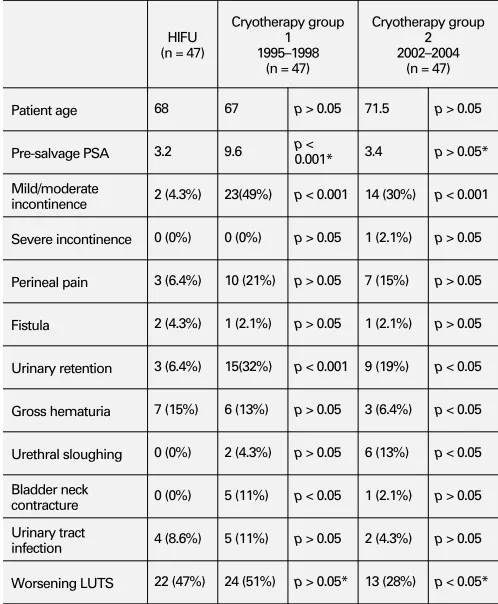
Results: Salvage HIFU treatment had lower rates of mild/moderate
incon-tinence and urinary retention as well as lower rates of perineal pain. HIFU was associated with a similar rate of worsening of lower urinary tract symptoms (LUTS) and gross haematuria when compared with our initial experience with CRYO. With experience, LUTS reduced follow-ing CRYO. Recto-Urethral fistula rates low at 2%, 2% and 4% respec-tively. Results are summarized in Table 1.
Conclusions: Salvage HIFU was associated with lower rates of
inconti-nence, perineal pain and bladder neck contracture than Salvage CRYO. Complication rates reduced with experience with CRYO with worsen-ing LUTS beworsen-ing statistically significant; however, HIFU still compares favorably to even our most experienced CRYO results. This study con-firms that salvage HIFU is a feasible salvage procedure with acceptable morbidity rates at least equivalent to salvage CRYO.
UP012
Clinical Outcomes of Secondary or Tertiary Treatment of Benign Prostatic Hyperplasia (BPH) with GreenLight HPS™ Laser Photoselective Vaporization Prostatectomy (PVP)
Strom K, Gu X, Spaliviero M, Wong C
University of Oklahoma Health Sciences Center, Oklahoma City, OK, USA
Introduction and Objective: Secondary procedure rates of surgical
ther-apy for BPH range between 1 and 14%. We evaluate GreenLight HPS™ laser PVP as a treatment for symptomatic BPH previously treated with surgical management.
Table 1. UP011. Morbidity outcomes between three groups
HIFU (n = 47)
Cryotherapy group 1 1995–1998
(n = 47)
Cryotherapy group 2 2002–2004
(n = 47)
Patient age 68 67 p > 0.05 71.5 p > 0.05
Pre-salvage PSA 3.2 9.6 p <
0.001* 3.4 p > 0.05*
Mild/moderate
incontinence 2 (4.3%) 23(49%) p < 0.001 14 (30%) p < 0.001
Severe incontinence 0 (0%) 0 (0%) p > 0.05 1 (2.1%) p > 0.05
Perineal pain 3 (6.4%) 10 (21%) p > 0.05 7 (15%) p > 0.05
Fistula 2 (4.3%) 1 (2.1%) p > 0.05 1 (2.1%) p > 0.05
Urinary retention 3 (6.4%) 15(32%) p < 0.001 9 (19%) p < 0.05
Gross hematuria 7 (15%) 6 (13%) p > 0.05 3 (6.4%) p < 0.05
Urethral sloughing 0 (0%) 2 (4.3%) p > 0.05 6 (13%) p < 0.05
Bladder neck
contracture 0 (0%) 5 (11%) p < 0.05 1 (2.1%) p > 0.05
Urinary tract
infection 4 (8.6%) 5 (11%) p > 0.05 2 (4.3%) p > 0.05
Worsening LUTS 22 (47%) 24 (51%) p > 0.05* 13 (28%) p < 0.05*
Methods: We prospectively evaluated our initial GreenLight HPS™ laser
PVP experience. Only patients who failed prior surgical therapy (transurethral prostate resection (TURP), transurethral microwave ther-apy (TUMT), holmium laser ablation of prostate (HoLAP) and potas-sium-titanyl-phosphate (KTP) laser PVP) for symptomatic BPH were included. Transurethral PVP was performed using a GreenLight HPS™ side-firing laser system.
Results: Prior surgical management included TURP (18), TUMT (9), KTP
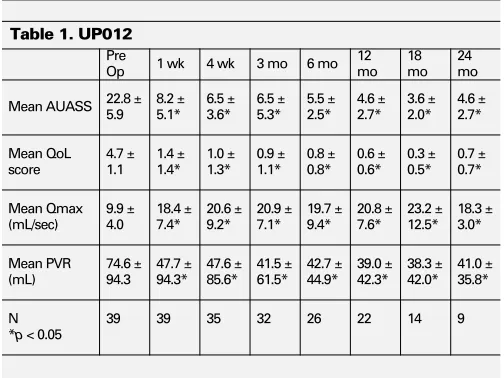
laser PVP (8), HoLAP (2), TUMT and TURP (1), and TUMT and KTP laser PVP (1) in 39 of 181 consecutive patients. Mean prostate volume was 80.8 ± 50.0 mL. Mean laser and operative times and energy usage were 12.5 ± 10.5 minutes, 30.0 ± 24.0 minutes and 83.2 ± 64.4 kJ, respectively. Five patients developed a urinary tract infection. There were 36 patients who had nonsignificant hematuria for less than one week. Three patients had persistent urinary retention requiring clean intermittent catheterization. No urethral strictures or urinary inconti-nence were noted. All patients were able to discontinue their prostate medications following surgery. Mean American Urological Symptom Association Score (AUASS) decreased significantly from 22.8 to 8.2, 6.5, 6.5, 5.5, 4.6, 3.6 and 4.6 (p < 0.05) at 1 and 4 weeks and 3, 6, 12, 18 and 24 months, respectively. Mean maximum flow rate (Qmax) and post void residual (PVR) measurements also showed significant improve-ment from baseline. The incidence of adverse events were low.
Conclusions: Our initial results demonstrate that GreenLight HPS™ laser
PVP is safe and effective for the treatment of symptomatic BPH recur-ring following prior surgical management.
UP013
Does Prostate Configuration Affect the Efficacy and Safety of GreenLight HPS™ Laser Photoselective Vaporization Prostatectomy (PVP)?
Gu X, Strom K, Spaliviero M, Wong C
University of Oklahoma Health Sciences Center, Oklahoma City, OK, USA
Introduction and Objective: We evaluate the efficacy and safety of
GreenLight HPS™ laser PVP for the treatment of lower urinary tract symptoms (LUTS) secondary to benign prostatic hyperplasia (BPH) with bilobe and trilobe prostates.
Methods: We prospectively evaluated our GreenLight HPS™ laser PVP
experience. Based on the results of cystoscopy and transrectal ultra-sonography, patients were stratified into two groups: bilobe (group I) and trilobe (group II) BPH. Transurethral PVP was performed using a 120W GreenLight HPS™ side-firing laser system. American Urological Association Symptom Score (AUASS), Quality of Life (QoL) score, max-imum flow rate (Qmax) and post void residual (PVR) were measured
preoperatively and at 1 and 4 weeks and 3, 6, 12, 18 and 24 months postoperatively.
Results: There were 181 consecutive patients identified (l: 101, ll: 80).
Among the preoperative parameters, there were significant differences in prostate volume (I: 46.5 ± 17.9, II: 97.5 ± 120.2 mL, p < 0.001.), Qmax (I: 10.1 ± 4.2, II: 8.7 ± 3.5 mL/sec, p = 0.027) and PVR (I: 60.4 ± 118.8, II: 97.5 ± 154.3 mL, p = 0.074), while AUASS (I: 22.7 ±6.0, II: 23.0 ±6.4, p = 0.695) and QoL (l: 4.7 ± 1.0, ll: 4.5 ± 1.1, p = 0.088) were similar. Significant differences in laser utilization (I: 8.9 ± 4.5 II: 19.5 ± 11.7 minutes, p < 0.001) and energy usage (I: 59.1 ± 30.0, II: 131.2 ± 79.6 kJ, p < 0.001) were noted. Clinical outcomes (AUASS, QoL, Qmax and PVR) were significantly improved post surgery within each group. AUASS, QoL and Qmax showed immediate and stable improvement during the follow-up period. There were no significant differences in the postoperative clinical outcome parameters between the two groups (p > 0.05). The incidences of adverse events were low in both groups.
Conclusions: Our experience suggests that BPH configuration has little
effect on the efficacy and safety of GreenLight HPS™ laser PVP.
UP014
Is The Efficiency of GreenLight HPS™ Laser Photoselective Vaporization Prostatectomy (PVP) Affected by Long-Term 5alpha-Reductase Inhibition (5ARI) Therapy?
Strom K, Gu X, Spaliviero M, Wong C
University of Oklahoma Health Sciences Center, Oklahoma City, OK, USA
Introduction and Objective: Hemoglobin is the primary chromophore
of the potassium-titanyl phosphate (KTP) laser. It is postulated that the efficiency of the GreenLight HPS™ laser PVP in patients on long-term 5ARI, which reduce angiogenesis in benign prostatic tissue, may be decreased. We evaluate GreenLight HPS™ laser PVP as treatment for benign prostatic hyperplasia (BPH) in patients on long-term 5ARI.
Methods: We prospectively evaluated our initial GreenLight HPS™ laser
PVP experience in patients with (5ARI+) and without (5ARI-) long-term 5ARI. Transurethral PVP was performed using a GreenLight HPS™ side-firing laser system with normal saline irrigant. Voiding trials were per-formed two hours post surgery. American Urological Association Symptom Score (AUASS), Quality of Life (QoL) score, maximum flow rate (Qmax) and post void residual (PVR) were measured preoperatively and at 1 and 4 weeks and 3, 26, 12, 18 and 24 months post surgery. Serum PSA and TRUS were also obtained at the 12 week follow-up interval.
Results: There were 181 consecutive patients identified; 57 in 5ARI+
were on either finasteride or dutasteride and 124 in 5ARI- were not. Mean prostate volumes were 67.1 ± 35.3 and 69.2 ± 41.9 mL (p = 0.646) and mean PSA values were 2.2 ± 2.4 and 2.7 ± 2.6 ng/mL (p = 0.289), respectively. There were no significant differences in the parameters of laser utilization (13.6 ± 9.2 vs. 13.4 ± 10.4 minutes, p = 0.965) and energy usage (87.1 ± 62.4 vs. 91.8 ± 69.6 kJ, p = 0.623). All were out-patient procedures with the majority of the out-patients catheter-free at dis-charge. All patients were able to discontinue their prostate medications following surgery. The mean rates of prostate vaporization (2.7 ± 1.3 vs. 3.6 ± 2.4 mL/min, p = 0.08; 0.61 ± 0.81 vs. 0.53 ± 0.36 mL/kJ, p = 0.47) and TRUS volume 12 weeks post surgery (34.5 ± 27.1 vs. 36.8 ± 21.3 mL, p = 0.665) were similar between the two groups. Compared to baseline, PVR values decreased significantly in the 5ARI+ group (p < 0.05) but not in 5ARI- group. AUASS, QoL and Qmax values showed immediate and significant improvement from baseline (p < 0.05). AUASS, QoL, Qmax and PVR values at every time point showed no significant difference (p > 0.05) between the two groups during the follow-up inter-val. The incidence of adverse events was low and similar between both groups.
Conclusions: Our findings suggest that 5ARI do not have a detrimental
effect on the efficiency and efficacy of GreenLight HPS™ laser PVP.
UP015
Duplicate Publications: A Survey of Redundancy in the Urological Literature
Hennessey K, Afshar K, Williams A, MacNeily A
University of British Columbia Department of Urologic Sciences, Vancouver, BC
Introduction and Objective: A redundant publication occurs when the
same author or group of authors publishes a partial or complete dupli-cate of the scientific data from an existing manuscript. The steady push for academic and career advancement within the medical community can lead to a culture of “publish or perish”. Unfortunately this may result in redundant publications that erode the value and quality of aca-demic literature. Our objective was to sample the extent and features of redundancy within the urological literature.
Methods: A review of all original index articles published in the Journal
of Urology in 2006 was conducted using the PUBMED search engine. Editorials, reviews, urological surveys, and letters to the editor were excluded. Suspected redundant publications were identified by com-bining the last names of the first, second and last authors with the key words provided by the original article. Search results were limited to 2004 -2008. Two senior investigators, each blind to the other, reviewed the suspected redundant publications and classified them as duplicate (identical materials, methods, results and conclusions), probable dupli-cate (almost identical materials, methods, results and conclusions), and salami-slicing (portions of index article repeated or continued). Discrepant classifications were resolved by mutual review and consensus.
Results: From a total of 723 original index articles, 28 were identified
to have 31 suspected redundant publications. Review of full text ver-sions of the suspected redundant publications resulted in one (0.1%) article being classified as a complete duplicate, 6 (0.8%) articles as probable duplicates, and 5 (.7%) articles as salami-sliced. Therefore 12/723 (1.7%) of index articles were found to have some form of redun-dancy. The proportion of redundant articles published prior to, and fol-lowing their index article was 7/12 (58.3%) and 4/12 (33.3%), respec-tively. One redundant article (8.3%) was published in the same month as its index article.
Conclusion: The detection of redundant publications is a difficult and
labo-rious process for peer reviewers and editors. This sampling of the Journal of Urology suggests that the duplication rate in the field of urology is small but significant and appears to be similar to other surgical subspecialties. Further assessment of other Urological journals is warranted.
UP016
Early Ambulation Following Robot-Assisted Laparoscopic Radical Prostatectomy (RALP): Is Pharmacologic Thromboembolic Prophylaxis Necessary?
Strom K, Spaliviero M, Gu X, Wong C
University of Oklahoma Health Sciences Center, Oklahoma City, OK, USA
Introduction and Objective: Inactivity is associated with increased
mor-bidity and coagulopathy after major surgery. After radical prostatec-tomy, ambulation typically commences the morning of postoperative day (POD) 1. Some centres employ routine pharmacologic deep venous thrombosis (DVT) and pulmonary embolism (PE) prophylaxis, often start-ing therapy prior to intubation. We review our initial RALP experience in which patients routinely ambulate hours after surgery, focusing on how our patients fare with respect to the incidence of DVT and PE.
Methods: Consecutive patients undergoing transperitoneal RALP by a
single surgeon (CW) were prospectively evaluated. Preoperative ted stockings and sequential compression devices (SCD) were provided in the ambulatory surgery unit. Following RALP and transfer from the post-surgical recovery room to a regular post-surgical ward, patients were instructed to ambulate with assistance twice before bedtime the day of surgery. Normal ambulation without assistance resumed POD 1. Pharmacologic anti-thrombotic therapy was not administered routinely before, during or after surgery unless requested by a consulting physician. Rates of common complications associated with immobility were examined.
Results: There were 161 patients identified, having a mean age of 62.0
± 8.1 years, an ASA of 2.2 ± 0.5 and 28.3 ± 3.9 kg/m². The mean oper-ating room time was 213.0 ± 54.0 minutes and mean hospitalization was 1.2 ± 1.0 days. The median urethral catheter duration was 5.0 ± 3.9 days. Adverse events included 1 fascial dehiscence, 2 (0.6%) DVT and 0 (0.0%) with PE. Anti-platelet therapy was withheld 10 days prior to surgery in one of the DVT patients.
Conclusions: Routine pharmacologic therapy to prevent perioperative
thromboembolic events adds to hospitalization costs at a minimum. These results suggest that prophylactic pharmacologic intervention may not be required for DVT and PE prophylaxis when ted stockings, SCDs and early ambulation are employed.
UP017
Clinical Experience Using in vivo Prostate Spectroscopic Imaging Technique at Short Echo Times
Sandhu G1, Venugopal N2,3,4, Lategan B5, Sivalingam S1, Al Mehairi S1,
Alamri A1, McCurdy B3,4, Ryner L2,3, Aljada I5, Drachenberg D1 1Department of Surgery (Section of Urology), University of Manitoba,
Winnipeg, MB; 2National Research Council Institute For Biodiagnostics,
Winnipeg, MB; 3Department of Physics and Astronomy, University of
Manitoba, Winnipeg, MB; 4Department of Medical Physics, CancerCare
Manitoba, Winnipeg, MB; 5Department of Pathology, University of
Manitoba, Winnipeg, MB
Introduction and Objective: Magnetic resonance spectroscopic
imag-ing (MRSI) is now widely used as a tool for mappimag-ing key biomarkers in the prostate. In this work we present a novel MRSI technique, which identifies short echo time metabolites and improves the clinical usabil-ity of MRSI.
Methods: Subjects with prostate cancer were scanned on a GE 1.5T MR
scanner using a standard endorectal coil in combination with a torso phased-array coil. MRSI data was obtained using a newly optimized pulse sequence (CV-MRSI) in addition to a set of T2-weighted fast spin echo (FSE) images. MRSI scans at long (130 ms) and short (40 ms) echo times (TE) were acquired using the standard, and novel technique. Each 3D MRSI acquisition used a 16x8x8 phase encode matrix, with a voxel size of 0.42 cm3. Preoperative biopsy was done using transrectal
ultra-sound. Following radical prostatectomy, the prostate was prepared for histopathological analysis. Spectra from voxels corresponding to malig-nant and normal tissue were analyzed using a modified version of LCModel.
Results: A continuous improvement in data collection was observed
when obtaining data from consecutive acquisitions. The spectra and LCModel fits obtained from the same voxels from long and short TE acquisitions. Comparing the spectra obtained at TE = 130 ms to that obtained at TE = 40 ms, we are observing on average 60% reduction in contaminating lipids, and significant improvement in the signal to noise ratio (SNR). As well, the citrate multiplet structure is clearly resolved. In addition we are also detecting several other short TE metabolites, such as taurine (Ta), inositol (In), and glutamate/glutamine (Glx) previously not observed.
Conclusion: MRSI can help decrease problems seen with conventional
UP018
Burkholderia Cepacia Infection of the Prostate Caused by Inoculation of Contaminated Ultrasound Gel During Trans-Rectal Biopsy of the Prostate
Organ M2, Hutchinson J1, Grantmyre J2
1Memorial University, St. John’s, NL; 2Dalhousie University, Halifax, NS
Introduction and Objectives: Ultrasound procedures and transmission
gel have been implicated in the spread of several bacterial pathogens including Burkholderia Cepacia. One of the authors (JH) has published a description of trans-rectal biopsy of the prostate leading to prostate infections with Burkholderia cepacia, secondary to intrinsically con-taminated ultrasound gel. That paper focused on the microbiologic and infection control aspects of the outbreak. In this report we describe in more detail the clinical aspects of 6 patients who had a biopsy of the prostate resulting in acute and chronic infection with B. cepacia includ-ing therapy and outcomes. Included is the first report of chronic prosta-titis caused by B. cepacia.
Methods: Patients who underwent trans-rectal biopsy of the prostate
between 2000 and 2002 in Halifax, Nova Scotia and St. John’s, Newfoundland and subsequently were shown to have an infection with B. cepacia were reviewed retrospectively. Clinical and laboratory data was collected by retrospective chart review.
Results: Contaminated ultrasound gel in this case was an unrecognized
source of infection. During the time these infections occurred, ultra-sound gel was purchased in large 4 to 5 L bottles and distributed to smaller refillable 250 ml to 1 L squeeze bottles. Therapy may be diffi-cult for B. cepacia prostatitis. They sometimes required multiple IV antibi-otics early in treatment to resolve symptoms. In particular, chronic prostate infection with B. cepacia, which has not been previously described in the literature, may be difficult to treat and resolve.
Conclusions: This series illustrates the importance of sterile technique and
also sterile ultrasound gel. Although the rectal mucosa is involved and considered not to be sterile, these infections demonstrate how harmful organisms can still be transmitted to the patient during a TRUS biopsy. Single sterile packets of ultrasound gel should be used and refilling of con-tainers should be banned. Attention should be taken to follow the manu-facturer’s recommendations regarding device reprocessing to ensure proper cleaning and disinfection. After these changes were made in St. John’s and Halifax there were no further urinary tract infections with B. cepacia.
UP019
Treatment of Chronic Radiation Cystitis with Hyaluronic Acid: A Case Series
Langille G, Pugsley D, Connors L, Bell D
Dalhousie University, Halifax, NS
Introduction and Objective: Chronic radiation cystitis is a difficult
clin-ical problem leading to significant patient morbidity. Treatment of this disorder is poorly defined and generally ineffective. In the normal blad-der, hyaluronic acid is theorized to function as a protective barrier aid-ing the repair of damaged mucosa. Intravesical instillation of hyaluronic acid is a recognized treatment for interstitial cystitis and thus a poten-tial agent for treatment of Radiation induced cystitis.
Methods: A retrospective chart review was performed assessing all patients
at a single centre treated with hyaluronic acid for exacerbations of chronic radiation cystitis between 2006 and 2009. Symptoms of this disorder can be quantified by the Radiation Therapy Oncology Group (RTOG) score for genitourinary radiation toxicity. This scale measures sympto-matology on a grade of 1 (minor) to 5 (major). RTOG scores were assigned to patients with post radiotherapy cystitis before and after a treatment course with hyaluronic acid (Cystistat).
Results: Eleven patients were identified who met such criteria. RTOG
measurements for patients were an average of 2.9 (2–4) prior to hyaluronic acid instillation. After intravesical therapy with hyaluronic acid, the average RTOG toxicity score decreased to 1.6 (0–4). Eight patients (8/12) had improvement in their symptoms, 3 had stable symptoms, and only one patient showed worsening symptoms.
Conclusions: Hyaluronic acid instillations for radiation induced cystitis
show promising preliminary results in this retrospective review. Further verification of its efficacy with prospective, randomized controlled tri-als is warranted.
UP020
Complications of Vasectomy and the Incidence of Post-Vasectomy Pain
Carlson W, Grantmyre J
Dalhousie Urology, Halifax, NS
Introduction: Vasectomy is a simple, effective and commonly used method
of contraception. In the United States, vasectomy is used by 11% of married couples and performed on approximately 500,000 men annu-ally. Vasectomy is the most common urologic procedure performed today with an estimated 2-3% complication rate. Despite this low com-plication rate, vasectomy is the most litigated urological procedure. The complication of scrotal pain is very concerning to patients although there are only a few papers published on this topic. The true incidence of post-vasectomy scrotal pain is unknown, but estimates range from 0.9-33%. Our retrospective study examines the overall complication rate of vasectomies and specifically the incidence of scrotal pain.
Methods: A retrospective analysis was performed on patients who
pre-sented to a single urologist regarding possible vasovasostomy between March 1997 and January 2009. The vasectomies had been performed by a variety of physicians without a standardized technique. Patients with pre-existing testicular pain were excluded. Data regarding compli-cations of vasectomy, specifically the incidence and duration of chronic scrotal pain were collected.
Results: A total of 313 patients were identified and reviewed. The mean
time from vasectomy to consultation was 102 months (range 10–432 months). The complication rate for hematoma, epididymitis, wound infection, hydrocele and failure was 8.6%. The incidence of tomy scrotal pain was 9.6% (n = 30). Of the 30 patients with post-vasec-tomy scrotal pain, 18 (60%) had occasional discomfort, 6 (20%) had post-coital pain, and 6 (20%) had chronic pain. Only 5 (17%) of the 30 patients with scrotal pain had a complication of their vasectomy. The pain eventually resolved in 6 (20%) of the patients.
Conclusion: Most of the literature surrounding vasectomy complications
comes from experienced centres and they estimate the risk at 2–3%. It has been previously shown that physician experience is the single most important factor relating to complications. Our data shows a higher com-plication rate of 8.6% possibly because it represents a variety of physi-cian experience and non-standardized technique. We found the inci-dence of post-vasectomy scrotal pain to be 9.6%. Most of these patients (60%) had occasional discomfort. Further study investigating the inci-dence and natural history of post-vasectomy scrotal pain with standard-ized questionnaires is necessary to better understand this complication.
UP021
Effective Communication of Study Results to Study Participants with Prostate Cancer: Results of a Survey
Hussain S1, Breunis H1, Timilshina N1, Alibhai S1,2
1University Health Network, Toronto, ON; 2Department of Medicine,
University of Toronto, Toronto, ON
Introduction and Objective: There are few data on how often or how
effectively clinical trial results are communicated to research study par-ticipants. We formally examined this issue in a survey which we admin-istered to participants in an observational clinical study who were invited to an end-of-study presentation of study results.
Methods: We invited all participants of a longitudinal matched cohort
Results: There were 59 of 70 presentation attendees (84%) who returned
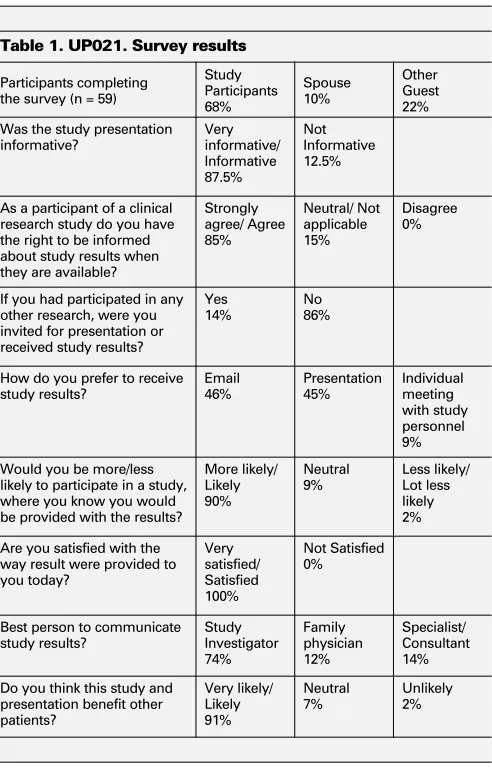
usable surveys. Thirty-nine (39) of 59 survey respondents were study par-ticipants while the rest were spouses or other guests; 71% of respondents were 65 years or older, 81% had completed at least some college or uni-versity, and 91% were either satisfied or very satisfied with participating in the study. Thirty-three percent of them had participated in clinical research before. Other key survey responses are summarized in Table 1.
Conclusion: The vast majority of participants in our study clearly wanted
major end-of-study results made available to them, with equal numbers desiring an e-mail summary or a group presentation. Most expected this to come from the study’s principal investigator. Yet this seems to be happening uncommonly. An additional advantage of ensuring at the outset that such a presentation will occur may be to enhance partici-pant recruitment and retention by gaining their trust, particularly in stud-ies without many direct personal benefits to participants.
UP022
Development of a Site-Specific BioBank to Enhance Genitourinary Oncology Biomarker Research
Chadwick K1, Evans K2, Evans A1, Fleshner N1
1University Health Network, Toronto, ON; 2Ontario Cancer BioMarker
Network, Toronto, ON
Introduction and Objective: The genitourinary (GU) oncology division
at Princess Margaret Hospital (PMH) has developed a site-specific BioBank to serve as a central repository for biospecimens obtained from patients attending out-patient clinics within the division. The GU BioBank was built to support research activities within the institution and beyond in a collaborative and accountable manner.
Methods: All consenting patients at high-risk for, or with bladder,
kid-ney, prostate, and testis cancers (the Cohorts) agree to provide speci-mens prior to, during and following their treatment(s). Each sample col-lection point (Clinical State) is dictated by detailed flow diagrams developed for each disease cohort. We have developed the following number of clinical states for each disease cohort: Prostate (14), Kidney (11), Bladder (7), Testis (11). All blood and urine specimens are processed and stored by our collaborators at the Ontario Cancer Biomarker Network (OCBN). The specimens are catalogued, centrifuged, aliquoted, bar-coded, and stored in liquid nitrogen. Relevant clinical databases within the division are used for clinical outcomes determination. The GU Site group com-mittee approves protocols and distributes samples to requesting investi-gators (following Research Ethics Board approval). The hierarchy for sample use gives precedence to those performing in-house academic projects, followed by collaborative academic projects, and lastly for commercial projects.
Results: Since the date of its inauguration in May 2008, over 3000 patients
have been recruited to the GU BioBank, and over 45,000 biospecimen aliquots have been stored. The GU Site BioBank continues to expand at a rate of 35 – 50 new participants per week, with a refusal rate of 7%. As of Jan 1 2010, the following number of specimen sets (one spec-imen set = all aliquots of plasma, serum, DNA and urine stored per patient per Clinical State) were available per disease cohort: Bladder (694); Prostate (2017); Kidney (329); Testicular (98); Other (133).
Conclusions: Focus to-date has been on producing a sufficient number
of high quality specimens to enable statistically significant results in proposed studies. The GU BioBank has now reached this point for sev-eral Clinical States, and we have recently approved sevsev-eral research proposals requesting specimens from the BioBank. By enabling such research, we hope to facilitate the discovery of new diagnostic and prog-nostic biomarkers and achieve our ultimate goal of personalized medi-cine and improved outcome for GU oncology patients.
UP023
Side Effects Causing Premature Termination of 3-year Maintenance Intravesical BCG: Not So Common
Abidali A1, Abdolell M2, Rendon R1
1Department of Urology, Queen Elizabeth II Health Sciences Centre,
Dalhousie University, Halfiax, NS; 2Department of Diagnostic Imaging,
Queen Elizabeth II Health Sciences Centre, Halifax, NS
Introduction and Objective: Bacillus Calmette-Guerin (BCG) is the
treat-ment of choice for the managetreat-ment of high-risk non-muscle invasive bladder cancer. A large randomized controlled trial has shown that maintenance BCG improves recurrence-free survival and worsening-free survival. However, the 3-year maintenance BCG (SWOG) proto-col, consisting of 27 installations, was shown to be associated with a very low completion rate of 16%, attributed largely to the side-effects of the treatment. We evaluated the rates of completion and reasons for premature treatment termination in our patients undergoing mainte-nance BCG with the SWOG protocol.
Methods: We evaluated 54 consecutive patients who were intended to
receive a 3-year maintenance course of BCG at our institution between July 1 2003 and June 30 2009. Basic demographic data, treatment response, adherence to treatment and side effects were collected retrospectively. Moderate to severe side effects were defined as those that mandated
Table 1. UP021. Survey results
Participants completing
As a participant of a clinical research study do you have the right to be informed about study results when
If you had participated in any other research, were you
How do you prefer to receive study results? likely to participate in a study, where you know you would be provided with the results?
More likely/
Are you satisfied with the way result were provided to you today?
discontinuation of therapy. Kaplan-Meier survival curves were employed to analyze survival data.
Results: The mean age of the entire cohort was 67 years (range 49–89)
and 42 (77.8%) patients were male. The median number of instillations was 21 (range 6–27). In total, 33 patients had a minimum of 3 years of follow-up allowing for completion of the maintenance protocol. Of these 33 patients, 15 (45%) completed the treatment without premature ter-mination, 3 (9%) did not complete due to death of unrelated causes during the treatment. Four (12%) did not complete as they were lost to follow-up, 8 (24.2%) patients did not complete due to BCG failure, while only 3 (9%) patients prematurely terminated treatment due to side-effects. This is demonstrated in the freedom from interruptions due to side effects survival graph.
Conclusions: These results illustrate that contrary to previous findings, in
a real-life clinical setting, side effects play a minor role (9%) in prevent-ing patients from completprevent-ing BCG maintenance therapy and that a signif-icant number (45%) of patients are able complete the full course. Considering the well illustrated benefits of maintenance BCG, concerns of frequent and significant side effects should not deter clinicians from its use.
UP024
Perioperative High-Dose Intensity M-VAC (HDI MVAC) for Muscle-Invasive Urothelial Carcinoma
Zhao Y, Potvin K, Ernst S, Chin J, Izawa J, Whiston F, Winquist E University of Western Ontario, London, ON
Introduction and Objective: Meta-analyses of randomized trials
indi-cate that overall survival is improved with the use of neoadjuvant chemotherapy (NAC) prior to cystectomy for muscle invasive urothelial carcinoma (UC) of the bladder. Typically perioperative cytotoxic regi-mens are selected based on objective response & survival benefits observed in the metastatic setting. HDI MVAC intensifies exposure to cisplatin & doxorubicin and shortens treatment time. In metastatic UC, HDI MVAC has a higher response rate (72%), lower neutropenia & mucositis rates, and superior survival compared to M-VAC (Sternberg 2006). These poten-tial advantages led to its perioperative use at our institution & we report our results to date.
Materials and Methods: Patients (pts) receiving HDI MVAC as adjuvant
or NAC for muscle-invasive UC were identified from institutional elec-tronic databases. Pts with distant metastases were excluded. Chemotherapy was given as described by Sternberg (2001). Baseline, treatment & out-come data were extracted & analyzed.
Results: Twenty eligible pts with muscle-invasive UC were identified
with mean follow up of 12 mths (range 1.5–43.4). M:F 17:3, median age 56 (range 39–76), ECOG status 0:1:2 was 12:6:1. There were 101 cycles given with 2 pts still on treatment. Fifteen pts have completed treatment as planned (11 pts had 6 cycles & 4 pts had 4 cycles). Three pts stopped treatment after 4 cycles due to fatigue (2) or urosepsis (1). No toxic deaths were observed. Five pts had treatment delays & 2 pts had febrile neutropenia. Median survival to date is 8.1 mths (range 1.5–43.4). In the adjuvant group (n = 12), 10 pts had resected stage 4 disease: pT4aN2 (2 pts), pT4aN1 (4), pT3bN1 (2) & pT3aN1 (2) and 2 pts had pT3aN0. Seven adjuvant pts have had recurrence & 6 have died. All pts in the NAC group (n = 8) had cystectomy. Downstaging occurred in 5/6 evaluable pts and RECIST response was 5 PR & 1 SD. No pT0 was seen but 1 pt was pTaN0 and 4 were pT2N0. Three NAC pts have had recurrence & 2 have died.
Conclusions: This HDI MVAC cohort was younger and had high risk
UC (74% pN+). Treatment was feasible & toxicity consistent with prior reports. Only 1 neoadjuvant pt had major response. HDI MVAC is a reasonable perioperative option for muscle invasive UC, but prognosis remains poor.
UP025
Microscopic Hematuria as a Predictor of Significant Urologic Pathology
Hildebrand B, MacMahon R
University of Manitoba, Winnipeg, MB
Introduction and Objective: To determine how often patients who
pres-ent to urologists with microscopic hematuria, and are investigated, are diagnosed with significant disease.
Methods: A retrospective chart review was performed of 248
consecu-tive patients who were referred with microscopic hematuria from January 2003, to December 2006. All patients included underwent full urologic work-up including, urinalysis, urine cytology, upper tract imaging, and cystoscopic examination.
Results: The average age was 60 years. These included 123 females and
125 males, with average ages of 61 and, 59 years respectively. Urologic malignancy was detected in four patients, one female and three males. All patients with malignancy were over the age of 60 and, all were smokers. Three of the patients were diagnosed with Ta lesions, of these, one had atypical cytology. One patient was diagnosed with T1G3 with CIS, with cytology showing TCC. This makes for an overall detection rate of 1.61%.
Conclusions: In this population it is suggested that the presence of
micro-scopic hematuria in smokers over the age of 60 can be associated with significant urologic pathology. In non-smokers under the age of 60 with microscopic hematuria investigation is extremely low yield.
UP026
Antitumour Activity of TRAIL Combined with Gemcitabine or Antisense Oligodeoxynucleotide Targeting Bcl2 in Xenogeneic Models of Human Bladder Cancer
Xiao J, Mak A, Moibi J, Sun B, Moore R
University of Alberta, Edmonton, AB
Introduction and Objective: Superficial bladder transitional cell
carci-noma (TCC) requires adjuvant intravesical therapy to prevent recurrence and progression. Tumour necrosis factor-related apoptosis-inducing lig-and (TRAIL) can selectively induce apoptosis in most tumour cells. In par-tially TRAIL-resistant TCC cells, we have recently observed that gemc-itabine and down-regulating Bcl2 with antisense oligodeoxynucleotide targeting Bcl2 (ASO-Bcl2) enhance apoptosis. These findings motivated us to further test the antitumour activity of TRAIL, combination of TRAIL with gemcitabine or ASO-Bcl2, in nude mice xenografted with human TCC cells.
Methods: Nude mice were either subcutaneously (s.c.) implanted with
UMUC14 cells in their left flanks or orthotopically with Ku-7 cells in their bladders. When s.c. tumours reached ~3 mm in diameter, animals were treated with (a) TRAIL, intratumour injection (i.t.) or intraperitoneal injection (i.p.), 20 µg daily; (b) gemcitabine, i.p., 2 mg twice weekly; (c) saline (control), i.t.; for 6 injections per animal. At 4 days after Ku-7 cell instillation, animals were allocated to intravesical treatments: (a) TRAIL, 40 µl (20 µg) on day 4, 5, 6, 11, 12, 13; (b) TRAIL, plus gemc-itabine (5 mg/ml) on day 7, 8, 14, 15, 19, 20; (c) TRAIL, plus ASO-Bcl2 (1000 µM) on day 7, 8, 14, 15, 19, 20; (d) saline control.
Results: Based on cytotoxicity data, TCC cells were divided into sensitive
or partially resistant to TRAIL or gemcitabine. UMUC14 cells were sensi-tive to TRAIL but partially resistant to gemcitabine, while Ku-7 cells were partially resistant to TRAIL. All 4 animals bearing s.c. UMUC14 tumours were cured by TRAIL i.t. and 2 of the 4 tumours were cured by gemc-itabine i.p. No tumour was cured by TRAIL i.p. or saline i.t. For the ortho-topic Ku-7 tumour model, the control group (6 mice) all had tumour with a median survival of 46 days. Other 3 groups (10 mice per group) received instillations of TRAIL, or TRAIL plus gemcitabine or ASO-Bcl2, attained a significant survival benefit over the controls with median survival of 95, 83 and 70 days, respectively. Tumour-free survivals were observed.
Conclusions: TRAIL can effectively control tumour growth when it is
UP027
Inhibition of Tyrosine Kinase and mTOR Signaling Pathways: Effect on Migration and Proliferation of Bladder and Kidney Cancer Cells
Moore R, Moibi J, Mak A, Vipulananthan N, Xiao J
University of Alberta, Edmonton, AB
Introduction and Objective: Management of advanced renal cell
carci-noma (RCC) and bladder transitional cell carcicarci-noma (TCC) remains a clinical challenge. Improved understanding of cell biology has led to development and approval of several new agents with specific signal-ing targets. Nevertheless, questions remain about the optimal use of these agents and combination approaches. This study investigated the impact of tyrosine kinase inhibitors (TKIs: Sorafenib, Sunitinib), mam-malian target of rapamycin (mTOR) inhibitor (mTORI: Temsirolimus) and tumour necrosis factor-related apoptosis-inducing ligand (TRAIL) on migration, invasion and proliferation of RCC and TCC cells.
Methods: RCC (786-O, ACHN, A498) and TCC (HT1376, UMUC14,
T24, RT112, 253J, MGHU3) cells in logarithmic phase in appropriate media were tested. To assess drug cytotoxicity, TCC cells were exposed to varying concentrations of sorafenib, sunitinib or temsirolimus for 20 h followed by TRAIL or growth medium for additional 20 h, after which the proportion of viable cells was determined by MTT assay. Expression of apoptotic proteins was determined by Western blot analysis. To assess impact on invasion, RCC cells (in Matrigel chambers of 8-micron pores) were incubated with TKIs in media without FBS; using 10% FBS in the lower chamber media as chemo-attractant. After 40 hours of migration, the filter containing the adherent cells was stained with hematoxalin, imaged under microscope and counted using Metamorph software. A wound-healing scratch assay was used to assess the migration of RCC cells cultured with TKIs. Cells were incubated and allowed to migrate for ~24 h with time-lapse images captured by an axiovert microscope and analyzed using t-scratch software.
Results: Sorafenib inhibited proliferation of TCC cells irrespective of
sensitivity. The sorafenib induction or augmentation of TRAIL-apoptosis in TCC cells was accompanied by increased activation of proapoptotic proteins (XIAP, p53, procaspases 9, 8 and 3). Sunitinib and Temsirolimus did not enhance the anticancer effect of TRAIL. Compared with controls (100% invasion), the invasion of RCC cells was reduced to <10% by Sorafenib and 30–75% by Sunitinib. A time- and dose- dependent RCC migration inhibition by TKIs was observed. Sorafenib, a more pan TKI, had greater effect than Sunitinib.
Conclusions: Inhibition of the tyrosine kinase pathway using sorafenib
(but not Sunitinib) potentiated TRAIL-induced lethality in TCC cells. TKIs also inhibit migration of RCC cells. This study provides valid ration-ale to use TKIs and TRAIL in neo-adjuvant therapy of RCC and TCC.
UP028
Females are in Higher Risk of Isolated Local Recurrence after Radical Cystectomy for Bladder Cancer
Bostrom P1, Alkhateeb S1, Trottier G1, Athanasopoulos P1, Mirtti T2,
Fleshner N1, Jewett M1, Zlotta A1
1Princess Margaret Hospital, University Health Network, Toronto, ON; 2Department of Pathology, Turku University Hospital, Turku, Finland
Introduction and Objectives: Local recurrences are relatively
uncom-mon after radical cystectomy and patients with local recurrences are known to have poor prognosis. Local recurrence may potentially be avoidable with correct surgical techniques such as larger resection mar-gins or extended lymph node dissection. Therefore, the study objective was to identify risk factors for isolated local recurrence for the purpose of avoiding these events in the future.
Material and Methods: We studied a large retrospective RC database
(n=601) including BC patients operated at the University Health Network, Toronto, Canada (n=351, study period 1992-2008) and University of Turku, Turku, Finland (n = 250, 1986–2005) with special attention to quality of the data. After excluding non-TCC tumours and patients with-out recurrence, we had a total of 181 patients. Isolated local recurrence was defined as tumour recurrence in the pelvis caudal to aortic
bifurca-tion with no evidence of distant metastasis. Analyzed variables included gender, smoking, type of diversion, extent of node dissection (<15 nodes vs. ≥15 nodes removed), pT-stage, N-status, CIS, lymphovascular inva-sion, margin status and neoadjuvant/adjuvant chemotherapy. Correlation between recurrence type and clinicopathological variables was exam-ined using univariate analysis, Kaplan-Meier survival method and cox regression multivariate analysis.
Results: Of the 181 patients with recurrences, 37 had isolated local
recurrence representing 20% of all recurrences and 7% of all TCC patients undergoing RC. The mean time to local recurrence was significantly shorter than to distant recurrence (10 vs. 19 months, p = 0.025) and the mean disease specific survival was 19 vs. 32 months for local and dis-tant recurrence, respectively (p = 0.14). In a multivariate analysis, female gender was the only significant risk factor for local recurrences (HR 3.41, 95% CI 0.13–0.65, p-value = 0.003). The rates for isolated local recurrences in patients undergoing extended and limited node dissec-tion were 15%, and 22%, respectively, but the difference was not sig-nificant (p = 0.29). Though positive bladder surgical margins were reported in 6% of all cases of recurrence, they had no correlation with local recurrence (p = 0.7) or gender (p = 0.3).
Conclusions: Surprisingly, female gender was significantly associated
with risk of isolated recurrence. The reason for this observation remains speculative, but attention should be paid to surgical technique in females. There was also a trend for decreased local recurrences in patients receiv-ing extended lymphadenectomy.
UP029
Radical Cystectomy Outcome and Prognostic Parameters: Combined Results from Two Large Institution
Bostrom P1, Alkhateeb S1, Athanosopoulos P1, Mirtti T2, Fleshner N1,
Jewett M1, Zlotta A1
1Princess Margaret Hospital, University Health Network, Toronto, ON; 2Department of Pathology, Turku University Hospital, Turku, Finland
Introduction and Objectives: Muscle-invasive bladder cancer (BC) is
an aggressive tumour with high risk of relapse after radical cystectomy (RC). As the role of perioperative chemotherapy after radical cystec-tomy is not well defined at the present time, we are in need of prognos-tic factors to determine patients at high risk of disease relapse. Our objective was to present combined results from two large series and to analyze our detailed database for variables associate with tumour relapse and poorer survival.
Material and Methods: A large retrospective RC database including BC
patients operated in University Health Network, Toronto, Canada (n = 351, study period 1992–12008) and University of Turku, Turku, Finland (250, 1986–2005) was studied. After excluding non-TCC tumours (n = 46), 555 patients were available for analysis. The relationship of gen-der, smoking, CIS, lymphovascular invasion (LVI), margin status, pT-stage, lymph node (LN) status, LN density (LND) and adjuvant chemother-apy to disease and overall specific mortality (DSS, OAS) was examined using univariate and multivariate analysis as well as Kaplan-Meier sur-vivals and Cox regression analysis.
Results: The mean FU was 4.0 years (median 2.3, range 0-20 years).
The 5-y and 10-y DSS was 70%, and 69%, respectively. The 10-y DSS for pT1, pT2, pT3, and pT4 were 81%, 66%, 53%, and 39%, respec-tively. For ND- and ND+ patients the 10-y DSS was 76%, and 36%, respectively. For ND positive patients with LND <20% 10-y DSS was 43% compared to 29% in patients with LND <20%. In a multivariate analysis, factors associated with DS