R E S E A R C H
Open Access
Global stability of May cooperative system
with feedback controls
Rongyu Han
1, Fengde Chen
1*, Xiangdong Xie
2*and Zhanshuai Miao
1*Correspondence: [email protected]; [email protected] 1College of Mathematics and Computer Science, Fuzhou University, Fuzhou, Fujian 350116, P.R. China
2Department of Mathematics, Ningde Normal University, Ningde, Fujian 352300, P.R. China
Abstract
In this paper, a May cooperative system with feedback controls is proposed and studied. The dynamic behaviors of the system are discussed by using the Lyapunov function method. Ifbi= 0,i= 1, 2, we show that feedback control variables have no
influence on the global stability of the unique positive equilibrium of the system, which means that feedback control variables only change the position of the positive equilibrium and retain its global stability property. Ifbi= 0,i= 1, 2, we can make the
system which has a unique globally stable equilibrium or has unboundedly large solutions become globally stable. Some examples are given to illustrate the feasibility of the main results.
MSC: 34C25; 92D25; 34D20; 34D40
Keywords: May cooperative system; feedback controls; Lyapunov function; global stability
1 Introduction
May [] suggested the following set of equations to describe a pair of mutualists:
dN dt =rN
– N
K+αN
,
dN dt =rN
– N
K+βN
,
(.)
whereN,Nare the densities of the species, respectively.r,Ki,α,β,i= , , are positive
constants. He showed that if the coefficients of system (.) satisfy
αβ< , (.)
then system (.) has a global stability equilibrium point (N∗,N∗), where
N∗=K+αK –αβ , N
∗
=
K+βK
–αβ .
If the amount of mutualistic interaction satisfies
αβ≥, (.)
then system (.) will ‘run away’, with both populations growing unboundedly large. So May brought the density restriction to the system and proposed the following system []:
˙
Since that many excellent results concerned with the dynamic behaviors of May coop-erative system are obtained. Cui and Chen [] addressed the nonautonomous system
˙
tions, and they obtained sufficient conditions which guarantee the existence of a unique globally asymptotically stable strictly positive periodic solution. In [], Cui further incor-porated continuous time delays and generalized it tonspecies. In [, ], the authors in-corporated discrete time delays in interspecies interaction and investigated the positive periodic and positive almost periodic solution of system.
On the other hand, in the real world, ecosystems are continuously disturbed by the un-predictable force. It is mostly humans’ interference. Furthermore human production ac-tivities is an important reason of species extinction [, ]. In some situations, one may wish to retain its stability. This is the significance in the control procedure of ecology balance. Therefore, scholars introduced the feedback control variables to the system. The dynamic behaviors of the Lotka-Volterra cooperative system with feedback controls have been dis-cussed extensively; see [–]. In [], Chen et al.first proposed the nonautonomous
n-species cooperation system with continuous delays and feedback controls as follows:
dxi(t)
control variables into a two species competition system as follows:
dx(t) dt =x(t)
b–ax(t) –ax(t) –αu(t)
,
dx(t) dt =x(t)
b–ax(t) –ax(t) –αu(t)
,
du(t)
dt = –ηu(t) +ax(t), du(t)
dt = –ηu(t) +ax(t).
(.)
They obtained sufficient conditions to guarantee the existence of a globally attracting pos-itive equilibrium of the system with feedback controls. Chen and Chen [] discussed the global stability of a unique interior equilibrium for a Leslie-Gower predator-prey model with feedback controls:
˙
N(t) = (r–aN–bN–cu)N, ˙
N(t) = r–a N N
–cu
N, ˙
u(t) = –fu+gN, ˙
u(t) = –fu+gN.
(.)
They showed that under the assumptionab≥ar, the unique interior equilibrium of
system (.) is globally stable. However, the authors invoked numerical calculations to found that the unique interior equilibrium of system (.) is globally stable also under the condition thatab<arholds. So the conditionab≥aris unnecessary for the
glob-ally stable property of system (.). This is a question to be studied in the future. Recently, Liet al.[] proposed and studied the following competitive system with feedback controls:
˙
x(t) =x(t) b–ax(t) –a +∞
K(s)x(t–s)ds–cu(t)
,
˙
x(t) =x(t) b–a +∞
K(s)x(t–s)ds–ax(t) –cu(t)
,
˙
u(t) = –eu(t) +dx(t), ˙
u(t) = –eu(t) +dx(t),
(.)
wherebi,aij,ci,ei,di,i,j= , are positive constants.xi(t),i= , , denote the densities of
the populationsxi(t).ui(t),i= , , denote feedback control variables. They showed that if
the Lotka-Volterra competitive system is globally stable, the feedback control variables had no influence on the global stability of the system (.). If the Lotka-Volterra competitive system is showing extinction, they can make the extinct species become globally stable or still keep the property of extinction. They showed that the feedback control variables play an important role on the dynamic behavior of the system (.).
follows:
dx dt =rx
–bx– x
αx+k
–cu
,
dx dt =rx
–bx– x
βx+k
–cu
,
du
dt = –ηu+ex, du
dt = –ηu+ex,
(.)
whereri,bi,α,β,ki,ci,ei,ηi,i= , , are positive constants.xi(t),i= , , are the densities
of the species at timet.ui(t),i= , , denote feedback control variables.
System (.) satisfies the initial values
xi() > , ui() > , i= , . (.)
Obviously, the solutions of system (.) with initial values (.) are positive for allt≥. The rest of the paper is organized as follows. We will state and prove the main results in next section. In Section , numerical simulations are presented to illustrate our results. We end this work by a brief conclusion.
2 Main results
Lemma . System(.)admits a unique positive equilibrium P(x∗,x∗,u∗,u∗).
Proof Obviously,P(x∗,x∗,u∗,u∗) satisfies the following equations:
⎧ ⎪ ⎪ ⎪ ⎨ ⎪ ⎪ ⎪ ⎩
–bx–αxx+k–cu= ,
–bx–βxx+k –cu= ,
–ηu+ex= ,
–ηu+ex= .
(.)
By the third and the fourth equations of (.), we haveui=eηixii,i= , . Substituting them
into the first and the second equations of (.), respectively, we have
x=
k+βx
+Ak+Aβx
(.)
and
( –Ax)(k+αx) =x, (.)
whereAi=bi+cηieii,i= , . Substituting (.) into (.), we have
Dx+Ex+F= , (.)
where
FromD> ,F< , we see that (.) admits a unique positive solutionx∗. Substitutingx∗
to (.), we have a unique positive solutionx∗. So system (.) admits a unique positive equilibriumP(x∗,x∗,u∗,u∗), whereu∗i =eix∗i
ηi ,i= , , which completes the proof.
Before we state and prove the global stability of this work, we need to state a definition and a useful lemma.
Definition .[] A matrixA= ((aij)n×n) is said to be anMmatrix ifaij≤,i=j,i,j=
, , . . . ,n, and any one of the following conditions holds:
() all of the eigenvalues of the matrixAhave positive real parts; () the order principal minor of matrixAis positive;
() matrixAis nonsingular andA–≥;
() there exists a vectorx> such thatAx> ; () there exists a vectory> such thatATy> .
Lemma .[] If A is an M matrix,then there exists a positive diagonal matrix D=
diag(d,d, . . . ,dn),di> ,i= , . . . ,n,such that matrix B=(DA+ATD)is positive definite.
Theorem . The unique positive equilibrium P(x∗,x∗,u∗,u∗)of system(.)is globally stable.
Proof Now let us construct a Lyapunov function
V(t) =β
whereβi,i= , . . . , are positively undetermined coefficients. Calculating the upper right
derivative ofV(t) along the solution of system (.), we have
whereY= (|x–x∗|,|x–x∗|)T,D=diag(β,β),βi> ,i= , , and
Note first that the off-diagonal elements of the matrixGareaanda, which are
nega-tive. Furthermore, by simple algebraic computation, the two order principal minors of the matrixGare
From Definition ., it follows thatGis an M matrix; according to Lemma ., there exists a positive diagonal matrixD=diag(β,β),βi> ,i= , , such that the matrix(DG+GTD)
is positive definite. SodVdt < strictly for allx> ,x> ,u> ,u> , except the positive
equilibriumP(x∗,x∗,u∗,u∗), wheredV
dt = . SoV(t) satisfies Lyapunov’s asymptotic stability
theorem [] and the unique interior equilibriumP(x∗,x∗,u∗,u∗) is globally stable, which
completes the proof.
Proof Obviously,P(x,x,u,u) satisfies the following equations: ⎧
⎪ ⎪ ⎪ ⎨ ⎪ ⎪ ⎪ ⎩
–αxx+k–cu= ,
–βxx+k –cu= ,
–ηu+ex= ,
–ηu+ex= .
(.)
After simple algebraic computations, we have
Dx+Ex+F= , (.)
where
D=β(B+kBB+Bα), F= –(k+kkB+kα), E=k(B–Bβ) +k(B+Bα+kBB) + ( –αβ),
andBi=cηieii,i= , . FromD> ,F< , we see that (.) admits a unique positive
so-lution x. Similar to the analysis of Lemma ., system (.) admits a unique positive
equilibriumP(x,x,u,u).
Theorem . The unique positive equilibrium P(x,x,u,u)of system(.)is glob-ally stable.
Proof The proof of Theorem . is similar to that of Theorem ., and we omit the details
here.
3 Examples
The following three examples show the feasibility of our main results.
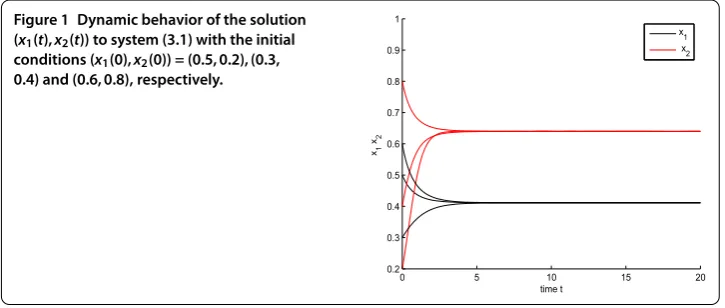
Example . Consider the following equations:
˙
x=x – x–
x x+
, x˙=x –x–
x x+
. (.)
By calculation, there exists a unique positive equilibrium of system (.), which is globally stable. Figure shows the dynamic behavior of system (.).
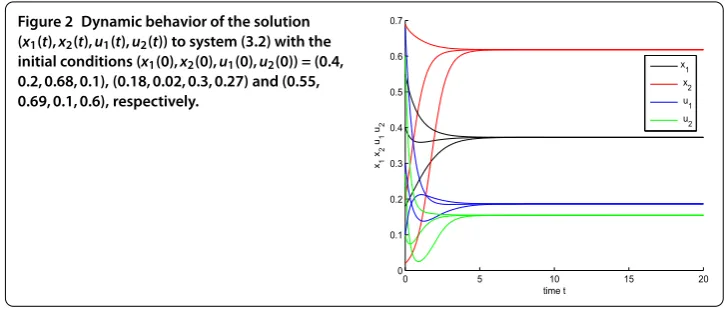
Figure 2 Dynamic behavior of the solution (x1(t),x2(t),u1(t),u2(t)) to system (3.2) with the initial conditions (x1(0),x2(0),u1(0),u2(0)) = (0.4, 0.2, 0.68, 0.1), (0.18, 0.02, 0.3, 0.27) and (0.55, 0.69, 0.1, 0.6), respectively.
Example . Now let us further incorporate the feedback control variables to system (.) and consider the following system:
˙
x=x – x–
x x+
– .u
,
˙
x=x –x–
x x+
– .u
,
˙
u= –u+x, ˙
u= –u+x.
(.)
From Theorem ., the positive equilibrium of system (.) is globally stable. Figure shows the dynamic behavior of system (.).
Example . Consider the following equations:
˙
x=x – x x+
– .u
,
˙
x=x –
x x+
– .u
,
˙
u= –u+ x, ˙
u= –u+x.
(.)
From Theorem ., there exists a unique positive equilibrium of system (.), which is globally stable. Figure shows the dynamic behavior of system (.).
4 Conclusion
In this paper, we propose and study May cooperative system with feedback controls. In Theorem ., by constructing a suitable Lyapunov function, we show that feedback control variables have no influence on the global stability of the system. Our result improve the corresponding result of Chenet al.[]. In [], Chen and Chen have a conjecture that the conditionab≥ar is not needed to ensure the global stability of the unique interior
Figure 3 Dynamic behavior of the solution (x1(t),x2(t),u1(t),u2(t)) to system (3.3) with the initial conditions (x1(0),x2(0),u1(0),u2(0)) = (2, 1, 4, 6), (6.4, 5.2, 7, 0.4) and (9.2, 4.1, 0.9, 3.3), respectively.
al.[, ], the authors showed that the feedback control variables have no influence on the permanence of the cooperation system. We have a further insight.
System (.) shows that ≤αβ= ,
which implies condition (.) holds, that is, both populations are growing unboundedly large. However, Figure and Theorem . show that the unique positive equilibrium is globally stable, which implies the feedback control variables which make both populations growing unboundedly large now become globally stable.
Competing interests
The authors declare that there is no conflict of interests.
Authors’ contributions
All authors contributed equally to the writing of this paper. All authors read and approved the final manuscript.
Acknowledgements
The authors are grateful to anonymous referees for their excellent suggestions, which greatly improve the presentation of the paper. Also, the research was supported by the Natural Science Foundation of Fujian Province (2015J010121, 2015J01019).
Received: 12 June 2015 Accepted: 30 September 2015
References
1. May, RM: Theoretical Ecology: Principles and Applications. Sounders, Philadelphia (1976)
2. Chen, LS, Song, XY, Lu, ZY: Mathematical Models and Methods in Ecology. Sichuan Science and Technology Press, Sichuan (2003) (in Chinese)
3. Cui, JA, Chen, LS: Global asymptotic stability in a nonautonomous cooperative system. Sys. Sci. Math. Sci.6(1), 44-51 (1993)
4. Cui, JA: Global asymptotic stability inn-species cooperative system with time delays. Sys. Sci. Math. Sci.7(1), 45-48 (1994)
5. Wei, FY, Wang, K: Asymptotically periodic solution ofN-species cooperation system with time delay. Nonlinear Anal., Real World Appl.7(4), 591-596 (2006)
6. Chen, HB, He, WS, Yang, LX, Liu, XJ: Asymptotically almost periodic solution ofNpopulation reciprocity system. J. Tianshui Norm. Univ.29(2), 24-27 (2009)
7. Zhao, L, Xie, XX, Yang, LY, Chen, FD: Dynamic behaviors of a discrete Lotka-Volterra competition system with infinite delays and single feedback control. Abstr. Appl. Anal.2014, Article ID 867313 (2014)
8. Li, Z, Han, MA, Chen, FD: Influence of feedback control on an autonomous Lotka-Volterra competitive system with infinite delays. Nonlinear Anal., Real World Appl.14(1), 402-413 (2013)
9. Chen, FD: Permanence of a discreteN-species cooperation system with time delays and feedback controls. Appl. Math. Comput.186(1), 23-29 (2007)
10. Chen, FD, Liao, XY, Huang, ZK: The dynamic behavior ofN-species cooperation system with continuous time delays and feedback controls. Appl. Math. Comput.181(2), 803-815 (2006)
12. Chen, FD, Xie, XD: Study on the Dynamic Behaviors of Cooperation Population Modeling. Science Press, Beijing (2014) (in Chinese)
13. Chen, LJ, Xie, XD, Chen, LJ: Feedback control variables have no influence on the permanence of a discreteN-species cooperation system. Discrete Dyn. Nat. Soc.2009, Article ID 306425 (2009)
14. Chen, LJ, Xie, XD: Permanence of an-species cooperation system with continuous time delays and feedback controls. Nonlinear Anal., Real World Appl.12(1), 34-38 (2011)
15. Gopalsamy, K, Weng, PX: Global attractivity in a competition system with feedback controls. Comput. Math. Appl.
45(4-5), 665-676 (2003)
16. Chen, LJ, Chen, FD: Global stability of a Leslie-Gower predator-prey model with feedback controls. Appl. Math. Lett.
22(9), 1330-1334 (2009)
17. Chen, LS, Song, XY, Lu, ZY: Mathematical Models and Methods in Ecology. Sichuan Science and Technology Press, Sichuan (2003) (in Chinese)