R E S E A R C H
Open Access
Mathematical modeling of the effects of
public health education on tungiasis—
a neglected disease with many challenges in
endemic communities
Rachel A. Nyang’inja
1,2*, David N. Angwenyi
3, Cecilia M. Musyoka
1and Titus O. Orwa
4*Correspondence:[email protected] 1Department of Mathematics, Shanghai University, Shanghai, China
2Department of Mathematics and Informatics, Taita Taveta University, Voi, Kenya
Full list of author information is available at the end of the article
Abstract
In this paper, we formulate and study a mathematical model for the dynamics of jigger infestation incorporating public health education using systems of ordinary differential equations and computational simulations. The basic reproduction number
REis obtained and used to determine whether the disease breaks out in the
population and results in an endemic equilibrium or dies out eventually
corresponding to a disease-free equilibrium. We carried out an analysis of the model and established the conditions for the local and global stabilities of the disease-free and endemic equilibria points. Using the Lyapunov stability theory and LaSalle invariant principle, we found out that the disease-endemic equilibrium point is globally asymptotically stable ifRE> 1 and unstable otherwise. Numerical simulations
are performed to illustrate our theoretical predictions. Both the analytical and numerical results show public health education is a very effective control measure in eradicating jigger infestation in the endemic communities at large.
Keywords: Basic reproduction number; Global stability; Jigger infestation; Lyapunov stability theory; Public health education
1 Introduction
Tungiasis is a parasitic skin disease caused by female sand flea or jigger (tunga penetrans) that mostly lives in dry sand and soil [1]. The impregnated female parasite attacks exposed skin and burrows itself into the skin, leaving a section of its abdomen exposed through a pore in the skin to enable it breathe and carry out other metabolic functions like feeding on blood vessels [2]. The first evidence of jigger infestation is a tiny dark spot on the skin at the point of penetration. When the eggs are ready, they are released through the orifice and after about one week hatch into fleas [3]. It is important to note that one female flea may lay hundreds of eggs, meaning that if the situation is not promptly corrected it can easily result into severe health effects.
Tungiasis is endemic in many countries including Latin America, the Caribbean, and Sub-Sahara Africa [4]. Researchers agree that it is a neglected health problem in impov-erished communities in the affected countries [5]. In Kenya, the neglect is evidenced by scarcity of epidemiological data [6]. It is estimated that about 2.6 million (6.5%) Kenyans
suffer from tungiasis and 10 million others are at risk [7]. Tungiasis is a common problem among people who live in Mount Kenya region, western Kenya, Rift Valley, and coastal regions [2]. In 2010, the prevalence of tungiasis in Muranga South, an endemic area, was 57%among children aged 5 to 12 years [8]. Unhygienic conditions have been identified as the major causes of tungiasis [9]. The jigger menace is a common problem among the low income populations, particularly where people live with furred animals under con-gested and filthy conditions [10]. Dirty and warm areas are optimal breeding grounds for the flea. Severe tungiasis infestations occur in vulnerable age groups such as children and the elderly, especially those from the economically challenged communities [11]. Jiggers cause extreme local itching, pain, and sensation in the skin of their victims. Other effects include: restlessness, edginess, poor appetite, susceptibility to opportunistic infections, lymphangitis, gangrene and extreme limb amputations, sepsis, loss of toes, poor health, poor school performance and drop out, low self-esteem, permanent distortion of shape of legs and hands, and can be life threatening [12].
Treatment of tungiasis involves identification of the parasite especially through mechical removal using a sterile, sharp pointed object such as a needle or pin followed by an an-tiseptic dressing. It may also be effectively treated by surgical extraction of embedded sand fleas under sterile conditions in medical facilities [13]. The fleas may also be deterred by washing the affected areas with disinfectants like potassium permanganate, topographic application of anti-parasitic agents, use of anti-inflammatory creams and use of repellents [14]. Personal hygiene and wearing of shoes are key in controlling jigger infection. Children and the elderly need to be well taken care of through provision of primary and affordable amenities and healthcare facilities within close proximity of low income populations.
The transmission of the infectious diseases has been of great interest to both medics and scholars [15]. Public health programs play a very important role in defining health issues since they serve as a major source of information and influence changes in the way people behave. It is, therefore, critical to study epidemic transmission and take effective strategies to prevent, control, and contain them. Individuals response to a disease threat depends on risk perception that is gained largely through information reported by the government to the public, for example, a number of infections, hospitalizations, and deaths, as provided by the public health department [16,17]. For instance, public health officials could be interested in epidemic measurements such as the peak number of infections, peak time, the total number of infections, and the end of epidemic, which are all directly related to important public health resources [18]. Public health programs, such as public vaccination or immunization, isolation, quarantine, and awareness creation through media, can affect disease transmission during an epidemic contagion [19].
deterministic model on HIV/AIDS transmission and studied the impact of educational programs and abstinence in Sub-Saharan Africa.
Despite the harm inflicted by tungiasis and countless challenges of the disease to the population, studies on the disease from mathematical modeling perspective are very scarce. Theoretical studies so far conducted on tungiasis have focused on the knowledge pertaining to the biology, epidemiology, and pathology of the jigger, possible causes of the disease, attitude and practices on the prevalence in different endemic communities [11,12, 23]. Only a few works do exist in the literature that address the problem from a mathemat-ical approach. Some of the challenges encountered in modeling of tungiasis disease and its control interventions include the limited understanding of how the disease manifests in humans, its transmission dynamics, the jigger flea, and the limited data on the disease that exist as most infested people shy away from seeking medical attention due to stigma that is associated with the disease. Recently, the authors in [24] spear-headed the application of mathematical models to tungiasis transmission dynamics. They formulated and stud-ied a mathematical model for the dynamics of tungiasis transmission in zoonotic areas by conducting a sensitivity analysis to determine the parameters with high impact on the basic reproduction number which could be targeted with the control interventions. Their results showed that reducing the on and off-host flea population and the effective contact rate between the sand flea sources and the hosts would be effective intervention strategies to decrease the probability of a large transient of tungiasis epidemic. This modeling work was extended in [25,26] to include stability and optimal control strategies with an aim to minimize on the number of infested humans, infested animals, and sand flea popula-tions. In [27], the author employed a susceptible-infected-removed (SIR) model to study the dynamics of jigger infestation incorporating treatment as a control strategy against infestation. It was established that a high probability of success of treatment leads to a low jigger prevalence in a population. All of these modeling efforts have not only provided useful information for understanding the mechanics of tungiasis disease transmission, but also highlighted the need for better data to construct and validate future models of tungia-sis. Disease spread is an important phenomenon that has been widely studied both in the fields of classical models [28–30] and in networks [31,32]. However, there are currently no models that comprehensively study the dynamics of tungiasis transmission with public health education as a control strategy, and that is our motivation for this study.
the existence and uniqueness of the disease positive endemic equilibrium. We have also established the sufficient conditions for the local and global stabilities of the disease-free and the disease-endemic equilibria and proved that they are both globally asymptotically stable. Section3presents numerical simulations to verify our theoretical results. Finally, we discuss and conclude this work in Sects.4and5, respectively.
2 The model
The total human population sizeNat timetis subdivided into compartments: susceptible compartmentS(t), in which all individuals are susceptible to jigger infestation; educated compartmentE(t), in which all individuals are educated on jigger infestation prevention strategies or treatment, and infected compartmentI(t), in which all individuals are in-fested by the disease and have infectivity. Since the incubation period is very short, we assume that the probability of survival till the infectious state for the individuals exposed to jiggers is unity and exclude the exposure stage. At each time step, each individual ex-ists in only one of the three stated compartments. Recruitment into susceptible popula-tion takes place at the rateΛ. We assume that the mass-action incidence transmission is defined by βSI, whereβ is the effective contact rate for disease transmission. When the jigger infected individuals receive treatment or other interventions, they will be cured and become susceptible again with the recovery rateγ. The rate at which public health educational strategies disseminate among susceptible individuals as per the public health intervention programs is represented byε. Since the influence of education may not be permanent or the strategies employed may not be very effective, the knowledge of tak-ing control measures gradually wears off, and so educated individuals will be infected at a lower rateαβEI, where 0 <α< 1. The fractionαreflects the effect of reducing the infec-tion due to public health educainfec-tion. In this work, 0 <α< 1 becauseα= 0 means education is completely effective in preventing jigger infection, andα= 1 implies education is not useful at all. Disease mortality is assumed to take place at the rateσ, whileμis the natural death rate.
From the flowchart described in Fig.1, we have the followingSEImodel with nonnega-tive initial conditions:
2.1 Positivity and boundedness of solutions
We sum up the three equations in model system (1) and obtain the total population size as
Figure 1Flowchart of an SEI model with education. Humans are recruited into the susceptible class at a rate
Λ. Susceptible individuals are infected by the infected persons at a per capita rateβSIand are educated at a per capita rateε. Infected individuals recover to be susceptible again at a per capita rateγ. The educated individuals are infected at a reduced per capita rateαβEIdue to ineffective educational intervention strategies. Per capita natural death rate and death rate due to jigger infestation are represented byμandσ, respectively
This gives
dN dt =
dS dt +
dE dt +
dI dt, dN
dt =Λ–μN–σI.
(3)
Model system (1) describes human population, therefore all the associated state variables are nonnegative for all timet> 0. The solutions of this model with positive initial data remain positive for all timet> 0. The positive invariant region can be obtained using The-orem1.
Theorem 1 The solutions of model system(1)are feasible for t> 0if they enter the invari-ant regionΓ.
Proof LetΓ = (S,E,I)∈ 3
+be any solution of the model equations with nonzero initial conditions. In the absence of infection or disease, equation (3) becomes
dN
dt ≤Λ–μN, (4)
dN
dt +μN≤Λ. (5)
The integrating factor for equation (5) iseμt. Multiplying both sides of equation (5) byeμt
gives
eμt dN dt +μNe
μt≤Λeμt, (6)
dNeμt≤Λeμtdt. (7)
Integrating both sides, we have
d[t]eμt=Λe μt
μ +C, (8)
N(t) = Λ
μ +Ce
Applying the initial conditionst= 0,N(0) =N0,N0≤Λμ+C, which implies
N0–
Λ
μ ≤C, (10)
⇒ N≤Λ
μ+
N0–
Λ μ e
–μt. (11)
Therefore, ast→ ∞in equation (11), the human populationN approachesL=Λμ (i.e.,
N→L=Λμ). The parameterL=Λμ is called the carrying capacity.
Hence,N is bounded and all feasible solution sets of the human population of model system (1) approach, enter, or stay in the regionΓ ={(S,E,I)∈R3+:S> 0,I≥0,E≥0,
N≤Λ μ}.
Therefore, the regionΓ is positively invariant, that is, the solution is positive for all times (t) and model system (1) is epidemiologically meaningful and mathematically well-posed in the domainΓ. Hence, it is sufficient to consider the dynamics of the flow it generates in a proper subsetΓ ={(S,E,I)∈R3
+:N≤Λμ.
Theorem 2 All feasible solutions of model system(1)are uniformly bounded in the subset regionΓ.
Proof Let the initial data set be {S(0) > 0, [I(0),E(0)≥0]} ∈Γ. Then the solution set
{(S,E,I)}(t) of model system (1) is nonnegative for allt> 0. Consider the first equation of model system (1) at timet. Letk=βI, that is, the force of infection. Then
dS
dt =Λ–kS– (ε+μ)S+γI
=Λ– (k+ε+μ)S+γI.
Now,
dS
dt ≥–(k+ε+μ)S. (12)
Separating variables in equation (12) and integrating both sides, we have
dS
S ≥–(k+ε+μ)dt,
dS S ≥–
(k+ε+μ)dt,
lnS≥–(k+ε+μ)t+C,
S(t) =e–(k+ε+μ)t,
S(t)≥Le–(k+ε+μ)t, whereL=eC.
Using the initial conditions,t= 0 implies (0)≥L. Therefore,
From the third equation of model system (1), we have
dI
dt =βSI+αβEI– (γ+σ+μ)I.
Again, making the substitutionk=βI, we have
dI
dt =kS+αkE– (γ+σ+μ)I.
Then
dI
dt ≥–(γ +σ+μ)I. (13)
Separating variables in equation (13) and integrating both sides gives
dI
I ≥–(γ +σ+μ)dt,
dI I ≥–
(γ +σ+μ)dt,
lnI≥–(γ +σ+μ)t+C,
I(t) =ke–(γ+σ+μ)t.
Applying the initial conditiont= 0 impliesI(0)≥k. Therefore,
I(t)≥I(0)e–(γ+σ+μ)t.
Similarly, it can be verified that the second equation of model system (1) is also positive
for all timet> 0, sinceeτ> 0 for allτ∈R.
2.2 Equilibrium points of the model
In this section, we analyze the model to investigate the stability of its equilibria both at disease-free equilibrium (DFE) and at disease-endemic equilibrium (EE). The disease-free equilibrium points of the model are its steady state solutions in the absence of infection or disease [33]. To obtain the equilibrium points of model system (1), we equate the deriva-tives to zero and solve for the variables:
Λ–βSI+γI– (ε+μ)S= 0
εS–αβEI–μE= 0
βSI+αβEI– (γ+σ+μ)I= 0. ⎫ ⎪ ⎪ ⎪ ⎬ ⎪ ⎪ ⎪ ⎭
(14)
UsingS+E=Λ
μ, it can be shown that the disease-free equilibrium of model system (1) is defined by
D0=S0,E0,I0=
Λ
(ε+μ),
Λε μ(ε+μ), 0
2.3 The basic reproduction numberRE
The basic reproduction numberRE is an important epidemiological parameter which is
defined as the expected number of secondary infections produced by a single infective individual in a completely susceptible population [28]. Specifically, we define the basic reproduction numberREof model system (1) as the number of secondary jigger infections
caused by a single jigger infected individual in the presence of public health educational interventions. When no such programs are employed, the basic reproduction number is defined byR0. It measures the power of a disease to invade a population under conditions that facilitate maximal growth. In general, the basic reproduction numberR0depends on the demographic, disease, and mobility parameters.
According to Van den Driessche and Watmough [34], and using the next-generation op-erator approach [28], the basic reproduction number can be computed byR0=ρ(FV–1), whereρ(M) represents the spectral radius of MatrixM,Fis the rate of occurring of new infections, andVis the rate of transferring individuals outside the original group. There-fore, the basic reproduction numberREof model system (1) is
RE=
βΛ μ(γ +σ+μ)
μ+αε μ+ε
. (15)
In the absence of public health education, ε= 0 and the basic reproduction number becomes
R0=
βΛ
μ(γ +σ+μ). (16)
Using (16), we can express (15) as
RE=R0
μ+αε μ+ε
. (17)
Since we have set 0 <ε< 1, it follows that{μμ++αεε}< 1, which implies thatRE<R0. When
ε= 0, we haveRE=R0. Thus, we see from expression (17) that public health educational interventions have a positive impact on the reduction of new infections.
It is important to note that we have used the next-generation approach in estimating the basic reproduction number; however, there exist other methods, including obtaining the eigenvalues of the Jacobian matrix, the survival function technique, and the existence of the endemic equilibrium, which can be employed in models where calculations are un-successful [35].
2.4 Local stability of the disease-free equilibrium
The disease-free equilibrium points of the model are its steady state solutions in the ab-sence of infection or disease. Again following Theorem 2 in Van den Driessche and Wat-mough [34], we present local stability property for the disease-free equilibrium in the fol-lowing theorem.
Theorem 3 The disease-free equilibrium of model system(1)is locally asymptotically
Proof We prove Theorem3by obtaining the eigenvalues of the Jacobian matrix and show that they have negative real parts.
The Jacobian matrix of model system (1) is given by
J=
The characteristic equation is given by
JD0–λI= 0.
We compute eigenvalues of the equation
The eigenvalues are obtained as follows:
λ1= –(ε+μ),λ2= –μandλ3= (βμΛ+αβΛεμ–(με+(εμ+)μ)(γ+σ+μ)) = (γ +σ+μ)(RE– 1). IfRE< 1, thenλ1,λ2, andλ3are all negative. The eigenvalues have negative real parts. It follows that the trace ofJ(D0) is negative and the determinant is positive. Therefore the disease-free equilibrium (DFE) is locally asymptotically stable in the regionΓ if and only ifRE< 1.
Thus, Theorem3is proved.
2.5 Global stability of the disease-free equilibrium
Theorem 4 The disease-free equilibrium(D0)of model system(1)is globally asymptoti-cally stable whenever RE< 1and unstable if RE> 1
Proof We use geometry to prove the global stability of the disease-free equilibrium (DFE) of model system (1). From Theorem3, we know that if 0 <RE< 0, the equilibriumD0is
locally asymptotically stable and there are no endemic equilibria in the regionΓ when 0 <RE< 1. According to Perko [36], any solution of model system (1) starting inΓ must
approach either an equilibrium or a closed orbit inΓ. With reference to Kelley and Peter-son [37], if the solution path approaches a closed orbit, then this closed orbit must enclose an equilibrium. Nevertheless, the equilibrium existing inΓ isD0when 0 <R
E< 1 and it is
located in the boundary ofΓ, therefore there is no closed orbit inΓ. Hence, any solution of system (1) with initial condition inΓ must approach the pointD0ast→ ∞. Therefore, the disease-free equilibriumD0 is globally asymptotically stable inΓ when 0 <RE< 1.
WhenRE> 1, thenλ3> 0, that is, the root will be positive. Therefore, the equilibriumD0
2.6 Existence of a unique positive endemic equilibrium
ϕ
∗(S∗,E∗,I∗) Theorem 5 An endemic equilibriumϕ∗(S∗,E∗,I∗)exists provided that RE> 1.Proof At an endemic state, equation (1) becomes
Λ–βS∗I∗– (ε+μ)S∗+γI∗= 0, (18)
εS∗–αβE∗I∗–μE∗= 0, (19)
βS∗I∗+αβE∗I∗– (γ +σ+μ)I∗= 0. (20)
To calculate endemic equilibrium (EE), we setϕ∗(S∗,E∗,I∗)= 0.
Solving forS∗in equation (18), we obtain
S∗= Λ+γI∗
βI∗+ (ε+μ). (21)
Solving forE∗in equation (19), we get
E∗= εS∗
(αβI∗+μ). (22)
We again solve forS∗in equation (20) and obtain
S∗=(γ+σ+μ) –αβE∗
β . (23)
Equating equation (21) to equation (23) and solving forE∗, we obtain
E∗=
γ +σ+μ αβ
–1
α
Λ+γI∗ βI∗+ (ε+μ)
. (24)
Substituting (23) into (22) and simplifying, we have
E∗=
ε
β(γ +σ+μ)
(αβI∗+μ+αε). (25)
To solve forI∗, we equate equations (24) and (25) and simplify to get
0 =α2β2(σ+μ)I∗2+αβ(αΛ+μγ + 2αεγ +αεσ+αεμ)
– (γ+σ+μ)αβμ+ 2α2βε+α2βμI∗
+αΛμβ+Λαβε+αε2γ +αεγ μ+αε2σ+αεσ μ+αε2μ+αεμ2
–α(γ+σ+μ)εμ+αε2+μ2+αεμ= 0. (26)
Equation (26) can be expressed as
where
A=α2β2(σ+μ),
B=αβ(αΛ+μγ + 2αεγ+αεσ+αεμ) – (γ +σ+μ)αβμ+ 2α2βε+α2βμ,
C=αΛμβ+Λαβε+αε2γ +αεγ μ+αε2σ+αεσ μ+αε2μ+αεμ2
–α(γ+σ+μ)εμ+αε2+μ2+αεμ.
(28)
To obtainI∗, we solve the quadratic equation (27) by determining the value ofCin ex-pression (28) using
I∗=–B± √
B2– 4AC
2A .
SinceRE=μ(γβΛ+σ+μ)
μ+αε
μ+ε > 1, it is easy to show from equation (28) that
α(γ +σ+μ)εμ+αε2+μ2+αεμ
>αΛμβ+Λαβε+αε2γ+αεγ μ+αε2σ+αεσ μ+αε2μ+αεμ2. (29)
This proves thatC< 0, whenRE> 1. Clearly, equation (27) can only be expressed as
(A)I2∗– (B)I∗– (C) = 0.
The equationI∗= 0 corresponds to a situation when there is no disease in the population.
In case of backward bifurcation, multiple endemic equilibria must exist. This implies that while considering equation (26), there are three cases we have to consider depending on the signs ofBandCsinceAis always positive. That is,
(a) IfB< 0andC= 0or√B2– 4AC= 0, then equation (26) has a unique
disease-endemic equilibrium point (one positive root) and there is no possibility of backward bifurcation.
(b) IfC> 0andB> 0andB2– 4AC> 0, then equation (26) has two endemic equilibria (two positive roots), and thus there is possibility of backward bifurcation to occur. (c) Otherwise, there is none.
However, it is important to note thatCis always positive ifRE< 1 and negative ifRE> 1.
Hence the above explanation leads to the following theorem.
Theorem 6 The jigger infection model has
(i) Precisely one unique endemic equilibrium ifC< 0⇔RE> 0.
(ii) Precisely one unique endemic equilibrium ifB< 0andC= 0orB2– 4AC= 0. (iii) Precisely two unique endemic equilibria ifC> 0,andB< 0orB2– 4AC> 0. (iv) None,otherwise.
From (29) it is observed that there is only one positive root of equation (27). That is,
I∗> 0. We can therefore conclude that there exists one unique positive disease-endemic
2.7 Local stability of the endemic equilibrium
Theorem 7 If RE> 1,then the disease-endemic equilibrium of model system(1)is locally asymptotically stable.
Proof A disease is endemic in a population if it persists in the population. We investigate the stability of the endemic equilibrium using the trace and the determinant. The Jacobian matrix atϕ∗(S∗,E∗,I∗) is given by seen from the Jacobian matrix that the trace (τ) ofJϕ∗is negative and the determinant is positive. That is,
Therefore, we can conclude that model system (1) has an asymptotically stable endemic
equilibrium wheneverRE> 1. Thus, Theorem7is proved.
2.8 Global stability of the endemic equilibrium
We study the global asymptotic stability of the endemic equilibrium using the Lyapunov direct method and LaSalle’s invariance principle [38,39].
Theorem 8 If RE> 1,then the endemic equilibrium of model system(1)is globally
asymp-totically stable.
Proof To prove the theorem, we begin by constructing a suitable Lyapunov linear and quadratic function of the form
L=Σi3=1Ui
xi–x∗ilnxi
, (30)
whereUiis a properly selected constant,xiis the population ofith compartment,x∗i is the
equilibrium value ofxiandUi> 0. The Lyapunov function denoted byLis continuous and
The global stability of the endemic equilibrium holds if its time derivative dLdt ≤0. The time derivative of the Lyapunov functionLis given by
dL
We adopt the approach used in [40] and have the following expression:
dL
Z(ϕ∗) is non-positive by following the approach of Korobeinikov [29] and McCluskey [40]. Thus,Z(ϕ∗)≤0 for allϕ≥0. Hence,dL/dt≤0 inϕand is zero whenϕ=ϕ∗. Therefore, the largest invariant set inϕsuch thatdL/dt= 0 is the singleton (ϕ∗) which is our endemic
equilibrium point. By LaSalle’s invariant principle [39] we conclude that (ϕ∗) is globally
asymptotically stable. This completes the proof of Theorem8.
3 Numerical simulations
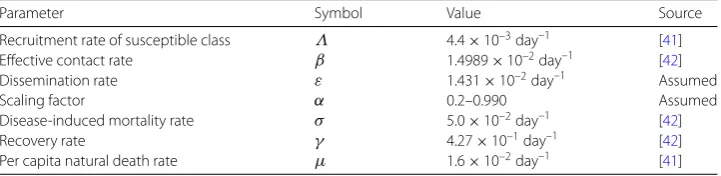
In order to illustrate our theoretical results, we carry out numerical simulations for the mathematical model using the set of parameters from literature as shown in Table1. The values of some parameters in our model are assumed.
4 Discussion
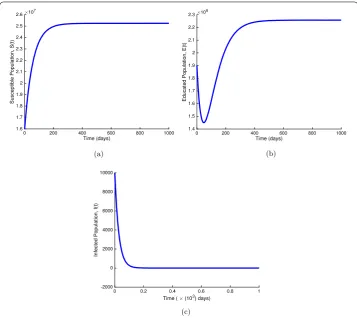
Figure2shows the local stability of disease-free equilibrium whenRE= 0.19090 < 1 as t→ ∞for susceptible (a), educated (b), and jigger-infested (c) populations. From the fig-ure, we note that the number of susceptible individuals (see Fig.2(a)) is more than the
Table 1 Parameter values used in Figs.2,3,4,5and6
Parameter Symbol Value Source
Recruitment rate of susceptible class Λ 4.4×10⁻³day–1 [41]
Effective contact rate β 1.4989×10⁻²day–1 [42]
Dissemination rate ε 1.431×10⁻²day–1 Assumed
Scaling factor α 0.2–0.990 Assumed
Disease-induced mortality rate σ 5.0×10⁻²day–1 [42]
Recovery rate γ 4.27×10⁻¹day–1 [42]
Figure 2The dynamics of susceptible (a), educated (b), and infected (c) populations in model system (1) whenRE= 0.19090 < 1. Used parameter values are in Table1
number of educated individuals (see Fig.2(b)). This may be due to the fact that public health education is not necessary at this time since there are still no infections in the pop-ulation. In Fig.2(c) we also observe that the number of jigger-infested individuals drops rapidly to zero as the number of educated individuals increases. This confirms our theoret-ical findings that public health education is a very effective control measure in eradicating the jigger menace.
Figure3shows that the disease-endemic equilibriumϕ∗is locally asymptotically stable whenRE= 1.231 > 1 ast→ ∞for the susceptible and educated populations (a) and the
jigger-infested population (b). Figure3(b) depicts a sharp increase in the number of in-fested individuals at the onset of an infection before the stability status is attained. This could be attributed to the decrease in the educated population in Fig.3(a) which has con-sequently resulted in an increase in the number of susceptible individuals. This implies that if the control measures are implemented whenever there is an outbreak of jigger in-festation, then the disease prevalence is most likely to be contained.
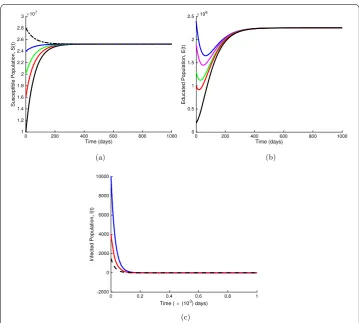
In Fig. 4(a), (b), and (c), we present the time evolution of the density of susceptible, educated, and jigger-infested populations, respectively, with different initial values when
RE= 0.19090 < 1. From Fig.4, we note that a steady increase in the number of educated
Figure 3The dynamics of model system (1) whenRE= 1.231 > 1 for the susceptible and educated populations (a) and the infected population (b) based on parameter values in Table1
Figure 4Global stability of the disease-free equilibrium. (a): global stability of the disease-free equilibrium whenRE= 0.19090 < 1 for the susceptible population. (b): global stability of the disease-free equilibrium whenRE= 0.19090 < 1 for the educated population. (c): global stability of the disease-free equilibrium when RE= 0.19090 < 1 for the infected population. Parameter values are available in Table1
Figure 5Global stability of the disease-endemic equilibrium whenRE> 1. (a): global stability of the disease-endemic equilibrium for the susceptible population. (b): global stability of the disease-endemic equilibrium for the educated population. (c): global stability of the disease-endemic equilibrium for the jigger-infested population. The used parameter values are available in Table1
In Fig. 5(a), (b), and (c), we present the time evolution of the density of susceptible, educated, and jigger-infested populations, respectively with different initial values when
RE= 1.231, which is greater than unity. The numerical result illustrated in Fig. 5
con-firms that model system (1) has only one unique positive endemic equilibrium point when
RE> 1. This implies that there is no bifurcation and the disease will persist in the
popula-tion if control measures are not put in place whenever there is an outbreak.
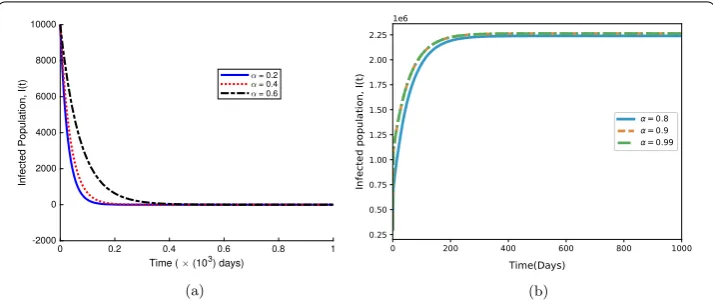
Finally, in Fig.6(a), we study the influence of parameterαon the total density of infested individuals withα= 0.2, 0.4, 0.6 whenRE= 0.7671 < 1, where we establish that decreasing
the value ofαcould accelerate the extinction of the jigger menace. Figure6(b) depicts the effect of different values of the parameterαwithRE= 1.2783 > 1 on the total density of
jigger-infested individuals. From Fig.6, we observe that whenαapproaches one, the dis-ease approaches an endemic equilibrium point. That is, the infection persists in the popu-lation. This implies that whenRE> 1, public health education does not completely change
Figure 6The influence of different values ofαon the total density of jigger infested individuals. For (a),
α= 0.2, 0.4, 0.6 withRE= 0.7671, whereasα= 0.80, 0.90, 0.99 for (b) withRE= 1.2783. Other parameter values are as displayed in Table1
5 Conclusion
In this paper, the jigger infestation mathematical model with public health education as an intervention strategy was formulated and comprehensively analyzed. Using the theory of differential equations, the invariant set in which the solutions of the model are biologically meaningful was derived. Boundedness of solutions was also proved. Analysis of the model showed that there exist two possible solutions, namely the disease-free equilibrium point and the positive endemic equilibrium point. Further analysis showed that both the disease-free and the endemic equilibria points are locally and globally asymptotically stable. It means that the jigger menace will disappear ifRE< 1, otherwise, it will be prevalent if RE> 1.
Numerical simulations have been performed to support the analytical results. At the same time, we have discussed the influence of different values ofαon the total density of the jigger-infested individuals, establishing that public health education is an effective measure of controlling the jigger menace as it reduces the spreading threshold. From this work, we recommend that control measures be put in place especially in resource-poor communities where the disease is endemic. Even though tungiasis is a public health haz-ard, reliable data on the disease occurrence are very scarce. The disease is in many ways a hidden disease that is generally neglected by healthcare providers and political decision makers.
This work provides a basic dynamical model that can be used to understand the im-pact of public health education on jigger infestation. Finally, the model has mass-action transmission, which assumes homogeneous mixing; however, in reality, the contact pro-cess of population cannot be uniform collision, different people contact person may be entirely different per unit of time. For future work, we propose that complex networks [31,32,43–46], which consider the mechanisms of epidemic transmission in large-scale social networks with distinct heterogeneities, be incorporated into the model.
Acknowledgements
Funding
This work was partially supported by China Scholarship Council under CSC No. 2015404006 and Taita Taveta University.
Competing interests
The authors declare that they have no competing interests.
Authors’ contributions
RAN designed the study, performed the mathematical analysis of the model and discussions, and also wrote and typeset the manuscript. DNA and TOO performed numerical simulations. TOO also edited the manuscript. CMM proofread the final manuscript. All authors read and approved the final manuscript.
Author details
1Department of Mathematics, Shanghai University, Shanghai, China.2Department of Mathematics and Informatics, Taita Taveta University, Voi, Kenya. 3Department of Mathematics, Masinde Muliro University of Science and Technology, Kakamega, Kenya. 4Institute of Mathematical Sciences, Strathmore University, Nairobi, Kenya.
Publisher’s Note
Springer Nature remains neutral with regard to jurisdictional claims in published maps and institutional affiliations.
Received: 8 May 2018 Accepted: 8 November 2018
References
1. Veraldi, S., Valsecchi, M.: Imported tungiasis: a report of 19 cases and review of the literature. Int. J. Dermatol.46(10), 1061–1066 (2007)
2. Kamau, T.M., Ngechu, R.N., Haile, Z.T., Mwitari, J.: An exploration of factors associated with jigger infestation (tungiasis) among residents of Muranga North District, Kenya. Int. J. Health Sci. Res.4(3), 1–8 (2014)
3. Ehrenberg, J.P., Ault, S.K.: Neglected diseases of neglected populations: thinking to reshape the determinants of health in Latin America and the Caribbean. BMC Public Health5(1), 119 (2005)
4. Heukelbach, J., De Oliveira, F.A.S., Hesse, G., Feldmeier, H.: Tungiasis: a neglected health problem of poor communities. Trop. Med. Int. Health6(4), 267–272 (2001)
5. Heukelbach, J., Wilcke, T., Harms, G., Feldmeier, H.: Seasonal variation of tungiasis in an endemic community. Am. J. Trop. Med. Hyg.72(2), 145–149 (2005)
6. AKT: The Jigger menace in Kenya. Anti-jigger magazine. Ahadi Kenya Trust (October 2018 (2018)). Available at from.
http://www.jigger-ahadi.org/Anti
7. MPHS: Kenya National Assembly Official Record (Hansard). The parliamentary ministerial statement on tungiasis in Kenya. Ministry of Public Health and Sanitation. Available at from
http://www.parliament.go.ke/the-national-assembly/offices/hansard-department. (Retrieved October 2018), (2009) 8. Ngomi, N.N.: Tungiasis in 5–12 year olds and associated factors in Murang’a South district, Central Kenya. Abstracts of
postgraduate thesis (2012)
9. Ruttoh, S.K., Ochieng’Omondi, D., Wanyama, N.I.: Tunga penetrans – a silent setback to development in Kenya. J. Environ. Sci. Eng. B1(4B), 527–534 (2012)
10. Ugbomoiko, U.S., Ariza, L., Ofoezie, I.E., Heukelbach, J.: Risk factors for tungiasis in Nigeria: identification of targets for effective intervention. PLoS Negl. Trop. Dis.1(3), 87 (2007)
11. Eisele, M., Heukelbach, J., Van Marck, E., Mehlhorn, H., Meckes, O., Franck, S., Feldmeier, H.: Investigations on the biology, epidemiology, pathology and control of tunga penetrans in Brazil: I. Natural history of tungiasis in man. Parasitol. Res.90(2), 87–99 (2003)
12. Feldmeier, H., Eisele, M., Sabóia-Moura, R.C., Heukelbach, J.: Severe tungiasis in underprivileged communities: case series from Brazil. Emerg. Infect. Dis.9(8), 949 (2003)
13. Feldmeier, H., Sentongo, E., Krantz, I.: Tungiasis (sand flea disease): a parasitic disease with particular challenges for public health. Eur. J. Clin. Microbiol. Infect. Dis.32(1), 19–26 (2013)
14. Mwangi, J.N., Ozwara, H.S., Gicheru, M.M.: Epidemiology of tunga penetrans infestation in selected areas in Kiharu constituency, Murang’a County, Kenya. Trop. Dis. Travel Med. Vaccines1(1), 13 (2015)
15. Yao, H., Liang, R.: Vaccination strategies of a modified SIS model on complex networks. IJCTT4(3), 346–351 (2015) 16. Tchuenche, J.M., Dube, N., Bhunu, C.P., Smith, R.J., Bauch, C.T.: The impact of media coverage on the transmission
dynamics of human influenza. BMC Public Health11(1), 5 (2011)
17. Liu, R., Wu, J., Zhu, H.: Media/psychological impact on multiple outbreaks of emerging infectious diseases. Comput. Math. Methods Med.8(3), 153–164 (2007)
18. Collinson, S., Heffernan, J.M.: Modelling the effects of media during an influenza epidemic. BMC Public Health14(1), 376 (2014)
19. Huo, H.-F., Wang, Y.-Y.: Impact of media coverage on the drinking dynamics in the scale-free network. SpringerPlus 5(1), 204 (2016)
20. Huo, H.-F., Wang, Y.-Y.: Impact of media coverage on the drinking dynamics in the scale-free network. SpringerPlus 5(1), 204 (2016)
21. Mukandavire, Z., Garira, W., Tchuenche, J.: Modelling effects of public health educational campaigns on HIV/AIDS transmission dynamics. Appl. Math. Model.33(4), 2084–2095 (2009)
22. Bhunu, C.P., Mushayabasa, S., Kojouharov, H., Tchuenche, J.: Mathematical analysis of an HIV/AIDS model: impact of educational programs and abstinence in sub-Saharan Africa. J. Math. Model. Algorithms10(1), 31–55 (2011) 23. Feldmeier, H., Sentongo, E., Krantz, I.: Tungiasis (sand flea disease): a parasitic disease with particular challenges for
public health. Eur. J. Clin. Microbiol. Infect. Dis.32(1), 19–26 (2013)
25. Kahuru, J., Luboobi, L., Nkansah-Gyekye, Y.: Stability analysis of the dynamics of tungiasis transmission in endemic areas. Asian J. Math. Appl.2017, Article ID ama0385 (2017)
26. Kahuru, J., Luboobi, L.S., Nkansah-Gyekye, Y.: Optimal control techniques on a mathematical model for the dynamics of tungiasis in a community. International Journal of Mathematics and Mathematical Sciences2017(2017) 27. Nthiiri, K.J.: Mathematical modelling of jigger infection incorporating treatment as a control strategy. Int. Electron. J.
Pure Appl. Math.11(2), 87–97 (2017)
28. Diekmann, O., Heesterbeek, J.A.P., Metz, J.A.: On the definition and the computation of the basic reproduction ratio R0 in models for infectious diseases in heterogeneous populations. J. Math. Biol.28(4), 365–382 (1990)
29. Korobeinikov, A., Wake, G.C.: Lyapunov functions and global stability for SIR, SIRS, and SIS epidemiological models. Appl. Math. Lett.15(8), 955–960 (2002)
30. Anderson, R.M., May, R.M.: Infectious Diseases of Humans: Dynamics and Control. Oxford University Press, London (1992)
31. Pastor-Satorras, R., Castellano, C., Van Mieghem, P., Vespignani, A.: Epidemic processes in complex networks. Rev. Mod. Phys.87(3), 925 (2015)
32. Pastor-Satorras, R., Vespignani, A.: Epidemic spreading in scale-free networks. Phys. Rev. Lett.86(14), 3200 (2001) 33. Omondi, O.L., Wang, C., Xue, X., Lawi, O.G.: Modeling the effects of vaccination on rotavirus infection. Adv. Differ. Equ.
2015(1), 381 (2015)
34. Van den Driessche, P., Watmough, J.: Reproduction numbers and sub-threshold endemic equilibria for compartmental models of disease transmission. Math. Biosci.180(1–2), 29–48 (2002)
35. Li, J., Blakeley, D., Smith, R.J.: The failure of R0. Comput. Math. Methods Med. (2011).
https://doi.org/10.1155/2011/527610
36. Perko, L.: Differential Equations and Dynamical Systems, vol. 7. Springer, Berlin (2013)
37. Kelley, W.G., Peterson, A.C.: The Theory of Differential Equations: Classical and Qualitative. Springer, Berlin (2010) 38. La Salle, J., Lefschetz, S.: Stability by Liapunov’s Direct Method with Applications, vol. 4. Elsevier, Amsterdam (2012) 39. LaSalle, J.P.: The Stability of Dynamical Systems, vol. 25. SIAM, Philadelphia (1976)
40. McCluskey, C.C.: Lyapunov functions for tuberculosis models with fast and slow progression. Math. Biosci. Eng.3, 603–614 (2006)
41. CIA: The CIA World Factbook. C I Agency. Skyhorse Publishing, New York (2011)
42. KNBS: Kenya Demographic Profile. Available athttps://reliefweb.int/sites/reliefweb.int/files/resources/Kenya. (Retrieved October 2018), (2014)
43. Barrat, A., Colizza, V., Vespignani, A.: Epidemic spreading and complex networks. Complex Networks254(2010) 44. Barabasi, A.-L., Albert, R.: Emergence of scaling in random networks. Science286(5439), 509–512 (1999) 45. Pastor-Satorras, R., Castellano, C., Van Mieghem, P., Vespignani, A.: Epidemic processes in complex networks. Rev.
Mod. Phys.87(3), 925 (2015)