2301
Testing The Weak Form Of Efficiency Of
Cryptocurrencies: A Case Study Of Bitcoin And
Litecoin
Iqbal Thonse Hawaldar, Rajesha T M, Lolita Jane D Souza
Abstract: This study examines the weak form of efficiency of the exchange rate of cryptocurrencies against US Dollar. The study is based on the exchange rate of Bitcoin and Litecoin against US Dollar from 2013 to 2017. The data is tested for heteroscedasticity, and the efficiency of these coin market is analysed using unit root and stationary tests such as Augmented Dickey-Fuller (ADF) test, Philips Perron (PP) test and Kwiatkowski–Phillips–
Schmidt–Shin (KPSS) tests. The results of the study reveal that the Bitcoin and Litecoin exchange rate exhibit a random walk. Speculation helps for the
rapid growth of these currency markets. It is advisable for the investors to invest for short term to get higher returns rather than for the long-term. Investment in cryptocurrencies involves market shocks due to its unpredictable nature.
Index Terms: Bitcoin, Cryptocurrencies, Digital currency, Litecoin, Random walk, Weak form efficiency.
————————————————————
1 I
NTRODUCTIONCryptocurrency is an encrypted digital currency, which is used as an alternative for paper money in online transactions. Bitcoin was the first decentralised cryptocurrency, introduced in the year 2009 as an open source software. Since then, a lot of other digital currencies were introduced into the virtual market, and these currencies are often called altcoins. These cryptocurrencies share the typical blockchain transaction (public ledger), and participants run the network by using digital token, without a centralised system, which is in oppose to the central banking and centralized money market system. Decentralized cryptocurrency is generated by the entire cryptocurrency system conjointly, at a rate that is outlined in the system and will be publicized once it is generated in the system. In centralized banking and economic systems, the government administers the supply of the currency by producing units of fiat currency. Whereas in the matter of decentralized cryptocurrency, governments will not produce, and legality of these currencies vary from country to country. During the early stage of 2014, use and trade of bitcoins by the financial entities had banned by the central bank of China, when it was in the affluent phase. Whereas in America usage of bitcoin has been legalized in 2014 and it was considered as a property for tax collection, by the internal revenue service of the United States.
In the case of Russia, usage of cryptocurrencies other than Russian ruble is considered as illegal.
Fig 1: Percentage of Total Market Capitalization of Cryptocurrencies as on November 2017
Source: coinmarketcap.com/
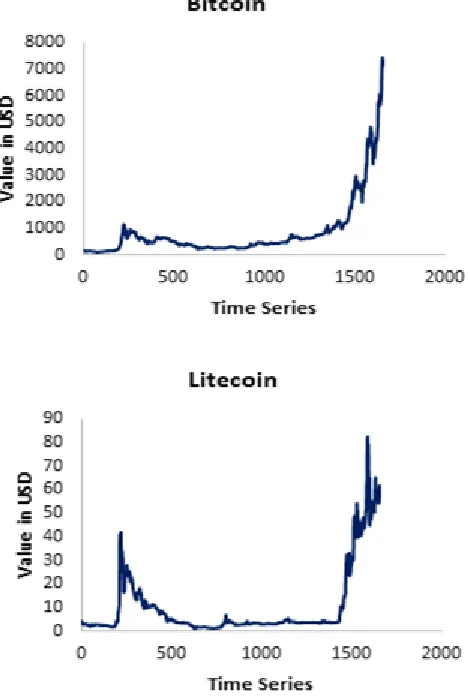
In June 2017, there were more than 1,100 cryptocurrencies in the online market with a market capitalization of more than USD 100 billion. These currencies are highly volatile and identically distributed in contrast with the traditional currencies. Figure 1 indicates that during November 2017, Bitcoin was the highly popular digital currency [5] with a market share of 55.56%. Whereas, the Litecoin, which is most similar to Bitcoin, but the payment cost of Litecoin is almost zero. In November 2017, bitcoin trading reached its lifetime high level with an exchange rate of USD 9,800 (Financial Express, November 2017). Fig 2 shows the historical growth of the exchange rate of Bitcoin and Litecoin, against USD from April 2013 to November 2017. In December 2013, the exchange price of Bitcoin reached its maximum, i.e. $1147, since it was launched in the year 2009. After that peak, the Bitcoin price reached its three years low of $177 in 2015. Where as in the case of Litecoin, it came into existence from 2011, which also exhibited similar patterns of price fluctuations like Bitcoin and it shares similarities with Bitcoin in terms of its algorithms and use of block chain technology. For a longtime, Litecoin was the immediate rival for Bitcoin concerning to the market and trade volume.
————————————————
Iqbal Thonse Hawaldar, Professor, Department of Accounting and Finance, College of Business Administration & Director for Accreditation and Quality Assurance Centre, Kingdom University, Bahrain. Email:
Rajesha T M, Institutional Assessment Administrator, Accreditation and Quality Assurance Center, Kingdom University, Bahrain. Email: [email protected]
2302 Fig 2 Bitcoin and Litecoin Exchange rate against USD from April
2013 to November 2017
Source: coinmarketcap.com/
Capital market is said to be efficient if it reveals all the necessary information to its stakeholders, in determining the security prices [12]. Based on the different information (), which affects the price fluctuations, the efficiency of the market is categorized into three forms, viz. weak form, semi-strong form and semi-strong form. The weak form of the Efficient Market Hypothesis (EMH) is the condition, where the stock return is the replication of all the historical information related to the stock prices (9, 14, 15}. Thus, the stock returns are serially un-correlated and will have a constant mean [10, 11, 12, 13, 14, 15]. Cryptocurrencies are still in its developing stage; therefore, it is essential to research to understand the efficiencies of the market. The main source of uncertainty in the digital currency market is the extreme volatility of the price; thereby, it is very difficult to predict the price fluctuations of these currencies [1]. In this study, we have tested unit root and stationarity of the historical exchange price data of Bitcoin and Litecoin using, Dickey-Fuller, Phillips Perron and Kwiatkowski–Phillips–Schmidt–Shin tests.
2. Review of Literature
In this section, we reviewed the important studies related to the volatility of cryptocurrencies and the efficient market hypothesis.
2.1 Volatility of Cryptocurrencies
[3] analyzed the statistical properties of the cryptocurrencies by fitting parametric distributions and observed that, there is no single distribution fits well to all the cryptocurrencies. Whereas the generalized hyperbolic distribution fits well for the most popular cryptocurrencies such as Bitcoin and Litecoin. [1] examined the weak form efficiency of Bitcoin and Litecoin by using GARCH (1,1) unit root modelling with structural break and tested the efficiency by applying unit root test and found that Bitcoin and Litecoin market weak form efficiency is inconsistent as the unit root test indicates the existence of stationarity in the Bitcoin model. The study concludes that as the value of cryptocurrencies depends on the conjecture power, it leads the investors to overvalue or devalue the cryptocurrencies there by resulting in the market price fluctuations. [4] studied the price volatility of the cryptocurrencies by GARCH modelling and the result reveals that the most popular cryptocurrencies such as Bitcoin, Litecoin, Ethereum and others exhibit high volatility in their value, especially in the in case of inter-daily prices. [15] in their study examined the dynamic properties of Bitcoin and SP500 index by GARCH modelling and vector auto regressive specifications and the results of the study revealed that Bitcoin does not hold any hedge nor any diversifier attributes, it exhibits its intrinsic attributes, and it is not related to developments of SP500 stocks. [2] developed a new dynamic model, that could account for the asymmetries in the price volatility and long memory, to study the crypto currencies financial time series behaviour and their study provide evidence that the long memory and the leverage effect of the cryptocurrencies significantly impact the dynamic price volatility of the cryptocurrencies. [16] attempted to test the volatility of bitcoin by selecting GARCH (1 1), IGARCH (1 1), EGARCH (1 1), TGARCH (1 1) and GJR-GARCH (1 1) models and applied OLS regression to the price volatility series to examine the day of the week effect. The outcomes of the study indicated that TGARCH (1 1) model best fits the price volatility data of bitcoin and the study revealed that the most significant volatility of prices appears to be on Sunday. [13] determined the statistical property of cryptocurrencies by characterizing the exchange rate of cryptocurrencies versus the US Dollar by fitting parametric distributions and observed that, returns are non-normal, and he suggest that the results are significant for investment and risk management purposes.
2.3 Efficient Market Hypothesis
2303
R
d= Ln P
dP
d−1𝜎i2= 0 + 1 Xi1 + 2 Xi2 +…….. +k Xik (2) the Run test revealed that the stock prices do not follow
random walk thus concluded that the individual stocks listed in Bahrain Bourse are not weak form efficient. [7, 9, 14] tested the weak form efficiency of BSE and NSE, two major equity markets of India. They analyzed the data from 1997 to 2011 using different statistical methods such as ADF, PP and KPSS tests, and the results of the tests succeeded to recognize weak form efficiency only from 2007 to 2011. Whereas for the earlier period PP test results indicated weak form inefficiency, thus they rejected the argument of weak form efficiency of these equity markets for the sample period. [12, 11, 16] examined the efficiency of stock markets for various economic development levels, by applying stationarity test with multiple structural breaks and it has been found that the stock prices of 26 developing and 32 developed countries are stationary indicating that there is an existence of arbitrage opportunities among these markets. This result is inconstant with the theory of the efficient market hypothesis.
3. Objectives and Hypotheses
The objective of the study is to test the weak form efficiency of the exchange rate of Bitcoin and Litecoin against US Dollar. To examine these objective following hypotheses are constructed:
H1: Cryptocurrency exchange rates are Non-volatile.
H2: The exchange rate of selected cryptocurrencies is normally distributed.
H3: The exchange rate residuals of selected cryptocurrencies are homoscedastic
H4: There is a presence of unit root in the exchange rate series of Bitcoin and Litecoin.
H5: The exchange rate series of Bitcoin and Litecoin are stationary.
4. Research Methodology
The objective of the study is to test the presence of the weak form efficiency of the daily exchange rate of Bitcoin and Litecoin against US dollar. The study is based on the exchange rate of Bitcoin and Litecoin against US dollar ranging from 2013-2017 retrieved from coin market, and the data has been tested for heteroscedasticity using Breusch-Pagan test and found that the residuals are heteroscedastic. Weak form efficiency of the exchange rate of these cryptocurrencies has been tested using Augmented Dickey-Fuller test, Phillips-Perron test and KPSS test. Daily log returns of exchange rate data indicate that the selected data is independent and normally distributed
(1)
Where,
Pd = Closing exchange rate of current day P (d-1) = Closing exchange rate of the previous day
Breusch-Pagan Test for Heteroscedasticity
Assuming a linear heteroscedasticity equation of independent variables:
(2) Since, due to the possibility of an error term in the population model u ̂i, which can refer as an OLS residual.
̂
i2= 0 + 1 Xi1 + 2 Xi2 +…….. +k Xik + viWhere the hypothesis is set to be H0: Var (ui / Xi) =
𝜎
2 and H1: Var (ui / Xi) ≠𝜎
2Where the null hypothesis indicates that H0: 1 = 0, 2 =0, 3 =0………. k= 0
So Breusch-Pagan equation can be written as:
(3)
5. Data Analysis
Table1 provides the summary statistics of daily exchange and the log return rate of Bitcoin and Litecoin. From table 1 it is evident that the exchange rate, mean, median & minimum values of Bitcoin are very much high compared to that of Litecoin, which indicates its dominance and high significance in the cryptocurrency market [3]. The exchange rate of both cryptocurrencies is positively skewed, with Bitcoin is being skewed the most. Regarding the results of the Kurtosis, both digital currencies are having higher values than the normal distribution. It is observed that the greater the value of variance and standard deviation for both Bitcoin and Litecoin indicates, the higher volatility (H01) in the exchange rates of these digital currencies. The Log return table gives a better picture by providing skewness within the limit indicates that the log return of both Bitcoin, as well as Litecoin, is normally distributed. Thus, H02 is accepted, and it indicates that the exchange rates of the selected digital currencies are consistent with the assumptions of the weak form efficient market hypothesis.
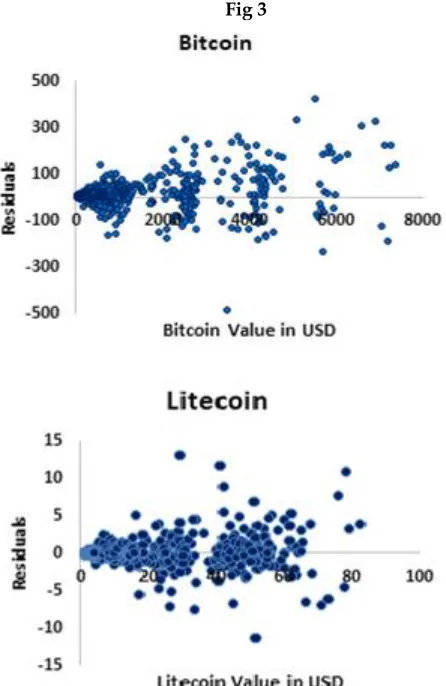
2304 Fig 3
The above figure indicates the exchange rate clustering of the Bitcoin and Litecoin against US Dollar; this result is also supported by the Breusch-Pagan test for heteroscedasticity. Thus, we reject H03, as the exchange rate residuals of selected cryptocurrencies are heteroscedastic. Since the data is found heteroscedastic, we tested the data for the random walk behaviour using ADF test, PP test and KPSS test.
Table 2. Unit Root and Stationary Test for Random Walk
Table 2 provides the results of ADF, PP and KPSS tests, which has been categorized on a yearly basis, and each test has been conducted at the 0.01 significance level. The results of the ADF test indicates the presence of unit root for all the specified time intervals for both Bitcoin and Litecoin. This supports the argument that Exchange rates of Bitcoin and Litecoin against US Dollar exhibit random walk pattern. This argument also backed by the Philips- Perron test as it has failed to determine the stationarity in the series of data. The results of ADF and PP tests support to accept the null hypothesis (H04) since the results revealed the presence of unit roots in the series. KPSS test was conducted to test the stationarity of the series, and the results indicated that as the series is not stationary for both in the cases of Bitcoin and Litecoin. Thus, H05 is rejected. Based on the Unit root and Stationarity test results, we can reject the null hypothesis, as the observed t-statistics is lesser than its critical value. Therefore, we can conclude that both Bitcoin as well as Litecoin exhibit random walk model, thereby it is consistent with weak form efficiency.
5. Conclusion
This paper is an attempt to test whether the cryptocurrency prices exhibit a random walk or not. Our study examined the price data of Bitcoin and Litecoin, and the results revealed that both digital currencies exhibit random walk pattern as the presence of unit roots observed in the statistical test results. Which means that these cryptocurrency markets are weak-form efficient; thus, it is not possible to predict the future returns based on the past price information of the currencies. The rapid growth in the cryptocurrency is a result of speculation power, so it is advisable for the investors to invest in cryptocurrencies for a shorter period to earn higher return rather than investing for long-term as it involves high market risk and unpredictability of the market behaviour [6, 9, 14] Further research is required to analyze the cryptocurrency behaviour concerning the regulatory arbitrage and monitory policy.
R
EFERENCES[1] Alam, S. (2017). Testing the weak form of an efficient market in cryptocurrency. Journal of engineering and applied sciences, 12(9), 2285-2288.
[2] Catania, L and Grassi, S (2017). Modelling Crypto-Currencies Financial Time-Series. Available at SSRN: https://ssrn.com/abstract=3028486
[3] Chan, S., Chu, J., Nadarajah, S., & Osterrieder, J. (2017). A statistical analysis of cryptocurrencies. Journal of Risk and
Financial Management, 10(2), 12.
doi:10.3390/jrfm10020012
[4] Chu, J., Chan, S., Nadarajah, S., & Osterrieder, J. (2017). GARCH modelling of cryptocurrencies. Journal of Risk and Financial Management, 10(4), 17.
[5] Cocco, L., Concas, G., & Marchesi, M. (2017). Using an artificial financial market for studying a cryptocurrency market. Journal of Economic Interaction and Coordination, 12(2), 345-365.
2305 blockchain stack position. Available at SSRN:
https://ssrn.com/abstract=3073727.
[7] Gupta, R., & Yang, J. (2011). Testing weak form efficiency in the Indian capital market. International Research Journal of Finance and Economics, 75(1), 108-119.
[8] Hamid, K., Suleman, M.K., Ali Shah, S.Z., & Imdad Akkash, R., 2010. Testing the weak form of efficient market hypothesis: Empirical evidence from Asia-Pacific markets. International Research Journal of Finance and Economics, 58, pp. 121-133.
[9] Hawaldar, I. T., Rohit, B., & Pinto, P. (2017). Testing of the
weak form of efficient market hypothesis: evidence from the Bahrain Bourse.14 (2), 376-385.
[10]Hawaldar, I. T. (2016 a). The Cross-Sectional Variations in Portfolio Returns: Evidence from Bahrain Bourse. British Journal of Economics, Finance and Management Sciences, 12(2), 1-11.
[11]Hawaldar, I. T. (2016 b). The Reaction of Bahrain Bourse to Announcement of Annual Financial Results. International Review of Business Research Papers, 12(1), 64-75.
[12]Iqbal, T.H. & Mallikarjunappa, T. (2011). Efficiency of Stock Market: A Study of Stock Price Responses to Earnings Announcements. LAP Lambert Academic Publishing Company, Germany.
[13]Iqbal, & Mallikarjunappa, T. (2010). A Study of Efficiency of the Indian Stock Market. Indian Journal of Finance, 4(5), 32-52.
[14]Iqbal, & Mallikarjunappa, T. (2009). Indian Stock Market Reaction to Quarterly Earnings Information. Indian Journal of Finance, 3(7), 43-50.
[15]Iqbal, & Mallikarjunappa, T. (2007). Market Reaction to Earnings Information: An Empirical Study. AIMS International Journal of Management, 1(2), 153-167. [16]Kumar, H., & Jawa, R. (2017). Efficient market hypothesis
and calendar effects: Empirical evidences from the Indian stock markets. Business Analyst 37(2), 145-160
[17]Lee, C. C., Lee, J. D., & Lee, C. C. (2010). Stock prices and the efficient market hypothesis: Evidence from a panel stationary test with structural breaks. Japan and the world economy, 22(1), 49-58
[18]Malkiel, Burton G (1991). “Efficient Market Hypothesis”, in The New Palgrave Dictionary of Money and Finance, ed. by Peter Newman, Murray Milgate, and John Eatwell (Cambridge University Press), pp. 739-42.
[19]Osterrieder, J (2016). The Statistics of Bitcoin and Cryptocurrencies: Advanced Risk & Portfolio
Management Paper. Available at SSRN:
https://ssrn.com/abstract=2872158
[20]Poshakwale, S. (1996). Evidence on weak form efficiency and day of the week effect in the Indian stock market. Finance India, 10(3), 605-616.
[21]Stavroyiannis, S & Babalos, V (2017). Dynamic Properties of the Bitcoin and the US Market Available at SSRN: https://ssrn.com/abstract=2966998 or http://dx.doi.org/10.2139/ssrn.2966998
[22]Urquhart, A. (2017). Price clustering in Bitcoin. Economics