United Kingdom ISSN 2348 0386 Vol. VII, Issue 11, November 2019
Licensed under Creative Common Page 113
http://ijecm.co.uk/
WHAT IS THE FUTURE PATH OF DEVELOPING COUNTRIES?
Nozimjon Ortikov
Senior Teacher at Tashkent Institute of Finance, Uzbekistan [email protected]
Samariddin Elmirzayev
Doctor of Science, Tashkent Institute of Finance, Uzbekistan [email protected]
Abstract
When it comes to the topic of industrialization in this world, most of economists will readily
agree that future path of developing countries will be different than the one they had experienced in the past. Where this agreement usually ends, however, is on the question of
how it looks like in the future. Whereas some are convinced that technology and Glob al Value Chains (GVCs) can shift the development policy from manufacturing to service and
agriculture sectors, others still maintain that path for development falls on industrialization. This article discusses these issues and provides different scenarios for developing
countries, including Uzbekistan.
Keywords: Industrialization, Structural transformation, Premature deindustrialization, Global Value Chains
INTRODUCTION
Reallocation of labor force from agriculture to industry and then to service sector – structural transformation – has been the salient feature of the economic growth of most developed and
Licensed under Creative Common Page 114 sector. Therefore, economic development has become for countries all about structural change and structural change in turn is about industrial policy or productive economic development policies which entails stimulating specific economic activities and promote structural change.
There are several legitimate reasons why industrialization or manufacturing has been the main drivers of economic growth in the past. As Rodrik (2016) puts it that “productivity
convergence, export expansion, and labor absorption create a virtuous cycle that propel the economy forward until the gap with the global frontier closes and the demands of technological progress become substantially greater.”Most importantly, rapid industrialization
can bring high growth rates in the absence of high level fundamental capabilities like human capital and institutions (Rodrik, 2012). Even though there was not unanimous agreement among development economists on which policy would promote industrialization more effectively, most of them will readily agree that industrialization paves the way to development (Gollin, 2018).
Conversely, common sense seems to dictate that remaining low income countries should follow in those steps in order to achieve rapid and sustained economic growth. If that is the case, then the prospects for them, according to many researchers, look bleak. For example, Rodrik (2016) believes that today’s world is different due to the forces of globalization and
technology. These two factors changed the organization of manufactures in such a way that current low-income countries face almost impossible task to repeat the success of East Asian tigers or the European and North American countries. In particular, today’s developing countries
are experiencing structural transformation without having fully industrialization. That is every successive cohort of industrializers saw a secular decline in the share of manufacturing employment - the process Rodrik calls it “premature deindustrialization”.
If we accept importance of industrialization for economic growth and the fact that today’s
low-income countries cannot emulate the transformation in a manner mentioned above, then it raises following the several urgent questions:
What would be the future path of those countries in a post-industrial world?
How could they generate sustained economic growth?
Are there any alternatives for those economies?
Is there any role for industrial policy and if yes, how should it be?
Licensed under Creative Common Page 115 WHY MANUFACTURING WAS SO IMPORTANT FOR GROWTH?
Countries grow over time only if its workers’ productivity increases. As Krugman (1994) reckon
that "productivity isn't everything, but in the long run it is almost everything. A country's ability to improve its standard of living over time depends almost entirely on its ability to raise its output per worker."Where does this productivity come from? Or in other words, which sector does have advantage over others for increased productivity?
To date, there has been no theoretical evidence which might claim that one particular sector has important to others for economic growth. Most growth theories are silent about the pros or cons of different sectors for growth. Solow’s classic growth theory is based on a single
sector (Solow, 1956) and long run growth comes from capital accumulation. His analysis made no point about particular sector for long run economic growth. Just as exogenous model, endogenous growth theory (Romer, 1986) also is modeled without mentioning explicitly any sector except pointing out the benefits of learning-by-doing as the potential sources of growth.
Literature on structural changes also does not provide convincing theoretical foundation why one sector might have comparative advantage over others in terms of productivity (See e.g.: Herrendorf, Rogerson, and Valentinyi (2014) for a recent survey on the mechanisms of structural transformation. See, among others, Baumol (1967), Ngai and Pissarides (2007, 2008), and Acemoglu and Guerrieri (2008) for the role of uneven productivity or different capital intensities.). Mechanism that gives a birth to structural change in all papers is a strong assumption which says there is uneven productivity between sectors. Two-sector or multi sector models then are calibrated to fit the data. On the other hand, another strand of literature in agricultural economics argues that productivity growth in agriculture, not in manufacturing, has been pivotal to economic growth and structural transformation (Gollin et al, 2007).
While growth and structural transformation theories don’t provide reliable theoretical
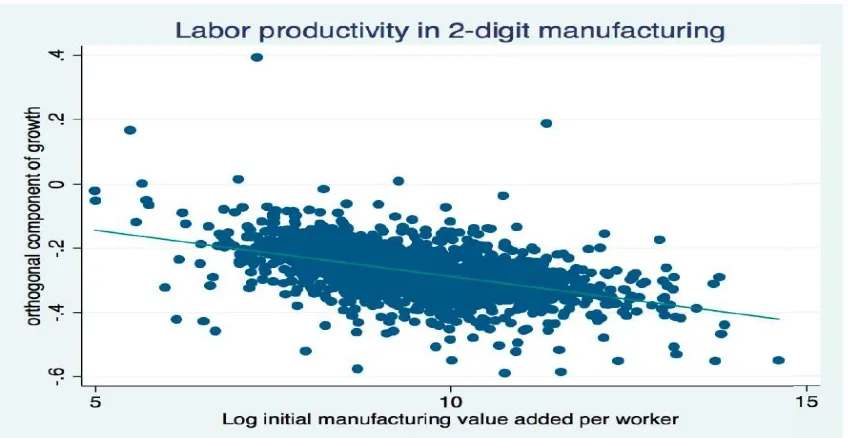
Licensed under Creative Common Page 116 Figure 1. There is unconditional productivity convergence in (formal) manufacturing
Source: Rodrik, Dani. “The past, present and future of economic growth”, 2012
Using 118 countries and 2000 observations in the sample (Figure 1), he finds that formal manufacturing industries uncover strong convergence relationship (convergence rate is around 2 percent per annum). Based on this result, he concludes that formal manufacturing industries lead the economy even in the presence of bad governance and lousy policies and productivity can be increased easily in this sector relative to traditional agriculture or most services.
It is worth noting that this was true in the past. As it was mentioned at the beginning, now world is believed to be different.
HOW WORLD IS DIFFERENT NOW?
So far, we have established that manufacturing industries played critical role for those countries which have sustained high growth rates for the past decades. Several factors explain this phenomenon. First, manufacturing industries have comparative advantage in terms of having positive dynamic productivity. Second, manufacturing products are tradable. Tradable goods matter because countries can expand scale of production infinitely by capturing market share in world market. This removes possibility of facing restricted demand in domestic market. Finally, manufacturing industries can absorb large number of unskilled workers who are in abundance in developing countries.
But, today’s world is different due to technological progress and globalization under
Licensed under Creative Common Page 117 industrialization and how would be the trajectory of structural transformation and industrial policies in developing economies.
Rodrik (2017) argues that these two distinctive features of world economy make difficult if not impossible to emulate the past experiences of Japan, East Asian Tigers, and other successful economies. Rapid technological progress has two effects on manufacturing: it has decreased significantly the price of manufacturing product relative to service items thereby reducing the chance of low-income countries’ entry into global trade; it made manufacturing
more capital and skill intensive lowering the labor-absorbing potential of this sectors. On the other hand, China’s joining into world market made difficult other small developing countries’
ability not only entering into market but also even carrying the import-substitution policy due to low level of tariffs across the world.
Another phenomenon of the recent past years is Global Value Chains (GVCs) which is the byproduct of introducing new technologies in manufacturing processes. While under the traditional model of industrialization (for example, South Korea, Taiwan, Hong Kong and Singapore), countries needed to build entire industries, but improvement in communication and information technology allowed countries to participate in global value chains even if in the absence of large industrial capacities. Striking example of a GVCs is the assembly of a computer disk drive in Thailand whose components are made in ten countries and imported to Thailand (Malherbe, 2018). Or take China where according to Koopman et al’s estimation (2008), foreign inputs accounted for half of China’s export value.
What were the implications of GVCs for manufacturing and industrialization of developing countries? There are two competing views on the role GVCs for low income countries. Baldwin (2011) argues that GVCs reduce entry costs and in turn ease industrialization. That means now developing countries only need to provide low-cost labor in order to be a part of global value chain. On the other hand, potential of industrialization becomes less important for aggregate economic growth (Rodrik, 2012). Because employment absorption capacity of manufacturing industries will be restricted and technology adoption and spillovers stay under control of those corporations which governs the supply chains.
Licensed under Creative Common Page 118 and Africa, to join in. Amador and Cabral (2017) were not alone in finding that “value-added
trade networks are very centralized and asymmetric, with hierarchical structures dominated by a few central countries that act as hubs.”
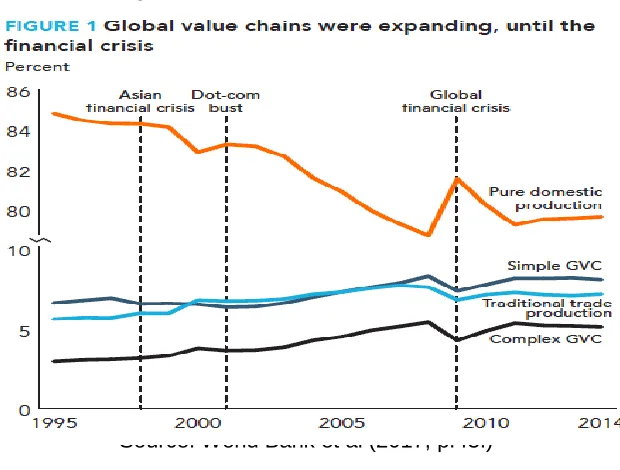
Second, the data from the World Bank et al’s (2017) report indicates that GVCs’
expansion trends seem to halt in recent years (Figure 2).In parallel, globalization also slowed down after the 2008 global financial crisis.
For example, Cowen (2016) argues that globalization as a trend may have peaked over the last twenty years. Third and most worrying fact is that job-creation-potential of export sector has been quite disappointing. Cali et all (2016) using input-output data have found that the job intensity of exports has steadily declined since around 2001 in both advanced and developing nations.
Figure 2. Trends in Global Value Chain
Source: World Bank et al (2017, p.43.)
In sum, all of those mentioned circumstances mean that path based on manufacturing looks both less suitable and likely. A new roadmap has to be invented for low-income countries. So, what are alternatives for sustained high growth? Can the economy of low-income countries based on service or agriculture sector achieve convergence toward developed nations? How should be productive development policy in today’s world?
FUTURE PATHS OF DEVELOPING COUNTRIES
Licensed under Creative Common Page 119 the past. Where this agreement usually ends, however, is on the question of how it looks like in the future. Whereas some are convinced that technology and GVCs can shift the development policy from manufacturing to service and agriculture sectors, others still maintain that path for development falls on industrialization.
Let’s take Rodrik’s views. Even though he accepts that developing countries will unlikely
emulate the past success of current developed nations, he does not believe that service sector has a capacity to absorb large number of workers in low-income countries. For that productivity should be very high in service-sector. It is true that service sector tends to be productive than traditional agricultural sector, however it has not generated as high productivity as done manufacturing over the course of history. In addition, service sector has a mixture of very diverse sub-sectors – some are tradable, others are not. Tourism, IT, finance indeed can be as
productive as manufacturing. But activities like retail, wholesale, and many personal services are technologically stagnant and most of the time operate informally. Trouble is that services in the first category cannot absorb large number of unskilled labor. Hence, they have less capacity to offer employment for low-skilled workers (Rodrik, 2017).
What should then developing-countries do in this case? He argues that since more growth comes from advances in service sector, countries should replace sectoral industrialization policies with massive investments in human capital and institutions. In terms of manufacturing, he asserts that selective policies like free-economic zones, incentivizing exporter firms, or providing incentives to foreign investors can be effective.
Similarly, Cowen (2016) also accepts the limitations of relying on manufacturing as a growth driver by developed countries. He even further argues that changes in manufacturing mentioned above might touch on service sector as well and offers a new path for the world which he names it – “trickle down growth”. Under such scenarios source of economic development becomes the erosion of intellectual properties and price discrimination.
A vivid example of this phenomenon is the spread of cell and smart phones in many poor nations despite the fact that innovation behind these devices have been developed in advanced nation. Part of that is the result of price discrimination. Besides, they also brought immense benefit to those countries. Entire chain of internet services has followed this process resulting in also spreading the intellectual property rent to these places.
How does this world look like according to Cowen (2016)? Well, important assumption is to have myriad of sectors in advanced countries with the increasing returns to scale of production technology. This is true the most tech-sectors. “If everything in the economy looks and acts like the tech sector, this source of growth could be quite significant indeed”. This
Licensed under Creative Common Page 120 and ideas more generally would be abundant in developing nations. Correspondingly, relative price of housing and other non-tradable stuffs like foods will be higher.
Moreover, this scenario does not require more savings and investment in physical infrastructure as it needed in the past for East Asian countries. Subsequently, when ideas and labor cheap those developing nations could specialize in cultural production, educational production, and computer programming, to take advantage of these efficiencies.
On the other hand, in these scenarios there might be another trickle-down effect from the high return of capital in developing countries. Accumulated capital by the companies in advanced nations might seek to invest them in developing countries with larger domestic markets. So, foreign capital also boosts the growth of these economies. Countries with smaller markets can become satellites or willing “economic colonies” of advanced economies like
Mexico did so with the USA or they can construct enclaves within the boundary of the country such as India practiced in Bangalore, Chennai, or Hyderabad.
On the contrary, Golling (2018) is more optimistic about the fate of developing countries even though he concedes that transformation might bypass manufacturing and countries have to rely on service based growth. He argues that current nature of service sector growth has a capacity to drive an economy up through some combination of technological progress (Solow growth), specialization and market expansion, and competition-driven creative destruction (Schumpeterian growth). According to him, “none of these processes are obviously limited to manufacturing, nor is trade necessary for an economy to participate in these processes.”
How will be the future path of resource-rich developing countries? Can such countries achieve high rapid growth through exporting of natural resources? Although natural resource sector can be seen as a type of manufacturing sector which might converge to the global frontier, it has several limitations (Rodrik, 2012). First, this sector is capital and skill intensive which limits its labor absorbing capacity. Second, it creates less spillover effects for other industries due to its nature of having a fewer upstream and downstream networks. Third, the whole economy inherently depends on the boom and bust cycle of natural resources prices in the world market. Next, rents from exporting resources go to states, a small group of investors, and a few workers. Finally, one vital prerequisite for those countries to manage and put the resource into long-term use is to have a solid institutions and high level of human capital.
UZBEKISTAN: STRUCTURAL TRANSFORMATION AND FUTURE GROWTH
Licensed under Creative Common Page 121 heavy dependence on agricultural and natural resources and transform the economy into a modern industrial one.
As Ajwad et al (2014) reckon that “after a period of deteriorating socio-economic indicators in the post-independence era, economic growth in the late 1990s and early 2000s consisted primarily of “catch-up growth.” However, more recent economic growth has been
driven predominantly by strong exports, increasing domestic demand, expansionary government policies, and a strong inflow of remittances. Attaining a growth rate of nearly 8 percent per year, Uzbekistan’s economic performance in the past decade outpaced not only its peers in ECA, but also the OECD countries” (Figure 3, Panel A).
As Popovand Chowdhury (2015) show that during the post-independence period Uzbekistan was able to carry out three important structural shifts in its economy: (1) decrease in cotton production and export and increase in food production, achieving self-sufficiency in food, (2) achieving self-sufficiency in energy and becoming a net fuel exporter; (3) increasing the share of industry in GDP and the share of machinery and equipment in industrial output and export. They also argue that Uzbekistan is a success story in terms of economic development in Post-Soviet era given the fact that its transformational recession was very mild as compared to other countries of former Soviet Union and its GDP more than doubled in 1989-2012 which is one of the better result among transition countries. They attribute this progress to two factors –
first favorable external environment and second and most important –to domestic economic policy.
Externally, commodities like cotton, gold and gas account for large proportion of exports and their prices have been increased in the past decades helping Uzbekistan to reap the benefits of boom market. Most importantly, good macroeconomic and industrial policy had paid off. In contrast to many post-Soviet countries, Uzbekistan managed to increase the share of industry in GDP, the share of machinery and equipment in total industrial output and in exports. Competitive export oriented auto industry has been created from scratch.
Licensed under Creative Common Page 122 Figure 3. Uzbekistan: share of sectors in GDP, 1995-2012
Source: “The Skills Road: Skills for Employability in Uzbekistan.” World Bank. Washington, DC. 2014
Outcomes from this growth model were mixed blessing. Initially low living standards went up but fell increasingly short of the country’s goal of reaching upper middle-income country status,
although Uzbekistan outperformed some of the other regional economies (Figure 4, Panel B).
Figure 4, Uzbekistan: Growth and Living Standards Panel A. Uzbekistan's GDP growth rate has
been stronger than most ECA countries
Panel B. Living Standards, 1995-2016 (PPP GDP per capita, current U.S. dollars)
Sources: World Development Indicators & IMF country report, May 2018
Licensed under Creative Common Page 123 In order to keep the pace of “catch-up” process, Uzbekistan needs to grow at rate at least what
it did in the past decades. As Cowen (2016)argues, for Uzbekistan further industrialization would be crucial since it cannot rely on its commodity exports. Because it is unlikely that bull market for commodities continues for a long time. Besides, Uzbekistan will have to slow down of gas production due to depletion of its reserves (Popov, 2014).
In turn, this begs the question of what can then substitute for exports of commodities? In my view, given the changes we see in the world industrial policy of Uzbekistan should be evaluated critically. Uzbekistan cannot no longer rely on its previous strategies. Path is not much different from other developing countries: the future rapid growth requires massive investments in human capital and institutions, selective policies like free-economic zones, incentivizing exporter firms, or providing incentives to foreign investors, developing tradable service sectors like tourism and immigration of human resources.
WAY FORWARD
In this paper, we tried to look at the existing paradigm of industrialization of developing countries, the role of industrialization comparing it with other countries’ past experiences, and limitation of “old” consensus for achieving higher growth rates and catching up advanced
economies in terms of GDP per capita.
There are still many possible extensions for a comprehensive examination of this topic. In particular, future studies will examine closely the industrialization process of Uzbekistan by analyzing each sub-sectors of economy to identify the causes of relatively slow pace of this phenomenon.
REFERENCES
Acemoglu, Daron, and Veronica Guerrieri., “Capital Deepening and Nonbalanced Economic Growth.” Journal of Political Economy 116 (3): 467–98, 2008.
Ajwad, Mohamed Ihsan, IlhomAbdulloev, Robin Audy, Stefan Hut, Joost de Laat, Igor heyfets, JennicaLarrison, ZlatkoNikoloski, and Federico Torracchi., “The Skills Road: Skills for Employability in Uzbekistan.” World Bank. Washington, DC, 2014.
Amador, Joao and Cabral, Sonia., “Global Value chains surveying drivers and measures”, Working paper series No. 1739, European Central Bank, 2014.
Baldwin, Richard., “Trade and Industrialization after Globalization’s 2nd Unbundling: How Building and Joining a Supply Chain are Different and Why It Matters,” NBER Working Paper 17716, December 2011.
Baumol, William J., “Macroeconomics of Unbalanced Growth: The Anatomy of Urban Crisis.”American Economic Review 57 (3): 415–26, 1967.
Cali, Massimiliano, et al., “The Labor Content of Exports Database,” Policy Research Working Paper 7615, World Bank, March 2016.
Licensed under Creative Common Page 124 Gollin, Doug.,“Structural transformation without industrialization”, Pathways for Prosperity Commission Background Paper Series; no. 2. Oxford. United Kingdom, 2018.
Gollin, D., Parente, S. L. & Rogerson, R., “The Food Problem and the Evolution of International Income Levels”, Journal of Monetary Economics, Volume 54, pp. 1230-1255, 2007.
Herrendorf, Berthold, Richard Rogerson, and ÁkosValentinyi., “Growth and Structural Transformation.” In Handbook of Economic Growth, Vol. 2, edited by Philippe Aghion and Steven N. Durlauf, 855–941. Amsterdam: North Holland. . 2014.
Koopman, Robert, Zhi Wang, and Shang-Jin Wei., “How Much of Chinese Exports is Really Made In China? Assessing Domestic Value-Added When Processing Trade is Pervasive” NBER Working Paper 14109, 2008.
Krugman, Paul., The Age of Diminished Expectations, Cambridge: MIT Press, 1994.
Malherbe, Stephan., “The impact of technology on barriers to industrialisation in developing countries”. Pathways for Prosperity Commission Background Paper Series, no. 6. Oxford, United Kingdom, 2018.
Ngai, L. Rachel, and Christopher A. Pissarides., “Structural Change in a Multisector Model of Growth.” American Economic Review 97 (1): 429–43, 2007.
Popov, Vladimir., "Can Uzbekistan's Economy Retain its High Growth Rate?" Ponars Eurasia Working Paper, December 2014.
Popov, Vladimir and Chowdhury, Anis., “What Uzbekistan tells us about industrial policy that we did not know?” MPRA paper 67013, October 2015.
Rodrik, Dani.,Straight Talk on Trade: Ideas for a Sane World Economy, Princeton, NJ: Princeton University Press; 2017.
Rodrik, Dani., "Unconditional Convergence in Manufacturing." Quarterly Journal of Economics, 2012.
Rodrik, Dani., “The past, present and future of economic growth”, 2012
Romer, Paul., “Increasing returns and long-run growth”. Journal of Political Economy, Volume94, pp. 1002-1037, 1986.
Solow, Robert.,“A contribution to the theory of economic growth”, The Quarterly Journal ofEconomics, Volume 70, pp. 65-94, 1956.
Trushin, Eskender and Francisco G. Carneiro., "Changing for the Better: The Path to Upper-Middle-Income status in Uzbekistan." Economic Premise, The World Bank, June 2013.