Modification of Incentive Scheme for a Batch Type Production Firm
Riju Thomas, M.Tech Scholar,
Govt.Engineering College, RIT, Kerala,
Biju Augustine P, Associate Professor,
Govt.Engineering College, RIT, Kerala,
Abstract
Everyone works for sustainability in this world. There are certain criteria’s which the industries need to look after for their sustainability, one of which is incentive scheme. If a proper incentive scheme is not followed in a firm, it will lead to financial problems and attribute attrition of employees. This paper discusses the implementation aspects of a new incentive scheme which help solve the problem of a mattress manufacturing firm from making use of a faulty scheme at present. The comparisons and the benefits of the new incentive scheme are also mentioned.
Keywords—Financial problems, Industry, Incentive, Sustainability.
INTRODUCTION
[7] The perception of incentive value depends upon how well it can support an individual’s ambitions and so the same incentive can motivate individuals differently depending on their personal goals or needs. If an organization has set some targets above which the employees will be receiving incentives then the organization should see that proper incentives are given to the employees in a fair manner and no one is given more incentive than he/she deserves. Also the company needs to check whether a free riding problem exist in the organization. Incentives are essential for an organization which wants to increase their rate of production and achievement [8]. In order to increase productivity and have competitive edge, organizations must reward effectively. With incentives absenteeism can be reduced as loyalty rate will also increase which leads to mutual benefits. [9] The impact of incentive schemes on attendance revealed that workers, trained employees and more experienced categories felt that incentive schemes help in improve attendance to the workers. Different industries use different methods of incentives depending upon the nature of the process that is carried out there. Some industries have their own incentive formula and schemes which are put confidential in order to retain their employees and use the experience of the employees in their firm itself for faster result with quality.
This paper describes the development and analysis of a new incentive scheme to be adopted in a mattress manufacturing unit with a view to modify the existing incentive schemes and thereby resolving the shortcomings caused by the inappropriate incentive formula used in the past. Current incentive scheme used is based on some crude norms, which are mainly based on the rule of thumb and are highly subjective and unsystematic. To substitute a new incentive formula, some norms are introduced based on the industry norms and doing some appropriations of the Novartis formula.
INCENTIVE FORMULA
[10] Today incentive systems are no longer just a way to get workers to produce more; they are used to aid in the implementation of strategy, to ensure goal congruence and minimize agency problems. [11] The success and the survival of any organization are determined by the way the workers are remunerated and rewarded (Lawler, 2003). The reward system and motivating incentives will determine the level of employees’ commitment and their attitude to work as poor incentives packages have been a major factor affecting employees’ commitment and productivity. [12] It is essential that the incentive scheme be perceived as being fair, and thus the goals set out by the scheme must be attainable, and better performing staff members must indeed be rewarded with higher salaries.
At present, the firm discussed in this paper uses a point based incentive scheme and the scheme contains non feasible assumptions that led to high incentives even when production rate was low. Point based scheme was found as faulty, as points were given improperly which lead to high payment of incentive for work with less effort. Also free riding problem existed as some of the employees were found receiving incentive just because of the effort by their group members.
A new formula is proposed which accounts for increased production rate as well actual payment of incentive. The formula is an adaption from Novartis formula and amendments were made in order to suit the process and the work of the mattress industry. Fig 1 shows the formula suggested for improvement in the incentive scheme.
Figure 1-Proposed Incentive Formula
unless an exceptional performance is shown by the organization itself. This formula accounts for:
motivation of the employees,
elimination of free riding problem
reduction of absenteeism
recognition of employee’s own performance rather than group
organization has the freedom to set the percentage in the first norm,
accounting the effort of the hard work by the worker
accounting for the organization’s performance and employee’s performance simultaneously
consistency of the quality of the product
For the success of this incentive scheme it needs to be monitored without any bias. Also precise calculation of all multipliers (norms) is essential.
application
Four different possibilities of implementing this incentive scheme are listed below; I. Direct implementation
II. Altering the basic salary
III. Rising the percentage of incentive decided by the management IV. New values to the business performance multiplier
Possibility I: Direct Implementation
In this, all the values i.e. the proposed percentage value by the management, individual performance value and the business performance value for a period of five months are directly entered into the formula and the final percentage of incentive that is to be paid to the employees depending upon their grade is decided. All these values also depend upon the number of times the target is achieved by the employees. The final amount that is to be paid to the employees as incentive during the specified time period is calculated for comparison with the amount that used to be paid earlier.
PossibilityII: Altering the Basic Salary
In this, modification is made by increasing the basic salary that is paid to the employees so that there will be satisfaction for the employees and organization will be able to retain their best employees along with gaining their loyalty. Then the same procedure of implementing the values into the formula is carried out and the final amount that is to be paid as incentive is calculated for later comparison.
PossibilityIII:Rising the percentage of incentive
The value that is set by the management regarding the percentage of incentive to be paid to the employees in the first norm of the formula is altered and an increased value is suggested such that it will be helpful in the negotiation process. This changed value will be then used throughout the steps in the implementation part of the incentive scheme. Again the same procedure of finding the final amount is done.
PossibilityIV: New values to the business performance multiplier
Values that were suggested in the business performance norm ranging between zero and 1.5 is modified and an increased value is put for each case based on the criteria set by the management for the same. This altered value is put in the formula depending upon the criteria’s set by the management e.g., if business performance is poor than previous month then 0.35 value was to be given but with the change, 0.50 value will be given in the formula. Then the same step of finding the final incentive amount to be paid is calculated.
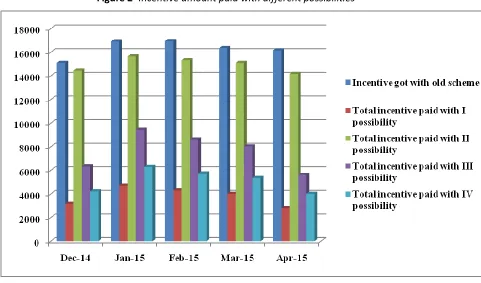
that section and their grades. Basic salary of the employees and proportion of incentive to salary affect the incentive formula and in turn the total amount to be paid as incentive. Based on the number of times the target has been achieved and the basic salary of the employees, these values are multiplied with the incentive percentage we get from the calculation and final incentive amount is found out. The comparison in the figure 2 is shown only after these changes are applied in the formula.
Figure 2-Incentive amount paid with different possibilities
INFERENCE OF NEW INCENTIVE PROPOSALS AND INFLUENCE ON PRODUCTION
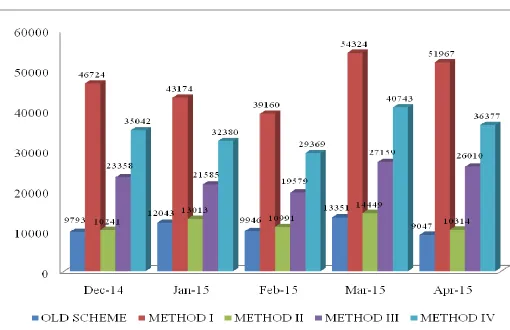
It is shown that with the previous incentive scheme, production is not increased but the incentives given are high. So it is understood that with the new incentive formula, less incentives are to be paid for the same amount of production. In figure 3 a comparison is shown between the numbers of units produced when the old incentive scheme is used and the number of units that can be produced if the same amount of incentive was given in the different possibilities of the new proposed incentive scheme. It is considered that the same incentive as of old scheme is paid for all possibilities and a comparison is shown between the numbers of units that will be produced with the respective possibility.
Figure 3-Number of units produced with different possibilities
CONCLUSION
REFERENCES
[1] Uri Gneezy, Stephan Meier, and Pedro Rey-Biel, “When and Why Incentives (Don’t) Work to Modify Behavior”, Journal of Economic Perspectives, Volume 25, Number 4, Fall 2011, Pages 191– 210.
[2] Haig R. Nalbantian, Andrew Schotter, “Productivity Under Group Incentives: An Experimental Study”, The American Economic Review, Vol 87 No. 3, 1997, Pages 314-341.
[3] Rajeswari Devadass, “Employees Motivation in Organizations: An integrative literature Review”, International Conference on Sociality and Economics Development, IPEDR, Vol.10, 2011.
[4] Bradley E. Wright, “Public-Sector Work Motivation: A Review of the Current Literature and a Revised Conceptual Model”, Journal of Public Administration Research and Theory. 2001:4:559-586.
[5] Mark Reed, Erica von Essen, Alister Scott, Mark Everard, Diane Mitchell, “Incentives Tools Literature Review”.
[6] Paul Oyer, “Why Do Firms Use Incentives That Have No Incentive Effects?”, The Journal of Finance, Vol. Lix, No. 4, August 2004.pp. 1619-1649.
[7] James Shah, E. Tory Higgins, and Ronald S. Friedman, “Performance Incentives and Means:How Regulatory Focus Influences Goal Attainment”, Journal of Personality and Social Psychology. 1998, Vol. 74, No. 2, 285-293.
[8] Edwinah Amah, Christine. A. Nwuche, Nwakaego Chukuigwe, “Effective Reward and Incentive Scheme for Effective Organizations”, Research Journal of Finance and Accounting, ISSN 2222-1697 (Paper) ISSN 2222-2847 (Online) Vol.4, No.13, 2013.
[9] Sravan Kumar Reddy, Sarfraz Karim, “Impact of Incentive Schemes on Employee Performance: A Case Study of Singareni Collieries Company Limited, Kothagudem, Andhra Pradesh, India”, Science, Technology and Arts Research Journal, ISSN: 2226-7522(Print) and 2305-3327 (Online), Oct-Dec 2013, 2(4): 122-125.
[10] Sindri Thor Hilmarsson, Pall Rikhardsson, “The Evolution of Motivation and Incentive Systems Research: A Literature Review”, http://ssrn.com/abstract=1965646.
[11] Falola Hezekiah Olubusayo, Ibidunni Ayodotun Stephen, Olokundun Maxwell, “Incentives Packages and Employees’ Attitudes to Work: A Study Of Selected Government Parastatals In Ogun State, South-West, Nigeria”, International Journal of Research in Business and Social Science IJRBS Vol.3 No.1, 2014 ISSN: 2147-4478.
[12] Martin Holtmann, Mattias Grammling, “Designing and Implementing Staff Incentive Schemes”,