1
Gamma and Beta model of growing and rotating Planck ball
U. V. S. Seshavatharam
1& S. Lakshminarayana
21
Honorary Faculty, I-SERVE, Survey no-42, Hitech city, Hyderabad-84, Telangana, India.
2Department of Nuclear Physics, Andhra University, Visakhapatnam-03, AP, India
Emails: [email protected] (and) [email protected]
Orcid numbers : 0000-0002-1695-6037 (and) 0000-0002-8923-772X
Abstract: With reference to Planck scale, Mach’s relation, increasing support for large scale cosmic anisotropy and preferred directions and by introducing two new parameters Gamma and Beta, right from the beginning of Planck scale, we make an attempt to estimate ordinary matter density ratio, dark matter density ratio, mass, radius, temperature, age and expansion velocity (from and about the baby universe in all directions). We would like suggest that, from the beginning of Planck scale, 1) Dark matter can be considered as a kind of cosmic foam responsible for formation of galaxies. 2) Cosmic angular velocity is directly proportional to squared cosmic temperature. 3) Ratio of critical temperature to actual temperature plays a heuristic role in understanding ordinary and dark matter density ratios. 4) Cosmic expansion velocity increases with decreasing total matter density ratio. 5) There is no need to consider dark energy for understanding cosmic acceleration.
Keywords: Planck scale; Mach’s relation; quantum cosmology; critical density; ordinary matter; dark matter; expansion velocity; angular velocity; Hubble’s law;
PACS Nos: 04.20.-q, 04.60.-m, 04.50.Kd, , 98.80.Qc, 98.80.Bp, 98.80.Es
1.
Introduction
According to current notion of modern cosmology, if the known laws of physics are extrapolated to the highest density regime, the result is a singularity which is typically associated with the Big Bang[1,2]. Even though it is intriguing to consider ‘big bang’ hypothesis, physics associated with big bang notion is speculative, confusing and misleading with respect to ‘Planck scale’ physics. Important demerits of big bang notion can be understood with the following points:
1) Preconditions of big bang are absolutely unclear and unknown;
2) No quantitative description is available for the matter content associated with the big bang event; 3) Physical reasons that led to big bang are unclear and unknown;
4) Quantitative description for big bang bursting force or pressure is unclear and unknown;
5) Whether big bang followed known physical laws are not - is also unclear and unknown;
6) Quantum information associated with big bang is unclear and unknown;
7) Within a fraction of second, how, big bang allowed ‘inflation’ to happen? - is a puzzling issue; 8) Applying Planck scale physics to big bang notion is a confusing issue;
9) Whether pre big bang or post big bang constitutes dark matter – is unclear and unknown;
10)Role of dark energy in big bang - is another complicated and questionable issue;
If one is willing to think in this way, it may not be wrong to say that, ‘big bang’ is a ‘meta’ physical concept and an ad hoc physical event. At any stage of its development and testing, any theoretical model footing on a metaphysical concept, will certainly leads to ambiguity and uncertainty. In this critical scenario, in a quantitative approach, it may not be wrong to consider a ‘growing’ or ‘evolving’ phase of ‘Planck scale’. Even though massive nature is unclear - with known physical
2
laws, Planck scale can be assigned with certain ‘mass’, certain ‘radius’, certain ‘volume’, certain ‘density’, certain ‘temperature’ and certain ‘pressure’ etc. Clearly speaking, Planck mass can be considered as a characteristic massive seed of the evolving universe and big bang can be replaced with an evolving Planck ball. Planck mass can be called as the ‘baby universe’ or ‘baby Planck ball’.
Since nothing is known, it is absolutely not possible to simulate a big bang, but with future science, engineering and technology, it is certainly possible to simulate any ‘Planck scale’ physical event. Till that time, cosmic observations can be analyzed with a notion of ‘growing Planck ball’. Thus, by replacing ‘big bang’ [3,4] with a growing Planck ball and considering ‘Mach’s relation’ [7-9] as a deep cosmic probe, in a hypothetical approach, an evolving model of quantum cosmology can be developed [10-12]. Since Planck scale is associated with Quantum theory and ‘spin’ is a basic property of quantum mechanics, it may not be wrong to consider a growing and rotating model of a Planck ball.
To make the model sensible and practical, in a quantitative approach, we assume that, ratio of Hubble
parameter to angular velocity is,
1 ln
3 2 2 8
4p
t t t H l Ht H ct G aTt
H where
Hpl,Ht
represent Planck scale and time dependent Hubble parameters respectively and
4t
aT is the thermal
energy density. Considering 0, current cosmic temperature and current Hubble parameter can be
fitted. Right from the beginning of Planck scale: 1) Considering 2
t t
GM R c and
3 2 2 8
,t
H c G an attempt is made to develop simple relations for estimating cosmic mass, radius and expansion velocity (referred to ‘from and about’ the baby universe in all directions). 2) Defining t
1 t
2,anotherattempt is made to develop ‘model’ relations for estimating dark matter density ratio and ordinary matter density ratio. Thus, in analogy with current ‘cosmic acceleration’, using
t, t
,we proposed simple relations for a decreasing trend of total matter density ratio with increasing trend of cosmic expansion velocity.1.1 Motivating points
1) Mach’s principle [13] is one of the iconic principles underlying general theory of relativity and
can be given a priority in developing a workable or unified model of cosmology.
2) Cosmic expansion, Lambda term, dark matter, cosmic temperature, inflation, cosmic acceleration,
dark energy and vacuum energy are different concepts, by using which alternative models of GTR are emerging and are being extended in many ways. In this sequence, quantum cosmology can also be given some consideration.
3) Quantum cosmology is a wide range physical model intended for understanding the in-built cosmological quantum phenomena on small scale as well as large scale distances. So far, progress in this direction is very nominal and ‘GTR’ needs a serious review with reference to ‘quantum cosmology’.
4) When universe is able to give birth to atoms, elementary parrticles and photons that show quantum behaviour, universe can certainly be considered as a quantum gravitational object for ever.
5) What to quantize? How to quantize? When to quantize? and What to measure? etc. are some interesting questions in current quantum cosmology and need a special focus. In this context, cosmic temperature can be considered as a characteristic feature of quantum cosmology.
6) With reference to particle physics, current technological limits on particle colliding energy, unidentified/unseen particles, unknown particle interactions and incomplete final unification scheme - to some extent, one can hopefully believe in the existence of dark matter [14].
7) Basically,‘dark energy’ was proposed for understanding cosmic acceleration. Careful analysis of
3
famous cosmological constant or vaccum energy. According to another new study [23], evidence for dynamical dark energy is very poor.
8) Density perturbations [21] and interaction between dark mtter and baryons [20] seem to play a crucial role in understanding observed cosmic acceleration and need of introducing dark energy seems to be ad-hoc.
9) Even though redshift is an index of cosmic expansion, without knowing the actual galactic distances and actual galactic receding speeds, with 100% confidence level, it may not be possible to decide the absolute nature of cosmic expansion rate.
10)If the Universe is the same in all directions, as the big bang models require, the hot spots and cold spots of CMBR in the afterglow of the big bang should be randomly splattered about the sky - the big temperature splotches and the small temperature goose pimples should have no preferred direction. The fact that they are aligned along the axis of evil leads Kate Land and Joao Magueijo [24] to suggest that, may be the assumptions behind the big bang models are wrong. In other words, the Universe is not the same in all places or directions, but has a special direction.
11)Considering a sample of 355 optically polarized quasars with accurate linear polarization measurements, Hutsem´ekers et al [25, 26], demonstrated that quasar polarization angles are definitely not randomly oriented over the sky. Polarization vectors appear coherently oriented over very large spatial scales, in regions located at both low and high redshifts and characterized by different preferred directions. These characteristics make the alignment effect difficult to explain in terms of local mechanisms, namely a contamination by interstellar polarization in our Galaxy.
12)According to Shamik Ghosh et al [27] -The tantalizing possibility that the cosmological principle may be violated is indicated by many observations. The most prominent of these effects is the so-called Virgo alignment, which refers to a wide range of phenomena indicating a preferred direction pointing towards Virgo. The Square Kilometer Array has the capability to convincingly test several of these effects. These include the dipole anisotropy in radio polarization angles [28], the dipole in the number counts and sky brightness [29-33] and in the polarized number counts and polarized flux [34]. These observations may indicate that we need to go beyond the standard Big Bang cosmology. Alternatively they may be explained by preinflationary anisotropic and/or inhomogeneous modes [35, 36]. In either case, confirmation of this alignment effect is likely to revolutionize cosmology.
13)According to Wen Zhao and Larissa Santos [37] - The foundation of modern cosmology relies on
the so-called cosmological principle which states a homogeneous and isotropic distribution of matter in the universe on large scales. However, recent observations, such as the temperature anisotropy of the cosmic microwave background (CMB) radiation, the motion of galaxies in the universe, the polarization of quasars and the acceleration of the cosmic expansion, indicate preferred directions in the sky. If these directions have a cosmological origin, the cosmological principle would be violated, and modern cosmology should be reconsidered.
14)Nature loves symmetry. Subject of cosmic ‘rotation’ is not new and not against to General theory
of relativity [38-43]. Quantum mechanics point of view, ‘spin’ is a basic and characteristic property. Quantum gravity point of view, it is reasonable to review the currently believed ‘standard cosmology’ with reference to cosmic rotation. In this context, in literature one can find interesting articles on cosmic rotation and angular velocity [44-60].
2.
Assumptions, concepts and relations
2.1 Nomenclatures
1)
OM
t Ratio of ordinary matter density to critical density. 2)
DM t
Ratio of dark matter density to critical density.3) Ht Hubble parameter and Hpl Planck scale Hubble parameter.
4) t Cosmic angular velocity and pl Planck scale angular velocity.
5)
expt
4
6)
MOM
t Cosmic ordinary mass content,
MDM
t Cosmic dark matter content. 7)
MOM MDM
t Mt Total matter content = Total mass of evolving Planck ball. 8) Rt Cosmic radius associated withMt= Radius of evolving Planck ball.9) Tt Cosmic temperature.
10)
2 2
4
3 1 ln
8
pl
t t
t
t t t
H
H H c
H G aT
Ratio of Hubble parameter to angular velocity.
11) 1
2
t t
A new number defined to be associated with ordinary matter density ratio and dark matter density.
12)
dg t Galactic distance from and about the baby universe or baby Planck ball. 13)
vg t Galactic receding speed from and about the baby universe or baby Planck ball.Note-1: For the above symbols, subscript 0 denotes current value and subscript
pl
denotes Planck scale value.2.2 Proposed assumptions
With respect to our earlier publications [61-65], in this paper we review the basic assumptions.
1) Planck scale and Mach’s relation play a crucial role in entire cosmic evolution.
2) Ratio of Hubble parameter to angular velocity is
2 2
4
3 1 ln
8
pl
t t
t
t t t
H
H H c
H G aT
.
3) Ordinary matter and dark matter, both, play a crucial role in estimating cosmic expansion velocity.
4) Dark matter can be considered as a kind of cosmic foam responsible for formation of galaxies [66,67].
Note-2: Based on these assumptions, from the beginning of Planck scale, a) With a ‘decreasing’ trend of total matter density ratio, cosmic expansion velocity can be shown to be increasing. b) With an ‘increasing’ trend of total matter density ratio, cosmic expansion velocity can be shown to be decreasing. c) With a constant trend of total matter density ratio, cosmic expansion velocity can be shown to be constant.
Note-3: According to Erik Verlinde [66] : Purely based on the observations it is more appropriate to say that general relativity or Newtonian gravity can only be saved by assuming the presence of dark matter. Therefore, without further knowledge, the evidence in favour of dark matter is just as much evidence for the possible breakdown of the currently known laws of gravity.
Note-4: According to D.G. Levkov et al [67]: If dark matter particles are bosons with sufficiently small mass, may form a Bose-Einstein condensate in the small galaxy halos or in even smaller substructures due to their gravitational interactions.
2.3 Choosing the magnitude of
H
01) As per the 2015 Planck data [68]:H0
67.31 0.96
km/sec/Mpc and the present temperatureof the CMB radiation is, T0
2.722 0.027
K.2) According to the advanced observational data analysis by Riess et al [69] current best value of
0 73.24 1.74
5
3) With reference to T02.722 K and our proposed set of concepts, in this paper, we choose,
18 1 0 70km/sec/Mpc 2.26853 10 .
H sec This value seems to lie in between (67.31 and 73.24)
km/sec/Mpc.
2.4 The Planck scale in entire cosmic evolution
So far no mainstream cosmological model implemented Planck scale in current cosmic evolution. In this complicated situation, in a positive approach, we make an attempt to implement the ‘Planck scale’ in the entire cosmic evolution. With further study, our approach can be developed for a better understanding. Based on quantum gravity, we define the Planck scale Hubble parameter,
5 43 1.854921 10 pl c H G
sec
1
. To proceed further, we define that,
2 2 4 3 1 ln 8 pl t t tt t t
H
H H c
H G aT
(1)
2 2 4
2 t
4 and
3 3 8 8 t t t c GaT aT
G c
(2)
Based on this relation, if defined 1.854921 1043 1
pl
H sec , one can choose different values of
inbetween
pl 1and 0141.2564. For each assumed value of H, one can get a corresponding andall other physical parameters can be estimated. For the Planck scale,
2 2 4 3 8 1 pl pl pl H c G aT and for
the current case,
2 2 0 0 0 4 0 0 0 31 ln 141.2564. 8
pl
H
H c H
H
G aT
In a simplified form, cosmic
temperature can be expressed as,
1
2 2 4 0.652632
3 1 1 8 pl t t t B t t H H H c T Ga k (3)
If one is willing to define,critical temperature as
1 2 2 4
3 , 8 t c t H c Ga T then,
Critical temperature Actual temperaturec t t
t t t T H T (4)
3. To estimate the cosmic mass, radius and expansion velocity
Let,
3 2 4 38 3
t
OM DM t t OM t DM t t
H
M M M R
G
(5)
2OM DM t t t
G M M GM R c
(6)
2 2
OM DM t t
t
G M M GM
R
c c
6
Based on these relations, it is possible to show that,
2
2
OM DM t
t
OM DM t t
G M M c
R
H c
(8)
exp
2
t t t
OM DM t
V R H c
(9)
2
3 2
exp tOM DM t t
OM DM t t t
c V c
M M M
GH GH (10)
Based on relations (6 to 10) and in terms of
OM
t and
DM
t,
OM t
2
exp tOM t
OM DM t t
c V M GH
(11)
2 exp
DM t t
DM t
OM DM t t
c V M GH
(12)
4.
Understanding the trend of ordinary and dark matter density ratios
With the help of defined t 1 ln pl ,
t t t H H H
on ad-hoc basis and with reference to the current
observed values of
OM
0and
DM
0,we are making an attempt to estimate the past values of
OM
tand
DM
t. In this context, the basic question to be answered is: Is there any scope for the existence for dark matter at Planck scale? In a positive approach, we hope that there exit ordinary matter as well dark matter at Planck scale in equal proportions. It needs further study.4.1 Current ordinary matter density ratio
If it is assumed that,
2 3 02 2
40 0 0 3 4 3 8 OM H c
M c R aT
G
(13)
As per relation (1),
2 3 02 20 0 0 3 1 4 3 8 OM H c
M c R
G
(14)
Based on relation (4), by considering an ad-hoc proportionality coefficient of the form,
0 0
1
Average of and ,
2 2 pl t pl t
2 22 3 0 0
0 0 0 0 0 0 0 0 3 4 3 8
and 1 1 0.04561
2
O OM
M
H c
M c R
7
2 3 0 0 20 0 0 3 4 3 8 OM H c
M c R
G
(16)
4.2 Current dark matter density ratio
Like the case of ordinary matter density,
2 3 02 2
40 0 0 3 4 3 8 DM H c
M c R aT
G
(17)
As per relation (1),
2 3 2 20 0 0 0 3 1 4 3 8 DM H c
M c R
G
(18)
Based on relation (4) and by considering an ad-hoc proportionality coefficient of the form,
2 2 0 2 0 1 , 2 2 pl t
2 0 02 2 2
2 3 0 0
0 0 0 2 0 0 0 a 1 3 4 3 8
nd 1 0.29384
2
DM DM
H c
M c R
G (19)
2 3 2 0 0 20 0 0 3 4 3 8 DM H c
M c R
G
(20)
4.3 General expressions for understanding the trend of ordinary and dark matter density ratios
By extrapolating the coefficient t to past and future as,
2 2 1 1 and 2 2 t t t t
(21)
22 2 1 1 (A) 2 1 1 2 1
(C) ; 2 (D ; ( ) B) t t t t t t t OM t t DM t
DM t t
t
t t
OM DM t
t t OM (22)
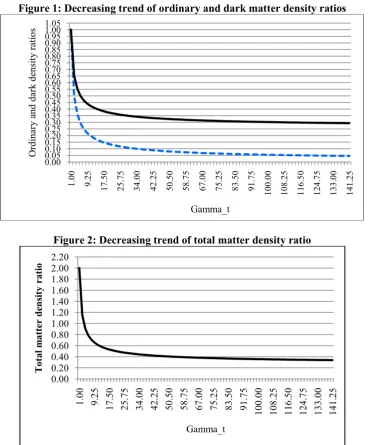
See figure 1 plotted with relations (22A) and (22B). With reference to critical density, dashed blue curve represents the trend of ordinary matter density ratio and black curve represents the trend of dark matter density ratio. See figure 2 (plotted with relation 22D) for a drcreasing trend of total matter density ratio.
8
research, various relations for t can be developed by using which, in near future, trend of ordinary and dark matter density ratios can be understood right from the beginning of Planck scale.
Figure 1: Decreasing trend of ordinary and dark matter density ratios
Figure 2: Decreasing trend of total matter density ratio
5.
Current and Planck scale physical parameters
See table 1 for various cosmic physical parameters associated with current and Planck scales.
Table 1: Current and Planck scale cosmic physical parameters
Current scale Planck scale
0 18 1 70km/sec/Mpc 2.26853 10 H sec 5 43 1.855 10 pl c H G
sec
1
0
0
1 ln Hpl 141.2564 H
1 ln 1
pl pl pl H H
OM0 0.04561
OM
pl 19 DM0 0.29384
DM
pl 11 2 2 4 0 0
0
3
1 2.721 K
8 H c T Ga 1 2 2 4
31
3 1
8
9.247 10 K
pl pl pl H c T Ga
0 0 0 0 26 23.207 10 m 10.40 Gpc
OM DM c R H 35 2
1.616 10 m
pl
pl
OM pl DM pl
c R H
Vexp 0 R H0 0 2.42654c
Vexp pl R Hpl plc
520 5.836 10 kg
OM
M
1.0882 10 kg8OM pl
M
530 3.752 10 kg
DM
M
1.0882 10 kg8DM pl
M
53 0
0 0
4.3352 10 kg
OM DM M M M
82.176 10 kg
OM pl DM pl
pl M M M
0
0
exp 0 exp 2 19.78 BillionYears pl R t V V 0 pl t
6.
Cosmic scale factor and red shift
With reference to the proposed relations (1) and (3) and with reference to the current definitions of cosmic redshift and scale factor, it is possible to show that,
0 0
0 0 0
0 0 0
0
1 1
exp exp
2
t t t
t t
t
t
t t
T H H
z
a T H H
(23)
Redshift can be expressed in the following form.
0
0
exp t 1
t
z
(24)
We are working on interpreting this relation and it needs further study.
7.
To estimate the current cosmic age
From the beginning of cosmic evolution, based on the proposed cosmic expansion velocities, cosmic age can be approximated with the following relation.
exp exp
2t pl t pl R R t V V (25)
where
Vexp t Vexp pl
2 can be considered as average expansion velocity.10
0 0
0
exp exp exp 0 exp 0
2
2
19.78 BillionYears
pl
pl pl
R R R
t
V V
V V
(26)
For a temperature of 3000 K, it is possible to show that,
12 -1 3000
3000
3000 3000 3000
0
3000 0 3000 3000
2.49 10 sec
1 ln 127.34774
1 10.285
exp 1 1102.407
K
pl K
K
K K
K K
K
H
H H Z
z
(27)
Cosmic age corresponding to a temperature of T=3000K can be estimated to be,
3000
3000
exp 3000 exp
17987.07 Years 2
K pl
K
K pl
R R
t
V V
(28)
This estimation is 21.13 times less than the current estimations and needs further study.
8.
Velocity and distance relation
In all directions, from and about the hypothetical baby Planck ball, current galactic receding speeds can be approximated with,
0 exp 0
exp 0
0 0 0 0
0 0
g
g g g
d V
v V d H d
R R
(29)
When
dg 0 R0,
vg 0 H R0 0. This can be compared with currently believed Hubble’s lawfor the current expanding universe.
9.
Results and Discussion
9.1 Cosmological constant problem
With reference to proposed concepts, ratio of the Planck scale critical density to the current critical density is,
2
2 2 2 2
121 0
0
3 3
6.685 10
8 8
pl pl
H c H c H
G G H
(30)
We wish to appeal that, this idea can be considered as a characteristic tool for constructing a model of ‘quantum gravity’ with cosmic evolution.
9.2 Horizon problem
11
properties. If one is willing to consider the concept of ‘matter causes the space-time to curve’, ‘horizon problem’ can be understood. According to hot big bang model, during its evolution, as the universe is expanding, thermal radiation temperature decreases and matter content increases. As matter content increases, based on Mach’s principle, at any stage of evolution, it is possible to have an
increasing radius of curvature, t 2
OM
t DM
t .G
R M M
c
For the current case,
0 2 OM 0 DM 0 10.40Gpc
G
R M M
c
and there is no scope for ‘causal disconnection’ of distant
visible matter.
9.3 Cosmic inflation
Basically, ‘inflation’ [70,71] is a period of super cooled cosmic expansion, where temperature seems to be dropped by a factor of 100,000 and is mostly model dependent. Mainstream cosmologists believe that just after the hot big bang, ‘inflation’ seems to be started at 1037 seconds and ended by
1032 seconds. During this time span, cosmic temperature seems to be dropped from 1027 K to 1022
K. Since that time, expansion initially decelerated and then, after about 6 billion years, began very slowly to accelerate. Most puzzling point to be noted is that, the detailed mechanism responsible for inflation is still unknown. Many cosmologists proposed different starting mechanisms for initiating and fine tuning the believed ‘inflation’. Since its introduction by Alan Guth in 1980, the inflationary paradigm has become widely accepted. Currently, a great debate is going on its existence [72,73]. In
this proposed model, when 1 10 sec ,37 1
t
H t
estimated
15.43, 1.73 10 K .28
t Tt
Similarly,
when 1 10 sec ,32 1
t
H t
estimated
25
26.946, 4.14 10 K .
t Tt
Thus, for the currently believed
inflationary time span of
10 to 1037 32
sec, estimated ratio of initial and final temperatures seems tobe around 400 and needs further study with respect to the believed ratio of 100000. We are working in this direction.
Strange point is that with our model, without considering ‘inflation’ concepts, starting from the Planck scale, it is possible to have a current cosmic radius of 10.4 Gpc and to some extent, it is consistent with current observations of 14.25 Gpc. Our estimated cosmic age corresponding to 2.7 K is around 20 billion years whereas big bang model estimation is 13.8 billion years. At lower time scales, our estimated cosmic age corresponding to 3000 K is around 18,000 years whereas big bang model estimation is 3,80,000 years. Point to be discussed in depth is, with big bang and inflation, after 3,80,000 years of evolution, cosmic temperature is 3000 K where as in our model, without big bang and inflation, after 18000 years of cosmic evolution, temperature is 3000K. From this, it is very clear to say that, compared to big bang and inflation, in our model temperature drop is faster in the beginning and slower in the later stages. Even though universe is accelerating, at present, drop in temperature seems to be very small and this can be considered as a hint for the observed large scale ‘Isotropic’ nature of CMBR.
9.4 Cosmic acceleration and expansion velocity
12
Now a days, main stream cosmologists are seriously working on ‘eternal light speed expansion’ [81, 82, 83]. In this context, in our earlier published papers, based on ordinary matter density and Hubble’s
law, we come across different magnitudes of cosmic expansion velocities ranging from 2cto12c. We
would like to suggest that, by considering a decreasing trend of ordinary matter and dark matter density, starting from the Planck scale, it is possible to get an expression for cosmic expansion velocity comparable to speed of light. It can be expressed as follows.
exp t 2
OM t DM t
V
c
(31)
Based on this expression, for the Planck scale,
exp plV c and for the current scale,
Vexp 02.427 .cInteresting point to be noted is that, after 20 billion years of cosmic expansion, increment in expansion velocity seems to be only
Vexp 0 Vexp pl1.427 .c See figure-3.From figure 3, it is very clear that, right from the beginning of cosmic evolution, cosmic expansion velocity seems have an increasing trend. To some extent, this can be compared with currently believed cosmic acceleration concept. Interesting point to be noted is that, expansion velocity seems
to depend on
OM
t 2 DM
t .
In near future, if decrease in
OM
t DM
t is found to be significant, one can expect ‘acceleration’ and if decrease in
OM
t DM
t is found to be insignificant, one can expect cosmic ‘constant rate of expansion’. It is for further study.Figure 3: Increasing trend of cosmic expansion velocity
9.5 Cosmic angular velocity
According to Haking S.W [43] - By vorticity one means the rotation of ‘nearby’ matter about an observer moving with the matter, relative to an inertial frame defined by gyroscopes. (Here ‘nearby’ should be interpreted as meaning at distances of about a hundred megaparsecs, to be near compared to the Hubble radius but far compared to the length scales of local phenomena such as the rotation of the Galaxy.) Thus in a sense, the whole Universe would be rotating, though, as the model is homogeneous, there would be no centre of rotation. Such rotation, if it existed, would be of great interest for the dynamical effects it could have on the Universe and on the formation of galaxies and
2.50E+08 3.00E+08 3.50E+08 4.00E+08 4.50E+08 5.00E+08 5.50E+08 6.00E+08 6.50E+08 7.00E+08 7.50E+08 8.00E+08
1.
00
9.
25
17
.5
0
25
.7
5
34
.0
0
42
.2
5
50
.5
0
58
.7
5
67
.0
0
75
.2
5
83
.5
0
91
.7
5
10
0.
00
10
8.
25
11
6.
50
12
4.
75
13
3.
00
14
1.
25
E
xp
an
si
on
V
el
oc
it
y
(
m
/s
ec
)
13
for its relation to Mach’s Principle. This states that the local inertial frame should be non-rotating with respect to distant matter.
With reference to our assumptions and relations, current angular velocity seems to be
20 13
0 1.606 10 rad/sec 5.068 10 rad/year.
This can be compared with other estimates. The first experimental evidence of the Universe rotation was done by Birch (1982), evidently. According to Birch, there appears to be strong evidence that the Universe is anisotropic on a large scale, producing position angle offsets in the polarization and brightness distributions of radio sources. These can probably be explained on the basis of a rotation of the Universe with an angular velocity of approximately 10 rad/year.13 Now a days L.M. Chechin [59, 60] is seriously working on cosmic
rotation.
According to Chechin [60], “In the early Universe, the orientation of its spin is random and the cosmological principle is satisfied. This result is naturally consistent with the CMB isotropy. In the modern Universe the rotation axis direction becomes anisotropic and the cosmological principle, strictly speaking, is not satisfied. This is confirmed by the large-scale anisotropy in the distribution of space objects and by the torque alignment direction. But since the value of the angular velocity of
our Universe is 10 Hz,19
Un
finding of such rotation and its influence on the natural processes is extremely difficult. So today dominates the view that the Universe is isotropic and the cosmological principle is satisfied in it”.
According to Godlowski [56], “Unfortunately, there is no relatively simple model of rotating universe derived from the general relativity theory, involving observables that could be used for its empirical testing. However, we can make some estimates of global rotation of the Universe on the grounds of the Newtonian equivalent of general relativity, while being fully aware that the Newtonian cosmology does not allow for describing actual evolution of the Universe, being but its conveniently applicable approximation. The situation is somewhat complicated by the fact that observationally it is very hard to distinguish the effects of global rotation from other effects, as the Casimir effect or dark radiation in the brane scenario of Randall-Sundrum. One can still estimate from the observational data the net contribution of all effects of this kind. It is shown that if it has a non-zero value, then one can explain the discrepancies between the values of matter density
m 0and of the Hubble constant derived from measurements of SNIa and CMBR. It allows also to account for the discrepancies between the observed and theoretical abundances of helium-4 and deuterium”.According to Li-Xin Li [48],
1) Global rotation provides a natural origin for the rotation of galaxies, and the morphology of the
objects formed from gravitational instability in a rotating and expanding universe depends on the amplitude of the density fluctuation, different values of the amplitude of the fluctuation lead to the formation of elliptical galaxies, spiral galaxies, and walls. The global rotation gives a natural explanation of the empirical relation between the angular momentum and mass of galaxies:
5 3
JM .
2) By studying the correlation between the angular momentum and mass of galaxies, it is possible to
find the angular velocity of the universe.
3) Current derived cosmic angular velocity is 21 13
0 6 10 rad/se 2 10 rad/year.
According toYuri N. Obukhov [50],
1) However, “whether our universe is rotating or not, it is of fundamental interest to understand the interrelation between rotation and other aspects of cosmological models as well as to understand the observational significance of an overall rotation”.
14 9.6 About dark matter
Considering the very nature of Dark matter, new studies suggest that, a) Dark matter can be eliminated with emerging gravity concept [66]. b) Dark matter can be considered as a Bose-Einstein condensate [67]. 3) Evidence for considering dark matter as a characteristic weakly interacting massive particle (WIMP) is geeting ruled out [84]. 4) Dark matter distribution can be understood through the distribution of intracluster light [85]. In this critical situation, our proposal of considering dark matter as a kind of ‘galactic foam’ can be given some consideration.
Dark matter may exist ot may not exsit, gravity may be emerging or may not be emerging, based on relation (22D) and fugure-2, observationally believed current total matter density ratio can be fitted and can be extrapolated to past and future in a verifiable approach. With further study, mystery of ‘total matter density ratio’ can be explored with respect to different theoretically extended ideas of general theory of relativity.
10.
Conclusions
(1) Planck mass can be considered as a characteristic representation of the mass of baby universe and Cosmological principle and big bang concepts can possibly be reviewed at fundamental level.
(2) Universe can be considered as a quantum gravitational object and dark matter can be considered as a kind of cosmic foam responsible for formation of galaxies.
(3) Mach’s relation can be given some consideration in developing a workable model of cosmology.
(4) Even though it is very interesting, it is also true that the proposed relation
2 2
4
3 1 ln
8
pl
t t
t
t t t
H
H H c
H G aT
is new and peculiar. We are confident that, its role,
scope and validity can be verified with further study.
(5) Estimated current cosmic Planck ball radius is about 10.40 Gpc and can be compared with
current observations of 14 Gpc. Current cosmic sphere seems to constitute around 14 Hubble spheres and needs further study with respect to the Bayesian model average estimate of >251 Hubble spheres proposed by Vardanyan et al [86, 87].
(6) We are working on understanding the scope, physical significance and validity of the
proposed ad-hoc coefficients,
2
21 t 2 and 1 2 .
t t t
(7) Trend of total matter density ratio seems to decide the fate of cosmic expansion rate and currently believed ‘dark energy’ concept can possibly be reviewed with respect to its real existence.
(8) Independent of galactic redshift data, we are working on finding alternative tools for understanding the cosmic expansion rate. In future, with advanced science, engineering and
technology, by considering d T
0dt or
0d H dt or
OM DM
0d dt
, absolute cosmic rate of
expansion can be estimated.
Acknowledgements
Author Seshavatharam is indebted to professors brahmashri M. Nagaphani Sarma, Chairman, shri K.V. Krishna Murthy, founder Chairman, Institute of Scientific Research in Vedas (I-SERVE), Hyderabad, India and Shri K.V.R.S. Murthy, former scientist IICT (CSIR), Govt. of India, Director, Research and Development, I-SERVE, for their valuable guidance and great support in developing this subject.
15
[1]Gamow G Nature 162 p 680 (1948)
[2]Gamow G Phys Rev 74 p 505 (1948)
[3]Abhas Mitra MNRAS 442 p382 (2014)
[4]Abhas Mitra Journal of Modern Physics 2 p 1436 (2011)
[5]Annila A Mon.Not.Roy.Astron.Soc.423 p 1973 (2012)
[6]Grahn P, Annila A, Kolehmainen E AIP Advances 8 035028 2018
[7]Arbab AI Spacetime & Substance Vol 2 p 55 (2001) [8]Arbab AI Gen.Rel. Grav 36 p2465 (2004)
[9]Miyazaki A arXiv:gr-qc/0101.112v1 (2001)
[10]Bojowald M Rep. Prog. Phys 78 p 023901 (2015)
[11]Padmanabhan T Current Science 88 p1057 (2005)
[12]Sivaram C Current Science Vol 79 p 25 (2000) [13]Einstein A Ann. Phys. 360 p 241 (1918)
[14]Rennan Barkana Nature 555 p 71 (2018)
[15]J T Nielsen, A Guffanti and S Sarkar Scientific Reports 6 p 35596 (2016)
[16]Lawrence H Dam, Asta Heinesen and David L Wiltshire Mon.Not.Roy.Astron.Soc. 472 p 835
(2017)
[17]J Colin, R Mohayaee, M Rameez and S Sarkar arXiv:1808.04597v1 (2018 )
[18]Balakrishna S Haridasu, Vladimir V Lukovic, Rocco D’Agostino and Nicola Vittorio A&A 600
L1 (2017)
[19]G´abor R´acz, L´aszl´o Dobos, R´obert Beck, Istv´an Szapudi and Istv´an Csabai Mon. Not. R. Astron. Soc. Lett. 469 L1 (2017)
[20]Lasha Berezhiani, Justin Khoury and Junpu Wang Phys. Rev. D 95 p 123530 (2017)
[21]Joel Smoller, Blake Temple and Zeke Vogler Proc. R. Soc. A 473 20160887 2017
[22]Gong-Bo Zhao et al Nature Astronomy 1(9) p 627 (2017)
[23]Deng Wang and Xin-He Meng Phys. Rev. D 96 p 103516 (2017)
[24]Kate Land and Joao Magueijo Phys.Rev.Lett. 95 p 071301 (2005)
[25]Hutsem´ekers D Astron. Astrophys. 332 p 410 (1998)
[26]D Hutsemekers, R Cabanac, H Lamy and D. Sluse Astron. Astrophys. 441 p 15 (2005)
[27]Shamik Ghosh, Pankaj Jain, Gopal Kashyap, Rahul Kothari, Sharvari Nadkarni-Ghosh and
Prabhakar Tiwari J. Astrophys. Astr. 37 p 25 (2016) [28]Jain P Ralston J P Modern. Phys. Lett. A 14 p 417 (1999) [29]Blake C Wall J Nature 416 p 150 (2002)
[30]Singal A K Astrophys.J. 742 L23 (2011)
[31]Gibelyou C and Huterer D MNRAS 427 p 1994 (2012)
[32]Tiwari P and Jain P MNRAS 447 p 2658 (2015)
[33]Rubart M and Schwarz D J Astrophys. Astr. 555 A p 117 2013 [34]Tiwari P and Jain P MNRAS 460 (3) p 2698 (2015)
[35]Aluri P K and Jain P Modern. Phys. Lett. A 27(04) p 1250014 (2012)
[36]Rath P K, Mudholkar T, Jain P and Aluri P K JCAP 1304 p 007 (2013)
[37]Wen Zhao and Larissa Santos The Universe No 3 p 9 (2015)
[38]Whittaker ET Yearbook of Roy. Soc. Edinburgh 5 (1945)
[39]Gamow G Nature 158 No 4016 p 549 (1946)
[40]Godel K Rev. Mod. Phys. 21 p 447 (1949)
[41]Raychaudhuri A K Phys. Rev. 98 p 1123 (1955)
[42]Narlikar J V Mon. Not. R. Astr. Soc. 126 p 203 (1963)
[43]Hawking SW Mon. Not. R. Astr. Soc.142 p 129 (1969)
[44]Birch P Nature Vol 298 p 451 (1982)
[45]Korotky VA and Obukhov YuN JETP 81(6) p 103 (1995)
[46]Nodland B and Ralston J P. Phys. Rev. Lett. 78 p 3043 (1997)
[47]Rainer W K¨uhne Mod. Phys.Lett. A 12 p2473 (1997)
[48]Li-Xin Li General Relativity and Gravitation 30 p 497 (1998) [49]Shwetabh Singh J. Astrophys. Astr. 20 p 67 (1999)
[50]Obukhov Y N Colloquium on Cosmic Rotation, Eds M. Scherfner, T. Chrobok and M. Shefaat
16
[51]Saulo Carneiro General Relativity and Gravitation Vol 34 p 793 (2002)
[52]Panov VF and Kuvshinova EV Gravitation & Cosmology Vol 10 p 156 (2004)
[53]Barrow J D and Tsagas C G Class. Quantum. Grav. 21 p 1773 (2004)
[54]Godlowski W and Szydlowski Marek Gen.Rel.Grav. 37 p 907 (2005)
[55]Shi Chun Su and M-C Chu Ap.J 703 p 354 (2009)
[56]Godlowski W International Journal of Modern Physics D 20 p 1643 (2011)
[57]Longo M Phys. Lett. B 699 p 224 (2011)
[58]Rong-Gen Cai and Zhong-Liang Tuo JCAP 1202 p 004 (2012)
[59]Chechin LM Astron.Rep. 60 p 535 (2016)
[60]Chechin LM Gravit. Cosmol. 23 p 305 (2017)
[61]Tatum ET Seshavatharam U V S and Lakshminarayana S Journal of Applied Physical Science
International 4 p 18 (2015)
[62]Seshavatharam U V S and Lakshminarayana S Physical Science International Journal 14(2) p
1 (2017)
[63]Seshavatharam U V S and Lakshminarayana S Physical Science International Journal 15(4): 1
2017
[64]Seshavatharam U V S and Lakshminarayana S International Journal of Astronomy
Astrophysics and Space Science 5(1) p 1 (2018)
[65]Seshavatharam U V S & Lakshminarayana S Prespacetime journal 9 326 (2018) [66]Erik Verlinde SciPost Phy 2 016 (2017)
[67]D.G. Levkov et al Phys. Rev. Lett 121, 151301 (2018)
[68]Planck Collaboration: Planck 2015 Results XIII Cosmological Parameters (2015)
[69]Riess AG et al Astrophys.J 826 p 56 (2016) [70]Guth AH Phys. Rev. D 23 p347 (1981) [71]Linde A Physics Letters B 108 p 389 (1982) [72]Steinhardt PJ Scientific American 304 p18 (2011)
[73]A Steinhardt P J and Abraham Loeb Physics Letters B 736 p 142 (2014) [74]Riess AG et al Astron.J 116 p1009 (1998)
[75]Perlmutter S et al Astrophys.J 517 p 565 (1999) [76]Weinberg DH et al Physics Reports 530 p 87 (2013)
[77]Zhengxiang Li, Puxun Wu and Hongwei Yu Phys. Lett B 695 p 1 (2011)
[78]D Rubin and B Hayden The Astrophysical Journal Letters 833 L30 (2016)
[79]I Tutusaus, B Lamine and A Blanchard arXiv:1803.06197 (2018)
[80]Christos G Tsagas J. Phys: Conf. Ser. 283 p 012040 (2011)
[81]John MV Mon.Not.Roy.Astron.Soc. 000 p 1 (2016)
[82]Jun-Jie, Wei Xue-Feng Wu, Fulvio Melia and Robert S Maier The Astronomical Journal 149 p
102 (2015)
[83]Fulvio Melia and Marco Fatuzzo Mon.Not.Roy.Astron.Soc. 456 p 3422 (2016)
[84]
https://www.forbes.com/sites/startswithabang/2019/02/22/the-wimp-miracle-is-dead-as-dark-matter-experiments-come-up-empty-again/#18c618f26dbc
[85]Mireia Montes and Ignacio Trujillo Mon.Not.Roy.Astron.Soc. 482 p 2838 (2019)
[86] Mihran Vardanyan, Roberto Trotta and Joseph Silk MNRAS Lett 413 L91 (2011)