Introduction
Magnetic memory in the form of hard disks has been in use in the computer industry since the first hard disk system was commercially released by IBM in 1956. That first system stored 2000 bits of data per square inch, equivalent to about 5 MB in total on 50 separate 24-inch diameter disks (1, 2), but data storage capacity grew exponentially throughout the latter half of the twentieth century, in tandem with – and sometimes outstripping – growth in processing power (3, 4).
The capacity of a hard disk system depends on many factors, but is fundamentally dictated by how much information the magnetic medium can hold (3, 5). This can be quantified using areal density: the number of bits per unit of surface area, currently quoted in gigabits per square inch (Gb in−2). For magnetic memory to keep pace with developments in the computer industry and see off challenges from competing solid-state memory technologies, areal densities must continue to grow rapidly. The next frontier in storage capacity will see density values of commercial systems of the order of terabits per square inch (Tb in−2). However, significant techno-logical innovation will be necessary to bring this about (3, 4).
Much of this innovation will centre on the mag-netic medium: how it is structured and what materials are used. Existing media contain platinum (Figure 1) and, more recently, ruthenium (6, 7). These metals offer a number of advantages in the magnetic stor-age of data and they have played an integral part in delivering the growth in areal density seen to date (2, 8–10). Demand for both in this application is sig-nificant, amounting to over 95,000 oz of platinum and over 50,000 oz of ruthenium in 2009 (6). It is therefore worth considering what role the platinum group metals (pgms) will play in increasing storage capacity into the future.
In fact, the pgms feature prominently in new mate-rials currently under research (3). This article has selected one example of a platinum-based material as illustration of this, with two contrasting approaches
highlighted. This is intended to give a flavour for the challenges facing the pursuit of higher areal densities and the novel ways in which these may be overcome.
The Limitations to Areal Density
Magnetic recording exploits the phenomenon of ferromagnetism. Ferromagnetic materials align with an applied magnetic field and retain much of this alignment as remnant magnetism after the external field has been removed; in other words they exhibit bulk anisotropy. In a granular ferromagnetic medium, data can therefore be encoded in the spatial orien-tation of the remnant magnetic fields of successive groups of grains, with each group then constituting one bit. The information is held in the transition from one bit to the next; the head will return a ‘1’ or ‘0’ depending on whether or not it picks up a change in direction (3).
Platinum in Next-Generation Materials
for Data Storage
PPG
GM
M H
HIIG
GH
HLLIIG
GH
HTTSS
Clearly, density is increased by reducing bit size and allowing more bits to be packed in per square inch. Bit size can be reduced in two ways: by including fewer grains per bit and by making the grains them-selves smaller. This is by no means straightforward and in practice has to be weighed against other per-formance parameters. The persistence and integrity of the data recorded in the magnetic medium is of particular importance: the bit configuration should be stable, ideally for five years or more, and the signal output from the bits should degrade only minimally (2). These factors place stringent require-ments on the medium that limit the extent to which bits can be downsized (4, 11).
The first requirement is an acceptable signal-to-noise ratio (SNR). In conventional granular media, grains are irregular in shape, size and arrangement. In addition, the magnetic fields of grains in adjacent bits may become coupled so that they do not align independently. These imperfections give rise to noise in the data and therefore each bit must consist of a number of grains sufficient for the average to be used as a distinguishable signal (2, 3, 11).
The second requirement is that the medium be thermally stable. For a given material, the smaller the grains are, the lower their energy barrier to mag-netisation reversal – making it more likely that the data will be disrupted by thermal variations in the environment. Each ferromagnetic material is there-fore subject to a lower limit for grain size below which data cannot be stably encoded: the superpara-magnetic limit (11).
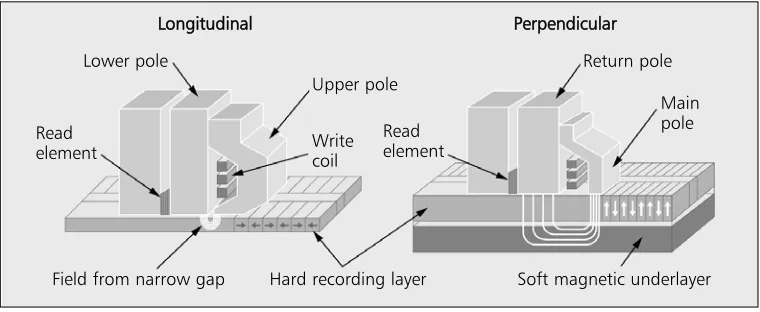
The recent introduction of perpendicular magnetic recording (PMR) facilitated improvements in both SNR and data stability by changing the orientation of the bits in the plane of the medium and adding a soft underlayer to enhance the write field (3, 11–13) (Figure 2). As a result PMR has allowed continued growth in data storage capacity, beyond what was thought achievable with conventional thin-film media. However, existing PMR media are not a complete departure from these conventional media and are still subject to the above-mentioned constraints limit-ing eventual reduction of bit size. Therefore, although the limit to areal density has been greatly deferred, it still exists. It is generally considered that to achieve densities much beyond 1 Tb in−2new materials will be necessary (3, 4).
Shrinking Bits
In the light of this, there are various approaches to be taken in developing media with reduced bit size.
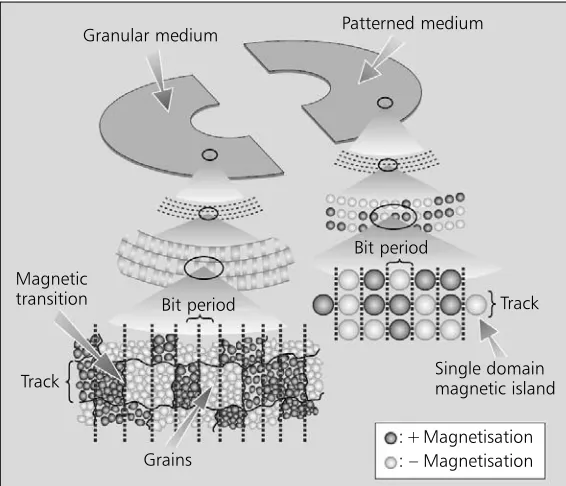
In the first instance, fewer grains would be neces-sary per bit if the medium were more regular with distinct transitions between bits. In the ideal case, bit shape and size would be consistent and the bits would be arranged in uniform arrays. There are a number of strategies currently being explored to improve regularity in magnetic media, with the con-cept of patterned media receiving particular atten-tion (2–4), notably from Hitachi Global Storage Technologies, Ltd (Figure 3) (13).
Bits can also be made smaller if the superpara-magnetic limit to grain size is lowered. The energy
Longitudinal Perpendicular
Lower pole Return pole
Read element
Hard recording layer Field from narrow gap
Upper pole
Main pole Read
element Write
coil
Soft magnetic underlayer
barrier of a grain in the absence of an external field, EB0, is given by KuV, where Vis the volume of
the grain and Kuis the magnetic anisotropy constant
(giving the magnetic anisotropy energy per unit volume) (3). Hence, to maintain the energy barrier while decreasing grain size, material with a higher anisotropy constant must be used. The medium then possesses a higher coercivity,Hc, a measure of the
intensity of the magnetic field which must be applied to remove all the remnant magnetism of the material and a good indicator of data stability. This also means that a more intense field is required to write, and overwrite, the data. As materials with very high anisotropy energy come into use, this may prove problematic due to practical restrictions on the magnetic field of the head. The problem is not insur-mountable and is the focus of much research and development, particularly into methods of microwave-assisted magnetic recording (MAMR) or heat-microwave-assisted magnetic recording (HAMR), in which the head car-ries an energy source to locally heat each bit as it is written, temporarily lowering the coercivity. After writ-ing, the bit is then quenched and returns to high coer-civity so that the information is stabilised (2, 4, 14).
Iron-Platinum Nanoparticles
Novel materials with large values of Kuand which can
be used in a highly regular form are thus being sought.
Iron-platinum alloys of approximately equimolar composition are known to have high Ku values,
specifically in the ordered tetragonal L10phase (3). Furthermore, it is possible to form L10 FePt nano-particles of very small size (around 3 nm) with a high degree of chemical stability (15, 16).
The use of nanoparticles in recording media has been proposed as an extension of the concept of patterned media. Patterned media consist of arrays of magnetic islands arranged in a nonmagnetic matrix. The grains within one bit (or island) are exchange coupled and act in concert, while being completely decoupled and independent from surrounding bits. Bit transitions are thus sharp, and the averaging required in conventional granular media is not necessary. However, ultrahigh densities (10 Tbit in−2 or more) will most likely not be achieved using current nanofabrication techniques such as lithog-raphy as it becomes increasingly difficult to man-ufacture structures on the very small scales required (2, 3). Nanoparticles, while potentially offering the same advantages as bit-patterned media, are gen-erated by chemical synthesis and form arrays through self - assembly, allowing smaller sizes to be obtained and facilitating regular arrangement on a substrate. Equally importantly, nanoparticles tend to be mono-disperse. Variation in size can be limited to below 5% (15), compared with 20–30% in granular media (17).
Granular medium Patterned medium
Magnetic
transition Bit period
Bit period
Track
Track
Grains
Single domain magnetic island
: +Magnetisation : – Magnetisation
FePt nanoparticles would therefore fulfil both the requirement for high anisotropy energy and the need for uniformity. However, there are a number of problems with the use of FePt nanoparticles which must be overcome to make them viable for magnetic recording.
Nanocubes
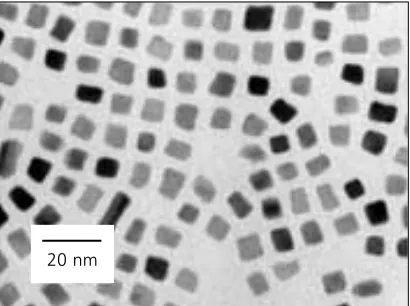
A patent from Seagate Technology LLC in the USA, one of the leaders in this field, reports progress on this front (18). It addresses two concerns: firstly, the fact that it is difficult to align the magnetic axes of spherical FePt nanoparticles once deposited on a surface and, secondly, that they produce a relatively small magnetic signal. The inventors claim a method for producing nearly cubic or rectangular FePt nanoparticles, 4–10 nm in size, which have their facets parallel to the (001) crystallographic plane (Figure 4)(19). During deposition onto a substrate, cubes will assume greater regularity than spheres sim-ply because to be stable the cubes must have one facet flat on the plane and therefore parallel to it. The cubic nanoparticles are found to arrange themselves with their [100] axes perpendicular to the surface, and their [010] and [001] axes parallel to it and aligned locally with each other in square arrays. In addition, these cubic nanoparticles produce a larger signal than spherical particles of similar dimensions. This is because signal strength depends on the magnetic thickness of the medium, and magnetic thickness of nanoparticles has been shown to be a function of their geometry: square is better (18).
There is, however, a potentially more serious lim-itation which this patent claims to have made only partial progress towards solving. Typically, Fe-Pt nanoparticles are produced via synthesis methods that form a magnetically soft face-centred cubic (fcc) crystal structure. Annealing is then necessary to transform the structure to the magnetically hard face-centred tetragonal (fct) phase (2, 16). The draw-back with heat treatment after synthesis is that it may lead to undesirable particle aggregation and magnetic coupling – precisely what patterned media are designed to prevent. The higher-temperature synthesis technique proposed in this patent does appear to induce some phase transformation from fcc to fct during formation of the particles, but it is likely that further annealing will be necessary.
The inventors do not address in this patent the issue of how to write data in a medium which is so magnetically hard that the required switching field is beyond the intensities achievable with existing head technology. However, it can be assumed that this patent forms part of a strategy that Seagate has previ-ously publicised: the use of HAMR in combination with FePt nanoparticles (20).
Capped Nanoparticles
A European research group may have found a way to harness the advantages of both FePt alloy and nanoparticles, without the attendant disadvantages described above. The proof of concept was carried out in the MAFIN project (for ‘magnetic films on nanospheres: innovative concept for storage media’), which was funded under the EU’s Sixth Framework Programme (21, 22). Instead of nanoparticles com-posed of ferromagnetic material, the group used silica nanospheres with a thin layer of the magnetic medium deposited as a cap. Initially, researchers looked into using multilayers of cobalt/platinum or cobalt/palladium as the magnetic medium (17, 23, 24) but in this project the focus moved to FePt as a prom-ising material (21).
If the deposition is done correctly, the spherical shape of the silica particles causes the magnetic film to form uniform, decoupled islands. Deposition of the film can be controlled to impart perpendicular anisotropy to the islands, or a ‘tilted’ medium can be created (Figure 5 (a)). Coercivity depends on the angle between the switching field and the magnetic easy axis of the particle. By tilting the medium, materials with a high Kucan be made more easily writable (17, 24).
Fig. 4. Bright-field transmission electron microscope (TEM) micrograph of unannealed iron-platinum nanocubes, deposited from a non-polar solvent on a carbon-coated copper TEM grid. Reprinted from (19) with permission from Elsevier
As the nanoparticles are not themselves magnetic, they can be arranged adjacent to and in contact with each other in closely packed arrays (Figure 5 (b)). The nanospheres are ∼25 nm in diameter and if they are packed tightly, a storage density of 1 Tb in−2should be possible. A successor project (TERAMAGSTOR for ‘terabit magnetic storage technologies’) is aiming to produce smaller spheres and higher densities (25). The research group has also proposed a novel way to write and read the FePt bits, using a fine probe with a magnetic tip (21).
Concluding Remarks
Ten years into the 21st century, data storage is still dominated by magnetic memory, particularly in the form of hard disk drives (HDDs) (26). While portable devices, and even some desk-top PCs, are now using solid-state drives (SSDs), their cost-per-GB of capacity remains at least an order of magnitude higher than that of HDDs (27, 28). This is likely to be the case for some years yet. Of more immediate concern, perhaps, are the demands placed on the technology by the need for ever-increasing storage capacities. While the
limits of existing materials are approaching, many new materials now in development are poised to deliver step-changes in areal density growth.
The pgms have featured in many major develop-ments in magnetic data storage, of which perpendicu-lar magnetic recording is the most recent example, and they look set to continue doing so. Just two examples of applied research into pgm-based mate-rials have been discussed here, but there are many more. It is quite possible that the platinum group metals may once again prove to be key in realising the standard medium for HDDs of the future.
MARGE RYAN
References
1 IBM Research History Highlights, History of IBM Research 1945–1998: http://www.research.ibm.com/about/past_ history.shtml (Accessed on 26th August 2010)
2 A. Moser, K. Takano, D. T. Margulies, M. Albrecht, Y. Sonobe, Y. Ikeda, S. Sun and E. E. Fullerton, J. Phys. D: Appl. Phys., 2002, 35, (19), R157
3 H. Wu, L. Zhang and Y. Song, ‘Principle, Technology, and Materials’, in “High Density Data Storage: Principle, Technology, and Materials”, eds. Y. Song and D. Zhu, World Scientific Publishing Co Pte Ltd, Singapore, 2009, pp. 1–68 and references therein
4 Z. Z. Badic´ and R. H. Victoria, Proc. IEEE, 2008, 96, (11), 1749
5 K. O’Grady and H. Laidler, J. Magn. Magn. Mater., 1999, 200, (1–3), 616
6 D. Jollie, “Platinum 2010”, Johnson Matthey, Royston, UK, 2010: http://www.platinum.matthey.com/publications/ pgm-market-reviews/archive/platinum-2010/ (Accessed on 14th September 2010)
7 I. R. McFadyen, E. E. Fullerton and M. J. Carey, MRS Bull., 2006, 31, (5), 379
8 M. Kitada and N. Shimizu, J. Appl. Phys., 1983, 54, (12), 7089
9 R. Wood, Y. Hsu and M. Schultz, ‘Perpendicular Magnetic Recording Technology’, Hitachi Global Storage Technolo-gies, Technical Library, White Paper, 27th December, 2007 10 ‘AFC Media – Extending the Limits of Longitudinal Recording’, Hitachi Global Storage Technologies, Technical Library, White Paper, 2nd November, 2007
11 S. Khizroev and D. Litvinov, “Perpendicular Magnetic Recording“, Kluwer Academic Publishers, Dordrecht, The Netherlands, 2004, pp. 1–22
12 D. Carter, Platinum Metals Rev., 2010, 54, (1), 53 13 A. C. Munce and J.-U. Thiele, Hitachi Rev., 2006, 55,
(December), 150 Top view
Side view
Material source
Silica nanosphere FePt island
Substrate
(b) (a)
Fig. 5. (a) Silica nanospheres with isolated magnetic caps of iron-platinum alloy, in this instance deposited at an angle to create a medium with a tilted
14 K. Matsumoto, A. Inomata and S. Hasegawa, Fujitsu Sci. Tech. J., 2006, 42, (1), 158
15 S. Sun, C. B. Murray, D. Weller, L. Folks and A. Moser, Science, 2000, 287, (5460), 1989
16 S. Sun, S. Anders, T. Thomson, J. E. E. Baglin, M. F. Toney, H. F. Hamann, C. B. Murray and B. D. Terris, J. Phys. Chem. B, 2003, 107, (23), 5419
17 G. Schatz, M. Albrecht, J. Boneberg and I. Guhr, ‘Information Storage Media’, US Appl. 2008/0,171,233 18 N. Shukla, T. J. Klemmer, D. K. Weller and C. Liu, Seagate
Technology LLC, ‘Method of Producing Self-Assembled Cubic FePt Nanoparticles and Apparatus Using Same’, US Appl. 2010/0,080,895
19 N. Shukla, C. Liu and A. G. Roy, Mater. Lett., 2006, 60, (8), 995
20 ‘Seagate Swings “HAMR” to Increase Disc Drive Densities by a Factor of 100’, Seagate, About Seagate, News, Press Releases, 21st August, 2002: http://www. seagate.com/ (Accessed on 26th August 2010) 21 ‘EU scientists aim to break storage capacity barrier’, CORDIS
News Release, 7th July, 2010: http://cordis.europa.eu/
fetch?CALLER=EN_NEWS&ACTION=D&SESSION=&RCN= 32298 (Accessed on 14th September 2010)
22 MAFIN Project: http://www.mafin-project.de/ (Accessed on 26th August 2010)
23 M. Albrecht, G. Hu, I. L. Guhr, T. C. Ulbrich, J. Boneberg, P. Leiderer and G. Schatz, Nature Mater., 2005, 4, (3), 203 24 G. Schatz, Acta Phys. Polonica A, 2009, 115, (2), 431 25 Terabit Magnetic Storage Technologies: http://www.
teramagstor.eu/ (Accessed on 14th September 2010) 26 E. Pinheiro, W.-D. Weber and L. A. Barroso, ‘Failure
Trends in a Large Disk Drive Population’, 5th USENIX Conference on File and Storage Technologies (FAST ’07), San José, California, USA, 13th–16th February, 2007 27 J. Handy, ‘Flash Memory vs. Hard Disk Drives – Which
Will Win?’, StorageSearch.com, June, 2005: http://www. storagesearch.com/semico-art1.html (Accessed on 26th August 2010)