394
An Assesment Of Construct Validity And
Reliability On Organizational Commitment
Anis Suryani, Fatwa Tentama
Abstract: The purpose of this research are to analyze construct validity and reliability on organizational commitment as well as finding the components which form the organizational commitment. Components which form the organizational commitment are affective, normative and continuance constructs. The subject of the research is constituted of 60 teachers specialiazed in teaching students to read the Qur’an in X University. The data is collected by using organizational commitment scale. Structural Equation Modeling (SEM) SmartPLS 3.2.8 with reflective construct through CFA 2nd order is utilized to analyze the data. Based on the result of the analysis, it is concluded that the components and indicators which form organizational commitment are valid and reliable. The dominant component which reflect construct of organizational commitment is the affective commitment with factor loading of 0.946. The lowest component which reflect the organizational commitment is continuance commitment with factor loading of 0.647. These indicate that all dimensions and indicators reflect and constitute the organizational commitment. Thus, this measurement model can be accepted for it yields a compatibility between the theory which describes the organizational commitment and the empirical data collected from the subject.
Keywords : Affective Commitment, CFA 2nd Order, Continuance Commitent, Normative Commitment, Organizational Commitment, Validity, Reliability
—————————— ——————————
1.
INTRODUCTION
Human resource is one of the most important variable in an organization. As the globalization era progresses, a demand is put on human resource to develop proactively [1]. Byars and Rue [2] state that its management is designed to provide and coordinate human resource in an organization. In a learning process, teachers or instructors are an important group of human resource. Commited teachers have a tendency to carry their duties effectively according to the demands of their profession. In addition, they are also willing to build a relationship between teachers and students in accordance with professional values. The essential aim of a teacher is to create a change in the students’ behavior in line with pedagogical principles. The teachers’ commitment and obedience are key factors in influencing the success of students’ learning process [3]. Commitment is an important element in a succesful teaching process. A committed teacher will care deeply for the students’ development and put their best effort in increasing the student’s learning quality [3]. Organizational commitment is a must-have trait for teachers because it is crucial for school efficiency as well as indirectly affect their students [4]. According to a research conducted by Emami and Darabi [5], organizational commitment is important since it is linked with other organizational variables such as turnover, attendance, and work motivation. In addition, organizational commitment also affect employees’ commitment in carrying out their roles as a member of society [6].
An individual with a high organizational commitment may also have a high altruistic spirit [7], as well as having a desire to share their knowledge and experience with others [8]. Organizational commitment also moderately affect organizational citizenship behavior [9]. According to Rego and Cunha [10] in organizational management, commitment is a central variable because the a commited individual tend to show a higher-level effort in working, thus giving their maximum contribution to the organization. Organizational commitment plays a role in the behavior of sharing knowledge.
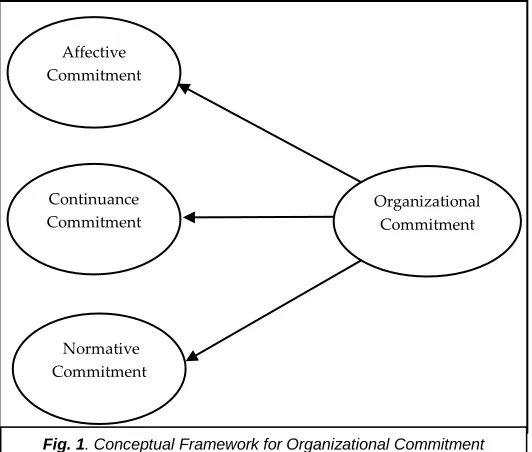
This means that individuals with a high organizational commitment often share their knowledge and have a good working relationship [11]. Organizational commitment indirectly affect work satisfaction and the individual’s motivation in bringing a change to his or her organization [12]. According to Celik, Dedeolu, and Inanir [13] organizational commitment positively affect the employees’ work satisfaction and performance [14], as well as controlling the negative effect of work stess [15]. Organizational commitment is the relative strength of an individual's identification with and involvement in a particular organization [16]. Furthermore, O’Reily and Chatman [17] state that organizational commitment is a psychological bond between individual and organization, including a sense of work involvement, loyalty and believe in organizational values. Allen and Meyer [18] state that organizational commitment is a psychlogical expression that reflects the relationship of the employees with the organization specifically in regard to the decision whether to continue or terminate their memberships in organizations. Organizational commitment is also defined as psychological bond between employees and organization that reduces voluntary resignation rate [18]. Robbins and Judge [19] define organizational commitment as certain conditions in which employees will side with the goals and objectives of the organization and their desire to maintain memberships in certain organizations. Furthermore, Luthans [20] defines organizational commitment as a strong desire to remain a member in a particular organization, a willingness to exert high-level effort on behalf of the organization, and a deep conviction and acceptance of the values and objectives of the organization. Moreover, Mathis and Jackson [21] define organizational commitment as an individual’s believe and acceptance of his or her organization’s goals and his or her inclination to work in said organization or cooperation. Organizational commitment according to Meyer and Allen [22] is constituted of three components which are affective, continuance, and normative commitment. Firstly, affective commitment is the emotional bond of the employees and their involvement in organizations. Employees who have strong affective commitment are willing to continue their jobs because they want to do it. These employees care about their organization and are proud to be part of it. Secondly, continuance commitment is a perception that refers to the awareness of the cost associated with leaving the organization. This component is illustrated by the ————————————————
Anis Suryani, Faculty of Psychology Ahmad Dahlan University, Yogyakarta, PH-089630701005. E-mail: [email protected] Fatwa Tentama, Faculty of Psychology Ahmad Dahlan University,
395 need of the individual to maintain his or her job in the
organization, the difficulty of finding other jobs outside a particular organization, and a willingness to do personal sacrifices. Thirdly, normative commitment is a sense of obligation to continue working in a particular organization. Employees who have a high normative commitment will feel that they have to stay in the organization and have a desire to perform maximum service. In the last decade, empirical studies in regard to organizational commitment show that organizational commiment can affect work satisfaction and burnout [23], turnover [24], work performance [25], work motivation [26], employees’ perspectives [27] and organizational citizenship behaviors [28].
One approach that can be used in testing the construct of a measurement model is Confirmatory Factor Analysis. Confirmatory Factor Analysis (CFA) is one of the main approaches in factor analysis. CFA can be used to test the dimensionality of a construct. This testing is used to conduct model measurement in order to describe how the components and behavioral indicators reflect latent variable namely work commitment by looking at factor loading of each component that constitute a construct. Confirmatory Factor Analysis (CFA) can also be used to test construct validity and reliability from indicators constitutive of latent construct [29]. CFA that is used in this research is second order confirmatory factor analysis (2nd Order CFA) which is a measurement model comprising of two levels of analsysis. The first level of analysis is conducted from the dimension of latent construct to its indicators and the second level of analysis is conducted from latent construct to its components [29]. According to the explanation above, it can be concluded that organizational commitment is a crucial trait a teacher must posses. Given the importance of organizational commitment, thus the problem statements of this study are: 1) is the organizational commitment construct valid and reliable? 2) are the components of affective, continuance and normative commitment able to form a construct/organizational commitment variable? The purpose of this study are to: 1) find out the validity and reliability of the construct of organizational commitment, and 2) find the components that constitute the
construct of organizational commitment.
2
RESEARCH
METHOD
2.1 Research Participant
The subject in this research were 60 teachers specialized in the teaching of reading the Qur’an in X University.
2.2 Research Design
The design of this study was semi-constructive in nature, where scale design was conducted through a collaboration between theoretical studies and information obtained directly from field data [30]. The advantage of semi-constructive design is to strengthen existing theories and produce as many behavioral indicators as possible. Afterward, testing was also done on psychometric properties including content validity, discriminating power, confirmatory factor analysis, and validity concurrent/external.
2.3 Instrument
Organizational commitment scale was designed by researcher based on the components of organizational commitment proposed by Meyer and Allen [22]. Those components include affective, continuance, and normative commitment. The scaling method on the organizational commitment scale used Likert scale model that the researcher developed by using four answers choices. This scale was consisted of 18 questions with four statements spanning two directions namely favourable and unfavourable. The format of the score in each of this statement can be seen in table 1.
TABLE1
SCORE OF ORGANIZATIONAL COMMITMENT SCALE
Statement Favorable score Unfavorable score
SS 4 1
S 3 2
TS 2 3
STS 1 4
Example of statement of an affective commitment component was “I am proud to be a part of my organization” and “I care about everything in regard to my organization”. Statement exemplifying continuance commitment component was “One of the reasons that I work in this organization is that I need this job,” and ”for me, it is very difficult to leave the job in this organization because it’s not certain that I can get a better job in other places”. Example of normative commitment’s statement was “I have a strong motivation to maintain my job in this organization” and “I will give maximum service in carrying out my duties in this job”. The making of items in this study referred to the components of organizational commitment proposed by Meyer and Allen [22]. The blueprint of organizational commitment scale can be seen in table 2.
TABLE2
BLUEPRINT OF ORGANIZATIONAL COMMITMENT SCALE
Component Indicators Numbers Item Total Normative
Commitment Continuance Commitment Affective Commitment
Organizational Commitment
396 Fav
o
Unfav o Affective
Commitment
a. Emotional bond between employee and organization b. Proud to be part of the
organization
c. Care about the organization
1,3, 5
4,7,9 6
Continuance Commitment
a. Need the job provided by the organization
b. Difficult to leave the organization
c. Difficult to look for other jobs
d. Require personal sacifice 2,6,
8
11,13 ,15
6
Normative Commitment
a. Strong desire to maintain the job in the organization b. Provide maximum service
10, 12, 14
16,17 ,18
6
Total 9 9 18
2.4 Construct Validity and Reliability
2.4.1 Construct Validity
The validity testing in this research utilized validity of reflective construct which is confirmatory in nature, to show the high quality result obtained from the use of measurement model in relation with theoretical reference employed to define a construct. There are two validity assesments in construct validity: 1) Convergent Validity, measured the correlation between item score and construct score, measured based on factor loading. According to Hair, Hult, Ringle, and Sarstedt [31] the higher the score of factor loading, the more important the role of loading will be in intrepreting matrix factor with loading value > 0.5 considered significant, then value of average variance extracted (AVE) > 0.5 [32]. 2) Discriminant Validity, carried out because different construct measurements should not highly correlate with each other that is the value of cross loading between construct and item is bigger than the value of other constructs. The method was to compare the root of AVE of a construct. It must be higher compared to the correlation between latent variables [32].
2.4.2 Construct Reliability
Realibility testing was conducted to show internal consistency of the measurement model by looking at the value of composite reliability and an even more higher value of the Cronbach's alpha. It showed the consistency of the value of each item in measuring latent variables. According to Hair, Hult, Ringle, and Sarstedt, [31] the expected composite reliability value and Cronbach’s alpha are > 0.7, value of 0.6 can still be accepted. Furthermore according to Cooper, internal consistency testing is fulfilled if construct validity has met the criteria so that the average variance extracted (AVE) represent internal consistency, because if the construct is valid then it is reliable but a reliable construct is not necessarily a valid construct [32].
2.5 Data Analysis
The data in this study were analyzed using SmartPLS 3.2.8 program with reflective construct through the 2nd Order CFA. According to Abdillah and Hartono [33] PLS is a variance-based structural equation analysis (SEM) that can simultaneously test measurement models to asses validity and reliability.
3 RESULT
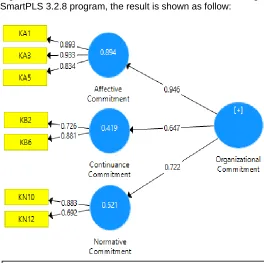
Based on the result of outer model testing analysis on organizational commitment scale conducted through SmartPLS 3.2.8 program, the result is shown as follow:
3.1 Convergent Validity
Based on the result of convergent validity testing, organizational commitment construct is considered valid because it fulfills the criterion with the value of the factor loading of variable-component is at > 0.5, which can be seen on table 2.
TABLE2
VALUE OF FACTOR LOADING (VARIABLE-COMPONENT)
Component Loading factor Annotation
Affective Commitment 0.946 0.647 0.722
Valid
Continuos Commitment 0.946 0.647 0.722
Valid
Normative Commitment 0.946 0.647 0.722
Valid
Based on the result of convergent validity assesment, organizational commitment construct is considered as valid because it fulfills the criterion that is the value of factor loading of component-indicator is > 0.5, which can be seen in table 3.
TABLE3
VALUE OF FACTOR LOADING (COMPONENT-INDICATOR)
Component Loading factor Annotation
KA1 0.893 Valid
KA3 0.933 Valid
397
KA5 0.834 Valid
KB2 0.726 Valid
KB6 0.881 Valid
KN10 0.883 Valid
KN12 0.692 Valid
The convergent validity test shows that average variance extracted or AVE on the organizational commitment construct has a value of 0.588. The value of average variance extracted or AVE on each dimension can be seen in table 4.
TABLE4
VALUE OF AVERAGE VARIANCE EXTRACTED (AVE)
Component AVE Annotation
Affective Commitment 0.788 Valid
Continous Commitment 0.652 Valid
Normative Commitment 0.630 Valid
3.2 Discriminant Validity
Based on value of dicriminant validity test, it is shown that the root of Average Variance Extracted or AVE of the same component is higher than the root of average variance extracted or AVE on other components, so that the criterion of discriminant validity is fulfilled. The root value of Average Variance Extracted (AVE) of organizational commitment construct can be seen in table 5.
TABLE5
ROOT VALUE OF AVERAGE VARIANCE EXTRACTED (AVE) OF
ORGANIZATIONAL COMMITMENT CONSTRUCT
Component KA KB KN
KA 0.888 0.514 0.582
KB 0.514 0.807 0.223
KN 0.582 0.223 0.793
3.3 Construct Reliability Testing
Construct reliability testing results in the value of Composite Reliability and Cronbach’s Alpha > 0.7, thus the items utilized in this research is considered reliable.
TABLE6
VALUE OF COMPOSITE RELIABILITY AND CRONBACH’S ALPHA OF
RESILIENCE CONSTRUCT
Variable Composite Reliability
Cronbach
alpha Annotation Organizational
Commitment
0.875 0.818 Valid
Result of construct reliability testing with Confirmatory Factor Analysis 2nd Order on Table 6 above shows that the construct has a a high reliability. Furthermore, it concludes that the components which measure construct/latent variable of
organizatonal commitment fulfill the criterion of unidimensionality [31]. This is shown by the value of Composite Reliability at 0.875 and Cronbach’s Alpha at 0.818. Based on the processing and analysis of data on the dimension of variable/construct of organizational commitment which is created by utilizing Confirmatory Factor Analysis 2nd Order, it is shown that the model can be accepted because all dimensions are able to reflect the formed variable/construct.
4 DISCUSSION
Based on the result of the analysis on construct validity and construct reliability, the components and indicators that make up organizational commitment are declared valid and reliable. This shows that all dimensions and existing indicators are able to reflect and are constitutive of organizational commitment. The most dominant component that reflects organizational commitment is affective commitment with factor loading of 0.946 where the main indicators are the teachers or instructors’s contentment in the workplace, their pride in being parts of the institution and the care the show in all matters relating to the institution. The lowest component that reflects organizational commitment is continuance commitment with a factor loading of 0.647 where the main indicators are the teachers or instructors’s reasoning in working at the institution is based on their needs to have a job and the difficulty in leaving their job due to the lack of better opportunities in other institutions or organizations. The finding of a research conducted by Syauta, Troena, Setiawan and Solimun [34] proves that organizational commitment has met the reliability requirement with value of 0.825. Other research Tsai [35] concludes that organizational commitment has met the reliability requirements with value 0.57. This study finds that organizational commitment has met the reliability requirement with value of 0.875. The most dominant component that reflects the organizational commitment in this study, namely the affective commitment has a factor loading value of 0.946. Based on the field data, affective commitment dominates organizational commitment because the teachers specialized in the teaching of reading of the Qur’an at X University feel happy, proud and care deeply about their students’ progress of learning to read the Qur’an, especially teachers or instructors who have been with the institution for a long time. The results of this study are expected to provide a picture on the validity and reliability of organizational commitment construct in the context of teachers or instructors specialized teaching their students to read and the Qur'an at X University so that it can be used as a reference in further research related to organizational commitment.
5 CONCLUSION
398 organizational commitment model in relation to other
variables.
ACKNOWLEDGMENT
The author would like to thank Ahmad Dahlan University and the Master of Psychology Programe University of Ahmad Dahlan for supporting the implementation of this research.
REFERENCES
[1] E. Sutrisno, Human Resource Management (in Indonesia). Jakarta: Kencana, 2009.
[2] L.L. Byars and L.W. Rue, Human Resource Management. Boston: Mc. Graw-Hill, 2000.
[3] T.C. Mart, “A Passionate Teacher: Teacher Commitment and Dedication to Student Learning,” International Journal of Academic Research in Progressive Education and Development, vol. 2, no. 1, 2013.
[4] S.F. Hamid, N. Nordin, A.A. Adnan, and N. Sirun, “A Study on Primary School Teachers’ Organizational Commitment and Psychological Empowerment in The District of Klang,” Procedia-Social and Behavioral Sciences, vol. 90, pp. 782-787, 2013. [5] M. Emami and M. Darabi, “Antecedents of Professional
Commitment,” Elixir Psychology, vol. 50, pp. 10466-10470, 2012.
[6] M. Kaplan and A. Kaplan, “The Relationship between Organizational Commitment and Work Performance: A Case of Industrial Enterprises,” Journal of Economic and Social Development (JESD), vol. 5, no. 1, pp. 46-50, 2018.
[7] P.M. Podsakoff, S.B. MacKenzie, J.B. Paine, and D.G. Bachrach, “Organizational Citizenship Behaviors: A Critical Review of The Theoretical and Empirical Literature and Suggestions for Future Research,” Journal of Management, vol. 26, no. 3, pp. 513-563, 2000.
[8] D. Hislop, “Linking Human Resource Management and Knowledge Management Via Commitment: A Review and Research Agenda,” Employee Relations, vol. 25, no. 2, pp. 182-202, 2003.
[9] T.W. Ng and D.C. Feldman, “Affective Organizational Commitment and Citizenship Behavior: Linear and Non-Linear Moderating Effects of Organizational Tenure,” Journal of Vocational Behavior, vol. 79, no. 2, pp. 528-537, 2011.
[10] A. Rego and M.P. Cunha, “Workplace Spirituality and Organizational Commitment: An Empirical Study,” Journal of Organizational Change Management, vol. 21, no. 1, pp. 53-75, 2008.
[11] X. Li, J. Zhang, S. Zhang, and M. Zhou, “A Multilevel Analysis of The Role of Interactional Justice in Promoting Knowledge-Sharing Behavior: The Mediated Role of Organizational Commitment,” Industrial Marketing Management, vol. 62, pp. 226-233, 2017.
[12] D.A. Yousef, “Organizational Commitment, Job Satisfaction and Attitudes Toward Organizational Change: A Study in The Local Government,” International Journal of Public Administration, vol. 40, no. 1, pp. 77-88, 2017.
[13] S. Çelik, B.B. Dedeoğlu, and A. Inanir, “Relationship between Ethical Leadership, Organizational Commitment and Job Satisfaction at Hotel Organizations,” Ege Akademik Bakış Dergisi, vol. 15, no. 1, pp. 53-64, 2015.
[14] A.Z. Hafiz, “Relationship between Organizational Commitment and Employee’s Performance Evidence from Banking Sector of Lahore,” Arabian Journal of Business and Management Review, vol. 7, no. 2, pp. 1-7, 2017.
[15] A. Jain, S. Giga, and C. Cooper, “Stress, Health and
Well-Being: The Mediating Role of Employee and Organizational Commitment,” International Journal of Environmental Research and Public Health, vol. 10, no. 10, pp. 4907-4924, 2013. [16] L.W. Porter, R.M. Steers, R.T. Mowday, and P.V. Boulian,
“Organizational Commitment, Job Satisfaction, and Turnover among Psychiatric Techni- Cians,” Journal of Applied Psychology, vol. 59, pp. 603-609, 1974.
[17] C.A. O'Reilly and J. Chatman, “Organizational Commitment and Psychological Attachment: The Effects of Compliance, Identification, and Internalization On Prosocial Behavior,” Journal of Applied Psychology, vol. 71, no. 3, 1986.
[18] N.J. Allen and J.P. Meyer, “Affective, Continuance, and Normative Commitment to The Organization: An Examination of Construct Validity,” Journal of Vocational Behavior, vol. 49, no. 3, pp. 252-276, 1996.
[19] T.A. Judge and S.P. Robbins, Essentials of Organizational Behavior. New York: Pearson Education, 2017.
[20] F. Luthans, C.B. Luthans, and W.K. Luthans, Organizational Behavior: An Evidence-Based Approach. United States of America: Information Age Publishing, 2015.
[21] R.L. Mathis, J.H. Jackson, S.R. Valentine, and P.A. Meglich, Human Resource Management. United States of America : Cengage Learning, 2015.
[22] J.P. Meyer and N.J. Allen, “A Three-Component Conceptualization of Organizational Commitment,” Human Resource Management Review, vol. 1, no. 1, pp. 61-89, 1991. [23] N. Tosun and H. Ulusoy, “The Relationship of organizational
Commitment, Job Satisfaction and Burnout on Physicians and Nurses?,” Journal of Economics & Management, vol. 28, pp. 90-111, 2017.
[24] N.H. Shah, F. Ahmad, N.B. Jumani, and M.A. Tariq, “Influence of Organizational Commitment on Turnover Intention of Private Secondary School Teachers,” Journal Application Environment, vol. 7, no. 3, pp. 244-251, 2017.
[25] S.M.B. Al Zefeiti and N.A. Mohamad, “The Influence of Organizational Commitment on Omani Public Employees’ Work Performance,” International Review of Management and Marketing, vol. 7, no. 2, pp. 151-160, 2017.
[26] P. Kamal and A.K. Ahluwalia, “The Influence of Organizational Commitment on Work Motivation: A Comparative Study of State and Private University Teachers,” The IUP Journal of Organizational Behavior, vol. 16, no. 2, pp. 55-69, 2017. [27] K.J. Adzeh, ”Assessing the Influence of Organizational
Commitment on Employee Perceptions of Superior Customer Value Creation,” Doctoral dissertation, Capella University, 2013.
[28] C.C. Huang and C.S. You, “The Three Components of Organizational Commitment on In-Role Behaviors and Organizational Citizenship Behaviors.,” African Journal of Business Management, vol. 5, no. 28, pp. 11335-11344, 2011. [29] H. Latan, Structural Equation Modeling Concepts and
Applications using LISREL 8,80 (in Indonesia). Bandung: Alfabeta, 2012.
[30] T.R. Hinkin, J.B. Tracey, and C.A. Enz, “Scale Construction: Developing Reliable and Valid Measurement Instruments,” Journal of Hospitality & Tourism Research, vol. 21, no. 1, pp. 100-120, 1997.
[31] Jr.J.F. Hair, G.T.M. Hult, C. Ringle, and M. Sarstedt, A Primer on Partial Least Squares Structural Equation Modeling (PLS-SEM). New York: Sage Publications, 2016.
399 [33] W. Abdillah and J. Hartono, Partial Least Square (PLS):
Alternative of Structural Equation Modeling (SEM) in Business Research (in Indonesia). Yogyakarta: Penerbit Andi, 2015. [34] J.H. Syauta, E.A. Troena, M. Setiawan, and Solimun, “The
Influence of Organizational Culture, Organizational Commitment to Job Satisfaction and Employee Performance (Study At Municipal Waterworks of Jayapura, Papua Indonesia),” International Journal of Business and Management Invention, vol. 1, no. 1, pp. 69-76, 2012.