RFID Based Wireless Intelligent Cart Using
ARM7
Pavan Badarinath
U.G. Student, Department of Electronics and Communication Engineering, BNM Institute of Technology,
Bangalore, India
ABSTRACT:This paper “RFID BASED WIRELESS INTELLIGENT CART USING ARM7” put forth an architecture and solution of an innovative system for the acquisition of products in shopping malls. The Intelligent Cart explores automatic identification technologies like RFID as a way to improve the quality of services provided by retailers and to augment the consumer value thus by using modernized techniques which also results in saving time. Shopping at big malls or any shopping precincts is a daily activity in metro cities. People from all walks of life purchase different materials and put them in the cart. Once the purchase is done, the billing counter has the cashier to prepare the bill using bar code reader which is a time-consuming process and lead to long queues at billing counters. Our aim is to develop a system that can be used to solve the mentioned challenge. The system will be placed in each cart. It will consist of a RFID reader. All the products in the mall will be equipped with unique RFID tags. When the consumer tries to put any products in the trolley or cart, tag will be detected and the name and other details of the products will be displayed on LCD. As we put the products, the costs will get added to total bill. Thus, the billing will be done in the trolley itself. At the billing Counter the total bill data will be transferred to computer via ZigBee module.
KEYWORDS:RFID, RFID tags, ZigBee.
I.INTRODUCTION
Shopping precinct or shopping centre is a place where most people will get their daily necessities. The count of shopping malls keeps on increasing over the years throughout the globe due to the demand of the public. Thus, the level of advancement of shopping mall system and infrastructure also accelerates. For shopping mall system, there are still plenty of spaces for improvement in terms of providing quality shopping experience to the consumers. Consumers often face few problems and inconvenience while shopping. These problems include worrying that the money brought is not enough for paying all the items wanted, insufficient information of particular item that are for sale and also wasting unnecessary time at the cashier. There are some existing methods to solve these issues which are enlightened in this paper. Certain techniques to solve above challenges are substituting the conventional way of keying item per item by hand to the cash register with the technology of barcode scanning where the price are stored in the barcode, and also set up a customer information counter to help the consumer if there are any enquiries about the items at shopping mall. The problems stated above might eventually be solved or else improved by the implementation of RFID technology in shopping mall. This can be done by simply attach an RFID tag to all the items in shopping mall and attach a RFID reader with an LCD display on the shopping trolley can reduce the intensity of all the problems above. With the implementation of this system, consumers can know the price of every item that are scanned in, total price of all the items, and also brief details of the item such as the weight or expiry date.
II. LITERATURE SURVEY
low-cost, easily scalable, and rugged system for assisting shopping in person. Mr. P Chandrasekar in "Smart Shopping Cart with Automatic billing System through RFID and ZigBee" proposed to develop a shopping cart with a Product Identification Device (PID) which will contain a microcontroller, a LCD, an RFID reader, EEPROM, and ZigBee module. Purchasing product information will be read through a RFID reader on shopping cart, meanwhile product information will be stored into EEPROM. The central billing system gets the cart information and EEPROM data, it accesses the product database and calculates the total amount of purchasing for that particular cart.
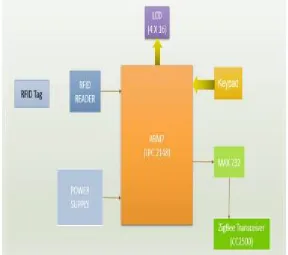
III.BLOCK DIAGRAM OF TRANSMITTER
In this unit the ARM processor is attached to a RFID reader. As the user puts the items in the trolley the reader on the trolley reads the tag and sends a signal to the ARM processor. The ARM processor then stores it in the memory and compares it with the lookup table. If it matches then it shows the name of item on LCD &also the total amount of items purchased.
Fig 1 Transmitter Block Diagram
continuous display of count due to persistence of Vision. A 4x4 matrix keypad is used to provide the provision to enter the stock. The keypad interfacing is used with a hardware interrupt INT0.This makes the microcontroller to scan the keypad whenever a key is pressed.
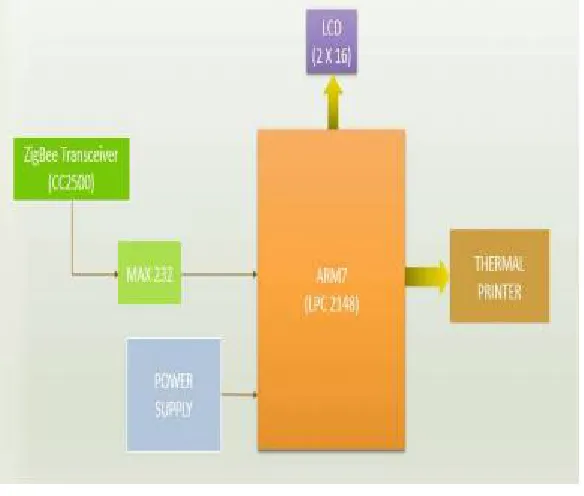
IV.BLOCK DIAGRAM OF RECEIVER
As soon as the shopping is over the user comes near the billing section. The total bill will display on the billing computer. Thermal printing is a digital printing process which produces a printed image by selectively heating coated thermochroic paper. The coating turns black in the areas where it is heated, producing an image. Two-colour direct thermal printers can print both black and an additional colour (often red) by applying heat at two different temperatures. Thermal transfer printing is a very different method that uses a heat-sensitive ribbon instead of heat sensitive paper.
Fig 2 Receiver Block Diagram
V.SOFTWARE IMPLEMENTATION
The system designing requires the following software’s Keil Software
Flash magic
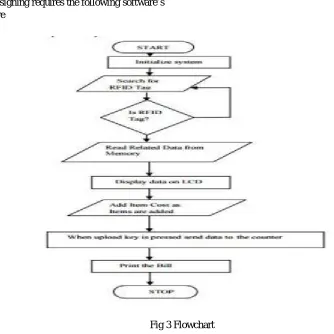
Fig 3 Flowchart
VI.RESULTS
The smart shopping trolley application creates an automated central billing system for supermarkets and malls. Using pid (product identification), customers will not have to wait near cash counters for their bill payment. Since their purchased product information is transferred to central billing system. Customers can pay their bill through credit/debit cards as well. The system proposed is highly dependable, authentic, trustworthy and time-effective. There will be reduction in salary amount given to employees, reduction in theft. Also, the system is very time-efficient. Different parameters such as the system parameters of smart trolley like products name, products cost, product weight etc. are continuously displayed.
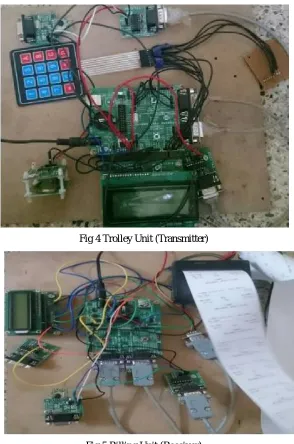
Fig 4 Trolley Unit (Transmitter)
Thus, we can say that
1. Automatic billing of products by using RFID technique will be a more viable option in the future. 2. The system based on RFID technique is efficient, compact and shows the better performance.
VII. CONCLUSION
The intended objectives were successfully achieved in the prototype model developed. The developed product is easy to use, low-cost and does not need any special training. We have also learned the architecture of the system that can be used in the shopping systems for intelligent and easy shopping in the malls to save time, energy and money of the consumers. Different parameters such as the products name, products cost etc. are continuously displayed. The decision-making process is done locally within the cart, thereby eliminating an overhead to the communication between the modes. There are a few challenges/drawbacks to be resolved to make the proposed system more robust. To begin with, in this project the latency time of the wireless communication with the server may need to be considered. Secondly, the communication is not very secure. Another ZigBee module operating at the same frequency can easily intercept the transmitted data. This issue will have to be resolved specifically with respect to billing to promote consumer confidence.
VIII. FUTURE SCOPE
Smart cart can be interfaced with wireless technologies to make it completely portable in the near future. Payment of bills using mobile can be implemented. A low-cost RFID scanner can be manufactured and used which can scan multiple tags (products) simultaneously for faster processing and lesser resources. Automatic scanning & availability of products can be introduced. Showing Product Availability: Even though the system provides product location, there is no surety that the Product will be in stock and available at that time. Hence, the system can include the functionality of displaying the Product availability. There can be voice assistance included. Instead of paying through cash or credit cards a consumer can use NFC based mobile phone for online payment through Wi-Fi advertisement of products can be done. LCD display can be replaced with touch screens.
REFERENCES
[1] Dr. Suryaprasad J, Praveen Kumar B O, Roopa D & Arjun A K "A Novel Low-Cost Intelligent Shopping Cart", 2014 Ieee. [2] Amine Karmouche, Yassine Salih-Alj, "Aisle-Level Scanning For Pervasive Rfid-Based Shopping Applications", 2013 Ieee. [3] Martin Mayer, Nobert Gortz And Jelena Kaitovic, "Rfid Tag Acquisition Via Compressed Sensing", 2014 Ieee.
[4] Satish Kamble, Sachin Meshram, Rahul Thokal & Roshan Gakre, "Developing A Multitasking Shopping Trolley Based On Rfid Technology", January 2014 International Journal Of Soft Computing And Engineering (Ijsce).
[5] Mr. P. Chandrasekar, Ms. T. Sangeetha, "Smart Shopping Cart With Automatic Central Billing System Through Rfid And Zigbee", 2014 Ieee. [6] Raju Kumar, K. Gopalakrishna, K. Ramesha, “Intelligent Shopping Cart”, International Journal Of Engineering Science And Innovative Technology (Ijesit) Volume 2, Issue 4, July 2013, Issn: 23195967.
[7] Galande Jayshree, Rutuja Gholap, Preeti Yadav, “Rfid Based Automatic Billing Trolley”, International Journal Of Emerging Technology And Advanced Engineering Website: Www.Ijetae.Com (Issn 2250-2459).
[8] Ieee Antennas & Propagation Magazine, 48, 2006, Pp:212-218 Theory And Propagation Magazine, 48, 2006, Pp: 212218, Theory And Measurement Of Back Scatting From Rfid Tags, P.V.Nikitin, K.V.S. Rao.
[9] Measurment, Vol.44, No.4, Pp.730-737, April 2011 Threshold-Based Identification Of Wireless Saw Rfid Tags With Pulse Position Encoding, G.Cerda-Villafana &Y.S.Shmaliy.
[10] Rfid Journal, 2002-2007, Refferd 6.8.2007, Available Http://Www.Rfidjournal.Com.
[11] Proceeding Of The 2004ieee International Conference On Networking,Sensing& Control,2004 Mobile Healthcare Services System Using Rfidl-Cheng-Ju, L.Li, C.Shi-Zong, W.Chi Chen, H.Chunhuang&C.Xin-Mei.