Scholarship@Western
Scholarship@Western
Electronic Thesis and Dissertation Repository
12-9-2015 12:00 AM
Adaptive Non-Local Means using Weight Thresholding
Adaptive Non-Local Means using Weight Thresholding
Asif Khan
The University of Western Ontario
Supervisor
Dr. Mahmoud R. El-Sakka
The University of Western Ontario
Graduate Program in Computer Science
A thesis submitted in partial fulfillment of the requirements for the degree in Master of Science © Asif Khan 2015
Follow this and additional works at: https://ir.lib.uwo.ca/etd
Part of the Computer Sciences Commons
Recommended Citation Recommended Citation
Khan, Asif, "Adaptive Non-Local Means using Weight Thresholding" (2015). Electronic Thesis and Dissertation Repository. 3369.
https://ir.lib.uwo.ca/etd/3369
This Dissertation/Thesis is brought to you for free and open access by Scholarship@Western. It has been accepted for inclusion in Electronic Thesis and Dissertation Repository by an authorized administrator of
(Thesis format: Monograph)
by
Asif Khan
Graduate Program in Department of Computer Science
A thesis submitted in partial fulfillment
of the requirements for the degree of
Masters of Science
The School of Graduate and Postdoctoral Studies
The University of Western Ontario
London, Ontario, Canada
c
Non-local means (NLM) is a popular image denoising scheme for reducing additive
Gaus-sian noise. It uses a patch-based approach to find similar regions within a search neighborhood
and estimate the denoised pixel based on the weighted average of all the pixels in the
neigh-borhood. All the pixels are considered for averaging, irrespective of the value of their weights.
This thesis proposes an improved variant of the original NLM scheme, calledWeight
Thresh-olded Non-Local Means(WTNLM), by thresholding the weights of the pixels within the search
neighborhood, where thethresholded weightsare used in the averaging step. The key
parame-ters of the WTNLM are defined using learning-based models. In addition, the proposed method
is used as a two-step approach for image denoising. At the first step, WTNLM is applied to
generate a basic estimate of the denoised image. The second step applies WTNLM once more
but with different smoothing strength. Experiments show that the denoising performance of
the proposed method is better than that of the original NLM scheme, and its variants. It also
outperforms the state-of-the-art image denoising scheme, BM3D, but only at low noise levels
(σ≤ 80).
Keywords: Image denoising, Additive Gaussian Noise, local Means, Two-stage
Non-local means, Spatial Domain Denoising
I am expressing my heartiest gratitude to the Almighty to give me the ability to complete my
thesis successfully. I would like to thank my thesis supervisor Dr. Mahmoud R. El-Sakka for
his noteworthy and valuable direction, guidance, motivation and encouragement in the way of
my progress. It was an absolute honor and privilege to work with such a modest and wise
person like him. Moreover, I am also thankful to all of my professors from the University of
Western Ontario for building my background to complete this task.
I am also grateful to my family for their continuous support and guidance.
Abstract ii
Acknowledgments iii
List of Figures vii
List of Tables ix
1 Introduction 1
1.1 Motivation . . . 2
1.2 Thesis Contribution . . . 2
1.3 Thesis Outline . . . 3
2 Background 4 2.1 Image Noise . . . 4
2.1.1 Additive Noise . . . 4
White Gaussian Noise . . . 5
Estimating additive white Gaussian noise . . . 6
2.1.2 Multiplicative Noise . . . 7
2.1.3 Salt & Pepper Noise . . . 7
2.2 Image Denoising . . . 7
2.2.1 Spatial Domain Approach . . . 8
2.2.2 Frequency Domain Approach . . . 8
2.3.1 Mean Filter . . . 9
2.3.2 Median Filter . . . 9
2.3.3 Gaussian smoothing . . . 10
2.3.4 Anisotropic Diffusion . . . 10
2.3.5 2-D Adaptive Wiener Filter . . . 11
2.4 Frequency Domain Methods . . . 12
2.4.1 Low-Pass Filter . . . 12
2.4.2 Wiener Filter . . . 13
2.4.3 BM3D . . . 14
2.4.4 BM3D Extensions . . . 16
BM3D Denoising using Shape-Adaptive Principal Component Analysis 16 BM3D Denoising using SSIM Optimized Wiener Filter . . . 16
2.5 Non-Local Means . . . 17
2.6 Non-Local Means Variants . . . 18
2.6.1 Principal Components of Non-Local Means . . . 18
2.6.2 Improved Non-Local Means based on dimensionality reduction . . . 19
2.6.3 SSIM-based Non-Local Means . . . 20
2.6.4 Iterative Non-Local Means . . . 20
2.6.5 Non-Local Euclidean Median . . . 21
2.6.6 Two-stage Non-Local Means with adaptive smoothing parameters . . . 21
2.7 Non-Local Means Applications . . . 22
3 Methodology 23 3.1 Adaptive Non-Local Means using Weight Thresholding . . . 23
3.2 Parameter Selection . . . 25
3.2.1 Cut-offWeight for Thresholding . . . 26
Exponential Model . . . 28
3.2.2 Patch Size and Search Window Size . . . 28
3.2.3 The two-step approach . . . 37
3.3 Summary of the selected parameters . . . 39
4 Experimental Results and Analysis 40 4.1 Image set . . . 40
4.2 Noise Generation . . . 40
4.3 Performance Measure . . . 42
4.3.1 Peak Signal to Noise Ratio (PSNR) . . . 43
4.3.2 Mean Structural Similarity (MSSIM) . . . 43
4.4 Results and Analysis . . . 45
4.4.1 Performance evaluation using PSNR . . . 45
4.4.2 Performance evaluation using MSSIM . . . 48
4.4.3 Visual Comparison . . . 51
4.4.4 Intensity Profile . . . 62
4.5 Summary . . . 66
5 Conclusion and Future Work 67 5.1 Conclusion . . . 67
5.2 Future Work . . . 68
Bibliography 69
Curriculum Vitae 74
2.1 Probability density function of Gaussian random variable . . . 5
2.2 Image affected with additive white Gaussian noise (a) Noise-free image. (b) Image affected with Gaussian noise (σ= 40) . . . 6
2.3 BM3D Block Diagram . . . 14
3.1 Training image set (a) Lena. (b) Barbara (c) Peppers (d) Baboon (e) Boats . . . 26
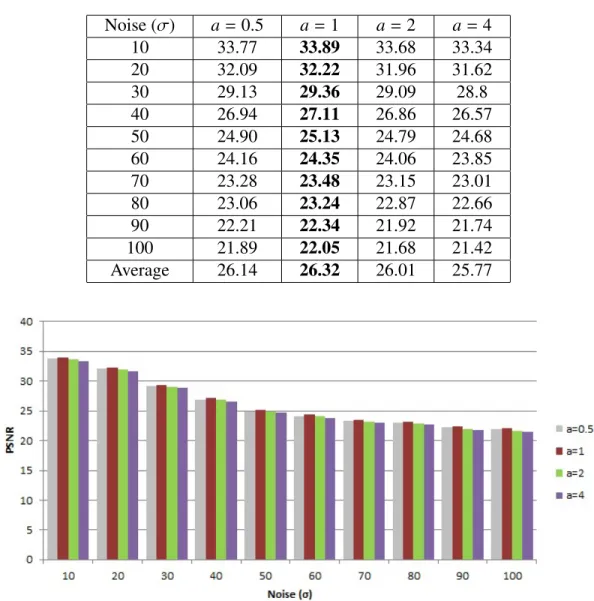
3.2 Bar chart of PSNR for different linear models (changing the coefficienta) . . . 27
3.3 Bar chart of PSNR comparison between different exponential models (chang-ing coefficienta) . . . 29
3.4 Bar chart of PSNR comparison between different search window size . . . 30
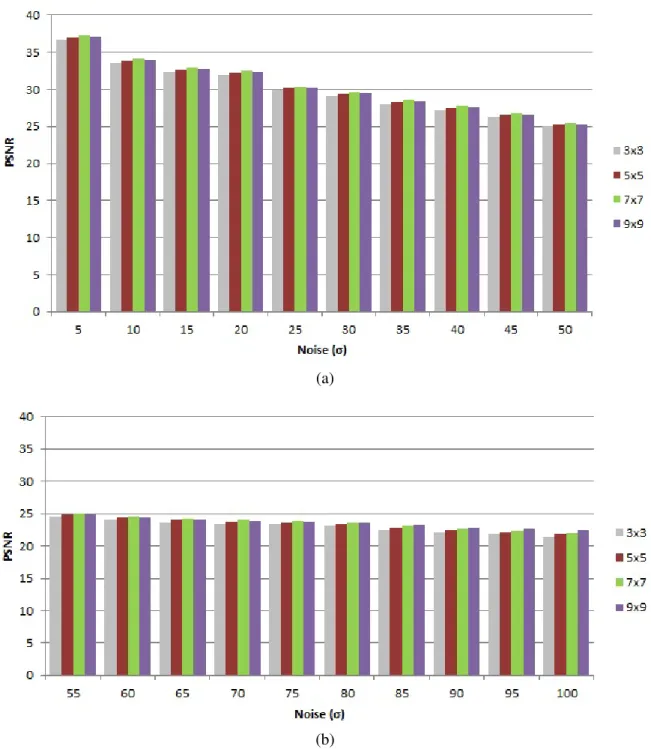
3.5 PSNR comparison between different patch sizes (a) Noise,σ5 - 50 (b) Noise, σ55-100 . . . 33
3.6 Plot of optimal search window for various noise levels . . . 35
3.7 Curve fitting using a linear model . . . 35
3.8 Curve fitting using a quadratic model . . . 36
3.9 Curve fitting using a exponential model . . . 36
3.10 Bar chart of PSNR comparison of proposed method for multiple steps . . . 38
4.1 Kodak Image Set (Grayscale) . . . 41
4.2 Example of Gaussian noise (σ=40) added to a noise-free image . . . 42
4.3 Bar chart of PSNR comparison of proposed and existing methods . . . 47
4.4 Bar chart of MSSIM comparison of proposed and existing methods . . . 50
4.6 Visual Comparison forσ=40 . . . 53
4.7 Visual Comparison forσ=60 . . . 54
4.8 Visual Comparison forσ=80 . . . 55
4.9 Visual Comparison forσ=100 . . . 56
4.10 Visual Comparison (Zoom) forσ=20 . . . 57
4.11 Visual Comparison (Zoom) forσ=40 . . . 58
4.12 Visual Comparison (Zoom) forσ=60 . . . 59
4.13 Visual Comparison (Zoom) forσ=80 . . . 60
4.14 Visual Comparison (Zoom) forσ=100 . . . 61
4.15 Row number 100 ofGirlimage used for generating intensity profile. Scan line shown as a red line. . . 63
4.16 Intensity Profile Comparison of the Girl image at scan line 100 (σ =40) . . . . 64
4.17 Intensity Profile Comparison of the Girl image at scan line 100 (σ =80) . . . . 65
3.1 PSNR Comparison of linear models for different coefficienta . . . 27
3.2 PSNR Comparison between exponential models for different coefficienta . . . 29
3.3 PSNR Comparison by changing the search window size . . . 30
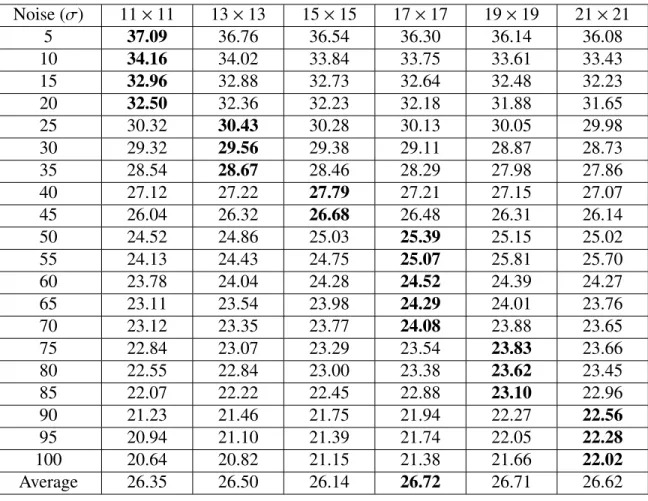
3.4 PSNR Comparison for fine tuning the search window size . . . 31
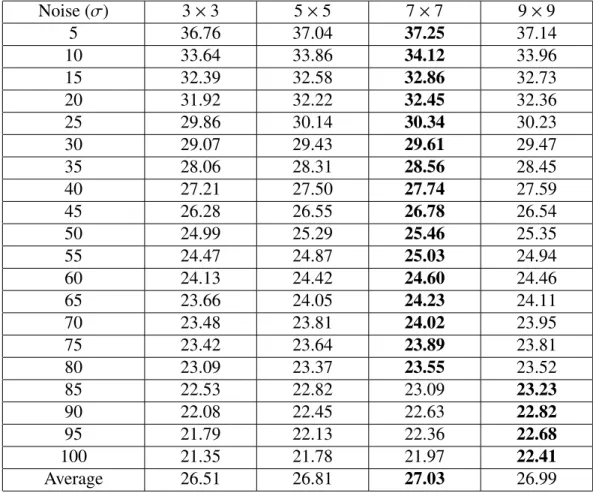
3.5 PSNR Comparison by changing the patch size . . . 32
3.6 PSNR Comparison by fixing patch size=9×9 and changing search window size 34
3.7 PSNR comparison of proposed method for multiple steps for various noise levels 38
4.1 PSNR comparison of theGirl image among the proposed method, the NLM
method, variants of NLM and BM3D denoising scheme for various noise levels 46
4.2 PSNR comparison of the proposed method, the NLM method, variants of NLM
and BM3D denoising scheme for various noise levels . . . 46
4.3 Standard deviation of PSNR values of proposed method and existing methods
for different noise levels . . . 47
4.4 MSSIM comparison of theGirlimage among the proposed method, the NLM
method, variants of NLM and BM3D denoising scheme for various noise levels 49
4.5 MSSIM comparison of the proposed method, the NLM method, variants of
NLM and BM3D denoising scheme for various noise levels . . . 49
4.6 Standard deviation of MSSIM values of proposed method and existing methods
for different noise levels . . . 50
image, the NLM method, variants of NLM and BM3D denoising scheme for
noiseσ= 40 . . . 63
4.8 Pearson correlation coefficient comparison of the proposed method, the noisy
image, the NLM method, variants of NLM and BM3D denoising scheme for
noiseσ= 80 . . . 63
Introduction
A digital image is made of finite number of elements, called pixels and can be defined as a
two dimensional function. For grayscale images, the pixel intensity, also referred to as
gray-scale value, takes on values between 0 and 255, where 0 represents the darkest pixel and 255
represents the brightest pixel.
The pixels of a digital image can be contaminated with noise which results in random
variation of brightness in the image. The noise is introduced during the image acquisition
phase due to image sensors, in low light environment, or during transmission. Image denoising
is the process of estimating the original image from a given noisy image and is one of the most
fundamental problems in image processing. For an imaging application, working with noisy
images can significantly affect the performance and reliability of the overall system. Image
denoising is used as a pre-processing step in imaging applications to reduce the amount of
noise and a major challenge is to reduce as much noise as possible while still keeping most of
the visual information, such as edges and textures.
1.1
Motivation
Earlier approaches to image denoising consisted of methods which attempt to estimate the
denoised value of a pixel based on the information in a local area around each pixel. While such
methods have been successful, to some extent, the resulting denoised images are often blurry.
Buades et al. proposed the Non-Local Means (NLM) denoising scheme [3][4], using a
non-local patch based concept. It attempts to identify self-similarities in a noisy image and calculate
a weighted average of similar pixels in order to estimate a denoised image. Although many
variants has been proposed after the original non-local means scheme, there are still room for
improvements. The underlying nature of non-local means using all pixels in a defined search
area tends to deviate the estimated denoised pixel value from the true noise-free intensity. In
addition, the key parameters of the original NLM are kept fixed, irrespective of the amount
of noise in the noisy image. One of our focus is to propose a variant of the non-local means
scheme for better denoising performance. Another focus is to empirically define a set of models
for determining the value of the key parameters, based on the noise level of a given image.
1.2
Thesis Contribution
The original non-local means denoising scheme considers all the pixels, defined within a search
area, for calculating the weighted average of the denoised image. This includes all the pixels
which are not similar to the reference pixel being denoised. Even with low weights, the pixels
which are not similar to the reference pixel being denoised will move the estimated denoised
intensity value from the true intensity. In our proposed method, we have thresholded the pixel
weights against a cut-offweight to use only a subset of the available pixels for calculating the
weighted average. In the original non-local means and its variants, the search window size
and patch size are fixed, irrespective of the level of noise. In our proposed method, we have
level. The models are determined using a learning based approach. We have also applied our
proposed method as a two-step process, where the basic denoised output of the first step is
further processed to remove remaining noise artifacts, especially at high noise levels.
1.3
Thesis Outline
The thesis is divided into five chapters. The current introductory chapter isChapter 1, where
we have outlined the objectives and thesis contributions. In Chapter 2, we discussed the
background of image denoising in details. InChapter 3, we introduced our proposed method
in details and explained the parameters selection procedure that we adopted in our proposed
method. In Chapter 4, we presented the experimental results of our proposed method and
compared them to that of the existing image denoising schemes. Finally, in Chapter 5 we
Background
2.1
Image Noise
Noise is a random signal which corrupts the original signal by adding unwanted information
to the signal. In a digital image, noise is a random variation of brightness. It is usually
pro-duced during the image acquisition phase, caused by the sensors of digital cameras or scanners.
Modern digital cameras have come a long way in using high quality sensors which have
sig-nificantly reduced the presence of noise during image acquisition yet, noise still can affect the
quality of an image, especially in low light conditions.
Digital noise types include: Additive noise,Salt and Pepper NoiseandMultiplicative noise.
2.1.1
Additive Noise
Additive noise gets added with the image signal. An image affected by additive noise can be
modeled using:
v(i)= u(i)+n(i), (2.1)
wherev(i) is the observed gray value at pixeli,u(i) is the noise-free gray value andn(i) is the
amount of noise at pixeli.
White Gaussian Noise
White noise is a random signal with a constant power spectral density [9]. Gaussian noise is a
statistical noise which follows the Gaussian distribution. The probability density function of a
Gaussian random variable,z, is modeled as shown:
p(z)= √1
2πσe
−(z−µ)2
2σ2 , (2.2)
wherezrepresents gray level,µis the mean,σis the standard deviation of the distribution, also
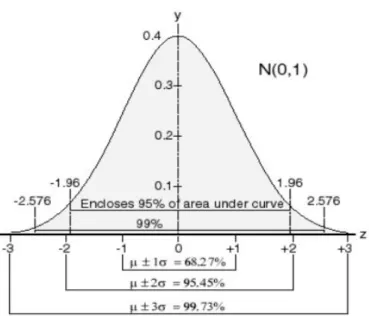
referred to as the noise density of the Gaussian noise signal, and σ2 is the variance. Figure
2.1 shows the probability density distribution of a Gaussian model. Almost all the area under
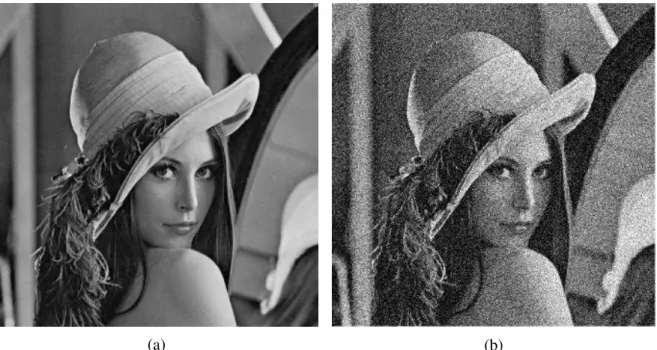
the curve lies betweenµ±3σ. Figure 2.2 shows an example of an image which is affected by
additive white Gaussian noise withσ=40.
(a) (b)
Figure 2.2: Image affected with additive white Gaussian noise (a) Noise-free image. (b) Image affected with Gaussian noise (σ=40)
Estimating additive white Gaussian noise
For optimal denoising of digital images affected with additive Gaussian noise, most methods
require some knowledge of the noise density,σ. Although the exact noise density may not be
possible to be known beforehand, a good estimation can be calculated. One of the methods
for estimating noise is the local variance method [1]. For estimating the noise density, a given
noisy image is divided in small sub-blocks. The gray value variance is calculated for each
sub-block and the variance of all the sub-blocks are averaged to estimate the noise variance
of the Gaussian noise. The noise density is the square root of the average variance. The size
of the sub-images used for calculating the value ofσ should ideally be the smallest possible
2.1.2
Multiplicative Noise
Multiplicative noise is a random signal which gets multiplied to the original signal.
Multiplica-tive noise can be modeled as shown:
v(i)= u(i)×n(i), (2.3)
wherev(i) is the observed gray value for pixeli,u(i) is the noise-free value andn(i) is the noise
at pixeli. Most common form of multiplicative noise isspeckle noise. Common methods for
removing speckle noise include Lee filter [18] and Frost filter [8].
2.1.3
Salt & Pepper Noise
Salt and Pepper noise is a form of impulse noise where the gray level of the affected pixels are
either changed to the maximum possible intensity level (255 in case of 8-bit grayscale images)
or to the minimum possible intensity value (0) . The noise appears as white and black pixels
(or dots) in the image and the noise density,d, of the salt-and-pepper noise is determined by
the number of pixels affected by the noise. It affects approximately d× N × M pixels in an
image, where d satisfies the condition 0 ≤ d ≤ 1 and N × M is the number of pixels in the
image.
2.2
Image Denoising
Most imaging system have an image acquisition phase and the performance of the overall
system depends on the quality of the image. The level of noise in the image plays a critical
role in the outcome of the system and it is desirable to have as much reduced noise as possible
during the image acquisition phase. Any noise added during this phase is first denoised before
while preserving the texture and edges of the image. A scheme which is able to reduce most
of the noise but completely blurs the entire image to a point where minimal visual information
can be extracted is not ideal. Similarly a denoising method which preserves a lot of the texture
in the image but fails to remove the noise to a satisfactory level is not an effective method as
well.
The image denoising methods can be classified primarily into two groups, based on the
approach they use for reducing noise effect:spatial domain approachesandfrequency domain
approaches
2.2.1
Spatial Domain Approach
The term spatial domain refers to the image plane itself [9]. In this domain, the raw observed
gray values of a noisy image are manipulated for estimating the denoised image. It takes
ad-vantage of the notion that pixels in a small local neighborhood are correlated. Spatial domain
approaches can be denoted by the expression g(x,y) = T[f(x,y)], where f(x,y) is an input
image,g(x,y) is the output, or, processed image andT is some operator defined over a
neigh-borhood of (x,y).
The neighborhood around an image pixel at position (x,y) is defined as a rectangular or
square sub-image centered at position (x,y). The size of the window is selected based on the
operation performed over the selected sub-image. The operatorT is usually applied over
sub-images centered on each pixels in the given image. The resulting processed image is considered
as the denoised image.
2.2.2
Frequency Domain Approach
In frequency domain approaches, the image is transformed to the frequency domain using, for
example, Fourier transform or wavelet transform. The frequency domain separates smooth
fre-quencies, thus making it easier to target and enhance certain regions in an image.
2.3
Spatial Domain Methods
This section covers some of the common spatial domain denoising methods. The spatial
do-main methods tries to estimate the denoised images based on the raw intensity value of image
pixels.
2.3.1
Mean Filter
The mean filter is a method of smoothing the image to reduce the noise in the image. The
mean filter operates by replacing the pixels in the image with the mean/average of the pixels
in a local neighborhood, including itself [9]. This helps reduce the pixel intensities which are
unrepresentative of its neighborhood. Mean filter is a convolution method and is based on a
kernel. The size of the kernel determines the degree of smoothing around each pixel. The
weights assigned to each position in the kernel can either be equal or can be weighted based
on the proximity to the center of the kernel. For example, if weights are assigned following
a Gaussian model then the pixels closer to the center will have more weights than the pixels
further from the center and the sum of the weights equals 1.
2.3.2
Median Filter
The median filter looks to remove noise by estimating the noise-free gray value based on the
median of the intensities of the pixels around the local neighborhood of a reference pixel [9]. A
N×Nwindow is centered around each pixels in the image and the pixel intensity of the center
is replaced by the median gray value of the pixels within the window. Compared to the mean
filter, median filter is more robust to the presence of outliers within the local window. Unlike
ignores outliers. The median filter is also used for denoising salt-and-pepper noise.
2.3.3
Gaussian smoothing
Gaussian smoothing is a 2-D spatial operator used to blur an image to remove noise. It is
based on a convolution kernel where the coefficients of the kernel followed a 2-D Gaussian
distribution. The kernel is used for averaging the gray value of a local neighborhood centered
at position (x,y) and the coefficients represents the weight assigned to each pixel position in
the window. Center pixel has the most importance and the weights assigned to the pixels in the
neighborhood reduces as the distance between the corresponding pixel and the center increases.
The isotropic Gaussian distribution, with varianceσ2, is shown:
G(x,y)= 1 2πσ2e
−x2+y2
2σ2 (2.4)
2.3.4
Anisotropic Di
ff
usion
The filtering approaches mentioned earlier use only the raw pixel values in a small local
neigh-borhood around each pixels to determine the denoised image. These methods do not take into
account the extent to which the neighborhood overlaps with smooth or textured regions. Thus
the use of such linear filters are detrimental for edge and texture preservation, resulting in blurry
denoised images. To mitigate the detail-loss issue of the isotropic averaging, Perona and Malik
proposed the iterative Anisotropic Diffusion approach [23]. It aims to reduce noise without
removing the fine details and edges in the images which are important for visual interpretation
by leveraging multiscale description of given noisy image. It involves embedding the original
image into a set of derived images I(x,y,t) by convolving the original image I0(x,y,t) with a
Gaussian kernelG(x,y;t) with variancet
The authors identified some criteria which any method for generating multiscale
descrip-tions of images must satisfy:
1) Casuality: It was first pointed out by Witkin and Koenderink in [29][16] and it states
that a scale-space representation should not generate any spurious details when moving from
fine to coarser scales.
2) Immediate Localization: At each resolutions the region boundaries should be sharp
and should coincide with the semantically meaningful boundaries at that resolution
3)Piecewise Smoothing: At all scales the intra-region smoothing should occur
preferen-tially over inter-region smoothing.
The authors proposed to use a non-linear smoothing model instead of a linear model, such
as Gaussian smoothing. In this model, the level of smoothing applied on each pixel is adjusted
based on the pixel position in a region. If a pixel is part of a smooth intra-region area more
blurring is applied to remove noise, but if the pixel is part of an edge pixel the smoothing is not
applied. This ensures that the smoothing occurs only in region areas and ignore the
intra-region areas in the image. To reduce the noise around edges, anisotropic diffusion is applied.
Instead of taking the Laplacian of an image to calculate the divergence of gradient in the image,
a new functiong() is multiplied by the gradient of the image and the divergence of the result
is taken. The functiong() calculates the degree of diffusion to be applied on the edges. If the
edge is strong the diffusion level is weak and if the edge is weak then it is diffused more.
2.3.5
2-D Adaptive Wiener Filter
The conventional Wiener filter operates in the frequency domain (covered later in Section
2.4.2). The Adaptive Wiener Filter proposed by Jin et al. [14] uses adaptive weighted
av-eraging for calculating the second order statistics required by the Wiener filter. The objective
of Wiener filter is to minimize the mean squared error between the restored and the actual
In the spatial domain, the objective function of the Wiener filter can be expressed as:
MS E( ˆx)= 1 N
N
X
i,j=1
( ˆx(i, j)−x(i, j))2, (2.6)
When x(i, j) and the noise are stationary Gaussian processes, the Wiener filter is the optimal
filter [17] and the Wiener filter has a simple scalar form:
ˆ
x(i, j)= σ
2
x(i, j) σ2
x(i, j)+σ2n(i, j)
[y(i, j)−µx(i, j)]+µx(i, j), (2.7) where,σ2andµare the signal variance and means respectively. The mean of the noise is zero.
2.4
Frequency Domain Methods
This section covers some frequency domain methods, namely the Low-Pass Filter, Wiener
FilterandBlock Matching and 3D Filteringmethods.
2.4.1
Low-Pass Filter
A low-pass filter is a filter that allows signals to pass unattenuated with frequency lower than
a certain threshold/cut-offfrequency [9]. Frequencies higher than the threshold are attenuated.
In digital images contaminated with additive noise, the random added signal is represented by
high frequencies. A low-pass filter reduces the effect of the additive noise by removing high
frequencies from the image. A simple low-pass filter is represented by the given expression:
H(k,l)=
1 i f
√
k2+l2< fthreshold
0 i f
√
k2+l2> fthreshold
In an image, the edges and fine details of an image are also translated to high frequencies
filter can soften the edges and textures and result in a blurred image. The amount of blurring
depends on the threshold frequency used by the low-pass filter.
2.4.2
Wiener Filter
Wiener filter is a transform domain approach used for recovering images affected with image
noise and image degradation, such as blur. The Wiener filter model attempts to restore images
by minimizing the Mean Squared Error (MSE) between the restored image and the original
image [9]. The objective function is shown below:
e2= E(f − fˆ)2, (2.8)
where f is the original image, ˆf is the restored image and the operatorEis the expected mean
squared error. The Wiener operates in the frequency domain of an image and the minimum
objective function is given as:
ˆ
F(u,v)= H
∗
(u,v)
|H(u,v)|2+ Sn(u,v)
Sf(u,v)
G(u,v), (2.9)
The terms in the equation are:
H(u,v)=degradation function
H∗(u,v)=complex conjugate of H(u,v)
Sn(u,v)=power spectrum of the noise
Sf(u,v)=power spectrum of the undegraded image
If the power spectrum of the noise is zero, i.e., the image is noise-free, the Wiener filter
reduces to an inverse filter. For a given noisy image, the power spectrum of the undegraded
approximated, as shown below:
ˆ
F(u,v)= H
∗
(u,v)
|H(u,v)|2+KG(u,v), (2.10)
whereKis a constant.
2.4.3
BM3D
In the field of image denoising, specifically for white Gaussian noise, a popular method has
emerged for tackling the problem of image noise called Block Matching and 3D Filter (BM3D).
It was proposed by K.Dabov et al. in 2006 [6]. BM3D demonstrated superior denoising
per-formance compared to the existing methods and have attracted the attention of researchers
working in the image of image enhancement and restoration.
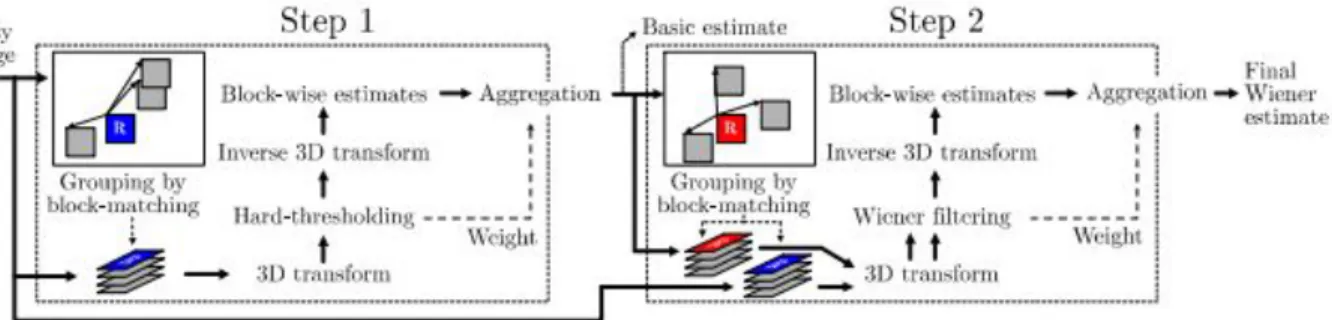
BM3D is a 2-step process and has been inspired by the non-local concept first introduced in
Non-Local Means (NLM). A block diagram illustrating the steps of BM3D is shown in Figure
2.3.
Figure 2.3: BM3D Block Diagram
In the first step, the process starts by defining a local neighborhood, also referred to as the
reference patch and searches for similar patches inside a search window, usually defined as
a bounded area around the reference patch. The similarity between the search patch and the
reference patch is decided based on a certain threshold. If the similarity is above the threshold,
be-tween the patches inside the bounded search area, all the similar patches are stacked together,
building a 3D block. BM3D applies some 3D transformations on the block to transform from
spatial domain to frequency domain. After the 3D transformation, the resulting coefficients are
thresholded, calledhard thresholding, where coefficients below a certain threshold are reduced
to zero. The block coefficients are transformed back to the spatial domain, using inverse 3D
transform. Next, BM3D generates a basic estimate of the denoised image from the block which
has been inverse transformed. For estimating the values of the reference patch, all the patches
in the 3D block are aggregated and it works by assigning different weights while estimating
the pixel values in the reference patch.
In the second step of BM3D another grouping of patches are carried out, similar to that
of the first step. This time however the grouping of patches into 3D blocks are done based
on the basic estimate obtained from the first step. After 3D blocks are generated by selecting
similar patches around the reference patch, the block is transformed using a 3D transformation.
Based on the transformed coefficients the restored image coefficients are estimated using the
restoration concept used in Wiener filter. The Wiener shrinkage coefficients are calculated for
the 3D blocks, followed by inverse transform to revert back to the spatial representation of the
3D block. Finally the Wiener shrinkage coefficients are multiplied by the 3D block to get the
2.4.4
BM3D Extensions
BM3D managed to demonstrate state-of-the-art performance compared to the previous
denois-ing models and after the method was initially proposed, researchers have continued to work
with the BM3D model to improve it’s denoising performance.
BM3D Denoising using Shape-Adaptive Principal Component Analysis
Dabov et al. proposed BM3D-SAPCA [7], an improvement over the regular BM3D using
shape adaptive image patches and applied Principal Component Analysis (PCA) on the
adap-tive shape neighborhood as part of the 3D transform on blocks. In the first step, it performs
shape adaptive grouping to find similar blocks and calculates the PCA basis of the 3D blocks.
The remaining steps, including 3D transform and hard thresholding, are carried out similar to
the one conventional BM3D.
BM3D Denoising using SSIM Optimized Wiener Filter
Hasan and El-Sakka [11] proposed an improvement in the Wiener filter optimized for
maximiz-ing the expected SSIM between the restored image and the original image. The improvement
in the underlying Wiener filter also helps to improve the performance of BM3D as it uses the
Wiener filter in the second phase of the denoising process. The main motivation was the
ob-servation that the mean squared error used in Wiener filter measures the absolute difference in
intensity between two images and it may occur than the mean squared error can have similar
values even when the two images are visually very different. To include some visual
infor-mation when denoising an image, the objective function of the Wiener filter is changed from
minimizing the expected MSE to maximizing the structural similarity between the restored and
2.5
Non-Local Means
Buades et al. proposed a non-local based approach for image denoising [3][4]. Images have
redundant or similar patterns in them and the Non-Local Means (NLM) approach attempts
to take advantage of such self-similarities to estimate the denoised gray value of each pixel.
Instead of using only a local region around each pixel for estimating the actual intensity of
the pixel, NLM uses a non-local approach by searching for similar patches, within a certain
search-bound, in the image. The center pixel of each patch contributes to a weighted averaging
based on the similarity between the reference and search patches.
When comparing the reference patch to a search patch, a variation of the Euclidean
dis-tance is measured. The Euclidean disdis-tance measures the sum of squared difference between
each pixel in a patch. To give more importance to pixels near the center of the patch, a
Gaus-sian weight distribution is used, thus resulting in the final measurement being the weighted
Euclidean distance,kN(i)−N(j)k2
2,a, wherea is the standard deviation of the Gaussian kernel
andN(i) andN(j) are the patches around pixeliand j, respectively. The weight associated with
each of the search patches is based on the similarity with the reference patch. After calculating
the Euclidean distance between the patches, the weight is assigned using:
w(i, j)= 1 Z(i)e
−
kv(Ni)−v(N j)k2
2,a
h2 , (2.11)
whereZ(i) is the normalizing constant as defined by:
Z(i)=X j
e−
kv(Ni)−v(N j)k2
2,a
h2 (2.12)
The constant,h, controls the decay rate of the exponential weight function. Given a noisy
image, the estimated valueNL[v](i), for pixeli, is computed as a weighted average of the center
NL[v](i)=X jI
w(i, j)v(j), (2.13)
wherew(i, j) is the weight calculated based on the similarity of neighborhood around pixel i
and j.
2.6
Non-Local Means Variants
The Non-Local Means(NLM) approach gained popularity due to its superior denoising results
compared to other existing spatial domain denoising models and researchers have continued
to work on the NLM approach to tackle some of it’s limitations. Some extensions have been
proposed to improve the computational cost.
2.6.1
Principal Components of Non-Local Means
Tasdizen used PCA to improve the computational time of non-local means [26]. The image
patches which are used in a given search space around a reference pixel are first projected
to a lower-dimensional subspace using PCA. The neighborhood similarity weights are then
calculated from the reduced subspace instead of the original full space. Let Mbe the number
of pixels in a neighborhood N and let {bp}Mp=1 be the eigenvector of the M × M empirical
covariance matrix for the set of all neighborhood vectors{v(N)j)} Q
j=1whereQdenotes the total
number of pixels in the image. The projections of the image neighborhood vectors onto the
d-dimensional PCA subspace is shown below:
v[d](Ni)= d
X
p=1
hv(Ni),bpi
| {z }
fp(Ni)
where fp(Ni) is the length of the ith vector’s projection onto the pth basic vector. Due to
or-thonormality of the basis
kv[d](Ni)−v[d](Nj)k2 =
d
X
p=1
(fp(Ni)− fp(Nj))2 (2.15)
The estimator fordis defined as:
ˆ
u[d](i)=X jSi
1 Zd(i)e
− Pd
p=1(fp(Ni)−fp(N j))2
h2 v(j) (2.16)
The proposed approach withd = Mis equivalent of the standard non-local means.
2.6.2
Improved Non-Local Means based on dimensionality reduction
Maruf and El-Sakka [20] proposed to improve the computational time of the original
non-local means algorithm by projecting image patches into a global feature space followed by
a dimensionality reduction using statistical t-test. In a preprocessing step, the global feature
space is generated by linearizing the patches to form a row vector of size j where j is the
number of pixels in the patch. The total size of the matrix C is N × j where N is the total
number of pixels in the image. After generating this matrix in the preprocessing step, a paired
t-test of the null hypothesis is computed on the matrix, where the hypothesis tries to accept or
reject a feature (i.e., an entire column in matrixC). After reducing the dimension of the initial
feature vector, the reduced vector is used for calculating the similarity between two patches.
The weighted averaging is based on the reduced feature space and thus reduces the exhaustive
search over all patches in a search region, as done in the standard non-local means method.
This achieves a reduction in the computation time of the algorithm.
Along with improvements in terms of the running time of the algorithm, the proposed
2.6.3
SSIM-based Non-Local Means
Rehman and Wang have proposed a SSIM based approach to non-local means [24]. For
calcu-lating the similarity between patches, the mean-squared error (MSE) may not always reflect the
true similarity between patches. As MSE measures the squared difference between the pixel
values, it may occur that two very different patches can have the same MSE values when
com-pared to the reference patch. The resulting denoised image may not have the best perceptual
quality. The SSIM-based approach uses the structural similarity to measure the likelihood of
similarity between the reference and the search patch. The weighted average is calculated as
shown:
ˆ X(i)=
P
jNiwS S I M(i, j)Y 0(j)
P
jNiwS S I M(i, j)
, (2.17)
whereNidenotes the set of patches in the search area defined around pixeliandWS S I M(i, j) is
the SSIM weight between patchiand j.
The proposed method needed to address two major concerns. First, when calculating the
structural similarity between patches, especially in high noise levels, the SSIM value may end
up comparing the noise between the patches instead of the underlying structure. To overcome
this concern, the authors proposed a way to estimate the noise in the patches and deduct the
estimated noise from the pixel intensity values before calculating the structural similarity.
The second issue to address is that two structurally similar patches may have different
contrast and mean values. To avoid the bias in mean and contrast, the patches are normalized
before the weighted averaging step.
2.6.4
Iterative Non-Local Means
Bronx and Cremer [2] proposed an iterative non-local means approach. The non-local means
method is applied on an image in iterative mode. In each iteration, the similarity between
weights, the weighted averaging is done by multiplying the weights of a patch with it’s center
gray value in the noisy version of the image. The proposed method did well on regular
tex-tured image but in non-regular textex-tured image the resulting denoising image lost texture and
significant blurring is observed.
2.6.5
Non-Local Euclidean Median
Chaudhury and Singer [5] proposed the Non-Local Euclidean Median, extending the concept
of the original Non-Local Means scheme. The method is derived from the observation that the
median is more robust to outliers than the mean. In the presence of noise in the image, the
weights averaged over all possible patches, especially in a search-bound defined around image
edges and lines, will move the resulting mean towards the outliers. The mean is the minimizer
of P
jwjkP−Pjk2 over all patches P. Non-Local Euclidean Median proposed the select the
patch,P, which minimizesP
jwjkP−Pjkand replace the noisy pixel value at position (x,y) in the image with the pixel value of the center of patchP.
2.6.6
Two-stage Non-Local Means with adaptive smoothing parameters
Zhu et al. [33] proposed a two-stage non-local means method with adaptive smoothing
param-eters. Based on the noise estimation of a given noisy image, smoothing parameterhbasicfor the
first stage is selected automatically and the basic denoised image is computed, as shown:
ˆ yi,basic =
X
j
wi j,basicyj, (2.18)
wherewi j,basic is the weight depending on the similarity between patchesi and jand satisfies
the usual conditions 0 ≤ wi j,basic ≤ 1 andPjwi j,basic = 1. The weight is calculated as show in Equation (2.19)
wi j,basic =exp(− 1 h2
basic
wherePiandPjare the patches centered on pixeliand jandhbasicis the smoothing parameter
which controls the decay rate of the exponential function. For the first stage the smoothing
parameter is set ashi j,basic =0.75×σ.
Most of the image noise is removed after the first stage but for high noise levels some
noise artifacts still remain in the image, thus the basic image is refined one more time. The
resulting ˆybasicimage of the first stage is again denoised using the non-local means method but
using different smoothing parametershf inal. The final image is computed as shown in Equation
(2.20)
ˆ yi,f inal =
X
j
wi j,f inalyiˆ,basic (2.20)
Similar to the first stage, the weights between patchiand jare calculated as:
wi j,f inal=exp(− 1
h2f inalkPi−Pjk
2) (2.21)
In the second step of the process, the smoothing parameter is defined as:
hf inal =
σ2
100, σ<30
0.5σ, σ≥ 30
2.7
Non-Local Means Applications
Non-local means and its variants have been used in various imaging applications such as
medi-cal imaging, including MRI brain images [13], CT scan imaging [15] and 3D ultrasound
imag-ing [12]. It is also used in video denoisimag-ing [10] [30], surface salinity detection [32] and metal
Methodology
The non-local means method defines a search area of sizeS ×S centered on the pixel,i, being denoised. The similarity of all the patches, defined around each of the pixels, within the search
area is considered during the weighted averaging process, where higher weights are assigned
to patches which are more similar, as determined by lower euclidean distance to the reference
patch. The goal of the weighted averaging process is to estimate the true noise-free intensity
value of pixeli, based on the similarity of the patches within the defined search area of a given
noisy image. The inclusion of center pixels of the patches which have low weights is likely to
deviate the resulting estimate from the true pixel intensity value of the denoised image.
3.1
Adaptive Non-Local Means using Weight Thresholding
In our proposed method, only a subset of the available patch centers are considered for the
estimation of the denoised pixel. The patches are selected based on the similarity measure
compared to the reference patch. Effectively, a cut-offweight,wthreshis selected using a defined
percentile value, wpercentile among the available patch weights within the bounded search area
and the weights of the patches are thresholded against wthresh. All weights above wthresh are
unchanged and weights below wthresh are reduced to zero, thus removing their pixel centers
from the weighted averaging process. The selected percentile is adjusted based on the noise
level of the given image. In real systems, the actual amount of noise in a noisy image cannot
be known beforehand. The noise can be estimated in digital image using fuzzy processing
techniques [25], image filters [21] and local variance estimate method [19]. In this research,
we used the local variance estimation method (see Section 2.1.1).
For low noise levels, a higher cut-offweight, wthresh, is selected for thresholding the patch
weights and as the noise level of a given image increases, wthresh is lowered to include more
patch centers for averaging. For lower noise levels, only the patches with high similarity
mea-sure to a reference patch can be used to estimate a denoised image. The remaining patches can
be considered outliers. So, a higher cut-offthreshold is selected for low noise levels. In high
noise, the Euclidean distance measurement may not give a true measure of patch similarity as it
will end up comparing, to some extent, the noise between patches along with the structures of
the patches. So, considering only the higher weighted patch centers, by keeping the threshold
value high, can in fact deviate the denoised estimation from the true value. To mitigate this
effect, the threshold value is lowered so that more pixels are averaged for attenuating the noise.
The denoised image is calculated as shown below:
NL[v](i)=X jI
ˆ
w(i, j)v(j), (3.1)
where ˆw(i, j) is the thresholded weight between patch at pixeliand patch at pixel jas shown:
ˆ w(i, j)=
w(i, j), ifw(i, j)>wthresh
0, otherwise
(3.2)
Non-local means has two key parameters, namely the patch size and the search size. These
parameters are kept constant irrespective of the amount of noise in the image. In our proposed
noise level in the image. Through a iterative learning approach, we have empirically defined
models for selecting the patch size and the corresponding search window size for any noise
level, σ. The models were determined empirically using an iterative learning approach on a
training image set.
The proposed method is applied in a two-step approach. In the first step, the proposed
method is used to generate a basic estimate of the denoised image. In the basic estimate, most
of the noise is reduced but still some visible noise artifacts remain, especially for stronger noise
levels and it is necessary to further denoise the basic image for better denoising [31]. As most
of the noise is reduced in the basic image, similar regions can be identified more easily which
helps to generate better denoised images in the second step. In the second step, the basic image
is denoised using a similar method utilized in the first step, but with smaller smoothing
param-eters. To verify that the two-step approach is sufficient, we conducted experiments to measure
the improvement in the denoising performance with further steps and found the amount of
improvements to be negligible. The results of this experiment is shown in Section 3.2.3
3.2
Parameter Selection
The primary parameters in the proposed method are:
1. Cut-offweight for thresholding
2. Patch size
3. Search window size
The parameters are determined empirically, based on experiments conducted on a set of test
images. The performance measure of tuning each of the parameters are used to define the
mod-els for the parameters. The set of test of images is shown in Figure 3.1. The training images are
and fine details. The Lena and Peppers images have smooth regions, while Barbara, Boats
and Baboonimages has lot more texture and fine details. All the PSNR values reported are
averaged after repeating each of the experiments 10 times.
(a) (b)
(c) (d) (e)
Figure 3.1: Training image set (a) Lena. (b) Barbara (c) Peppers (d) Baboon (e) Boats
3.2.1
Cut-o
ff
Weight for Thresholding
The patch size and search window size are fixed and the weights are thresholded based on the
cut-offweight percentile,wpercentile, determined by the model. For the purpose of determining
Table 3.1: PSNR Comparison of linear models for different coefficienta
Noise (σ) a= 0.25 a=0.5 a=1
10 33.43 33.75 33.87
20 31.85 32.12 32.25
30 28.74 29.06 29.15
40 26.63 26.91 26.98
50 24.71 24.96 25.07
60 24.00 24.28 23.95
70 23.08 23.33 22.75
80 22.75 23.14 22.57
90 21.87 22.28 21.64
100 21.48 21.71 21.22
Average 25.85 26.15 25.94
Figure 3.2: Bar chart of PSNR for different linear models (changing the coefficienta)
Linear Model
The linear model for determining the cut-offweight percentile is defined as:
wpercentile =ceil(100−aσ), (3.3)
whereceil() rounds a decimal value to the smallest following integer, coefficientais a constant
andσis the standard deviation of Gaussian noise.
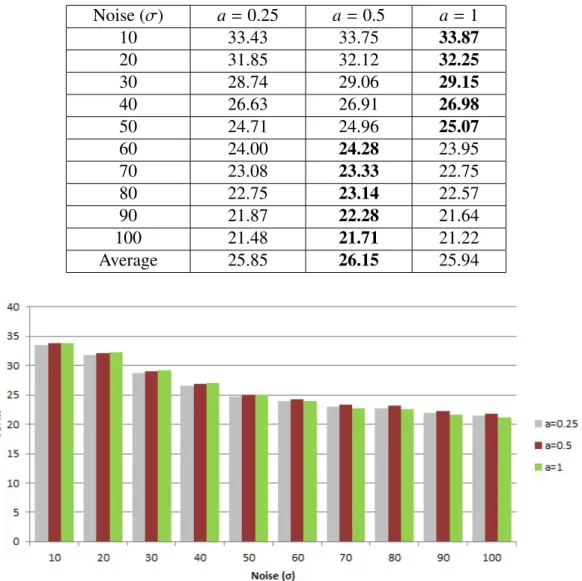
comparison of using different linear models for weight thresholding is tabulated in Table 3.1.
Figure 3.2 shows the bar chart of PSNR comparison between various linear models. For noise
levelsσ≤ 50, a coefficient value ofa= 1 generate better results and forσ>50, the coefficient valuea=0.5 demonstrate better performance.
Exponential Model
The exponential model for determining the cut-offweight percentile is defined as:
w
percentile=
ceil
(100
×
e
−0.01aσ
)
,
(3.4)
whereceil() rounds a decimal value to the smallest following integer, coefficientais a constant
andσis the standard deviation of Gaussian noise.
The result of using the exponential model for determining the cut-off weight is shown is
Table 3.2. Figure 3.3 shows the bar chart of PSNR comparison between different exponential
models. For the exponential model, the coefficient value of a = 1 demonstrate better results
for all noise levels. The average performance, as well as the noise-wise performance, of the
exponential model, with coefficienta = 1, has better denoising performance compared to the
linear models. So, the exponential model, with coefficienta=1 is selected for determining the
cut-offweight percentile for any given noise level,σ.
3.2.2
Patch Size and Search Window Size
For varying the search window size, the patch size is fixed at 7×7. The weights are thresholded using the exponential model, selected in previous section. The result of varying the search
window is shown in Table 3.3. The table shows that forσ<50 the search window size 11×11
perform optimally and forσ ≥ 50 the search size 21×21 performs best. To help determine
Table 3.2: PSNR Comparison between exponential models for different coefficienta
Noise (σ) a=0.5 a=1 a= 2 a= 4
10 33.77 33.89 33.68 33.34
20 32.09 32.22 31.96 31.62
30 29.13 29.36 29.09 28.8
40 26.94 27.11 26.86 26.57
50 24.90 25.13 24.79 24.68
60 24.16 24.35 24.06 23.85
70 23.28 23.48 23.15 23.01
80 23.06 23.24 22.87 22.66
90 22.21 22.34 21.92 21.74
100 21.89 22.05 21.68 21.42
Average 26.14 26.32 26.01 25.77
Figure 3.3: Bar chart of PSNR comparison between different exponential models (changing
coefficienta)
are again measured by varying the search window size, but this time using odd-integer window
sizes only between 11×11 and 21×21, while using more noise levels.
The patch size and search window size for a given noise level are determined empirically,
using an iterative learning approach on a training image set. At first, the patch size is fixed
and the search window size is varied, for each noise levels, to select the best search window
size. The noise levels, σ, ranges from 10 to 100, with a step size equals 5. Next, the patch
Table 3.3: PSNR Comparison by changing the search window size
Noise (σ) 5×5 11×11 21×21 35×35
10 33.26 34.19 33.94 33.40
20 31.44 32.48 31.66 31.28
30 28.83 29.35 28.68 28.27
40 27.44 28.12 28.06 27.44
50 23.79 24.56 25.05 24.40
60 22.84 23.70 24.27 23.91
70 22.15 23.09 23.73 23.48
80 21.66 22.56 23.41 23.19
90 20.73 21.57 22.88 22.42
100 20.35 21.06 22.52 22.15
Average 25.25 26.07 26.42 25.99
Figure 3.4: Bar chart of PSNR comparison between different search window size
determined in the previous step. The best patch size for each noise level is used to find the
corresponding optimal search window sizes one more time. This process is repeated until an
iteration is reached where updating the optimal search window size for a noise level did not
change the corresponding best patch size and vice versa.
To determine the patch and search window size models, the patch size is initially fixed at
7× 7 and the search window size is varied. The average PSNR comparison of the various
Table 3.4: PSNR Comparison for fine tuning the search window size
Noise (σ) 11×11 13×13 15×15 17×17 19×19 21×21
5 37.09 36.76 36.54 36.30 36.14 36.08 10 34.16 34.02 33.84 33.75 33.61 33.43 15 32.96 32.88 32.73 32.64 32.48 32.23 20 32.50 32.36 32.23 32.18 31.88 31.65
25 30.32 30.43 30.28 30.13 30.05 29.98
30 29.32 29.56 29.38 29.11 28.87 28.73
35 28.54 28.67 28.46 28.29 27.98 27.86
40 27.12 27.22 27.79 27.21 27.15 27.07
45 26.04 26.32 26.68 26.48 26.31 26.14
50 24.52 24.86 25.03 25.39 25.15 25.02
55 24.13 24.43 24.75 25.07 25.81 25.70
60 23.78 24.04 24.28 24.52 24.39 24.27
65 23.11 23.54 23.98 24.29 24.01 23.76
70 23.12 23.35 23.77 24.08 23.88 23.65
75 22.84 23.07 23.29 23.54 23.83 23.66
80 22.55 22.84 23.00 23.38 23.62 23.45
85 22.07 22.22 22.45 22.88 23.10 22.96
90 21.23 21.46 21.75 21.94 22.27 22.56
95 20.94 21.10 21.39 21.74 22.05 22.28
100 20.64 20.82 21.15 21.38 21.66 22.02
Table 3.5: PSNR Comparison by changing the patch size
Noise (σ) 3×3 5×5 7×7 9×9
5 36.76 37.04 37.25 37.14
10 33.64 33.86 34.12 33.96
15 32.39 32.58 32.86 32.73
20 31.92 32.22 32.45 32.36
25 29.86 30.14 30.34 30.23
30 29.07 29.43 29.61 29.47
35 28.06 28.31 28.56 28.45
40 27.21 27.50 27.74 27.59
45 26.28 26.55 26.78 26.54
50 24.99 25.29 25.46 25.35
55 24.47 24.87 25.03 24.94
60 24.13 24.42 24.60 24.46
65 23.66 24.05 24.23 24.11
70 23.48 23.81 24.02 23.95
75 23.42 23.64 23.89 23.81
80 23.09 23.37 23.55 23.52
85 22.53 22.82 23.09 23.23
90 22.08 22.45 22.63 22.82
95 21.79 22.13 22.36 22.68
100 21.35 21.78 21.97 22.41
Average 26.51 26.81 27.03 26.99
For the next step of determining the patch size to be used in our proposed method, the patch
size is varied while using the optimal search window for a given noise level, as shown in Table
3.3. The result of changing the patch size is shown in Table 3.5. The results indicated that the
patch size 7×7 works optimally for noise levelσ<85 and for noise levelσ≥ 85 the patch size 9×9 is optimal.
For noise levelσ≥ 85, the optimal patch size is different than the patch size used to find the optimal search window size previously. The experiment for finding the optimal search window
is again iterated, but this time only for noise levelsσ ≥ 85 and using a patch size 9×9. The PSNR comparison is shown in Table 3.6.
As the optimal search window size did not change, even with the updated patch size, the
(a)
(b)
Figure 3.5: PSNR comparison between different patch sizes (a) Noise,σ 5 - 50 (b) Noise, σ
Table 3.6: PSNR Comparison by fixing patch size=9×9 and changing search window size
Noise (σ) 11×11 13×13 15×15 17×17 19×19 21×21
85 22.28 22.51 22.74 23.02 23.27 23.14
90 21.53 21.75 22.02 22.21 22.54 22.85
95 21.24 21.47 21.82 22.19 22.48 22.64
100 21.17 21.32 21.65 21.86 22.11 22.43
Average 21.55 21.76 22.06 22.32 22.60 22.76
The optimal search window sizes and the corresponding noise levels are plotted in a graph,
as shown in Figure 3.6. The plotted points are used to determine a model, for the search
window size, using a best-fit curve for the given points. Three different models are used to
determine the best-fit curve:
1. Linear Model
2. Quadratic Model
3. Exponential Model
The best fit curve using a linear model is shown in Figure 3.7. The best fit curve for the
quadratic model is shown in Figure 3.8 and the curve for the exponential model is shown in
Figure 3.6: Plot of optimal search window for various noise levels
Figure 3.8: Curve fitting using a quadratic model
The goodness of each of the curve models is evaluated using the R-squared statistical
mea-sure. It measures how close the actual data points are to the fitted curve and the values range
from 0.0 to 1.0, where a higher value represents a better-fit curve. The equations and the
R-squared values of the three models are:
1. Linear Model: y= 0.117σ+9.758, R2 = 0.965
2. Quadratic Model:y= −0.0001σ2+0.127σ+9.574, R2 =0.965 3. Exponential Model:y= 10.409e0.008σ, R2 =0.952
Based on the R-squared values, the linear and quadratic models have very similarR2results.
In the quadratic model, the coefficient of the x2term is close to 0, making the model equation
very similar to the linear model. The R-squared value of the exponential model is lower than
that of the linear model and exponential functions are more computationally expensive than
linear functions. Comparing the curve fittings of the three models, the linear model is selected
for determining the search window size for any given noise levelσ.
As the search window is centered around the pixel being denoised, it is required to use
odd-numbered size for the search. For a given noise level, the result of the linear model is
rounded to the nearest odd number to be used as the search window size. The search window
size model is defined as:
S = roundodd(0.117σ+9.758) (3.5)
where, roundodd() rounds to the nearest odd integer andS ×S is the dimension of the search
window.
3.2.3
The two-step approach
Using the patch and search window size models along with the exponential weight thresholding
Table 3.7: PSNR comparison of proposed method for multiple steps for various noise levels
Noise Level 1 step 2 step 3 step 4 step
10 34.11 34.16 33.71 33.56
20 32.43 32.70 32.31 32.23
30 29.55 29.86 29.47 29.34
40 27.78 28.29 27.92 27.83
50 25.44 26.10 25.77 25.69
60 24.66 25.42 25.18 25.08
70 23.99 24.88 24.73 24.66
80 23.61 24.62 24.48 24.30
90 22.79 23.96 23.99 23.85
100 22.48 23.76 23.80 23.68
Average 26.68 27.37 27.14 27.02
Figure 3.10: Bar chart of PSNR comparison of proposed method for multiple steps
In each step, the proposed method was applied on the output image of the previous step. After
each iteration, the PSNR of the resulting denoised image was measured. The change in the
PSNR measurement, compared to the previous iteration, was used to determine the number of
iterations which demonstrated satisfactory performance improvement due to the extra iteration.
The PSNR comparison of multiple iterations of the proposed method is shown in Table 3.7. The
3.3
Summary of the selected parameters
The key parameters of the proposed method were empirically defined using different models.
The percentile of cut-offweight used for thresholding is defined as:
w
percentile=
ceil
(100
×
e
−0.01aσ
)
(3.6)
The patch-size,P×P, is selected as shown below: P=
7 ifσ<85
9, otherwise
(3.7)
The search window size,S ×S is determined as:
Experimental Results and Analysis
The proposed image denoising method has been tested on the standard Kodak image set. The
images are corrupted with additive white Gaussian noise with the noise level (standard
devia-tion), σranging from 10 to 100, with step size equals 10. The proposed method is compared
with the original non-local means scheme, variants of non-local means and the BM3D method.
4.1
Image set
All the experiments are carried out of the standard Kodak gray-scale image set. It comprises of
24 gray-scale images of dimensions 768×512 and 512×768. The images in the Kodak image
set are shown in Figure 4.1. The standard images are noise-free and additive white Gaussian
noise is added on top of the noise-free image to generate the noisy image.
4.2
Noise Generation
The additive noise signal is added to the original noise-free signal in order to generate the noisy
signal. For the purpose of our experimentation, the standard noise-free image are contaminated
by adding Gaussian white noise, distributed throughout the image. The final intensity values
(a) Windows (b) Door (c) Hats (d) Bike
(e) Lake (f) Flower (g) Houses (h) Bridge
(i) Beach (j) Landscape (k) Raft (l) Girl
(m) Island (n) Plane (o) Lighthouse (p) House
(q) Parrot (r) House 2
(s) Sail (t) Boat 2
(u) Statue (v) Model (w) Lighthouse 2 (x) Woman
(a) Original Image (b) Noisy Image
Figure 4.2: Example of Gaussian noise (σ=40) added to a noise-free image
were kept within the maximum intensity value of gray-scale images. In our experiments, all
the noisy images are generated inMAT LABusing the following method:
imNoise
=
im
+
(
255σ×
randn
(
size
(
im
)))
,
where
imNoise
is the noisy image,
im
is the original, noise-free image,
σ
is
the required noise level and the function
randn
() generates a random matrix
with Gaussian distribution and size equal to the dimension of the original input
image.
An example of additive white Gaussian noise added to a noise-free image is
shown in Figure 4.2
4.3
Performance Measure
To measure the performance of our proposed method in comparison to other
ex-isting denoising methods, we have used the Peak Signal to Noise Ratio (PSNR)
and the Mean Structural SIMilarity (MSSIM) measure. These measures are
denois-ing methods. We also performed subjective comparison between our proposed
method and existing denoising methods.
4.3.1
Peak Signal to Noise Ratio (PSNR)
The Peak Signal to Noise Ratio measures the ratio between the maximum
pos-sible power of a signal to the power of the noise which a
ff
ects the quality of
the original signal. The PSNR is usually expressed as the logarithmic
deci-bel scale. A higher value in PSNR represents better reconstructed or denoised
image. The PSNR is measured using:
PS NR
=
10 log
10(
MAX
2
I
MS E
)
,
(4.1)
where
MAX
Irepresents the maximum intensity of the image and
MS E
mea-sures the mean squared error between the original image and the degraded
im-age, defined as:.
MS E
=
1
M
×
N
M
X
i=0
N
X
j=0
(
u
i j−
v
i j)
2,
(4.2)
where
u
i jis the original image,
v
i jis the degraded image and the size of the
images is
M
×
N
.
4.3.2
Mean Structural Similarity (MSSIM)
One of the drawbacks of the PSNR measure is that it relies on the mean square
er-ences between isolated data points. To evaluate the performance of a denoising
method based on the degree of structural similarity between the original and
the reconstructed image, the Structural SIMilarity (SSIM) measure can be used
[27][28]. The SSIM measure provides a better assessment of an image
restora-tion or denoising method. The SSIM between two blocks is defined as:
S S I M
=
(2
µ
xµ
y+
c
1)(2
σ
xy+
c
2)
(
µ
2x
+
µ
2y+
c
1)(
σ
2x+
σ
2y+
c
2,
(4.3)
where,
x
and
y
are two identical sized window or patch,
µ
xand
µ
yare the
averages of
x
and
y
,
σ
2xand
σ
2yare the variance of
x
and
y
and
σ
xyis the
co-variance. The mean SSIM (MSSIM), averaged over all SSIM, is used as for the
4.4
Results and Analysis
The proposed method is compared with the original
Non-Local Means
(NLM)
scheme, the
Two-Stage Non-Local Means
(TS-NLM) scheme , the
Non-Local
Euclidean Median
(NLEM) scheme and the
Block Matching and 3D Filtering
(BM3D) scheme. All the objective measurements reported are averaged after
repeating each of the experiments 10 times. The denoising performances are
compared after running each of the denoising methods, including the proposed
method, on the same noisy image for each noise level,
σ
.
4.4.1
Performance evaluation using PSNR
Table 4.1 shows the PSNR comparison for the
Girl
image and Table 4.2 shows
the average PSNR values over all images in the Kodak image set, for various
noise levels. Figure 4.3 shows the bar chart of PSNR comparison among the
proposed method and existing denoising methods, for various noise levels. The
PSNR values are reported after averaging the results of 10 runs. The standard
deviation of PSNR for each of the noise levels is shown in Table 4.3.
The performance of the proposed method is better than the original
non-local means method and its variant for all noise levels. Yet, when compared
to BM3D, our proposed method managed to produce better results only when
σ
≤
80. The proposed method also demonstrated better performance than
Table 4.1: PSNR comparison of theGirlimage among the proposed method, the NLM method, variants of NLM and BM3D denoising scheme for various noise levels
Noise Level NLM TS-NLM NLEM BM3D Proposed
10 33.92 33.93 32.90 35.42 35.61
20 31.83 32.01 31.85 33.46 33.60
30 29.43 29.70 29.56 31.03 31.12
40 28.47 28.96 28.61 29.88 30.04
50 26.64 27.20 26.98 28.21 28.27
60 25.12 25.77 25.30 26.53 26.60
70 24.78 25.24 25.01 25.88 26.03
80 23.69 24.46 23.93 25.33 25.50
90 23.15 24.04 23.52 24.95 24.81
100 22.91 23.88 23.18 24.43 24.28
Average 26.99 27.52 27.08 28.51 28.59
Table 4.2: PSNR comparison of the proposed method, the NLM method, variants of NLM and BM3D denoising scheme for various noise levels
Noise Level NLM TS-NLM NLEM BM3D Proposed
10 32.61 32.63 32.60 34.05 34.27
20 30.77 30.94 30.82 32.25 32.43
30 28.58 28.83 28.67 29.80 29.95
40 27.02 27.47 27.29 28.19 28.33
50 24.88 25.54 25.01 26.07 26.09
60 23.93 24.66 24.16 25.38 25.46
70 23.24 24.02 23.76 24.74 24.91
80 22.90 23.56 23.23 24.46 24.65
90 22.21 23.18 22.64 24.25 24.13
100 21.98 22.83 22.29 23.97 23.84
Figure 4.3: Bar chart of PSNR comparison of proposed and existing methods
Table 4.3: Standard deviation of PSNR values of proposed method and existing methods for different noise levels
Noise Level NLM TS-NLM NLEM BM3D Proposed
10 0.056 0.054 0.055 0.051 0.052
20 0.063 0.061 0.062 0.059 0.058
30 0.069 0.066 0.064 0.063 0.060
40 0.084 0.082 0.078 0.076 0.077
50 0.089 0.085 0.087 0.085 0.083
60 0.094 0.096 0.096 0.095 0.096
70 0.096 0.097 0.095 0.098 0.095
80 0.102 0.100 0.101 0.102 0.103
90 0.113 0.112 0.111 0.107 0.105
100 0.115 0.114 0.113 0.111 0.112