Voice Based Security for Machines
Prof. Pradnya A. Kamble1, Inzamam Ul Haq Tambat2
Professor, Dept. of E&TC, Sinhgad Institute of Technology, Lonavala, SPPU Pune, India1 PG Student [VLSI], Dept. of E&TC, Sinhgad Institute of Technology, Lonavala, SPPU Pune, India2
ABSTRACT: The speech recognition system is a completely assembled and easy to use programmable speech recognition circuit. Programmable, in the sense that the words (or vocal utterances) you want the circuit to recognize can be trained. This board allows you to experiment with many facets of speech recognition technology..In our project we control the devices using the voice recognition method. Here HM2007 software recognizes the voice and it converts into binary format and transmits to the main control device. Laplace software is used to process the main control device. The hardware implementations can be achieved by sensors, fan motor controller device, Voice recognition device and light intensity control devices. With the help of this process is used to control the fan speed and light intensity by using the voice commands
KEYWORDS: ARM, Hidden Markov Model, Transceiver, Automated Meter, Monitoring System
I.INTRODUCTION
A.BACKGROUND OF THE STUDY
Various fields for research in speech processing are speech recognition, speaker recognition, speech synthesis, speech coding etc. Besides the physical differences, each speaker has his characteristic manner of speaking, which includes the use of a particular accent, rhythm, intonation style, pronunciation pattern, choice of vocabulary and so on. So, the speech signal carries the intended message, speaker information and language information, mood and health of speaker (up to some extent) etc. It is necessary to extract speaker specific features for recognizing the speaker [1]. Short term spectral features are easier to extract, compute and yield a good performance. Besides the pros of speaker recognition systems like its naturalness, low cost, memory efficient, thus applicable for mobile devices, it has cons like non-uniqueness because of its behaviourialnature, a person’s voice can be easily imitated etc.
II.METHODOLOGY
A. OVERVIEW
Speech recognition will become the method of choice for controlling appliances, toys, tools and computers. At its most basic level, speech controlled appliances and tools allow the user to perform parallel tasks (i.e. hands and eyes are busy elsewhere) while working with the tool or appliance. The heart of the circuit is the HM2007 speech recognition IC. The IC can recognize 20 words, each word a length of 1.92 seconds. This document is based on using the Speech recognition kit SR-07 from Images SI Inc in CPU-mode with an ATMega 128 as host controller. Troubles were identified when using the SR-07 in CPU-mode. Also the HM-2007 booklet (DS-HM2007) has missing/incorrect description of using the HM2007 in CPU-mode. This appendum is giving our experience in solving the problems when operating the HM2007 in CPU-Mode. A generic implementation of a HM2007 driver is appended as reference.
The speech recognition system is a completely assembled and easy to use programmable speech recognition circuit. Programmable, in the sense that we can train the words that we want the circuit to recognize. This circuit board allows
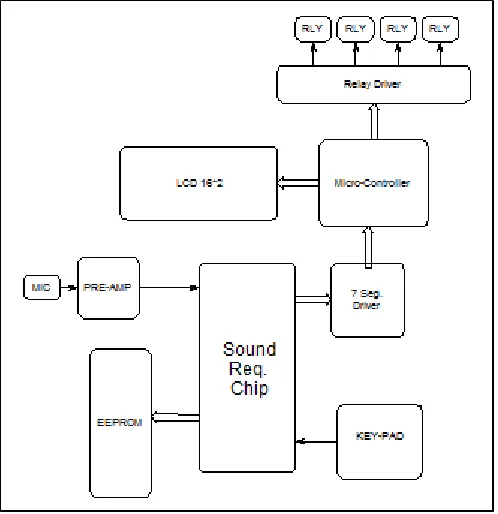
Fig . Basic block diagram of system
us to experiment with many facets of speech recognition technology. It has 8 bit data out which can be interfaced with any microcontroller for further development.
B. LEVELS OF THE STUDY
1. Training: The recognition of a speaker consists of computing its observations (quantized feature vectors), and then computingthe probability of its observations being generated from each of the HMM speaker models. The recognized speaker is the one corresponding to the model with the highest probability The applied testing algorithm is viterbi decoding.
so on. The circuit will accept and recognize up to 20 words (numbers 1 through 20). It is not necessary to train all word spaces. If you only require 10 target words that’s all you need to train.
Fig. no3 Speaker enrolment and recognition 2.Testing Recognition:
Repeat a trained word into the microphone. The number of the word should be displayed on the digital display. For instance, if the word “directory” was trained as word number 20, saying the word “directory” into the microphone will cause the number 20 to be displayed [5].
3. Error Codes:
The chip provides the following error codes. 55 = word to long
66 = word to short 77 = no match 4. Clearing Memory
To erase all words in memory press “99” and then “CLR”. The numbers will quickly scroll by on the digitaldisplay as the memory is erased [11].
5. Changing & Erasing Words
Trained words can easily be changed by overwriting the original word. For instances suppose word six was the word “Capital” and you want to change it to the word “State”. Simply retrain the word space by pressing “6” then the TRAIN key and saying the word “State” into the microphone. If one wishes to erase the word without replacing it with another word press the word number (in this case six) then press the CLR key.Word six is now
erased.
6. Voice Security System
This circuit isn’t designed for a voice security system in a commercial application, but that should not prevent anyone from experimenting with it for that purpose. A common approach is to use three or four keywords that must be spoken and recognized in sequence in order toopen a lock or allow entry.
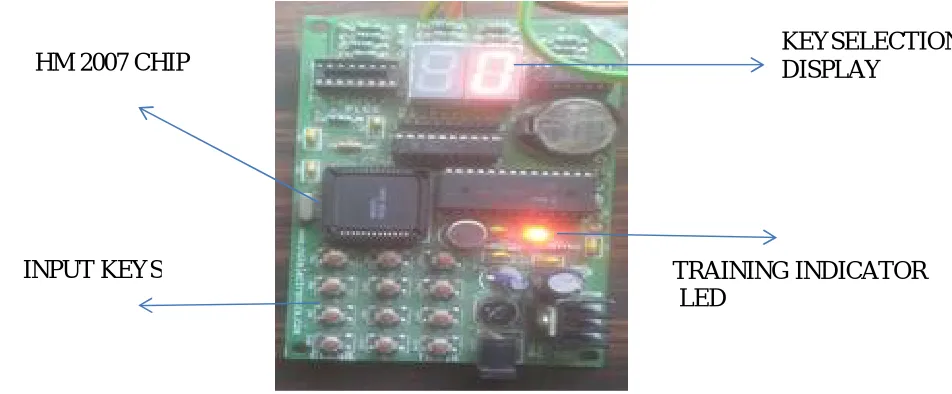
KEYSELECTION
DISPLAY
TRAINING INDICATOR
LED
HM 2007 CHIP
C. SYSTEM CONTROL , POWER SUPPLY AND DISPLAY
Fig. no.4 Power supply , controller and lcd display assembly
ARM7 - The LPC2131/32/34/36/38 microcontrollers are based on a 16/32-bit ARM7TDMI-S CPU with real-time emulation and embedded trace support, that combine the microcontroller with 32 kB, 64 kB, 128 kB, 256 kB and 512 kB of embedded high-speed flash memory. A 128-bit wide memory interface and a unique accelerator architecture enable 32-bit code execution at maximum clock rate. For critical code size applications, the alternative 16-bit Thumb mode reduces code by more than 30 % with minimal performance penalty.
Due to their tiny size and low power consumption, these microcontrollers are ideal for applications where miniaturization is a key requirement, such as access control and point-of-sale. With a wide range of serial communications interfaces and on-chip SRAMoptions of 8 kB, 16 kB, and 32 kB, they are very well suited for communication gateways and protocol converters, soft modems, voice recognition and low-end imaging, providing both large buffer size and high processing power. Various 32-bit timers, single or dualbit 8-channel ADC(s), 10-bit DAC, PWM channels and 47 GPIO lines with up to nine edge or level sensitive external interrupt pins make these microcontrollers particularly suitable for industrial control and medical systems.
Enhancements brought by LPC213x/01 devices
Fast GPIO ports enable port pin toggling up to 3.5 times faster than the original LPC213x. They a lso allow for a port pin to be read at any time regardless of its function.
Dedicated result registers for ADC(s) reduce interrupt overhead.
UART0/1 include fractional baud rate generator, auto-bauding capabilities and handshake flow control fully implemented in hardware.
Additional BOD control enables further reduction of power consumption. Key features common for LPC213x and LPC213x/01
16/32-bit ARM7TDMI-S microcontroller in a tiny LQFP64 or HVQFN64 package.
8/16/32 kB of on-chip static RAM and 32/64/128/256/512 kB of on-chip flash program memory. 128-bit wide interface/accelerator enables high-speed 60 MHz operation.
In-System Programming/In-Application Programming (ISP/IAP) via on-chip bootloader software. Single flash sector or full chip erase in 400 ms and programming of 256 B in 1 ms
ARM7 CPU CHIP
LCD DISPLAY
POWER
D. Motor Driver L293d
L293D IC generally comes as a standard 16-pin DIP (dual-in line package). This motor driver IC can simultaneously control two small motors in either direction; forward and reverse with just 4 microcontroller pins (if you do not use enable pins). Motor driver is basically a current amplifier which takes a low-current signal from the microcontroller and gives out a proportionally higher current signal which can control and drive a motor. In most cases, a transistor can act as a switch and perform this task which drives the motor in a single direction.
V. CONCLUSION AND RECOMMENDATIONS
The AMR system, which consist HM2007 module in a kit, ,beenCleary implemented. From above explanation we conclude that HM2007 can be used to detect voice signals accurately. After detecting voice signals these can be used to operate the mouse as explained earlier. Thus, we can implement microcontroller in voice recognition system for human machine interface in embedded system.
REFERENCES
[1] KarishmaChavan 2015 International Conference on Soft-Computing and Network Security (ICSNS -2015), Feb. 25 – 27, 2015, Coimbatore, INDIA
[2] ThorayaObaid, HaliemahRashed, Ali Abu El Nour, Muhammad Rehan, Mussab Muhammad Saleh, and Mohammed Tarique,” ZIGBEE BASEDVOICE CONTROLLED WIRELESS SMART HOME SYSTEM” International Journal of Wireless & Mobile Networks (IJWMN) Vol. 6, No. 1, February 2014
[3] Johan Olssan, “Text Dependent Speaker Verification with a Hybrid HMM/ANN System”,Thesis in Speech Technology, KTH, Stockholm, Nov 2002.
[4] T. Kinnunen, H Li, “An overview of text-independent speaker recognition: From features to super vectors”, Speech Communication, Elsevier, 2010.
[5] Chunyan Liang, Xiang Zhang, Lin Yang, Jianping Zhang, Yonghong Yan, “Perceptual MVDR-Based Cepstral Coefficients (PMCCs) for SpeakerRecognition”, ICSP 2010 Proceedings.
[6] Tomi Kinnunen, Rahim Saeidi, Filip Sedlk, Kong Aik Lee, Johan Sandberg,Maria Hansson-Sandsten and Haizhou Li, “Low-Variance Multitaper MFCC Features: A Case Study in Robust Speaker Verification”, IEEE Transactions on Audio, Speech and Language Processing, Vol. 20, No. 7, Sep 2012.
[7] Ambikairajah. E., “Emerging features for speaker recognition”, International Conference on Information, Communications & Signal Processing, 2007.
[8] Najim Dehak, Patrick J. Kenny, Rda Dehak, Pierre Dumouchel, and Pierre Ouellet, “Front-End Factor Analysis for Speaker Verification”, IEEE Transactions on Audio, Speech and Language Processing, Vol. 19,No. 4, May 2011.
[9] Huo Chun bao, Zhang Cai juan, “The Research of speaker recognition based on GMM and SVM”, International Conference on System Science and Engineering, 2012.
[10] Saurabh Bhardwaj, Smriti Srivastava, Madasu Hanmandlu and J.R.P.Gupta, “GFM-Based Methods for Speaker Identification”, IEEE Transactions on Cybernetics, Vol.43, No.3, June 2013.