Scholarship@Western
Scholarship@Western
Electronic Thesis and Dissertation Repository
6-23-2014 12:00 AM
Cognitive Predictors and Behavioural Mediators of
Cognitive Predictors and Behavioural Mediators of
Vulnerability-Specific Stress Generation in Depressed Adults
Specific Stress Generation in Depressed Adults
Katerina Rnic
The University of Western Ontario
Supervisor Dr. David Dozois
The University of Western Ontario
Graduate Program in Psychology
A thesis submitted in partial fulfillment of the requirements for the degree in Master of Science © Katerina Rnic 2014
Follow this and additional works at: https://ir.lib.uwo.ca/etd
Part of the Clinical Psychology Commons
Recommended Citation Recommended Citation
Rnic, Katerina, "Cognitive Predictors and Behavioural Mediators of Vulnerability-Specific Stress Generation in Depressed Adults" (2014). Electronic Thesis and Dissertation Repository. 2129.
https://ir.lib.uwo.ca/etd/2129
This Dissertation/Thesis is brought to you for free and open access by Scholarship@Western. It has been accepted for inclusion in Electronic Thesis and Dissertation Repository by an authorized administrator of
COGNITIVE PREDICTORS AND BEHAVIOURAL
MEDIATORS OF VULNERABILITY-SPECIFIC STRESS
GENERATION IN DEPRESSED ADULTS
(Thesis format: Monograph)
by
Katerina Rnic
Graduate Program in Psychology
A thesis submitted in partial fulfillment
of the requirements for the degree of
Master of Science
School of Graduate and Postdoctoral Studies
The University of Western Ontario
London, Ontario, Canada
ii
This longitudinal study investigated the prospective relation of core beliefs and
maladaptive behaviours with stress generation. A sample of 151 depressed females
completed a battery of questionnaires to assess the presence of early maladaptive
schemas, excessive reassurance seeking (ERS), avoidance, depression and anxiety.
Approximately three months later, participants were administered the Beck Depression
Inventory-II, a diagnostic interview, and a semi-structured contextual interview that
assessed the number and severity of life events experienced since Baseline. ERS
mediated the association between a Subjugation schema and dependent interpersonal
stress, and behavioural-nonsocial avoidance mediated the relation of an Abandonment
schema and dependent interpersonal stress. Furthermore, dependent interpersonal stress
mediated the relation of Abandonment, Subjugation, ERS, and avoidance with depression
at Follow-up, and ERS and behavioural avoidance both moderated the relation of
Abandonment and dependent interpersonal stress. Findings suggest several causal
mechanisms underlying the stress generation phenomenon.
Keywords: stress generation; stressful life events; depression; early maladaptive schemas;
iii
Acknowledgements
I would like to express my sincere gratitude and appreciation to my supervisor,
Dr. Dozois, for his guidance and support. I learned a huge amount from you and eagerly
look forward to continuing to work with you in the future. I would also like to thank Dr.
Stewart for training and supervising our team on the use of the LEDS system. Without his
involvement this project would not have been possible. As well, I would like to thank Dr.
Harkness for her invaluable advice and consultation at various stages of this project.
Heartfelt thanks to my research team: Nadia Maiolino, Sara Caird, Lindsay Szota,
Josh Hanna, Simone Cunningham, and Leah Katzman. Special thanks to Francois Botha
for providing reliability ratings for the SCID interview. I could not have asked for a more
dedicated and hardworking team, and I feel privileged to have worked with all of you.
I would also like to thank my committee members, Dr. Martin, Dr. Hayden, and
Dr. Norman for taking the time to read my manuscript and provide feedback. Dr. Martin
also created the online programs for running the questionnaire portions of the study,
which greatly facilitated with data collection.
Thank you to my year mates, Martin Smith, Christian Hahn and Nadia Maiolino,
and lab mates Rebecca McDermott, Lyndsay Evraire, and Francois Botha, for making my
Masters a wonderful experience and for your advice, support, and friendship. Finally, I
would like to express sincere thanks to Lukas Wilson, and to my family and friends for
iv
Table of Contents
Abstract and Keywords...ii
Acknowledgements...iii
Table of Contents...iv
List of Tables...v
List of Figures...vii
List of Appendices...viii
Introduction...1
Method...19
Participants...19
Materials...22
Procedure ...28
Results ...30
Discussion...56
References ...72
Appendices...90
v List of Tables
Table Page
Table 1 Demographic and Clinical Characteristics of Completers and
Non-completers
31
Table 2 Descriptive Statistics for EMSs, ERS, Avoidance, Life Events and
Depressive Symptoms
32
Table 3 Pearson Correlations between EMSs, and Independent Variables
(Depressive Symptoms and Life Events)
34
Table 4 Pearson Correlations between EMSs and Maladaptive Behaviours
(ERS and Avoidance
36
Table 5 Pearson Correlation Coefficients between Depressive Symptoms,
ERS, Avoidance, and Life Events
37
Table 6 Partial Correlations Between Predictors and Dependent Variables
Controlling for Covariates
38
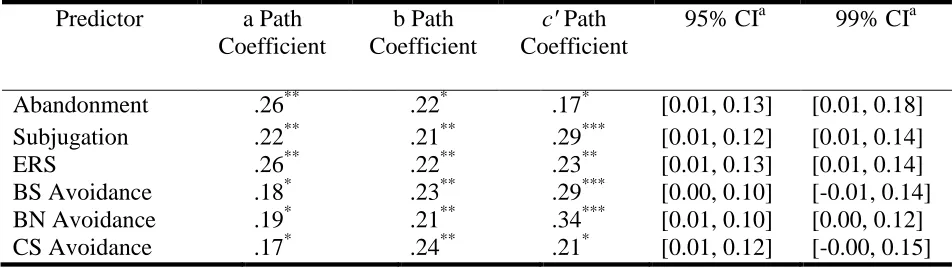
Table 7 The relation of Schemas/ Maladaptive Behaviours and Follow-up
Depression, Partially Mediated by Interpersonal Event Threat
45
Table 8 The relation of Schemas/ Maladaptive Behaviours and Follow-up
Depression, Partially Mediated by Interpersonal Event Threat
46
Table 9 ERS as a moderator of the Relationship between Abandonment and
Interpersonal Event Threat
50
Table 10 Behavioural-social avoidance as a moderator of the Relationship
between Abandonment and Interpersonal Event Threat
vi
Table 11 Behavioural-nonsocial avoidance as a moderator of the Relationship
between Abandonment and Interpersonal Event Threat
vii List of Figures
Figure Page
Figure 1 Participant Flow 21
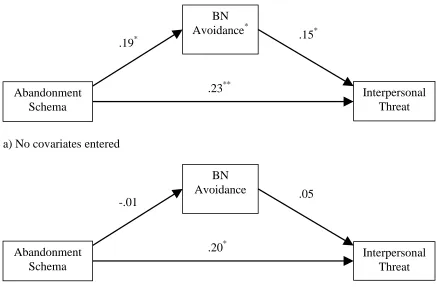
Figure 2 Mediating effects of Behavioural-nonsocial avoidance on the
relationship between Abandonment and Interpersonal Event threat
41
Figure 3 Mediating effects of Excessive reassurance seeking on the relationship
between Subjugation and Interpersonal Event threat
43
Figure 4 Moderating effects of Excessive Reassurance Seeking on the
relationship between Abandonment and Interpersonal Event threat
over time
48
Figure 5 Moderating effects of Behavioural-social avoidance on the
relationship between Abandonment and Interpersonal event threat over
time
51
Figure 6 Moderating Effects of Behavioural-nonsocial avoidance on the
relationship between Abandonment and Interpersonal event threat over
time
viii
List of Appendices
Appendix Page
Appendix A Definitions of Early Maladaptive Schemas 90
Appendix B Letter of Information and Consent Form for Screening 92
Appendix C Screening Debriefing Form for Eligible Participants 93
Appendix D Screening Debriefing Form for Ineligible Participants 94
Appendix E Baseline Assessment Letter of Information 95
Appendix F Baseline Assessment and Follow-up Consent Form 98
Appendix G Baseline Assessment Debriefing Form 99
Appendix H Follow-up Letter of Information 102
Appendix I Follow-up Debriefing Form 105
Cognitive Predictors and Behavioural Mediators of Vulnerability-Specific Stress
Generation in Depressed Adults
Major depression is a serious and debilitating disorder with an overall lifetime
prevalence rate of 17 % (Kessler et al., 2005), and is the leading cause of disability
worldwide (World Health Organization, 2012). Depression is also chronic and recurrent,
with each episode increasing the risk of subsequent ones (Kessler, 2002). Fully
elucidating the processes involved in the onset, maintenance, and recurrence of this
common disorder has therefore become crucial.
Stress has long been established as a precipitant to depression, especially in
individuals who are vulnerable due to biological and environmental risk factors (see
Hammen, 2005; Harkness, 2008; Kessler, 1997; Paykel, 2003, for reviews). This
diathesis-stress model (e.g., Beck, 1967; 1987; Ingram & Luxton, 2005) has dominated
research in psychopathology over the past four decades. Depression-prone individuals are
not, however, merely passive respondents to life stress, but also play an active role in
generating depressogenic life events. In this process of ‘stress generation’ (Hammen,
1991), the occurrence of stressful life events that the individual has contributed to are
termed ‘dependent’ events (e.g., getting into an argument), as opposed to those that are
fateful or ‘independent’ (e.g., death of a relative, a natural disaster). The latter are not
accounted for by stress generation processes. Dependent events, especially those that are
interpersonal and involve conflict, are more strongly associated with depression than are
independent events (Hammen et al., 1985; Kendler, Karkowski, & Prescott, 1999). As
such, the stress generation process may maintain current depression or increase the
2005), and therefore may account for the chronicity of major depression (Belsher &
Costello, 1998; Monroe & Harkness, 2005; Solomon et al., 2000). The stress generation
phenomenon is therefore a promising line of inquiry for understanding the mechanisms
underlying the course of depression.
The first study to report stress generation (Hammen, 1991) found that women
with a history of depression reported higher rates of dependent stressful life events,
especially those that were interpersonal. However, there was no significant difference in
the number of independent events that they experienced compared to women with bipolar
disorder, medical illness, or healthy controls. The finding that depressive symptoms or
diagnoses are associated with higher levels of dependent stress has since been replicated
in varying samples, including women with unipolar depression (e.g., Hammen, Shih, &
Brennan, 2004), clinical samples of men (Cui & Vaillant, 1997), non-clinical samples of
depression-prone college students (e.g., Joiner, Wingate, Gencoz, & Gencoz, 2005;
Potthoff, Holahan, & Joiner, 1995) and older adults (Moos, Schutte, Brennan, & Moos,
2005), among others (see Liu & Alloy, 2010, for a review). Moreover, Hammen (1991)
posited that negative dependent life events are caused, at least to some extent, by
enduring maladaptive characteristics and behaviours of the depression-prone individual.
Given that previously depressed individuals continue to generate dependent stress when
they are in remission (e.g., Daley et al., 1997), it appears that stressors are not generated
by depressive states per se, but by more stable characteristics and vulnerabilities that give
rise to these states.
Consistent with this idea, past research has found that personality traits, such as
perfectionism (Flett, Hewitt, Garshowitz, & Martin 1997), dependency/self-criticalness
(Mongrain & Zuroff, 1994; Priel & Shahar, 2000; Shahar, Joiner, Zuroff, & Blatt, 2004),
low perceived control (Auerbach, Eberhart, & Abela, 2010) and sociotropy/autonomy
(Nelson, Hammen, Daley, Burge, & Davila, 2001; Shih, 2006) are related to the
generation of stressful life events. Social risk factors, including insecure attachment
styles (Bottanari, Roberts, Kelly, Kashdan, & Ciesla, 2007; Hankin, Kassel, & Abela,
2005), ineffective interpersonal problem solving (Davila, Hammen, Burge, Paley, &
Daley, 1995), and low perceived social support (Flynn, Kecmanovic, & Alloy, 2010) are
also associated with the generation of negative dependent events.
Given the stability of cognitive factors and the significance of cognition in the
course of depression (e.g., Dozois & Beck, 2008; Hayden et al., 2008; see Gotlib &
Joormann, 2010, for a review), an important line of inquiry is the role that various
cognitive vulnerabilities to depression may play in generating stress over time. Harkness
and Stewart (2009) found that cognitive-affective depressive symptoms (e.g., sadness,
guilty feelings, worthlessness) were predictive of stress generation. Empirical research
has also found that rumination (Flynn et al., 2010; Kercher & Rapee, 2009),
dysfunctional attitudes (Safford, Alloy, Abramson, & Crossfield, 2007), negative
inferential style (Gibb, Beevers, Andover, & Holleran, 2006; Kercher & Rapee, 2009
Safford et al., 2007), and early maladaptive schemas (Calvete, Orue, & Hankin, 2013;
Eberhart, Auerbach, Bigda-Peyton, & Abela, 2011) predict the generation of dependent
and negative life events.
Substantial evidence supports the notion that enduring maladaptive characteristics
examines levels of stress associated with particular content areas (e.g., Shahar et al.,
2004), such as interpersonal and noninterpersonal (e.g., education, work, health)
domains. Hammen et al. (1985) investigated schemas and stress using a diathesis-stress
formulation and found that Dependence schemas interacted specifically with
interpersonal stress to predict depression. Self-critical schemas, on the other hand,
interacted with stress in the achievement domain, although this effect was less consistent
across a series of follow-ups than the findings for Dependent schemas. These findings
underscore the importance of examining specificity in the associations of vulnerabilities
with subtypes of stress.
Vulnerabilities may also show specificity in the types of stress they generate. For
example, a person who believes she will inevitably fail at whatever she does in areas of
achievement (i.e., a noninterpersonal risk factor) may avoid attending classes or studying
and fail a course as a result (i.e., noninterpersonal stress), putting her at risk for
depression. A person who believes he cannot depend on others for support (i.e.,
interpersonal risk factor) may withdraw from friends, resulting in breakdowns in close
relationships (i.e., interpersonal stress) and greater subsequent depressive symptoms.
Some evidence exists for vulnerability-specific stress generation, particularly for
predicting interpersonal stress (e.g., excessive reassurance seeking: Birgenhier, Pepper, &
Johns, 2010; Prinstein, Borelli, Cheah, Simon, & Aikins, 2005; Shih et al., 2009;
attachment: Hankin et al., 2005) However, specificity has not been a consistent finding
(e.g., Segrin, 2001), possibly due to methodological issues discussed in detail below.
Interpersonal vulnerabilities are among the strongest predictors of the duration of
involving their social network prior to the onset of an episode than do men (Dalgard et
al., 2006; Kendler, Thornton, & Prescott, 2001; Maciejewski, Prigerson, & Mazure,
2001). Cyranowski, Frank, Young, and Shear (2000) posited that women are particularly
vulnerable to developing depression after experiencing interpersonal events because of
their need for affiliation. Given that dependent interpersonal stress is most closely
associated with depression (Hammen, Marks, Mayol, & deMayo, 1985; Kendler,
Karkowski, & Prescott, 1999), coupled with the fact that interpersonal dependent events
are more common than noninterpersonal events (e.g., Harkness & Stewart, 2009), stress
generation appears to be largely an interpersonal process. Therefore,
interpersonally-relevant vulnerabilities are hypothesized to be the most interpersonally-relevant to generating
interpersonal events, and dependent interpersonal events are also expected to have the
greatest impact on depressive symptoms. Noninterpersonally-relevant vulnerabilities are
expected to predict noninterpersonal events, which may have less of an impact on
depressive symptoms than the aforementioned relation.
This study examined the role of cognitive risk factors for depression and
corresponding maladaptive behaviours in generating dependent stress in the interpersonal
and noninterpersonal domains in individuals with mild to severe depressive symptoms.
The extent to which stress generation was vulnerability-specific, such that the content
area of risk factors (interpersonal versus noninterpersonal) predicts the same domain of
stress, was also investigated. This study also examined depressive schemas. These
cognitive structures have a dramatic influence on individuals’ experiences and their
interpretations of their environments (Dozois & Beck, 2008), and are therefore likely
Schemas
Schemas are core beliefs or “broad organizing principle[s] for making sense of
one’s life experience” (Young, Klosko, & Weishaar, 2003, p.7). They have also been
described as “relatively enduring internal structures of stored generic or prototypical
features of stimuli, ideas, or experiences that are used to organize new information”
(Clark, Beck, & Alford, 1999, p. 79). According to Beck’s cognitive theory of depression
(1967; 1983), schemas initially develop in childhood and are later expanded upon, and
used as heuristics for organizing information and expectations about the world,
relationships with others, and oneself. However, these core beliefs can become
maladaptive when they involve broad, pervasive and inflexible cognitions, or when they
are no longer relevant for the situation or environment the individual finds him or herself
in. Such depressive schemas have a significant impact on a person’s experience of the
world by negatively biasing and directing attention, encoding, and the retrieval of
information and memories in ways that reinforce the core belief (Dozois & Beck, 2008;
Hayden, Seeds, & Dozois, 2009). Consistent with a diathesis-stress model, schemas
predict depression when activated by stressful life events (Hammen et al., 1985; see
Scher, Ingram, & Segal, 2005, for review)
Young (1990; 1994; Young & Brown, 2003) expanded on Beck’s theory by
suggesting that early maladaptive schemas (EMSs) develop in childhood and are
elaborated on throughout life. Young proposed 15 specific EMSs, organized into five
domains: Disconnection and Rejection (difficulty forming secure and satisfying
relationships with close others and a belief that needs for stability, nurturance, love and
independently and having a poorly developed sense of identity), Other-Directedness
(meeting the needs of others before one’s own needs in order to gain conditional
acceptance), Impaired Limits (beliefs that one is superior and entitled to special
privileges and that one lacks self-discipline and an ability to delay gratification), and
Over-vigilance and Inhibition (sacrificing relationships, relaxation, and happiness in
order to meet strict self-imposed standards; see Appendix A). These schemas arise in
response to unmet developmental needs and contain memories, emotions, cognitions and
bodily sensations that influence how one thinks, feels, acts, and relates to others. These
self-defeating cognitive patterns are conceptualized as dimensional constructs that vary in
severity and put individuals at risk for developing psychopathology. EMSs have high
temporal stability over 6 months in children as young as 9 years old (Rijkeboer, van den
Bergh, & van den Bout, 2005) and over 2.5-5 years in adults (Riso et al., 2006).
Furthermore, all five schema domains are positively associated with depressive
symptomatology (Eberhart et al., 2011; Schmidt, Joiner, Young, & Telch, 1995). The
bulk of past research has, however, only examined main effect models whereby schemas
were correlated with depression (for an exception, see Dozois, Martin, & Faulkner,
2013). As such, there is a paucity of research examining how these schemas impact
depressive symptoms. Given the significant role that schemas play in shaping information
processing and experiences, it is likely that they also shape depressed persons’
interactions with their environment in such a way as to generate stress. Indeed, the idea
that schemas create life stress is consistent with the underlying assumptions of the
Only two studies have examined the relation of schemas to life stress using a
stress generation framework. Calvete, Orue, and Hankin (2013) found that Disconnection
and Rejection schemas predicted stress in a non-clinical sample of adolescents. In
contrast, no significant findings were obtained for Impaired Autonomy schemas. The
checklist measure of life stress used in this study was interpersonally-focused, and the
authors suggested that Impaired Autonomy may influence stress in other domains of life
(in a manner consistent with vulnerability-specificity stress generation). Eberhart and
colleagues (2011) found that interpersonal schemas (Disconnection and Rejection,
Impaired Autonomy and Performance, Other-directedness domains) predicted
interpersonal stress which, in turn, predicted increases in depressive symptoms. Stressors
also mediated the relation between several schemas and subsequent depression, and there
was little evidence for interactive effects of schemas with stress (i.e., a diathesis-stress
model). However, this study was limited in that it only studied a subset of schemas and
used a non-clinical sample. Furthermore, this research investigated minor, everyday
hassles on a weekly basis using a checklist measure. This methodology is problematic
because the evidence linking minor events to major depression is fairly weak and
inconsistent (Harkness, 2008; Mazure, 1998) and cognitive vulnerabilities are more
closely related to the generation of major stressors (Safford et al., 2007) than with daily
hassles (Gibb et al., 2006). Furthermore, checklist measures of life stress have severe
limitations, as discussed below.
The current study explored the relation of Young’s schemas to dependent life
stress. Interpersonally-relevant schemas, such as Abandonment/instability,
Self-sacrifice, Dependence/incompetence, and Enmeshment/undeveloped self, were
hypothesized to predict dependent interpersonal stress (and not noninterpersonal stress).
Failure, Insufficient Self-Control, and Unrelenting standards were expected to predict
noninterpersonal stress (and not interpersonal stress). There were no specific hypotheses
for Entitlement/grandiosity and Vulnerability to harm schemas.
Hypothesized Behavioural Mediators
Schemas do not contain behaviours; rather, Young contends that behaviours occur
in response to the content of schemas (Young et al., 2003). Furthermore, he suggests that
these behaviours are coping mechanisms used to adapt to and escape the overwhelming
emotions schemas produce. Although these strategies may initially help the individual
manage his or her distress, they eventually reinforce the individual’s negative core
beliefs, ultimately rendering these behaviours maladaptive. Understanding how schemas
may predispose individuals to generate life stress through intervening behaviours and
interactions is important for elucidating the mechanisms by which EMSs cause
individuals to be vulnerable to future depressive symptomatology. Behaviours resulting
from schema content may partially or fully account for the influence of cognitive
vulnerabilities on the generation of life stress. In the present study, two types of
behaviour that are closely associated with depression were investigated: avoidance and
excessive reassurance seeking.
Avoidance.
Avoidance has received relatively little attention in the depression literature
despite being a key feature in Ferster’s (1973) functional analysis of depression. Ferster
external aversive stimuli by withdrawing and gradually reducing positively reinforcing
behaviour, so that eventually the depressed individuals’ behaviour is marked by passivity.
Avoidance is also an important component of Lewinsohn’s (1974) model of depression,
whereby an event disturbs an individual’s pattern of responding, such that his or her
behaviour no longer evokes enough positive reinforcement to continue to initiate or
maintain goal-directed behaviours, gradually resulting in increased inactivity and
avoidance.
Avoidance has been conceptualized previously as a coping strategy, a
problem-solving style, and a personality dimension, all three of which have been found to be
associated with depression, both concurrently and over time (Ottenbreit & Dobson,
2004). As a coping strategy, avoidance can be divided into two domains: cognitive and
behavioral avoidance. ‘Cognitive avoidance coping,’ includes responses that deny or
minimize a problem or its consequences, or that accept a situation due to the belief that
circumstances are unchangeable (Ottenbreit & Dobson, 2004). ‘Behavioural avoidance
coping’ encompasses responses that involve seeking alternative rewards, or escaping the
situation and avoiding direct responses to a stressor (Ottenbreit & Dobson, 2004). In
contrast, approach coping involves directly addressing a problem. Holahan, Moos,
Holahan, Brennan, and Schutte (2005) found that baseline avoidance predicted chronic
and acute life stress four years later, which predicted greater depression ten years from
baseline in a sample of mixed clinical and non-clinical late middle aged adults. Life stress
was a full mediator for men and a partial mediator for women. From a problem-solving
perspective, avoidance is the outcome of ineffective problem solving, whereas active
individuals with an avoidant problem solving style had greater insecure attachment
cognitions and generated more stressful life events than did those who used active
problem solving. Research on avoidance as a personality dimension has investigated
‘harm avoidance,’ the tendency to inhibit behaviour in order to avoid punishment and
novel stimuli (Ottenbreit & Dobson, 2004). Although harm avoidance has never been
examined in the context of stress generation, Cummings and colleagues (2013) found that
symptoms of Avoidant Personality Disorder in a non-clinical sample led to higher levels
of daily stress generation, which was mediated by poor conflict management skills. The
authors asserted that avoidance may be especially detrimental in conflict situations since
withdrawal merely postpones an argument or may lead to social isolation and rejection.
Ottenbreit and Dobson (2004) developed the Cognitive Behavioural Avoidance
Scale (CBAS) to provide an integrative measure that incorporates various dimensions of
avoidance. Previously used indices were subscales of broad coping or personality
measures that had used varying definitions of avoidance, making the comparison of
results across studies difficult. The CBAS uses a trait conceptualization of avoidance
since there is evidence for stability of avoidance coping over time. The CBAS measures
two factors: cognitive/behavioural avoidance and social/nonsocial avoidance. The
coverage of these domains permits the investigation of what avoidance strategies
individuals employ and, in turn, how this impacts the generation of interpersonal versus
noninterpersonal stressful life events.
In this study, avoidance was hypothesized to mediate the relation of schemas on
dependent life stress. It was also expected that social avoidance would be specific to
Excessive reassurance seeking.
Coyne’s (1976) interpersonal theory of depression states that individuals
susceptible to depression, in response to their symptoms of low self-worth, tend to
persistently seek reassurance from close others regarding their worth and lovability and
the value of the relationship. This is done to attain the care and interest of others and to
increase self-esteem, regardless of whether this assurance has already been provided.
Depressed individuals may fail to use or may question the authenticity of the provided
support, thinking that reassurance is motivated by pity, and engage in a repetitive pattern
of seeking and discounting reassurance as insincere. Although close others may at first
provide reassurance, they eventually become frustrated, leading to a deterioration of the
relationship and rejection of the depressed individual. This outcome confirms to the
depressed person his or her negative self-perceptions and increases doubt regarding the
genuineness of the initial feedback provided. Consistent with Coyne’s model, ERS is
related to both depressive symptoms and interpersonal rejection (see Starr & Davila,
2008, for a review).
Not surprisingly, ERS has also been found to relate to interpersonal stress
generation. Pothoff, Holahan, and Joiner (1995) found that minor stressful life events
mediated the relation between ERS and depression over five weeks in a non-clinical
sample of college students. Shahar and colleagues (2004) found that ERS predicted only
spousal stress over 5 weeks. The lack of association with other types of relational stress
(e.g., involving friends or roommates) might have been due to the fact that these
relationships involve less intimacy than a spousal relationship. As such, the negative
aware of how annoyed he or she is making the relationship partner feel. Using a daily
diary method, Shih and Auerbach (2010) found that ERS predicted stressful interpersonal
dependent (and not achievement) events in women but not men. Using a contextual threat
based interview measure and daily diary, Eberhart and Hammen (2009) found that ERS
predicted conflict stress generation over four weeks for women in exclusive romantic
relationships. Eberhart and Hammen (2010) also found that the relationship of ERS to
depression was mediated by conflict stress in a romantic relationship over a four-week
period, whereas a diathesis-stress model (whereby conflict stress was hypothesized to
interact with ERS to predict depression) was not supported. Furthermore, Birgenheir et
al. (2010) found that ERS predicted greater negative life events and also mediated the
relation of sociotropy to negative interpersonal life events, and Shih, Abela and Starrs
(2009) found that children of depressed parents who engage in ERS generate more
interpersonal but not non-interpersonal stress (with the exception of children younger
than 10 years old).
Ironically, individuals with depression commonly report engaging in ERS as a
way to increase self-esteem, decrease anxiety, receive affection, and prevent social harm
(Parrish & Radomsky, 2010). Therefore, it appears that ERS is a coping mechanism used
in response to personal and relationship insecurities, which backfires and results in
rejection and subsequent depression. Past studies have found that ERS predicts
interpersonal (e.g., rejection), but not noninterpersonal stress, providing evidence for
vulnerability-specific stress generation. Furthermore, because ERS appears to be a
behaviour used to cope with underlying beliefs, it is expected to mediate the relation of
Furthermore, past research has found that the interaction of ERS and an Abandonment
schema results in greater depression (Evraire & Dozois, 2014), likely because the
combination of ERS with this cognitive risk factor is particularly aversive to relationship
partners. These findings suggest that ERS may moderate (rather than mediate) the
relationship of particular schemas and dependent stress. It is possible that other schemas
might also interact with various depressotypic behaviours in a manner that renders the
individuals’ interactions more conflictual or aversive to others, thereby resulting in the
generation of greater interpersonal stress. For example, individuals may engage in certain
maladaptive behaviours more intensely or over a prolonged duration (which may be more
toxic to relationships) when they also have a particular schema. Therefore, moderation of
maladaptive behaviours was also tested for schemas. To reduce the number of analyses
conducted, moderation was only tested for schemas that predicted dependent
interpersonal stress.
Measuring Stressful Life Events
The importance of examining the dependency and the severity of life events
makes the measurement of stress a particularly significant consideration. There are two
primary methods of measuring life stress: checklist indices and contextual interview
rating systems. Checklists are easy to administer and score and are much less labour- and
time-intensive than are interview-based assessments of life stress. As such, checklists
remain widely used despite serious limitations (Harkness, 2008). For example,
respondents may have idiosyncratic criteria for whether an experience ‘counts’ as a
particular stressful life event, and a respondent’s opinion of what constitutes a serious
example, one individual may report a serious illness in the family when their child had
the flu, whereas others may not. Meanwhile, the investigator may define a serious illness
as the diagnosis of a chronic or life-threatening disease. Unfortunately, participants often
do not have an opportunity to ask the investigator for clarification. Respondents may also
endorse items due to demand characteristics (Uher & McGuffin, 2010). That is, they may
recognize that stress is being measured and respond in a manner consistent with their
general views about stress. Depressed individuals, in particular, may experience cognitive
dissonance and systematically over-endorse events because they are seeking an
explanation for their poor mental health.
Interviews circumvent many of these problems. They are comprised of
standardized questions that all participants are asked, and interviewers have the
opportunity to use provided probes, or follow-up questions, to glean important contextual
information (Harkness, 2008). Therefore, an interviewer specifies what he or she means
by a ‘serious illness,’ for example, and provides clarification when necessary. If a
participant reports a serious illness, the interviewer asks about the nature of the illness
and what impact it had on day-to-day life. Collecting detailed idiographic information
also prevents events from being ‘double-counted,’ as participants may report an event
more than once under different categories when using a checklist measure (Monroe,
2008). For example, a car accident may be reported as both a health and a financial event.
Furthermore, checklists are susceptible to memory and mood-congruent biases,
such that depressed individuals tend to interpret, remember and report life events as more
negative (Simons, Angell, Monroe, & Thase, 1993), resulting in issues of shared-method
assess more objectively how threatening events are by distinguishing the severity of the
actual event from the participant’s perception of threat, which may be inflated (Monroe &
Depue, 1991) or contaminated by cognitive and personality variables (Shih et al., 2009).
This is achieved by asking only about objective facts associated with life events rather
than about the participants’ subjective reactions, and by keeping raters blind to the
clinical status and subjective reactions of the respondent, which could be confounded
with the dependent variable of interest. As mentioned above, interviews also take
idiosyncratic contextual differences into account (Harkness, 2008). For example, finding
out that one is pregnant has very different implications for a woman who planned the
pregnancy, has a reliable partner and is financially stable, compared to a single woman
with low socioeconomic status who had not wanted to become pregnant. Despite these
two experiences being vastly different in terms of their severity, checklist measures
would treat them equally. Context is also important for understanding the degree to which
the event was dependent on the individual’s actions or choices (Harkness, 2008). Finally,
interviews use calendars and timelines to aid autobiographical memory and to establish
when an event occurred, which is important for ensuring that events did, in fact, occur
during the time period of interest. The use of interviews guards against ‘telescoping’ (i.e.,
reporting events as occurring more recently than they did).
Interviews are also advantageous over checklists in terms of their psychometric
properties. Checklist measures have low test-retest reliability (r = .08 over 6 months in
psychiatric patients; Horowitz, Schaefer, Hiroto, Wilner, & Levin, 1977) and low
agreement in endorsement of events among married couples living together (e.g., only
Investigator-defined events (using standardized and operational criteria) and events
defined by participants using a checklist have a surprisingly low correlation (McQuaid,
Monroe, Roberts, & Johnson, 1992) and, when participants are subsequently interviewed
about events they had previously endorsed, many change their report. Some respondents
reported that they had endorsed events that only vaguely corresponded to events that had
occurred in their lives because they did not want to appear ‘boring.’ Duggal and
colleagues (2000) found that checklists only captured 32% of severe life events occurring
prior to an onset of depression, and Lewinsohn, Rohde, and Gau (2003) reported that the
overall percentage of valid events captured by a checklist as defined by a criterion was
well below 50%. In contrast, interviews detect severe life events (Duggal et al., 2000) and
are able to distinguish life events that are stressful as opposed to trivial, the latter of
which may be unpleasant but do not increase the risk for depression (Gorman, 1993).
Interviews also show high predictive validity, and are able to predict depressive
symptoms (McQuaid, Monroe, Roberts, Kupfer, & Frank, 2000), unipolar and bipolar
depressive episodes (Johnson et al., 2008), remission (McQuaid et al., 2000), and
treatment outcome (McQuaid et al., 2000; Monroe et al., 2006). Interviews are more
sensitive and reliable in detecting events relevant to depression and provide more precise
ratings of severity, all of which results in greater statistical power (Monroe, 2008).
Unfortunately, the vast majority of past research has used checklist measures
despite their many disadvantages, all of which result in random and/or systematic error.
This overuse of checklist indices may account for some conflicting findings in the
stress generation is found. Hammen (2005) also noted that a true test of the stress
generation hypothesis requires the use of a contextual interview-based measure.
The current study
This study expands on the stress generation hypothesis, as originally advanced by
Hammen (1991). The prospective impact that schemas have on the generation of negative
dependent events (over and above the influence of Baseline depressive symptoms) was
examined using a follow-up period of approximately three months. It was hypothesized
that these variables would contribute to stress generation, such that the presence of early
maladaptive schemas would be predictive of negative dependent events occurring over
subsequent months. Furthermore, this study investigated a vulnerability-specificity model
for schemas, such that negative interpersonally relevant schemas were hypothesized to
predict interpersonal events (and not noninterpersonal events), and schemas relevant to
noninterpersonal domains of life (i.e., Failure, Insufficient Self-Control, Unrelenting
standards) would predict noninterpersonal events (and not interpersonal events).
Furthermore, it was hypothesized that the behaviours of excessive reassurance
seeking and avoidance would mediate the prospective relation of schemas with dependent
stress. In line with its interpersonal focus and the findings of previous studies, it was
hypothesized that ERS would mediate only interpersonal schemas to predict interpersonal
stress. Cognitive/behavioural avoidance was expected to mediate the relation of cognitive
vulnerabilities to both interpersonal and noninterpersonal stress. In line with the
vulnerability-specific stress generation hypothesis, social avoidance was expected to
mediate interpersonal stress, and nonsocial avoidance to mediate noninterpersonal stress.
interact with particular behaviours in predicting dependent interpersonal stress. These
analyses were conducted only for schemas that related to dependent life events after
controlling for Baseline depressive symptoms and any additional clinical or demographic
covariates. Finally, interpersonal stress generation was expected to have a relatively
greater impact than noninterpersonal stress generation on subsequent depression.
Hypotheses were tested in a sample of women, as females are more likely than
males to experience depressive episodes (e.g., Nolen-Hoeksema & Girgus, 1994), life
events (Harkness, Alavi, Monroe, Slavich, Gotlib, & Bagby, 2010), and interpersonal
stressors in particular (e.g., Shih et al., 2006). That is, the stress generation phenomenon
may be more pervasive in women. Therefore, rather than use this variable as a statistical
covariate, gender was controlled experimentally. Symptoms of anxiety and worry were
also controlled for due to the high comorbidity of anxiety and depression, and evidence
that anxiety may also predict stress generation (e.g., Judah et al., 2013). A
semi-structured contextual interview was used to measure stress.
Method Participants
The sample was comprised of 151 female undergraduate and graduate students at
the University of Western Ontario (UWO). Participants were recruited by advertisements
distributed throughout campus and on Facebook, and by short presentations advertising
the study in large undergraduate classes. Furthermore, individuals who participated in a
previous depression-related study, and who had provided consent to be re-contacted,
were invited by phone or email to participate in the current study. Interested individuals
the Depression scale of the Depression Anxiety and Stress Scales (DASS-21;Lovibond
& Lovidbond, 1995). Only individuals who scored ≥ 7 (indicating at least moderate
depressive symptoms) were eligible for the study. These individuals were contacted and
scheduled for their Baseline Assessment. Furthermore, only those with a score ≥ 14 on
the BDI (indicating at least minimal depressive symptoms) at Baseline Assessment were
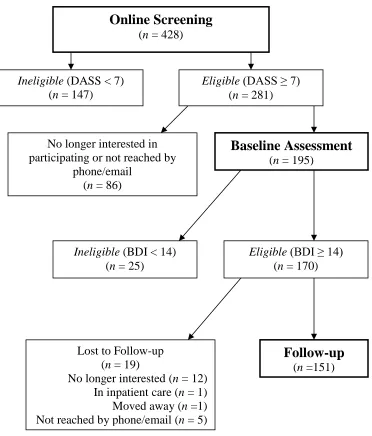
invited to participate in the Follow-up (see Figure 1 for a participant flow diagram). This
procedure ensured that a final sample of individuals exhibiting at least minimal
depressive symptoms was obtained. Participants were entered in a draw to win an iPad
and were compensated with $20 for each wave of the study, for a total of $40 for
Figure 1. Participant Flow.
Online Screening
(n = 428)
Eligible (DASS ≥ 7)
(n = 281)
Follow-up
(n =151) Lost to Follow-up
(n = 19)
No longer interested (n = 12) In inpatient care (n = 1) Moved away (n =1) Not reached by phone/email (n = 5)
No longer interested in participating or not reached by
phone/email (n = 86)
Ineligible (BDI < 14) (n = 25)
Ineligible (DASS < 7) (n = 147)
Eligible (BDI ≥ 14)
(n = 170)
Baseline Assessment
The final sample was comprised of 151 women, which represented a retention
rate of 89% from Baseline Assessment to Follow-up. The final sample was primarily
comprised of Caucasian and Asian individuals and participants ranged in age from 18 to
28 years (M = 19.69, SD = 2.15). Furthermore, 34.4% of participants (n = 52) were in a
current episode of Major Depressive Disorder (MDD) at Follow-up according to the Fifth
edition of the Diagnostic and Statistical Manual of Mental Disorders (DSM-5; American
Psychological Association, 2013). In addition, 43% (n = 65) of participants met past
criteria for MDD but were not currently depressed, 4.0% (n = 6) had Dysthymia, 6.6% (n
= 10) had Adjustment Disorder, 1.3% (n = 2) were in a current episode of Other
Specified Depressive Disorder, and 13.2% (n = 20) had no history of depression. Length
of follow-up ranged from 92 to 164 days (M = 126.53, SD = 15.07).
Materials
Depression subscale of the Depression Anxiety and Stress Scales – 21 (DASS-21;
Lovibond & Lovibond, 1995). Individuals interested in participating in the study
completed an online screening survey, which was comprised of the 7 items from the
Depression subscale of the DASS-21, a self-report questionnaire of depressive
symptomatology. Items are ranked on a 4-point scale from 0 (Did not apply to me at all)
to 3 (Applied to me very much, or most of the time) based on their applicability during the
past week, with possible scores ranging from 0 to 21. The depression scale shows good
convergent validity with the Beck Depression Inventory (Lovibond & Lovidbond, 1995;
see Dozois & Dobson, 2010, for review). In the present study, the internal consistency
Beck Anxiety Inventory (BAI; Beck, Epstein, Brown, & Steer, 1988; Beck & Steer,
1990). The BAI is a 21-item self-report questionnaire that assesses the severity of anxiety
symptoms. Participants rate how much they have been bothered by each symptom in the
past week from 0 (not at all) to 3 (severely - I could barely stand it). Total scores are
computed by summing ratings. The BAI has shown strong psychometric properties in
adult samples, including good test-retest reliability, convergent validity with other
measures of anxiety, and divergent validity with indices of depression (e.g., Beck et al.,
1988; Hewitt & Norton, 1993). Cronbach’s alpha was .89 in this study.
Penn State Worry Questionnaire (PSWQ; Meyer, Miller, Metzger, & Borkovec,
1990). The PSWQ is a 16-item self-report measure that assesses trait worry. Individuals
rate statements on a 5-point Likert-type scale, from 1 (not at all typical of me) to 5 (very
typical of me). After reverse scoring selected items, items are added to produce a total
score. This instrument has strong psychometric properties in both clinical and
nonclinical samples, including high test retest reliability, and convergent, discriminant,
and criterion validity (Brown, Antony, & Barlow, 1992; Davey, 1993). Cronbach’s alpha
was .92 in this study.
Young Schema Questionnaire-Short Form (YSQ-SF; Young and Brown, 2003).
The YSQ-SF is a 75-item self-report questionnaire that assesses 15 early maladaptive
cognitive schemas: Emotional inhibition, Emotional deprivation, Mistrust/abuse, Social
isolation/alienation, Defectiveness/shame, Abandonment/instability, Failure,
Dependence/incompetence, Vulnerability to harm or illness, Enmeshment/undeveloped
self, Subjugation, Entitlement/grandiosity, Insufficient self-control/self-discipline,
statement on a 6-point scale from 1 (completely untrue of me) to 6 (describes me
perfectly). Higher scores reflect the greater presence of maladaptive schemas. This
instrument has strong psychometric properties (e.g., Hoffart et al., 2005; Welburn,
Coristine, Dagg, Pontefract, & Jordan, 2002). The average Cronbach’s alpha across
schemas was .86 in this study.
Depressive Interpersonal Relationships Inventory-Reassurance Seeking Subscale
(DIRI; Joiner, Alfano, & Metalsky, 1992). The DIRI is a 4-item self-report questionnaire
that assesses individuals’ tendency to engage in reassurance seeking behaviour in their
current relationships (e.g., “Do you find yourself often asking the people you feel close to
how they truly feel about you?) and the reactions of close others to the behaviour (e.g.,
“Do the people you feel close to sometimes get fed up with you seeking reassurance from
them about whether they really care about you?”). Participants rate how much they agree
with these statements on a Likert-type scale from 1 (not at all) to 7 (very much). Ratings
are summed, with higher scores indicative of greater reassurance seeking. This measure
has been found to have high internal consistency (Joiner et al., 1992) and demonstrates
good construct and criterion validity when compared with judges’ ratings of ERS (Joiner
& Metalsky, 2001). The DIRI is a reliable measure of reassurance seeking that is distinct
from general dependency, dependence on close others, negative affectivity and doubt in
others’ sincerity (Haeffel, Vlelz, & Joiner, 2007; Joiner & Metalsky, 2001). Cronbach’s
alpha was .90 in the current study.
Cognitive-Behavioural Avoidance Scale (CBAS; Ottenbriet & Dobson, 2004). The
CBAS is a 31-item self-report measure of avoidance across four dimensions as
leave social gatherings), behavioural-nonsocial (e.g., I quit activities that challenge me
too much), cognitive-social (e.g.,I try not to think about problems in my personal
relationships), and cognitive-nonsocial (e.g., I avoid making decisions about my future).
Participants rate their agreement with statements on a 5-point Likert-type scale from 1
(not at all true for me)to 5 (extremely true for me), such that higher scores indicate
greater levels of avoidance. The behavioural-social (BS) scale is composed of 8 items
(possible scores range from 8-40), the behavioural-nonsocial (BN) scale is composed of 6
items (scores range from 6-30), the cognitive-social (CS) scale consists of 7 items (scores
range from 7-35), and the cognitive-nonsocial (CN) scale is comprised of 10 items
(scores range from 10-50). The CBAS has good psychometric properties, including good
internal consistency, strong test-retest reliability over three weeks, and evidence of
divergent and convergent validity (Ottenbriet & Dobson, 2004). In the current sample,
Cronbach’s alpha was .90 for the social scale, .69 for the
behavioural-nonsocial scale, .74 for the cognitive-social scale, and .85 for the cognitive-behavioural-nonsocial
scale.
Beck Depression Inventory-II (BDI-II; Beck, Steer, & Brown, 1996). The BDI-II
is a 21-item instrument that assesses the presence and severity of unipolar depressive
symptoms. Individuals rate each statement on a 0 to 3 scale according to how well it
describes how they have felt over the past two weeks. Total scores are yielded by
summing items, with higher scores indicating greater depressive symptoms. The BDI-II
has been widely used with adult samples and is recognized for its strong psychometric
properties (e.g., Beck, Steer, & Garbin, 1988, see Dozois & Covin, 2004, for a review).
Life Events and Difficulties Schedule (LEDS-II; Bifulco et al., 1989). The LEDS
is a semi-structured, contextual interview and rating system used to assess the number
and severity of stressful life events occurring over a specified period of time in ten
domains: health, education, housing, reproduction, dating relationships, other
relationships, employment, crime/legal, finance, and other crises/deaths. The LEDS
interview uses probes that encourage respondents to discuss the context surrounding each
life event. This procedure allows for sensitive ratings to be made that take the
individual’s life circumstances into account. Interviewers were trained not to ask about
participants’ subjective reactions to, or perceptions of, stressors. In addition, interviewers
were trained not to ask about how stressors related to the participants’ depression, or to
query about events directly related to participants’ mental health (e.g., beginning
pharmacotherapy, inpatient stay at a psychiatric ward). During interviews, a time line that
included anchoring events, such as holidays and birthdays, was used to help participants
with event dating. Participants were asked only about events that occurred since they
completed the first session of the study. Brown and Harris (1989) determined that
respondents are able to report accurately on past life events, and dating reliability using
the LEDS is high for up to two years.
Interviews were conducted by three graduate-level clinical psychology students,
and were rated by four undergraduate-level research assistants. Interviews were
audio-recorded, and interviewers subsequently wrote vignettes of each life event reported by a
participant, excluding any information regarding the participant’s emotional reactions and
depression. Interviewers later presented these vignettes to a panel of two raters who were
events (see Brown & Harris, 1989). This system has the benefit of allowing raters rather
than respondents to decide whether an event is significant enough to be included in the
coding system. Ratings were determined using the LEDS manual, which provides
operational criteria and explicit rules for defining various life events, as well as over
5,000 illustrative examples. Each event rating was standardized and anchored by the
threat and independence ratings of representative case examples. Ratings of whether an
event was interpersonal or noninterpersonal were based on the operational definitions of
these constructs in the LEDS manual. ‘Interpersonal’ events are those for which the focus
or primary content of the event involves a relationship (e.g., participant breaks up with
her partner). Noninterpersonal events are those that are not focused on an interpersonal
relationship (e.g., participant is diagnosed with diabetes). Raters made independent
ratings, and any discrepancies were discussed and resolved by consensus. Interviewers
and raters were trained and supervised by an expert with the LEDS system who has over
5 years of experience.
Events were rated for their level of contextual threat (i.e., severity) on a 5-point
scale (1 = marked, 2a = high moderate, 2b = low moderate, 3 = some, 4 = little/none;
Brown & Harris, 1989). Each event was subsequently reverse-coded into a 5-point scale,
from 1 (little/no threat), to 5 (marked threat). One positive event counted in the LEDS
system (i.e., starting a new confiding friendship) was removed from the dataset since this
is not negative stress and therefore not part of the stress generation phenomenon. In all
cases, this event had been rated 4 before reverse-coding (i.e., little/no threat). To create
cumulative threat variables for each participant, the values of events were summed.
created for each participant for total events, independent events (e.g., grandparent’s death
from cancer), and dependent events, the latter of which was further subdivided to create
variables for dependent interpersonal events (e.g., major argument with a roommate) and
dependent non-interpersonal events (e.g., fails a course needed to graduate). Inter-rater
reliability for the threat ratings was κ = .77. Raters achieved perfect reliability on the
independence and interpersonal ratings (κ = 1.00). To minimize bias, raters were blind to
participants’ level of depressive symptomatology and clinical status, scores on all
Baseline measures, and to participants’ subjective reactions to life events.
Diagnostic Interviews. Participants were administered the Major Depressive
Disorder, Dysthymia, and Adjustment Disorder sections of the Structured Clinical
Interview for DSM-IV Axis I Disorders (SCID-I/P; First, Spitzer, Gibbon, & Williams,
1994) at Follow-up in order to evaluate current clinical diagnoses. To interpret diagnostic
information according to the DSM-5, the bereavement exclusionary criterion from the
DSM-IV was not applied. The reliability and validity of the SCID-I/P in detecting
psychopathology has been well-documented (e.g., Ambrosini, 2000; Williams et al.,
1992). Interviews were audio-recorded, and an independent graduate-level rater rated
20% (n = 30) of the tapes. A perfect match for diagnosis was achieved for 90% of tapes
(κ = .85).
Procedure
Advertisements for the study provided individuals with a link to a secure website
where potential participants completed the Depression Subscale of the DASS-21.
Following screening, all individuals who met inclusion criteria were contacted by phone
individuals were seated at a computer in one of four separate rooms to maintain
anonymity. After providing informed consent, participants completed a demographic
form and the BAI, PSWQ, YSQ-SF, DIRI, CBAS, and BDI-II, as well as additional
measures for related studies, in a randomized order. Participants were then debriefed,
provided with a list of mental health resources on campus and in the community, and
compensated. In accordance with the UWO Nonmedical Research Ethics Board, those
individuals who reported elevated scores on an item on the BDI-II indicating the presence
of suicidal ideation were assessed for imminent risk of self-harm during debriefing.
Beginning three months after the Baseline Assessment, participants who had
obtained a BDI-II score ≥ 14 were contacted, in order of when they came in for their first
appointment, by phone or email to be scheduled for their second session of the study.
Three months was chosen as the minimum length of time between Baseline Assessment
and Follow-up because this is the length of time at which life events are at their highest
etiologic relevance for the onset of depression (Brown & Harris, 1989), and was therefore
considered a meaningful length of time for predicting depression and depression-related
phenomena. After providing informed consent, participants completed the BDI-II. They
were then administered the SCID-I/P and LEDS interviews. The BDI-II was administered
first. Since the BDI-II is a continuous measure, it was selected as the measure of
depression most important to protect from mood-priming effects. Furthermore, the LEDS
was administered last as it was deemed the measure most resilient to the effects of
mood-priming and response bias due to its extensive use of memory aids and its focus on only
objective (and not subjective) indicators of stress. Finally, participants were debriefed,
Results Preliminary Analyses
Demographic characteristics and descriptive statistics on Baseline Assessment
measures are stratified by Follow-up completion versus non-completion (i.e., lost to
Follow-up) and presented in Table 1. Participants who completed Follow-up did not
differ significantly from those lost due to attrition in age, ethnicity, or total scores on the
DASS-21, BDI-II, DIRI, and CBAS (all ps > .56). Participants who completed the
Follow-up had higher BAI scores than those that did not, t(156) = 2.10, p = .04.
Preliminary analyses indicated that .003% of the total number of items was missing and
missing data were randomly distributed throughout the sample. When less than 5% of
data are missing from a data set and the distribution of missing data is random, most
procedures used for handling missing data yield similar results (Tabachnick & Fidell,
2007). The current study used listwise deletion.
The dependent variables of interest were BDI-II scores at Follow-up and three
types of life event threat variables (independent, dependent interpersonal, and dependent
noninterpersonal). For the remainder of this thesis, dependent interpersonal and
dependent noninterpersonal event threat will be referred to as interpersonal and
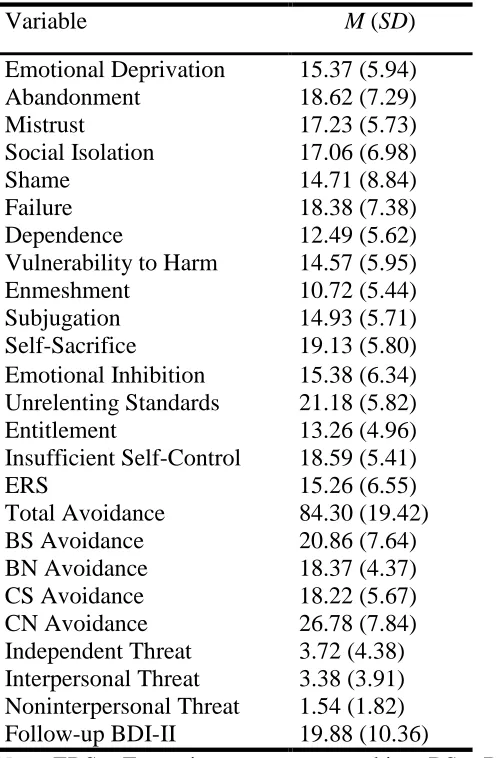
noninterpersonal event threat, respectively. Table 2 presents the descriptive statistics for
all variables of interest. In the time interval between each participant’s Baseline
Assessment and Follow-up, the frequencies and percentages of participants who
experienced at least one independent event and dependent event were 76.2% (n = 115)
and 87.4% (n = 132), respectively. Moreover, 69.5% (n = 105) experienced at least one
Table 1
Demographic and Clinical Characteristics of Completers and Non-completers
Variable
Completed Follow-up (n = 151)
Did not Complete Follow-up (n = 19)
Age M (SD) 19.69 (2.15) 19.63 (2.59)
Ethnicity
Caucasian n (%) Asian n (%)
African Canadian n (%) Hispanic n (%)
First Nations n (%) Other n (%)
Screening 77 (51.0) 53 (35.1) 4 (2.6) 4 (2.6) 1 (0.7) 12 (7.9) 12 (63.2) 5 (26.3) 0 (0) 0 (0) 0 (0) 2 (10.5)
DASS-21 M (SD) Baseline Assessment BDI-II M (SD) BAI M (SD) PSWQ M (SD) DIRI M (SD)
CBAS Total Score M (SD)
12.07 (3.96) 27.36 (8.45) 23.03 (10.93) 65.10 (10.45) 15.26 (6.55) 84.30 (19.42) 12.58 (4.30) 26.26 (9.64) 17.28 (10.82) 62.00 (9.06) 15.05 (6.77) 81.44 (18.36)
Table 2
Descriptive Statistics for EMSs, ERS, Avoidance, Life Events and Depressive Symptoms
Variable M (SD)
Emotional Deprivation 15.37 (5.94)
Abandonment 18.62 (7.29)
Mistrust 17.23 (5.73)
Social Isolation 17.06 (6.98)
Shame 14.71 (8.84)
Failure 18.38 (7.38)
Dependence 12.49 (5.62)
Vulnerability to Harm 14.57 (5.95)
Enmeshment 10.72 (5.44)
Subjugation 14.93 (5.71)
Self-Sacrifice 19.13 (5.80)
Emotional Inhibition 15.38 (6.34)
Unrelenting Standards 21.18 (5.82)
Entitlement 13.26 (4.96)
Insufficient Self-Control 18.59 (5.41)
ERS 15.26 (6.55)
Total Avoidance 84.30 (19.42)
BS Avoidance 20.86 (7.64)
BN Avoidance 18.37 (4.37)
CS Avoidance 18.22 (5.67)
CN Avoidance 26.78 (7.84)
Independent Threat 3.72 (4.38)
Interpersonal Threat 3.38 (3.91)
Noninterpersonal Threat 1.54 (1.82)
Follow-up BDI-II 19.88 (10.36)
Note: ERS = Excessive reassurance seeking; BS = Behavioural-social; BN =
noninterpersonal event.
Univariate analyses were performed to examine the relation of BDI-II scores at
Follow-up to demographic and clinical characteristics of the sample. BDI-II scores were
not significantly associated with ethnicity F(5, 144) = 0.38, p = .87. However, BDI-II
scores at Follow-up were related to age (r = -.20, p = .01), and Baseline scores on the
BDI-II (r = .62, p < .001), BAI (r = .39, p <.001), and PSWQ (r = .27, p = .001).
A series of univariate tests were conducted to examine the relation of event threat
variables with demographic and clinical variables. Independent event threat was not
significantly associated with age (r = .04, p = .67), ethnicity (F(5, 145) = 0.92, p = .47),
or PSWQ (r =.09, p = .30). Unexpectedly, Independent event threat was related to BDI-II
scores at Baseline Assessment (r = .20, p = .01). It was also related to scores on the BAI
(r = .20, p = .02). Dependent Interpersonal event threat was not associated with age (r =
-.09, p = .25), ethnicity (F[5, 145] = 1.11, p = .36), or PSWQ scores (r = .07, p = .41), but
was significantly associated with Baseline BDI-II (r = .22, p = .01) and BAI (r = .18, p =
.04) scores. Noninterpersonal event threat was not associated with age (r = -.003, p =
.97), ethnicity (F[5, 145] = 0.92, p = .47), BAI (r = .06, p = .49), PSWQ (r = -.03, p =
.75), or Baseline BDI-II (r = .04, p = .62).
Associations Among the Study Variables
Pearson correlations between EMSs and depressive symptoms and life event
threat are displayed in Table 3. Baseline and Follow-up BDI-II scores were significantly
and positively related to all EMSs with the exception of Enmeshment and Entitlement
schemas. Independent event threat was significantly and positively correlated with
Table 3
Pearson Correlations between EMSs, and Independent Variables (Depressive Symptoms and Life Events)
EMS Baseline BDI-II Follow-up BDI-II Independent
Threat
Interpersonal Threat
Noninterpersonal Threat
Emotional Deprivation .22** .27** -.001 .08 .14
Abandonment .32*** .22** -.01 .26** .07
Mistrust .38*** .31** .14 .08 .06
Social Isolation .55*** .46*** .16 .02 .01
Shame .55*** .51*** .10 .11 .09
Failure .47*** .39*** .02 .03 .04
Dependence .33*** .22** .01 .05 .07
Vulnerability to Harm .42*** .29*** .20* .16 .04
Enmeshment .12 .03 .13 -.03 .04
Subjugation .42*** .34*** .14 .21** -.06
Self-Sacrifice .34*** .26** .23** .12 .12
Emotional Inhibition .20* .18* .13 .02 .13
Unrelenting Standards .17* .18* .13 .02 .07
Entitlement -.04 -.10 -.16 -.06 .05
Insufficient Self-Control .39*** .28** -.17* .04 -.04
Note: EMS = Early Maladaptive Schema; BDI-II = Beck Depression Inventory-II
*
Insufficient Self-Control. Interpersonal event threat was positively related to
Abandonment and Subjugation schemas. Noninterpersonal event threat did not relate
significantly to any EMSs.
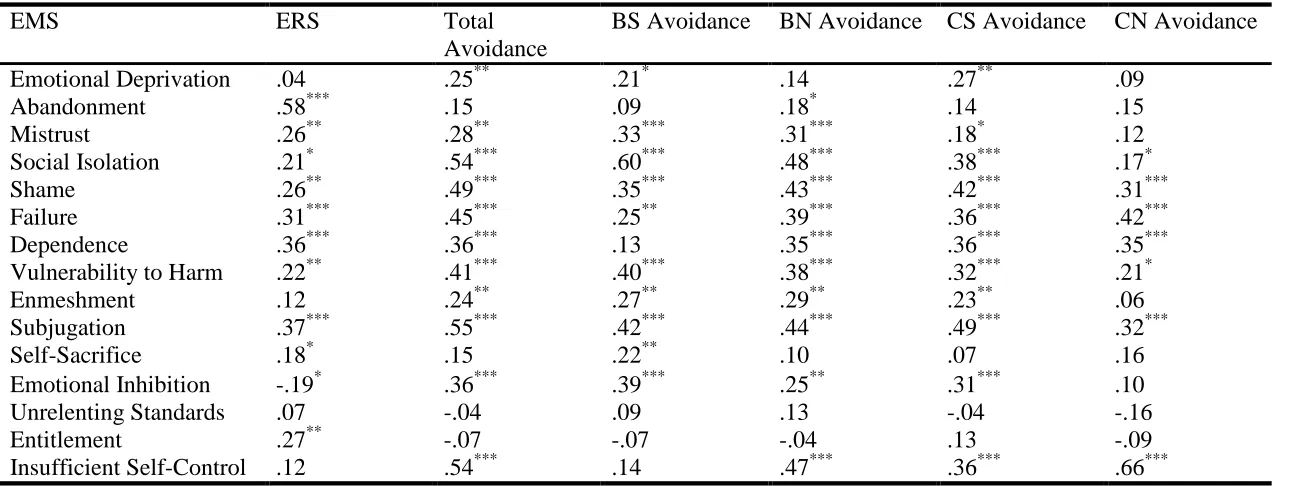
Associations between EMSs and maladaptive behaviours (ERS and avoidance)
are displayed in Table 4. ERS was positively correlated with most EMSs with the
exception of Emotional Deprivation, Enmeshment, Unrelenting Standards, and
Insufficient Self-Control. ERS was negatively correlated with Emotional Inhibition.
Furthermore, total avoidance was significantly and positively correlated with all EMSs
except for Abandonment, Self-Sacrifice, Unrelenting Standards and Entitlement.
Associations between EMSs and subtypes of Avoidance are also displayed in Table 4.
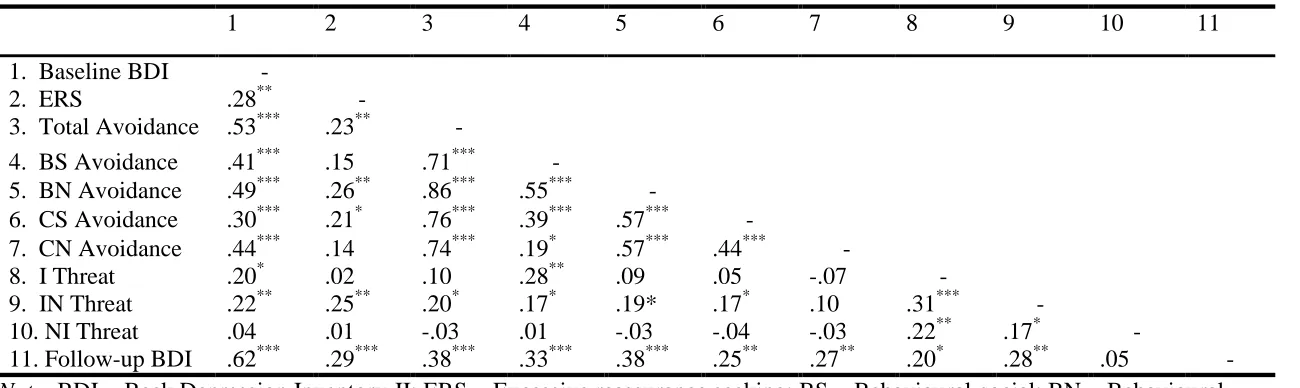
Correlations between depressive symptoms, ERS, avoidance, and life events are shown in
Table 5. Depressive symptoms at Baseline and Follow-up were related to ERS, all
avoidance variables, and all life event variables with the exception of noninterpersonal
event threat. Furthermore, independent event threat was positively related to BS
avoidance. Interpersonal event threat was related to ERS, total avoidance, BS avoidance,
BN avoidance, and CS avoidance. Noninterpersonal event threat was not related to any
maladaptive behaviours.
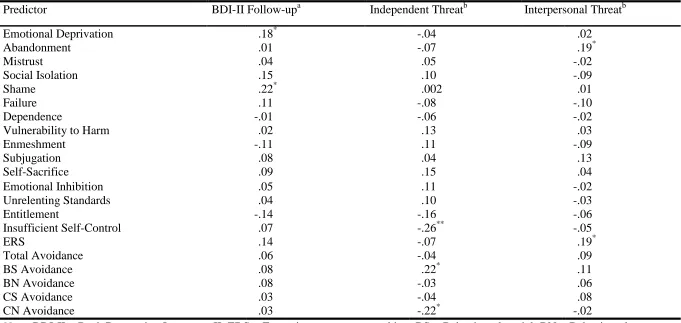
To observe what predicts depression at Follow-up when controlling for
demographic and clinical covariates (i.e., BDI-II at Baseline, BAI, PSWQ and age),
partial correlations for all EMSs and maladaptive behaviours were computed (see Table
6). Similarly, partial correlations were computed to investigate the predictors of
independent and interpersonal event threat controlling for Baseline BDI-II and BAI.