Modeling and Control of a Multi-Component
Continuous Crude Distillation Column Using
LabVIEW
CH. Suresh Kumar 1, Mohammed Wajid Ali 2
Assistant Professor, Dept. of EIE, VNR Vignana Jyothi Institute of Engineering and Technology, Hyderabad,
Telangana, India1
PG Student [E&I], Dept. of EIE, VNR Vignana Jyothi Institute of Engineering and Technology, Hyderabad,
Telangana, India 2
ABSTRACT: The present work is done in graphical based software called LabVIEW to develop and model a distillation column and study a basic crude oil plant in which different products are obtained and controlling of the process is done. By this virtual instrumentation software saves the cost, time and energy that are used in the traditional instrumentation where the total setup is to be done. The method used here for the designing of the number of trays and feed trays in the distillation column is the MC CABE THIELE method in which the mole fraction of liquid and vapour are taken into consideration and the number of trays and feed trays are calculated and the basic vapour - liquid equilibrium differential equations are used for the construction of trays, condenser, boiler vapour, feed tray in the process. This work shows the effective use of virtual instrumentation in the process monitoring and control. A split range type of setup is present in the reflux drum to control the product. In this project we present and crude oil plant setup in which the different products are received at different trays and temperature and controlling is done.
KEYWORDS: Modeling, Distillation Column, Controllers, Simulation, LabVIEW.
I.INTRODUCTION
Separation technology plays an important role in the process industry. Typical separation techniques include distillation, absorption, extraction etc, with distillation being the most frequently used in the chemical process industry. Distillation is the separation of a liquid mixture into its component parts or fractions based on the differences in their volatilities or boiling points. It is widely used in petroleum processing, petrochemical production, natural gas processing, coal tar processing, brewing, liquefied air separation, hydrocarbon solvents production and other industries where product separation of liquid mixtures is required; however its widest application is in the petroleum refineries. In the petroleum refineries the crude oil feedstock is a complex multi-component mixture which has to be separated into groups of compounds within relatively small range of boiling points or fractions.
The crude oil distillation systems, including distillation columns and their heat recovery systems, is the first stage of processing in a petroleum refinery. It is a highly energy intensive process, consuming fuels at an equivalent of 1% to 2% of the crude oil processed. As the price of energy increases, considerable effort has been made to reduce the energy requirement of the crude oil distillation process. At the same time, increasing concerns about the environment resulted in stricter regulations on the emission of green house gases. Consequently, both economic and environmental issues are important factors in the design of crude oil distillation system. Inside crude oil distillation systems, the distillation columns have strong interactions with the associated heat recovery systems. Compared to the conventional design approach of crude oil distillation systems, the heat-integrated design approach is more likely to and a better solution, from which the minimized energy consumption can be obtained. Less energy consumption also means less gas emissions, which is beneficial for the environment.
tower contains a number of trays where hydrocarbon gases and liquids interact. The liquids flow down the tower and the gases up. The fractions that rise highest in the column before condensing are called light fractions, and those that condense on the lowest trays are called heavy fractions.
Fig 1: schematic diagram of crude oil distillation column
II.
MATHEMATICAL MODEL AND ASSUMPTIONSVarious processes are involved in the industries and to make them efficient, controlling of these processes has to be done. Various control strategies are employed for the purpose. The plant, control system, actuator, feedback devices, Sensor, in whole, completes a process control system. Application of the control system to a plant is a two sided sword; the whole system can become unstable or inefficient if the control system is not appropriately designed. Since the components of the control system are very expensive, and design of the control system is a time consuming process, it makes real time testing of the application of the control system practically impossible.
Thus an alternative technique exists in which the equations which govern the plant behaviour is first stated and then transfer equation which relate the plant output and the input is build. The controller is then designed mathematically and then analysed, with various testing tool available such as root locus techniques, Nyquist criterion, Routh Hurwitz method, Bode Plot analysis, for the various performance criterions. One of the most important tasks in the analysis and design of control system is Mathematical Modeling of the systems. The most common methods of the modeling of the linear systems are Transfer Function approach and the State Equation approach.
task of determining not only how to accurately describe a system mathematically, but more importantly, how to make proper assumptions and approximations, whenever necessary, so that the system may be adequately characterized by a linear mathematical model.
Equations of vapour liquid equilibrium:
To model this system some assumptions have been used, such as, the binary system (two components) has constant relative volatility throughout the column and theoretical (100% efficient) trays. A 100% efficient tray is a tray, in which vapour leaving a tray is in equilibrium with the liquid on the tray. So, the simple vapour liquid equilibrium is used,
=
1 + ( −1)
Where,
= Liquid composition on the nth tray (mole fraction more volatile component) = Vapour composition on the nth tray (more fraction more volatile component) = Relative volatility.
Equations of condenser and reflux drum:
= −( + )
Equation of Tray:
( )
= − + −
Equation of Top Tray:
( )
= − + −
Equation of feed Tray:
( )
= − + − +
Equation of condenser:
= −( + )
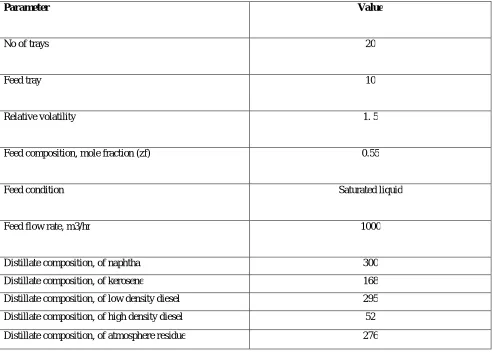
MODEL PARAMETERS USED IN THE CRUDE OIL DISTILLATION MODEL
Parameter Value
No of trays 20
Feed tray 10
Relative volatility 1. 5
Feed composition, mole fraction (zf) 0.55
Feed condition Saturated liquid
Feed flow rate, m3/hr 1000
Distillate composition, of naphtha 300
Distillate composition, of kerosene 168
Distillate composition, of low density diesel 295
Distillate composition, of high density diesel 52
Distillate composition, of atmosphere residue 276
Table 1: model parameters
III. MODELING & CONTROL USING LabVIEW
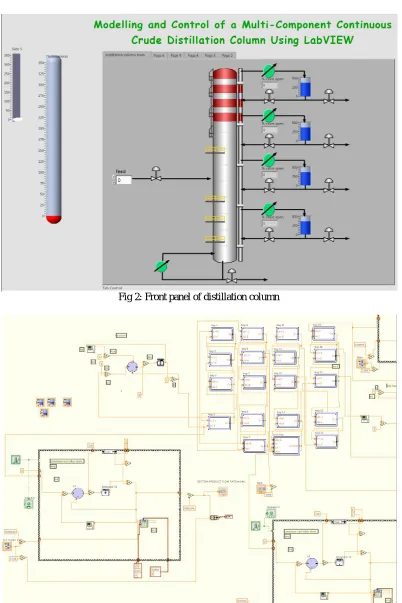
In this dissertation modeling has been done in LabVIEW software. LabVIEW has dedicated software which only deals with the Control Design and Simulations of the different plant models and control system. This part of LabVIEW is very similar to the SIMULINK of the MATLAB by MathWorks Inc. SIMULINK contains different toolboxes which deals with simulations of the different system such as Hydraulic Systems, Electrical Systems etc. LabVIEW also has different toolboxes which include PID Toolbox, Fuzzy control Toolbox, and different toolbox which deals with simulations of the plant such as Linear Systems, Non linear System, Simulation Loop etc. This chapter discusses how the different equations depicting the behaviour of the distillation column, and how the controller for distillation column have been designed in the LabVIEW.
Fig 2: Front panel of distillation column
IV.CONTROL STRATEGIES
A controller generates the control signal based on the control strategy employed and the input variable. The input variable to a controller is the error i.e. difference between the There are various types of process control strategies such as:
Feed back control
Feed forward Controller
Cascade Controller
Adaptive Controller
IMC based Controller
Robust Controller etc.
In all above techniques the Feedback controller is the oldest. The combinations of the above said controllers are also employed to enhance the performance of the overall control system. Like, Feed forward controller, feedback controller, cascade controller are usually employed cumulatively so as to reject disturbance and control the process variable effectively. Feedback controllers have different types, the most frequently used one is,
Proportional Integral Derivative controller
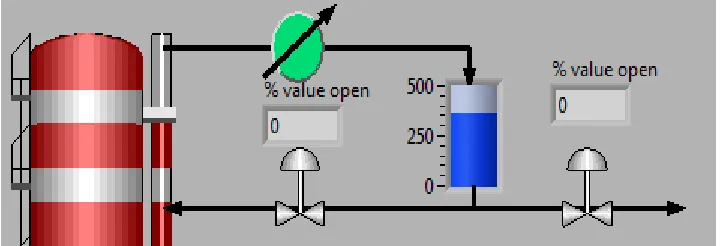
Top product (Distillate) composition and the bottom product composition are the output i.e. Controlled variables of the plant system, and the manipulate variables are the Reflux Rate (L) and the Vapour Boilup Rate (V).Here in the reflux drum side we have two valve opening one for reflux flow and the other for distillate flow these are in a split range controller used in the process where the system acts upon. When we need and higher flow rate in the distillate side the control valve raises at the distillate side and closes at the reflux side.
Fig 4: Split Range Controller Setup
Control variable output Reflux valve(open %) Distillate valve(open %)
4mA 100 0
8mA 75 25
12mA 50 50
16mA 25 75
20mA 0 100
V. RESULT AND DISCUSSION
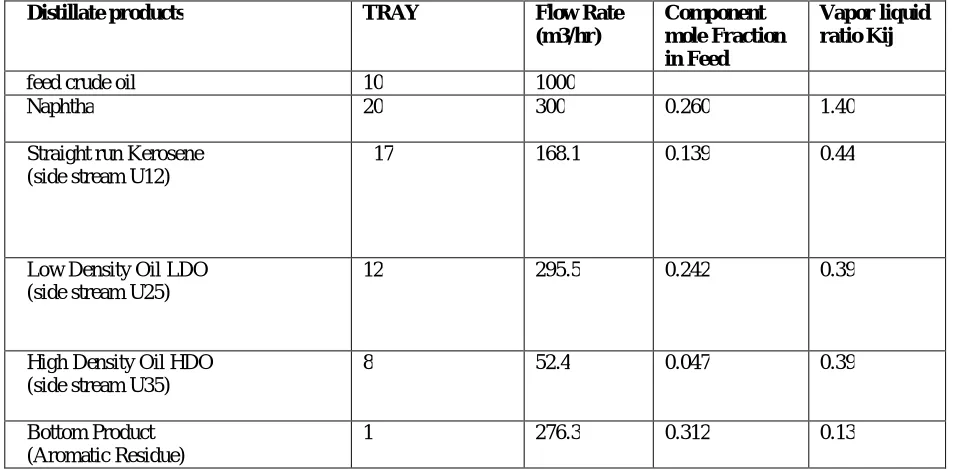
Distillate products TRAY Flow Rate (m3/hr)
Component mole Fraction in Feed
Vapor liquid ratio Kij
feed crude oil 10 1000
Naphtha 20 300 0.260 1.40
Straight run Kerosene (side stream U12)
17 168.1 0.139 0.44
Low Density Oil LDO (side stream U25)
12 295.5 0.242 0.39
High Density Oil HDO (side stream U35)
8 52.4 0.047 0.39
Bottom Product (Aromatic Residue)
1 276.3 0.312 0.13
Table 3: Operating data of the Crude Distillation Unit
VI.CONCLUSION
In this dissertation a mathematical model and a suitable control strategy has been applied. The mathematical model in the present work is based on the molar concentrations of the components in the product streams and according to them a controller has been employed. The present work can be further explored in areas, such as, instead of the molar concentrations, the mass flows can be used to develop a model for the column and hence a controller to make the distillation process energy efficient and effective. More advanced controllers such as robust controller, Fuzzy Controller, and Neural Controller can also be studied for their feasibility to be employed with distillation column dynamics.
REFERENCES
[1] AKPA, Jackson Gunorubon and UMUZE, Omonigho Deprive: Simulation of a Multi-component Crude Distillation Column.
[2] Zalizawati Abdullah, Norashid Aziz, Zainal Ahmad: Nonlinear Modelling Application in Distillation Column
[3] Jiann – Shiou Yang, “Optimization-Based PI/PID Control for a Binary Distillation Column”, American Control Conf., June, 2005, pp. 3650 –
3655.
[4] I. Makaremi and B. Labibi,“Control of Distillation Column – A Decentralized Approach”, Proc. of IEEE Int. Conf. on Control Application,
Oct. 2006, pp. 711 – 714.
[5] I. M. Adel, I. Elamvazuthi and N.H.B.B. Mohd. Hanif, “Monitoring and Controlling System for Binary Distillation Column”, Proc. of IEEE
Student Conf. On Research and Development, Nov. 2009, pp. 453 – 456.