ISSN 2286-4822
www.euacademic.org DRJI Value: 5.9 (B+)
Depth of Vocabulary Knowledge Impact on Reading
Comprehension with reference to Inferencing
Strategy (A case study of
Shaqra
Girls’ College)
NADIA ELZAIN AHMED DAWINA
Shaqra University, KSA
Abstract:
This study sets out to explore the learner’s depth of vocabulary knowledge upon reading comprehension. It also seeks to highlight the learner’s inference strategy in arriving at meaning from the context. The population of the current study is 100 undergraduates from Shaqra Girls’ College. In order to measure the depth of the students’ vocabulary, a text containing 20 unknown words has been distributed to the girls. They were asked to read and infer the meanings of the words from the context. Judging by the results, the deeper knowledge of vocabulary learners have, the more successful they have been in inferring the meanings of the new words. Moreover, brighter students used more varied lexical inferencing strategies than their poor counterparts. The findings provide implications for educators, tutors, syllabus designers and course developers that the depth of vocabulary is such a powerful indicator for the learner’s ability to infer meaning from the context.
Key words: Vocabulary Knowledge Impact, Reading Comprehension
Inferencing Strategy, Shaqra Girls‘ College
1. INTRODUCTION
Person, 1984; Grace and Bower, 1990, Whitney, 1987). Inferencing has been defined as the links that people set up when they try to understand texts (G. Brown& Yule, 1983). Inferencing occurs at all levels of the reading comprehension process, ranging from integrating the text with background knowledge (Kintsch, 1988), to connecting the different parts of the text together (Garrod & Sanford, 1990; Kintsch, 1988, 1998), to linking known to unknown elements in the text in order to arrive at a coherent structure of the information in the text (Garrod & Sanford, 1990; Graesser & Bower, 1990; Graesser & Zwaan, 1995). Such processes are assumed to involve prediction and interpretation of the text for meaning; hence, they are considered important processes by theories in cognitive psychology that conceptualize reading as an active meaning-construction process and a creation of a mental representation of the text (Kitsch, 1988, 1998).
This study takes as its focal point the employment of inferencing strategy to texts in order to make ―informed guessing‖ about the meaning of unknown lexical items drawing heavily on linguistic and non-linguistic cues dispersed across the text (Haastrup, 1991, p. 40). L2 learners have been observed to draw on this particular strategy of lexical inferencing so excessively to unfold the meaning of the text (de Bot, Paribakht, & Wesche, 1997; Frantzen, 2003; Fraser, 1999; Huckin & Bloch, 1993; Morrison, 1996; Paribakht& Wesche, 1999; Parry, 1993). Lexical inferencing has also been found to be closely associated with incidental vocabulary learning that is, when learners set about reading texts without prior intention of acquiring new lexical items (Huckin & Coady, 1999; Nagy, 1997). Thus, Wesche and Paribakht (1999) argue that ―much—if not most—lexical development in both L1 and L2 appears to occur as learners attempt to comprehend new words they hear or read in context‖ (p. 176).
second language acquisition, the nature of this role still needs to be intensively explored. (Paribakht &Wesche, 1999). To this end, and given the important role currently attributed to L2 learners‘ lexical knowledge in L2 reading comprehension (Laufer, 1996, 1997; Nassaji, 2002, 2003a; Nation, 2001; Qian, 2002; Read, 1993, 1997, 2000), the present study as was already stated has examined the particular role learners‘ depth of vocabulary knowledge plays in lexical inferencing.
The question to be posed in this connection is the extent to which the L2 learners‘ depth of vocabulary knowledge determines the type of lexical inferencing they opt for, and how does this extent affect the learners‘ success in deriving word meaning from context?
2. ELEMENTS RESPONSIBLE FOR THE SUCCESS OF LEXICAL INFERENCING
Inference, by definition, is an evidential mental process leading to a conclusion. It is a common practice in all walks of life. It is important for a doctor to diagnose disease as well as for the detectives to examine clues and establish the case. It is even a genuine part of the mechanics to repair engine problems. In our everyday life, we infer motives, purpose and intentions.
Consequently, inference is essential and part of, being human. We become involved in inference processes every day. We interpret actions to be examples of behavior characteristics, intents, or expressions of particular feelings. We infer it is raining when we see someone with an open umbrella. We infer people are thirsty if they ask for a glass of water or that their lips are dry. We infer that evidence in a text is authoritative when it is attributed to a scholar in the field.
beyond specific remarks underlying significance or broader meaning. When we read that someone cheated on his or her income taxes, we might take that as an example of financial ingenuity, daring, or stupidity. We seek purposes and reasons.
Inferences are not happening by chance. While they may come about mysteriously with a sudden jump of recognition, a sense of "Ah ha!" inferences are very orderly. Inferences may be guesses, but they are educated guesses based on supporting evidence.The evidence seems to require that we reach a specific conclusion.
Evidence is said to imply; readers infer. While this image suggests an intent or power on the part of evidence that does not exist—how, after all, can a fact compel a certain conclusion?—the image and resulting terminology are useful nonetheless. The sense of inevitability to the conclusion suggests that we did not jump to that conclusion or make it up on our own, but found it by reasoning from the evidence.
Inferences are not reached by mathematical strictness. Inferences do not have the certainty obtained with deductive reasoning. Inferences have a propensity of reflecting prior knowledge and experience as well as personal beliefs and assumptions. Inferences thus tend to reflect one's stake in a situation or one's interests in the outcome. People may reason differently or bring different assumptions or premises to bear.
3. INFERENCING AND READING
The same situation applies to the written word. A text does not contain a meaning. Upon reading a written text, readers bring lots of things to the text. One of the thing with which they approach the text is their background knowledge. Readers
construct meaning by what they take the words to mean and how they process sentences to find meaning. Readers draw on their knowledge of the language and of conventions of social communication. They also draw on other factors, such as knowledge of the author (―Would Henry say such a thing?), the occasion (―No one knew such things then!‖), or the audience (―He‘d never admit that publicly.‖) They infer unstated meanings based on social conventions, shared knowledge, shared experience, or shared values. They make sense of remarks by recognizing implications and drawing conclusions. Readers read ideas more than words, and infer, rather than find, meaning.
4. BREADTH OF VOCABULARY KNOWLEDGE AND READING COMPREHENSION
In research on vocabulary learning, a distinction has often been made between two dimensions of vocabulary knowledge: depth
of knowledge and size, or breadth of knowledge (Haastrup & Henriksen, 2000; Meara, 1996; Read, 2000). Breadth of vocabulary knowledge has been taken to referto the quantity or number of words learners know at a particular level of language proficiency (Nation, 2001).
proficiency or placement purposes should include the broadest possible range of word families. An estimation of total vocabulary size can be attained in two ways. The first is based on sampling from a dictionary, and the second is based on corpus-derived lists of word families grouped by frequency. The dictionary sampling method involves selecting a dictionary that contains the number of word families that learners are expected to know, then testing a selection of those words. The problem with this method is that higher frequency words tend to have longer entries, and are thus more likely to end up on the test, which may skew the results.
The second method to estimate vocabulary size is to select word families according to their frequency in a corpus. Usually, these word families are grouped together into the first 1,000 most frequent words, the second 1,000 most frequent words, and so on. This kind of test has generally been used only with people with low English vocabularies, namely non-native speakers of English (Nation, 1990).
There are at present two widely used vocabulary size tests available, the Eurocentres Vocabulary Size Test 10KA (EVST; Meara and Jones, 1990), the Vocabulary Levels Test (VLT; Nation, 1983, 1990). They are well documented in the literature. More specifically, there is research evidence available concerning their validity as assessment procedures for their intended purpose. They also represent innovations in vocabulary assessment and serve to highlight interesting issues in the test design.
correlation ranges widely. In Yang and Deng‘s (1996) research, the correlation was very high (r=0.89 P<0.01). In Li‘s (2003) research, it was moderate(r=0.69 P<0.01). But Lu (2004) found a low correlation between the two factors(r=0.321 p<0.01)
5. DEPTH OF VOCABULARY KNOWLEDGE AND READING COMPREHENSION
Qian (1999, 2002, 2004) used the depth-of-vocabulary-knowledge (DVK) measure in his investigation of the relationship between L2 vocabulary knowledge and reading comprehension ability. DVK measure was intended to contribute to inferences about the test-taker‘s depth of receptive English vocabulary knowledge by measuring three vocabulary elements: synonymy, polysemy, and collocation. He showed that this DVK measure accounted for a significant amount of the variance in the reading scores beyond what was predicted by a vocabulary breadth test. However, he suggested caution should be exercised in generalizing the findings from the study because the concept of depth of vocabulary knowledge was only partially operationalized. However, In China LI (2003) showed in his study that the correlation between the depth of vocabulary (the preciseness of the word definition; the ability to choose the meaning of words according to the context; the syntactic characteristic of the vocabulary) and reading comprehension was lower than that of the breath of vocabulary and reading comprehension. He also made a tentative conclusion that polysemy might contribute little to reading comprehension.
6. TESTING AND ANALYZING LEXICAL INFERENCING STRATEGIES:
learners of English. The passage contained 374 words, with 10 target words highlighted (see Appendix). The passage had been designed to elicit the use of a variety of inferencing strategies and processes, ranging from those involved in the use of nonlinguistic global comprehension processes to those involved in the use and integration of word-level cues such as prefixes and affixes (Haastrup, 1991). Before being used in the present study, the passage was pilot-tested with a group of ESL students assumed to have similar language proficiency to the participants in the main study. The pilot study revealed that the students had a good overall comprehension of the text (mean of comprehension: 7.6/10). It also showed that the percentage of unknown words in the passage ranged from 4.27% to 2.67%, derived by dividing the total number of the words reported as unknown by the total number of words in the passage and multiplying the results by 100.
7. TYPES OF STRATEGIES USED
1. Identifying
(a) Repeating: The learner repeats any portion of the text, including the word, the phrase, or the sentence in which the word has occurred. Example: ―‗our beliefs assessment . . . . . .‘ May be . . . waver is Something ‗beliefs assess . . .‘‖
(b) Word Analysis: The learner attempts to figure out the meaning of the word by analyzing it into various components, such as roots, affixes and suffixes. Example: ―‗and smell of
evaluation is ev-and value.‘ Something has value or attach value to .‖
(c) Word–Form Analogy: The learner attempts to figure out the meaning of the word based on its sound or form similarity with other words. Example: ―‗unpleasantness . . .‘ maybe it is not good .
2. Evaluating
(a) Verifying: The learner examines the appropriateness of the inferred meaning by checking it against the wider context. Example: ―‗but when we ourselves become ill, our beliefs waver . . .‘ our belief of change . . . changes . . . when we become ill our beliefs change . . . yeah.‖
(b) Self-Inquiry: The learner asks himself or herself questions about the word or the meaning he or she has already inferred. Example: ―‗hazards . . .‘ should it be pollution according to the sentence? Pollutions? No, no . . . it should not be that . . . it may be something different.‖
3. Monitoring
(a) Monitoring: The learner shows a conscious awareness of the problem by judging its ease or difficulty.
staff . . . contract . . . yes . . . this is easy . . . this easy . . . maybe it‘s difficult, I am not sure.‖
8. PARTICIPANTS
The number of participants who attended the experiment has been a hundred students. They were divided into five groups to facilitate their control assistance. They are asked to say aloud how they guess the meaning of specific words which written in bold type.
Table 1 Type of Strategy use Correct versus Wrong use Type of Strategies Frequency of
Strategy Use
Percent of Strategy Use
Mean of success
Identifying
Word 90 48.1%
Repeating 97 51.9%
Section 67 59.3%
Word Analysis 7 26.9%
Word form 19 73.1%
Analogy 10 25%
Evaluating 30 75%
Self-inquiry 24 70.6%
Verifying 27 29.4%
Monitoring 16 73%
Table 2 Correct and incorrect versions
1. Spelling mistakes
2. Run-on sentences
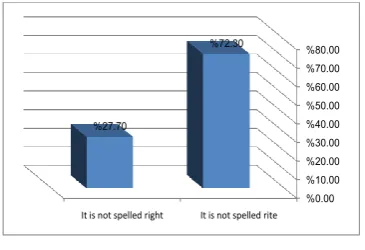
It is not spelled rite It is not spelled right
My dog barks at the beggar but she is too lazy to chase
him My dog barks at the
beggar, but she is too lazy to chase him