Cloud Data Protection for Masses
Mr.
Ch.V.V.Narasimha Raju
1& D Nanda Kishore
21
Associate Professor, Dept of CSE, Marri Laxman Reddy Institute Of Technology & Management, Hyderabad, Telangana
2
M.Tech CSE (PG Scholar), Dept of CSE, Marri Laxman Reddy Institute Of Technology & Management, Hyderabad, Telangana
ABSTRACT
Offering strong data protection to cloud users while enabling rich applications is a challenging task. We explore a new cloud platform architecture called Data Protection as a Service, which dramatically reduces the per-application development effort required to offer data protection, while still allowing rapid development and maintenance.
Cloud computing promises lower costs, rapid scaling, easier maintenance, and service availability anywhere, anytime, a key challenge is how to ensure and build confidence that the cloud can handle user data securely. A recent Microsoft survey found that “58 percent of the public and 86 percent of business leaders are excited about the possibilities of cloud computing. But more than 90 percent of them are worried about security, availability, and privacy of their data as it rests in the cloud.” We propose a new cloud computing paradigm, data protection as a service (DPaaS) is a suite of security primitives offered by a cloud platform, which enforces data security and privacy and offers evidence of privacy to data owners, even in the presence of potentially compromised or malicious applications. Such as secure data using encryption, logging, key management.
Keyword: data protection to cloud; data protection as a service; data security and privacy
1.1 INTRODUCTION
Cloud computing promises lower costs, rapid scaling, easier maintenance, and services that are available anywhere, anytime. A key challenge in moving to the cloud is to ensure and build confidence that user data is handled securely in the cloud. A recent Microsoft survey [10] found that ―...58% of the public and 86% of business leaders are excited about the possibilities of cloud computing. But, more than 90% of them are worried about security, availability, and privacy of their data as it rests in the cloud.‖ There is tension between user data protection and rich computation in the cloud. Users want to maintain control of their data, but also want to benefit from rich services provided by application developers using that data. At present, there is little platform-level support and standardization for verifiable data protection in the cloud. On the other hand, user data protection while enabling rich
computation is challenging. It requires specialized expertise and a lot of resources to build, which may not be readily available to most application developers. We argue that it is highly valuable to build in data protection solutions at the platform layer: The platform can be a great place to achieve economy of scale for security, by amortizing the cost of maintaining expertise and building sophisticated security solutions across different applications and their developers.
Target Applications
and business applications such as word processors and spreadsheets. More precisely, we focus on deployments which meet thefollowing criteria: • applications that provide services to a large number of distinct end users, as opposed to bulk data processing or workflow management for a single entity;
• Applications whose data model consists mostly of sharable data units, where all data objects have ACLs consisting of one or more end users (or may be designated as public);
• And developers who write applications to run on a separate computing platform—which Encompasses the physical infrastructure, job scheduling, user authentication, and the base Software environment—rather than implementing the platform themselves
Data Protection and Usability Properties
A primary challenge in designing a platform-layer solution useful to many applications is allowing rapid development and maintenance. Overly rigid security will be as detrimental to cloud services’ value as inadequate security. Developers do not want their security problems solved by losing their users! To ensure a practical solution, we consider goals relating to data protection as well as ease of development and maintenance.
Integrity: The user’s private (including shared)
data is stored faithfully, and will not be corrupted.
Privacy: The user’s private data will not be
leaked to any unauthorized person.
Access transparency: It should be possible to obtain a log of accesses to data indicating who or what performed each access.
Ease of verification: It should be possible to offer some level of transparency to the users, such that they can to some extent verify what platform or application code is running. Users may also wish to verify that their privacy policies have been strictly enforced by the cloud.
Rich computation: The platform allows most computations on sensitive user data, and can run those computations efficiently.
Development and maintenance support: Any developer faces a long list of challenges: bugs to
find and fix, frequent software upgrades, continuous change of usage patterns, and users’ demand for high performance. Any credible data protection approach must grapple with these issues, which are often overlooked in the literature on the topic.
1.2 EXISTING SYSTEM
Cloud computing promises lower costs, rapid
scaling, easier maintenance, and service
availability anywhere, anytime, a key challenge is how to ensure and build confidence that the cloud can handle user data securely. A recent Microsoft survey found that ―58 percent of the public and 86 percent of business leaders are excited about the possibilities of cloud computing. But more than 90 percent of them are worried about security, availability, and privacy of their data as it rests in the cloud.‖
This tension makes sense: users want to maintain control of their data, but they also want to benefit from the rich services that application developers can provide using that data. So far, the cloud
offers little platform-level support or
standardization for user data protection beyond data encryption at rest, most likely because doing so is nontrivial. Protecting user data while
enabling rich computation requires both
specialized expertise and resources that might not
be readily available to most application
developers.
1.3 PROPOSED SYSTEM
Building in data-protection solutions at the platform layer is an attractive option: the platform can achieve economies of scale by amortizing expertise costs and distributing sophisticated security solutions across different applications and their developers. We propose a new cloud computing paradigm, data protection as a service
2.1 LITERATURE REVIEW
Literature survey is the most important step in software development process. Before developing the tool it is necessary to determine the time factor, economy and company strength. Once these things are satisfied, ten next steps are to determine which operating system and language can be used for developing the tool. Once the programmers start building the tool the programmers need lot of external support. This support can be obtained from senior programmers, from book or from websites. Before building the system the above consideration are taken into account for developing the proposed system. Cloud computing is the provision of dynamically scalable and often virtualized resources as a services over the internet Users need not have knowledge of, expertise in, or control over the technology infrastructure in the "cloud" that supports them. Cloud computing represents a major change in how we store information and run applications. Instead of hosting apps and data on an individual desktop computer, everything is hosted in the "cloud"—an assemblage of computers and servers accessed via the Internet.3.1 MODULES
MODULE DESCRIPTION:
1. Cloud Computing
2. Trusted Platform Module
3. Third Party Auditor
4. User Module
3.1.1 Cloud Computing
Cloud computing is the provision of dynamically scalable and often virtualized resources as a services over the internet Users need not have knowledge of, expertise in, or control over the technology infrastructure in the "cloud" that supports them. Cloud computing represents a major change in how we store information and run applications. Instead of hosting apps and data on an individual desktop computer, everything is hosted in the "cloud"—an assemblage of computers and servers accessed via the Internet.
Cloud computing exhibits the following key characteristics:
1. Agility improves with users' ability to re-provision technological infrastructure resources.
2. Multi tenancy enables sharing of resources and costs across a large pool of users thus allowing for:
3. Utilization and efficiency improvements for systems that are often only 10–20% utilized.
4. Reliability is improved if multiple redundant sites are used, which makes well designed cloud computing suitable for business continuity and disaster recovery.
5. Performance is monitored and consistent and loosely coupled architectures are constructed using web services as the system interface.
6. Security could improve due to centralization of data, increased security-focused resources, etc., but concerns can persist about loss of control over certain sensitive data, and the lack of security for stored kernels. Security is often as good as or better than other traditional systems, in part because providers are able to devote resources to solving security issues that many customers cannot afford. However, the complexity of security is greatly increased when data is distributed over a wider area or greater number of devices and in multi-tenant systems that are being shared by unrelated users. In addition, user access to security audit logs may be difficult or impossible. Private cloud installations are in part motivated by users' desire to retain control over the infrastructure and avoid losing control of information security.
7. Maintenance of cloud computing applications is easier, because they do not need to be installed on each user's computer and can be accessed from different places.
3.1.2 Trusted Platform Module
that specification, often called the "TPM chip" or "TPM Security Device". The TPM specification is the work of the Trusted Computing Group.
Disk encryption is a technology which protects information by converting it into unreadable code that cannot be deciphered easily by unauthorized people. Disk encryption uses disk encryption software or hardware to encrypt every bit of data that goes on a disk or disk volume. Disk encryption prevents unauthorized access to data storage. The term "full disk encryption" (or whole disk encryption) is often used to signify that everything on a disk is encrypted, including the programs that can encrypt bootable operating system partitions. But they must still leave the master boot record (MBR), and thus part of the disk, unencrypted. There are, however, hardware-based full disk encryption systems that can truly encrypt the entire boot disk, including the MBR.
3.1.3 Third Party Auditor
In this module, Auditor views the all user data and verifying data and also changed data.
Auditor directly views all user data without key. Admin provided the permission to Auditor.
After auditing data, store to the cloud.
3.1.4 User Module
User store large amount of data to clouds and access data using secure key. Secure key provided admin after encrypting data. Encrypt the data using TPM. User store data after auditor, view and verifying data and also changed data. User again views data at that time admin provided the message to user only changes data.
4.1 UML DIAGRAMS
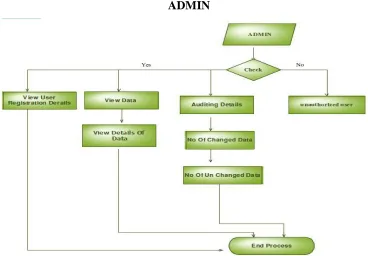
Data Flow Diagram / Use Case Diagram / Flow Diagram
The DFD is also called as bubble chart. It is a simple graphical formalism that can be used to represent a system in terms of the input data to the system, various processing carried out on these data, and the output data is generated by the system.
ADMIN
User
Figure 4.2: User flow diagram
5.1 CONCLUSION
As private data moves online, the need to secure it properly becomes increasingly urgent.
The good news is that the same forces concentrating data in enormous datacenters will also aid in using collective security expertise more effectively. Adding protections to a single cloud platform can immediately benefit hundreds of thousands of applications and, by extension, hundreds of millions of users. While we have focused here on a particular, albeit popular and privacy-sensitive, classes of applications, many other applications also need solutions.
6.1 REFERNCES AND BIBLIOGRAHY
Good Teachers are worth more than thousand books, we have them in Our Department
REFERENCES
[1] http://www.mydatacontrol.com.
[2] The need for speed.
http://www.technologyreview.com/files/54902/G
oogleSpeed charts.pdf.
[3] C. Dwork. The differential privacy frontier. In TCC, 2009.
[4] C. Gentry. Fully Homomorphic Encryption Using Ideal Lattices. In STOC, pages 169–178, 2009.
[5] A. Greenberg. IBM’s Blindfolded Calculator. Forbes, June 2009. Appeared in the July 13, 2009 issue of Forbes magazine.
[6] P. Maniatis, D. Akhawe, K. Fall, E. Shi, S. McCamant, and D. Song. Do You Know
Where Your Data Are? Secure Data Capsules for Deployable Data Protection. In HotOS,
2011.
[7] S. McCamant and M. D. Ernst. Quantitative information flow as network flow capacity. In PLDI, pages 193–205, 2008.
[8] M. S. Miller. Towards a Unified Approach to Access Control and Concurrency Control. PhD thesis, Johns Hopkins University, Baltimore, Maryland, USA, May 2006.
[9] A. Sabelfeld and A. C. Myers. Language-Based Information-Flow Security. IEEE Journal on Selected Areas in Communications, 21(1):5– 19, 2003.
[10] L. Whitney. Microsoft Urges Laws to Boost Trust in the Cloud. http://news.cnet.com/ 8301-1009 3-10437844-83.html.
Sites Referred:
http://java.sun.com
http://www.sourcefordgde.com http://www.networkcomputing.com/ http://www.roseindia.com/