ISSN 2286-4822
www.euacademic.org DRJI Value: 5.9 (B+)
Teaching Practice Challenges in Virtual Learning
Environments and Their Motivational Aspects
ELIZANGELA TONELLI Cognition and Language Master, UENF Professor at Espírito Santo Federal Institute – IFES
BRUNA MORAES MARQUES Cognition and Language Master, UENF CARLOS HENRIQUE DE SOUZA MEDEIROS
Communication PhD, UFRJ Professor at North Fluminense State University, UENF
FABRÍCIO MORAES DE ALMEIDA1 PhD in Physics (UFC) Post-doctorate in Scientific Development Regional (DCR/CNPq) Researcher of the Doctoral Program and a Master’s Degree in Regional Development and Environment (PGDRA - UNIR) Leader of line 2 - Technology Development and Systemic - the
Research Group GEITEC-Federal University of Rondonia Brazil
Abstract:
In Distance Learning, the communication process is basically done by writing in Virtual Learning Environments (VLE´s) through synchronous and asynchronous technological tools. These tools are the links between the teacher and student when anchored by motivational and affective actions become one of the base supporting the success of Distance Learning courses. This study aim´s to identify some aspects of written communication within the forums that compromise affectivity and student motivation given that these factors are considered essential for learning. Based on theories and analyzes of dialogues occurred in questions of forums. The result appointed that the teacher who acts as distance Learning tutor should not focus only on conceptual and reflexive contents , but also the emotional and that
essentially the what matters is that the educational activities , as well as communication , are permeated by the feeling of welcome , respect , sympathy and appreciation, in addition to acceptance and understanding.
Key words: Distance Learning; Written Communication; Teaching practice; Affectivity
1. Introduction
Information Technologies are seen today in environments that offer various relationships and human coexistence forms. The computer use as a tool of access, execution and storage area expert systems, the use of computer networks and in most cases the Internet - the network of networks – make almost limitless activities directed to education, helping to disseminate and validate teaching techniques and knowledge itself.
It is a fact that, to provide theoretical basis for knowledge acquisition is not enough for success. It is needed to motivate and engage students in the process. It is in this context that highlights distance learning communication importance, which is basically made in writing way, through virtual classrooms. Registering a motivational and affective language through writing has been one of the biggest challenges of this education kind.
According to BOCK (1999) "Motivation is a process that occurs within the subject" being, however, closely linked to exchange relations that it establishes with the environment, especially his/her teachers and peers, through communication. These factors become necessary and essential conditions for change and learning.
guiding objective was to identify some written communication aspects within the forums that compromise student`s affectivity and motivation given that these factors are considered essential for learning.
The methodology used initially was the collected bibliography related to communication and language elements and their occurrence within Virtual Learning Environments by their interlocutors. Having the researched theory, it was made an affective aspects analysis of distant tutor and student discourses, based on an interdisciplinary line involving psychoanalysis, pedagogy and linguistics.
The analyzed clippings were extracted from a Mathematics I discipline questions forum, offered in the 1st semester of Informatics Bachelor, at distance, of Espírito Santo Federal Institute (IFES).
Considering the continuous interaction importance between distant tutors and students in distance education, this study`s relevance is to highlight Distance Learning challenges in knowledge construction and critical thinking of the student focused on dialog and affective interaction present in distant tutor written communication, through the available tools in the VLE`s.
From the analyzed aspects in messages posted by students and teacher, it was observed that written communication has limitations and for this reason it is necessary a bigger care, clarity and affection in words articulating and recording, taking into account different interpretation ways by the receiver.
2. Communication and Language
knowledge accumulation, since human memory is not able to bear all the knowledge received.
The Verbal communication is any kind of information
spread or exchange through written or spoken language. It is also understood as stimuli and responses transmission, caused by a complete or partly shared system. When a message is sent, it is necessary that the emitter has the sensitivity to raise the receiver attention and predict its effect.
The so-called emotive or "expressive" function, emitter centered, aims a direct expression of the speaker attitude towards what s/he is talking about. It tends to give the impression of a certain emotion, real or simulated (JAKOBSON, 2007, p.123)
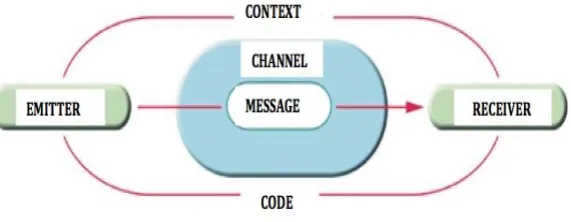
Jakobson (2007) notes that for communication occurrence it is necessary that all elements of this process are agreed, as shown in Figure 1:
Figure 1 – Jakobson (2007). Communication Scheme.
According to Jakobson (2007) scheme, communication must occur in a set of elements consisting of: an emitter (or sender), which produces and emits a particular message, addressed to a
situational referents), must use a same code (signs structured set) and establish an effective contact through a communication channel. If any of these elements or factors fails, a noise situation on communication occurs, understood as any phenomenon that somehow disrupts message transmission and its perfect reception or decoding by the receiver.
2.1 Communication in Virtual Learning Environments
In Distance Education, the communication process occurs primarily by writing on virtual learning environments (VLEs`) through synchronous technology tools (chats, web conferences) and asynchronous (email, forums). These tools are the links between trainer and trainee that anchored by motivational and affective actions become one of the supporting pillars to distance education courses success.
According Fiuza (2002), the VLE's can be defined as systems that support any activity kind performed by the student, that is, a tools set used during the teaching and learning process. These systems allow integrating multiple media, languages and resources, present information in an organized way and developing interactions between people and knowledge objects.
Vavassori and Raabe (2003) complement that a Virtual Learning Environment is a system that brings together a number of resources and tools, enabling and empowering its use in learning activities through the Internet, in a distance learning course.
Behar et al. (2005) consider the Virtual Learning Environment (VLE) as consisted of a technological infrastructure (graphic interface, synchronous/ asynchronous communication and other features) and all relations (affective, cognitive, symbolic, etc.) established by participating subjects, with the primary focus on learning.
education. But it is not enough to have a communication modern infrastructure and diverse teaching methodologies. It is vitally important to idealize how these methodologies will 'dialog' to the Virtual Learning Environment, therefore with the student. The success of these constructions will basically depend on these relations` quality through the used language.
Each individual has a particular and personal way to learn. Some are extroverted, more open to a relaxed and informal discourse, others are introverted. Some act by emotion, others by reason. It has also to be considered according to Pallof and Pratt (2004), that the student who chooses distance education has certain characteristics. The audience is more mature and independent. The temperament styles, perception and cognition are also particular: some learn better individually, others like to interact with others and have concrete experiences.
It is observed nowadays that Virtual Learning Environments have implied characteristics that, notably, give importance to the student`s welfare, staying the same, emotionally receptive to information that will be provided for his/her learning, in addition to these environments, possibilities of, through interactivity, gradually increase the chance of success during learning.
Wallon (1968) says that the school should not be limited to instructional content, but with the student as a whole person, in his/her affective, cognitive and motor dimensions. Therefore, social Exchange influences on affectivity, interactivity and therefore on learning.
2.2 Teacher/tutor role and affectivity in virtual learning environments
In an educational structure based on a virtual platform, the distance tutor is responsible for maintaining the interaction with the student and her/his interest, using appropriate techniques for learning development. The system is responsible for helping the student to produce something with the acquired knowledge.
The distance tutor main function is to "mediate" the knowledge acquisition because of her/his technical and scientific content mastery on a particular disciplinary content and her/his ability to stimulate the response search by the participant.
Grounded through these discussions we must consider the distant tutor role is constituted on one of the main learning pillars in distance education, if her/his duties are anchored on
autonomy, communication and mediation principles.
Pretti (2007) says that autonomy cannot be regarded as a ready human quality. Autonomy is the ability of an individual take to her/himself, her/his own formation, becoming the author of her/his own life project. S/he builds her/his own knowledge. The tutor's role is to drive the distance student`s studies through synchronous and asynchronous digital tools and to be agile in feedbacks, so that the student does not feel alone and abandoned.
Freire (2002) complements this idea by saying that this autonomy is built between learner and educator as decisions are being taken through a dialogic relationship.
Communication and dialogue imply that people are open to new ideas, new ways of seeing the same point, allowing new formats in their thought structures.
guidance, participation, affection and encouragement to interaction. The dialogicity has a fundamental role in the teaching-learning process. It can be said that it is the knowledge acquisition genesis. Therefore, when the student develops affection and consideration for their classmates and teachers, more stable interpersonal relationships are formed, which favors cognitive expansion and the need to socialize acquired knowledge. Now we are not talking about the individual but, collectively, increased collective intelligence, that is, 'all for all'. (Levy, 1998)
In this teaching practice, the old teacher profile as "knowledge keeper", makes place to mediator teacher figure, the " knowledge facilitator". One who creates a compelling situation that will cause the student understand that there are no ready answers and that knowledge is formed from a search that will trigger on another search, and so on.
levels and real developmental level), a development level where one can solve the problems alone, by her/himself (real development level), and the ones that will only be able to solve with someone`s help who can give support content, until s/he gets to master them by her/himself (potential development level).
3 Methods and Analysis
According to the study objectives, since this is an exploratory and descriptive subject, the methodology used was the analysis of written communication from the dialogue between a distant Mathematics tutor (Distant Tutor A) and two 1st period student (Student A and Student B), both of Computer Science Bachelor's Course, offered in distance mode, by Espírito Santo Federal Institute (IFES). The analyzed clippings were taken from one of the questions forum of Mathematics I discipline, on the content "quadratic function" from the period between May 24 and June 5, 2010. Participants' names have been omitted so that their identities were preserved.
Hi teacher, my response was both positive and negative infinite numbers. I suggest that the resolution be provided since the book is riddled with errors. A hug. (Student A, Monday, May 24, 2010, 15:25).
Hi, I cannot provide the resolution, but here goes some tips that will help: (...) a hug. (Ans: Distant Tutor A, Tuesday, May 25, 2010, 10:31).
I did exactly that, but the answer did not match. I do not understand this attitude of you of not giving the solution. Some colleague reached the correct answer and can help me (Ans:Student A, Tuesday, May 25, 2010, 11:04).
All that you stated I already know. I have no problem with signs study. My problem is at the intersection. I have not studied it in high school and there are no good examples in the material, moreover the material is all wrong and created more confusion with those open and closed balls. I will try to solve the question from the answer "backwards (Ans: Student A, Thursday, May 27, 2010, 9:27).
Hello students, follows a review of question 7 of the abstract on the quadratic function, it was made from a student`s resolution ... A hug to everyone! (Ans: Distant Tutor A, Thursday, May 27, 2010, 11:22).
When talking about teaching and learning, whether in the classroom or distance mode, one must consider that we will always have a students` diverse group, whether in the classroom or in Virtual Learning Environments. In relation to communication and language, it is necessary to consider each action that the emitter transmits, that is, the message will culminate into an effect and a reaction in the receiver (Jakobson, 2007).
In the clippings we saw above, one can observe the student`s anxiety when confronted with the unknown. At the conversation beginning the student already asks the teacher to send him the resolution, justifying that the material contains errors. According to some investigations made in the academic context by some Cognitive Psychology theorists, based on information processing, anxiety is one of the causes that denote internal dissatisfaction and therefore demotivation (Miller, 1980; Wigfield & Eccles, 1989).
In the shown dialog it can be seen that the teacher develops her/his role as "instigator", but the student due to anxiety becomes impatient with the teacher`s attitude (or even nervousness) that leads her/him to criticize her/his attitude and even the used material.
The concern aspects are also denoted as negative expectations about her/himself, when s/he says that "s/he had not studied some content in the basic series, needed for resolution." Hence it can be seen the use of a subterfuge to her/his difficulties on the problem. The Distant Tutor A (emitter) posture to Student A`s questions is of attention, however, some "lines" on the receiver`s (student A) anxiety, denoted as a contempt or disrepute to her/his ability, "... cannot provide resolution."
We know that writing is subjective, even if the emitter writes on an affective way, the receptivity forecast is no understanding guarantee. Certainly, many factors will affect the "subtext" of the sent message, as the affective ties that have been developed between the pairs, the emotional state that is the receiver and others. Let`s consider other clippings:
Hello, couldn`t you start with an easier? This ways it discourages. First because I cannot handle with... and second because I don`t know how to put 63000/64000 as potential form with base 2. Any tips? (Student B, Friday, June 4, 2010, 14:45)
Dear student, I suggest that you review Elementary Education topics. You have doubt in passing from one side to the other of equality. The beginning of Resolution 1 and the next ... See you soon. (Ans: Distant Tutor, Friday, June 4, 17:15)
Unfortunately your diagnostic is wrong. (laughs). I have no difficulty in passing from one side to another of equality, except for a possible distraction. [...]
this kind of "suggestion" because the forums are public places and the written word can create major misunderstandings. (Ans: Student B, Friday, June 4, 2010, 17:53)
Dear student, are you okay? Glad to know that you did not consider my answer as an offense. When you wrote on the forum I inferred that you were having doubt to move on to another side of equality, 64000/63000 and not the opposite, as it should be. Unfortunately there is a limitation in Distance Education resource (forum), since it cannot convey emotion, voice tone, etc.. Because I said with the best intentions, without wanting to offend anyone. Unfortunately, you do not know me personally, but for the work we have done in the past six months and we are developing this semester, you were able to wisely understand that it was not an offense. I hope that other colleagues will understand so well. Let`s go forward because we still have much work. Hugs. (Ans: Distant Tutor, Friday, June 5th, 23:15)
Hello regarding the exercise, I actually changed the order. In your place I would have reached the same conclusion. I totally agree with you about the forums in emotions transmission. Sometimes I get worried if my criticisms are seen as too "tough" and even taken personally because of written language coldness. Be sure that each of them has the target only the material and it is never personal, always with improvement goal. Please convey this to the course staff. Despite not knowing you personally, I have already got your competence when you taught in the troubled discipline of Mathematical Logic and also here, because the doubts are being clarified. A hug, and as you say, let's move on! (Ans: Student B, Saturday, June 5, 2010, 10:35)
All right, your message will be transmitted to the staff. Also see exercise 5 suggestions of exponential function summary in the doubts forum of the fourth week. A hug. (Ans: Distant Tutor, Saturday, June 5, 2010, 10:47)
her/himself unmotivated to solve the exercise, explaining that this is very difficult.
Through a writing error of student B, the teacher infers that s/he was having difficulties in one of the basic contents (move to the other side of the equality) and suggests that s/he also seek guidance on other resources, in this case, elementary school mathematics. Even if the teacher has used endearment words like "dear student", it is noticeable that the teacher`s speech was perceived as an insult or as a discredit to her/his reasoning ability, it is very clear when he adds "PS" at the end of message.
Returning to Jakobson`s (2007) observation, to communication take place effectively it is necessary that for the message to be "decoded" by the receiver. Even with the entire teacher`s "good intentions" to the student, there was a misunderstanding, that Jakobson calls "noise,” thus compromising the message`s intent and its perfect reception. When writing, the correct would be to assume the message receiver’s role, that is, to put ourselves in the place of those who will read.
Fortunately, student and teacher reached a consensus: the writing has its limitations regarding emotion and affection, as denoting student B`s speech, “I totally agree with you about the forums in emotions transmission. Sometimes I get worried if my criticisms are seen as too "tough" and even taken personally because of written language coldness(...)”.
As pointed out in this study`s theoretical framework, the tutor should not only focus on conceptual and reflexive interventions, but also on affective. In distance education or any other interaction kind that occurs through verbal written language it is necessary to think about "what to write" and how to "write".
Essentially, what matters is that the educational activities, as well as communication, are permeated by the welcome feeling, respect, empathy and appreciation, in addition to acceptance and understanding. These feelings do not only mark the student`s relationship with what is being learned, as well as her/his self-image, which favors autonomy and strengthens confidence in her/his abilities and decisions, it is what reports Tassoni (2000) when referring to affectivity and learning.
4. Final Considerations
Evidently, the Information and Communication Technologies brought a great improvement to humanity in various fields. Not more than other areas, Education has also improved within these templates.
With Distance Education emergence, the classroom became virtual learning environments and the physical space and the books stopped being one of the main authors in the educational process.
This fact has made that the model teacher "knowledge keeper" give place to the interactionist model, the facilitator and mediator. Teaching models have also accompanied technological advances and the computerization era, remodulating the banking school in digital school.
language. In this new educational scenario also arises a new teacher profile: the distant tutor.
Considering writing as the interactive channel between the teacher (tutor) and student, this communication kind great challenge is to get synchronized understanding between emitter-channel-receiver, in this particular case, tutor - VLE-student. Through written analysis of the dialogues in forums, it was observed that certain "lines" initiate a series of unnecessary conflicts, even if we consider the teacher`s (tutor) intentions as being "the best". The malaise caused often occurs because of anxiety caused by expectations related to oneself (teacher and student) or even related to physiological factors such as nervousness and displeasure.
Considering cultures diversity, learning styles and content knowledge by the students and also considering that the tutoring is noticeable by the work of structuring the studies components when guiding, stimulating and provoking the student to build their own knowledge, it can be concluded that for tutors to be a true mediator is necessary to learn to listen, identify each student`s profile, and consequently, put her/himself in messages receiver`s role. Thus, it is possible to transform the discourse into chat, explanation into talk, and affection and confidence into success and motivation.
To summarize, facing this new "teaching" and "learning" model is required to think about how to "interact" with these cyber facilitators, because the architecture, adaptation and use of its tools, make necessary the investment in training tutors in its details, also involving the teaching staff with the control and organization of the content to be taught.
REFERENCES
Bock, A. N. B. (org). 1999. Psychologies: an introduction to the Psychology study. 13th ed. São Paulo: Saraiva.
Behar, P.A., Walquil, M., Bernardi, M., and Moresco, S. 2005. “Reflecting on a methodology and research to VLE's.” In:
International Congress on Distance Education Quality, 2005, São Leopoldo. Anais. São Leopoldo: Unisinos, v. 1. Cavellucci, L. C B. 2003. Learning styles: searching individual
differences. In:
HTTP://www.iar.unicamp.br/disciplinas/am540_2003/lia/ Estilos_de_aprendizagem.pdf. Accessed on: 07/11/2011. Fiuza, P. J. 2002. Motivational aspects in distance education:
strategic analysis and actions design. Dissertation (Master). Postgraduation Program in Production Engineering from Santa Catarina Federal University. Florianópolis, SC.
Freire, P. 2006. Autonomy Pedagogy: Necessary knowledge for educational practice. 34 ed. São Paulo: Paz e Terra. Jakobson, R. 2007. Linguistics and Communication. Ed. 24, São
Paulo: Cultrix.
Lévy, P. 1998. “The contemporary revolution in communication.” Famecos Magazine, Porto Alegre 9: 37-49.
Monteiro, M. N. 1980. An anxiety study and its implications on
academic performance. Unpublished Master's
Dissertation, Clinical Psychology Postgraduate Course in Pontifícia Universidade Católica do Rio de Janeiro. Rio de Janeiro.
Pretti, O. “Learner autonomy in distance education: meanings
and dimensions.” In:
Palloff, R. and Pratt, K. 2004. The virtual student: a guide to work with online students. Trad.: Vinícius Figueira. Porto Alegre: Artmed, 2004.
Tassoni, E. C. M. 2000. Affectivity and Written Production: The teacher in classroom mediation. Dissertation (Education Master), UNICAMP, Campinas. Available at: < http://www. bibliotecadigital. Unicamp. br/document, accessed on march 17, 2014.
Tobias, S. 1980. “Anxiety and instruction.” In Test anxiety: Theory, research and applications, edited by I. G. Sarason, 289-309. Hillsdale, NJ: Erlbaum.
Tobias, S. 1985. “Test anxiety: Interference, defective skills and cognitive capacity.” Educational Psychologist 20.
Vygotsky, Lev S. 1989. The mind social formation: the higher psychological processes development. 3ª.ed. São Paulo: Martins Fontes.
Vavassori, F. B. and Raabe, A. L. A. 2003. Learning Activities Organization Using Virtual Agents: A Case Study.
Online Education Book, Marco Antônio da Silva, 2ªEd, Loyola Editor, São Paulo.
Wallon, H. 1968. The child psychological development. Lisboa: Editions 70.