ISSN 2286-4822 www.euacademic.org
Impact Factor: 0.485 (GIF)
DRJI Value: 5.9 (B+)
Research Center Libraries: A Study
VEENA KAMBLE
Vasantrao Naik Mahavidyalaya Aurangabad, Maharashtra India
Abstract:
This paper covers the following issues: Why Research Libraries are required, Brief History of Research Institute Libraries in Aurangabad (Maharashtra, India), Objectives of the study, Research Centre Library Functions and Facilities, their Services and Availability of the ICT facilities in Research Centre Library, Findings and Suggestions.
Key words: Research Center, Dr. Babasaheb Ambedkar Research Center and Mulana Abul Kalam Azad Research Center, OPAC ICT, LAN
Introduction
Research development is creative work undertaken systematically to increase the stock of knowledge, including knowledge of humanity, culture and society, and the use of this stock of knowledge to devise new applications. The research library is creating value as both infrastructure and as co-creator in relation to the knowledge production in society. The form of value creation is different in the two situations. Research libraries create both values to the public and to private users.
Information and Communication Technology (ICT) is being increasingly used in library and information services for the acquisition, storing, processing and dissemination of information. Libraries and information centers have been using ICT based resources and services to satisfy the diverse information needs of their users. At the same time it is found that the use of information and communication technology has become increasingly important in R & D libraries. R & D libraries are switching over to ICT based resources and services at an accelerated pace. E-journals, CD-ROM databases, online databases, e-books, web based resources and a variety of other electronic resources are fast replacing the traditional resources of Research libraries.
Why Research Libraries are required?
its implementation in educational, social and economic sector of the society, there is a need to establish and strengthen research libraries.
Libraries have changed and are changing, developing new roles and services. Libraries contribute to the research performance of individuals and institutions in many different ways. The key characteristics of research libraries and the links between the individual researchers and libraries have profound influence on the research output. A recent report submitted by the Research Information Network of the Research Libraries, UK (2011) suggests the following ten different initiatives that libraries should provide to support both individual researchers and the research performance of their host institutions.
1. Good libraries help institutions to recruit and retain top researchers;
2. Libraries help researchers win research grants and contracts;
3. Libraries promote and exploit new technologies and new models of scholarly communication;
4. Repositories increase the visibility of the institution and raise its research profile;
5. Outward-facing libraries contribute to institution-wide initiatives;
6. Specialist staff work in partnership with academic departments;
7. Connecting with researchers enhances the value of the library’s services;
8. Dedicated spaces provide a better work environment for researchers;
9. Easy access to high-quality content is a key foundation for good research;
Scope and Limitations of the Study:
The study addresses only two Research Institute Library in Aurangabad City. The selected research institute libraries such as Dr. Babasaheb Ambedkar Research Center and Maula Azad Research Center are studied in detail.
Brief History of Research Institute Libraries in Aurangabad (Maharashtra, India)
Aurangabad is an old historical city founded by Malik Ambar in 1610 and later named after the Mughal emperor Aurangzeb. Aurangabad city has grown up as an International Tourist Centre on account of its vicinity with the world famous rock cut temples at Ellora and Ajanta, particularly the beautiful paintings or frescoes at Ajanta.
The caves depict the tenets of Budhism which was adopted by Dr. Babasaheb Ambedkar with millions of his followers. The renaming of the University as Dr. Babasaheb Ambedkar Marathwada University has further treasured the contribution of this great leader and Messiah of the dawn to the nation and society at large.
Main Objectives of the Research Centers:
1. To promote social equality and to inspire intellectuals on a social mission;
2. To study the entire aspects of social problems relating to economic, educational, cultural and ethnic conditions prevailing in society;
3. To work as a recognized research center of the Dr. Babasaheb Ambedkar University, Aurangabad and other research institutions in India and Abroad.
Objectives of the Study:
1. To study both research center libraries in detail;
2. To understand the use of modern information and communication technologies in R & D Libraries;
3. To know different types of technology involved in the library activities;
4. To know the status of ICT in the library;
5. To know the classification and cataloguing scheme adopted.
Research Methodology:
Data Analysis and Interpretations:
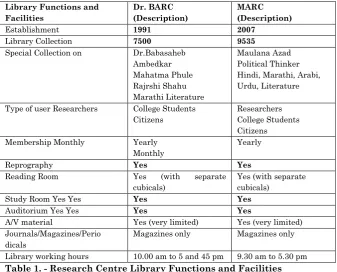
The present study reports the analysis of data gathered through the questionnaire designed for library professionals of research libraries of Dr. BARC and MARC. Research libraries surveyed ranged widely in terms of nature of library users served, funding agency, budget, collections, services, infrastructure facility, database, automation software, Internet, security, training to library professionals and users etc. The abbreviated form of names of research institutes is used in this study to represent their respective research libraries. It is observed from the questionnaire that the oldest or first established research library is Dr. BARC (1991) and MARC (2007).
Library Functions and Facilities
Dr. BARC (Description)
MARC (Description)
Establishment 1991 2007
Library Collection 7500 9535
Special Collection on Dr.Babasaheb Ambedkar Mahatma Phule Rajrshi Shahu Marathi Literature
Maulana Azad Political Thinker Hindi, Marathi, Arabi, Urdu, Literature
Type of user Researchers College Students Citizens
Researchers College Students Citizens Membership Monthly Yearly
Monthly
Yearly
Reprography Yes Yes
Reading Room Yes (with separate
cubicals)
Yes (with separate cubicals)
Study Room Yes Yes Yes Yes
Auditorium Yes Yes Yes Yes
A/V material Yes (very limited) Yes (very limited) Journals/Magazines/Perio
dicals
Magazines only Magazines only
attracted students, researchers, scholars and people with huge number of collection items, 7500 and 9535 respectively. There are separate setting arrangement in study rooms and Reading rooms. Making use of auditorium of the research center for conducting debates, essay writing, art exhibitions, cultural programme etc., the auditorium would also be allowed for seminar activities by other social organizations. The Table demonstrates that research libraries under the study work eight hours per day.
Library Functions and Facilities Dr. BARC (Description) MARC (Description)
Library Software Global Software (Which is provided by Aurangabad Municipal Corporation, Aurangabad)
Global Software (Which is provided by Aurangabad Municipal Corporation, Aurangabad)
Status of Library Automation
Partially Automated Partially Automated
Classification Scheme DDC DDC
Cataloguing Method followed
AACR II AACR II
Cataloguing made available in
library
- Cards
- OPAC of library
- Cards
- OPAC of library
Internet Yes Yes
Website Aurangabad Municipal
Corporation, Aurangabad 59.90.140.204:8000/ EIPPROD/single Index.isp Aurangabad Municipal Corporation, Aurangabad 59.90.140.204:8000/ EIPPROD/single Index.isp Table 2. - Research Centre Library Services
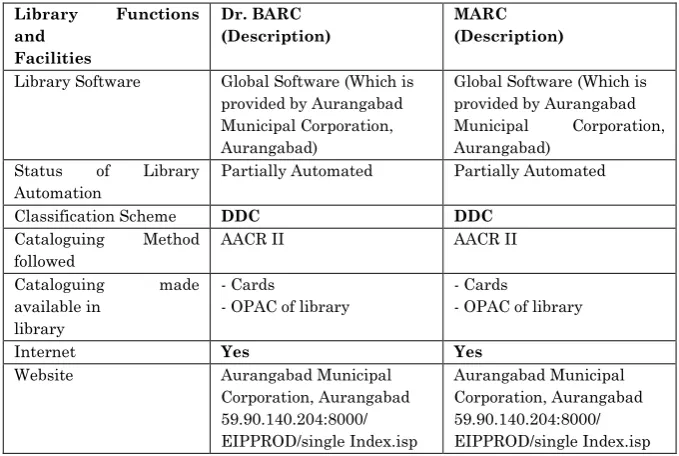
For effective use of library resources, libraries follow AACR – II in Dr. BARC and MARC. Research libraries catalogues are made available on OPAC of the library as well as available on OPAC of LAN.
Library Functions and Facilities
Dr. BARC (Description)
MARC (Description)
Computer 02 15
Computer with access to LAN
02 15
Library software Yes Yes
Barcode Yes Yes
Internet Access with LAN No No
Telephone Intercom Yes Yes
Table 3. - Availability of the ICT facilities in Research Centre Library
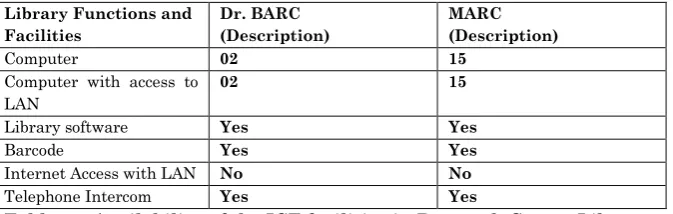
ICT facilities are using in research libraries specifically information processing, organizing, storing, searching and retrieving Information Technology environment. It is observed from Table 3 that both libraries are using computers, Computer with library software, Computer with access to LAN, Barcode & Scanner etc, while CCTV facility exists only in MARC.
Findings and Suggestions:
Findings
1. Aurangabad Municipal Corporation, Aurangabad, realized the importance for such a center and has taken initiatives with these two major projects of research centers.
2. It is observed from the study that Dr. BARC and MARC have published and unpublished work speeches of nation’s two Heroes.
4. The research libraries have good infrastructure facilities.
5. The research libraries classify their documents according to DDC (60%) and UDC (20%).
6. For cataloguing they follow AACR-II, and catalogues of these research libraries are also made available through OPAC.
7. It is clear from the study that these research centers have partially automated their libraries.
8. There are 3 to 4 permanent employees, but they are not library professionals.
9. The main barriers of ICT application are lack of inadequate trained staff, keeping abreast of new developments and changes in the nature of job, gap and psychological stress between the old and young staff that are fluent in application of ICT.
Suggestions:
1. Both research libraries should concentrate on procuring theses / projects and and more A/V materials on special Dr. Babasaheb Ambedkar as well as Maulana Azad. 2. Appoint a Library professional as a Knowledge
Manager.
3. Most important is to develop ICT facilities with internet, LAN etc.
4. The research libraries should safeguard their resources by implementing any one of the electronic security systems in addition to professional security. It may be video cameras, closed circuit television, electronic security systems etc.
Conclusion:
from Aurangabad and other places in the region which have been deprived of such facilities so far. The Research Center libraries have given due recognition and importance in terms of collection, budget, infrastructure facility, staff and users. These Research libraries have good infrastructure facilities to provide the services through LAN. These Research libraries are using standards to create internal databases, which are used for information retrieval purposes.
BIBLIOGRAPHY:
_______. Aurangabad Municipal Corporation Link. Available at 59.90.140.204:8000/EIPPROD/singleIndex.isp
_______. 2011. “Research Information Network. The Value of Libraries for Research and Researchers – a Report.” London: Research Libraries UK.
Kumari, C. Jalaja and Mallinath Kumar. 2010. “Information Literacy Programme in Research Libraries in Kerala: An Assessment.” In Confetti of Thoughts on Library and Information Studies:Essays in Honour of Pro.C.V. Rajan
Pillai, edited by S. Humaoon Kabir and K. G. Suddhir,
179-188. New Delhi: Authors Press 2010.
Maruthi, G. 2011. “Use of ICT in Research and Development Libraries in Karnataka: A study.” 8th International CALIBER. Goa: Goa University.