Novel Cyclic Redundancy Check software for
compressed & decoded Data
P
ragya Rathore
1&Vandana Kapoor
21
M-TECH, Dept. CSE Delhi Institute of Technology, Management & Research, Faridabad, Haryana,
INDIA,Mail Id:- [email protected]
2
ASSISTANT PROFESSOR, Dept. CSE Delhi Institute of Technology, Management & Research,
Faridabad, Haryana, INDIA,Mail Id:[email protected]
Abstract
The aim of this Paper is to describe a software using which, size of any file can be reduced. Files will be
compressed using the CRC (Cyclic Redundancy Check) algorithm. The efficiency will be determined by
comparing the compression ratio of the original file to the compressed file. The compressed file will be
decoded accordingly.
Keywords:CRC (Cyclic Redundancy Check),software,compressed file,decoded.
1.
Introduction
As the world evolves to rely more and more on
computers and data storage, data
compressionbecomes an increasingly useful and
important tool. Most data used by humans
contains a high amount ofredundancy.
Compression algorithms aim to eliminate this
redundancy, while still preserving all
theinformation contained in the original data.
The end result is a reduction in storage
requirements, inexchange for increased
computation.
This software help in reducing the size of a file
by reducing number of bits originally needed to
storethat file
1.1 Product perspective
The reduction in the size of the file will
result in better memory management.
While transferring a file via network it
would consume lesser network
resources.
The time required to transmit the file in a
network would be less as compared to
theuncompressed file.
1.2 Product Functions
The software developed will be used for
reducing number of bits needed for storing a
file.
1.3 User Characteristics
Any computer user who wants to reduce the
Also any use who deals with various file
formats can use this software to compress all the
files.
1.4 General Constraints
This software must be installed at the users
workstations.
Assumption
The user must have some basic
knowledge to deal with the software.
The user must be able to distinguish
between compressed file and
uncompressed file.
Dependencies
Algorithm structure.
Compression ratio.
2.
Related Work
The software must take a file with any extension
as input and the output must be thereduced form
of the input file. Here reduction means that
number of bits needed to represent theinput file
is reduced.
2.1 Functions
This software will take as input a file and will
reduce the number of bits needed to storethat
file. CRC (Cyclic Redundancy Check)
algorithm for compression will be implemented.
2.2 Performance Requirements
Every programmatic implementation of
compression encoding has a
differentcompression ration and performance.
Choosing the right encoder from a list of
publiclyavailable encoders is not a simple task
because performance and compression ration
alsodepend on the type of data, particularly on
the size of the alphabet (number of
differentsymbols) and words (in case of LZ
encoding). One of two particular encoders may
have betterperformance for small alphabets
while the other may show better performance
forlarge files. Most encoders have limitations on
the size of the alphabet.
So an algorithm must be selected such that it
could compress most of the fileformats giving
high compression ratio and efficiency. The
software must give thecompressed file instantly
not taking much time. The time complexity and
spacecomplexity must be optimized.
2.3 Compression- Compression is the process
of encoding information using fewer bits
(orother information-bearing units) than an
un-encoded representation would use, through use
ofspecific encoding schemes.Compression is
useful because it helps reduce the consumption
of expensive resources,such as hard disk space
or transmission bandwidth. On the downside,
compressed data must bedecompressed to be
used, and this extra processing may be
detrimental to some applications. Forinstance, a
compression scheme for video me require
expensive hardware for the video to
is being decompressed ( the option
ofdecompressing the video in full before
watching it may be inconvenient, and requires
storagespace for the decompressed video). The
design of data compression schemes therefore
involvestrade-offs among various factors,
including the degree of compression, the
amount of distortionintroduced ( if using a lossy
compression scheme), and the computational
resources required tocompress and uncompress
data.
2.4 Symmetry and asymmetry, in the context
of data compression, refer to the time
relationbetween compression and
decompression for a given compression
algorithm.If an algorithm takes the same time
and space to compress a data archive as it does
todecompress it, it is considered symmetrical.
The point to be noted here is that, compression
and decompression, even for a
symmetricalgorithm, may not be perfectly
symmetric in practice, depending on the devices
the data it beingcopied to and from, and other
factors.
While if the compression and decompression
times of an algorithm are vastly different, itis
considered asymmetrical.Symmetric algorithms
are typically used for media streaming
protocols, as either theserver taking too long to
compress the data, or the client taking too long
to decompress, wouldlead to delays in the
viewing of the data.
Asymmetrical algorithms wherein the
compression is faster than the decompression
canbe useful for backing up or archiving data, as
in these cases data is typically much more
oftenstored than retrieved.
2.5 Lossless data compression is a class of data
compression algorithms that allows theexact
original data to be reconstructed from the
compressed data. The term lossless is in
contrastto lossy data compression, which only
allows an approximation of the original data to
bereconstructed, in exchange for better
compression rates.
Lossless data compression is used in many
applications. For example, it is used in theZIP
file format and in the UNIX tool GZIP. It is also
often used as a component within lossy
datacompression technologies.
Lossless compression is used in cases where it is
important that the original and thedecompressed
data be identical, or where deviations from the
original data could bedecompressed data is
identical. Or where deviations from the original
data could be deleterious.Typical examples are
executable programs, text documents and source
code. Some image fileformats, like PNG or GIF,
use only lossless compression, while others like
TIFF and MNG mayuse either lossless or lossy
used for archiving orproduction purpose, with
smaller lossy audio files being typically used on
portable players and inother cases where storage
space is limited and/ or exact replication of the
audio is unnecessary.
3.
Implementation
3.1 Proposed System:
This software is used for compression. The
software is designed in such a way that it
cancompress any type of file like text, image,
audio and video. So this software is a general
compressor thatcan compress any kind of file.
The basic functionality of this software is to
compress a file which is supplied by the user.
Alsotis job is to decompress the compressed file
The working of the software can be better
understood by the following steps:-
Compression process
- Take input file from the user
- Check whether the file has .zip extension or
not
- If the file has an extension .zip ten give an
error message to the user that the file is already
compressed and end the process.
-If file does not have .zip as its extension then
Ask the location where the user wants to
save the compressed file
Browse to the location
Compress the file using the algorithm
Decompression process
-Take input file from the user
- Check whether the file haz .zip extension or
not.
- If the file does not have the extension .zip then
give an error message to the user that the file
isalready decompressed and end the process
- If file has .zip extension then
Ask the location where the user wants to
save the decompressed file
Browse to the location
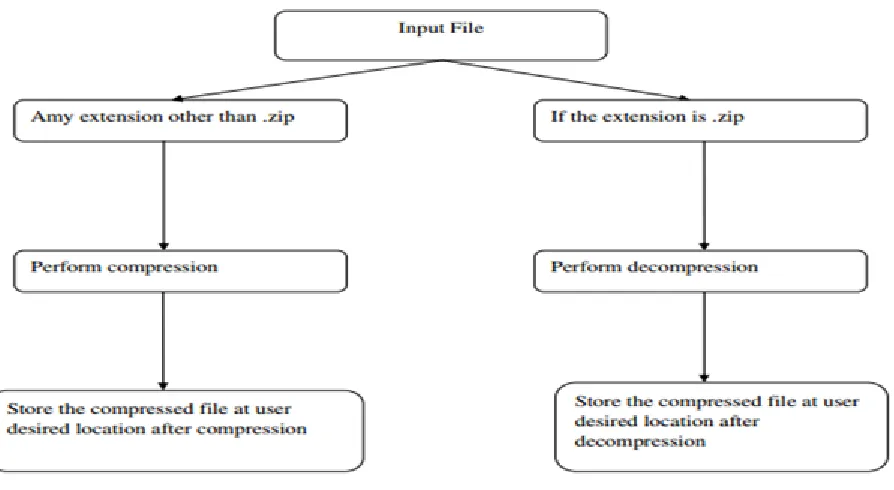
Fig 1: Functional block diagram.
Brief description of the various blocks used in
the project
Input file – The first step of the process of the
software is to ask the user to give a file as the
1.input. This input can be single file, multiple
files or a folder
2. Compression- This process compresses the
given file by reducing the number of
bitsrequired to store the file
3. Decompression- This process decompresses
the compressed file such that original file
isobtained
4. .zip- It is the extension given for all the
compressed files. Whenever a file is compressed
itwould be stored with an extension .zip
5. Other Extension- Other extension refer to
various file extension that are used for
differentfile formats like .txt and .doc for text
files, jpg and .gif for images, .mp3 and .wav for
audiofiles, .mp4 and .3gp for video files. In
other words, the file with any extension other
than .zipwill be used for compression while files
with extension .zip would be used
fordecompression.
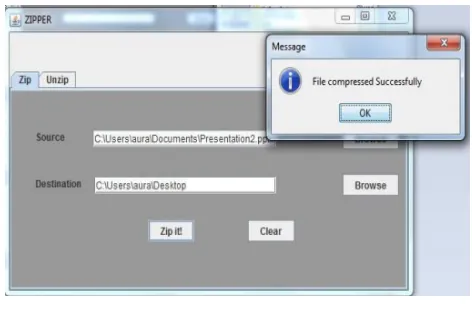
Fig 2: Before zip file browse file from system.
Fig 3: File After zipping Success Page.
5.
Conclusion
As the world evolves to rely more and more on
computers and data storage, data compression
becomesan increasingly useful and important
tool. Most data used by humans contains a high
amount ofredundancy. Compression algorithms
aim to eliminate this redundancy, while still
preserving all theinformation contained in the
original data. The end result is a reduction in
storage requirements, inexchange for increased
computation.
Nonetheless, but algorithms form important
bases for more sophisticated work. In particular,
thealgorithm as presented are known as
0-order…they don’t base any of their symbol can
be a very goodpredictor of the next symbol. For
instance, in C language source code a right curly
brace “}” is almostalways followed by carriage
return.
6.References
[1] Wade, Graham (1994). Signal coding and
processing (2 ed.). Cambridge University
Press.p. 34. ISBN 978-0-521-42336-6.
Retrieved 2011-12-22. The broad objective of
source coding is to exploitor remove 'inefficient'
redundancy in the PCM source and thereby
achieve a reduction in the overall sourcerate R.
[2] Mahdi, O.A.; Mohammed, M.A.; Mohamed,
A.J. (November 2012). "Implementing a Novel
Approach aConvert Audio Compression to Text
Coding via Hybrid Technique" (PDF).
International Journal of ComputerScience Issues
9 (6, No. 3): 53–59. Retrieved 6 March 2013.
[3] Pujar, J.H.; Kadlaskar, L.M. (May 2010). "A
New Lossless Method of Image Compression
andecompression Using Huffman Coding
Techniques" (PDF). Journal of Theoretical and
Applied InformationTechnology 15 (1): 18–23.
[4] Salomon, David (2008). A Concise
Berlin:Springer. ISBN 9781848000728.e. S.
Mittal and J. Vetter, "A Survey of Architectural
Approaches for Data Compression in Cache and
MainMemory Systems", IEEE Transactions on
Parallel and Distributed Systems, 2015.
[5] Tank, M.K. (2011). Implementation of
Limpel-Ziv algorithm for lossless compression
using VHDL.Think quest 2010: Proceedings of
the First International Conference on Contours
of ComputingTechnology. Berlin: Springer. pp.
275–283.
[6] Navqi, Saud; Naqvi, R.; Riaz, R.A.;
Siddiqui, F. (April 2011). "Optimized RTL
design and implementationof LZW algorithm
for high bandwidth applications"
(PDF).Electrical Review 2011 (4): 279–285.
[7] Mahmud, Salauddin (March 2012). "An
Improved Data Compression Method for
GeneralData" (PDF).International Journal of
Scientific & Engineering Research 3(3): 2.
Retrieved 6 March 2013.i. Arcangel, Cory. "On
Compression" (PDF). Retrieved6 March 2013.
[8] Marak, Laszlo. "On image compression"
(PDF). University of Marne la Vallee. Retrieved
6 March 2013.
[9] Mahoney, Matt. "Rationale for a Large Text
Compression Benchmark". Florida Institute of
Technology.Retrieved5 March 2013.
[10] Shmilovici A.; Kahiri Y.; Ben-Gal I.;
Hauser S. "Measuring the Efficiency of the
Intraday Forex Market witha Universal Data
Compression Algorithm" (PDF). Computational
Economics, Vol. 33 (2), 131-154., 2009.
[11] Ben-Gal. "On the Use of Data Compression
Measures to Analyze Robust Designs" (PDF).
IEEE Trans. OnReliability, Vol. 54, no. 3,
381-388, 2008.
[12] Korn, D.; et al. "RFC 3284: The VCDIFF
Generic Differencing and Compression Data
Format". InternetEngineering Task Force.