Implementation of Ofdm System by Using Convolutional Coding and Bch
Coding With Adaptive Modulation
PRAVIN P.KAWARE (M.E.) 1
P.N.NARWADE (Ph.D), Assistant professor 2
1,2Khurana Sawant Institute of Engineering & Technology, Hingoli, Maharashtra, India [email protected] [email protected]2
Abstract
When Orthogonal Frequency Division Multiplexing (OFDM) is a used it has several benefits for high speed data transmission over wireless as it is multicarrier transmission scheme. OFDM uses a large number of narrow bandwidth carriers. In an OFDM, individually each subcarrier is attenuated under the frequency-selective and fast fading channel if the same fixed transmission scheme is used for all OFDM subcarriers therefore it gets results in highest attenuation leads to performance is poor. The main aim of this paper is the introduction of the adaptive modulation to get an understanding of the differences between fixed & adaptive modulations schemes. Basically in this paper work, adaptive modulation is implemented by dividing whole subcarriers into blocks of adjacent subcarriers. By calculating average instantaneous signal to noise (SNR) same modulation scheme is applied to all subcarriers of same block. Here we observed average bit error rate (BER) performance of OFDM system under fixed modulation and adaptive modulation. Average BER performance of these modulation techniques is observed with various inverse fast Fourier transform (IFFT) size and using simpler adaptive Quadrature amplitude modulation (QAM) schemes. The simulation results show that BER performance of OFDM system using adaptive modulation is better than fixed modulation. The proposed adaptive modulation and coding Technique for OFDM maintains fixed BER under changing channel condition.
Keywords:
OFDM, adaptive modulation, SNR estimation, convolution code, channel Estimation, bit error rate.I. I
NTRODUCTION
As we know that in the recent few years, there has been a vast growth in wireless technology in India. Trying to acquiring goal is to provide universal personal and multimedia communication without depending on mobility or location with high data rates. To meet such objective, the next upcoming generation personal communication networks will need to be support a wide range of services including high quality facsimile, voice, still images, data, streaming video etc.
Upcoming future area services are likely to add applications requiring very high transmission up to the rates of several Megabits per seconds (Mbps). In these days the data rate for 4G is near about 1 GB/s for home area or personal use and 100Mb/s for industrial or services area. Over mobile radio channels When transmission of data byte at high bit rates, the channel impulse response can extend over many symbol periods, which gets results to inter symbol interference (ISI). Orthogonal Frequency Division Multiplexing (OFDM) is one of the promising candidates to mitigate the ISI. OFDM signal divides bandwidth (nothing but the difference between two frequencies) is into many narrowband channels.
noise can be best to use for which modulation scheme? The answer according to Md. Rakib Al Mahmud and Zaigham Shabbir Khan would be finding in performance of AWGN for each modulation scheme.
Adaptive modulation is maintaining the balance between Bit Error Rate and signal to noise through the improvement of the Spectral Efficiency. In a slowly varying fading channel ,for more effective way use of adaptive modulation with noise based on signal to noise estimation. Kamran Arshad gives an adaptive scheme of channel estimation in wireless OFDM systems, keeps tracks the multipath fading channel by using the LMS algorithm.
Ultimate aim is to measure the channel in OFDM systems, and according to channel suitable modulation and coding rate will be adapted. The performance of Orthogonal Frequency Division Multiplexing signal transmitted with & without adaptive modulation is done using computer simulations performed using MATLAB. With the objective of adapting, the main aim of adaptive modulation and coding (AMC) is to powerful change the face of modulation and coding scheme in subsequent frames, the overall throughput or power to the channel condition.
Actually, when implementing orthogonal frequency division multiplexing over a spectrally shaped channels the appearance of bit errors intensive in a set of severely faded sub carriers, which should be not included from data transmission. At the other side of this, the frequency domain fading, while imperfect the SNR ratio of some sub-carriers, may improve others above the average signal-to-noise ratio. Therefore, the potential loss of throughput due to the barring of faded sub carriers can be lower by using higher order modulation modes on the sub-carriers exhibiting higher signal-to-noise ratio. Moreover, other system criteria such as the coding rate of error correction coding schemes, can be adapted at the transmitter according to the channel frequency response.
1.1 ADAPTIVE CODING AND MODULATION
The idea of adaptive coding and modulation is to maintain a regular performance by varying transmitted power level, modulation scheme, coding rate or any combination of these schemes .It leads to vary the data rate without sacrificing bit error rate performance. Since in telephonic communication
systems, the local mean value of the received signal level varies due to the fading channel, Adaptive coding and modulation is an effective way to reach high data rates and it has proved to be a bandwidth efficient technology to transmit multimedia information over mobile wireless channels.
II.
O
BJECTIVE
There are various objectives are achieved by using the adaptive modulation & coding techniques. The main objectives are given as follows-
To remove the Bit Error rate in OFDM system.
To provide good protection against co channel interference and impulsive parasitic noise
To makes efficient use of the spectrum by allowing overlap.
Using adequate channel coding and interleaving one can recover symbols lost due to the frequency selectivity of the channel.
III.
L
ITERATURE
R
EVIEW
[1]. Chang Kyung Sung et.al proposed this paper in this paper a rate adaptation scheme is proposed which utilizes the estimated bit error for supportable transmission rates. In this user equipment chooses the best modulation & coding scheme level based on OFDM symbol rather than on the whole subcarrier. Then user needs to send back only the selected MCS level, so the amount of the feedback reduces to a single integer irrespective of the number of subcarriers Simulation results shows that the proposed scheme can significantly reduce the system complexity while minimizing the performance loss.
proposed to improve the performance. This shows multiple estimates from different frequencies can enhance the performance significantly
[3]Sandeep Singh et.al proposed this paper this paper presents OFDM with link adaptation algorithm applied to multiple input & multiple output (MIMO) systems. In this paper we apply an optimization discrete bit loading algorithm & power allocation for each subcarrier assuming CSI is known at both transmitter &receiver..To improve BER performance of wireless systems coding techniques such as gray code & trellis coded modulation are employed at the transmitter. We found that link adaptation algorithm. Improves the BER performance & minimizes the overall power input at the transmitter while maintaining a defined data rate. These scheme gives better BER performance over un-coded algorithm.
[4] A.Sudhir Babu et.al proposed this paper in this paper the performance of transmission modes are evaluated by calculating the probability of Bit Error Rate (BER) versus the Signal Noise Ratio (SNR) under the frequently used three wireless channel models (AWGN, Rayleigh and Rician). We consider the data modulation and data rate to analyze the performance that is BER vs. SNR. We also consider multipath received signals. The simulation results had shown the performance of transmission modes under different channel models and the number of antennas.
[5]Dr.Serkout N. Abdullah et.al proposed this paper in this paper studies the adaptive coded modulation for coded OFDM system using punctured convolution code, channel estimation, equalization and SNR estimation. In this technique signal to noise ratio is estimated at receiver and then transmitted to the transmitter through feedback channel.
IV.
PROPOSED METHOD
The sub band adaptive transmission schemes are employed to reduce the complexity. In sub band adaptive OFDM transmission, all subcarriers in an AOFDM symbol are split into blocks of adjacent subcarriers referred to as sub bands. The same mode is employed for all subcarriers of the same sub band. The choice of the modes to be used by the transmitter for its next OFDM symbol is determined by the
channel quality estimate of the receiver based on the current OFDM symbol. Perfect channel estimation is assumed in this paper. In this simulation the instantaneous SNR of the subcarrier is measured at the receiver. The channels quality varies across the different subcarriers for frequency selective channels. The received signal at any subcarrier can be expressed as.
Where the channel coefficient at any subcarriers is, is the transmitted symbol and Wn is the Gaussian noise sample. So the instantaneous SNR can be calculated using
The conservative approach in threshold based adaptation is by using the lowest quality subcarrier in each sub band for controlling the adaptation algorithm. It means that the lowest value of SNR will be used in mode selection. By using this method, the overall BER in one sub band is normally lower than the BER target. If the overall BER can be Optimize adaptive coding technique to improve performance of OFDM system closer to the BER target by choosing a more suitable modulation mode or code rate, the throughput of the system will be higher.
Therefore a better adaptation algorithm is used in this paper to provide a better tradeoff between throughput and overall BER by choosing a more suitable scheme for each sub band. Instead of using the lowest SNR in each sub band, the average value of the SNR of the subcarriers in the sub band is going to be used [1].
COFDM and OFDM are sometimes used as synonyms.
Fig.1 Block Diagram of Proposed Work Analysis
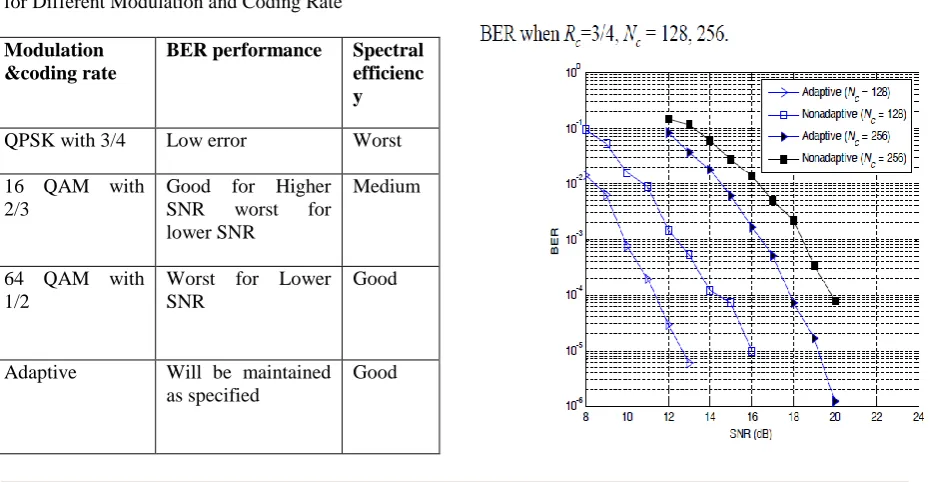
Quantitative analysis of different modulation techniques with different code rate is given in the table1below
Table 1: BER Performance and Spectral Efficiency for Different Modulation and Coding Rate
Modulation &coding rate
BER performance Spectral
efficienc y
QPSK with 3/4 Low error Worst
16 QAM with 2/3
Good for Higher SNR worst for lower SNR
Medium
64 QAM with 1/2
Worst for Lower SNR
Good
Adaptive Will be maintained as specified
Good
V.
R
ESULTS &
D
ISCUSSION
Results of different adaptive and non adaptive modulations schemes are drawn below which shows reduced BER at low SNR.
Fig.2 BER when Rc=1/2,Nc=128,256
Subcarriers are grouped into
The average instantaneous SNR for each sub-band are calculated
The average instantaneous SNR are compared with the threshold value to choose
the mode
The information about modulation and coding used are sent to the transmitter using
Fig.3 BER when Rc=3/4,Nc=128,256
Fig.4 SNR vs. BER plot for different modulations and code rate
V.
C
ONCLUSION
The ACM scheme improve the performance of the OFDM wireless communication system as it merge two adaptive schemes based on modulation and coding. The results show that the ACM scheme adjusts effectively to the channel environment since it allocates (1/2 QPSK) to the decreasing SNR value and (1/2 16- QAM, 3/4 16-QAM, 3/4 64-QAM and 3/4 256-QAM) to the increasing SNR value The ACM system provides better spectral efficiency at most ranges of SNR, at low SNR, the system achieves 2 bits per symbol, as QPSK is primarily used. The concept of adaptive modulation optimizes the bandwidth efficiency for wireless communications without excessive complexity.
R
EFERENCES
1] K. Ben Lataief, J. C. I. Chang and R. D. Murch, 1996, ―”A high transmission method for wireless personal communication”,‖ Kluwer Academic Publisher,
[2] R. Prashad, “OFDM for wireless communication systems”, Artech house publishes, London, 2004, ch. 1, pp. 1-18.
[3] Y. Li and G. L. Stuber, “Orthogonal Frequency Division Multiplexingfor Wireless Communication”. [4] R. van Nee and R. Prasad,” OFDM for Wireless Multimedia Communications”.
[5] Norwood, MA: Artech House, 2000.
[6] R. G. Gallager, “Information Theory and Reliable Communication. Wiley,1968”.
[7] IEEE standard for wireless LAN: Medium Access Control and Physical Layer Specification, P802.11, January 1999.
[8] Mohammaed Slim Alouini and Andrea J. Goldsmith “Capacity of Rayleigh fadingchannels under different Adaptive Transmission and Diversity combiningTechniques”,
[9] IEEE Transactions on Vehicular Technology, Vol. 48, No. 4, July 1999.