DOI: http://dx.doi.org/10.26483/ijarcs.v8i9.5054
Volume 8, No. 9, November-December 2017
International Journal of Advanced Research in Computer Science
RESEARCH PAPER
Available Online at www.ijarcs.info
© 2015-19, IJARCS All Rights Reserved 496
ISSN No. 0976-5697
COLLUSION BW HOLE ATTACK
Sunil Kumar Jangir
Department of Computer Science and Engineering, JECRC University,Jaipur,
Rajasthan,India
Naveen Hemrajani
Department of Computer Science and Engineering, JECRC University,Jaipur,
Rajasthan,India
Abstract- In this world of technology, it is important to provide security and to find the loopholes present in the network. There are two types of networks – wired network and wireless network. Wireless network is more vulnerable to attacks as compared to the wired networks as a number of nodes are never fixed in wireless network. Any node can come and join the network as well as any node can leave the network. This paper includes conclusions of some Denial of Service attacks and their effect on the MANETs, How they attack and which methodology they adopt. This paper mainly focuses on proposing a new attack which can cause severe harm to the network. This attack inhibits the strategy of two main attacks –BlackHole and Wormhole attack. This attack actually works in collaboration with some internal nodes which will work for a malicious node and will help that node in causing disruption to the network. In particular, this paper describes all the weak areas of a network that can be targeted by this new attack.
Keywords: MANET; DOS ;Security Attacks
1.INTRODUCTION
As already mentioned, this paper proposes a new attack, a type of a Denial of Service attack which can not only slow down the network but can also result in defaming as it is hard to find outthe actual intruder in the network. The name of this attack is Collusion BW Hole Attack .As in MANET, the communication starts when there is a node that has a data or a message packet that is to be sent to some other node. For the transmission of this packet the source node will choose a path which is both secure and less time consuming. For selection of this path the source node will look for the routing tables of other nodes and will find a suitable path to transmit the packet. Here, in Collusion BW attack, the intruder will take advantage of this demand of source node to hack the network and will eventually steal or drop the data. The intruder node will work with two or more internal nodes, who will form a tunnel and simultaneously send that data to the intruder node rather than sending it to the desired node. The whole methodology and strategy of this new proposed attack is described further in the paper. This paper includes only the description of this attack, the methodology that can be used by these intruding nodes and the weaknesses of a network that can be targeted by this attack.
2.MANET
Mobile Ad Hoc Network is a cluster of mobile nodeswhich can communicate with one another without a specified and predefined topology or central administration. MANETs are dynamic in nature, which means any node which wants to communicate can join the network and similarly any node can leave the network after the completion of its work at any time. It provides flexibility asthere is an absence of centralized system and it follows a decentralized system which means there are no server and client. Thus, it offers a peer-to-peer network in which any node can act as a host and as a router at the same time.[1] It is very easy to form a MANET network at cheap prices as it does not follow the
predefined and centralized infrastructure, this property is the reason why MANET is widely used and becoming popular nowadays. But due to its flexible and dynamic nature, it is becoming vulnerable to many severe attacks. These attacks are mainly intended to steal the information that is transferred among communicating parties.[2,3]
As in MANET no restriction is applied on the nodes, any node can join the network, this can lead to severe consequences like eavesdropping, stealing of information, denial of services, response delay etc.
As compared to wired network A MANET is more prone to attacks due to the following factors:
• The Nodes have limited energy due to whichsecurity solutions that are complex cannot be used in MANET. • Transmission of data packets and routing is done using wireless medium.Wireless medium being a shared network and generally unreliable and makes eavesdropping more likely. Even if we make the channel reliable, the communication might be unreliable due to the broadcasting nature of the MANETs.
•MANET does not have any central management point or node, which makes it hard to ensure that all the nodes that are taking part in the network are benign.
• Routing is very challenging because the network topology of network keeps on changing and the mobility of nodes plays a very important role in the network.[4-6]
3.AODV
An Ad hoc On-Demand Distance Vector routing protocol is tailored particularly for the mobile nodes, where the time span for the establishment of new network and the termination of previous one is not fixed. Thus, this protocol seeks to provide less processing time, memory consumption and network utilization as well as fast adaption to dynamic forming links. It works on destination sequence numbers and gives loop freedom[9][13-15]
3.1 Security Flaws in AODV
Sunil Kumar Jangir et al, International Journal of Advanced Research in Computer Science, 8(9), Nov–Dec, 2017,496-500
© 2015-19, IJARCS All Rights Reserved 497
designedto provide the authentication,confidentiality, integrity and non-repudiation.AODV can easily be compromised by a malicious node to disrupt its routing. The misbehaviour of an inside attacking node is discussed in. The actions that are performed by the inside attackers to disrupt the routing in AODV are
1) It may modify or forge the RREQ or RREP packets. 2) To work as a legitimate node it may spoof either the destination IP or the source IP and thus is able to receive or drop data packets.
3) To degrade the performance of the network and to increase the routing delayit may generates a fake RERR packet,
4) The attacker may send fake RREPs of highest sequence numbers (like Blackhole attack) to cause a DoS attack. 5) To deplete the node batteries, it may create the routing loops and launch sleep deprivation or resource consumption attacks.
6) To disrupt the normal routing behaviour it replays old routing messages or make a tunnel/wormhole.[7-13]
4.COLLUSION BW HOLE ATTACK
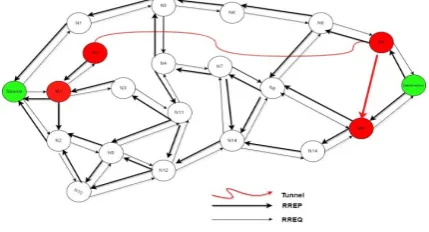
When an RREQ( Route request packet) is sent from a source node to other nodes in the network for the transmission of the package then the malicious node MN1 in the network may send Route Reply (RREP) with higher sequence number. As we know that the higher sequence number is replaced by the lower sequence number and allows the source node or other node to transmit the packet with the node with higher sequence number. Here the source node transmit the packet from the malicious node and the malicious node MN1 again send route request (RREQ) for the transmission of packet then again a malicious node MN2 send route reply with higher sequence number and the packet is again transmitted through the malicious node MN2. When a packet is transmitted to second malicious node MN2 in the network it tunnels the packet to the other malicious node MN3. When the packet is tunneled to the malicious node MN3 then usually broadcast of RREQ occurs but here in this attack case uni-cast occurs and the packet is dropped. This attack satisfies the vulnerability present in AODV so this attack is not possible to detect easily which are.
1) To modify or forge RREQ or RREP packets.
2) Source IP address or Spoof destination pose as the legitimate network node and thus drops or receive the data packets.
[image:2.595.51.266.643.759.2]3) Make a tunnel/wormhole or replay old routing messagesto disrupt the normal routing behaviour.
Figure 1: How a packet is dropped in Collusion BW Hole Attack
In AODV there is black hole and worm hole attack. In worm hole attack the attacking node capture the packet from one location and transmits that to the other node which is located at distant. A wormhole attack can be exploited very easily by attacker without compromising with the legitimate node and without having the knowledge of that. Whereas in black hole attack, when the source node attempts to send some data packets to a destination node, and starts the routing discovery process thena malicious node, MN1 shows that it has the route for the destination node every time it receives RREQ packets. Then it sends the response to source node at once. If the reply from a normal node for example (N1,N2,...,N14) etc. reaches the source node of the RREQ first, everything works well but when the packet is received by MN1 node then it makes the source node think that the routing discovery process is completed and ignores all other reply messages, and starts to send data packets. A forged routing has been created. As a result of which all the packets through MN1 are simply lost or consumed and never received by its desired destination.
Collusion BW Hole Attack is different from these attack because in this attack the packets are dropped once received by the malicious node where as in Collusion BW Hole Attack there is no packet drop by first malicious node and in worm hole attack after tunnelling the broadcast of packet occur while in Colliding Collusion BW hole attack uni cast occur and the packet is dropped by the malicious node but at the same time the RREP and RREQ route request and reply of the neighbour legitimate node are managed such a way that the dropped packet node(malicious node) can never be identified.
4.1 Symptoms of Attack
Hence we can make a conclusion that our attack Collusion BW Hole Attack is valid only when:
Case 1: The Malicious Node MN1 receives the packet from the source node by sending the higher sequence number of route reply RREP of the route request RREQ sent by the source node (Malicious Activity).
Case 2: After tunnelling when the malicious node MN3 receive the packet there must occur a unicast instead of broadcast and the packet is dropped after the tunnelling. It means here is forge that MN1 is going to drop the packet but from MN1 to MN3 they keep transmitting the packets among them self resulting in Spoofing of the destination and IP address to work as legitimate node.
4.2 Proposed Attack Model
NL: Set of legitimate nodes. NM: Set of malicious nodes.
N: Total Number of nodes used i.e., NL NM B: Packet Drop By the Node
Collusion BW Hole Attack: An ordered set of attackers {MN1, MN2, MN3 ...},MN is the malicious node. MN1 is first malicious node that receives packet from the source by sending route reply of high sequence number to the source node and works as legitimate node
© 201 that n mali BW that also sequ the r 4.3 H The resul type poin j Sunil
15-19, IJARCS A
node is a mali cious node A Hole Attack i all the nodes NMNL this h uence number route request t
How Is It Mor
Collusion BW lt in more dis s of attacks w nts describe its
In this attac collaboration are stealing f which is an network. Now displaying an Secondly, the intruder node nature and o genuine node and making it Third key fac making nodes still the iden hidden as wh node will nev The main int network, it m just wants to taking place network. Eve communicatin impossible to Also, if the network, then display any s dependent on disguised mal
Thus, these Collusion B harmful to attacks in M Attack, etc. vital role in node
.
l Kumar Jangir e
All Rights Reserve
icious node w A NM (MN
is executed th taking part m happens when Seq_no. to th to the neighbo
re Dangerous
W Hole Attac astrous effect with diminish s harmful cons
ck two or m to form a tun from the netw
intruder wh w, identifying ny suspicious a e nodes whic e will someti other times t es. Thus, con t hard for him ctor in this att s are identifie ntity of the m
ile being in th ver show any s truder node i may happen to o eavesdrop to
between the n ery algorithm
ng in the net predict which
main intrude n it will proper suspicious act n the tunnel w
licious nodes
e points’ su BW Hole Atta
a network th MANETs like The tunnel f n hiding the i
et al, Internation
ed
which means A N1, MN2, MN hen N N must me mali
n a route re he source nod ouring node.
Than Other A
ck defined in ts as it posses hed cons. The
sequences.
morenodes w nnel and the in work will be ho wants to g this third no activity is a to ch are workin imes show th they will beh nfusing the n m to be found a tack is that ev ed by the netw main intruder he network the suspicious act is not bounde
be some exter o the commu nodes that ar can be appli twork, but for h node is genu er node is di
rly hide its ide tivity. It wil which is form
in the network
ums up the ack and how hen other Den Blackhole att formed in thi identity of th
nal Journal of A
A must belong N3...). Collusi NM which mea cious node, a equest of hi de when it sen
Attacks
n this paper c the pros of tw e following k
will work in nformation th
sent to a no slow down t ode which is n ough row to ho ng for the ma heir illegitima have as norm network hand at once. ven if the tunn work handler b r node will e tunnel maki tivity.
ed to be in t rnal node whi unication that
e present in t ed to the nod r outsiders it uine.
isguising in t entity and won l be complete med by the tw
k.
whole idea it can be mo nial of Servic tack, Wormho s attack plays he main intrud
Advanced Resear to ion ans and igh nds can wo key a hey ode the not oe. ain ate mal dler nel but be ing the ich is the des is the n’t ely wo of ore ces ole s a der 5. Pa Si Ar Si M Ap Ro N Pa N Ba D M N Si ef du fig nu ei sin hi tu
rch in Computer
.SIMULATI arameter imulator rea imulation time MAC pplication traffi outing protocol o. of S-D pairs ause time
o. of malicious andwidth ata payload Maximum speed
o. of nodes
[image:3.595.308.549.81.285.2]5.1 Eff
[image:3.595.331.536.330.459.2] [image:3.595.349.521.492.649.2]Figure 2 : A
Figure
ince the ratio ffect of attack ue to the ever gure the ave umber of atta ither drop the ngle loop. H ighest Averag unnelled and ro
r Science, 8(9), N
ION & RESU
Table 1: Si
fic ls
nodes
fect of number
Average PDR with
3: NOR with inc
of source-de kers on variou
increasing nu erage End to ackers increas e packet or ke Here Collusio
ge ETE Delay otated in its o
Nov–Dec, 2017,49 ULTS imulation Para V N 1 5 8 C A 8 1 2 2 5 1 1
r of attackers i
h increasing num
reasing number o
stination pair us network pa
umber of attac o End Delay ses this is bec
eep on rotatin on BW hole y as in this wn loop for IP
96-500 49 ameters Value NS3 000 x1000 500 sec 802.11 CBR AODV 8 0 sec 2 – 10 2 Mbps 512Bytes/Packe
0 – 50 m/s 00
in network
mber of attackers.
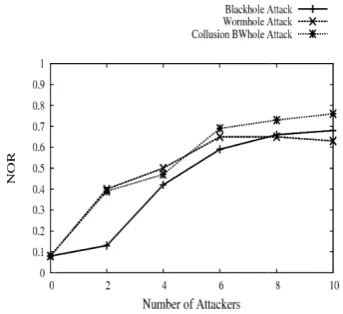
of attackers.
is fixed whil arameters incr ckers. As show
increases a cause the atta ng the packet Attacks have case the pack P table updati
98 et le the reases wn in s the ackers
© 201 that Aver as th The it br will incre desti maxi less legit F 5.2 E The netw node disco incre trans pack drop decre PDR num node disco Dela Sunil
15-19, IJARCS A
it works as a rage PDR inc he packet start effect of NOR roadcasts the
be large in n eases the route ination but in imum as no b
chance that t timate node.
igure 4 : Average
[image:4.595.328.537.44.411.2]Effect of Netw
Figure 5 : Ave
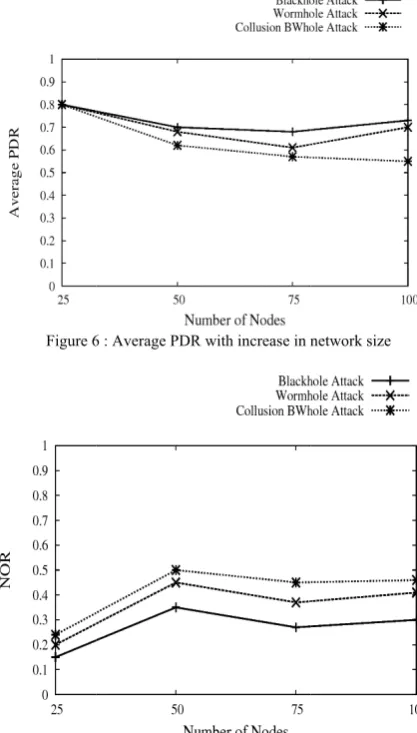
effect of At work and vice es, the probab overy route i ease in the n smitted by th kets that are re p increases as eases the Col R in this case. mber of nodes
es the broadca overy also in ay also increas
l Kumar Jangir e
All Rights Reserve
a legitimate no reases with in ts dropping wi R increases w messages use number and s e will include n Collusion broadcast occu the broadcast
e ETE Delay with
work Size
rage ETE Delay w
ttacker node e versa becau ility that the a s very less. T network size he source wi eceived by the s number of n
llusion BW H Normalize R increases as w ast messages
creases gradu ses if the netw
et al, Internation
ed
ode and canno ncreasing num
ith increase in with increase in ed for route d since the num e various attac
BW hole at ur, here unica message is r
h increasing numb
with increase in n
is very less use of the le attacker becom
The PDR dec as the num ill be always e destination n nodes increas Hole attack ha Routing Overh with an increa which are us ually so avera work size incre
nal Journal of A
ot be identifie mber of attacke n attacker effe
n the attacker discovery whi mber of attack cker node for t
ttack it will ast occur so ve received by a
ber of attackers.
network size
s in low den esser number mes a part of t creases with mber of pack
s less than t node. The pack
ses so the PD as the minimu head increases
asing number ed for the rou age End to E eases. Advanced Resear ed. ers ect. as ich ker the be ery any nse of the an ets the ket DR um s if of ute End A pr a of re th be tu oc an In ro be no no m m dr th le th
[image:4.595.54.254.170.318.2]rch in Computer
Figure 6
Figu
As per the sim reviously purp
packet from t f high seque equest is gener he network w een hijacked b unnel the pack
ccurs which h nd the attack. n our Collusio oute reply to t
etween the rep ode and also ode at the beg malicious nod malicious node
ropped somew he network th egitimate route his attack.
r Science, 8(9), N
6 : Average PDR
ure 7 : NOR with
6.CON
mulation resu posed attacks the source nod
nce number rated which in which alarms
by the attack ket to other ma
helps in ident
on BW Hole the source nod ply of the Ma the packet is ginning , after e the unicas e safe from b where near the hat the packet
e so no detec
Nov–Dec, 2017,49
with increase in n
h increase in netw
NCLUSION
ult it can be when a Malic de by generat and a large ncreases the a
the network er, also when alicious node tification of th
Attack as ea de so there is alicious node s not dropped tunnelling of st occur whi eing detected e destination n t transmission ction techniqu 96-500 49 network size work size concluded th cious node rec ting the route amount of amount of traf that a packe n a malicious then the broa he malicious
ach node send very less tim and the legiti d by the mali
the packet to ch also keep d and the pack node which as n was going i ue works to d
[image:4.595.43.268.363.496.2]Sunil Kumar Jangir et al, International Journal of Advanced Research in Computer Science, 8(9), Nov–Dec, 2017,496-500
© 2015-19, IJARCS All Rights Reserved 500
7.REFERENCES
[1]. Pravin R Satav; Pradip M. Jawandhiya “Review on single-path multi-single-path routing protocol in manet: A study”International Conference onRecent Advances and Innovations in Engineering (ICRAIE) ,(2016)
[2]. Yuxia Bai; Yefa Mai; Nan Wang “Performance comparison and evaluation of the proactive and reactive routing protocols for MANETs”Wireless Telecommunications Symposium (WTS) ,(2017)
[3]. Mohd Imran; Mohammad Abdul Qadeer “Evaluation Study of Performance Comparison of Topology Based Routing Protocol, AODV and DSDV in MANET” International Conference on Micro-Electronics and Telecommunication Engineering (ICMETE),(2016)
[4]. Sharma B.S., Chauhan N,” Security issues and their solutions in MANET” International Conference on Futuristic Trends on Computational Analysis and Knowledge Management (ABLAZE), New Delhi, India(2015)
[5]. Salehi M. and Samavati H. , “Simulation based Comparison of Ad hoc Reactive and Proactive Algorithms Under the Effect of New Routing Attacks”. Sixth International Conference on Next Generation Mobile Applications, Services and Technologies, 100(2011).
[6]. Mike Burmester; Breno de Medeiros “On the Security of Route Discovery in MANETs”IEEE Transactions on Mobile Computing, Volume: 8, Issue: 9 pp: 1180 - 1188, DOI: 10.1109/TMC.2009.13,(2009)
[7]. Kishor Jyoti Sarma; Rupam Sharma; Rajdeep Das “A survey of Black hole attack detection in Manet” International Conference on Issues and Challenges in Intelligent
Computing Techniques (ICICT),2014
[8]. Revathi B., D.Geetha, “A Survey of Cooperative Black and Gray hole Attack in MANET” International Journal of Computer Science and Management Research ,1(2) (2012). [9]. Sunil J. Soni; Suketu D. Nayak “Enhancing security features
& performance of AODV protocol under attack for MANET”International Conference on Intelligent Systems and Signal Processing (ISSP) , (2013)
[10]. 10.Nikam D.P,Raut V.,”Improoved MANET Security Using Elliptic Curve Cryptography and EAACK” International Conference on Computational Intelligence and Communication Networks (CICN), Jabalpur ,India(2015) [11]. Kannhavong B. , Nakayama H. , Nemoto Y., Kato N. and
Jamalipour, “ A survey of routing attacks in mobile ad hoc networks”. In Wireless Communications, IEEE 14 (5),85-91,(2007).
[12]. Gupta C.,Pathak P., "Movement based or neighbor based tehnique for preventing wormhole attack in MANET", In Symposium on Colossal Data Analysis and Networking (CDAN),( 2016)
[13]. Khalili M., Taheri H., Vakilinia S., “Preventing black hole attack in AODV through use of hash chain”, in Proc. of 19th Iranian Conference Electrical Engineering (ICEE), Iran, 1(2011).
[14]. Vishnu K, and Amos J .Paul,” Detection & Removal of cooperative Black/Gray hole attack in Mobile ADHOC Networks.” International Journal of Computer Applications 1(22), 38-42.( 2010)
[15]. Sharma, N. and Sharma, A. 2012 , "The Black-Hole Node Attack in MANET," Advanced Computing &