Original Research Article
Menstrual disorders associated with thyroid dysfunction
Ramya M. R., Parvathavarthini, Darshan Savery, R. Sankareswari*
INTRODUCTION
Menstrual disorders pose a huge burden on gynecology outpatient department, accounting for approximately 20% of attendance.1 Thyroid hormones play an important role
in normal reproductive physiology through direct effects on the ovaries and indirectly by interacting with sex hormone-binding globulin. Thyroid dysfunction can lead to menstrual irregularities and infertility.2 In India,
thyroid disorders are among the most common endocrine disorder.3 Onset of thyroid disorders increases with age,
and it is estimated that 26% of premenopausal and menopausal women are diagnosed with thyroid disease.4
Thyroid disorders are more common in women than in men and in older adults compared with younger age groups.5 Hypothyroidism is associated with a wide
spectrum of reproductive disorders ranging from abnormal sexual development, menstrual irregularities, and infertility.6 The impact of hypothyroidism on the
menstrual cycle has been identified since the 1950s and leads to changes in cycle length and blood flow.6
Abnormal uterine bleeding has significant impact on quality of life and it also impose financial burden. “FIGO PALM COEIN” classification for causes of abnormal uterine bleeding(AUB) includes both structural and non-structural causes.
Structural causes are polyp adenomyosis, fibroids, malignancies, and hyperplasia. Thyroid disorders are 10 times more common in females than males. This high prevalence in female is possibly due to autoimmune nature of thyroid disorders. The underlying cause of DUB Department of Obstetrics and Gynecology, Sri Venkateshwaraa Medical College Hospital and Research Centre, Ariyur, Pondicherry, India
Received: 11 September 2017
Accepted: 05 October 2017
*Correspondence:
Dr.R. Sankareswari,
E-mail: [email protected]
Copyright: © the author(s), publisher and licensee Medip Academy. This is an open-access article distributed under the terms of the Creative Commons Attribution Non-Commercial License, which permits unrestricted non-commercial use, distribution, and reproduction in any medium, provided the original work is properly cited.
ABSTRACT
Background: Present study was done to evaluate the thyroid function in patients presenting with varying menstrual patterns of reproductive age group from 15 to 45 years of age.
Methods: This prospective study was carried out in obstetrics and gynecology Department of Sri Venkateshwaraa Medical College, Pondicherry, India on 155 women, clinically given the provisional diagnosis of dysfunctional uterine bleeding (DUB). All these patients were investigated for T3, T4, TSH (Thyroid stimulating hormone) levels and grouped according to that.
Results: Among the 155 women (58.7%) were normal thyroid function, (41.3%) had hypothyroid and (1.3%) had subclinical hypothyroidism.
Conclusions: There is a high prevalence of thyroid disorders in cases which are clinically diagnosed as DUB. Evaluating for thyroid and treating it medically which was most accurate and cost effective and unnecessary surgery was avoided. Hence the thyroid function evaluation should be mandatory in cases of DUB to detect thyroid dysfunction and these cases should be referred to physician for further medical treatment.
Keywords: Dysfunctional uterine bleeding, Hyperthyroidism, Hypothyroidism, Subclinical hypothyroidism, Thyroid
dysfunction
is uncertain ovarian dysfunction and consequent hormonal imbalance.7 The introduction of serum thyroxin
level, T3 and serum thyroid stimulating hormone TSH radioimmunoassay has increased the sensitivity and specificity of thyroid function testing. The serum TSH assay has been shown to be a sensitive indicator of diminished thyroid functional reserve, since TSH levels become elevated before circulating serum thyroxin levels fall below the normal range.8 Hence the study is to
evaluate the thyroid function test in patients complaining of irregular menstrual patterns it will help in further management of DUB.
METHODS
It was a prospective study. This study was carried out in the department of obstetrics and gynecology at Sri Venkateshwaraa Medical College Hospital and Research Center. 155 women who were clinically diagnosed as dysfunctional uterine bleeding were selected for the study. The study was carried out from October 2015 to April 2017.
Inclusion criteria
• All cases provisionally diagnosed to have dysfunctional uterine bleeding from puberty to premenopausal age groups.
• All patient having major complaint of menstrual disturbances e.g., menorrhagia, polymenorrhoea, polymenorrhagia, metropathia hemorrhagica, metrorrhagia, oligo and hypomenorrhoea.
Exclusion criteria
• Patients who are on drug,
• Overt clinical symptoms of thyroid dysfunction, • Pregnant women,
• History of bleeding disorder • Patients with goiter
• Ca thyroid were excluded in the study.
All these patients were subjected to routine investigations like urine examination for albumin, sugar, microscopy, hemoglobin percentage, blood counts, bleeding time, clotting time. Then all patients were subjected for serum T3, T4 and TSH estimation. T3 and T4 were assayed by competitive chemiluminescent immunoassay. Level of T3, T4 and TSH were noted. Patients were then grouped into 4 categories.
• Euthyroid
• Subclinical hypothyroid • Hypothyroid
• Hyperthyroid
Patients found to have thyroid dysfunction were referred to physician for further management.
Statistical analysis
SPSS version-20 was used for statistical analysis and calculated frequency, percentages, mean, SD and median. As a descriptive statistics for inference to compare the difference between quantitative variables we used independent T-test, to compare qualitative variable we used chi-square test at 5% level of significance.
RESULTS
In this study, 56.8% were in the age group 21-30 years, 36.1% were between 31-40 years (Table 1).
[image:2.595.315.542.466.565.2]Among 155 study participants, most of them were in the age between 20 to 44 years with mean 28.5±5.3. 56.8% were in age group 21-30 years, 36.1% were in age group 31-40 years.
Table 1: Age distribution.
Age Group No. of Cases Percentage
<20 Years 10 6.5 21-30 Years 88 56.8 31-40 Years 56 36.1 >40 Years 1 0.6
Total 155 100
Among the 155 cases, 69 (44.5%) had menorrhagia, oligomenorrhoea in 22 cases (14.2%) polymenorrhagia in 21 cases (13.5%) (Table 2).
Table 2: Distribution of type of bleeding.
Bleeding Frequency Percent
Acyclical 21 13.5 Amenorrhoea 4 2.6 Mennorrhagia 69 44.5 Oligomennorhoea 22 14.2 Polymenorrhagia 21 13.5 Polymenorrhoea 18 11.6
Total 155 100
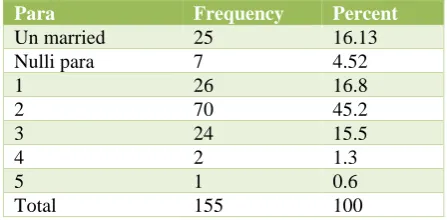
In the parity index - 25 (16.13%) were unmarried and 7 (4.52%) were nullipara. 80% of them had 1to5 live births (Table 3).
Table 3: Distribution of study participants regarding parity.
Para Frequency Percent
Un married 25 16.13 Nulli para 7 4.52
1 26 16.8
2 70 45.2
3 24 15.5
4 2 1.3
5 1 0.6
[image:2.595.316.540.655.765.2]Table 4: Distribution of thyroid function.
Thyroid Function Frequency Percent
Euthyroid 91 58.7 Hypothyroid 64 41.3 Sub clinical hypothyroid 2 1.3 Hyperthyroid 0 0
Among the study participants, 91 (58.7%) were normal thyroid function, 64 (41.3%) had hypothyroid and among hypothyroid 2 (1.3%) had subclinical hypothyroid (Table 4).
[image:3.595.57.545.210.284.2]Most of them were in the reproductive age group (Table 5).
Table 5: Comparison of types of thyroid with age group.
Age group Euthyroid Hypothyroid Sub clinical hypothyroid Chi Sq P
<20 Years 6 (6.6) 4 (6.2) 1
0.77 0.8
21-30 Years 52 (57.2) 36 (56.3) 1 31-40 Years 32 (35.2) 24 (37.5) 0 >40 Years 1 (1) 0 0
[image:3.595.56.542.316.414.2]Total 91 64 2
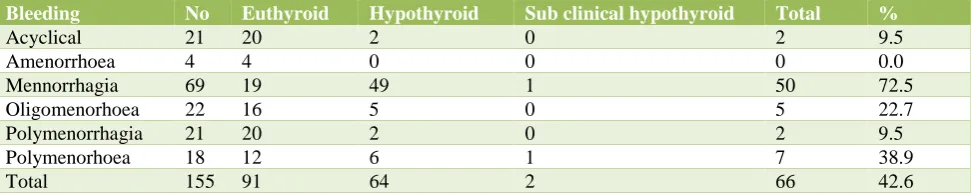
Table 6: Comparison of types of thyroid with type of bleeding.
Bleeding No Euthyroid Hypothyroid Sub clinical hypothyroid Total %
Acyclical 21 20 2 0 2 9.5
Amenorrhoea 4 4 0 0 0 0.0
Mennorrhagia 69 19 49 1 50 72.5
Oligomenorhoea 22 16 5 0 5 22.7
Polymenorrhagia 21 20 2 0 2 9.5
Polymenorhoea 18 12 6 1 7 38.9
Total 155 91 64 2 66 42.6
Most of them had Menorrhagia (72.5%), Polymenorrhoea and Oligomenorrhoea in both normal and hypothyroid (Table 6). Comparison of type of thyroid with parity
[image:3.595.49.546.539.624.2]among unmarried 8 (32%) had hypothyroid and in nullipara 3 (42.86%) had hypothyroid. Majority of hypothyroid prevailed in para either 2 or 3 live births (Table 8).
Table 7: Comparison of age group with type of bleeding.
Age
Group Acyclical Amenorrhoea Menorrhagia
Oligo menorrhoea
Poly
menorrhagia
Poly
menorrhoea Total p
<20 Yrs 0 0 7 1 0 2 10
0.13
21-30 Yrs 11 0 42 13 11 11 88
31-40 Yrs 9 4 20 8 10 5 56
>40 Yrs 1 0 0 0 0 0 1
[image:3.595.52.548.657.767.2]Total 21 4 69 22 21 18 155
Table 8: Comparison of type of thyroid with parity.
PARA No Euthyroid Eu % Hypothyroid Hypo % Sub clinical hypothyroid Sub Hypo %
Un married 25 17 68.00 8 32.00 0 0.00 Nulli para 7 4 57.14 3 42.86 0 0.00 Para 1 26 17 65.38 9 34.62 1 3.85 Para 2 70 37 52.86 33 47.14 0 0.00 Para 3 24 13 54.17 11 45.83 1 4.17
Para 4 2 2 100.00 0 0.00 0 0.00
Para 5 1 1 100.00 0 0.00 0 0.00
In 69 patients with high TSH level, menorrhagia in 49 cases, oligomenorrhoea in 6, polymenorrhoea in 7 cases and it is clinically significant P=0.001(Table 9). Table 9 explains comparison of thyroid function with type of bleeding by chi square test. There is significant
[image:4.595.54.546.187.338.2]association between TSH levels with type of bleeding (chi sq = 41.04, p = 0.001). There is no significant association between T3 levels with type of bleeding (chi sq = 9.47, p = 0.5). Similarly, there is no significant association between T4 levels with type of bleeding (chi sq = 8.8, p = 0.6).
Table 9: Comparison of thyroid levels (TSH, T3, T4) with type of bleeding.
TSH
Levels No Acyclical Amenorhoea Mennorhogia
Oligo mennorhoea
Poly
menorrhagia Poly
menorhea P
Low 4 1 0 1 0 1 1
Chi sq=41.04 P=0.001
Normal 82 17 4 19 16 16 10
High 69 3 0 49 6 4 7
T3 Levels
Low 92 16 3 39 15 12 7
Chi sq=9.47 P=0.5
Normal 61 5 1 29 7 9 10
High 2 0 0 1 0 0 1
T4 Levels
Low 11 1 0 5 4 0 1
Chi sq=8.8 P=0.6 Normal 129 19 4 58 16 18 14
High 15 1 0 6 2 3 3
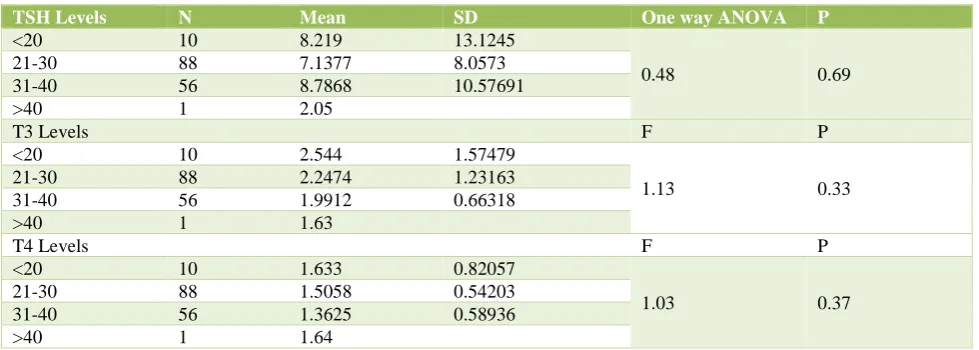
Table 10: Comparison of thyroid levels (TSH, T3, T4) with age group.
TSH Levels N Mean SD One way ANOVA P
<20 10 8.219 13.1245
0.48 0.69 21-30 88 7.1377 8.0573
31-40 56 8.7868 10.57691
>40 1 2.05
T3 Levels F P
<20 10 2.544 1.57479
1.13 0.33 21-30 88 2.2474 1.23163
31-40 56 1.9912 0.66318 >40 1 1.63
T4 Levels F P
<20 10 1.633 0.82057
1.03 0.37 21-30 88 1.5058 0.54203
31-40 56 1.3625 0.58936 >40 1 1.64
T3, T4, TSH levels have no clinical significance when compared with the age group (Table 10). Table 10 explain that there is no significant difference in TSH level due to age by one way ANOVA (F = 0.48, p = 0.69). There is no significant difference in T3 level due to age by one way ANOVA (F = 1.13, p = 0.33). There is no significant difference in T4 level due to age by one way ANOVA (F = 1.03, p = 0.37). In this study maximum patients, 56.8% were in age group 21–30 years, followed 31 – 40 years (36.1%).
DISCUSSION
Thyroid disorders in general and hypothyroidism in particular are the common causes of menstrual disorders in women. Menarche, pubertal growth and development,
menstrual cycles, fertility and fetal development, postpartum period, reproductive years, and postmenopausal years are profoundly influenced by the thyroid status of women. It is recognized universally that menstrual disturbances may accompany and even may precede thyroid dysfunction. Menorrhagia was the most common complaint among the patients with menstrual disorders, similar were observations of Pahwa.9 (50 %),
where menorrhagia was the most common complaint which is also similar to Present study. With hypothyroidism According to studies conducted by Krassas GE et al oligomenorrhoea and menorrhagia are the most common menstrual disturbances in patients.10
[image:4.595.54.544.368.543.2]menorrhagia was the most common menstrual disturbance and 76.6% of hypothyroid cases had menorrhagia. Studies show that prevalence of sub-clinical hypothyroidism is 4% to 8% in the general population, and upto 15% to 18% in women who are over 60 years of age.12 In this study 93.8% of hypothyroid cases were
between 21-40 years of age. But no significant association between age group and type of bleeding. Majority of hypothyroid cases prevailed in multipara either 2or 3 live births and 20.65% of hypothyroid cases were nulliparous in this study. Novak S mentions both hypothyroidism and hyperthyroidism can be associated with abnormal bleeding. With hypothyroidism, menstrual abnormalities, including menorrhagia are common. Present study also confirms this observation. Coagulation abnormalities such as von willebrand’s disease can have a variable clinical picture and may escape diagnosis until the reproductive years.13 Jeffcoates 2008, mentions,
hypothyroidism tends to cause menorrhagia or polymenorrhoea these symptoms being present in 30-40% of cases. Present study also confirms this finding-72.5% menorrhagia and 38.9% polymenorrhoea. Thyroid function should be especially evaluated in all cases of menorrhagia. Hypothyroidism and hyperthyroidism can both depress ovarian and menstrual function, the latter never causes amenorrhoea unless exophthalmos is present. Hyperthyroidism can result in oligomenorrhoea and amenorrhoea and it can also lead to elevated levels of plasma oestrogen. In present study, no hyperthyroid case was detected.4 cases of amenorrhoea which were euthyroid in this study. When hyperthyroidism is associated with amenorrhoea, it is necessary to recognize that it may be merely a manifestation of a pituitary fault which is also the cause of menstrual upset. In this study there is significant association between TSH level with type of bleeding (p=0.001 and chi. Sq =41.04) Hypothyroidism is associated with an increase in thyrotrophin releasing hormone which in turn may be associated with a raised prolactin level and hence amenorrhoea.14
CONCLUSION
This study which was done on patients who were provisionally diagnosed with dysfunctional uterine bleeding concludes that there is a high prevalence of thyroid disorders in cases which are clinically diagnosed as DUB. Evaluating for thyroid and treating it medically which was most accurate and cost effective and unnecessary surgery was avoided. Hence the thyroid function evaluation should be mandatory in cases of DUB to detect thyroid dysfunction and these cases should be referred to physician for further medical treatment.
Funding: No funding sources Conflict of interest: None declared
Ethical approval: The study was approved by the Institutional Ethics Committee
REFERENCES
1. Albers JR, Hull SK, Wesley RM. Abnormal uterine bleeding. AmFam Phys. 2004;69(8):1915-34. 2. Poppe K, Glinoer D. Thyroid autoimmunity and
hypothyroidism before and during pregnancy. Human Reprod Update. 2003;9:149-61.
3. Kochupillai N. Clinical endocrinology in India. Curr Sci. 2000;79:1061-7.
4. Hollowell JG, Staehling NW, Flanders WD, Hannon WH, Gunter EW, Spencer CA,et al. Serum TSH, T4, and thyroid antibodies in the United States population (1988 to 1994): National Health and Nutrition Examination Survey (NHANES III). J Clin Endocrinol Metab. 2002;87(2):489-99.
5. Cappola AR, Ladenson PW. Hypothyroidism and atherosclerosis. J Clin Endocrinol Metab. 2003;88:2438-44.
6. Bals-Pratsch M, Geyter D, Muller C, Frieling U, Lerchl A, Pirke KM et al. Episodic variations of prolactin, thyroid stimulating hormone, luteinizing hormone,melatonin and cortisol in infertile women with subclinical hypothyroidism. Human Reprod.1997;12: 896–904.
7. Davey DA. DUB. Dewhurst text book of obstetrics and gynecology for post Graduates. Chapter 40, 5th
ed.1990:590-600.
8. Ivor MD Jackson. Thyrotropin releasing homone. New Engl J of Med. 1982;306:154.
9. Pahwa S, Shailja G, Jasmine K. Thyroid dysfunction in dysfunctional uterine bleeding. J Adv Res Bio Sci. 2013;5(1):78-83.
10. Padmaleela K, Thomas V, Lavanya KM, Kiranmai D. Thyroid disorders in dysfunctional uterine bleeding (DUB) among reproductive age group women- a cross-sectional study in a tertiary care hospital in Andhra Pradesh India. Int J Med Pharma Sci. 2013;4(1):41-6.
11. Andrew D. Weeks Evidence supports associations between hypothyroidism and menorrhagia. BMJ. 2000;320:649.
12. Villar HC, Seconato H. Valente O, Atallah An. Thyroid hormone replacement for subclinical hypothyroidism. Cochrane Database Syst Rev. 2007;3:CD003419.72980 1517-24.
13. Hillard PJA. Benign Diseases of the Female Reproductive Tract. Symptoms and Signs. Jonathan S. Berek. Novak’s gynaecology. Chapter 13. 13th ed.
Philadelphia USA;2002:351-368.
14. Kumar P, Malhotra N. Abnormal and excessive uterine bleeding. Jeffcoates. Priniciples of gynecology. 7th ed. New Delhi; 2008:598-616.