Development and Characterization of Epoxy based
Polymer Matrix Hybrid Composite using Chicken
feather, Ceramic powder and Wood flour
Kiran.R.T1,Saju. K .K2 ,SandeshKiran3, R.Rajashekar4,B .M .Rajaprakash5 Research scholar, Department of Mechanical Engineering, UVCE, Bangalore, INDIA1 Research scholar, Department of Mechanical Engineering, UVCE, Bangalore, INDIA2 Research scholar, Department of Mechanical Engineering, UVCE, Bangalore, INDIA3 Asst Professor, Department of Mechanical Engineering, UVCE, Bangalore, INDIA4 Professor and chairman, Department of Mechanical Engineering, UVCE, Bangalore, INDIA5
Email: [email protected], [email protected], [email protected], [email protected], [email protected]
Abstract- Polymer Matrix Composites (PMCs) are gaining more importance compared to monolithic materials. They are finding application from household to engineering requirement. With the urge to develop new PMCs, their properties have been increased by the addition of one or more fibers. In order to add more economic value to chicken feather, it has been researched to incorporate chicken feather fibre, ceramic powder and wood flour into Epoxy resin to produce hybrid composite. The present work describes the development and characterization of natural fiber based hybrid polymer composite consisting of chicken feather, ceramic powder and wood flour as reinforcement and epoxy resin as the matrix. Hand layup technique is used to develop the hybrid composite. . The optimum percentage of volume fraction of ceramic powder, chicken fiber and wood flour is determined using Taguchi technique. It was observed that tensile strength of the hybrid composite increases considerably which indicate that the developed hybrid composite can be used as a potential alternate material for many structural and non-structural applications.
Keywords – Epoxy Resin, Chicken feather, Ceramic powder, Wood flour, Hybrid Polymer Composite, Taguchi Technique.
1. INTRODUCTION
A composite is a combination of two materials in which one of the material, called the reinforcing phase, is in the form of fibers, sheets, or particles, and is embedded in the other materials called the matrix phase. Composites typically have a fiber or particle phase that is stiffer and stronger than the continuous matrix phase and serve as the principal load carrying members. The matrix acts as a load transfer medium between fibers. Hybrids can have more than one reinforcing phase and a single matrix phase or single reinforcing phase with multiple matrix phases or multiple reinforcing and multiple matrix phases.[1]
Chicken feathers are waste products of the poultry industry. Billions of kilograms of waste feathers are generated each year by commercial poultry processing plants, creating a serious solid waste problem in many countries.[2]The presence of honeycomb structures of chicken feather is the main reason for the low density of barbs.[3]None of the natural or synthetic fibers commercially available have a density as low as that of chicken feathers which is around 0.8 g/cm3.[4]A ceramic is an inorganic non-metallic solid made up of either metal or non-metal compounds that have been shaped and then hardened
by heating to high temperatures. In general, they are hard, corrosion-resistant and brittle. Ceramics are generally made by taking mixtures of clay, earthen elements, powders, and water and shaping them into desired forms. Once the ceramic has been shaped, it is fired in a high temperature oven known as a kiln. Often, ceramics are covered in decorative, waterproof, paint-like substances known as glazes. All ceramics can be assigned to one of three basic categories, depending on what type of clay is used and the temperature at which it is fired: earthenware, stoneware, and porcelain. In ceramics, the bonding of atoms together is much stronger in covalent and ionic bonding than in metallic, hence metals are ductile and ceramics are brittle.[5]
area. Specific properties of natural fiber composite such as light weight, low cost, renewable in nature, high specific strength and modulus have widened the usage over other materials.In automobile industry the use of wood based natural fiber composites enhance mechanical strength, acoustic performance, reduce material weight and fuel consumption, improve biodegradability, production cost for the auto interior parts. Furthermore, wood fibers used in reinforcement and fillers for plastics, can also replace high-cost materials such as calcium carbonate and glass fiber.[6]
The objective of this study is to determine the optimal volume fraction composition of chicken fiber, ceramic powder and wood flourusing Taguchi’s experimental design method. Orthogonal arrays of Taguchi, the signal-to-noise (S/N) ratio are employed to find the optimal levels and to analyze the effect of the volume fraction variation on the tensile strength of the hybrid composite.
Kishor S. Joshi and SunitaM.Bagewadi (2016) studied various properties of Chicken quill including density, tensile strength, specific modulus, % elongation and compared with other fibers. They concluded that chicken quill can be used as a reinforcing material using epoxy/polyester resin as matrix material [7]. T. Subramani, S.Krishnan, S.K.Ganesan and G.Nagarajan (2014) conducted investigation of mechanical properties in polyester and phenyl-ester composites reinforced with chicken feather fiber. The bi-directional CFF reinforced composites were produced with phenyl ester and polyester resins with fiber reinforced composites. It is found that the compressive properties of the CFF reinforced composites are significantly better than the control composites. The CFF reinforced composite have potential applications due to its improved behavior and structural applications. The investigation shows that 20 % CFF and 80% Polyester having highly superiorproperties such as tensile, flexural and impact value. The tensile and flexural property values decrease when the fibre loading percentages increases [8].G. Narendar, V. Chandra Sekhar and S. Charvani (2017) studied the tensile properties of emu feather fiber reinforced epoxy composites for various fiber loading and fiber length. It is observed that there is a slight decrease in tensile strength with increase in fiber length. Maximum tensile strength of 28.28 MPa at one percent of fiber loading and one centimeter length of fiber. Minimum tensile strength of 19.30 MPa can be observed for 5 percent of fiber loading [9].
Antaryami Mishra (2017) conducted investigation of mechanical characteristics of chicken feather-teak wood dust filled epoxy composite. During these investigations it has been seen that the composite with 15 % teak wood dust and 5 % chicken feather is a good proposition for application as packing materials,
instrument casings, light decorative fittings and other such applications as it has shown highest tensile strength amongst all the materials considered [10]. Ibtihal-Al-Namie, Ahmed Aladdin Ibrahim, Mana lFleyah Hassan (2011) studied the mechanical properties of polymer composites reinforced with ceramic particulates.. The epoxy resin used as a Matrix material is Ep-10 and the reinforcement particulate materials are silica with particle size (53-63)µm and alumina with particle size (106-150)µm ,and having weight fraction of 20%, 30% and 40% respectively. Specimens of the matrix material and the six types of composite materials were subjected to tensile, compression, bending, impact and hardness tests. Experimental tests results indicate that the composite materials have significantly higher modulus of elasticity than the matrix material. It was found that the enhancement in modulus of elasticity is directly proportional to the weight fraction of reinforcement material and that alumina composites have higher modulus of elasticity than silica composites with equivalent weight fraction.[11]M. Uzun, E. Sancak , I. Patel , I. Usta , M. Akalın , M. Yuksek (2011)studied the mechanical properties of the chicken feather quill and fibre reinforced vinylester and polyester composites. It was found that the impact properties of the CFF reinforced composites are significantly better than the control composites however both the tensile and the flexural properties of the CFF reinforced composites have poorer values compared to the control composites[12]
to be produced by a mechanical mixing technique. Flexural strength and modulus of epoxy resin coated silica fillers composites at 80 to 95 volume percentage of filler content. Flexural properties normally will be enhanced with incorporation of fillers, this is in agreement with many researchers. It is interesting to note that epoxy composites filled at 80 volume percentage showed better flexural strength than those of the unfilled epoxy. However, as expected the flexural strength decreased with an increase in the coated silica content from 85 to 95 volume percentage. It is believed that the insufficiency of epoxy resins to coat the fillers at 85 to 95 volume percentage results in poor interfacial properties, high void content is subsequently reduces the flexural strength. From SEM micrographs it can be seen that fillers are fully coated by epoxy and it showed homogeneous dispersion at 80 volume percentage[14]. Rahul Kumar, Kausik Kumar, Prasanta Sahoo and Sumit Bhowmik (2014) investigated onsundi wood dust reinforced epoxy composite which were processed with seven different percentage filler weight. The tensile and flexural tests were performed at three different speeds to study the mechanical behaviour of the composites. From the observation it was found that the mechanical property increases up to certain filler percentage and then properties gradually decrease. From this we can conclude that filler size and filler content plays an important role in the property of resulting composite. The microstructure of the composites is also studied to analyze the change using scanning electron microscopy [15].
It can be concluded that there is a scope to develop a hybrid composite material by judiciously selecting the composition of Chicken feather, Ceramic powder and Wood flour reinforcements resulting in enhanced properties by using epoxy resin and corresponding hardener as the matrix material. The aim of this research paper is to optimize the composition of reinforcements for higher tensile strength of hybrid composite and to evaluate mechanical properties. Taguchi technique was employed to determine the optimum composition of reinforcements.
2. MATERIALS AND METHODOLOGY
2.1 Materials used
[image:3.612.314.522.105.314.2]The reinforcement materials including chicken fiber, ceramic powder, wood flour and matrix material including epoxy resin and hardener are shown in Table 2.1 with their specific properties including density and tensile strength. The reinforcements used are processed before being used in the development of hybrid composite.
Table 2.1 Specification of Materials Used
2.1.1Chicken feather
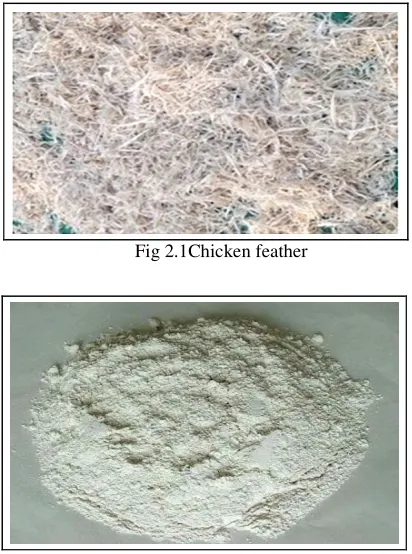
It is washed with ethanol to remove the blood stains and foul smell, followed by water. It is then subjected to drying under sunlight for 48 hours. Figure 2.1 shows the chicken feathers after treatment.
2.1.2 Ceramic powder
It is powdered by ball milling and filtered by a sieve to obtain a uniform size of 100µmas shown in Figure 2.2.
[image:3.612.314.520.109.312.2]Fig 2.1Chicken feather
Fig 2.2 Ceramic Powder
S.No Materials Specification
01 Epoxy resin (HSC 7600) Hardener (HSC 8210)
Density: 1.1 g/cm3 UTS: 50MPa
02 Ceramic Powder Density: 1.2g/cm3
03 Chicken feather Density :0.82g/cm3 04 Wood flour Density: 0.27
[image:3.612.314.520.429.706.2]2.1.3 Wood flour
[image:4.612.97.299.170.289.2]It isobtained from ply wood board and particle size of 2 µm is used as shown in Figure 2.3
Fig 2.3Wood Flour
2.2 Hand Layup Method
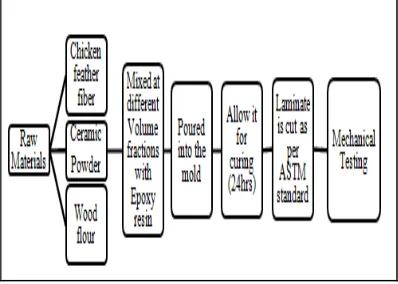
The method implemented in the fabrication of chicken feather, ceramic powder and wood flour hybrid composite is hand layup procedure and is a closed molding technique. The process flow chart of hand layup technique is show in Figure 2.4. In this method, ceramic powder and wood flour are mixed with epoxy resin for uniform dispersion. Chicken feathers of varying sizes are randomly oriented in the mould cavity. Epoxy resin mixed with wood flour and ceramic powder is applied over the chicken feather for proper wetting. A roller is used to compact the layer.
Fig 2.4 Hand Layup Process flow chart
2.3 Overview of Taguchitechnique
Design of experiment (DoE) as a statistical technique has been applied to determine simultaneously individual and interactive effects of manufacturing parameters on the composites
performance. The conventional DoE, a full factorial method, can study all the possible cases of various factors but requires a large number of experiments and high cost. The Taguchi method is a powerful DoE technique to overcome this problem as it can decrease the number of experiments significantly by a specially designed orthogonal array (OA), which can accommodate the selected manufacturing parameters for the analysis. Furthermore, signal to noise ratio (S/N) reflecting both the amount of variation present and the mean response of several repetitions can be used in Taguchi method to measure the amount of variability in the response data. The S/Ncan minimise the effects of noise (uncontrollable) factors and identify control factors settings, thus reducing the sensitivity of the system performance to a source of variation.[15]
The objective of this study is to determine the optimal values of input parameters namely, volume fraction composition of ceramic powder, chicken fiber and wood flour using Taguchi’s experimental design method. Orthogonal arrays of Taguchi, the signal-to-noise (S/N) ratio are employed to determine the optimal combination of volume fractions of above mentioned reinforcements and to analyze their effects on the tensile strength of resulting composite.
3. EXPERIMENTATION PLAN
3.1 Selection of process parameters and their levels
[image:4.612.96.295.476.618.2]In order to optimize the volume fraction of reinforcements for maximum tensile strength of hybrid composite, it is necessary to obtain the range of reinforcements. It is found that the tensile strength of chicken fiber epoxy composite increases to a volume fraction of 16% and further increase of volume fraction decreases the tensile strength, hence the range selected for chicken fiber is 14%, 16% and 18% [15]. Similarly in case of ceramic powder, the range selected is 8%, 10% and 12% [16] and for wood flour the range selected is 8%, 10% and 12% [6]. Table 3.1 showsthe control parameters selected and their corresponding levelsfor developing hybrid composite with an objective to achieve maximum tensile strength.
Table 3.1 Control Parameters and their Levels Sl.
No.
Control Parameters Level 1 Level 2 Level 3
1 Volume fraction of Chicken fiber
14 16 18
2 Volume fraction of Ceramic powder
8 10 12
3 Volume fraction of wood flour
[image:4.612.313.523.602.722.2]3.2 Design of experiments and data analysis
For the three control parameters and three levels selected, a set of 9 experiments are performed based on L9 orthogonal array as shown in Table 3.2. The Ultimate Tensile Strength (UTS) determined from experiments and Signal to Noise ratio computed are tabulated.[15]
UTS= () ………... “Eq. (1)”
The loss function (L) for objective of Higher is Better (HB) is defined as follows:[15]
L!"= 1/% & 1/y()*+
,- ………. “ Eq. (2)” Where“n”indicatesthenumber of experiments and y()* is the responseforUltimate tensile strength (UTS). The S/N ratio can be calculated as a logarithmic transformation of the loss function as shownbelow.[15]
S/N ratio for UTS = -10log10(LHB)………… “Eq. (3)” The S/N ratios and experimental measured values of Ultimate tensile strength are computed using equations (1) and (3).
Table3.2 Experimental Design using L9Orthogonal Array
Expt No
Volume Fraction of Chicken Fiber in (%) (A)
Volume Fraction of Ceramic powder in (%) (B)
Volume Fraction of Wood flour in (%)
(C)
Tensile Strength (Mpa)
Signal to Noise ratio
1 14 8 8 51.32 34.20
2 14 10 10 57.54 35.199
3 14 12 12 67.98 36.64
4 16 8 10 80.32 38.09
5 16 10 12 91.32 39.21
6 16 12 8 94.30 39.50
7 18 8 12 97.32 39.76
8 18 10 8 87.32 38.82
9 18 12 10 80.85 38.15
3.3 Analysis of variation(ANOVA)
In order to understand the impact of various factors and their interactions, analysis of variance (ANOVA) is carried out to determine the order of significant factors as well as interactions.[15] Table 3.3 shows the results of the ANOVA with the tensile strength. The last column of the Table indicates that the main effects are highly significant (all having very small p- values).From Table 3.3, it can be concluded
[image:5.612.313.522.168.331.2]that the volume fraction of chicken fiber (p=0.059) and volume fraction of wood flour (p=0.310) have great influence on tensile strength.
Table 3.3 ANOVA table for tensile strength
Source DF Adj SS Adj MS F-Value P-Value
% Vol of Chicken
fiber
2 1755.32 877.66 15.96 0.05
% Vol of Ceramic powder
2 33.46 16.73 0.30 0.76
% Vol of Wood
flour
2 244.49 122.24 2.22 0.31
Error 2 109.92 54.96
Total 8 2143.2044
3.4 Mechanical characterization
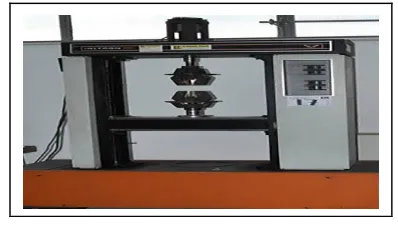
[image:5.612.95.301.413.594.2]Ultimate tensile strength is the maximum stress that a material can withstand while being stretched before fracture. The tensile test specimen was prepared according to ASTM D3039 standard. The specimens of size 250 mm x 25 mm x 5mm were tested with a cross head speed of 1 mm / min. The Universal Testing Machine, Instron 1195 used in tensile testingis shown in Figure 3.1 and tensile test specimen is shown in Figure 3.2.
Fig. 3.1UTM setup for Tensile test
[image:5.612.322.521.474.587.2]4. RESULTS AND DISCUSSION
4.1 Determination of optimum parameters
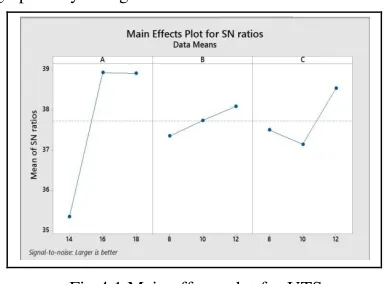
[image:6.612.96.292.169.311.2]The effect of three process parameters on ultimate tensile strength (UTS) is shown in graphically in Figure 4.1.
Fig 4.1 Main effects plot for UTS
[image:6.612.93.297.412.655.2]Using MINITAB 18, response tables for S/N ratio of UTS is calculated as shown in Table 4.1. Based on the analysis of S/N ratio, the optimum volume fractions for UTS along with their corresponding levels are obtained and is shown in Table 4.2.
Table 4.1 Response table for S/N ratio
From Figure 4.1, the optimum percentage of reinforcements for maximum tensile strength is identified and shown in Table 4.2.
Table 4.2 Optimum Composition of Reinforcements
4.2 Ultimate tensile strength
Tensile test was conducted for hybrid composite (16% Chicken fiber, 12% Ceramic powder and 12% Wood flour) and Control (Neat) composite specimens .Table 4.3 lists the UTS of hybrid composite and Control composite.
Table 4.3 Ultimate tensile strength of hybrid composite
4.3 Confirmation experiment for Ultimate Tensile Strength
The optimal combination of control parameters has been determined. However, the final step is to predict and verify the improvement of the observed values through the use of the optimal combination level of volume fractions. The estimated S/N ratio for UTS can be calculated with the help of predictionequation (4).
%. = %+ ∑3,-(n − n)………. “Eq. (4)”
The confirmation experiment is performed by conducting a test with specific combination of the factors and levels evaluated. After determining the optimum conditions and predicting the response under these conditions, a new experiment was conducted for LEVEL
Volume Fraction of Chicken Fiber (%) (A)
Volume Fraction of Ceramic Powder (%) (B)
Volume Fraction Wood Flour (%) (C)
1 35.34 37.35 37.50
2 38.93 37.74 37.14
3 38.81 38.096 38.53
Delta 3.57 0.74 1.39
Rank 1 3 2
Parameter Level Optimum Value
Volume fraction of Chicken fiber in %
2 16
Volume fraction of Ceramic powder in %
3 12
Volume fraction of Wood flour in %
3 12
Trial
#1
UTS
(MPa)
Average UTS
of Hybrid
Composite
(MPa)
UTS of
Control
Composite
(MPa) 1 99.30
97.22 50 2 97.21
preparing hybrid composite with the optimum levels of the volume fractions of reinforcement.[15] Table 4.4 shows the comparison of the experimental results for theoptimal conditions with predicted results for maximum tensile strength.
Table 4.4 Optimal Conditions of Prediction v/s Experimental
5. CONCLUSION
The experimental investigation on the effect of hybridization on tensile strength of chicken fiber, ceramic powder and wood flour reinforced epoxy composite leads to the following conclusions:
• The successful development and fabrication of a new class of epoxy based composite has been done. • By Taguchi’s design of experiments the optimum volume fraction for the hybrid composite is determined as 16% chicken fiber, 12% ceramic powder and 12% wood flour.
• For optimum volume fraction of reinforcements identified, the tensile strength, of hybrid composite is calculated and compared with control composite. It is found that the hybridization resulted in considerable increase in the tensile property of hybrid composite. The increase in the tensile property is due to the increased adhesion of fibers with the matrix material which can be due to the proper dispersion of ceramic powder and wood flour in the epoxy resin and inclusion of Quill along with chicken fiber also contributed to an increase in the tensile strength of hybrid composite.
• When the tensile property predominates material selection process, the developed hybrid composite can be considered to be used in automobile parts including door panels, door trim, mirror casing, bumper beam, instrument panel, helmets due to their superior tensile properties over currently using natural/synthetic fiber reinforced composites.
REFERENCES
[1] Hardinnawirda Bintikahar, A thesis on “The effect of rice husk as filler in Polymer matrix composites”, University of Malayasia, Pahang, 2012.
[2] Menandro N. Acda, “Sustainable Agriculture: Technology, Planning and Mgt” ISBN: 978-1-60876-269-9, Editor: Augusto Salazar and Ismael Rios, 2009. Nova Science Publishers, Inc, Page:353.
[3] Ana Laura Martínez - Hernández and Carlos Velasco-Santos “Keratin fibers from Chicken feathers: Structure and advances in Polymer composites”. Nova Science Publishers, Inc, 2012. ISBN 978-1-62100-336-6 Editors: Renke Dullaart et al. pp. 149-211.
[4] ChintaS.K, LandageS.M, YadavKrati “Appln of Chicken Feathers in Technical Textiles” International Journal of Innovative Research in Science, Engineering and Technology, Vol. 2, Issue 4, April 2013.
[5] Ajay Kumar Mishra, “Solgel Based Nano ceramic Materials: Preparation, Properties and Applns”, Springer Publications.ISBN978-3-319-49510-1, doi:10.1007/978-3-319-49512-5.
[6] Rahul Kumar, Kausik Kumar, PrasantaSahoo and SumitBhowmik “Study of mechanical properties of wood dust reinforced epoxy composite”, 3rd International conference on materials processing and characterization (ICMPC 204), Procedia: MaterialsScience,6(2014)551-556,
www.elsevier.com/locate/procedia.
[7] Kishor S. Joshi and Mrs. SunitaM.Bagewadi “Analysis of Properties of Artificial biological composite materials”.International Journal of Engineering Research and General Science Volume 4, Issue 1, January-February, 2016, ISSN 2091-2730.
[8] T. Subramani, S.Krishnan, S.K.Ganesan and G.Nagarajan “Investigation of Mechanical Properties in Polyester and Phenyl- ester Composites Reinforced With Chicken Feather Fiber”. Int. Journal of Engineering Research and Applications ISSN : 2248-9622, Vol. 4, Issue 12 ( Part 4), December 2014, pp.93-104.
[9] G. Narendar, V. Chandra Sekhar and S. Charvani “Tensile Properties of Fiber Reinforced Epoxy Composites for various Fiber loading and Fiber Prediction Experimental
S/N Ratio 40.99 39.75
Tensile strength
(MPa)
101.344 97.22
length”. International Journal of Latest Engineering Research and Applications (IJLERA) ISSN: 2455-713, Volume – 02, Issue 10, October – 2017, PP –66-71.
[10] Antaryami Mishra “Investigations of Mechanical Characteristics of Chicken Feather-Teak wood Dust Filled Epoxy Composites”. International Journal of Engineering Research and Development, Volume 13, Issue 4 (April 2017), PP.01-09.
[11] Ibtihal-Al-Namie, Ahmed Aladdin Ibrahim, Manal Fleyah Hassan, “Study the mechanical properties of epoxy resin reinforced with silica (quartz) and alumina particles”,The Iraqi joural for mechanical and material engineering, Vol 11, No.3, 2011.
[12] M. Uzun , E. Sancak , I. Patel , I. Usta , M. AkalınM. Yuksek“Mechanical behaviour of chicken quills and chicken feather fibres reinforced polymeric composites”.
International Scientific Journal published monthly by the World Academy of Materialsand Manufacturing Engineering, Volume 52,Issue 2, December 2011, Pages 82-86.
[13] Isiaka O. Oladele, Jimmy L. Olajide, and AdekunleS. Ogunbadejo “The Influence of Chemical Treatment on the Mechanical Behaviour of Animal Fibre-Reinforced High Density Polyethylene Composites”. American Journal of Engineering Research(AJER), Volume-04, Issue-02,pp-19-26.
[14] P.L. Teh , M. Mariatti , H.M. Akil, C.K. Yeoh , K.N. Seetharamu ,A.N.R. Wagiman , K.S. Beh, “ The properties of epoxy resin coated silica fillers composites”, Materials Letters 61(2007) 2156-2158, www.elsevier.com/locate/matlet.
[15] Saju K K, Sandeshkiran, B M Rajaprakash (2018) "Development and Characterization of Epoxy based Polymer Matrix Hybrid Composite using chicken feather, coir fiber and egg shell powder”. Symposium:148thAnnual Technical Meeting/Symposium-March 10-14, 2019, San Antonio, USA, organized by The Minerals, Metals and Materials Society (TMS), USA. Status: Accepted for presentation and publication in TMS 2019.
[16] M. Hussain, Y. Oku, A. Nakahira, K. Niihara.(1996) "Effects of wet ball-milling on particle dispersion and mechanical properties of particulate epoxy composites".Materials Letters 26 (1996) 177-184, Elsevier.