Hypothesis Transformation and Semantic Variability Rules Used in
Recognizing Textual Entailment
Adrian Iftene
„Al. I. Cuza“ University, Faculty of
Computer Science, Iasi, Romania
[email protected]
Alexandra Balahur-Dobrescu
„Al. I. Cuza“ University, Faculty of
Computer Science, Iasi, Romania
[email protected]
Abstract
Based on the core approach of the tree edit distance algorithm, the system central mod-ule is designed to target the scope of TE – semantic variability. The main idea is to transform the hypothesis making use of ex-tensive semantic knowledge from sources like DIRT, WordNet, Wikipedia, acronyms database. Additionally, we built a system to acquire the extra background knowledge needed and applied complex grammar rules for rephrasing in English.
1
Introduction
Many NLP applications need to recognize when the meaning of one text can be expressed by, or inferred from, another text. Information Retrieval (IR), Question Answering (QA), Information Ex-traction (IE), Text Summarization (SUM) are ex-amples of applications that need to assess such a semantic relationship between text segments. Tex-tual Entailment Recognition (RTE) (Dagan et al., 2006) has recently been proposed as an application independent task to capture such inferences.
This year our textual entailment system partici-pated for the first time in the RTE1 competition. Next chapters present its main parts, the detailed results obtained and some possible future im-provements.
2
System description
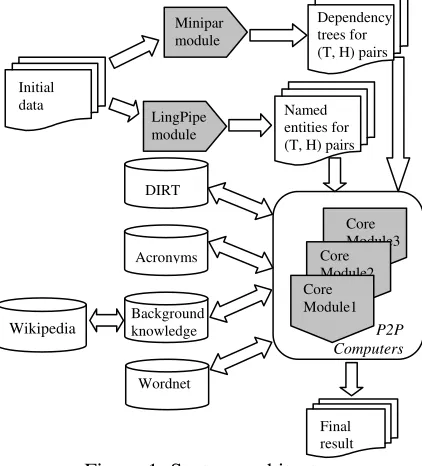
The process requires an initial pre-processing, fol-lowed by the execution of a core module which uses the output of the first phase and obtains in the end the answers for all pairs. Figure 1 shows how
1 http://www.pascal-network.org/Challenges/RTE3/
[image:1.612.320.531.258.491.2]the pre-processing is realized with the MINIPAR (Lin, 1998) and LingPipe2 modules which provide the input for the core module. This one uses four databases: DIRT, Acronyms, Background knowl-edge and WordNet.
Figure 1: System architecture
The system architecture is based on a peer-to-peer networks design, in which neighboring com-puters collaborate in order to obtain the global fit-ness for every text-hypothesis pair. Eventually, based on the computed score, we decide for which pairs we have entailment. This type of architecture was used in order to increase the computation speed.
3
Initial pre-processing
The first step splits the initial file into pairs of files for text and hypothesis. All these files are then sent to the LingPipe module in order to find the Named entities.
2 http://www.alias-i.com/lingpipe/
Initial data
DIRT Minipar module
Dependency trees for (T, H) pairs
LingPipe module
Named entities for (T, H) pairs
Final result
Core Module3 Core Module2 Core Module1 Acronyms
Background knowledge
Wordnet
P2P Computers
Wikipedia
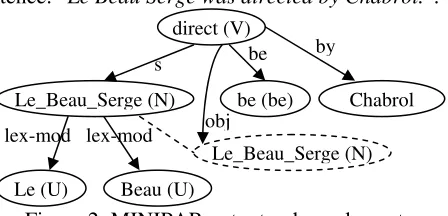
In parallel, we transform with MINIPAR both the text and the hypothesis into dependency trees. Figure 2 shows the output associated with the sen-tence: “Le Beau Serge was directed by Chabrol.”.
Figure 2: MINIPAR output – dependency tree For every node from the MINIPAR output, we consider a stamp called entity with three main fea-tures: the node lemma, the father lemma and the edge label (which represents the relation between words) (like in Figure 3).
Figure 3: Entity components
Using this stamp, we can easily distinguish be-tween nodes of the trees, even if these have the same lemma and the same father. In the example from Figure 1, for the “son” nodes we have two entities (Le_Beau_Serge, direct, s) and (Le_Beau_Serge, direct, obj).
4
The hypothesis tree transformation
Presently, the core of our approach is based on a tree edit distance algorithm applied on the depend-ency trees of both the text and the hypothesis (Kouylekov, Magnini 2005). If the distance (i.e. the cost of the editing operations) among the two trees is below a certain threshold, empirically estimated on the training data, then we assign an entailment relation between the two texts.The main goal is to map every entity in the de-pendency tree associated with the hypothesis (called from now on hypothesis tree) to an entity in the dependency tree associated with the text (called from now on text tree).
For every mapping we calculate a local fitness value which indicates the appropriateness between entities. Subsequently, the global fitness is calcu-lated from these partial values.
For every node (refers to the word contained in the node) which can be mapped directly to a node
from the text tree, we consider the local fitness value to be 1. When we cannot map one word of the hypothesis to one node from the text, we have the following possibilities:
• If the word is a verb in the hypothesis tree, we use the DIRT resource (Lin and Pantel, 2001) in order to transform the hypothesis tree into an equivalent one, with the same nodes except the verb. Our aim in performing this transforma-tion is to find a new value for the verb which can be better mapped in the text tree.
• If the word is marked as named entity by Ling-Pipe, we try to use an acronyms’ database3 or if the word is a number we try to obtain informa-tion related to it from the background knowl-edge. In the event that even after these operations we cannot map the word from the hypothesis tree to one node from the text tree, no fitness values are computed for this case and we decide the final result: No entailment.
• Else, we use WordNet (Fellbaum, 1998) to look up synonyms for this word and try to map them to nodes from the text tree.
Following this procedure, for every transforma-tion with DIRT or WordNet, we consider for local fitness the similarity value indicated by these re-sources. If after all checks, one node from the hy-pothesis tree cannot be mapped, some penalty is inserted in the value of the node local fitness.
4.1
The DIRT resource
For the verbs in the MINIPAR output, we extract templates with DIRT- like format. For the sample output in Figure 2, where we have a single verb “direct”, we obtain the following list of “full” tem-plates:N:s:V<direct>V:by:N and N:obj:V<direct> V:by:N. To this list we add a list of “partial” tem-plates: N:s:V<direct>V:, :V<direct>V:by:N, :V<direct>V:by:N, and N:obj:V<direct>V:.
In the same way, we build a list with templates for the verbs in the text tree. With these two lists we perform a search in the DIRT database and ex-tract the “best” trimming, considering the template type (full or partial) and the DIRT score.
According to the search results, we have the fol-lowing situations:
3 http://www.acronym-guide.com
direct (V)
Le_Beau_Serge (N) be (be) Chabrol
Le_Beau_Serge (N)
Le (U) Beau (U)
s be by
obj lex-mod
node lemma edge label
a) left – left relations similarity
This case is described by the following two tem-plates for the hypothesis and the text:
relation1 HypothesisVerb relation2 relation1 TextVerb relation3
This is the most frequent case, in which a verb is replaced by one of its synonyms or equivalent ex-pressions
The transformation of the hypothesis tree is done in two steps:
1. Replace the relation2 with relation3,
2. Replace the verb from the hypothesis with the corresponding verb from the text. (see Figure 4).
Figure 4: Left-left relation similarity b) right – right relations similarity: the same
idea from the previous case.
c) left – right relations similarity
This case can be described by the following two templates for the hypothesis and the text:
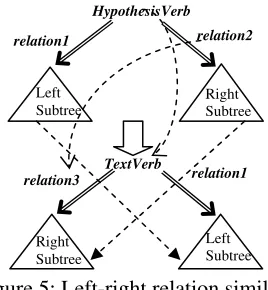
relation1 HypothesisVerb relation2 relation3 TextVerb relation1
The transformation of the hypothesis tree is: 1. Replace the relation2 with relation3,
2. Replace the verb from the hypothesis with the corresponding verb from the text.
[image:3.612.356.490.62.207.2]3. Rotate the subtrees accordingly: left sub-tree will be right subsub-tree and vice-versa right subtree will become left-subtree (as it can be observed in Figure 5).
Figure 5: Left-right relation similarity This case appears for pair 161 with the verb “at-tack“:
T: “The demonstrators, convoked by the solidarity with Latin America committee, verbally attacked Salvadoran President Alfredo Cristiani.”
H: “President Alfredo Cristiani was attacked by demonstrators.”
In this case, for the text we have the template N:subj:V<attack>V:obj:N, and for the hypothesis the template N:obj:V<attack>V:by:N. Using DIRT, hypothesis H is transformed into:
H’: Demonstrators attacked President Alfredo Cristiani.
Under this new form, H is easier comparable to T. d) right – left relations similarity: the same
idea from the previous case
For every node transformed with DIRT, we con-sider its local fitness as being the similarity value indicated by DIRT.
4.2
Extended WordNet
For non-verbs nodes from the hypothesis tree, if in the text tree we do not have nodes with the same lemma, we search for their synonyms in the ex-tended WordNet4. For every synonym, we check to see if it appears in the text tree, and select the map-ping with the best value according to the values from Extended WordNet. Subsequently, we change the word from the hypothesis tree with the word from WordNet and also its fitness with its indicated similarity value. For example, the relation between “relative” and “niece” is accomplished with a score of 0.078652.
4 http://xwn.hlt.utdallas.edu/downloads.html
HypothesisVerb relation1 relation2
TextVerb
relation3 relation1
Left Subtree
Right Subtree
Right Subtree
Left Subtree
HypothesisVerb relation1 relation2
TextVerb
relation1 relation3
Left
Subtree Right Subtree
Right Subtree Left
4.3
Acronyms
The acronyms’ database helps our program find relations between the acronym and its meaning: “US - United States”, and “EU - European Union”. We change the word with the corresponding ex-pression from this database. Since the meaning is the same, the local fitness is considered maximum, i.e. 1.
4.4
Background Knowledge
Some information cannot be deduced from the al-ready used databases and thus we require addi-tional means of gathering extra information of the form:
Argentine [is] Argentina Netherlands [is] Holland 2 [is] two
Los Angeles [in] California Chinese [in] China
Table 1: Background knowledge
Background knowledge was built semi-automatically, for the named entities (NEs) and for numbers from the hypothesis without correspon-dence in the text. For these NEs, we used a module to extract from Wikipedia5 snippets with informa-tion related to them. Subsequently, we use this file with snippets and some previously set patterns of relations between NEs, with the goal to identify a known relation between the NE for which we have a problem and another NE.
If such a relation is found, we save it to an out-put file. Usually, not all relations are correct, but those that are will help us at the next run.
Our patterns identify two kinds of relations be-tween words:
• “is”, when the module extracts information of the form: ‘Argentine Republic’ (Spanish: 'Re-publica Argentina', IPA)’ or when explanations about the word are given in brackets, or when the extracted information contains one verb used to define something, like “is”, “define”, “represent”: '2' ('two') is a number.
• “in” when information is of the form: 'Chinese' refers to anything pertaining to China or in the form Los Angeles County, California, etc.
5 http://en.wikipedia.org/wiki/Main_Page
In this case, the local fitness for the node is set to the maximum value for the [is]-type relations, and it receives some penalties for the [in]-type relation.
5
Determination of entailment
After transforming the hypothesis tree, we calcu-late a global fitness score using the extended local fitness value for every node from the hypothesis - which is calculated as sum of the following values:
1. local fitness obtained after the tree trans-formation and node mapping,
2. parent fitness after parent mapping,
3. mapping of the node edge label from the hypothesis tree onto the text tree,
4. node position (left, right) towards its father in the hypothesis and position of the map-ping nodes from the text.
After calculating this extended local fitness score, the system computes a total fitness for all the nodes in the hypothesis tree and a negation value associ-ated to the hypothesis tree. Tests have shown that out of these parameters, some are more important (the parameter at 1.) and some less (the parameter at 3.). Below you can observe an example of how the calculations for 3 and 4 are performed and what the negation rules are.
5.1
Edge label mapping
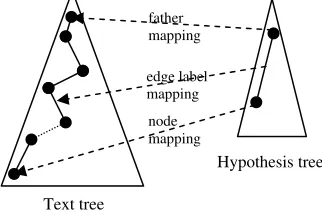
[image:4.612.345.506.569.675.2]After the process of mapping between nodes, we check how edge labels from the hypothesis tree are mapped onto the text tree. Thus, having two adja-cent nodes in the hypothesis, which are linked by an edge with a certain label, we search on the path between the nodes’ mappings in the text tree this label. (see Figure 6)
Figure 6: Entity mapping
Text tree
node mapping father mapping
edge label mapping
It is possible that more nodes until the label of the edge linking the nodes in the hypothesis exist, or it is possible that this label is not even found on this path. According to the distance or to the case in which the label is missing, we insert some penalties in the extended local fitness.
5.2
Node position
After mapping the nodes, one of the two following possible situations may be encountered:
• The position of the node towards its father and the position of the mapping node towards its father’s mapping are the same (left-left or right-right). In this case, the extended local fit-ness is incremented.
• The positions are different (left-right or right-left) and in this case a penalty is applied ac-cordingly.
5.3
Negation rules
For every verb from the hypothesis we consider a Boolean value which indicates whether the verb has a negation or not, or, equivalently, if it is re-lated to a verb or adverb “diminishing” its sense or not. Consequently, we check in its tree on its de-scending branches to see whether one or more of the following words are to be found (pure form of negation or modal verb in indicative or conditional form): “not, may, might, cannot, should, could, etc.”. For each of these words we successively ne-gate the initial truth value of the verb, which by default is “false”. The final value depends on the number of such words.
Since the mapping is done for all verbs in the text and hypothesis, regardless of their original form in the snippet, we also focused on studying the impact of the original form of the verb on its overall meaning within the text. Infinitives can be identified when preceded by the particle “to”. Ob-serving this behavior, one complex rule for nega-tion was built for the particle “to” when it precedes a verb. In this case, the sense of the infinitive is strongly influenced by the active verb, adverb or noun before the particle “to”, as follows: if it is being preceded by a verb like “allow, impose, gal-vanize” or their synonyms, or adjective like “nec-essary, compulsory, free” or their synonyms or noun like “attempt”, “trial” and their synonyms, the
meaning of the verb in infinitive form is stressed upon and becomes “certain”. For all other cases, the particle “to” diminish the certainty of the action expressed in the infinitive-form verb. Based on the synonyms database with the English thesaurus6, we built two separate lists – one of “certainty stressing (preserving)” – “positive” and one of “certainty diminishing” – “negative” words. Some examples of these words are “probably”, “likely” – from the list of “negative” words and “certainly”, “abso-lutely” – from the list of “positive” words.
5.4
Global fitness calculation
We calculate for every node from the hypothesis tree the value of the extended local fitness, and af-terwards consider the normalized value relative to the number of nodes from the hypothesis tree. We denote this result by TF (total fitness):
r NodesNumbe Hypothesis
calFitness ExtendedLo
TF = node∈H node
After calculating this value, we compute a value NV (the negation value) indicating the number of verbs with the same value of negation, using the following formula:
rOfVerbs TotalNumbe
r VerbsNumbe Positive
NV = _
where the Positive_VerbsNumber is the number of non-negated verbs from the hypothesis using the negation rules, and TotalNumberOfVerbs is the total number of verbs from the hypothesis.
Because the maximum value for the extended fitness is 4, the complementary value of the TF is 4-TF and the formula for the global fitness used is:
) 4 ( * ) 1 (
*TF NV TF
NV ess
GlobalFitn = + − −
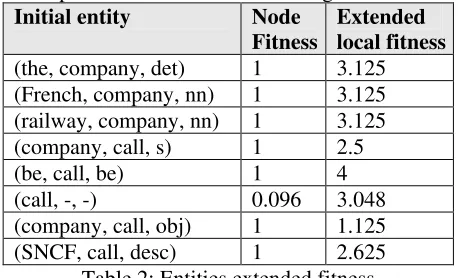
For pair 518 we have the following: Initial entity Node
Fitness Extended local fitness (the, company, det) 1 3.125 (French, company, nn) 1 3.125 (railway, company, nn) 1 3.125 (company, call, s) 1 2.5
(be, call, be) 1 4
[image:5.612.313.542.531.670.2](call, -, -) 0.096 3.048 (company, call, obj) 1 1.125 (SNCF, call, desc) 1 2.625 Table 2: Entities extended fitness
TF = (3.125 + 3.125 + 3.125 + 2.5 + 4 + 3.048 + 1.125 + 2.625)/8 = 22.673/8 = 2.834
NV = 1/1 = 1
GlobalFitness = 1*2.834+(1–1)*(4-2.834) = 2.834 Using the development data, we establish a threshold value of 2.06. Thus, pair 518 will have the answer “yes”.
6
Results
Our system has a different behavior on different existing tasks, with higher results on Question An-swering (0.87) and lower results on Information Extraction (0.57). We submitted two runs for our system, with different parameters used in calculat-ing the extended local fitness. However, the results are almost the same (see Table 3).
IE IR QA SUM Global Run01 0.57 0.69 0.87 0.635 0.6913 Run02 0.57 0.685 0.865 0.645 0.6913
Table 3: Test results
To be able to see each component’s relevance, the system was run in turn with each component re-moved. The results in the table below show that the system part verifying the NEs is the most impor-tant.
System Description Precision Relevance Without DIRT 0.6876 0.54 % Without WordNet 0.6800 1.63 % Without Acronyms 0.6838 1.08 %
Without BK 0.6775 2.00 %
Without Negations 0.6763 2.17 % Without NEs 0.5758 16.71 %
Table 4: Components relevance
7
Conclusions
The system’s core algorithm is based on the tree edit distance approach, however, focused on trans-forming the hypothesis. It presently uses wide-spread syntactic analysis tools like Minipar, lexical resources like WordNet and LingPipe for Named Entities recognition and semantic resources like DIRT. The system’s originality resides firstly in creating a part-of and equivalence ontology using an extraction module for Wikipedia data on NEs (the background knowledge), secondly in using a distinct database of acronyms from different do-mains, thirdly acquiring a set of important context influencing terms and creating a semantic equiva-lence set of rules based on English rephrasing
con-cepts and last, but not least, on the technical side, using a distributed architecture for time perform-ance enhperform-ancement.
The approach unveiled some issues related to the dependency to parsing tools, for example separat-ing the verb and the preposition in the case of phrasal verbs, resulting in the change of meaning.
Another issue was identifying expressions that change context nuances, which we denoted by “positive” or “negative” words. Although we ap-plied rules for them, we still require analysis to determine their accurate quantification.
For the future, our first concern is to search for a method to establish more precise values for penal-ties, in order to obtain lower values for pairs with No entailment. Furthermore, we will develop a new method to determine the multiplication coefficients for the parameters in the extended local fitness and the global threshold.
8
Acknowledgements
The authors thank the members of the NLP group in Iasi for their help and support at different stages of the system development. Special thanks go to Daniel Matei which was responsible for preparing all the input data.
The work on this project is partially financed by Siemens VDO Ia i and by the CEEX Rotel project number 29.
References
Dagan, I., Glickman, O., and Magnini, B. 2006. The PASCAL Recognising Textual Entailment Challenge. In Quiñonero-Candela et al., editors, MLCW 2005, LNAI Volume 3944, pages 177-190. Springer-Verlag. Fellbaum, C. 1998. WordNet: An Electronic Lexical
Database. MIT Press, Cambridge, Mass.
Kouylekov, M. and Magnini, B. 2005. Recognizing Tex-tual Entailment with Tree Edit Distance Algorithms. In Proceedings of the First Challenge Workshop Rec-ognising Textual Entailment, Pages 17-20, 25–28 April, 2005, Southampton, U.K.
Lin, D. 1998. Dependency-based Evaluation of MINIPAR. In Workshop on the Evaluation of Parsing Systems, Granada, Spain, May, 1998.