Precision-focused Textual Inference
D. G. Bobrow, C. Condoravdi, R. Crouch, V. de Paiva, L. Karttunen, T. H. King, R. Nairn, L. Price, A. Zaenen
Palo Alto Research Center
Abstract
This paper describes our system as used in theRTE3task. The system maps premise and hypothesis pairs into an abstract knowledge representation (AKR) and then performs en-tailment and contradiction detection (ECD) on the resultingAKRs. Two versions ofECD were used inRTE3, one with strict ECDand one with looserECD.
1 Introduction
In theRTEtextual entailment challenge, one is given a source textTand a hypothesisH, and the task is to decide whether H can be inferred fromT. Our sys-tem interprets inference in a strict way. Given the knowledge of the language embedded in the system, does the hypothesis logically follow from the infor-mation embedded in the text? Thus we are empha-sizing precision, particularly in question-answering. This was reflected in our results in the RTE3 chal-lenge. We responded correctly withYESto relatively few of the examples, but on the QA-type examples, we achieved 90-95% average precision.
The methodology employed is to use the linguis-tic information to mapTandHonto a logical form in AKR, our Abstract Knowledge Representation. The AKR is designed to capture the propositions the au-thor of a statement is committed to. For the sake of ECD, the representation ofT may include elements that are not directly expressed in the text. For ex-ample, in theAKRofJohn bought a carincludes the fact that the car was sold. TheAKRofJohn forgot to buy milkincludes the fact that John did not buy milk. Our reasoning algorithm tries to determine whether theAKRofHis subsumed by theAKRofTand detect cases when they are in conflict.
The Entailment and Contradiction Detection (ECD) algorithm makes a distinction that is not part of the basicRTEchallenge. IfTentails the negation ofH, we answer NO (Contradiction). On the other
Process Output
Text-Breaking Delimited sentences Named-entity recognition Type-marked Entities Morphological Analysis Word stems plus features LFGParsing Functional Structure Semantic processing Scope,
Predicate-argument structure AKRrules Conceptual, Contextual,
Temporal Structure
Figure 1: The processing pipeline: processes with their ambiguity-enabled packed outputs
hand, if there is no direct entailment we answerUN -KNOWN. We do not try to construct a likely scenario that would linkT andH. Nor have we tried to col-lect data on phrases that would tend to indicate such likely associations betweenTandH. That approach is clearly very useful (e.g. (Hickl et al., 2006)), and could be used as a backup strategy with our more formal entailment approach. We have chosen to fo-cus on strict structural and lexical entailments.
This paper describes the processing pipeline for mapping toAKR, theECDalgorithm, the challenges we faced in processing theRTEdata and a summary of our results onRTE3.
2 Process Pipeline
Figure 1 shows the processing pipeline for mapping texts to AKR. The input is a text of one or more sentences.
n=50.
The parser takes the output of the morphology (i.e. a series of lemmata with their tags) and pro-duces a tree (constituent-structure) and a depen-dency structure (functional-structure) represented as an attribute-value matrix. The functional-structure is of primary importance for the semantics and AKR. In particular, it encodes predicate-argument relations, including long-distance dependencies, and provides other syntactic features (e.g. number, tense, noun type).
The output of the syntax is input for the seman-tics that is produced by an ambiguity enabled packed rewriting system. The semantics is described in de-tail in (Crouch and King, 2006). Semantic process-ing assigns scope to scope-bearprocess-ing elements such as negation and normalizes the output of the syntax. This normalization includes reformulating syntactic passives as actives (e.g.The cake was eaten by Mary.
/Mary ate the cake.), resolving many null pronouns (e.g.Laughing, John entered the room/Johni
laugh-ing, Johni entered the room.), and canonicalizing
measure phrases, comparatives, and dates. More complex normalizations involve converting nominal deverbals into the equivalent verbal form, identify-ing arguments of the verb from the arguments of the nominal (Gurevich et al., 2006). For example, the semantic representation ofIraq’s destruction of its WMDis similar to the representation ofIraq de-stroyed itsWMD.
The final main task of the semantics rules is to convert words into concepts and syntactic grammat-ical functions into roles. The mapping onto concepts uses WordNet (Fellbaum, 1998) to map words into lists of synsets. The named entity types provided by the morphology and syntax are used to create more accurate mapping of proper nouns since these are not systematically represented in WordNet. The se-mantic rules use the grammatical function subcat-egorization information from the verb and the role information found in extended VerbNet (Kipper et al., 2000) to map syntactic subjects, objects, and obliques into more abstract thematic roles such as Agent, Theme, and Goal (Crouch and King, 2005). This mapping into thematic-style roles allows the system to correctly align the arguments in pairs like (1) and (2), something which is impossible using just syntactic functions. In the first, the object and
sub-ject have a common thematic role in the alternation between transitive and intransitive; while in the sec-ond, the common role is shared by the subjects.
(1) John broke the vasesyn:object,sem:patient.
The vasesyn:subject,sem:patientbroke.
(2) Johnsyn:subject,sem:agentate the cake.
Johnsyn:subject,sem:agentate.
The goal of these semantic normalizations is to abstract away from the syntactic representation so that sentences with similar meaning have similar se-mantic representations. However, the sese-mantics is still fundamentally a linguistic level of representa-tion; further abstraction towards the meaning is done in the mapping from semantics to AKR. The AKR is the level of representation that is used to deter-mine entailment and contradiction in ourRTE3 sys-tem. A preliminary description of its logic was pro-vided in (Bobrow et al., 2005). The AKR mapping converts grammatical tense and temporal modifiers into temporal relations, identifies anaphoric refer-ents and makes explicit the implied relation between complement clauses and the main verb (e.g. for
manage, fail) (Nairn et al., 2006). AKR also deals with standard phrases that are equivalent to simple vocabulary terms. For example,take a flight to New York is equivalent to fly to New York. These uses of “light” verbs (e.g. take, give) are not included in synonyms found in WordNet. Another class of phrasal synonyms involve inchoatives (e.g. take a turn for the worse/worsen). We included a special set of transformation rules for phrasal synonyms: some of the rules are part of the mapping from se-mantics to AKR while others are part of the ECD module. The mapping toAKRis done using the same ambiguity-enabled ordered rewriting system that the semantics uses, allowing theAKR mapping system to efficiently process the packed output of the se-mantics.
Conceptual Structure
subconcept(claim:37,[claim-1,. . .,claim-5]) role(Topic,claim:37,claim cx:37)
role(Agent,claim:37,Bush:1) subconcept(Bush:1,[person-1]) alias(Bush:1,[Bush])
role(cardinality restriction,Bush:1,sg)
subconcept(possess:24,[possess-1,own-1,possess-3]) role(Destination,possess:24,wmd:34)
role(Agent,possess:24,Iraq:19)
subconcept(Iraq:19,[location-1,location-4]) alias(Iraq:19,[Iraq])
role(cardinality restriction,Iraq:19,sg) subconcept(wmd:34,
[weapon of mass destruction-1]) role(cardinality restriction,wmd:34,pl)
Contextual Structure
context(t)
context(claim cx:37)
context relation(t,claim cx:37,crel(Topic,claim:37)) instantiable(Bush:1,t)
instantiable(Iraq:19,t) instantiable(claim:37,t)
instantiable(Iraq:19,claim cx:37) instantiable(possess:24,claim cx:37) instantiable(wmd:34,claim cx:37)
Temporal Structure
temporalRel(After,Now,claim:37) temporalRel(After,claim:37,possess:24)
Figure 2: AKRforBush claimed that Iraq possessed
WMDs.
Bush:1 which refer to the kinds of object that the sentence is talking about. The subconcept facts ex-plicitly link these terms to their concepts in Word-Net. Thus claim:37 is stated to be some subkind of the type claim-1, etc., and wmd:34 to be some subkind of the type weapon of mass destruction-1. Terms like claim:37 and wmd:34 do not refer to individuals, but to concepts (or types or kinds). Saying that there is some subconcept of the kind weapon of mass destruction-1, where this subcon-cept is further restricted to be a kind of WMD pos-sessed by Iraq, does not commit you to saying that there are any instances of this subconcept.
The instantiable assertions capture the commit-ments about the existence of the kinds of object
de-scribed. In the top-level context t, there is a com-mitment to an instance of Bush and of a claim:37 event made by him. However, there is no top-level commitment to any instances of wmd:34 possessed by Iraq:19. These commitments are only made in the embedded claim cx:37 context. It is left open whether these embedded commitments correspond, or not, to the beliefs of the speaker. Two distinct levels of structure can thus be discerned inAKR: a conceptual structure and a contextual structure. The conceptual structure, through use of subconcept and role assertions, indicates the subject matter. The contextual structure indicates commitments as to the existence of the subject matter via instantiability as-sertions linking concepts to contexts, and via context relations linking contexts to contexts. In addition, there is a temporal structure that situates the events described with respect to the time of utterance and temporally relates them to one another.
3 Entailment and Contradiction Detection
ECDis implemented as another set of rewrite rules, running on the same packed rewrite system used to generate theAKRrepresentations. The rules (i) align concept and context terms in text (T) and hypoth-esis (H) AKRs, (ii) calculate concept subsumption orderings between alignedT and H terms, and (iii) check instantiability and uninstantiability claims in the light of subsumption orderings to determine whether T entails H, T contradicts H, or T neither entails not contradictsH. For the purposes of RTE3, both contradiction and neither contradiction nor en-tailment are collapsed into a NO (does not follow) judgment.
One of the novel features of this approach is that T and H representations do not need to be disam-biguated before checking for entailment or contra-diction. The approach is able to detect if there is one reading ofTthat entails (or contradicts) one reading ofH. The T andH passages can in effect mutually disambiguate one another through theECD. For ex-ample, althoughplaneandlevelboth have multiple readings, they can both refer to a horizontal surface, and in that senseThe plane is dryentailsThe level is dry, and vice versa.
repre-sented as lists of WordNet hypernym lists, in Word-Net sense order. Two concept terms can be aligned if a sense synset of one term (i.e. the first element of one of the term’s hypernym lists) is contained in a hypernym list of the other term. The alignment can be weighted according to word sense; so a con-cept overlap on the first senses of a T and H term counts for more than a concept overlap on thenand
mth senses. However, no weightings were used in RTE3. For named entities, alignment demands not only a concept overlap, but also an intersection in the “alias” forms of the proper nouns. For exam-ple,“George Bush” may be aligned with “George” or with “Bush”. Context alignment relies on associ-ating each context with an indexing concept, usually the concept for the main verb in the clause heading the context. Contexts are then aligned on the basis of these concept indices.
Typically, anHterm can align with more than one T term. In such cases all possible alignments are proposed, but the alignment rules put the alternative alignments in different parts of the choice space.
Having alignedTandHterms, rules are applied to determine concept specificity and subsumption rela-tions between aligned terms. Preliminary judgments of specificity are made by looking for hypernym in-clusion. For example, anH term denoting the con-cept “person” is less specific than a T term denot-ing “woman”. These preliminary judgments need to be revised in the light of role restrictions modifying the terms: a “tall person” is neither more nor less specific than a ”woman”. Revisions to specificity judgments also take into account cardinality modi-fiers: while “person” is less specific than “woman”, “all persons” is judged to be more specific than “all women”.
With judgments of concept specificity in place, it is possible to determine entailment relations on the basis of (un)instantiability claims in the T and H AKRs. For example, suppose the T andH AKRs contain the facts in (3).
(3) T: instantiable(C T, Ctx T) H: instantiable(C H, Ctx H)
where concept C T is aligned with C H, C T is judged to be more specific than C H, and context Ctx T is aligned with context Ctx H. In this case, the hypothesis instantiability claim is entailed by
the text instantiability claim (existence of something more specific entails existence of something more general). This being so, the H instantiability claim can be deleted without loss of information.
If instead we had the (un)instantiability claims in (4) for the same alignments and specificity relations,
(4) T: instantiable(C T, Ctx T) H: uninstantiable(C H, Ctx H)
we would have a contradiction: the text says that there is something of the more specific type C T, whereas the hypothesis says there are no things of the more general type C H. In this case, the rules explicitly flag a contradiction.
Once all (un)instantiability claims have been compared, it is possible to judge whether the text en-tails or contradicts the hypothesis. Entailed hypothe-sis (un)instantiability assertions are deleted from the representation. Consequently, if there is oneTandH AKRreadings and one set of alignments under which all theH(un)instantiability assertions have been re-moved, then there is an entailment of H by T. If there is a pair of readings and a set of alignments under which a contradiction is flagged, then there is a contradiction. If there is no pair of readings or set of alignments under which there is either an en-tailment or a contradiction, thenTandHare merely consistent with one another. There are exceptional cases such as (5) where one reading of T entailsH and another reading contradicts it.
(5) T: John did not wait to call for help. H: John called for help.
OurECDrules detect such cases.
WordNet often misses synonyms needed for the alignment in the ECD. In particular, the hierarchy and synsets for verbs are one of WordNet’s least de-veloped parts. To test the impact of the missing syn-onyms, we developed a variation on the ECD algo-rithm that allows loose matching.
specificity judgments unless theTandHverbs have very similar arguments / role restrictions.
When such a loose verb alignment is made, we explicitly record this fact in a justification term in-cluded in the alignment fact. Similarly, when judg-ing concept specificity, each rule that applies adds a term to a list of justifications recorded as part of the fact indicating the specificity relation. This means that when the final specificity judgments are deter-mined, each judgment has a record of the sequence of decisions made to reach it.
(Un)instantiability comparisons are made as in strict matching. However, the criteria for detect-ing an entailment are selectively loosened. If no contradiction is flagged, and there is a pairing of readings and alignments under which just a single H instantiability assertion is left standing, then this is allowed through as a loose entailment. However, further rules are applied to block those loose entail-ments that are deemed inappropriate. These block-ing rules look at the form of the justification terms gathered based on specificity judgments.
These blocking rules are manually selected. First, a loose matching run is made without any block-ing rules. Results are dumped for each T-H pair, recording the expected logical relation and the jus-tifications collected. Blocking rules are created by detecting patterns of justification that are associated with labeled non-entailments. One such blocking rule says that if you have just a single H instantia-bility left, but the specificity justifications leading to this have been shown to be reliable on training data, then the instantiability should not be eliminated as a loose entailment.
4 Challenges in Processing theRTEData
The RTE3 data set contains inconsistencies in spelling and punctuation between the text and the hypothesis. To handle these, we did an automatic prepass where we compared the strings in the pas-sage text to those in the hypothesis. Some of the special cases that we handled include:
• Normalize capitalization and spacing
• Identify acronyms and shorten names
• Title identification
• Spelling correction
Role names in VerbNet are in part intended to cap-ture the relation of the argument to the event be-ing described by the verb. For example, an object playing an Agent role is causally involved in the event, while an object playing a Theme or Patient role is only supposed to be affected. This allows participants in an action to be identified regardless of the syntactic frame chosen to represent the verb; this was seen in (1) and (2). Sometimes the roles from VerbNet are not assigned in such a way as to allow such transparent identification across frames or related verbs. Consider an example. InEd trav-els/goes to BostonVerbNet identifies Ed as playing a Theme role. However, inEd flies to BostonVerbNet assigns Ed an Agent role; this difference can make determining contradiction and entailment betweenT andHdifficult. We have tried to compensate in our ECD, by using a backoff strategy where fewer role names are used (by projecting down role names to the smaller set). As we develop the system further, we continue to experiment with which set of roles works best for which tasks.
Another open issue involves identifying alterna-tive ways vague relations among objects appear in text. We do not match the expression the Boston teamwiththe team from Boston. To improve our re-call, we are considering loose matching techniques.
5 Summary of our results onRTE3
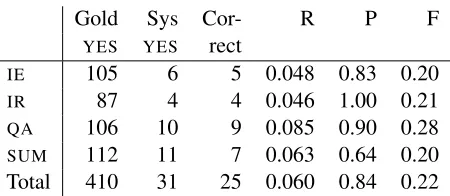
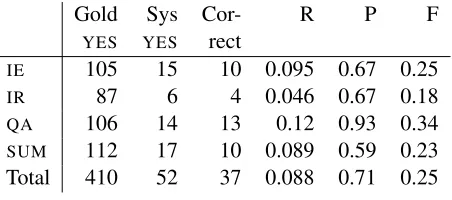
We participated in the RTE challenge as a way to understand what our particular techniques could do with respect to a more general version of textual en-tailment. The overall experiment was quite enlight-ening. Tables 1 and 2 summarize how we did on the RTE3 challenge. System 1 is our standard system with strictECD. System 2 used the looser set ofECD rules.
Gold Sys Cor- R P F
YES YES rect
IE 105 6 5 0.048 0.83 0.20
IR 87 4 4 0.046 1.00 0.21
QA 106 10 9 0.085 0.90 0.28
[image:5.612.316.541.571.669.2]SUM 112 11 7 0.063 0.64 0.20 Total 410 31 25 0.060 0.84 0.22
Gold Sys Cor- R P F YES YES rect
IE 105 15 10 0.095 0.67 0.25
IR 87 6 4 0.046 0.67 0.18
QA 106 14 13 0.12 0.93 0.34
[image:6.612.75.301.54.154.2]SUM 112 17 10 0.089 0.59 0.23 Total 410 52 37 0.088 0.71 0.25
Table 2:System 2 with LooseECD
As can be seen, we answered very few of the ques-tions; only 31 of the possible 410 with aYESanswer. However, for those we did answer (requiring only linguistic, and not world knowledge), we achieved high precision: up to 90% onQA. However, we were not perfect even from this perspective. Here are sim-plified versions of the errors where our system an-swered YES, and the answer should be NOwith an analysis of what is needed in the system to correct the error.
The wrong result in (6) is due to our incomplete coverage of intensional verbs (seek, want, look for,
need, etc.).
(6) T: The US sought the release of hostages. H: Hostages were released.
The object of an intensional verb cannot be assumed to exist or to occur. Intensional verbs need to be marked systematically in our lexicon.
The problem with (7) lies in the lack of treatment for generic sentences.
(7) T: Girls and boys are segregated in high school during sex education class.
H: Girls and boys are segregated in high school. The natural interpretation ofHis that girls and boys are segregated in high school ALL THE TIME. Be-cause we do not yet handle generic sentences prop-erly, our algorithm for calculating specificity pro-duces the wrong result here. It judges segregation in H to be less specific than inTwhereas the opposite is in fact the case. Adding the word “sometimes” to Hwould make ourYESthe correct answer.
The distinction between generic and episodic readings is difficult to make but crucial for the in-terpretation of bare plural noun phrases such asgirls
andboys. For example, the most likely interpreta-tion ofCounselors are availableis episodic: SOME counselors are available. But Experts are highly
paidis weighted towards a generic reading: MOST IF NOT ALLexperts get a good salary.
These examples are indicative of the subtlety of analysis necessary for high precision textual infer-ence.
References
Danny Bobrow, Cleo Condoravdi, Richard Crouch, Ronald Kaplan, Lauri Karttunen, Tracy Holloway King, Valeria de Paiva, and Annie Zaenen. 2005. A basic logic for textual inference. InProceedings of the AAAI Workshop on Inference for Textual Question An-swering.
Dick Crouch and Tracy Holloway King. 2005. Unify-ing lexical resources. InProceedings of the Interdisci-plinary Workshop on the Identification and Represen-tation of Verb Features and Verb Classes.
Dick Crouch and Tracy Holloway King. 2006.
Se-mantics via F-structure rewriting. In Proceedings of
LFG06. CSLI On-line Publications.
Dick Crouch, Mary Dalrymple, Ron Kaplan, Tracy King, John Maxwell, and Paula Newman. 2007. XLE docu-mentation. Available on-line.
Christiane Fellbaum, editor. 1998. WordNet: An
Elec-tronic Lexical Database. The MIT Press.
Olga Gurevich, Richard Crouch, Tracy Holloway King, and Valeria de Paiva. 2006. Deverbal nouns in
knowl-edge representation. InProceedings of FLAIRS 2006.
Andres Hickl, John Williams, Jeremy Bensley, Kirk Roberts, Bryan Rink, and Ying Shi. 2006. Recog-nizing textual entailment with LCC’s GROUNDHOG
system. InThe Second PASCAL Recognising Textual
Entailment Challenge.
Karin Kipper, Hoa Trang Dang, and Martha Palmer. 2000. Class-based construction of a verb lexicon. In
AAAI-2000 17th National Conference on Artificial In-telligence.
John Maxwell and Ron Kaplan. 1991. A method for
disjunctive constraint satisfaction. Current Issues in
Parsing Technologies.
Rowan Nairn, Cleo Condoravdi, and Lauri Karttunen. 2006. Computing relative polarity for textual
infer-ence. InProceedings of ICoS-5.
Stefan Riezler, Tracy Holloway King, Ron Kaplan, Dick
Crouch, John Maxwell, and Mark Johnson. 2002.
Parsing the Wall Street Journal using a Lexical-Functional Grammar and discriminative estimation
techniques. InProceedings of the Annual Meeting of