Volume 8, No. 5, May-June 2017
International Journal of Advanced Research in Computer Science
SURVEY PAPER
Available Online at www.ijarcs.info
Augmented Reality (AR) Applications: A survey on Current Trends, Challenges, &
Future Scope
Daiwat Amit Vyas
Department of Information Technology Institute of Technology, Nirma University
Ahmedabad, Gujarat - India
Dvijesh Bhatt
Department of Information Technology Institute of Technology, Nirma University
Ahmedabad, Gujarat - India
Abstract: In the last decade with the advances in computer hardware technologies, display devices, controller devices, software enhancements has tremendously aided the Augmented Reality (AR) Technology to grow from leaps to bounds. Augmented Reality (AR) is a technique that enables users to interact with their physical environment through the overlay of digital information. AR is a field of computer science which deals with combination of reality with computer generated data i.e it aids enhancement over a real world environment in real time. Virtual Reality (VR) and Augmented Reality (AR) are technologies that have a wide spread reach in various technological fronts and has a very promising prospect for various diversified research avenues. An in-depth understanding of trends, challenges, future scope for AR systems is discussed in this survey paper. Authors have made a conscious effort to investigate the state of the art in AR Technologies and its diversified engineering application areas. Various aspects of the design of an AR system are taken into consideration, like the interface devices for interacting with virtual world, software’s, the hardware etc. Also, described are a few specific applications that have been developed using the AR technology and possible avenues for future research in the field of AR. Latest trends & evolution of this technology have been touched upon for better understanding. Various applications have been explored and possible approach for enhancing the use of this technology have been discussed. We have discussed some of the limitations in developing such systems. Tools available for development of AR applications that satisfy the current requirements are included. Future directions and suggestions for effectively and efficiently improving the application areas have been focused upon. This paper will provide a better insight for anyone who wishes to do research in the field of AR.
Keywords: Augmented Reality (AR), Virtual Reality (VR), display devices
I. INTRODUCTION
The term Augmented Reality (AR) is used to describe a combination of technologies that enable real-time mixing of computer-generated content with live video display. AR is based on techniques developed in VR [1] and interacts not only with a virtual world but has a degree of interdependence with the real world. Augmenting a reality makes sense as soon as we focus on the human being and on his perception of the world. Reality cannot be increased but its perceptions can be improved, and a better result can be achieved. We will however keep the term of Augmented Reality even if we understand it as an “increased perception of reality”.
AR technology uses real world object or real world space as a foundation and incorporates other technologies that help in adding contextual data to widen the scope of understanding for a person for the subject. The contextual data added can be any computer-generated sensory input such as sound, video, graphics or GPS data.
We can define an AR system to have following properties:
Combines real and virtual objects in a real environment
Runs interactively and in real time
Aligns i.e calibrates real and virtual objects with each other
One can envision AR as a technology in which one could see more than others see, hear more than what others hear and perhaps even touch and feel, smell and taste things that other people cannot feel. It is such an advancement in technology which enables us to perceive completely computational
elements/objects within real world experience, entire creatures and structures, even that helps us is our daily activities while interacting almost unconsciously through mere gesture and speech. Theoretically, augmented reality (AR) is an emerging area in computer science that enhances a human or a machine’s perception of an environment. It combines multiple technologies in the field of computer vision such as computer graphics and user interfaces into a single system. [2]
It provides numerous benefits to human and also to various automation and computing system by superimposing additional information in the form of computer generated 2D and 3D graphics on the user’s view of the surrounding environment.
Azuma [3] defines AR to be when “3D virtual objects are integrated into a 3D real environment in real time.” First, it requires the combination of virtual elements and real environment. One can think of AR as a part of a virtuality continuum theorized and conceptualized by Milgram and F. Kishino [4]. It is a combination where the real scene viewed by the user and a virtual scene generated by the computer is augmented with additional information. The virtual components are merged and combined with the real view to create the augmented view scene. An AR system supplements the real world with virtual (computer-generated) objects that appear to coexist in the same space as the real world [5] [6] [7].
There are basically three types of Augmented Reality (AR) systems:
i.GPS and Compass Based AR systems ii.Marker Based AR systems
GPS and Compass Based AR systems: It uses the on-board GPS and Compass for determining a user’s current position and accordingly the camera screen will be augmented and virtual objects will be aligned accordingly. Mainly used for mobile phones and hand-held devices. Tracking and provide location markers for better understanding of a user’s surrounding and navigation can be facilitated.
Marker Based AR: Tracking method for visual marker
detection, pose estimation for Image or object recognition and 3D Object Tracking in Augmented View. The visual markers design can differ from one to another. But the use of these visual markers limit the interactivity and are constrained to a range of photos or objects encapsulated within a border to create the marker. In order to use this approach, these visual marks have to be printed previously and also be kept for future uses.
Fig 1.1 An example of a Marker Based AR {Source: http://www.arlab.com/blog/markerless-augmented-reality}
Marker-Less AR: In order to perform the object tracking, marker-less augmented reality systems rely in natural features instead of fiducial marks. Therefore, there are no ambient intrusive markers which are not really part of the environment.
Fig 1.2 An example of a Marker-Less AR
{Source:
For AR systems various display technologies are essential. Basically there are two types:
i. Monitor based AR display
ii.Video see through AR display with Head Mounted Display (HMD)
Monitor-based augmented reality display: In this a
[image:2.595.48.279.253.400.2] [image:2.595.45.281.483.650.2]computer system monitor is used as an output for visualization of AR system.
Fig 1.3 Monitor based AR display technology
Video see-through augmented reality display with HMD: In
this aHMD is used where the visual AR output can be viewed by the user.
Fig 1.3 HMD based AR display technology
II. AUGMENTED REALITY AND VIRTUAL REALITY
Wherever we discuss AR technology it becomes mandatory to discuss Virtual Reality (VR). VR in simple terms can be described as an imaginary worlds that only exist in computers and our minds. To put emphasis on VR let us split it into two terms: Virtual and Reality. Virtual can be defined as something being in essence or in effect but not in a fact. Reality can be defined as something apparently that exists. Virtual Reality can be termed as an artificial environment which is experienced through sensory stimuli (as sights and sounds) provided by a computer and in which one’s actions partially determine what happens in the environment [8]. Further we can defines a virtual reality to be a computer-generated environment that can be interacted with as if that environment was real. [9]A good virtual reality system will allow users to physically walk around objects and touch those objects as if they were real. Ivan Sutherland, the creator of one of the world’s first virtual reality systems stated”. The ultimate display would, of course, be a room within which the computer can control the existence of matter. A chair displayed in such a room would be good enough to sit in. Handcuffs displayed in such a room would be confining, and a bullet displayed in such a room would be fatal” sutherland68. Comparison of VR and AR:
Virtual Reality Augmented Reality
It creates immersive computer system generated virtual environments which replaces
actual real environments.
It augments real world environment with computer
User is immersed completely into virtual environment and completely cut-off from real
world.
immersed but not completely cut-off from real world, in fact both
[image:3.595.32.287.56.185.2]co-exist.
Fig 2.1 Reality, AR, VR [10] Table 2.1 VR and AR Comparison
AR and VR open the doors to a wide range of practical applicability. With their distinctive ability to solve problems, dramatically simplify processes and engage people – all of these characteristics lead AR and VR to sustaining technology which can address various problems and provide solutions in education, healthcare, engineering, sports, construction and various other fields.
III. LITERATURESURVEY
An extensive literature survey was carried out by referring various research papers related to augmented reality and its applications. The basic highlights of some of the research papers and survey has been mentioned in this section. The survey was carried out considering various diversified applications of AR, challenges in AR applications, various possible solutions to resolve the identified problems and possibilities in future for AR. This survey laid an important foundation for this survey paper and it would also be useful to understand Augmented Reality with a different view point for researchers.
"
R. T. Azuma, A Survey of Augmented Reality, vol. 4,no. August, pp. 355385, 1997."
This paper describes the characteristics of Augmented Reality systems with their basic application areas, including a detailed discussion of the tradeoffs between optical and video blending approaches for developing various end applications. The major focus included are registration and sensing errors which are two of the biggest problems in building effective Augmented Reality systems. The paper also summarizes current efforts to overcome the above mentioned problems. Future directions and areas requiring further research are discussed in this paper. This survey provides a starting point for anyone interested in researching or using Augmented Reality for various applications. After the basic problems with AR are solved and with advances in visual and graphics systems, the ultimate goal would be to generate virtual objects that are so realistic that they are virtually indistinguishable from the real environment, which improves overall AR system. [11]
"A. Nawab, K. Chintamani, D. Ellis, G. Auner, and A.
Pandya, Joystick mapped Augmented Reality Cues for End-E_ector controlled Tele-operate Robots, 2007 IEEE Virtual Real. Conf., pp. 263266, 2007."
This paper reports the positive effects of Augmented Reality on operator performance during end-effector controlled teleoperation using only camera views. It provides a solution to overlay a color coded coordinate system on the
end-effector of the robot using Augmented Reality techniques. The mapped and color coded coordinate system is then directly mapped to similarly color coded joysticks used for control of end-effector mounted on robotic arm for various tooling and maintenance applications. The AR view along with mapped co-ordinate markings on the joystick give the user a clear notion of the effect of their joystick movements on the end-effector of the robot. All camera views display this registered dynamic overlay information on demand as per the user’s requirement. [12]
"S. Hashimoto, TouchMe: An Augmented Reality
Based Remote Robot Manipulation.
In robotic telemanipulation activities the mapping between the user input and resulting robot motion is not always intuitive. This paper proposes a touch-based interface for remotely controlling a robot from a third-person view, which is called TouchMe. This system allows the user to manipulate each part of the robot by directly touching it on a view of the world as seen by a camera looking at the robot from a third-person view. It also describes the TouchMe interaction and its prototype implementation for roboti applications. It presented the design, implementation and an initial evaluation of an augmented reality interface for controlling a multi-DOF robot. Also, experimental results do conclude that the users requested richer visualization for understanding the state of the robot. [13]
"S. Buraga, . Tanas, and M. Brut, A VRML-based
Environment Used to Learn Virtual Reality Concepts, pp. 4551."
This paper presents a VRML-based environment used for learning virtual reality concepts. The environment uses a complex library of VRML (Virtual Reality Modeling Language) objects and an intranet-style Web site. It describes the architecture of environment and the library of over 50 VRML objects used in this application. To proper explain the VRML source-code, an annotation Web tool is implemented by using XML mark-ups added to each object. The available objects are used by the students to develop different virtual worlds. This environment uses a complex library of VRML (Virtual Reality Modeling Language) objects. The developed objects models simple or complex fragments of virtual scenes that can be used later in whole virtual worlds. Using VRML one can create different virtual objects which can be used for various applications related to virtual reality and augmented reality. [14]
"J. Vallino, Interactive augmented reality, 1998"
This paper provides a novel approach to make augmented reality interface interactive. It presents techniques that can free the user from restrictive requirements such as working in calibrated environments, results with haptic interface technology incorporated into augmented reality domains, and systems considerations that underlie the practical realization of these interactive augmented reality techniques. [15]
"J. Kristo and T. Manesh, AUGMENTED REALITY
Nowadays production in many modern industries is largely driven by the use of industrial robots to manufacture and process materials, components of products, and other goods. Industrial robots are used in a variety of applications ranging from the automotive industry, to construction, to food processing, and to a large quantity of other scenarios. To a significant extent, industrial robotics facilitates the mass production associated with these industries. Additionally, industrial robots fulfill an ethical obligation to society. They help prevent tasks that would otherwise be hazardous or harmful to humans, and, by increasing competitiveness and manufacturing potential, also help create jobs and increase the revenue generated in a particular market. This paper seeks to examine the use of Augmented Reality systems as a mode of offline programming specifically for the development of industrial robots and the advantages of such systems when compared to alternative methods. [16]
"J. Das, W. C. Evans, M. Minnig, A. Bahr, G. S.
Sukhatme, and A. Martinoli, Environmental Sensing using Land-based Spectrally selective Cameras and a Quadcopter.
This paper describes a 3D modeling system in Augmented Reality environment, named 3DARModeler. It can be considered a simple version of 3D Studio Max with necessary functions for a modeling system such as creating objects, applying texture, adding animation, estimating real light sources and casting shadows. The 3DARModeler introduces convenient, and effective human-computer interaction to build 3D models by combining both the traditional input method (mouse/keyboard) and the tangible input method (markers). It has the ability to align a new virtual object with the existing parts of a model. The 3DARModeler targets non- technical users. As such, they do not need much knowledge of computer graphics and modeling techniques. All they have to do is select basic objects, customize their attributes, and put them together to build a 3D model in a simple and intuitive way as if they were doing in the real world. Using the hierarchical modeling technique, the users are able to group several basic objects to manage them as a unified, complex object. The system can also connect with other 3D systems by importing and exporting VRML/3Ds Max files. A module of speech recognition is included in the system to provide flexible user interfaces. [17]
“R. Aigner, The Development and Evaluation of an
Augmented Reality Assisted Multimodal Interaction System for a Robotic Arm, no. September, 2010."
This paper introduces a novel multimodal interaction approach for operating and programming industrial robots, by combining six degree of freedom tracking with human speech input and touchscreen interaction. For additional operator support, augmented reality is proposed for visualization. The resulting system enables for natural and intuitive interaction with the robotic arm, while providing descriptive visual information, and can be rapidly adopted by novice users. This thesis also presents the results of a user study, which was conducted to prove the viability of the proposed interaction technique. The data shows that all major design goals were
achieved, since it performed superior in most aspects, compared to a rather common robot controlling system. [18]
“I. Y. Chen, B. Macdonald, and W. Burkhard,
Markerless Augmented Reality for Robots in Unprepared Environments.
This paper presents a markerless AR system that combines recent tracking and detection techniques for AR visualization of robot task relevant information. We employ natural feature tracking techniques to compute the camera pose for accurate registration of virtual objects. Automatic relocalisation of the camera pose is achieved using a planar object detection algorithm which recovers from tracking failures. Experiments using a camera mounted on a mobile ground robot demonstrated accurate tracking and successful recovery of planar features in an unprepared indoor environment. [19]
“D. W. F. Van Krevelen and R. Poelman, A Survey of
Augmented Reality Technologies , Applications and Limitations, vol. 9, no. 2, 2010."
This paper describes the field of AR, including a brief definition and development history, the enabling technologies and their characteristics. It surveys the state of the art by reviewing some recent applications of AR technology as well as some known limitations regarding human factors in the use of AR systems that developers will need to overcome. [20]
“K. Chintamani, R. D. Ellis, C. Tan, and A. Pandya,
Automated Augmented Reality Operator Aids for Space Robotic Teleoperations, 2012."
Collision-free teleoperation of robotic arms is a critical requirement on the International Space Station (ISS). Astronauts manually navigate robotic arms using video views and are hindered by factors such as limited fields of view, display-control misalignments and poor depth perception. Augmented reality (AR) interfaces can be useful in mitigating many of these issues. An AR technique that synthesizes computer-generated end-effector trajectories in multiple exocentric camera views of the remote robot in the form of color-coded 3D visual aids is presented. Using these visual-aids, the user manipulates the end-effector through a series of rotations and translations from start to goal. An experiment to determine manual end-effector performance under three conditions was conducted: with AR (AR), with the same aids presented in a stand-alone 3D VR display (VR), and finally, a combination of the two (AR-VR). The AR and AR-VR constrained the robotic arm to well-defined safe regions while VR alone led to significant deviations. [21]
"H. C. Fang, S. K. Ong, and a. Y. C. Nee, Robot Path
and End-Effector Orientation Planning Using Augmented Reality, Procedia CIRP, vol. 3, pp. 191196, Jan. 2012."
approach enables the users to create a list of control points interactively on a parameterized curve model define the orientation of the end-effector associated with each control point and generate a ruled surface representing the path to be planned. [22]
“N. Andre, by Masters of Science, 2013."
Augmented reality (AR) technologies are becoming increasingly popular as a result of the increase in the power of mobile computing devices. Emerging AR applications have the potential to have an enormous impact on industries such as education, healthcare, research, training and entertainment. There are currently a number of augmented reality toolkits and libraries available for the development of these applications; however, there is currently no standard tool for development. In this thesis they propose a modular approach to the organization and development of AR systems in order to enable the creation novel AR experiences. It also investigates the incorporation of the framework that resulted from our approach into game engines to enable the creation and visualization of immersive virtual reality experiences. They address issues in the development process of AR systems and provide a solution for reducing the time, cost and barrier of entry for development while simultaneously providing a framework in which researchers can test and apply advanced augmented reality technologies. [23]
IV. APPLICATIONSOFAUGMENTEDREALITY
Applications for augmented reality are broad and have a widespread and diversified reach. The military uses augmented reality to assist men and women making repairs in the field. The gaming industry is moving at a rapid pace and games outside like the old days are now indoor games equipped with the wearable head gear and other display technologies.
One can classify application of augmented reality in below mentioned areas:
• Military • Medical
• Maintenance & Repair • Entertainment
• Gaming
• Advertisement & Promotion • Navigation
• Pharma • Architecture • Navigation • Education
• Mobile Applications
A few application areas have been described in this section:
Military: The Heads-Up Display (HUD) is the typical
example of augmented reality when it comes to military applications of the technology. A transparent display is positioned directly in the fighter pilots view. Data typically displayed to the pilot includes altitude, airspeed and the horizon line in addition to other critical data. The term "heads-up" comes from the fact that the pilot doesn't have to look down at the aircraft's instrumentation to get the data they need.
The Head-Mounted Display (HMD) is used by ground troops. Critical data such as enemy location can be presented to the soldier within their line of sight. This technology is also used for simulations for training purposes.
Medical: There have been really interesting advances in
the medical application of augmented reality. Medical students use the technology to practice surgery in a controlled environment. Visualizations aid in explaining complex medical conditions to patients. Augmented reality can reduce the risk of an operation by giving the surgeon improved sensory perception. This technology can be combined with MRI or X-ray systems and bring everything into a single view for the surgeon.
Neurosurgery is at the forefront when it comes to surgical applications of augmented reality. The ability to image the brain in 3D on top of the patient's actual anatomy is very powerful for the surgeon. Since the brain is somewhat fixed compared to other parts of the body, the registration of exact coordinates can be achieved. Concern still exists surrounding the movement of tissue during surgery. This can affect the exact positioning required for augmented reality to work.
Maintenance & Repair: Using a head-worn display, a
mechanic making repairs to engine can see superimposed imagery and information in their actual line of sight. The procedure might be presented in a box in the corner and an image of the tool that they would use can illustrate the exact motion the mechanic needs to perform. The augmented reality system can label all the important parts. Complex procedural repairs can be broken down into a series of simple steps. Simulations can be used to train technicians which can significantly reduce training expenses.
Gaming: With recent advances in computing power and
technology, gaming applications in augmented reality are on the upswing. Head-worn systems are inexpensive and computing power is more portable than ever. Ogmento, an augmented reality game developer recently received $3.5 million of institutional funding to develop gaming applications for the iPhone and Android devices. Ogmento is betting on continued adoption of this niche technology and acceptance by the gaming community.
Advertising and Promotion: The James Cameron
movie, Avatar, blurred the lines between reality and animation. The promotion and advertising campaign pushed
augmented reality like never before.
by Mattel include a card that can be read by a webcam. The result is an augmented reality robot or character that comes to life on your computer screen. The technology which was developed by Total Immersion also includes interactivity by adding a button to the cards. Pressing the buttons causes the on-screen character to shoot a gun or even recite part of the script.
movies are covered by Layers. Layer is more than just a browser. It's an augmented reality platform that encourages developers to build application or "Layers" that they can sell.
Quiznos, a sub fast-food chain specializing in toasted subs, contracted with Winvolve, Inc. to build a Layer in an attempt to keep their brand cutting edge. The Quiznos "Layer" was launched in June 2010 and includes a store locater, 3D animations, coupons based on the user's location and videos.
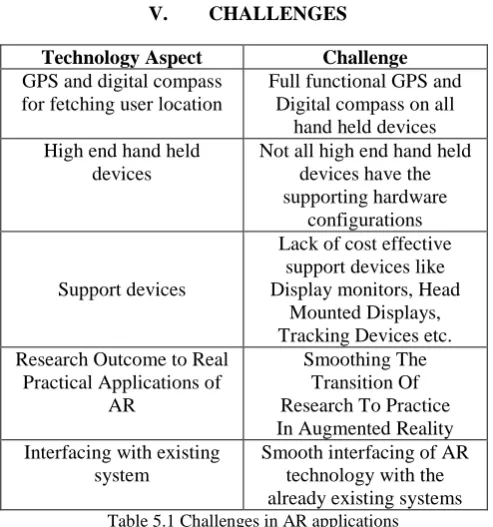
V. CHALLENGES
Technology Aspect Challenge
GPS and digital compass for fetching user location
Full functional GPS and Digital compass on all
hand held devices High end hand held
devices
Not all high end hand held devices have the supporting hardware
configurations
Support devices
Lack of cost effective support devices like Display monitors, Head
Mounted Displays, Tracking Devices etc. Research Outcome to Real
Practical Applications of AR
Smoothing The Transition Of Research To Practice In Augmented Reality Interfacing with existing
system
[image:6.595.41.288.158.422.2]Smooth interfacing of AR technology with the already existing systems Table 5.1 Challenges in AR applications
A significant tradeoff practice in AR research is the rapid inclusion of academic research done in industrial AR applications and other AR application areas. A key barrier to the adoption of this AR research into real life practical applications was the lack of cost efficient support devices that possessed the sophisticated sensors, display devices and information processing capabilities needed to track users and their interactions with the real world. The widespread adoption of hand held devices and other supporting devices for AR applications has driven rapid advances in the computing industry and removed this key barrier to make rapid inroads in applying AR technology to real life practical applications. Current-generation control devices, mobile devices, such as smartphones and tablets, have an array of sophisticated sensors, powerful processing and storage capabilities, and persistent network connections that make them ideal platforms for building AR applications.
Industries and academic researchers have collaborated in developing cost effective solutions for popularizing AR applications. Many leading technology giants have begun commercializing AR applications in industries ranging from entertainment, gaming, advertisement, retail shopping experiences to print advertising to automotive driving assistance etc. The bulk of these commercial applications are built atop commercial-off-the shelf (COTS) mobile platforms, such as iPhone and Android. Many of the companies commercializing these applications are directly applying the results of academic research carried out by researchers by collaborating their work with their industry practices and applying academic research carried such as Kalman filtering,
to handle noise in commodity mobile sensors or deriving structure-from-motion algorithms to construct 3-D representations of physical objects using camera imagery for their industrial AR based applications.
In prior research, many investigators developed sophisticated head-mounted computing and other hardware equipment to create immersive AR applications. Despite the sophistication and novelty of the AR experiences that these devices enabled, however, they were impractical to manufacture cost effectively and use in practice. The proliferation of COTS mobile device platforms has also reduced the cost of developing other specialized sensor-based hardware platforms. [24]
Key areas of research in the field of AR applications include: [24]
i. The use of AR in safety-critical systems, such as automobiles, medical, pharma etc.
ii. Building AR applications that fuse data from unmanned vehicles and robots to enhance user perception of their environment.
iii. Applications of AR in mobile computing.
iv. Cognitive models for understanding the impact of AR on human perception and approaches for using these models to enhance therapeutic applications.
v. Research solutions for constructing real-world tools that can manipulate cyber information; approaches for enhancing the perceived realism of AR experiences.
As AR matures and becomes more widely adopted within industry, new avenues of research will open to solve emerging issues. Although prior research has investigated key technical challenges of AR, the real-world application of this technology will continue to uncover new needs. Already, privacy and security are becoming major concerns as Google Glass has gained increasing traction.
VI. SOME EXAMPLE AR DEMO APPLICATIONS
Basic Concept demonstration regarding Augmented
Reality
Fig 6.1 Augmented Reality Concept demo using checkerboard marker
[image:6.595.317.546.585.702.2]position and rotation cannot be modified in real time.
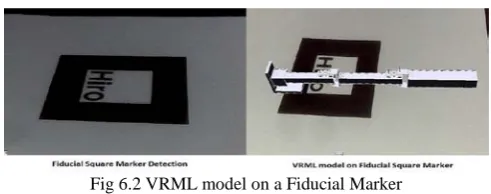
An Augmented scene generated with VRML model of a
[image:7.595.39.285.109.206.2]multi-link arm loaded on a fiducial square marker
Fig 6.2 VRML model on a Fiducial Marker
A VRML model of a multi-link was loaded on a fiducial square marker in augmented view. The position of the virtual model can be modified using manual editing of location parameters. Also, the virtual model can be rotated along various axis based on rotation parameters provided by the user.
VII. CONCLUSION
With the increase in research outcomes in the field of AR, VR and other related connecting technologies, slowly there is a paradigm shift in AR applications from pure entertainment based AR applications to pure engineering purpose based AR applications like in the field of robotics, medical, civil engineering, mechanical engineering etc. Various tools and integrated libraries and frameworks have boosted AR application development. Development in AR technologies has made interactions of human beings with virtual world more immersive, lively and interactive so much so that they mutually co-exist.
VIII. REFERENCES
[1] R. T. Azuma et al., “A survey of augmented reality,” Presence, vol. 6, no. 4, pp. 355–385, 1997.
[2] D.W.F. van Krevelen, R.P.: ‘A Survey of Augmented RealityTechnologies, Applications and Limitations’, The International Journal of Virtual Reality, 2010, 9, (2), pp. 1-20
[3] R.T. Azuma, “A Survey of Augmented Reality,” Presence-Teleoperators and Virtual Environments, vol. 6, no. 4, pp. 355-385, 1997.
[4] P. Milgram and F. Kishino, “A Taxonomy of Mixed Reality Visual Displays,” IEICE Trans. Information and Systems, vol. 77, no. 12, pp. 1321-1329, 1994.
[5] J. Novak-marcincin, Augmented Virtual Reality Applications In Manufacturing Systems, 2007.
[6] I. Collaborative, A S urvey of C V E Technologies and S ystem s by Emmanuel Frcon, 2004.
[7] S. K. S. K. Ong, A. Y. Nee, and S. K. Ong, Virtual Reality and Augmented Reality Applications in Manufacturing. SpringerVerlag, 2004.
[8] 2004.D. Van Krevelen and R. Poelman, “A survey of augmented reality technologies, applications and
limitations,” International Journal of Virtual Reality, vol. 9, no. 2, p. 1, 2010.
[9] D. Van Krevelen and R. Poelman, “A survey of augmented reality technologies, applications and limitations,” International Journal of Virtual Reality, vol. 9, no. 2, p. 1, 2010.
[10] D. Kornack P. Milgram and F. Kishino, “A taxonomy of mixed reality visual displays,” IEICE TRANSACTIONS on Information and Systems, vol. 77, no. 12, pp. 1321– 1329, 1994.
[11] R. Azuma, R. Behringer, S. Feiner, S. Julier, and B. Macintyre, Recent Advances in, no. December, 2001.
[12] A. Nawab, K. Chintamani, D. Ellis, G. Auner, and A. Pandya, Joystick mapped Aug- mented Reality Cues for End-Effector controlled Tele-operated Robots, 2007 IEEE Virtual Real. Conf., pp. 263266, 2007.
[13] S. Hashimoto, TouchMe : An Augmented Reality Based Remote Robot Manipulation.
[14] S. Buraga, . Tanas, and M. Brut, A VRML-based Environment Used to Learn Virtual Reality Concepts, pp. 4551.
[15] J. Vallino, Interactive augmented reality, 1998.
[16] J. Kristo and T. Manesh, AUGMENTED REALITY AND CO-, pp. 18, 2013.
[17] J. Das, W. C. Evans, M. Minnig, A. Bahr, G. S. Sukhatme, and A. Martinoli, Environmental Sensing using Landbased Spectreally selective Cameras and a Quadcopter.
[18] R. Aigner, The Development and Evaluation of an Augmented Reality Assisted Multimodal Interaction System for a Robotic Arm, no. September, 2010.
[19] I. Y. Chen, B. Macdonald, and W. Burkhard, Markerless Augmented Reality for Robots in Unprepared Environments.
[20] D. W. F. Van Krevelen and R. Poelman, A Survey of Augmented Reality Technologies Applications and Limitations, vol. 9, no. 2, 2010.”
[21] K. Chintamani, R. D. Ellis, C. Tan, and A. Pandya, Automated Augmented Reality Operator Aids for Space Robotic Teleoperations, 2012.
[22] H. C. Fang, S. K. Ong, and a. Y. C. Nee, Robot Path and End-Effector Orientation Planning Using Augmented Reality, Procedia CIRP, vol. 3, pp. 191196, Jan. 2012. [23] N. Andre, by Masters of Science, 2013
[24] Applications of Augmented Reality By Jules White, Douglas C. Schmidt, Mani Gloparvar-Fard Proceedings of the IEEE | Vol. 102,No. 2, February 2014
[25] AUGMENTED REALITY Massimiliano Di Capua ,
Master of Science , 2008 Professor David L . Akin Department of Aerospace Engineering Space Systems Laboratory.
[26] E. Ragan, C. Wilkes, D. A. Bowman, V. Tech, and T. Hllerer, Simulation of Augmented Reality Systems in Purely Virtual Environments, pp. 287288, 2009.
[27] I. Y. Chen, B. Macdonald, and W. Burkhard, Markerless Augmented Reality for Robotic Helicoptor Applications, pp. 125138, 2008.
![Fig 2.1 Reality, AR, VR [10] Table 2.1 VR and AR Comparison](https://thumb-us.123doks.com/thumbv2/123dok_us/689228.1076334/3.595.32.287.56.185/fig-reality-ar-vr-table-vr-ar-comparison.webp)