similarity and relatedness
Peter Kolb Universit¨at Potsdam
Potsdam, Germany
Abstract
Recent work has pointed out the differ-ence between the concepts of semantic similarity and semantic relatedness. Im-portantly, some NLP applications depend on measures of semantic similarity, while others work better with measures of se-mantic relatedness. It has also been ob-served that methods of computing simi-larity measures from text corpora produce word spaces that are biased towards either semantic similarity or relatedness. De-spite these findings, there has been lit-tle work that evaluates the effect of vari-ous techniques and parameter settings in the word space construction from corpora. The present paper experimentally investi-gates how the choice of context, corpus preprocessing and size, and dimension re-duction techniques like singular value de-composition and frequency cutoffs influ-ence the semantic properties of the result-ing word spaces.
1 Introduction
A growing number of applications in natural lan-guage processing rely on knowledge about the semantic similarity between words. These sim-ilarities are used for example in ontology learn-ing (Cimiano et al., 2005), information retrieval (M¨uller et al., 2007), and word sense disambigua-tion (Patwardhan et al., 2007).
One has to differentiate between semantic “si-milarity” and semantic “relatedness” (Budanitsky and Hirst, 2006). The first is a narrower concept that holds between lexical items having a simi-lar meaning, like palm and tree. It is usually de-fined via the lexical relations of synonymy and hy-ponymy. (Geffet and Dagan, 2005) require that semantically similar words can be substituted for
each other in context, which must not be true for semantically related words.
The broader concept semantic relatedness holds between lexical items that are connected by any kind of lexical or functional association. Dissim-ilar words can be semantically related, e.g. via relations like meronymy (palm – leaf), or when they belong to the same semantic field (palm – co-conut). (Turney, 2008) seems to equate “related” with “associated” and defines: “Two words are as-sociated when they tend to co-occur (doctor and hospital)”.
Unfortunately, measures of semantic similarity and relatedness rely on hand-crafted lexical re-sources like WordNet, which are not available for many languages and have limited coverage, partic-ularly in specialized domains. Therefore, (Kilgar-riff, 2003) and others have argued for using “dis-tributional similarity” as a proxy for semantic sim-ilarity. Distributional semantics is based on the as-sumption that words with similar meaning occur in similar contexts (Harris, 1968). Several successful methods to compute the distributional similarity of words from text corpora have been proposed, including (Landauer and Dumais, 1997), (Grefen-stette, 1994), and (Sahlgren, 2001).
(Budanitsky and Hirst, 2006) emphasize the dif-ference between semantic and distributional simi-larity. Methods that measure the similarity of the distributional behaviour of words do not take into account the different senses a word has, and there-fore mix up the similar words for all the word senses. While semantic similarity is a relation be-tween concepts, distributional similarity is a rela-tion between words.
context capture distributional relatedness. (Kil-garriff and Yallop, 2000) call these two variants “tight” and “loose” word similarities. (Sahlgren, 2006) comes to the conclusion that word spaces based on direct co-occurrences capture related-ness, while spaces that are based on indirect or second-order co-occurrences capture similarity. The difference between semantic similarity and re-latedness is not only of theoretical interest. In fact some NLP applications require measures of semantic similarity, while others perform better with semantic relatedness. (Sahlgren and Karl-gren, 2008) give an example from the area of text mining. For the analysis of opinions in blogs and discussion forums it is useful to automatically de-tect synonyms and spelling variants for an inter-esting term like recommend, thereby discovering terms that are used similarly in the given sublan-guage, for example love, lurve, looove and re-comend. To solve this task, measures of seman-tic similarity are much better suited. On the other hand, to find out what people associate with a tar-get word like Xbox, measures of semantic related-ness should be preferred.
Other applications where a strict notion of simi-larity is more appropriate are automatic thesaurus generation and paraphrasing. In contrast, for word sense disambiguation the semantically re-lated context word coconut is as useful as the sim-ilar word tree to disambiguate between the mean-ings of palm.
As these example applications show it is important to employ a word space with the right type of re-lations for use with a given application. But while (Rapp, 2002) and especially (Sahlgren, 2006) have investigated the effects of context choice and co-occurrence type on the semantic properties of the resulting word spaces, we are only aware of (Peirs-man et al., 2007) to have tested the influence of dimension reduction techniques (namely Random Indexing and frequency cutoffs) on the outcome. The aim of the present paper is to experimentally confirm that the application of other dimension re-duction techniques like singular value decomposi-tion (SVD) and corpus preprocessing techniques like lemmatization also have considerable effect on the nature of the resulting word space.
In the next section we present our method for com-puting distributional similarity, in section 3 we describe three other systems we have chosen for comparison. Section 4 evaluates the performance
of the systems against human relatedness judge-ments and similarities based on WordNet. We re-port on a series of experiments concerning the size of the input corpus, the choice of context (syntac-tic vs. window-based), corpus preprocessing and filtering by word frequency. In section 5 we dis-cuss the findings, and in the last section we sum-marize our contributions.
2 Our Method: DISCO
Our method for computing the distributional sim-ilarity between words is called DISCO (extract-ing DIStributionally similar words us(extract-ing CO-occurrences) and works as follows. In a pre-processing step, the corpus at hand is tokenized and highly frequent function words are eliminated. Since we want to keep the method independent from language-specific resources, neither part of speech tagging nor lemmatization are performed, and we use a simple context window of size±3 words for counting co-occurrences. Our evalua-tions showed that it is beneficial to take the exact position within the window into account, as has been done by (Rapp, 1999). This can be seen as a crude approximation of syntactic dependency rela-tions. Instead of syntactic dependency triples like <donut, OBJ-OF, eat>we get triples of the form <donut, -2, eat>. Consequently, the features that describe a word’s distribution are not just words as in a pure bag-of-words approach, but ordered pairs of word and window position.
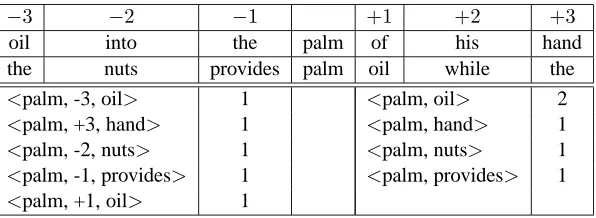
Consider the example in table 1. It shows two occurrences of the word palm in a context of±3 words. When taking the exact window position into account, then palm is described by the five dif-ferent features that result from the two occurrences (we ignore function words), listed on the lower left of the table. The features<*, -3, oil>and<*, +1, oil>are distinct and have nothing more in com-mon than<*, +3, hand>and<*, -1, provides>. If the exact position is not observed, we get only four features (lower right of table 1), since the two occurrences of oil can not be distinguished any more. A context that observes the exact window position leads to tighter similarities than a window without exact position. In section 4.4 we evalu-ate the effect the window-position context bears on the resulting similarities.
−3 −2 −1 +1 +2 +3
oil into the palm of his hand
the nuts provides palm oil while the
[image:3.612.160.458.57.166.2]<palm, -3, oil> 1 <palm, oil> 2 <palm, +3, hand> 1 <palm, hand> 1 <palm, -2, nuts> 1 <palm, nuts> 1 <palm, -1, provides> 1 <palm, provides> 1 <palm, +1, oil> 1
Table 1: Example of using window position triples (WPT) as context for counting co-occurrences. WPT features are shown in the 1st column of the lowest row, the bag-of-words features in the 4th column.
The matrix size is notv×fas usual (withvbeing the number of words for which word vectors are built, f being the number of words used as fea-tures), but v×f ·r (ris the window size). The next step is to transform the absolute counts in the matrix fields into more meaningful weights. For this feature weighting we found the measure pro-posed by (Lin, 1998c), which is based on mutual information, to be optimal:
g(w, w′, r) = log(f(w, r, w′)−0,95)f(∗, r,∗) f(w, r,∗)f(∗, r, w′)
(1) wherewandw′ stand for words andrfor a win-dow position (or a dependency relation, respec-tively), andfis the frequency of occurrence. To arrive at a word’s distributionally similar words the next step is to compare every word vector with all other word vectors. For vector comparison we use Lin’s information theoretic measure ((Lin, 1998a)) as given in equation (2). Because a word vector represents the distribution of a word in the corpus, this vector comparison gives us the words which are used in similar contexts. Put differently, it finds the words that share a maximum number of common co-occurrences. For example, if bread co-occurs with bake, eat, and crispy, and cake also co-occurs with these three words, then bread and cake will be distributionally similar. Note that bread and cake do not need to co-occur themselves a single time to be regarded as similar.
As an example of the outcome, the twelve distri-butionally most similar words for palm are listed here:
palms (0.1345) coconut (0.1059) olive (0.0870) pine (0.0823) citrus (0.0745) oak (0.0677) mango (0.0652) cocoa (0.0645) banana (0.0627) bananas (0.0623) trees (0.0570) fingers (0.0560)
Such a list of distributionally similar words can in turn be seen as the “second order” word vector of the given word, containing not only the words which occur together with it, but those that oc-cur in similar contexts. We can now compare two words based on their second order word vectors, too. This use of higher-order co-occurrences is to some extent comparable to what is achieved in LSA by singular value decomposition (Kon-tostathis and Pottenger, 2006).
In conclusion, DISCO provides two different sim-ilarity measures: DISCO1, that compares words based on their sets of co-occurring words, and DISCO2, that compares words based on their sets of distributionally similar words (i.e. DISCO2 compares the second order word vectors).
3 Description of the other Systems
LSA. Latent semantic analysis (Landauer and Dumais, 1997) is arguably the most popular variant of word space. Its core step is a dimen-sion reduction technique called singular value decomposition (SVD). SVD computes the least mean square error projection of a matrix onto a lower dimensional matrix. It achieves a kind of generalization by combining columns that represent words with similar meanings. In our experiments we used the LSA implementation accessible athttp://lsa.colorado.edu.
PMI-IR (pointwise mutual information - in-formation retrieval). (Turney, 2001) presents a method for computing the similarity between ar-bitrary words that utilizes the WWW search en-gine AltaVista1 according to the following
for-1
lin(w, w′) =
Pr p=1
Pv wi=1
(
g(w, wi, p) +g(w′, wi, p) : g(w, wi, p)>0 and g(w′, wi, p)>0
0 : else
Pr
p=1Pvwi=1(g(w, wi, p) +g(w ′, w
i, p))
(2)
mula, adapted from pointwise mutual information:
PMI-IR(w1, w2) =logH(w1NEARw2) H(w1)H(w2) (3)
whereH(w)is the number of hits the search en-gine returns for the queryw. The more often two words co-occur near each other on a web page, the higher is their PMI-IR score. We computed the PMI-IR similarity values for our evaluation data by querying AltaVista on 4/10/2008.
WordNet::Similarity. WordNet::Similarity (Pedersen et al., 2004) is a Perl module based on WordNet that has been widely used in a va-riety of natural language processing tasks. It implements three measures of semantic related-ness (namely Hirst-St.Onge (hso), Lesk (lesk) and vector pairs (vp)) and six measures of seman-tic similarity (Jiang and Conrath (jcn), Leacock and Chodorow (lch), Lin (lin), path length (path), Resnik (res), and Wu and Palmer (wup)). The lat-ter utilize the is-a relations in WordNet. Since there are only is-a relations between nouns and be-tween verbs in WordNet, the similarity measures cannot be applied to adjectives or across part of speech.
4 Evaluation 4.1 Data
We built several DISCO word spaces according to the method outlined above. The first word space is based on 300,000 articles from the En-glish Wikipedia2, amounting to some 267 million tokens. We considered all words with a corpus frequency of at least 100, resulting in a vocabu-lary size ofv=226,000, and used thef =101,000 most frequent words as feature words. This word space is employed in experiments 1 and 2 (sections 4.2 and 4.3).
In experiment 3 (section 4.4) we tested different parameter settings, which meant we had to build a number of word spaces. To limit the compu-tational effort we decided to use a smaller cor-pus: the British National Corpus which consists
2
http://en.wikipedia.org
of roughly 110 million tokens.
(Finkelstein et al., 2001) prepared a list of 353 noun-noun pairs and employed 16 subjects to esti-mate their semantic relatedness on a scale from 0 to 10. We use this list as our evaluation data. As seven word pairs contained at least one word that was unknown to WordNet, we deleted them from the list, leaving 346 word pairs for testing.
4.2 Correlation with Human Judgements of Semantic Relatedness
Our first experiment measures the correlation (ac-cording to the Pearson correlation coefficient) of the candidate systems with the averaged seman-tic relatedness scores assigned to the 346 word pairs by the human subjects. Table 2 shows the results. The first two correlation values in the first row of the table are taken from (Finkelstein et al., 2001). Among the systems listed in the first row, DISCO1 shows the lowest correlation with the hu-man judgements, comparable to that of Finkelstein et al.’s vector approach. DISCO2 performs much better, but is still worse than LSA. The best score is achieved by PMI-IR, which is in accordance with other results reported in the literature (Tur-ney, 2001).
The WordNet-based measures (shown in the sec-ond row of the table) perform worse, which comes as no surprise for the six measures of similarity, since they are not intended to measure relatedness. But the three measures of relatedness (hso, lesk, and vp) do not perform much better. The best scor-ing vector pairs measure (vp) only achieves the same score as DISCO1.
4.3 Correlation with WordNet::Similarity
Vector-based LSA PMI-IR DISCO1 DISCO2
0.41 0.56 0.63 0.39 0.51
hso lesk vp jcn lch lin path res wup
[image:5.612.130.483.59.112.2]0.35 0.21 0.39 0.23 0.35 0.30 0.38 0.36 0.30
Table 2: Correlation of several systems with the semantic relatedness values assigned by humans.
[image:5.612.175.435.147.212.2]jcn lch lin path res wup avg. PMI-IR 0.14 0.12 0.06 0.15 0.22 0.11 0.13 LSA 0.16 0.26 0.21 0.29 0.28 0.22 0.24 DISCO1 0.38 0.39 0.33 0.45 0.43 0.33 0.38 DISCO2 0.15 0.40 0.39 0.35 0.44 0.40 0.36
Table 3: Correlation between WordNet-based semantic similarity and four systems based on word distri-butions.
In this task, PMI-IR performs worst (cf. ta-ble 3), whereas DISCO1 shows the highest cor-relation on average. The behaviour of the two DISCO measures is difficult to compare, because DISCO1 scores higher than DISCO2 three times, but DISCO2 also scores higher than DISCO1 four times. If we take the averaged score, DISCO1 turns out slightly better. In any case, both DISCOs perform much better than PMI-IR and LSA.
4.4 Effect of different parameter settings and techniques
Our third experiment tests various parameter set-tings for the DISCO1 measure. As DISCO2, which was meant as a substitute for LSA, per-formed worse than LSA in the first experiment, we do not further evaluate this measure. Instead, we combine DISCO1 with SVD in the last part of ex-periment 3.
In the previous experiments a 267 million token corpus from the English Wikipedia was used, in the following we use a smaller corpus, namely the British National Corpus, which consists of only about 110 million tokens, i.e. has only 40% of the size of the Wikipedia corpus.
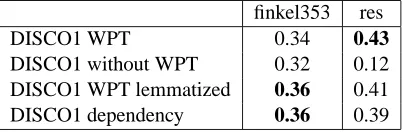
The reduced size of the input data has a noticeable effect on the computation of semantic relatedness (first row in table 4). While in the previous ex-periments DISCO1 achieved a correlation of 0.39 with the Finkelstein gold standard for semantic re-latedness (abbreviated as finkel353 in table 4), the same method now only scores 0.34 on the same task, which constitutes a decrease by 12.8%. To quantify the effect of corpus size on semantic similarity we compute the correlation with
Word-finkel353 res
DISCO1 WPT 0.34 0.43
DISCO1 without WPT 0.32 0.12 DISCO1 WPT lemmatized 0.36 0.41
DISCO1 dependency 0.36 0.39
Table 4: Experiment 3: Correlation between DISCO1 and two gold standards for different pa-rameter settings.
Net::Similarity’s Resnik measure from experiment 2 (res in table 4). As one can see from tables 3 and 4, the reduced size of the corpus has no neg-ative effect on semantic similarity: the correlation stands at 0.43.
To quantify the benefit of our poor man’s depen-dency triples – the window position triples (WPT) as explained in section 2 – we built a word space with a simple bag-of-words window as context. The size of the window remains the same (three words on either side of the target word), but the po-sition inside the window is not observed any more. The result is shown in the second row of table 4. The correlation with the semantic relatedness gold standard drops from 0.34 to 0.32 (-5.9%). The cor-relation with the similarity reference crashes down by 72.1% from 0.43 to 0.12.
Next we lemmatized the corpus before apply-ing DISCO usapply-ing the well known Tree Tagger (Schmid, 1994). While lemmatization has a pos-itive effect on semantic relatedness (cf. the third row in table 4) it has an almost equally strong neg-ative effect on semantic similarity.
[image:5.612.318.519.265.331.2]f finkel353 res 101,000 0.34 0.43
50,000 0.37 0.43 20,000 0.40 0.45 10,000 0.41 0.46 5,000 0.40 0.43 1,000 0.38 0.43
[image:6.612.134.259.57.165.2]500 0.36 0.33
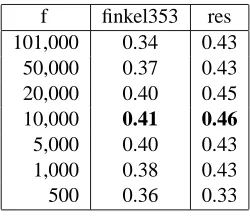
Table 5: Frequency cutoff: Correlation of DISCO1 with the two gold standards for different quantities of feature words.
our corpus to extract syntactic dependency triples. This increases the correlation with the semantic re-latedness gold standard from 0.34 to 0.36 (last row in table 4). That is, robust parsing has the same effect as lemmatization. Since Minipar automat-ically does lemmatization, we can conclude that syntactic dependency triples are no better than our window position triples.
Surprisingly, the correlation with the semantic similarity gold standard drops from 0.43 to 0.39 (-9.3%). We hypothesize that this might be the ef-fect of noise produced by the parser.
Recall from section 2 that the size of the co-occurrence matrix is given by v × f ·r with v being the number of vocabulary items for which word vectors are collected, f being the number of feature words (the words that are used to pop-ulate the word vectors), andr being the window size. As stated in section 4.1, for all experiments so far we chosef = 101,000, i.e. we used the 101,000 most frequent words in the corpus as fea-ture words. We will now systematically decrease this parameter. The effect of this adjustment can be seen in table 5. As the number of feature words decreases, the correlation with both gold standards increases, peaking at f = 10,000. Forf lower than1,000, the performance of semantic similar-ity drops sharply, whereas semantic relatedness seems to suffer relatively less from such a dramatic decrease of the number of features. Note that for the optimal setting of this parameter the perfor-mance for semantic relatedness is now even better than with the much bigger corpus from the previ-ous experiments (0.41 as compared to 0.39 in table 2). The same holds for the correlation with the se-mantic similarity gold standard (0.46 vs. 0.43, cf. table 3).
The frequency cutoff at f = 10,000 lead to
a considerable reduction of the size of our co-occurrence matrix which enabled us to apply the singular value decomposition to it. We used SVDLIBC3 to reduce the matrix to its 300 prin-cipal components (i.e. we reduced the matrix size from v×10,000·r tov ×300). The result is shown in table 6. The use of SVD significantly increases the correlation with the relatedness gold standard, whereas it decreases the correlation with all six similarity measures.
5 Discussion
In the first experiment (see section 4.2) we found that PMI-IR scored best at the task of comput-ing semantic relatedness, outperformcomput-ing LSA and even more DISCO. The most interesting result of experiment 1 was that DISCO2 scored much better than DISCO1. Since the only difference between the two measures is the use of second order co-occurrences by DISCO2, we can conclude that for computing semantic relatedness higher-order co-occurrences can substitute for SVD – not fully, but at least to a certain degree.
We also observed that the three WordNet-based measures of semantic relatedness performed quite badly. The reason for this is unclear.
Experiment 2 (section 4.3) evaluated the corre-lation of different methods with semantic simi-larities produced by WordNet::Similarity. It was shown that DISCO1 scored much better in this task than PMI-IR and LSA. Moreover, the higher-order co-occurrences of DISCO2 did not seem to have a consistent positive effect. From this re-sult we can conclude that singular value decom-position and higher-order co-occurrences increase the performance when computing semantic relat-edness, but they do not help in computing seman-tic similarity. This conclusion is confirmed by the last part of experiment 3 (section 4.4), where we combined DISCO1 with SVD, leading to a sig-nificant performance increase for the relatedness gold standard, but to a decrease for all six similar-ity measures.
The poor performance of PMI-IR in the sec-ond experiment can be explained by the type of co-occurrence it is based on. While DISCO1 compares words based on their collocation sets, thereby finding words that are used similarly, PMI-IR’s similarities are collocations. Therefore it rather produces very loose word similarities, i.e.
3
finkel353 jcn lch lin path res wup
DISCO1-10K 0.41 0.62 0.52 0.50 0.52 0.46 0.47
DISCO1-10K-SVD 0.55 0.46 0.37 0.41 0.39 0.38 0.35
Table 6: Performance of DISCO1 after frequency cutoff at f = 10,000 with and without singular value decomposition (SVD)
words that are topically similar.
Experiment 3 (section 4.4) suggests that measures of relatedness highly profit from more input data. This is confirmed by the finding of experiment 1 that PMI-IR outperforms LSA, despite the fact that both methods use co-occurrence in a short piece of text as context. While LSA addition-ally employs SVD, there is nothing in PMI-IR that would explain its strong performance except the huge size of the corpus it is based on (the web). Experiment 3 also confirms that the recording of the position within the context window has an enormous positive effect on computing semantic similarity, while the effect on semantic relatedness is less significant. This could be expected from the discussion of the relevant literature in section 1, where distributional similarity is explicitly de-fined by the use of a strict context that pays atten-tion to syntactic features like word order. Our ex-periments indicate that any method which “blurs” the context (bag-of-words window, lemmatization, SVD) decreases the quality of semantic similar-ity. Instead, a “naked” approach based on indi-rect co-occurences should be chosen. This finding is in line with (Peirsman et al., 2007) who state that “severely reducing the dimensionality of the word vectors leads to a retrieval of more loosely related words.” One should presume that conse-quently a syntactic context would score best, since this is the strictest imaginable context. There-fore, it is a bit surprising that the use of Minipar did not lead to an improvement. (Rapp, 2004) seems sceptical about the advantages of syntac-tic dependency triples over simple window ap-proaches and assumes that the employment of a part-of-speech tagger will result in the same per-formance as the use of a parser. This hypothesis is confirmed by our results. (Grefenstette, 1996) and recently (Pad´o and Lapata, 2007) and (Peirs-man et al., 2007) compared syntactic and window based approaches, and found that syntactic con-texts performed superior. However, they used bag-of-words windows without taking into account the position inside the window. We propose that our
window position triples should be rather seen as a syntactic context and not as a bag-of-words con-text. Yet we believe that for languages with a less strict word order than English (like for example Czech) syntactic dependency triples will outper-form our window position triples.
Another interesting finding of experiment 3 re-sulted from the application of a frequency fil-ter. We found that limiting the size of the co-occurrence matrix to the 10,000 most frequent fea-ture words yielded the highest performance for both semantic similarity and relatedness.
6 Conclusion
In the present paper we have reported on several experiments regarding the influence of dimension reduction techniques, corpus size, and choice of context on the semantic properties of the resulting word spaces.
For future work we propose to carry out application-centered evaluations in order to con-firm the practical relevance of the similarity– relatedness distinction put forth in this paper. DISCO is freely available for research pur-poses at http://www.linguatools.de/ disco_en.html.
References
A. Budanitsky and G. Hirst. 2006. Evaluating WordNet-based Measures of Lexical Semantic Re-latedness. Computational Linguistics, 32(1).
P. Cimiano, A. Hotho, and S. Staab. 2005. Learning Concept Hierarchies from Text Corpora using For-mal Concept Analysis. Journal of Artificial
Intelli-gence Research, 24:305–339.
L. Finkelstein, E. Gabrilovich, Y. Matias, E. Rivlin, Z. Solan, G. Wolfman, and E. Ruppin. 2001. Plac-ing search in context: the concept revisited. In
WWW ’01: Proceedings of the 10th international conference on World Wide Web, pages 406–414,
New York, NY, USA. ACM.
of the 43rd Annual Meeting of the ACL, pages 107–
114.
G. Grefenstette. 1994. Explorations in Automatic
The-saurus Discovery. Kluwer, Dordrecht.
G. Grefenstette. 1996. Evaluation techniques for au-tomatic semantic extraction: comparing syntactic and window based approaches. In B. Boguraev and J. Pustejovsky, editors, Corpus Processing for
Lexi-cal Acquisition, pages 205 – 216. MIT Press,
Cam-bridge, MA.
Z.S. Harris. 1968. Mathematical Structures of
Lan-guage. Interscience Publishers, New York.
A. Kilgarriff and C. Yallop. 2000. What’s in a the-saurus? In Proceedings of the Second
Confer-ence on Language Resources and Evaluation, pages
1371–1379, Athens.
A. Kilgarriff. 2003. Thesauruses for Natural Language Processing. In Proceedings of Natural Language
Processing and Knowledge Engineering (NLPKE),
Beijing.
A. Kontostathis and W.M. Pottenger. 2006. A frame-work for understanding latent semantic indexing (LSI) performance. Information Processing and Management, 42(1):56–73, January.
T.K. Landauer and S.T. Dumais. 1997. A Solu-tion to Plato’s Problem: The Latent Semantic Anal-ysis Theory of Acquisition, Induction and Repre-sentation of Knowledge. Psychological Review,
104(2):211–240.
D. Lin. 1998a. Automatic Retrieval and Clustering of Similar Words. In Proceedings of COLING-ACL
1998, Montreal.
D. Lin. 1998b. Dependency-based Evaluation of MINIPAR. In Workshop on the Evaluation of
Pars-ing Systems, Granada, Spain.
D. Lin. 1998c. Extracting Collocations from Text Cor-pora. In Workshop on Computational Terminology, pages 57–63, Montreal, Kanada.
S. Mohammad and G. Hirst. 2005. Distributional Mea-sures as Proxies for Semantic Relatedness. Unpub-lished.
C. M¨uller, I. Gurevych, and M. M¨uhlh¨auser. 2007. In-tegrating Semantic Knowledge into Text Similarity and Information Retrieval. In Proceedings of the
First IEEE International Conference on Semantic Computing, pages 57–63, Montreal, Kanada.
S. Pad ´o and M. Lapata. 2007. Dependency-based Construction of Semantic Space Models.
Compu-tational Linguistics, 33(2):161–199.
S. Patwardhan, S. Banerjee, and T. Pedersen. 2007. UMND1: Unsupervised Word Sense Disambigua-tion Using Contextual Semantic Relatedness. In
SemEval-2007: Proceedings of the 4th International Workshop on Semantic Evaluations, pages 390–393,
Prague, Czech Republic, June.
T. Pedersen, S. Patwardhan, and J. Michelizzi. 2004. WordNet::Similarity - Measuring the Relatedness of Concepts. In Proceedings of Fifth Annual Meeting
of the North American Chapter of the Association for Computational Linguistics (NAACL-04), pages
38–41, Boston, MA., May.
Y. Peirsman, K. Heylen, and D. Speelman. 2007. Finding semantically related words in Dutch. Co-occurrences versus syntactic contexts. In Workshop
on Contextual Information in Semantic Space Mod-els (CoSMo 2007), Roskilde.
R. Rapp. 1999. Automatic Identification of Word Translations from Unrelated English and German Corpora. In Proceedings of ACL, pages 519–526.
R. Rapp. 2002. The Computation of Word As-sociations: Comparing Syntagmatic and Paradig-matic Approaches. In Proceedings of COLING-02, Taipeh.
R. Rapp. 2004. A Freely Available Automatically Generated Thesaurus of Related Words. In
Proceed-ings of LREC 2004, pages 395–398.
M. Sahlgren and J. Karlgren. 2008. Buzz Monitoring in Word Space. In European Conference on
Intelli-gence and Security Informatics (EuroISI 2008).
Es-bjerg, Denmark.
M. Sahlgren. 2001. Vector-based Semantic Analy-sis: Representing Word Meanings Based on Ran-dom Labels. In Alessandro Lenci, Simonetta Mon-temagni, and Vito Pirrelli, editors, The Acquisition
and Representation of Word Meaning. Kluwer
Aca-demic Publishers.
M. Sahlgren. 2006. The Word-Space Model: Us-ing distributional analysis to represent syntagmatic and paradigmatic relations between words in
high-dimensional vector spaces. Ph.D. thesis,
Stock-holm.
H. Schmid. 1994. Probabilistic Part-of-speech Tag-ging Using Decision Trees. International
Confer-ence on New Methods in Language Processing.
P.D. Turney. 2001. Mining the Web for Synonyms: PMI-IR versus LSA on TOEFL. In Proc. of the
Twelth European Conference on Machine Learning,
pages 491–502.
P.D. Turney. 2008. A uniform approach to analogies, synonyms, antonyms, and associations. In
Proceed-ings of the 22nd International Conference on Com-putational Linguistics (Coling 2008), pages 905–