Scott Martens
Centrum voor Computerlingu¨ıstiek, KU Leuven Blijde-Inkomststraat 13, bus 3315
3000 Leuven Belgium [email protected]
Abstract
The first task of statistical computational linguistics, or any other type of data-driven processing of language, is the ex-traction of counts and distributions of phe-nomena. This is much more difficult for the type of complex structured data found in treebanks and in corpora with sophisti-cated annotation than for tokenized texts. Recent developments in data mining, par-ticularly in the extraction of frequent sub-trees from treebanks, offer some solutions. We have applied a modified version of the
TreeMiner algorithm to a small treebank
and present some promising results.
1 Introduction
Statistical corpus linguistics and many natural lan-guage processing applications rely on extracting the frequencies and distributions of phenomena from natural language data sources. This is rela-tively simple when language data is treated as bags of tokens or as n-grams, but much more compli-cated for corpora annotated with complex feature schemes and for treebanks where syntactic depen-dencies are marked. A great deal of useful infor-mation is encoded in these more complex struc-tured corpora, but access to it is very limited using the traditional algorithms and analytical tools of computational linguistics. Many of the most pow-erful techniques available to natural language pro-cessing have been built on the basis of n-gram and
bag of words models, but we already know that
these methods are inadequate to fully model the information in texts or we would have little use for treebanks or annotation schemes.
Suffix trees provide some improvement over n-grams and bag-of-words schemes by identify-ing all frequently occurridentify-ing sequences regard-less of length (Weiner, 1973; McCreight, 1976;
Ravichandran and Hovy, 2002). While this has value in identifying some multi-word phenomena, any algorithm that models languages on the basis of frequent contiguous string discovery will have trouble modeling a number of pervasive phenom-ena in natural language. In particular:
• Long distance dependencies – i.e., dependen-cies between words that are too far apart to be accessible to n-gram models.
• Flexible word orders – languages usually have contexts where word order can vary. • Languages with very rich morphologies that
must be taken into account or where too much
important information is lost through lemma-tization.
• Correlations between different levels of ab-straction in annotation, such as between the lemma of a verb and the semantic or syntac-tic class of its arguments.
• Extra-syntactic correlations that may involve
any nearby word, such as semantic priming
effects.
In treebanks and other annotated corpora that can be converted into rooted, directed graphs, many of these phenomena are accessible as
fre-quently recurring subtrees. For example, consider
the Dutch idiom “naar huis gaan”, (to go home). The components of this phrase can appear in a va-riety of orders and with words inserted between the constituents:
1. Ik zou naar huis kunnen gaan. (I could go home.)
2. We gaan naar huis. (We’re going home.)
In a treebank, these two sentences would share a common subtree that encompasses the phrase “naar huis gaan”, as in Figure 1. Note that for this purpose, two subtrees are treated as identical if the
Figure 1: The two Dutch sentences Ik zou naar
huis kunnen gaan and We gaan naar huis, parsed,
and with the frequent section highlighted. Note that these two subtrees are identical except for the order of the nodes. (N.B.: This tree does not take the difference between the infinitive and conju-gated forms into account.)
only difference between them is the order of the children of some or all the nodes.
Most theories of syntax use trees to represent in-terlexical dependencies, and generally theories of morphology and phonology use either hierarchical tree structures to represent their formalisms, or use unstructured bags that can be trivially represented as trees. Most types of linguistic feature systems are at least in part hierarchical and representable in tree form. Because so many linguistic phenomena are manifest as frequent subtrees within hierarchi-cal representations that are motivated by linguistic theories, efficient methods for extracting frequent subtrees from treebanks are therefore potentially very valuable to corpus and computational linguis-tics.
2 Previous and Related Work
Tree mining research is a subset of graph min-ing focused specifically on rooted, directed acyclic graphs. Although there is research into extracting frequent subtrees from free (unrooted and undi-rected) trees, free tree mining usually proceeds by deciding which node in any particular tree will be treated as a root, and then treating it as if it was a rooted and directed tree (Chi et al., 2003).
(a)
(b) (c) (d)
Figure 2: Tree (a) and different types of subtree: (b) a bottom-up subtree of (a), (c) an induced sub-tree of (a), and (d) an embedded subsub-tree of (a).
Research on frequent subtree discovery generally draws heavily on early work by Zaki (2002) and Asai et al. (2002) who roughly simultaneously be-gan applying the Apriori algorithm to frequent tree discovery (Agrawal et al., 1993). For a summary of Apriori, which is widely used in data mining, and a short review of its extensive literature, see Kotsiantis and Kanellopoulos (2006). A broad summary of algorithms for frequent subtree min-ing can be found in Chi et al. (2004).
Research into frequent substructures in compu-tational linguistics is quite limited. The Data
Ori-ented Processing model (Bod et al., 2003) along
with its extension into machine translation - the
Data Oriented Translation model (Poutsma, 2000;
Poutsma, 2003; Hearne and Way, 2003) - is the most developed approach to using frequent sub-tree statistics to do natural language processing. There is also growing work, largely stemming out of DOP research, into subtree alignment in bilin-gual parsed treebanks as an aid in the development of statistical and example-based machine transla-tions systems (Hassan et al., 2006; Tinsley et al., 2007; Zhechev and Way, 2008).
3 Key concepts
Among the key concepts in tree mining is the dif-ference between bottom-up subtrees, induced
lic...” This structure is a subtree of one of the sentences in the Alpino corpus of Dutch where a node has
two children with the same labels - two NPs. This often occurs with conjunctions and can prevent the algorithm from discovering some frequent subtrees.
subtree T0 ofT is a subtree where every node in
T0is either the root ofT0or its parent inT is also its parent inT0. An embedded subtreeT0 ofT is a subtree where every node inT0is either the root ofT0 or its parent inT0 is one of its ancestors in
T. See Figure 2 for an example of these different types of subtrees.
Linear time solutions exist for finding all fre-quent bottom-up subtrees in a treebank because this problem can be transformed into finding all frequent substrings in a string, a problem for which fast solutions are well known (Luccio et al., 2001; Luccio et al., 2004).
Solutions for induced and embedded subtrees draw heavily on Zaki (2002) (the TreeMiner gorithm) and Asai et al. (2002) (the FREQT al-gorithm), both of whom propose Apriori-style ap-proaches. This type of solution has the general property that runtime is proportionate to the size of the output: the sum of the number of times each frequent subtree appears in the treebank. This is not readily predictable, because the number and frequencies of subtrees is not formally de-terminable from the size of the treebank and can grow very rapidly.
3.1 Ordered and unordered trees
TreeMiner/FREQT approaches require all trees to
be ordered so that the nodes of any frequent sub-tree will always appear in the same order every time it appears. The children of each non-leaf node are sorted into a lexicographic order, but
this only guarantees that frequent subtrees will al-ways appear with the same ordering if no node has more than one non-leaf child node with the same label. This is not uniformly true of natural
language parse trees, as shown in Figure 3. So-lutions exist that remove this limitation - notably Chi et al. (2003) - but they come at a significantly increased processing cost.
3.2 Closed trees
Given that this type of approach to subtree discov-ery has runtime bounds proportionate to the unpre-dictable size of the output, one way to keep subtree discovery within manageable bounds is to restrict the output. Many of the frequent trees present in treebanks are redundant, since they are identically distributed with other, larger trees, as in Figure 4.
If a corpus has a sequence of tokensABCDE that appears f times, then that corpus also con-tains at leastfinstances of the sequencesA,B,C,
D,E,AB,BC,CD,DE,ABC,BCD,CDE,
ABCD, andBCDE. If any of these sequences appears only in the context ofABCDE, then they are redundant, because they have the same count and distribution as the longer sequenceABCDE. If a set of sequences is identically distributed -appearing in all the same places - then the longest of those sequences is called a closed sequence. In more formal terms, a sequence S that appears f times in a corpus is called closed if and only if there is no prefix or suffix asuch that aS or Sa also appearsf times in the corpus. This definition extends easily to trees: A subtreeT in a treebank is closed if and only if there is no node that can be added to it to produce a new subtreeT0 such that the frequency ofT0is equal to the frequency ofT. All subtrees in a corpus are either closed subtrees or are subtrees of closed subtrees that appear in exactly the same places in the treebank. The set of closed subtrees in a treebank is the smallest set of subtrees that encompasses all the distributions of subtrees in the treebank. Any subtree that is not in the list of closed subtrees is either a subtree of one of the closed subtrees that appears exactly as often and in all the same places, or does not appear in the treebank at all.
There are algorithms that extract only
(a) The common subtree of the two parse trees in Figure 1: “naar huis gaan”
(b) Redundant subtrees of tree (a). There are many more such structures.
Figure 4: Closed and non-closed subtrees in just the two sentences in Figure 1. In a larger treebank, some of these might not be redundant.
information, since any non-closed subtree present in the treebank is a subtree of a closed one and shares its distribution.
4 Algorithm and data structures
The algorithm used in this research is an extension of the TreeMiner algorithm (Zaki, 2002), modified to extract only closed subtrees. It takes a minimum frequency threshold as a parameter and extracts only those subtrees which are closed and whose frequency is at least equal to the threshold. This algorithm suffers from the same shortcoming of Zaki’s original algorithm in that it is only guar-anteed to find all frequent subtrees among ordered trees where no node has two non-leaf children with the same label.
It has one novel property which it appears not to share with any other subtree extraction scheme to date: This algorithm outputs subtrees in order from the most frequent to the least. Given the difficulty of predicting in advance how large the output will be, and the large size of many natural language data sources, this can be a real boon. If output size or memory usage grow too large, or too much time has passed, the program can be stopped while still guaranteeing that it has not missed any more frequent subtree than the last one outputted.
This section can only very briefly describe the algorithm.
4.1 Definitions
A treebank is any collection of trees where each node bears a label and each node is uniquely ad-dressable in such a way that the address an of a nodenis always greater than the addressapof its parentp. This is accomplished by representing all trees as ordered depth-first canonical strings. (See Chi et al. (2005b).)
Each appearance of a subtree within a treebank is characterized by the address of its root in the treebank and the address of its rightmost node. This data structure will be called a Hit. The list of all Hits corresponding to all the appearances of some subtree in the treebank will be called a
HitList. So, for each subtree there is a
correspond-ing HitList and vice-versa. HitLists are always constructed in sequential order, from first instance in the treebank to last, and can never contain du-plicates.
We will define the function queueKey on
HitLists to output an array of four numbers in a
specific order, given a HitList as input:
1. The number of Hits in the HitList.
2. The distance from the address of the root of the first Hit to the end of the treebank.
3. The distance from the address of the right-most node of the first Hit to the end of the treebank.
4. The number of nodes in the subtree associ-ated with that HitList.
These keys are sortable and designed to ensure that HitLists from a single treebank can always be sorted into a fixed order such that, for two HitLists
AandB, ifA > Bthen:
1. Ahas more Hits thanB.
2. IfAhas the same number of Hits asB, then the root of the first Hit inAprecedes the root of the first Hit inB.
3. IfA’s first root is identical toB’s, then the ad-dress of the rightmost node of the first Hit in
Aprecedes the address of the rightmost node of the first Hit inB.
4. If the first Hit inAis exactly the same the first
stores key-data pairs and stores the keys in order from greatest to least. The data structure used to implement a self-sorting queue in this research is an AVL tree (Adelson-Velskii and Landis, 1962), however, other structures could equally well have been used. The self-sorting queue will be used to maintain a sorted list of HitLists, sorted in the or-der of their queueKeys as described above.
4.2 Initialization
Fix a minimum frequency thresholdtfor the sub-trees you wish to extract from the treebank. Start processing by initializing one HitList for each unique label in the treebank with the set of Hits that corresponds to each occurrence of that label. We will treat each as a HitList with an associ-ated subtree containing only one node. This set is constructed in linear time by iterating over all the nodes in the treebank.
Of the initial HitLists, throw away all those with fewer than threshold frequency t Hits in them.
The remaining HitLists are inserted into the self-sorting queue.
4.3 Extracting induced subtrees without checking for closure
Extracting all the subtrees above a fixed frequency - not just the closed subtrees - in order from the most frequent to the least, proceeds as follows:
1. Initialize as described in Section 4.2. 2. Pop the top HitListhland its associated
sub-treesfrom the queue. 3. Extendhl:
(a) Visit each Hit in hl and find all the nodes that can be added to the right side ofsto produce new induced subtrees. (b) Generate new HitLists for all subtrees
that extendsby one node to the right. (c) Test each new HitList to make sure it
appears more than threshold frequency
t times, and if it does, insert it into the queue.
(d) Outputsandhl.
4. Repeat until the queue is empty.
This is essentially identical to the TreeMiner and FREQT algorithms already published by Zaki (2002) and by Asai et al. (2002), except that it outputs frequent subtrees in order from the most frequent to the least.
By controlling the order in which HitLists reach the top of the queue, it is possible to efficiently prevent any subtree which is not a closed sub-tree or a prefix of a closed subsub-tree from being extended, and to prevent any subtree that is not closed from being outputted.
Every subtree with a frequency of f is either a closed subtree, a prefix of a closed subtree that also has a frequency off and can be constructed by adding more nodes to the right, or is a redun-dant non-closed subtree that need not be extended or stored. Consider a redundant, non-closed sub-treex and a closed subtree or prefix of a closed subtreey which has the same frequency, and has the same set of addresses for the rightmost node of each of its appearances in the treebank. The sort order of the self-sorting queue (see Section 4.1) ensures that if a prefix of a closed subtreey is in the queue and some subtree of it x is also in the queue, thenyis closer to the top of the queue than
x is. Furthermore, it can be proven that the pre-fix of a closed subtree with the same distribution as any non-closed, redundant subtree will be gen-erated, inserted into the queue, and removed from the top of the queue beforexcan reach the top.
So, to preventxfrom being extended or stored, all that is necessary is to check to see there is some closed subtree or prefix of a closed subtreeysuch that:
• yhas already been at the top of the queue. • yhas the same frequency asx.
• The set of rightmost nodes of every Hit in
y’s HitList is identical to the set of rightmost nodes of every Hit inx’s HitList.
• xis a subtree ofy
This can be checked by constructing a hash value for each HitList based on its frequency and some subset of the set of rightmost nodes of ev-ery Hit. In our experiments, we used only the first node of each HitList. If x’s hash value matches some previously processed y’s hash value, then check if x is a subtree of y and reject it if it is. The result is to only instantiate closed subtrees and their prefixes, and subtrees which are one node ex-tensions of closed subtrees and their prefixes.
worst case bounds for TreeMiner because it does not instantiate all frequent subtrees. There is addi-tional approximately constant time processing for each instantiated subtree to check for closure and to store it in the self-sorting queue. At the lowest frequency thresholds, this can take up the major-ity of runtime, but is generally negligible at high frequencies.
5 Results
We applied this algorithm to a parsed and hand-corrected 7137 sentence subset of the Alpino Tree-bank of Dutch.1 The average sentence length in this small treebank is roughly 20 words, and the corresponding trees have an average of approx-imately 32 nodes for a total of 230,673 nodes. With the minimum frequency set to 2, this algo-rithm extracted 342,401 closed subtrees in about 2000 seconds on a conventional workstation run-ning Linux2. The same implementation but with-out testing for closure - which makes this algo-rithm equivalent to TreeMiner - extracted some 4.2 million trees in roughly 11,000 seconds. Closed tree extraction contrasts quite favorably to extrac-tion without closure, even over a small dataset.
Min. Freq. Subtrees extracted Runtime Threshold
Table 1: Runtime and closed trees extracted at dif-ferent minimum frequency thresholds, using the 7137 sentence sample of the Alpino Treebank.
Runtime and the number of trees produced fall very dramatically as thresholds rise - so much so
1
http://www.let.rug.nl/vannoord/trees/
2A Dell Precision 490 workstation with an Intel
Dual-Core Xeon processor and 8GB of memory. The algorithm was not implemented to use two processors.
Sentences Total Subtrees Runtime nodes extracted
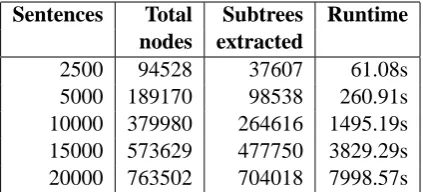
2500 94528 37607 61.08s 5000 189170 98538 260.91s 10000 379980 264616 1495.19s 15000 573629 477750 3829.29s 20000 763502 704018 7998.57s
Table 2: Runtime and closed trees extracted from automatically parsed samples of the Europarl Dutch corpus, keeping the minimum frequency threshold constant at 5 for all sizes of treebank.
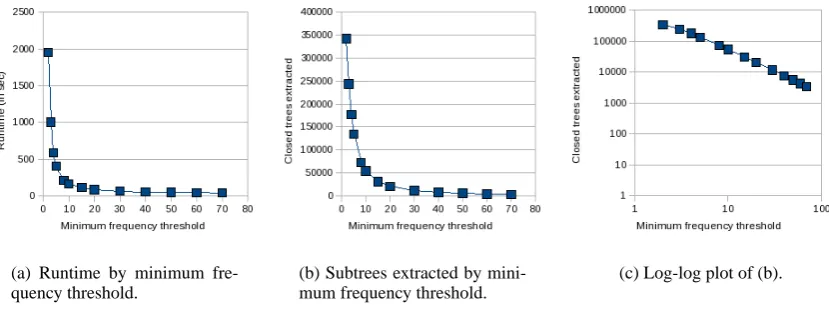
that setting the minimum frequency to 3 instead of 2 halved the runtime. This pattern is characteristic of a power law distribution like Zipf’s law. (See Table 1 and Figure 5.) Given the pervasiveness of power law distributions in word frequencies, it should perhaps not be surprising to discover that frequent closed subtrees in treebanks are similarly distributed. This research may be the first effort to empirically support such a conclusion, although admittedly only very tentatively.
To test the impact of varying the size of the tree-bank, but keeping the minimum frequency thresh-old constant, we used a section of the Dutch por-tion of the Europarl corpus (Koehn, 2005) auto-matically parsed using the Alpino Dutch parser (van Noord, 2006) without any manual correction. Random samples of 2500, 5000, 10000, 15000 and 20000 sentences were selected, and all sub-trees of frequency 5 or higher were extracted from each, as summarized in Table 2. As treebank size grows, the number of subtrees extracted at the same minimum frequency threshold, and the time and memory used extracting them, grows expo-nentially. This is in sharp contrast to algorithms that extract frequently recurring strings, which in-crease linearly in time and memory usage as the data grows.
However, if the minimum frequency threshold is kept constant as a proportion of the size of the treebank, then the number of trees extracted re-mains roughly constant and the time and memory used to extract them grows roughly linearly with the size of the treebank. Table 3 shows the result for different sized random samples of the parsed
Europarl corpus.
quency threshold. mum frequency threshold.
Figure 5: Runtime (a) and subtrees extracted (b) from the Alpino sample using different minimum fre-quency thresholds. Figure (c) is a log-log plot of (b). Figure (c) looks close to a straight line, which is characteristic of a power law distribution.
Sents Total Min. Subtrees Run nodes Freq. extracted time
Thres.
2500 99323 5 42905 72.95s 5000 194736 10 42783 122.18s 10000 382022 20 41988 216.23s 15000 574632 30 43078 325.86s 20000 770240 40 44416 435.19s
Table 3: Runtime and closed trees extracted from automatically parsed samples of the Europarl Dutch corpus, with minimum frequency thresh-olds kept roughly constant as a proportion of the sample size.
label (see sections 3.1 and 4), we attempted to determine if this problem is marginal or perva-sive. The 7137 sentence Alpino Treebank sample contains 3833 nodes with more than one non-leaf child node with identical labels or roughly 1.7% of all nodes. Furthermore, these nodes are present in 2666 sentences - some 37% of all sentences! This is a very large minority.
In order to estimate the effect this phenomenon has on the extraction of closed trees, we looked for outputted trees that are not closed by compar-ing the HitLists of all outputted trees to all other outputted trees with the same frequency. Table 4 shows the number of trees with identical distribu-tions to other outputted trees - i.e. trees that ap-peared to be closed to this algorithm, but in fact are not. The number was surprisingly large, but distributed overwhelmingly at the very lowest fre-quencies.
Min. Freq. Non-closed as a % of Threshold trees all trees extracted
2 2874 0.84%
3 693 0.28%
4 225 0.13%
5 101 0.08%
8 18 0.02%
10 11 0.02%
15 6 0.02%
20 3 0.01%
30 0 0.00%
Table 4: Non-closed trees from the 7137 sentence sample of the Alpino Treebank, produced erro-neously as closed trees because of repeated labels. There were no non-closed trees extracted at fre-quencies over 30.
6 Conclusions
advantage of comprehensive subtree censuses to become fully syntax-aware, instead of relying on
bag of words and n-gram models.
However, there are a number of drawbacks and caveats that must be highlighted.
Runtime, memory usage and output size are dif-ficult to estimate in advance. This is mitigated in part by the order in which subtrees are outputted, making it possible to extract only the most fre-quent subset of subtrees given fixed time and space bounds. Empirically, it appears that resource re-quirements and output size can also be estimated by sampling, if minimum frequency thresholds can be kept constant as a proportion of total tree-bank size.
The formalisms used in most theories of syn-tax allow nodes to have multiple non-leaf chil-dren with the same labels. Although errors caused by non-unique labels are overwhelmingly present only among the lowest frequency subtrees, er-rors appear often enough to pose a non-negligible problem for this algorithm.
We are investigating the degree to which this can be mitigated by making different choices of linguistic formalism. Syntax trees that contain only binary trees - for example, those constructed using Chomsky Normal Form rules (Jurafsky and Martin, 2009) - cannot have identically labelled non-leaf children, but must suffer some loss of generality in their frequent subtrees because if it. Other theories can reduce the size of this source of error, notably dependency syntax which often uses fewer abstract labels (Tesni`ere, 1959; Mel’ˇcuk, 1988; Sugayama and Hudson, 2006), but will most likely be poor sources of highly general rules as a consequence.
Furthermore, tree mining algorithms exist that eliminate this problem, but at some cost. We are investigating a hybrid solution to the non-unique label problem that identifies only those subtrees where more resource-intensive closure checking is necessary. This will guarantee the correct extrac-tion of closed subtrees in all cases while minimiz-ing the additional processminimiz-ing burden.
Among the open problems suggested by this re-search is the degree to which the empirical results obtained above are dependent on the language of the underlying data and the linguistic formalisms used to produce treebanks. Different linguistic theories use different abstractions and use their ab-stract categories differently. This has an
immedi-ate effect on the number of nodes in a treebank and on the topology of the trees. Some theories produce more compact trees than others. Some produce deep trees, others produce shallow trees. It is likely that the formalisms used in treebanks have a pervasive influence on the number and kind of frequent subtrees extracted. By doing quantita-tive research on the structures found in treebanks, it may become possible to make reliable opera-tional choices about the linguistic formalisms used in treebanks on the basis of the kinds of structures one hopes to get out of them.
Acknowledgments
This research is supported by the AMASS++ Project3 directly funded by the Institute for the
Promotion of Innovation by Science and Technol-ogy in Flanders (IWT) (SBO IWT 060051).
References
Georgiy M. Adelson-Velskii and Yevgeniy M. Landis. 1962. An algorithm for the organization of informa-tion. Proceedings of the USSR Academy of Sciences, 146(2):263–266.
Rakesh Agrawal, Tomasz Imielinski and Arun Swami. 1993. Mining association rules between sets of items in large databases. Proceedings of the 1993 ACM SIGMOD International Conference on Man-agement of Data, 207–216.
Tatsuya Asai, Kenji Abe, Shinji Kawasoe, Hi-roki Arimura, Hiroshi Sakamoto and Set-suo Arikawa. 2002. Efficient substructure discovery from large semi-structured data. Proceed-ings of the Second SIAM International Conference on Data Mining, 158–174.
Rens Bod, Khalil Sima’an and Remko Scha, editors. 2003. Data-Oriented Parsing. CLSI Publicatons, Stanford, CA.
Yun Chi, Yirong Yang and Richard R. Muntz. 2003. Indexing and Mining Free Trees. UCLA Computer Science Department Technical Report No. 030041.
Yun Chi, Richard R. Muntz, Siegfried Nijssen and Joost N. Kok. 2004. Frequent Subtree Mining – An Overview. Fundamenta Informaticae, 66(1-2):161– 198.
Yun Chi, Yi Xia, Yirong Yang and Richard R. Muntz. 2005a. Mining Closed and Maximal Frequent Subtrees from Databases of Labeled Rooted Trees. IEEE Transactions on Knowledge and Data Engi-neering, 17(2):190–202.
3http://www.cs.kuleuven.be/˜liir/
2005b. Canonical forms for labelled trees and their applications in frequent subtree mining. IEEE Transactions on Knowledge and Data Engineering, 8(2):203–234.
Hany Hassan, Mary Hearne, Khalil Sima’an and Andy Way. 2006. Syntactic Phrase-Based Statisti-cal Machine Translation. Proceedings of the IEEE 2006 Workshop on Spoken Language Translation, 238–241.
Mary Hearne and Andy Way. 2003. Seeing the Wood for the Trees: Data-Oriented Translation. Proceed-ings of the 9th Machine Translation Summit, 165– 172.
Daniel Jurafsky and James H. Martin. 2009. Speech and Language Processing. Pearson Prentice Hall, Upper Saddle River, NJ.
Philipp Koehn. 2005. Europarl: A Parallel Corpus for Statistical Machine Translation. Proceedings of the 10th Machine Translation Summit, 79–86.
Sotiris Kotsiantis and Dimitris Kanellopoulos. 2006. Association Rules Mining: A Recent Overview. GESTS International Transactions on Computer Science and Engineering, 32(1):71–82.
Fabrizio Luccio, Antonio Enriquez, Pablo Rieumont and Linda Pagli. 2001. Exact Rooted Subtree Matching in Sublinear Time. Universit`a Di Pisa Technical Report TR-01-14.
Fabrizio Luccio, Antonio Enriquez, Pablo Rieumont and Linda Pagli. 2004. Bottom-up subtree isomor-phism for unordered labeled trees. Universit`a Di Pisa Technical Report TR-04-13.
Edward M. McCreight. 1976. A Space-Economical Suffix Tree Construction Algorithm. Journal of the Association for Computing Machinery, 23(2):262– 272.
Igor A. Mel’ˇcuk. 1988. Dependency Syntax: Theory and Practice. State University of New York Press, Albany, NY.
Arjen Poutsma. 2000. Data-Oriented Translation. Proc. of the 18th International Conference on Com-putational Linguistics (COLING 2000), 635–641.
Arjen Poutsma. 2003. Machine Translation with Tree-DOP. Data-Oriented Parsing, 63–81.
Deepak Ravichandran and Eduard Hovy 2002. Learn-ing surface text patterns for a question answerLearn-ing system. Proceedings of the 40th Annual Meeting of the Association for Computational Linguistics (ACL-02), 41–47.
Kensei Sugayama and Richard Hudson, editors. 2006. Word Grammar: New Perspectives on a Theory of Language Structure. Continuum International Pub-lishing, London.
turale. Editions Klincksieck, Paris.
John Tinsley, Mary Hearne and Andy Way. 2007. Exploiting Parallel Treebanks for use in Statisti-cal Machine Translation. Proceedings of Treebanks and Linguistic Theories (TLT ’07), Bergen, Norway 175–187.
Gertjan van Noord. 2006. At last parsing is now operational. Verbum Ex Machina. Actes de la 13e conf´erence sur le traitement automatique des langues naturelles (TALN6), 20–42.
Peter Weiner. 1973 Linear pattern matching algorithm. 14th Annual IEEE Symposium on Switching and Au-tomata Theory, 1–11.
Mohammed J. Zaki. 2002. Efficiently mining fre-quent trees in a forest. Proceedings of the 8th ACM SIGKDD International Conference on Knowledge Discovery and Data Mining, 1021–1035.

![Figure 3: “...between the European Commission and the government of the [German] Federal Repub-lic...” This structure is a subtree of one of the sentences in the Alpino corpus of Dutch where a node hastwo children with the same labels - two NPs](https://thumb-us.123doks.com/thumbv2/123dok_us/731023.1082509/3.595.161.441.61.110/figure-european-commission-government-federal-structure-sentences-children.webp)