DOI: http://dx.doi.org/10.26483/ijarcs.v11i2.6514
Volume 11, No. 2, March-April 2020
International Journal of Advanced Research in Computer Science
RESEARCH PAPER
Available Online at www.ijarcs.info
ISSN No. 0976-5697
A SURVIVAL ANALYSIS ON PATTERN CLASSIFIER AND DETECTION
TECHNIQUES FOR DEFECTIVE IMAGE ANALYSIS
Dr. S. Sahaya Tamil Selvi
Head and Assistant Professor, Department of Computer Science St. Joseph’s College for Women
Tirupur, India
Abstract: Image based defect detection becomes a demanding task in estimating the quality of intermediate and end products in fabric and granite manufacturing, pipeline installation in heavy industries. A fabric defect detection scheme improves the quality for image defect detection and achieves higher accuracy to detect images. But, the image detection is complex in noisy applications. When the image size is large, it provides the false positive detection. The automated fabric defect classification techniques were used to analyze the ability of classifiers that employed in defect inspection systems with geometrical features. But in defect classification technique, level of accuracy is not satisfactory and real-time constraints needs to be addressed. Fabric defect detection is a significant problem in fabric quality control processing, and need to develop fast, efficient, reliable and real-time defect detection through image analysis techniques. Our research work on filtering, pattern classification and pattern detection aims to identify normal and defective image patterns from trained class patterns of the training image dataset.
Keywords: Automated fabric defect classification; filtering; Pattern classification; Feature Extraction; Segmentation; Principal Component Analysis(PCA); Peak Signal-to-Noise Ratio (PSNR); Artificial Neural Network (ANN); Particle Swarm Optimization(PSO)
I. INTRODUCTION
Image processing operations such as preprocessing, feature selection, classification and pattern detection enable the imaging application to analyze the product images at its granular (pixel) level. In most of recent work, preprocessing operation of the input image, evaluate local homogeneity of image pixel with a squared window of neighborhood pixels (window size could be 4,8,16, as per the level of granular image analysis required). Feature selection is carried out to identify most predominant features in the image. The homogeneous pixels with predominant features are grouped to form various image object segments. The object segments may reveal the nature of the pixels at the corresponding regions of the image, which help to identify the defective portion in the preprocessed image.
Defect detection is an important step for quality assurance in fabric production. With the growth of computer and digital image processing technology, computer vision is used to identify the fabric defects to replace the traditional methods. Image segmentation is the fundamental method and necessary technology in the computer vision. Fabric defects are caused by the unequal interwoven connecting the warps and wefts or by the faults and pollution of raw materials. The texture in the defect area is different with the normal fabric surface. It is instinctive to remove fabric defect texture and shape feature in spatial domain.
Image classifier techniques are applied to classify the segmented image portion and generate multiple image object classes (i.e., normal, defect, minimal defect) based on the intrinsic property of the pixel similar to a particular class. To identify the normal or defect nature of the image, pattern detection methods are used to train the normal and defective image patterns from standard product images. Then the test images are verified by checking the pattern similarity with
trained image patterns to accurately identify whether the product images are defective or normal patterns.
II. LITERATURE SURVEY
A nonlinear diffusion filter denoising framework [2] was planned to consider the information of gradient and gray levels of the image in removing noise and distortion in the preprocessing stage of image analysis. But, the non linear diffusion filter increased the computational complexity and processing overheads of the preprocessing operation on the input images of varied sizes. To improve the quality of image defect detection, a fabric defect detection scheme [1] was developed. The fabric defect detection scheme uses the local homogeneity and neural network and generated defective H-images. The choice of windows size of the neighborhood pixel mask required to calculate the H-image cause difficulty in recognizing the noisy pixels, in turn remove non noisy pixels. If the mask size is relatively large, then it will cause some false alarms.
Pulse Coupled Neural Network (PCNN) model [5] was introduced to generate adaptive image segmentation for detecting fabric defects. PCNN model and regional growing theory are joined to improve the fabric defect detection. PCNN model is sufficient and efficient for fabric defect detection. However, PCNN model produced average quality on fabric defect detection, and MSE was bit higher. The automated fabric defect classification technique [3] was developed to analyze the different geometrical featured classes in the fabric image and improve the automated fabric defect inspection. Classification techniques develop a computer vision based on Fabric defect inspection system. However, level of accuracy for multiple fabric images was average and unreliable in estimating the defective portion’s specific location and feature.
feature matching process to identify the defects in radiographic images. However, the weld identification approaches are unable to handle the varied geometrical defect and produce false positive recognition. Multi-view Alignment Hashing (MAH) approach [6] was developed to identify image pattern detection with better accuracy. Regularized kernel based matrix factorization is generated to evaluate multiple features of pixels being hashed. However, single images feature unable to provide multiple descriptive views for different images, on hashing. Multiple view of features, at times provide ambiguous detection result.
III. PATTERN CLASSIFIER AND DETECTION TECHNIQUES FOR DEFECTIVE IMAGE ANALYSIS
Defect detection is an essential step for quality guarantee in fabric production. Defect detection results in the less production efficiency and detection results. Fabric defect detection is a key issue in fabric quality control processing. With the growth of computer and digital image processing technology, computer visions are used to identify the fabric defects to substitute the traditional techniques. Image segmentation is the fundamental process and important technology in the computer vision. Fabric defects are caused by means of the irregular interwoven connecting warps and wefts or by means of the defects and pollution of raw materials. The texture in the defect area is not same in the normal fabric surface. It is sensitive to remove fabric defect texture and shape feature in spatial area.
Fabric defect detection is a key issue in fabric quality control processing and required to develop fast, efficient, reliable and real-time defect detection through image analysis techniques. Each defects occurred in fabrics is analyzed. An appropriate set of geometric features are selected for classifying the defects and suitable pattern detection techniques should be adopted to reduce false positive rate, defect detection accuracy, image size, etc.
A. Fabric Defect Detection using Local Homogeneity Analysis and Neural Network
[image:2.595.307.562.56.251.2]Defect detection is the important step in quality control of modern processes. In fabric field, defect detection is a significant method because of the used material. In textured images, discontinuities denote a significant feature like boundaries. It is recognized that the local homogeneity analysis is the technique to identify the discontinuities. Because of the nonparametric nature and capability to explain difficult decision regions, neural network is the classifiers utilized for defect detection.
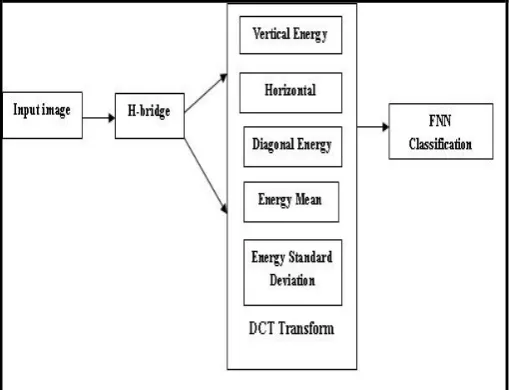
Figure 1. Block diagram of Fabric Defect Detection using -image and FFN
Feature reduction denotes the changing of the original features into a lower dimensional space. Many feature extraction techniques are derived from linear methods like principal component analysis (PCA). PCA is an exact technique for attaining the data dimensionality reduction. The technique creates a new set of variables are known as principal components (PCs). It increases the difference of the planned vectors. PC is a linear grouping of the unique variables. All PCs are orthogonal to each other where it fails to have the redundant information. The PCs forms an orthogonal fundamental for the space of the data. The initial PC contains the highest variability. The second PC comprises the next highest variability. The few components are placed and others with less variability are removed.
The designed technique has scanning of the attained image with a squared window and calculating the local homogeneity for all pixels and building the -image. The -image is partitioned into overlapping squared blocks. The five types of energy are calculated using the DCT employed for each block that creates the energies. Every pixel of the attained image is classified using a feature vector. After that, the statistical or -score normalization method is used in all features vectors that create the input to the neural network. The number of inputs of the neural network is not same as the number of feature removal. They attained by means of a principal component analyzing (PCA) routine. The routine is used to control the number of inputs of neural network. The number of inputs is taken as four. The number of training vectors is similar to the number of pixels in the fabric surface. The network contains a single output.
B. Feature Selection for Fabric Defect Classification Using Neural Network efects in Fabric
[image:3.595.30.294.248.376.2]Defect analysis is a key method to automated textile defect inspection issues than other parts. Defect analysis identifies the defects and gives clues to appropriate feature. Defect classification creates issues as classification process comprised of many steps. The choice of an unsuitable set of features increases the difficulties and creates the classification task harder [11]. Choice of suitable set of features is used to overcome a classification issues. In a suitable feature set, the traits of the features are large and the number of features is small. The technique contains statistical defect detection and NN based classification. Statistical defect detection is an easy process.
Table I. Peak Signal-to-Noise Ratio of Filtering, Classification and Detection Techniques
Sr.
No. Inspection types Inspection Manual Automated Inspection
1 Defect detection 70% 85%
2 Statistics ability 0% 90%
3 Response type 50% 80%
4 Inspection speed 30m/min 120m/min
5 Reproducibility 50% 90%
6 Information exchange 20% 87%
[image:3.595.37.284.474.593.2]
Automated fabric inspection systems are real-time applications which require an efficient algorithm to manage fabrics. NNs are suitable for real-time systems due to their parallel processing capability. NNs include strong capability to control the complex classification issues.
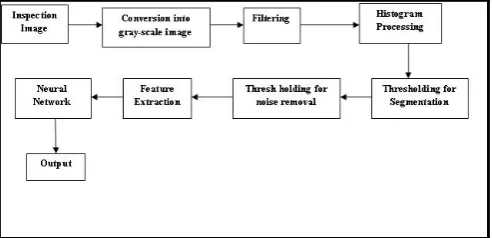
Figure 2. Block Diagram of Textile Defect Inspection Method
Figure 2 describes the block diagram of textile defect inspection model. Initially, it initiates with an inspection image of uni-color knitted fabric that changed into a gray-scale image. After that, the images are filtered to smooth it and to eliminate the noises. The gray-scale histogram of the image is created and two threshold values are estimated from the histogram. With these threshold values, the image is changed into a binary image. The noises are taken out through thresholding. Feature vector is created by calculating a number of features of the defect.
C. Defect identification from Radiographic Images aquisition
The designed technique contains four main stages. They are: radiographic image digitization, image enhancement (pre-processing), image segmentation and defect identification. Every stage has a large number of processes that carried out consecutively to interface with the input. The digitalization of radiographic films is maintained with a digital camera or digital scanner. Because of nature of the data acquisition and digitization process, the quality of the raw radiographic images is changed. The function of the preprocessing stage is to enhance the quality and reliability of the images to allow the segmentation and recognition processes. A small fraction of a scanned radiographic image symbolizes welds. The image segments denote weld areas that are lexicographically-ordered into 1D signal. MFCCs and polynomial coefficients are removed from the PDSs of the signals. Many PDS estimation methods are employed and ANNs are utilized for feature matching.
Radiographic image improvement is employed for the radiograph interpretation. The film digitization process creates small-contrast images with granularities. Image enhancement is necessary for improving the contrast between the image background and the weld defect areas. It is also used for extracting the noise from the digitization process. Histogram equalization is an image improvement method to enhance the visual appearance of the image by allocating equal numbers of pixels to intensity values. Image contrast is increased with Adaptive Histogram Equalization (AHE) through improving the contrast of each pixel with its local neighborhood. The histograms are determined for small regional areas of pixels. AHE provides contrast in local areas with the traditional histogram equalization method.
IV. COMPARISON OF PATTERN CLASSIFIER AND DETECTION TECHNIQUES AND SUGGESTIONS
In order to compare the pattern classification and detection techniques for defective image analysis in the experiment, various parameters are used.
A. Peak Signal-to-Noise Ratio (PSNR)
The peak signal-to-noise ratio (PSNR) is the ratio between the maximum power of a signal and the power of unwanted noise that affects the reliability of the image. PSNR is measured in terms of decibel (dB).
(1) Where,
(2)
Table II. Peak Signal-to-Noise Ratio of Filtering, Classification and Detection Techniques
Number of Tested Images (No.)
Peak Signal-to-Noise Ratio (dB)
Fabric Defect Detection Scheme
Fabric Defect Classification Using
NN
Weld Defect Identification
Approach
10 31 36 41
20 35 42 44
40 43 49 52
50 46 52 55
60 49 56 59
70 54 62 65
[image:4.595.31.291.58.133.2]The Peak Signal-to-Noise Ratio comparison takes place on existing Fabric Defect Detection Scheme, Fabric Defect Classification using NN and Weld Defect Identification Approach.
Figure 3. Peak Signal-to-Noise Ratio of Filtering, Classification and Detection Techniques
Figure 3 and Table II explain the peak signal to noise ratio of filtering, classification and detection techniques. Peak signal to noise ratio of fabric defect detection scheme is lower compared to weld defect identification approach and fabric defect classification using neural network. Peak signal to noise ratio of fabric defect detection scheme is 15.37% lower than fabric defect classification using neural network (NN) and 23.18% lower than weld defect identification approach.
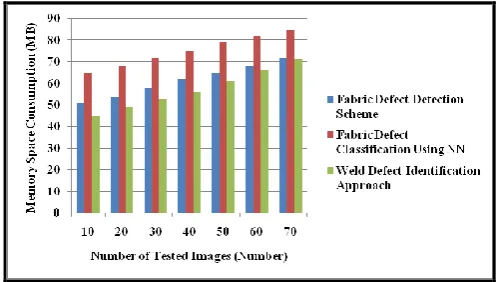
B. Memory Space Consumption for Image Classification The total amount of memory space is consumed by the tested images while classifying the images. It is measured in terms of Mega Bytes (MB).
Table III. Memory Space consumption of Filtering, Classification and Detection Techniques
Number of Tested Images (No.)
Memory Space consumption (MB)
Fabric Defect Detection Scheme
Fabric Defect Classification Using
NN
Weld Defect Identification
Approach
10 51 65 45
20 54 68 49
30 58 72 53
40 62 75 56
50 65 79 61
60 68 82 66
70 72 85 71
The memory space consumption comparison takes place on existing Fabric Defect Detection Scheme, Fabric Defect
[image:4.595.305.554.92.233.2]Classification using NN and Weld Defect Identification Approach.
Figure 4. Memory Space consumption of Filtering, Classification and Detection Techniques
Table III and Figure 4 describes the memory space consumption of filtering, classification and detection techniques. Memory space consumption of weld defect identification approach is lesser compared to fabric defect detection scheme and fabric defect classification using neural network. Weld defect identification approach consumes 32.35% lesser memory space than fabric defect classification using neural network (NN) and 7.81% lesser than fabric defect detection scheme, that are used to improve the visual appearance of an image or used to convert the image to a form, which can be better suited for further analysis in the subsequent stages by a human or a machine[6].
C. Execution time
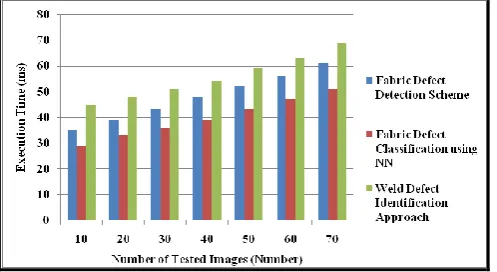
Execution time is defined as the amount of time consumed for detecting the defected images from the number of tested images. It is measured in terms of milliseconds (ms).
[image:4.595.39.295.190.324.2](3)
Table IV. Execution time of Filtering, Classification and Detection Techniques
Number of Tested Images (No.)
Memory Space consumption (MB)
Fabric Defect Detection Scheme
Fabric Defect Classification Using
NN
Weld Defect Identification
Approach
10 35 29 45
20 39 33 48
30 43 36 51
40 48 39 54
50 52 43 59
60 56 47 63
70 61 51 69
[image:4.595.299.559.537.724.2] [image:4.595.30.306.568.753.2]Figure 5. Execution time of Filtering, Classification and Detection Techniques
In figure 5, the execution time of filtering, classification and detection techniques are compared. Fabric defect classification using neural network consumes lesser execution time compared to fabric defect detection scheme and weld defect identification approach. Fabric defect classification using neural network takes 20.15% lesser execution time than fabric defect detection scheme and 41.04% lesser than weld defect identification approach. Multiple view of features, at times provide ambiguous detection result.
V. DISCUSSION OF LIMITATION OF PATTERN CLASIFICATION AND DETECTION TECHNIQUES
Classification techniques designs a computer vision based on Fabric defect inspection system. A defect classification technique consists of more accuracy, model complexity and consumes less training time. But in the defect classification technique, level of accuracy is not sufficient to meet the demand of competitive international market. Weld defect identification approach is derived from the generation of the database of defect features with Mel-Frequency Cepstral Coefficients (MFCCs) and polynomial coefficients removed from the Power Density Spectra (PDSs). Artificial Neural Networks (ANNs) are used for feature matching process that detects the defects in radiographic images.
The fabric defect detection scheme employs the local homogeneity and neural network. Computing a new homogeneity images in detection is represented as H-image. The application of discrete cosine transform (DCT) to H-image, extracts different representative energy features. The local homogeneity and neural network achieves higher accuracy to detect images. A fabric defect detection scheme improves the quality for image defect detection. The arbitrarily choice of windows size of the mask is essential to calculate the H-image that affects the defect detection. If the mask size is relatively large, then it will cause some false alarms.
A. Related works
Markov random field (MRF) level set method [7] was introduced to build energy function correlation of a pixel with its neighbors and encourages them to fall into same region to detect noise and distortion pixels. Algebraic Multi Grid (AMG) and Sparse Field method (SFM) increase time step and decrease computation domain in MRF for noise removal process. However, MRF method unable to handle heavy noise levels of the input image, affect the quality of noisy removal and preprocessing capabilities.
A set of geometric features extraction technique [9] was developed to solve the textile defect classification problems. The geometric features are justified in terms of distinguishing qualities and used a statistical feature extraction technique to extract the defect features. However, feature set may not have enough distinguishing information to detect and classify textile fabric defects with required accuracies[10]. Moreover, during acquiring images, lighting was not good enough and a captured image does not have high quality.
A fast converging Riemannian steepest descent method [8] was designed to improve the convergence of Nonparametric Active Contours for image pattern segmentation. Steepest descent method derives a general and tractable closed-form of analytic expression for manifold’s Riemannian metric tensor. However, fast converging Riemannian steepest descent method did not handle multiple image formats for detecting segmented patterns and also generate complexity in image featured pattern detection.
B. Future direction
The future direction of using the filtering, pattern classification and detection technique identifies the normal and defective image patterns from trained class patterns of the training image dataset. Initially, non-linear filtering technique is planned for removing noise from the acquired input images. Then, swarm optimization and detection technique classifies the preprocessed images for identifying the normal and defective portions of the images.
VI. CONCLUSION
By taking the survey, it is concluded that different defect detection methods are used to identify the defects from many images are not effective in existing methods. At first, many individual image processing operations fails to recognize the defects exactly. In filtering techniques, the unwanted noises are not properly filtered to detect the exact defect location of the images. Defect classification techniques are designed for automated fabric defect inspection system. Later, defect classifiers of automated fabric defect inspection systems in existing techniques are not efficient because of less accuracy, high complexity and larger training time. For this reason, new defect detection technique is planned. The wide range of experiments on existing techniques calculates the comparative results of the various detection techniques and its limitations. Finally, from the result, the research work can be carried out in pattern classification and detection technique for identifying the normal and defective image patterns from trained class patterns of the training image dataset.
VII. REFERENCES
[1] Ali Rebhi, Issam Benmhammed, Sabeur Abid, and Farhat Fnaiech, “Fabric Defect Detection Using Local Homogeneity Analysis and Neural Network”, Hindawi Publishing Corporation Journal of Photonics Volume 2015, Article ID 376163, 2015
[2] Zhenyu Zhou, Zhichang Guo, Gang Dong, Jiebao Sun, Dazhi Zhang, and Boying Wu,” A Doubly Degenerate Diffusion Model Based on the Gray Level Indicator for Multiplicative Noise Removal”, IEEE Transactions On Image Processing, Vol. 24, No. 1, January 2015
[4] O. Zahran, H. Kasban, M. El-Kordy, F.E. Abd El-Samie,” Automatic weld defect identification from radiographic images”, NDT&E International 57 (2013) 26–35, Elsevier 2013
[5] Xiaoshu Si School of Electronic Information, Wuhan University, Wuhan, China, Hong Zheng and Xuemin Hu School of Electronic Information, Wuhan University, Wuhan, China,” Fabric Defect Detection Based on Regional Growing PCNN”, Journal of Multimedia, vol. 7, no. 5, october 2012
[6] Li Liu, Mengyang Yu, Student Member, IEEE, and Ling Shao, Senior Member, IEEE, “Multiview Alignment Hashing for Efficient Image Search”, IEEE Transactions On Image Processing, Vol. 24, No. 3, March 2015 [7] Xi Yang., Xinbo Gao., Dacheng Tao., Xuelong Li., and
Jie Li., “An Efficient MRF Embedded Level Set Method for Image Segmentation”, IEEE Transactions On Image Processing, Vol. 24, No. 1, January 2015
[8] Jia He, Qian Jiang, “ Research on the Fabric Defect Detection Method based on Improved PSO and NN
Algorithm”, International Journal of Digital Content Technology and its Applications(JDCTA) Volume 6 , Number 8, May 2012 doi:10.4156/jdcta.vol6.issue8.21 [9] P Md. Tarek Habib and M. Rokonuzzaman, “A Set of
Geometric Features for Neural Network-Based Textile Defect Classification”, ISRN Artificial Intelligence Volume 2012, Article ID 643473, Hindawi 2012
[10] S. Sahaya Tamil Selvi and Dr. G. M. Nasira, “Plain Woven Fabric Defect Detection using GLCM based Feature Extraction”, International Journal for Research in Applied Science & Engineering Technology (IJRASET) Volume 6 Issue V, May 2018