Volume 11, Special Issue I, May 2020
International Journal of Advanced Research in Computer Science CONFERENCE PAPER
Available Online at www.ijarcs.info
VOICE BASED ROBOTIC VEHICLE WITH OBSTACLE AVOIDANCE
Lokireddy Sai Siddhardha Reddy, MSumanth, Maram Venkata Nagasai Teja Bavigadda Purushotham Naidu, Shalini Tiwari
Abstract:The major principle of the robotic vehicle is to examine the user voice command and perform the given user task and without the human presence inparticular area can controlthe robot via user voice input. To control the robot through user voice inputit requires android app to communicate via Bluetooth HC-05 module. Subsequently, the robotic vehiclehas skill-ability to senses the object and tells the user to keep away from the object with the aid of selecting another way with the help of Ultrasonic sensor module. Therefore, this paper offers mainly for physically disabled peoples. Thereby in future, they drive their own vehicle with a more safety and security from unexpected attempt at sudden hit-and-run cases due to automatic braking or slow down feature. For the hardware, customized Arduino will give the control over the motors that use to run the robotic vehicle. Ultrasonic sensors interact with the Arduino help in automatic braking of a vehicle on sudden obstacle detection.
Keywords—voice command, obstacle, Bluetooth module, Ardiuno, Ultrasonic ranging sensor.
I. INTRODUCTION
Generally,robotsare made bydifferent frame works such as mechanically, electrically, and computing technology which can be utilized to perform various operationin mechanical or residential use.These robots can reduce the human efforts and have more interaction with user.
To achieve such robots can be controlled via user voice inputs or commands. These robots can help the user to freeup their hands and perform on various operation within the vehicle. To perform the various task given by user it requires Smartphone to communicate with robot. To process the voice commands a simple and efficient method is to utilize asmartphone. Smartphones are incredible gadgets fit for performing numerous functions like PC. Here, the proposal focuses in an issue faced by specially abled people who wish to drive their vehicle on their own but they cannot because of the natural cause. In this proposed system, the emphasis is on voice control of robot with automatic braking, speed slow down and avoidance of obstacles consequently or physically (through voice command).
In this paper, we will use an android app to pass on the voice commands to the Arduino through Bluetooth communication using Bluetooth module. Ultrasonic sensor will act as the obstacle detector, which will act as a mediator for Arduino microcontroller (or the CPU) and the proximal environment, and it would eventually lead to
slowing down the vehicle or to fully break its motion. It would be a great aid for the safety of people driving it.
II. LITERATURE SURVEY
Ritika Pahuja and Narender Kumar [5], they discussed about how the robot can be controlled by using remote buttons in the android applications in smartphone via specified conventional components.
Nitin Bhuwania,S R Madkarand Maitri Parida [4] explained that how the robotic vehicle is controlled by using Wi-Fi module via android application and it can also controlled by sending an ordinary message.
Kalane,Pathak, Javed, Aarushi Koul, Raunak Varshney [3]mentioned thatsome basic commands such as upwards, reverse, left and right side to control the robotic vehicle via Bluetooth module by android application in smartphone
III. SYSTEM DESIN AND ANALYSIS
A. Block Diagram
Lokireddy Sai Siddhardha et al, International Journal of Advanced Re
Advances in Computing & Information Technology (IACIT
Organized by School of Computing and Information Technology
Arduino via Bluetooth module. Then Arduino executes the user inputs and the robot start user actions, ultrasonic sensor transmits sound waves if sound waves hit any object then obstacle is found and immediately the robot stops. At this state, the robot is in hold position un user gives next voice command.
Figure1. Block diagram of robot
B. System Flow
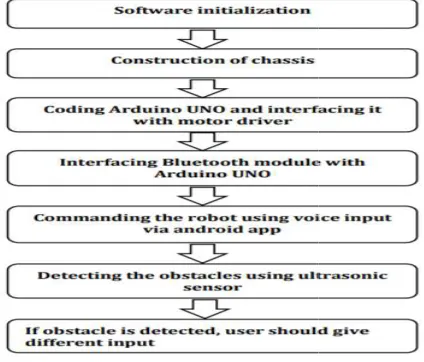
The general flow of the robot is defined below,
Figure 2. System Flow of robot
IV. SYSTEM REQUIREMENTS
The system design consists of following components:
A. Arduino uno
B.L298N DC Motor Driver
C. Bluetooth
D. Ultrasonic detecting sensor
E. 300RP Motors
International Journal of Advanced Research in Computer Science, Vol 11, Special Issue I, May 2020,47
2nd International Conference on
Advances in Computing & Information Technology (IACIT-2020) Date: 29-30 April 2020
Organized by School of Computing and Information Technology Reva University, Bengaluru, India
th module. Then Arduino executes the s and the robot start user actions, ultrasonic sound waves if sound waves hit any immediately the robot the robot is in hold position until the
The general flow of the robot is defined below,
SYSTEM REQUIREMENTS
The system design consists of following components:
F. Connecting Wires
G. Power supply (or battery)
H. Arduino Ide
I. BT Voice Control for Arduino(SMART PHONE APPLICATION )
A. Arduino Uno
Figure3. Arduino Uno
Microcontroller is the major part of the robot.
is programmed with help of Embedded C programming language.The board has 14 digital input/output pins, 6 analog input/output pins and programmable with the Arduino ide.
B. L298N Motor Driver
Figure 4. L298N Motor Driver
This dc Motor derives controls motors as well as regulate the speed and direction of dc motor given by user input.
C. Bluetooth
Figure 5. HC-05
The Bluetooth HC-05 module is utilized
user voice commandfrom Smartphone to microcontroller. The Bluetooth HC-05 can be used as either transmitter or search in Computer Science, Vol 11, Special Issue I, May 2020,47-52
48
. BT Voice Control for Arduino(SMART PHONE
Arduino Uno
Microcontroller is the major part of the robot. Arduino uno is programmed with help of Embedded C programming The board has 14 digital input/output pins, 6 analog input/output pins and programmable with the
L298N Motor Driver
controls motors as well as regulate the speed and direction of dc motor given by user input.
receiver.Thismodule is automaticallyreconnects within 30 minutesand disconnected when the vehicle is out of range.
D. Ultrasonic detecting sensor
Figure 6. Ultrasonic Sensor
Ultrasonic sensor consists four pins. It transmit waves, if sound waves hit any object the vehicle will stop immediately. This module is used to detect the object in front of the robot and alert the microcontroller. This module also includes an ultrasonic transmitter,receiver and control circuit.
E. 300RP Motors
Fig.6: 300RP Motors
This motoris used to generate the motion.
the DC motor can be controlled bychanging supply voltage.This dc motor is used for movement of the robot vehicle.
F. Connecting Wires
Figure 7. Connecting Wires
A wire is a single, flexible and usually
shape.Wires are used to bear or pass the electricityand telecommunications signals.These wires are used to connect the components of the robot.
receiver.Thismodule is automaticallyreconnects within 30 minutesand disconnected when the vehicle is out of range.
four pins. It transmits sound waves, if sound waves hit any object the vehicle will stop
. This module is used to detect the object in-front of the robot and alert the microcontroller. This module also includes an ultrasonic transmitter,receiver
used to generate the motion. The speed of DC motor can be controlled bychanging supply for movement of the robot
is a single, flexible and usuallycylindrical in
.Wires are used to bear or pass telecommunications signals.These wires are used to connect the components of the robot.
G. Power supply (or battery)
Figure 8. Power Supply
This power supply is used to power the DC motor.
H. Arduino Ide
Figure 9. Arduino Ide
The open-source Arduino Software (IDE) makes it easy to write code and transfer it to the board. Arduino IDE software runs on Windows Operating System, Mac Operating System, and LinuxOperation System. Arduino IDE, the written code
microcontroller via type B USB.
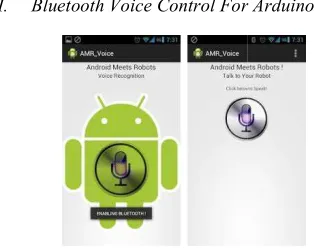
I. Bluetooth Voice Control For Arduino
Figure 10. Application for Bluetooth Voice Control
This application is used to send the user voice to the robot via smartphone through module.
Power Supply
is used to power the DC motor.
Arduino Ide
source Arduino Software (IDE) makes it easy to write code and transfer it to the board. Arduino IDE software runs on Windows Operating System, Mac Operating System, and LinuxOperation System. In the written code is transfer into
Bluetooth Voice Control For Arduino
Application for Bluetooth Voice Control
Lokireddy Sai Siddhardha et al, International Journal of Advanced Re
Advances in Computing & Information Technology (IACIT
Organized by School of Computing and Information Technology
V. METHODOLOGY
Our proposed system consists of the three sections:
A. Input section
The voice commands are sent to robot through Android device via Bluetooth.
B. Microcontroller Section
These commands are sent to the microcontroller by Bluetooth. The microcontroller process these command andUltrasonic sensor transmits sound waves, if sound waves hit any object the vehicle will stop immediately
this state, the robot is in hold position until the user gives next voice command.
C. Output Section
Based on the command received by the microcontroller the robot moves in different direction. And also,Ultrasonic sensor used to detect the obstacle.
Figure 11. Circuit Diagram of Robot
VI. RESULT
At the point when the robot gets voice order or command, the robot begins to move.
The commands of the user can be"Forward", "Backward", "Left", "Right" and “Stop”.
Depending upon the order given by the user, the robot works as indicated by it.
When the obstacle comes before the robot with the distance less than 100cm, the Ultrasonic
International Journal of Advanced Research in Computer Science, Vol 11, Special Issue I, May 2020,47
2nd International Conference on
Advances in Computing & Information Technology (IACIT-2020) Date: 29-30 April 2020
Organized by School of Computing and Information Technology Reva University, Bengaluru, India
Our proposed system consists of the three sections:
The voice commands are sent to robot through Android
These commands are sent to the microcontroller by The microcontroller process these commands
sound waves, if sound waves hit any object the vehicle will stop immediately.At this state, the robot is in hold position until the user gives
ed on the command received by the microcontroller the robot moves in different direction. And also,Ultrasonic
Circuit Diagram of Robot
At the point when the robot gets voice order or command,
The commands of the user can be"Forward", "Backward", "Left", "Right" and “Stop”.
Depending upon the order given by the user, the
When the obstacle comes before the robot with the distance less than 100cm, the Ultrasonic
sensor senses the obstacle immediately robot stops.
At this state, the robot is in hold position until the user gives next voice command.
The voice commands given the robot are as follows:
TABLE I. User Commands
INPUT(User Voice
command)
OUTPUT (Robot command)
Move forward direction It goes Front
Move backward direction
It goes Back
Move left It takesLeft
Move right It takesRight
Stop It stops
Garba Rotation of the robot vehicle in square shape
Thus, our robot makes movement according to user commands.
TABLE II. Presence of obstacle
S.no Conditions Present of
obstacle
1 Distance is greater than or equal to and present of obstacle, the possible voice Command are “Forward”, “Backward”, “Left” “Right”, “Stop”.
search in Computer Science, Vol 11, Special Issue I, May 2020,47-52
50
the obstacle,if it is detected
At this state, the robot is in hold position until the user gives next voice command.
given the robot are as follows:
2nd International Conference on
Advances in Computing & Information Technology (IACIT-2020) Case2: When distance is less than 100cm and present of
obstacle, the possible voice Command are “Backward”, “Left”, “Right”, “Stop”.
VII. Comparison
In paper [1]robot is designed which can detect obstacles in its path and to be avoided.
-The proposed paper deals with detection obstacles in its path and stops Automatically and also using “stop” command manually.
In paper [2]robot is designed to move in different direction by avoiding obstacles using ultrasonic sensor.
- The proposed paper deals with collisions avoidance automatically by using Ultrasonic sensor and navigate the car through various voice commands manually.
In paper [3] robot is designed wirelessly controlled by using smart phone via Bluetooth module.
- The proposed paper deals with designing a car with Bluetooth module which take voice commands from user using Android application.
In paper [5] robot motion is controlled by using remote buttons in the android application in smartphone.
-The proposed paper deals with designing the control system of car through voice commands manually and an Automatic Sensor which stops when an obstacle is in its path.
In paper[6] robot is controlled in desired position by using user voice commands or push buttons.
-The proposed paper deals with designing a car to take voice commands from user through Bluetooth and respond manually. And also respond automatically by stopping the vehicle when objects are near-by using ultrasonic sensor.
A. Advantages
The proposed model is cheaper than the Artificial Intelligence (AI) technology used today.
Easy to install in vehicles.
B. Limitations
This can only be used where similar technology vehicles are running.
C. Disadvantages
A voice error will occur if the voice input is not accuracy provided by the user or near to smartphone.
D. Application
• Home automation
• Physically handicapped
• Industrial Robots
• Low range Mobile Surveillance Devices
• Military Applications
• Assistive devices
VIII. CONCLUSION
Usage of the proposed system will reduce the accidents. It deals with the regular issues of the drivers, prevention of whether they are completely fit for differently abled. Unused drivers would not confront the issue of changing the paths every now and again. Be as many as possible, this innovation must be applicable on the streets having vehicles of the latest innovation running on it. This can be expected as the demand or limitation of the proposed model. These robotic systemsreduce human efforts as well as helps the military, research purposes and industries.
IX. FUTURE ENHANCEMENT
Our project can conclude that the robot is controlled by giving user voice commands. So, it is simply implemented or used in future scope for many fields and also reduces human effort. This may use for some mechanical application and residential purpose. Bluetooth communication technique works efficiently with some time delay after several runs and test. This can only be used where similar technology vehicles are running.
Lokireddy Sai Siddhardha et al, International Journal of Advanced Research in Computer Science, Vol 11, Special Issue I, May 2020,47-52
2nd International Conference on
Advances in Computing & Information Technology (IACIT-2020) Date: 29-30 April 2020
Organized by School of Computing and Information Technology Reva University, Bengaluru, India
52 [1]Tabassum F, Lopa S, Tarek MM,Ferdosi BJ ,“Obstacle avoiding
robot”. Global J. Res. Eng., 17(1). Version 1.0 , 2017.
[2] Kirti Bhagat, Sayalee Deshmukh, Shraddha Dhonde, Sneha Ghag, “Obstacle Avoidance Robot”,Volume 5, Issue 2, February 2016.
[3]Mrumal.K. Pathak, Javed Khan, “ROBOT CONTROL DESIGN USING ANDROID SMARTPHONE”,2 Feb 2015, ISSN :2347-5471.
[4]S R Madkar, Vipul Mehta, Nitin Bhuwania, Maitri Parida,“Robot Controlled Car Using Wi-Fi Module”. ISSN: 2277 128X Pg:31-33.
[5] Narender Kumar,Ritika, “Android Mobile Phone Controlled Bluetooth Robot Using8051 Microcontroller”, ISSN: Page:2345 – 3879.
[6] Preeti M,Soniya Z, Rupali, Aishwarya, Megha, “Voice Control Robot Using Android Application”.Vol-3, Issue-2, 2017, ISSN: 2453-1361.
AUTHOR’S PROFILE
Lokireddy Sai Siddhardha Reddyis currently pursuing B.Tech in Computer Science and Engineering at REVA University, Bengaluru, Karnataka, India.
Email: [email protected]
M Sumanth is currently pursuing B.Tech in Computer Science and Engineering at REVA University, Bengaluru, Karnataka, India.
Email: [email protected]
Maram Venkata Nagasai Tejais currently pursuing B.Tech in Computer Science and Engineering at REVA University, Bengaluru, Karnataka, India.
Email: [email protected]
Bavigadda Purushotham Naidu is currently pursuing B.Tech in Computer Science and Engineering at REVA University, Bengaluru, Karnataka, India.
Email: [email protected]