Volume 7, No. 3, May-June 2016
International Journal of Advanced Research in Computer Science RESEARCH PAPER
Available Online at www.ijarcs.info
A Novel Approach Based on Fingerprint Identification and Face Recognition
Monika Neha Yadav
Research Scholar (M.tech)
Dept. of Computer Science & Applications Kurukshetra University, Kurukshetra, India
Assistant Professor
Dept. of Computer Science & Applications Kurukshetra University, Kurukshetra, India
Vinod Kumar
Assistant Professor
Dept. of Computer Science & Applications Kurukshetra University, Kurukshetra, India
Abstract: In real world applications unimodal biometrics have some limitations such as noise sensitivity, data quality, non-universality, interclass difference. These issues can be tackled easily by multimodal biometric system. This paper investigates the fusion of face visual features by using e-PCA that resolves the issue of visual difference in face classification process. An implementation of face and fingerprint fusion using PCA based and hamming distance for calculating minutiae features in fingerprint is fused at matching score level .This paper uses match score level by choosing the id of both face and fingerprint Better result can be obtained using Euler PCA if multiple instances of same person were used for matching and combining. Templates of fingerprint and face feature are tested on self created image database. PCA observes different dimensions and evaluate the principle dimensions where the variation is high. This proposed work is tested in MATLAB 2015b with performance metrics FAR of 3.33%, FRR of 3.27 and accuracy by changing the person instance feature at every time.
Keywords: Biometrics, ePCA, PCA, Biometrics Technique, Multimodal Biometric
I. INTRODUCTION
[image:1.612.52.298.535.673.2]Human recognition by using Physiological and behavioral traits of a person is termed as Biometrics. [1]. Biometric systems have been developed based on fingerprints, facial features, voice, hand geometry, handwriting, iris and retina etc[2]. Biometric is a type of recognition which collect information fusion from different sources and then those extracted feature are consolidated at one safe place known as database template. Based on these perspective biometric follow two principal modes of operation verification (1:1) and identification (1: N).
TABLE I. Levels of security schemes
Methods Examples Characteristics
Knowledge Based Something we know, password or
PIN etc
Easy to use, and can also be easily forgotten but ease of
guess.
Token Based Something we have, e.g. key or ID
card
They can be duplicated, stolen or lost, Ease of use.
Biometrics Something we are, e.g. fingerprint,
hand, iris
Unique for each individual and are reliable, difficult to
forge, more secure
II. MULTIMODAL BIOMETRICS
The biometric system especially useful for an appropriate application depending on its features strength and weakness [3].Biometric systems based on single eccentricity of information for person authentication are called Unimodal systems [11]. However these system posses several drawbacks like noise in sensor data, non universality, intra class variation, inter class similarity and spoofy attacks. To overcome these problems concept of multimodal biometrics is come that combine more than one biometric trait from more than one source. The key point in multimodal biometrics is the fusion of various biometric modality data [4]. Information from different biometric attributes can be integrated at the feature level (integrating the features of different biometrics), score level (combination of accurate matching score of the real and pretender scores), or decision level (combining the decisions). [6, 7] This paper proposed score level fusion of face and fingerprint extraction using minutiae extraction scheme and face recognition by using ePCA approach. In fingerprint recognition multiple instance of one impression are fused at match score and then normalized is followed to normalize at one domain range for fusion. The sum score of both using weighted sum rule is used for face and fingerprint multimodal biometric system.
III. RELATED WORK
decision level fusion of both traits. The result was proved having FAR of 0.019999% and FRR of 1.07%. Youssef ELMIR et al. [9] launched score level fusion scheme for fingerprint and voice. In their research author extracted features using Coif let Wavelet transform. Their result was shown using cumulative match score curve. K.Geetha et al. [10] proposed a feature level fusion of fingerprint and palm print. An effective Coiflet Wavelet approach was proposed for fusion of finger and palm print. They used SVM classifier for fused the features of these two traits. Experiment result demonstrate that they achieved 97.53% with RBM kernel best classification accuracy by selecting fingerprint from FVC2002 database and palm print images were captured from CCD Camera. Kawulok et al. [11] presented a combination of face and eyes for better results of biometric system. Linlin shen et al. [12] proposed the integrating face and palm print to efficient match between stored template in the database and acquired template and thus provide a reliable authentication.
IV. PROPOSED WORK
The proposed modal for person authentication utilizes face and fingerprint modalities acquired from image database. In this work we approached the minutiae based extraction. All fingerprint images are assigned an id and we use fingerprint impression of one person with different alignment, rotation and orientation. All fingerprint images are assigned an id and we use fingerprint impression of one person with different alignment, rotation and orientation. This will obviously provide more security and accuracy. Face recognition uses EPCA. In this paper face and fingerprint recognition is fused at match score level using weighted sum score level fusion. The system uses Euclidean distance for matching for traits based on this matching is performed. Now we are going to discuss the steps of fingerprint and face recognition in detail.
A. Fingerprint recognition
Fingerprint biometrics is one of the oldest methods for providing a reliable, stable technology in civilian and government applications. Fingerprint impression can be taken easily obtained by physically touch the surface of any object from thumb pad fingerprint scanner device may be obtained. Normally fingerprint minutiae consist of 60 to 80 minutiae but this value may be different for different fingerprints. A fingerprint consist of mainly ridge ending and bifurcation feature sets. Minutiae are the terminations of ridge and bifurcations point at which ridge form two branches. Fingerprint modalities are used for last long history due to easy to use acquisition. Every person has ridges, valleys, grooves, and direction of lines on top surface of fingers whose development occurs after the few seven months of birth. The basic structure of fingers show as highest peaking portion of ridges act as empty while ridges look as white, ridges are low. Ridges further divided as whorl, loop, arch, dot, bifurcation, ridge ending, island, delta, and dot. A fingerprint recognition technology mainly works in two phase :
Enrollment phase : In the enrollment phase, first of all sensor scans the fingerprint of user and then
determine the minutiae point , feature extractor extracts the minutiae points from image and then system stores the minutiae information along with demographic information of the person as a template in the database.
Recognition phase: In the recognition phase, sensor generates the fingerprint image of user namely as a query image. Minutiae extractor will extracts the minutiae points from query image and then the matcher module compares the minutiae points of query (user’s) image with the stored minutiae template in database and then a match score is generated by the system. After that, System determines the person’s identity by comparing the obtained match score with the threshold value. The basic function of the fingerprint recognition system is shown in Fig 2.
Figure1. General Architecture of Fingerprint Recognition
B. Fingerprint Recognition Steps:
The fingerprint classification based on mainly two strategies. They exhibit local features and global features [13, 14]. The main ingredients of thumb impression are defined by its type, position of minutiae; orientation etc. and global characteristics of fingerprint can be easily seen with our eyes like pattern type, orientation, position, spatial frequency, line types- dot, island, core, curvature points. Local features can be characterized as minutiae points. It is true that global attributes of more than one person are similar but their local features can never be same. Discovery of local features needs to determine the ridge ends or bifurcation.
In order to extract these minutiae various steps must be followed:
1. Image acquisition
database. This case is useful in criminal and forensic investigation.
2. Image Enhancement
A fingerprint image may be contaminated due to noise present in image, holes, blurred image, and smeared mark on surface, corrupted devices or scanner. It is impossible to regenerate minutiae points from unrecoverable points. Enhancement is necessary step to increase contrast between ridges and furrows, to get rid of unrecoverable regions, to improve clarity of ridges minutiae and bifurcation, speedy extraction of minutiae. It also involves increase brightness of an image, histogram equalization, normalization, orientation estimation, frequency evaluation points, filtering of an image, binarization and thinning steps. The very first step in enhancement is normalization. Normalization may be performed to check image quality and also for easily comparison with different modalities. Let I (m, n) represent Grey scale value of image at points (m, n). M (I) and V (I) shows mean and variance of an image.
Normalized image NI can be shown as below:
(1)
(2)
The resulting matrix G after normalization step is:
Where M0 and V0 represent respectively the ideal values of
M and V
3. Fingerprint Extraction
Features extraction mainly uses three approaches such as feature based method (global), image based, minutiae based features (local).The local and global feature describe the whole structure and characteristics of impression such as loop, arch, whorl etc patterns like two ridge meets, ridges singular point, ridges count, core point, lines type etc made up all these features. The extracted features from each fingerprint contain the orientation details like position of center point, bifurcation and ridge ending and Euclidean distance between feature vector points.
4. Image binarization
Binarization is performed to convert the image gray scale image into two forms 1 or 0. Generally 1 is taken as white and 0 as black; background inversion of this level is also possible along this an appropriate threshold value is taken. Fingerprint highlighted with black shows the ridges and white furrows for processing.
5. Minutiae Marking
The ridge ending and bifurcation of an image are shown by minutiae. Most commonly method to extract minutiae is crossing number as given in equation (6). For explaining crossing point let’s take 3 x 3 matrix in which our main concern is on central element for each calculated pixel. With help of crossing point it become easy to classify minutiae points for ridges, bifurcation and non minutiae points and this will also improve the quality of fingerprint verification. IF value of CN is one then it is ridge end and three means bifurcation, more than 3 means crossing point.
(4) 6. Minutia extraction
Minutia extraction is processed in 4 steps [14]:
Image thinning
Fingerprint ridge thinning process eliminating the redundant pixels of ridges and this will carried out till the ridges are just one pixel wide in length. This step obviously removes noise as well.
Fingerprint image passed for orientation, alignment checking process for discovery of direction of each point where ridges are ending, edges; two ridges are splitting and so on in thumb impression. This is done by Sobel filter that represents edges in output graph. From this graph we can imagine the gradient points it means direction of each edge (from original image and testing image) also define direction with maximum intensity (dark region or light). This implies that for finger impression whose orientation matched but gradient points are goes in opposite direction corresponding to edge with different directions. For resolve this we need to do image masking that gives only that interested image area known as ROI region of interest. This step give the only region where the minutiae points are matching.ROI is processed through image masking. Given an image of size 388 X 374 pixels calculating the gradient points using sobel filter this give us maximum, minimum for each pixel. A least square method is used as given by equation:
(5)
The tangent value of the block direction subsequently estimated as:
(6)
For fingerprint segmentation two steps are main one is to block direction prediction points and direction of each gradient point. While second is Morphological operation in this close/open operation is done. The open operation gives more extensive image by removing background noise and close operation makes image smaller in size eliminate empty white space.
image is generated with no discontinuity. This step is used to get maximum intensity.
Minutia marking –Highlight the ridge ending, bifurcations, orientations matching point all are backbone for fingerprint recognition. The most commonly method for this is crossing number concept as in (4) equation.
False minutia removal-Eliminate the unwanted ridges that are overlapping, over inking etc. false minutiae are of many types as multi breaks in between furrows and ridges, lake, ladder, wrinkle, triangle so on [15].
Determination of terminations and bifurcations matching- Since various data acquisition conditions such as impression pressure can easily change a minutia form into a different one, we adopt the elastic match representation for both termination and bifurcation. So each minutia is wholly described by its coordinates (x, y) and its orientation.
7. Minutiae Matching
Given two image to be matched i.e. one image chosen dynamically and another chosen by system from database; now segmented image of each block will be matched based on ridges associated with two reference minutiae points . Now calculate the matching minutiae in each block coordinates; i.e. where x-axis coincident with the reference segmented image with direction of minutiae points. Matching criteria assume that if the threshold value is larger than the already set value of threshold then it will align as authenticated otherwise rejected. In matching stage we actually evaluate the matched minutiae pairs from two images nearly with same position and direction are same. Also in matching algorithm for different alignment of impression from each person is taken then each minutia in the template either matched within rectangle box and orientation is slightly deformed.
8. Decision
Now each minutiae point in segmented image either has one match or no match correspondent minutiae in template. Next evaluate the of similarity minutiae points of each matched pair; if the score value is larger than the threshold it means images from same fingers. Moreover, the elastic matching criteria has large computation and complexity of false minutiae. Minutiae match will perform calculation on each matched minutiae pairs with having nearly same position and direction.
The probability of False Acceptance in both face and fingerprint occurs concurrently. The following Equation gives the conditional probability as follows :
P(I Fc∩ IFp )= P (I Fc ) P(IFp ) (7) The probability of both face and fingerprint false acceptance occur simultaneously. Equation 1 can be rewritten as follows :
P(IFc | I FP ) = P(I Fc)
P (IFp | IFc) = P ( IFp ) (8)
The probability of P (IFc | I FP) means if the false acceptance of face occurs when fingerprint false acceptance is occur. P (IFp | IFc) = P ( IFp ) means if the
[image:4.612.316.534.146.262.2]false acceptance of fingerprint occurs when face false acceptance is occur.
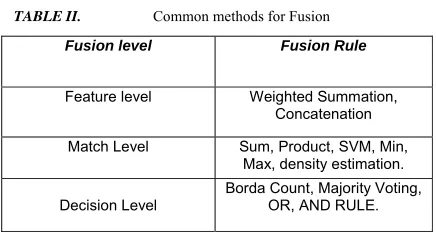
TABLE II. Common methods for Fusion
Fusion level Fusion Rule
Feature level Weighted Summation,
Concatenation
Match Level Sum, Product, SVM, Min,
Max, density estimation.
Decision Level Borda Count, Majority Voting, OR, AND RULE.
C. Face recognition
Face Recognition [16] is most preferred biometric Technology that uses face to authenticate a person from a digital video image or video frame from a video source. Face recognition has potential applications in universities, access control, surveillance, ATM’s, hospital, criminal investigations and many more. Face recognition technology generally involves the primary steps as follows: Image capture, second step is face detection from acquired image. It can also be normalized or enhanced for further processing. Feature Extraction at next step face detection takes place in which desired facial features are extracted. Matching these features against the features stored in the database, determine identity finally the output of face recognition process is used (if there is match or not).
F. Steps in Face Recognition by e-PCA :
In face recognition during image processing step average image of faces are calculated by subtracting the value of average image from original image. Each 2D facial image is treated as 1D vector. So for this image must be in grey scale. Next evaluate the covariance matrix in this step outliers of image are removed by estimating one standard deviation now we select only that feature space that lies within this standard deviation values all other values are eliminated or rejected. Then find out the Eigen vector and Eigen values from this matrix. Each image is projected on the similarity bases so we compare each image in testing with training image in Eigen space; image which closely matched will be identify else rejected. Now discuss these steps in details:
1) First let a face image of size mxn. Let the training set of images {I1, I2, I3……IM} are provided to the
system.
2) Now evaluate the average of images
(2)
3) Next calculate the empirical mean detection for evaluating the median of face mean. .For calculating the covariance value of image is
Where A= is deviation.
And C = N2 X N2 matrix, A is N2 X M size. Now since C is a complex size image so we can construct the image for reduce dimensionality. To calculate the Eigen faces from covariance matrix is one of the difficult tasks as each Eigen face represents the separate high dimension pixel value Since M is far less than N2 by N 2(as A is of dimensions N2 X M and AT of M X N2) .
To reduce the dimensionality evaluate covariance matrix given above in its transpose form as
L= ATA (4)
Now L is of dimension M X M as AT is of (N2 X M) dimension and A is of (M X N2). 4) Next process is to calculate the Eigen faces and
Eigen values. Where Eigen faces actually the vector of set of faces. Let Eigen values and Eigen vector be given as :
Where X is Eigen Vector and is Eigen values.
Eigen vector of this corresponding covariance, (m x n) has size of Eigen faces.
5) Each image in testing must have mean centered image. Now map each image with same Eigen space.
6) Once we select the k Eigen faces from training set (where k << M and as well as whole representative of training set they must not lose any important information about the data and they are selected heuristically )Next project each k Eigen vector (with k weight) into Eigen space as shown below :
ωk = A Vi (6)
Where A shows the best selected k Eigen faces multiplying this with Vi is depicting the ith Eigen vector in low dimensional space. Where ωk is the kth high dimensional weight vector. If we multiply the A with Vi will gives us the corresponding Eigen vector in higher dimensionality space.
Whereas value of Vi can be represented as Xi – V. This step regenerates or maps back the Eigen Vector in the original dimensionality. Dimensionality reduction not only avoid the huge computation but also reduce the noise. And at the same time reduce the huge selection process. 7) Project Eigen images into corresponding Eigen
Space as :
Yki=ωkT(Si) (i=1, 2, 3…..N) (7) 8) The training set of image that is provided by the
system and Eigen faces are calculated from PCA multivariate approach. A 2-D facial image was represented as a 1-D vector. Each of the Eigen Faces is actually a special feature of PCA and is expressed by Eigen face coefficients (weight). 9) Each Eigen faces formed by linear combination of
k weight associated with each Eigen faces represented as :
Ωi= { w1, w2,w3, ………..wk}. Where wk represents kth weights or percentages of the Eigen vector. The weights can be evaluated as:
wk= ωkTi (8)
Where i is the average image and formed with set of linear combination of Eigen faces and the value of i
i = ∑ (9)
k is Eigenfaces.
10) Each Eigen faces in original set formed up by k Eigen faces (vector) and the mean faces.
Each image is projected on the similarity bases so we compare each image in testing with training image in Eigen space; image which closely matched will be identify else rejected. [image:5.612.326.549.541.668.2]
11) As we have computed and stored the associated weight vector for every given image present in training set. Next calculate the Euclidean Distance from the restoration image and the image that we have for testing. Compare the input weight vector with the stored weight vector sets. The Euclidean distance can be formulated by this formula : || a – b || = √|ai – bi|2 (10)
G. Normalization :
The score obtained from both subsystems are normalized before fusion. The Min-Max normalization is used for obtaining the score in one common range [0…1]. It tells us the lowest and upper bound of scores.
Let Z be the total score obtained from face and fingerprint and F be the normalized score. The formula for evaluating the normalization score is as follows:
F = Z – min (z’)/max (z’)-min (z’)
H. Match Score Level Fusion:
Match Score Level Fusion: The procedure for weighted sum rule can be searched in paper of Jain and Ross [18]. The value of fused score can be evaluated as follows: F= w1 x1+ w2 x2 +…….. wn xn (1) The value of wi is the weight assigned for multi-instance system. The normalized score obtained from each modality are fused together using weighted sum rule fusion.
Now addition of each obtained score in result as follows:
(2)
Where Sfusescore is the fused score using weighted sum rule fusion.
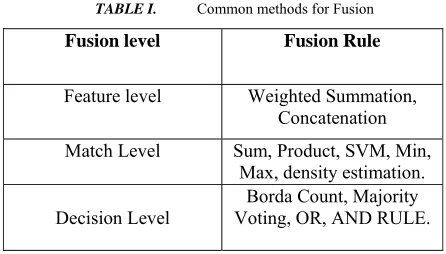
TABLE I. Common methods for Fusion
Fusion level Fusion Rule
Feature level Weighted Summation,
Concatenation Match Level Sum, Product, SVM, Min,
Max, density estimation.
Decision Level Voting, OR, AND RULE. Borda Count, Majority
G. Architecture of Proposed Scheme:
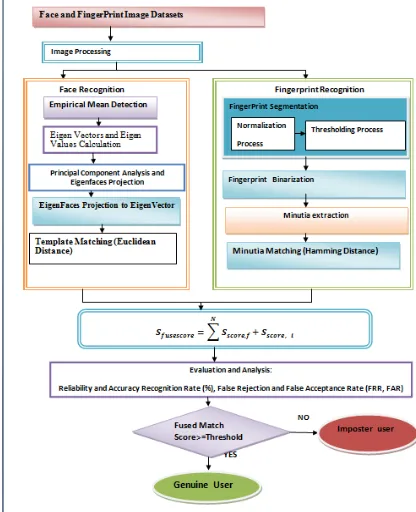
The proposed modal for person authentication utilizes face and fingerprint modalities acquired from image database. In this work we approached the minutiae based extraction. All fingerprint images are assigned an id and we use fingerprint impression of one person with different alignment, rotation and orientation. This will obviously provide more security and accuracy. Face recognition uses EPCA. In this paper face and fingerprint multimodal biometric traits are fused at match score level using weighted sum score level fusion. The system uses Euclidean distance (for face) and Hamming Distance (for fingerprint) matching for traits based on this matching is performed. Min-Max Normalization technique is used before fusion. This will help to generate a normalized score of fingerprint and face. After that fusion is done using weighted sum rule fusion as given in equation (1) below. If this fusion score is greater than threshold value then the user is authorized else imposter.
(1)
Now we are shown with the help of diagram the overall multimodal fusion of fingerprint and face is shown in Fig.4.
[image:6.612.329.537.51.307.2][image:6.612.60.288.319.689.2]
Figure 2. FingerPrint Recognition
Figure 3. Face Recognition
Figure 4. Proposed Work Modal
V. RESULT AND EVALUATION:
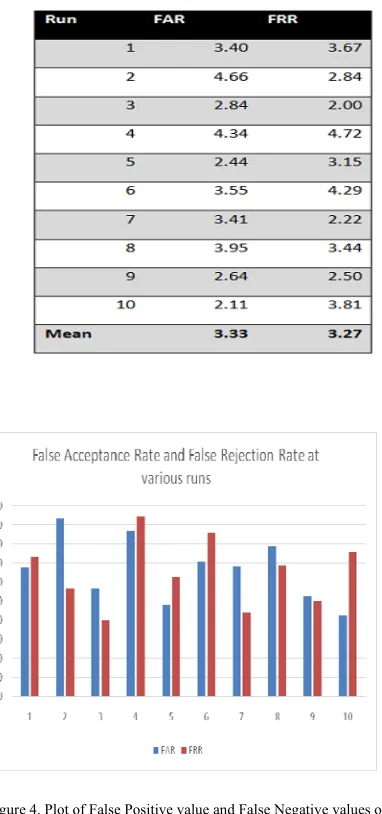
In database 10 images of face are self created and 80 images of fingerprint are taken from CASIA fingerprint V5 database. Now for every given face image it check with every other images of fingerprint in stored database. If the similarity score is greater than threshold value it is authenticated otherwise not. The performance matrices are shown by ROC analysis and we get FAR 2.84% and FRR of 2%.
Figure 3. Results of matched minutiae points a) Original image b) Matched Minutiae points (ridge ending, bifurcation, orientation)
[image:6.612.332.540.471.580.2]
TABLE II. MATCH SCORE OF FALSE POSITIVE VALUES AND FALSE REJECTION VALUES
Figure 4. Plot of False Positive value and False Negative values of Face modalities (EPCA) + Fingerprint modalities (Minutiae Extraction).
Figure 5. ROC (Receiver Operating Characteristics) For True Positive values vs. false acceptance value
VI. COMPARISON OF PROPOSED APPROACH
WITH EXISTING TECHNOLOGIES
In this paper multimodal biometrics is used as it gives more efficiency and improves performance compared with unimodal technology. Euler PCA methodology is a robust, direct, fast solution as well as efficient method for face recognition. EPCA resolves the dimensionality problem. Our approach takes less time and provides much better solution than existing technology.
VII. CONCLUSION
In this paper ePCA is used for image reconstruction in face recognition. Euler PCA outperforms better than PCA. Fingerprint recognized based on minutiae extraction method. In this paper fusion of face and fingerprint are done using weighted sum rule fusion.
The multimodal architecture makes use of multiple traits or features of human being or object and then authentication module checks in parallel whether there is the accuracy in the presence of object under analysis. The proposed approach is effective in terms of higher security, overall performance and integrity aspects. It is an effective approach that can be integrated with the liveness detection approaches so that the global optimization and less fault rate can be achieved.
VIII. REFERENCES
[1] Jain, Anil, Lin Hong, and Sharath Pankanti. "Biometric identification." Communications of the ACM 43, no. 2 (2000): 90-98.
[2] biometric systemDelac, Kresimir, and Mislav Grgic. "A survey of biometric recognition methods." In Electronics in Marine, 2004. Proceedings Elmar 2004. 46th International Symposium, pp. 184-193. IEEE, 2004.
[3] Jain, Anil K., Lin Hong, and Yatin Kulkarni. "A multimodal biometric system using fingerprint, face and speech." In Proceedings of 2nd Int'l Conference on Audio-and Video-based Biometric Person Authentication, Washington DC, pp. 182-187. 1999. [4] Flynn P., Jain A. K. ,Ross A.A.,”Handbook of
biometrics” New York: Springer,2007.
[5] Sanjekar, P. S., and J. B. Patil. "An overview of multimodal biometrics." Signal & Image Processing 4, no. 1 (2013): 57.
[6] Mitchell H.B. (2007) Multi-Sensor Data Fusion, Springer, 281
[7] Ross A and Govindarajan R., SPIE Conference on Biometric Technology for Human Identification, 5779,196-204, 2005.
[8] Park, Y.H., D.N. Tien, E.C. Lee, K.R. Park and H.C., “ A multimodal biometric recognition of touched fingerprint and finger-vein “,Proceedings of the International Conference on Multimedia and Signal Processing, May 14-15, IEEE Xplore Press, Guilin, Guangxi, pp: 247-250,2011.
[9] Youssef ELMIR, Zakaria ELBERRICHI, Reda ADJOUDJ , Score level fusion based multimodal biometric identification fingerprint and voice .
[image:7.612.67.272.513.704.2][11] Kawulok M., Szymanek J., “Precise multi-level face detector for advanced analysis of facial images”, IET Image Process., Vol. 6, Iss. 2, pp. 95–103l, 2012.
[12] Linlin Shen, Li Bai, and Zzhen Ji,” FPCODE: An efficient approach for multi-modal biometrics”, International Journal of Pattern Recognition and Artificial Intelligence, Vol. 25, No. 2 pp. 273-286, 2011.
[13] J. Tsai-Yang, and V. Govindaraju: A minutia-based partial fingerprint recognition system, Center for Unified Biometrics and Sensors, University at Buffalo, State University of New York, Amherst, NY USA 14228, 2006.
[14] L. Hong, Y. Wan and A. Jain: ‘Fingerprint image enhancement:Algorithm and performance evaluation’; Pattern Recognition and Image Processing Laboratory, Department of Computer Science, Michigan State University, pp.1-30,2006.
[15] Manvjeet Kaur, Mukhwinder Singh, Akshay Girdhar, and Parvinder S. Sandhu, “ Fingerprint Verification System using Minutiae Extraction Technique “ , World Academy of Science, Engineering and Technology IEEE, pp. 497-502, 2008.
[16] Debnath Bhattacharyya, Rahul Ranjan,
FarkhodAlisherov A., and Minkyu Choi, “Biometric Authentication: A Review” , International Journal of u-
and e- Service, Science and Technology,Vol. 2, No. 3, September, pp. 13-28,2009.
[17] Turk, M.A. and Pentland, A.P, "Face recognition using Eigenfaces," in Computer Vision and Pattern Recognition, 1991. Proceedings CVPR '91., IEEE Computer Society Conference, pp.586-591,1991. [18] Turk M., Pentland A., “Eigen faces for recognition”,
Journal of Cognitive neuroscience, Vol. 3, Massachusetts Institute of Technology, pp 71-86,1991.
[19] J. Mazanec, M. Melisek, M. Oravec, J.
Pavlovicova,“Support Vector Machine, PCA and LDA in Face Recognition”, Journal of Electrical Engineering, vol. 59, No. 4, pp. 203-209, 2008.
[20] P N. Belhunmeur, J. P. Hespanha, D. J. Kriegman, “Eigenfaces vs Fisherfaces Recognition Using Class specific linear projection”, IEEE Trans Pattern Analysis and Machine Intelligence, 1997.