
Volume 2, No. 4, July-August 2011
International Journal of Advanced Research in Computer Science
RESEARCH PAPER
Available Online at www.ijarcs.info
A Qualified Study of e-Mitra and Proposed e-DISC Model towards Implementation of
Integrated e-Governance
Sanjay Tejasvee
* Research Scholar, Department of Computer Science,Suresh Gyan Vihar University, Jaipur (Raj.) - India [email protected]
Prof. (Dr.) S.S.Sarangdevot
Director,Department of C.S. and I.T., J.R.N.R.V. University, Udaipur (Raj.) - India
Abstract:Most of state Governments has formed the State Data Centre (SDC), District Governance Society, State Wide Area Network (SWAN) and Common Service Centers (CSCs) at various divisional, district and as well as rural areas to face directly the end users and serve them services to provide good governance . Through the various centers associated services accessible to the citizens in efficient, transparent and rapid way. The Rajasthan State Government also taken e-Governance very sincerely and started various projects towards the citizens for enhanced better governance, out of them e-Mitra is one of the most significant & rapid project working on ”Effective governance, better citizen services” concept. This paper basically walks around the comparative and qualified research study of e-Mitra (established model) and e-Disc (proposed or anticipated model) of e-Governance such as basic views, strategy, key objectives, components and functional features along with explanation of integration. The purpose of this paper is to view proportional study of e-Mitra and a proposed model with commence the progress and benefits obtain by the ICTs towards integrated e-Governance along with given the recommendations for successful implementation of integrated projects.
Keywords: SDC, SWAN, CSCs, e-Governance, e-Mitra, e-Disc, ICTs.
I. INTRODUCTION
Basically, e-Governance is generally understood as the use of Information and Communications Technology (ICT) at all levels of the Government in order to provide services to the citizens, interaction with business enterprises and communication and exchange of information between different agencies of the Government in a speedy, convenient efficient and transparent manner. [1]
e-Governance (electronic governance) is a significant appliance of ICTs to accomplish the process of deliverance of information and service of e-Government to the citizens with better manner. Here, the meaning of better manner is transparent, reliable and accountable.
The term e-government is of recent origin and there exists no standard definition since the conceptual understanding is still evolving. The generally accepted definition is: "e-government" refers to the use of Information and Communication Technologies (ICTs) by government agencies for any or all of the following reasons [2] [5]:
a. Exchange of information with citizens, businesses or other government departments
b. Speedier and more efficient delivery of public services
c. Improving internal efficiency
d. Reducing costs or increasing revenue e. Re-structuring of administrative processes
Dr. APJ Abdul Kalam, former President of India, has visualized e-Governance in the Indian context to mean:
“A transparent smart e-Governance with seamless access, secure and authentic flow of information crossing the interdepartmental barrier and providing a fair and unbiased service to the citizen.” [3][4]
[image:1.595.316.564.354.433.2]Following figure: 1 shows the end users of e-Governance
Figure 1. e-Governance Target Agents[6]
Government of Rajasthan (A State of India) also takes various initiatives towards e-Governance for concerted to citizens. In the way of good governance, Government of Rajasthan (A State of India) takes a very important initiative through a model for convenience and transparency to the deliver the services under the single roof based on single window concept. As shown the strategy, policies and features of e-Mitra project, we proposed a conceptual model to delivery of services to access more benefits.
II. E-MITRA:ASOLUTIONPROJECTOF
E-GOVERNANCE
citizens were supposed to avail three types of services from any e-Mitra kiosks across the State viz. [11]
A. What is e-Mitra ?
As a general term we can say e-Mitra (Electronic Mitra) means friends helping through electronic method. E-Mitra is an integrated application to serve the various kinds of services through specific centers. e-Mitra identified by a quote “Effective governance, better citizen services”.
e-Mitra is an integrated project to facilitate the urban and the rural masses with maximum possible services related to different state government departments through Lokmitra-Janmitra Centers/Kiosks. [7]
The definition for [8] e-governance as provided by the world bank group emphasizes on, better delivery of government services to citizens, improved interactions with business and industry, citizen empowerment through access to information and more efficient government management. This means that the various arms of government redefine their relationship with the common citizen, community interest groups and business, assisted by various facts of information technology, networking, mobile computing etc.
All Government services should be available to the common man in his locality, throughout his life, through a one-stop-shop (integrated service delivery), ensuring efficiency, transparency, & reliability. With a view to deploy IT for the benefit of citizens of the states, Government of Rajasthan launched two citizen friendly projects namely e-Mitra in urban area and CSC in rural area .[9]
E-Mitra is an ambitious E-governance initiative of Government of Rajasthan which is being implemented in all 33 Districts of the state using Public-Private Partnership (PPP) model for the convenience and transparency to the citizen to deliver the services almost at their door steps. [10]
B. Key objectives of e-Mitra [8][10]
a. To provide wide range of citizen friendly services of different departments under one roof through an e-platform.
b. To facilitate the citizens by, do not have to run around various departments.
c. Its aim is to deploy information technology (IT) for the benefit of the masses.
d. To provide quality, cost effective services with an innovative accessibility of information to citizens. [8]
C. Role Players in PPP Model of e-Mitra:
The e-Mitra Project is implemented through the District e-Mitra Societies under the technical guidance of Department of Information Technology & Communication (DoIT&C). The PPP model of the e-Mitra scheme envisages a 3-tier structure consisting of [10] following:
a. RajCOMP: State Designated Agency (SDA)
responsible for managing the implementation over the entire State.
b. District e-Mitra Society: To act as an extended arm
of SDA at district level to execute and monitor the e-Mitra scheme under the chairmanship of the respective District Collector.
c. Local Service Provider: To be appointed by SDA
that will be responsible for establish the
kiosk/service centers to provide various state government/center government and other private sector services under one roof; and
d. Kiosk Operator: To be appointed by the SCA.
D. Functional features of e-Mitra:
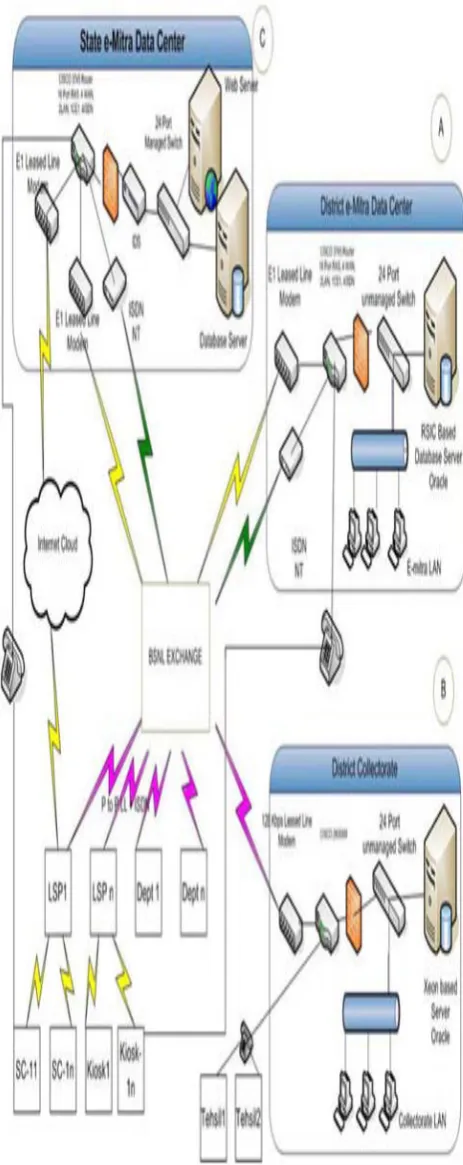
[image:2.595.318.550.178.761.2]Figure: 2 showing the network connectivity and transformation of data processing system in e-Mitra working architecture. It is technical transmission diagram showing functional features of e-Mitra.
E.
Recent Services being delivered through
[image:3.595.40.281.86.405.2]e-Mitra/CSC Kiosks [Sou
Table I. Recent Services being delivered through e-Mitra
G2C Services B2C Services
• Payment of electricity bills, water bills
Selling of Patwar Forms (RPSC)
• Deposition and collection of exam fee for Patwar Exams (RPSC)
• Online RSRTC bus ticketing of RSRTC*
• Payment of various dues/fee of Municipal corporation* • Payment of various dues/fee
of Rajasthan Housing Board* • Application for revaluation of marks for Board of Secondary Education*
• Access to Land & Revenue Records (ROR)*
• Sale of Stamp Paper, revenue ticket, deed writing* • NREGA Services
*These services are proposed / running in selective zone/ in process
• E-Tickets of Railway & Airlines
• Payment of Land Line & Cell One bills (BSNL) • Western Union Money
Transfer
• Bill collection of Airtel, Reliance, Tata Teleservices, Idea • Financial & insurance
services of ICICI Bank • Online PAN Card
Applications • Online L.P.G.-Gas
Booking • Prepaid Mobile
Recharges (Vodafone, Airtel, Idea, BSNL, Reliance, TATA etc.) • DTH Recharges (TATA
Sky, Big TV, Dish TV etc.)
III. KEYCOMPONENTSOFE-GOVERNANCE
MODEL
There are two major components of the e-Governance project. One is Back Office processing and the other is Service Counters [10]
A. State Data Center:
The State Data Centre (SDC) has been set up by Government of Rajasthan. It houses all critical ICT infrastructure and applications under a unified and secured environment and facilitates vertical and horizontal integration of departmental data and services. SDC is operational on 24x7 basis except the scheduled maintenance period and permissible down time. All major Government Buildings/Departments have been provided connectivity to SDC and the web-based e-Mitra portal (www.emitra.gov.in) is hosted at SDC, Yojana Bhawan, Jaipur. All the G2C services at kiosks are delivered through this portal. All the participating departments and service counters will hook on to SDC to make the system work. All the participating departments and e-Mitra Kiosk holder will hook on to web based e-Mitra web based portal which is hosted at SDC, Yojana Bhawan, Jaipur to make the system work.
A. Service Counters:
Citizens are availing services related to multiple departments/organizations at the e-Mitra counter. Right from deposition of application comprising of financial transaction to final deliverable collection, every activity will take place at these counters. Only for the cases where there is some statutory requirement of personal verification, will the citizen be required to go to the concerned government functionary.
IV. THESTATE’SE-GOVERNANCE
FRAMEWORK
[image:3.595.318.556.284.594.2]The e-Mitra project is an integral part of this framework. In the picture above, the left hand side depicts the integrated ICT infrastructure created and owned by the State Government. This will include State level and district level data centers interconnected with Secretariat Network and enterprise networks of various departments over a statewide WAN. This is going to be the integrated IT enabled Back Office of the State Government. The right hand side of the picture denotes the e-enabled service delivery channels of the e-Mitra model. Citizens are going to interface with the State Government through these access points. These e-Mitra Front Offices are going to be owned and operated by private partners on a sustainable revenue model. Following pictorial diagram represents the proposed framework of e-Governance developed by the Government of Rajasthan.
Figure 2. Figure 3: EProposed e-Governance Framework [10]
V. E-DISCMODEL
in touch with to avail required service. Same thing happened also in e-DISC based technical architecture.
According to Kumar (2002), a single window payment gateway called “FRIENDS” (Fast, Reliable, Instant, Efficient network for Disbursement of Services) brought about a significant change in Tiruvananthapuram in Kerala particularly in the rural areas for sugar factories; co-operative credit societies and grameena banks. After the success, governments like Kerala and Andhra Pradesh have adopted Computer Aided Administration Registration Department (CARD) software for implementation of e-Governance projects. Tamilnadu plans to implement paperless district offices based on the architecture of Andhra Pradesh’s file management system. [12]
Figure: 4 Architecture of E-DISC Architecture
The main objective of the E-DISC architecture is to provide better solution of effective service delivery with integrated way of associated Government departments. E-DISC architecture tells, entire connectivity should be on World Wide Web portal with a specific user along with secure by strong password and one special connectivity slot allotted to the every department which is coupled to e-Governance. Through this connectivity particular department will able to view only related transaction online and maintain easily.
As the architecture [13] describe the Local Service Providers (LSPs) provided services to the citizen and public information services, application and grievance related services to the citizen. Actually counter of Kiosks deliver the service to the citizens as means we can say the main key
factor of E-DISC architecture is the person who is seating on the counter of the kiosk as in e-mitra project in Rajasthan. EDISC technical architecture includes three main objects such as DC, LSP, and Kiosk. First: District data center (owned by State Government, operated and managed by a private sector partner as Total Solution Provider (TSP)), Second LSP built, owned and operated by private partners and third Kiosks (built, owned and operated by individual entrepreneurs through LSPs). As we can say there is three level or stages then after the actual service and effective service delivery possible, so the duties and responsibilities are also plays different role the E-DISC architecture as using Client Server architecture for Centers and Kiosks.
A. Key benefits of e-DISC:
a. Almost manual work would be finished between district data center and associated department. b. Online Communication can be done at any time. c. Quick Rectification possible in any related
transaction as soon as found the mistake.
d. Strong and healthy relationship developed repeatedly between district Governance society and concerned department.
e. Reduce extra working burden of associated department.
f. Increasing Information and communication technology environment and get better transparency.
g. Citizen would feel more satisfied by gating immediate solution.
h. Easy integration possible with new planned project in concerned department.
i. Increase the encouragement in the public sector to improve ICT skills and capability.
j. elimination of entries in manifold registers
VI. RECOMMENDATIONSTOPROMOTE
SUCCESSFULIMPLEMENTATION
Following points are recommended for successful implementation of integated e-Governance projects such as e-Mitra & Proposed model e-Disc):
a. All projected services should be provided throughout the centers.
b. Back offices should be follows the automatic computerized technique for consolidation and rectification and maintain all relevant information. c. The forms for various applications and grievances
should be standardized and available in electronic format.
d. Instead of manual collection of applications and grievances, collection should be through online or electronic medium
e. Regularly inspect is must towards LSPs and Centers and ensure & take necessary actions. f. Analysis and Evaluation should be conducted by
the State Government to assess the benefits accruing to the public and steps needed for effective use of e-Mitra Project in e-governance. g. Proper training and healthy environment for
h. Suitable and comfortable environment for the citizens/end users
VII. CONCLUSION
The main aim to put into practice ICTs is to give opportunities towards citizens. e-Governance has makes possible to provide Government’s information and services online to the public and private sector. The project of e-Governance can reduced the gap between private and public sectors with the optimal use of ICT resources. e-Mitra is an ambitious e-Governance initiative of Government of Rajasthan stare of India which is being implemented in all districts of the state based PPP model for the deliver various services with transparency towards the citizen almost at door step within one roof. e-DISCmodel can be compiling as large range of deliverance. DISC architecture of e-Governance is a model of proper distribution of Government’s information and serves services to citizens with the combination of concerned department accession.
Both of these models are comprehensible the concept and theoretical framework effective, accurate and successful deliverance of information and services. Future works may be remains to e-Disc model rather are technical or framework based. We can say these Systems such as e-Mitra and e-Disc, along with integrated service delivery having multiple services and technology-driven transactional capabilities, are absolute symbol of better and smart governance.
VIII. REFERENCES
[1] Subash Bhatnagar; “e-Government: From Vision to Implementation”, 2004; Sage Publications;
[2]
[3] Inaugural address at IIT Delhi during International Conference on e-Governance.
[4] e-Governance: Conceptual Framework; chapter:2; [http://arc.gov.in/11threp/ARC_11thReport_Ch2.pdf, page no.10]
[5] E-GOVERNANCE AND BEST PRACTICES; annex- 6.3.1; Page: 256
[6] Prakash Singh (06808010), Zahir Koradia (07405002);
E-Governancein India;
[7]
[8] Dr. Janak Singh Meena** Naresh Kumar Sagar; E-GOVERNANCE & GOOD E-GOVERNANCE; International Referred Research Journal, October,2010.ISSN- 0974-2832VoL.II *ISSUE-21;page no:8;[http://www.ssmrae.com/ admin/images/55e0eac14bbc0f2cc76b081c66a14e10.pdf
[9]
[10]
2011)
[11]E-mitra rajasthan and web site of doit and rajcomp, jaipur and Audit Report (Civil) for the year ended 31 March 2008 page No. 88 and page 96.andhttp://emitra.gov.in/egov Construction.jsp
[12]Kumar, A, E-Governance Must Fetch Economic Returns, 2002.
[13]Sanjay Tejavee et al. / E-Governance and Effective Deliverance of Information and Services to Citizens Architecture(IJCSIT) International Journal of Computer Science and Information Technologies, Vol. 1 (4) , 2010, 298-302
[14]
![Figure 1. e-Governance Target Agents[6]](https://thumb-us.123doks.com/thumbv2/123dok_us/706927.1078823/1.595.316.564.354.433/figure-e-governance-target-agents.webp)
![Figure 2. Figure 3: EProposed e-Governance Framework [10]](https://thumb-us.123doks.com/thumbv2/123dok_us/706927.1078823/3.595.318.556.284.594/figure-figure-eproposed-e-governance-framework.webp)
