!
"
#"#
$ % %#
&
'
((( )
A Simple Neural Network Approach to Implementing Technical Institute Student
Feedback System in Spreadsheet
Abstract:Artificial Neural Networks (ANN) proven its own value in technical education and that has led to the emergence of Artificial Neural Networks as a major paradigm for Data Mining applications. Neural nets have gone through two major development periods the early 60’s and the mid 80’s. Neural Networks Neural networks have emerged as a field of study within AI and engineering via the collaborative efforts of engineers, physicists, mathematicians, computer scientists, and neuroscientists. Although the strands of research are many, there is a basic underlying focus on pattern recognition and pattern generation, embedded within an overall focus on network architectures. In our paper we can introduce student feedback system with using concept of artificial neural network in Microsoft Excel. Excel provides popular and low cost for technical education modeling technique and decision analysis techniques.
Keywords: - Artificial Neural Networks, Neural Networks
,
spreadsheet, feedback system, VBA program.I. INTRODUCTION
Neural networks have emerged as a field of study within AI and engineering via the collaborative efforts of engineers, physicists, mathematicians, computer scientists, and neuroscientists. Although the strands of research are many, there is a basic underlying focus on pattern recognition and pattern generation, embedded within an overall focus on network architectures. An artificial neural network is a system based on the operation of biological neural networks, in other words, is an emulation of biological neural system. Why would be necessary the implementation of artificial neural networks? Although computing these days is truly advanced, there are certain tasks that a program made for a common microprocessor is unable to perform; even so a software implementation of a neural network can be made with their advantages and disadvantages[1].Artificial neural network (ANN) are non linear mapping structure based on human brain. They are powerful tool for modeling especially when underlying data relationship is unknown. The basic processing elements of neural networks are called artificial neurons, or simply neurons or nodes. In a simplified mathematical model of the neuron, the effects of the synapses are represented by connection weights that modulate the effect of the associated input signals, and the nonlinear characteristic exhibited by neurons is represented by a transfer function. The neuron impulse is then computed as the weighted sum of the input signals, transformed by the transfer function. The learning capability of an artificial neuron is achieved by adjusting the weights in accordance to the chosen learning algorithm. We develop ANN with help of spreadsheet.
Spreadsheets provide a popular and cost-effective alternative for teaching modeling and decision analysis techniques, but there currently exist few spreadsheet-based tools for teaching basic ANN concepts. This note seeks to
address this situation by introducing a very simple approach to implementing and training ANNs in Microsoft Excel, using only Excel’s inherent front-end spreadsheet capabilities. Such an approach is very suitable for a course where only 1 or 2 days might be spent on the topic of ANNs.
II. LITERATURE REVIEW
A. Overviews of Artificial Neural Network
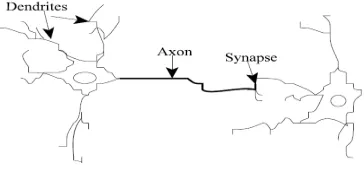
An artificial neuron is a computational model inspired in the natural neurons. Natural neurons receive signals through synapses located on the dendrites or membrane of the neuron. When the signals received are strong enough (surpass a certain threshold), the neuron is activated and emits a signal though the axon. This signal might be sent to another synapse, and might activate other neurons.
The complexity of real neurons is highly abstracted when modeling artificial neurons. These basically consist of inputs (like synapses), which are multiplied by weights (strength of the respective signals), and then computed by a mathematical function which determines the activation of the neuron. Another function (which may be the identity) computes the output of the artificial neuron (sometimes in dependence of a certain threshold). ANNs combine artificial neurons in order to process information. An artificial neuron is a device with many inputs and one output as shown Figure 2.
Figure 2. An artificial neuron
Referring to Figure 2, the signal flow from inputs
x1. . . xn is considered to be unidirectional, which are indicated by arrows, as is a neuron’s output signal flow (O). The neuron output signal O is given by the following relationship:
where wj is the weight vector, and the function f(net) is referred to as an activation (transfer) function. The variable
net is defined as a scalar product of the weight and input vectors.
net = w1 x1+…….+wn xn.
Figure 3. Multilayered artificial neural network
The objective of this type of ANN is for the network to “learn” and be able to predict the output values that are associated with a given input value. This learning occurs by
adjusting the weights on the arcs in the network so that for a given value of the ANN’s estimated value of output will closely approximate the actual value of output associated with input. This requires iteratively presenting the network with a set of data containing known pairings of input and output values and adjusting the weights to reduce any error in the network’s predictions.
B. Characteristic of neural networks
• The neural networks exhibits mapping capabilities and they can map input pattern to their associated output patterns
• The neural networks can process information in parallel, at high speed and distributed manner.
• Neural networks work as single layer and multilayer network model.
• Neural network as ability to learn where neural network generate their own rule.
• The neural networks are robust and are fault tolerant. • ANN computations may be carried out in parallel, and
special hardware devices are being designed and manufactured.
III. NEURAL NETWORK ARCHITECTURES
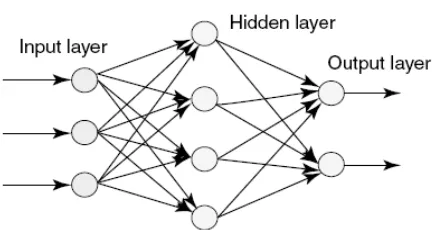
The basic architecture consists of three types of neuron layers: input, hidden, and output layer. A neural network has to be configured such that the application of a set of inputs produces the desired set of outputs.
A. Feed-forward networks
In feed-forward networks, the signal flow is from input to output units, strictly in a feed-forward direction. There is no feedback (loops) i.e. the output of any layer does not affect that same layer. The data processing can extend over multiple (layers of) units, but no feedback connections are present. Recurrent networks contain feedback connections. Contrary to feed-forward networks, the dynamical properties of the network are important. In some cases, the activation values of the units undergo a relaxation process such that the network will evolve to a stable state in which these activations do not change anymore. In other applications, the changes of the activation values of the output neurons are significant, such that the dynamical behavior constitutes the output of the network. They are extensively used in pattern recognition. This type of organization is also referred to as bottom-up or top-down.
B. Feedback networks
term is often used to denote feedback connections in single-layer organizations.
IV. IMPLEMENTING ARTIFICIAL NEURAL
NETWORK IN EXCEL
The iterative nature of presenting training data to an ANN, along with the assumption that the back propagation algorithm is needed for training purposes, belies the fact that an ANN can be implemented and trained quite
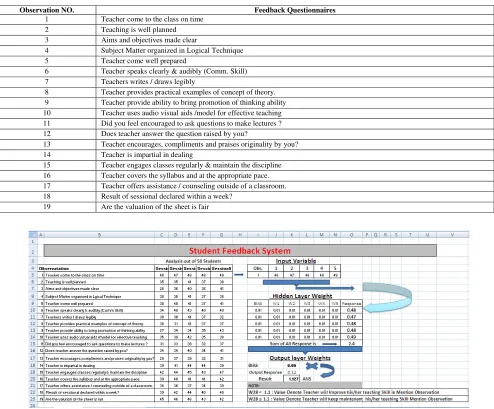
easily using only the front-end capabilities of Spreadsheet (i.e., no VBA programming is required). Figure 4 presents an example that illustrates the first step of the proposed approach. Following table 1. Shows that observations are made when calculating a feedback of students:
Table 1. Feedback of Student Questionnaires
Observation NO. Feedback Questionnaires
1 Teacher come to the class on time
2 Teaching is well planned
3 Aims and objectives made clear
4 Subject Matter organized in Logical Technique
5 Teacher come well prepared
6 Teacher speaks clearly & audibly (Comm. Skill)
7 Teachers writes / draws legibly
8 Teacher provides practical examples of concept of theory. 9 Teacher provide ability to bring promotion of thinking ability 10 Teacher uses audio visual aids /model for effective teaching 11 Did you feel encouraged to ask questions to make lectures ? 12 Does teacher answer the question raised by you?
13 Teacher encourages, compliments and praises originality by you?
14 Teacher is impartial in dealing
15 Teacher engages classes regularly & maintain the discipline 16 Teacher covers the syllabus and at the appropriate pace. 17 Teacher offers assistance / counseling outside of a classroom. 18 Result of sessional declared within a week?
19 Are the valuation of the sheet is fair
Figure 4: Implementation of Neural Networks In Spreadsheet
The goal in this example is to develop an ANN that accurately predicts whether a teaching skill of Teacher/Lecturer is beneficial or required some changes in his/her teaching, based on five session feedback report take out of 50 students in one class and we consider only positive answer such as (Yes and Sometime) and ignore Negative
answer from students. The training data are given in columns A through G of the spreadsheet.
have more layers of neurons with some having increased layers of input layer and output layer’s variables. The synapses store parameters called "weights" which are used to manipulate the data in the calculations, and is implemented in columns I through N. Each portion of the ANN is described below.
1. Input Layer: Cell I5 contains an integer indicating which of the 19 observations of data we want to feed
into the neural network. Cells J5 through N5 contain the various input variable values of the observation selected in cell I5.
2. Hidden Layer. Cells I10 through N10 are reserved to represent the weights (and bias values) between the nodes in the input and hidden layer of the ANN. Default values of 0.01 were entered manually for these cells.
3. Their optimal values will be determined later. Using the input values in cells J5 through N5 and the weights in cells I9 through N9, the responses from the three nodes in the hidden layer are computed in cells O 10 through O14 and Addition operation are perform on all response and the addition can be store in O15(Addition of Values column O10 to O14) .
4. Output Layer. Again, default values of 0.05 were entered in these cells and their optimal values will be determined later. The response of the output node is computed in cell K20 using the values in K18.
With the basic ANN model in place, the next task is to run each of the observations through the ANN and to keep track
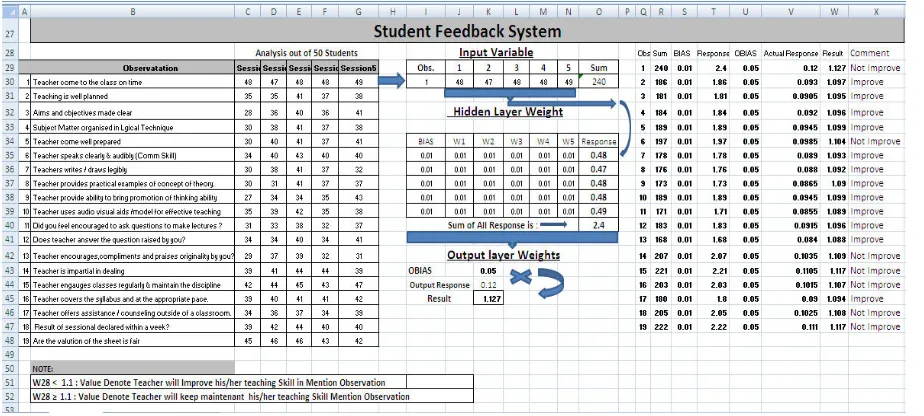
of the network’s output value for each observation. Below figure 5. Shows that calculation of overall feedback of Teacher/Lecturer as per our organization.
For Calculation feedback following formulas is used.
Cells No. Formula Used.
R30 =SUM(C30:G30) T30 =PRODUCT(R29,S29) V30 =PRODUCT(T29,U29) W30 =EXP(V29)
X30 =IF(W29>1.1,"Not Improve”,” Improve")
Table 1. Formulas used in Feedback System.
It is important to note that the numbers in the data table are dynamic. That is, if any of the values change in the cells representing the weights for the ANN, the results in the data table are automatically updated to reflect these changes. As
noted earlier, the back propagation algorithm is typically used to compute optimal (or good) weights for an ANN.
Figure 5: Summarizing Neural Network result for all observation.
V. CONCLUSION
The discussion above introduced a simple approach to implementing and training ANNs using only the standard front-end capabilities of a spreadsheet. This approach offers an easy way for educators to introduce students to ANN
Furthermore, the simplicity and ease of use of Excel as a platform can contribute to discussions about the relative speed and data-handling capacity of different modeling packages, as well as their ability to support effective, practical decision making. Possible extensions include the development of flexible procedures for altering the number of nodes in the hidden layer and for incorporating hold-out data to avoid over fitting.
VI. REFERENCES
[1] Warner, B.,& Misra, M. (1996).Understanding neural networks as statistical tools. The American Statistician, 50(4), 284–293.
[2] BISHOP, C. M. 1995. Neural Networks for Pattern Recognition. Oxford University Press, New York. [3] HERTZ, J., KROGH, A., AND PALMER, R. G.
1991. Introduction to the Theory of Neural Computation. Addison-Wesley, Reading, MA. [4] Smith, K., & Gupta, J. (2002). Neural networks in
business: Techniques and applications. Hershey, PA: IGI Publishing.
[5] Mandic, D. and Chambers, J. (2001) Recurrent Neural Networks for Prediction: Learning Algorithms, Architectures and Stability, John Wiley & Sons, New York.
[6] “Financial Time Series as Random Walks”. Extracted on March5, 2007 from
http://www.cs.sunysb.edu/~skiena/691/lectures/lect ure8.pdf
[7] Smith, Leslie. “An Introduction to Neural Networks”. Centre for Cognitive and Computational Neuroscience. April 2, 2003. Retrieved on March 6, 2007 from http://www.cs.stir.ac.uk/~lss/NNIntro/InvSlides [8] Bose, N. K.; & Liang P. (1996). Neural network
fundamentals with graphs, algorithms, and applications.McGraw-Hill.
[9] Warner, B.,&Misra, M. (1996).Understanding neural networks as statistical tools. The American Statistician, 50(4), 284–293.