ABSTRACT
JOHANSSON, ANDERS STURE. Develop Methods To Evaluate the Performance of
Aflatoxin Sampling Plans for Shelled Corn. (Under the direction of Thomas Burton
Whitaker.)
Eighteen lots of shelled corn were tested for aflatoxin contamination. The
variability and distributional characteristics associated with the aflatoxin testing
procedure were investigated. The total variance associated with testing shelled corn was
estimated and partitioned into sampling, sample preparation, and analytical variances.
All variances were found to increase with an increase in aflatoxin concentration. Using
regression analysis, mathematical expressions were developed to model the relationship
between aflatoxin concentration and the total, sampling, sample preparation, and
analytical variances. The expressions for these relationships were used to estimate the
variance for any sample size, subsample size, and number of analyses for a specific
aflatoxin concentration. For example, testing a lot with 20 parts per billion (ppb)
aflatoxin using a 2.5 lb sample, Romer mill and 50 g subsample, and HPLC analysis, the
total, sampling, sample preparation, and analytical variances are 274.9 (CV=82.9%),
214.0 (CV=73.1%), 56.3 (CV=37.5%), and 4.6 (CV=10.7%), respectively. The
percentage of the total variance for sampling, sample preparation, and analytical is 77.8,
20.5, and 1.7 %, respectively.
Next, fifteen positively skewed distributions were each fitted to 18 empirical
distributions of aflatoxin test results for shelled corn. The compound gamma distribution
was selected to model the sample aflatoxin test results for shelled corn. The method of
moments technique was chosen to estimate the parameters of the compound gamma
compound gamma distribution for any lot aflatoxin concentration and test procedure.
Observed acceptance probabilities were compared to operating characteristic curves
predicted from the compound gamma distribution and all 18 distributions of sample
aflatoxin test results were found to lie within a 95% confidence band.
Using the mean and variance relationships to compute the parameters of the
compound gamma distribution, 16 sampling plans, based on four sample sizes and four
sample acceptance levels were created and analyzed. For a given sample size, decreasing
the sample acceptance level, using a sample acceptance level equal to the regulatory
guideline: (a) decreases the percentage of lots accepted while increasing the percentage
of lots rejected at all aflatoxin concentrations; (b) increases misclassification of lots
(both false positives and false negatives) while decreasing the percentage of correct
decisions; and (c) decreases the average aflatoxin concentration in the lots accepted and
lots rejected. For a given sample size where the sample acceptance level is less than the
regulatory guideline, the number of false positives increases and the number of false
negatives decreases when compared to the situation where the sample acceptance level
equals the regulatory guideline. For a given sample size, where the sample acceptance
level is greater than the regulatory guideline, the number of false positives decreases and
the number of false negatives increases when compared to the situation where the sample
acceptance level equals the regulatory guideline. Increasing the sample size for a given
sample acceptance level, where the legal limit equals the sample acceptance level: (a)
increases the percentage of lots accepted at lower concentrations while increasing the
decisions; and (c) decreases the average aflatoxin concentration in the lots accepted while
DEVELOP METHODS TO EVALUATE THE PERFORMANCE OF
AFLATOXIN SAMPLING PLANS FOR SHELLED CORN
by
ANDERS STURE JOHANSSON
A dissertation submitted to the Graduate Faculty of North Carolina State University
in partial fulfillment of the requirements for the Degree of
Doctor of Philosophy
BIOLOGICAL AND AGRICULTURAL ENGINEERING
Raleigh
1998
APPROVED BY:
__________________________ __________________________
Chair of Advisory Committee
DEDICATION
I would like to dedicate this dissertation
to my father
Anders Daniel Johansson
who in our short time together provided me with a lifetime of morals
and values,
to my grandmother
Mammaw
who was always there to support me (many times financially)
through all of life's challenges,
to my parents
Teak and Betsey Edgeworth
BIOGRAPHY
Anders Sture Johansson was born April 4, 1969 to Anders Daniel Johansson and
Elizabeth Walters Johansson in Wilmington, Delaware. In 1970, Anders' family moved
from Delaware to North Carolina. His father, Anders Daniel, died in 1979. Anders'
mother later married Teak Edgeworth and the family lives in Salisbury, North Carolina.
His grandfather, Anders Sture, one brother, and his grandfather’s three cousins were
raised on a farm in Sardol, Sweden where two of the three cousins still farm today.
Anders has a grandmother who lives in Salisbury and two step-brothers: Reid, the elder
lives in Peach Tree City, Georgia, and Stan, the youngest lives in Boone, North Carolina.
Anders attended Hurley Elementary, Knox Middle, and Salisbury High Schools in
Salisbury. Anders continued his education at North Carolina State University in Raleigh,
North Carolina. In May 1991, Anders received a Bachelor of Science Degree from North
Carolina State University in Biological and Agricultural Engineering. Following
graduation, he enrolled in a Masters of Science program at North Carolina State
University working with the United States Department of Agriculture's Agriculture
Research Service under the supervision of Dr. T. B. Whitaker in peanut quality. He
graduated in December 1993. Anders remained at North Carolina State University to
pursue a Ph. D. degree working in corn quality under the guidance of Dr. T. B. Whitaker.
ACKNOWLEGDEMENTS
I would like to express my appreciation to the following people who have
contributed, directly or indirectly, to this study.
Dr. T. B. Whitaker for his guidance, encouragement, support, and especially
patience throughout this study. He treats me as if I was one of his own children, except
when reviewing my papers.
Dr. F. G. Giesbrecht for his guidance to help answer many of the statistical
questions I have had. I'm not sure what I will do when he fully retires!
Dr. W. M. Hagler, Jr., Faye Suggs and Hunter Edwards for conducting the
analytical procedures and for helping me to understand the details of the analytical
methods involved in my study.
Dr. J. H. Young for his guidance and suggestions throughout this study.
Andrew Slate because he has been a daily part of this study from the first day.
Andrew has helped with everything from debugging SAS programs to riffle dividing
samples. He has also been a very good friend and listener.
United States Department of Agriculture's Agriculture Research Service for the
grant money to conduct this study.
Mary Allison Ford for her undying support and praise throughout both, my
Master's Thesis and Ph. D. Dissertation.
My grandmother, parents, and the rest of the family for all of their support and
TABLE OF CONTENTS
LIST OF TABLES ...VIII
LIST OF FIGURES ... X
GENERAL INTRODUCTION... 1
References ... 4
CHAPTER 1. ESTIMATION OF VARIANCE COMPONENTS ASSOCIATED WITH TESTING SHELLED CORN FOR AFLATOXIN... 5
ABSTRACT... 5
INTRODUCTION ... 5
EXPERIMENTAL PROCEDURE ... 8
Theoretical Considerations ... 8
Methods... 11
RESULTS AND DISCUSSION ... 12
Sampling Variance... 13
Combined Sample Preparation And Analytical Variance... 14
Analytical Variance... 15
Sample Preparation Variance... 17
Application of Results... 18
SUMMARY ... 21
REFERENCES ... 22
CHAPTER 2. DETERMINATION OF A SUITABLE STATISTICAL MODEL TO SIMULATE OBSERVED DISTRIBUTIONS OF AFLATOXIN TEST RESULTS IN SHELLED CORN ... 24
ABSTRACT... 24
INTRODUCTION ... 24
Risks ... 25
Operating Characteristic Curve... 26
Theoretical Distribution ... 27
Parameter Estimation Methods ... 29
Goodness of Fit ... 30
Observed Distribution ... 30
RESULTS ... 31
Goodness of Fit ... 31
Parameter Estimation ... 38
Operating Characteristic Curve... 42
SUMMARY ... 44
REFERENCES ... 45
CHAPTER 3. EVALUATION OF AFLATOXIN SAMPLING PLANS FOR SHELLED CORN ... 48
ABSTRACT... 48
INTRODUCTION ... 49
METHODS ... 50
Risks ... 50
Operating Characteristic Curve... 52
Crop Distribution ... 53
RESULTS ... 56
Sample Acceptance Level ... 61
Sample Size... 66
SUMMARY ... 68
REFERENCES ... 69
CONCLUSIONS ... 71
APPENDICES ... 74
APPENDIX 1. EXPERIMENTAL DESIGN... 75
APPENDIX 2. SAMPLE AFLATOXIN TEST RESULTS FOR 24 LOTS OF SHELLED CORN... 76
Compound Gamma Distribution Density Function (1)... 80
Negative Binomial Distribution Density Function (1)... 81
Three-parameter Log Normal Distribution Density Function (3)... 82
Truncated Normal Distribution Density Function (4)... 82
References ... 82
APPENDIX 5. SAS PROGRAM TO DETERMINE THE DISTRIBUTIONAL PARAMETERS AND GOODNESS OF FIT FOR EACH OF THE THEORETICAL DISTRIBUTIONS USING THE VARIANCE ESTIMATES FROM CHAPTER 1. ... 83
Compound Gamma Distribution... 83
Negative Binomial Distribution ... 88
Log Normal Distribution... 92
Truncated Normal Distribution... 95
APPENDIX 6. SAMPLE AFLATOXIN TEST RESULTS USED TO DETERMINE THE DISTRIBUTIONAL PARAMETERS FOR EACH OF THE THEORETICAL DISTRIBUTIONS. ... 99
LIST OF TABLES
Table 1-1: Average aflatoxin concentration, sample variance, and combined subsampling and analytical variance components for all 18 lots of shelled corn. ** ... 13
Table 1-2: Average aflatoxin concentration, analytical variance, and coefficient of variation among replicate aflatoxin test results on 15 aliquots quantified by HPLC.**... 16
Table 2-1: The number of times each theoretical distribution provided an acceptable fit to the 18 observed distributions of sample test results using the power divergence test. ... 32
Table 2-2: Number of times each theoretical distribution provided a best fit to the 18 observed distributions of sample test results when using the power divergence test. ... 34
Table 2-3: Average of all 18 power divergence test results for each theoretical
distribution. ... 34
Table 2-4: Maximum value of the power divergence test for each theoretical distribution. ... 35
Table 2-5: Summary comparison for each of the theoretical distributions. Percentage of acceptable fits, percentage of best fits, average of GOF tests, and maximum values of GOF tests are included... 36
Table 2-6: Lot concentration, compound gamma distribution parameters, and results of the power-divergence test for each lot. ... 37
Table 3-1: Cumulative distribution among lot aflatoxin concentrations estimated from aflatoxin sample results from FDA crop data. ... 61
Table 3-2: Effect of increasing sample size using a 5 ppb sample acceptance level on the percentage of lots accepted and rejected, false positives, false negatives,
correct decisions, and average ppb among lots accepted and lots rejected... 62
Table 3-3: Effect of increasing sample size using a 10 ppb sample acceptance level on the percentage of lots accepted and rejected, false positives, false negatives,
correct decisions, and average ppb among lots accepted and lots rejected... 63
Table 3-4: Effect of increasing sample size using a 15 ppb sample acceptance level on the percentage of lots accepted and rejected, false positives, false negatives,
Table 3-5: Effect of increasing sample size using a 20 ppb sample acceptance level on the percentage of lots accepted and rejected, false positives, false negatives,
correct decisions, and average ppb among lots accepted and lots rejected... 64
Table 3-6: Effect of decreasing sample acceptance level where the regulatory guideline equals 20 ppb and using a 20 kg sample size on the number of false positives, false negatives and correct decisions. ... 65
Appendix 2 Table 1: Sample aflatoxin test results for lots 1 - 6. Table includes 32 samples per lot with subsamples A and B for odd numbered lots and
subsample A for even numbered lotsa... 76 Appendix 2 Table 2: Sample aflatoxin test results for lots 7 - 12. Table includes 32
samples per lot with subsamples A and B for odd numbered lots and
subsample A for even numbered lotsa... 77 Appendix 2 Table 3: Sample aflatoxin test results for lots 13 - 18. Table includes 32
samples per lot with subsamples A and B for odd numbered lots and
subsample A for even numbered lotsa... 78
LIST OF FIGURES
Figure 1-1: Total Variance partitioned into sample, sample preparation, and analytical components. ... 9
Figure 1-2: Sampling variance versus aflatoxin concentration for 1.13 kg test samples of shelled corn. ... 14
Figure 1-3: Combined sample preparation and analytical variance versus aflatoxin concentration for test subsamples of shelled corn using 50 g subsamples, 1 aliquot per subsample, and HPLC... 15
Figure 1-4: Analytical variance versus aflatoxin concentration for test subsamples of shelled corn using 15 aliquots per subsample and HPLC. ... 17
Figure 2-1: Typical operating characteristic curve showing the performance of an
aflatoxin sampling plan when testing lots with aflatoxin concentration C. ... 27
Figure 2-2: Comparison of compound gamma (CG2.5MM) theoretical distribution to the observed distribution of 32 aflatoxin test results. ... 38
Figure 2-3: Lambda parameter (compound gamma distribution using method of moments and alpha = 2.5) versus aflatoxin concentration for 2.5 lb. samples. ... 40
Figure 2-4: Number of contaminated kernels per 10,000 kernels versus aflatoxin
concentration for 2.5 lb. samples. ... 42
Figure 2-5: Observed and predicted acceptance probabilities for a 2.5 lb. sample and a 20 ppb acceptance level... 43
Figure 3-1: Typical operating characteristic curve showing the performance of an
aflatoxin sampling plan when testing lots with aflatoxin concentration C. ... 53
Figure 3-2: OC curves for 5, 10, 15, and 20 ppb sample acceptance level when using a 2.5 kg sample size. ... 57
Figure 3-3: OC curves for 5, 10, 15, and 20 ppb sample acceptance level when using a 5 kg sample size. ... 57
Figure 3-4: OC curves for 5, 10, 15, and 20 ppb sample acceptance level when using a 10 kg sample size. ... 58
Figure 3-5: OC curves for 5, 10, 15, and 20 ppb sample acceptance level when using a 20 kg sample size. ... 58
Figure 3-7: OC curves for 2.5, 5, 10, and 20 kg sample sizes when using a 10 ppb sample acceptance level... 59
Figure 3-8: OC curves for 2.5, 5, 10, and 20 kg sample sizes when using a 15 ppb sample acceptance level... 60
Figure 3-9: OC curves for 2.5, 5, 10, and 20 kg sample sizes when using a 20 ppb sample acceptance level... 60
GENERAL INTRODUCTION
Aflatoxin is a naturally occurring mycotoxin that has been proven toxic and
carcinogenic (1). This toxin was first discovered in the 1960's when thousands of turkey
poults died (1). The deaths of the turkey poults were traced to aflatoxin contaminated
feed.
Aflatoxin is mainly produced by two fungi, Aspergillus flavus and Aspergillus
parasiticus (2). These fungi can easily invade agricultural commodities when
environmental conditions, such as temperature and moisture, are conducive.
The synthesis of aflatoxin in corn by fungi is a potential threat to animal and
human health. The U. S. Food and Drug Administration (FDA) has currently set an
aflatoxin guideline of 20 parts per billion (ppb) in products for all commodities destined
for human consumption (3). Regulatory guidelines that define the maximum
concentration of aflatoxin allowable in food and feeds have been established in more than
90 countries (3). To ensure that consumer-ready products meet FDA aflatoxin
guidelines, commodity industries and manufacturers use aflatoxin-sampling plans or
sample acceptance schemes to either accept or reject a bulk lot based on the lot’s
estimated aflatoxin concentration. A sampling plan is defined as an aflatoxin test
procedure combined with a sample acceptance limit. The test procedure consists of
sampling, sample preparation, and analytical steps. The sample acceptance limit is a
threshold concentration that may or may not be equal to the regulatory guideline. If the
sample test result is less than or equal to the sample acceptance limit, the bulk lot is
Aflatoxin inspection and sampling programs are usually developed by commodity
industries to meet FDA requirements. Processing plants voluntarily test domestic lots of
shelled corn, and some states offer voluntary aflatoxin testing programs. Commodity
industries also use aflatoxin sampling plans to classify bulk lots into aflatoxin categories
to decrease the amount of aflatoxin contaminated corn entering the food chain. In
addition, the Federal Grain Inspection Service (FGIS) tests all lots of shelled corn for
aflatoxin that are destined for export. The ability to evaluate any aflatoxin sampling plan
will provide a means to design the most efficient sampling plan for the resources
available.
Estimating the true amount of aflatoxin in a lot of shelled corn is difficult because
of the distribution of contaminated kernels in a lot. A small percentage of the kernels are
contaminated and some contaminated kernels have extremely high concentrations of
aflatoxin (4). Studying the variability associated with testing samples of shelled corn for
aflatoxin will provide a base for statistically measuring the effectiveness of sampling
plans. Each component of the total variance (sampling, sample preparation, and analysis)
must be investigated to show the amount of variance associated with each step of the
testing procedure. The variability associated with the testing procedure leads to some lots
being misclassified by the sampling plan. The frequency of misclassifications depends
upon the regulatory guideline, sample acceptance level and the design of the testing
procedure. The degree to which misclassifications will occur can be evaluated with the
help of an operating characteristic (OC) curve.
predict the parameters of the theoretical distribution from the observed distribution must
also be developed.
Once OC curves are produced, they can be used to predict the probability that a
lot of shelled corn at a specific aflatoxin concentration will be accepted by a specified
sampling plan. The percentages of lots with a given lot concentration that will be
accepted and rejected by the specified sampling plan gives an indication of the
misclassification errors associated with the sampling plan. The ability to evaluate the
performance of an aflatoxin-sampling plan by using an OC curve provides a method to
estimate the costs involved with different sampling plans and helps identify the most
efficient plan for the resources available.
The purpose of the research was to evaluate the effectiveness of aflatoxin sample
plans to correctly classify lots of shelled corn. To accomplish this overall goal, three
specific objectives had to be completed:
1. Estimate the variance components associated with testing shelled corn for aflatoxin.
2. Determine a suitable theoretical model to simulate observed distributions of aflatoxin test results in shelled corn.
3. Evaluate aflatoxin sampling plans for shelled corn.
The results of these three objectives are presented as three manuscripts. Each
manuscript focuses on a specific objective. The first manuscript estimates the variance
associated with each step of the aflatoxin testing procedure and produces relationships
between each variance component and aflatoxin concentration. The second manuscript
determines a suitable theoretical model to simulate the observed distribution of aflatoxin
The third manuscript evaluates the effectiveness of aflatoxin sampling plans where
different sample sizes and difference acceptance levels are utilized.
References
1. Rodricks, J. V., and H. R. Roberts. 1977. Mycotoxin Regulation in the United States. Pages 753-757 in Mycotoxins: In Human and Animal Health. J. V. Rodricks, C. W. Hesseltine, M. A. Mehlman. (eds). Illinois: Pathotox.
2. Diener, U. L., R. E. Pettit, and R. J. Cole. 1982. Chapter 13: Aflatoxins and Other Mycotoxins in Peanuts in Peanut Science and Technology. H. E. Pattee, and C. T. Young (eds). Yoakum, Texas: American Peanut Research and Education Society, Inc.
3. Food and Agriculture Organization. 1997. Worldwide regulations for mycotoxins 1995. Food and Nutrition Paper 64, 4.
4. Curculu, A. F., L. S. Lee, R. Y. Mayne, and L. A. Goldblatt. 1966. Determination of aflatoxins in individual peanuts and peanut sections. Journal of American Oil
CHAPTER 1.
ESTIMATION OF VARIANCE COMPONENTS
ASSOCIATED WITH TESTING SHELLED CORN FOR
AFLATOXIN
ABSTRACT
The variability associated with testing lots of shelled corn for aflatoxin was
investigated in this study. Eighteen lots of shelled corn were tested for aflatoxin
contamination. The total variance associated with testing shelled corn was estimated and
partitioned into sampling, sample preparation, and analytical variances. All variances
were found to increase with an increase in aflatoxin concentration. Using regression
analysis, mathematical expressions were developed to model the relationship between
aflatoxin concentration and the total, sampling, sample preparation, and analytical
variances. The expressions for these relationships were used to estimate the variance for
any sample size, subsample size, and number of analyses for a specific aflatoxin
concentration. Testing a lot with 20 parts per billion (ppb) aflatoxin using a 2.5 lb
sample, Romer mill and 50 g subsample, and HPLC analysis, the total, sampling, sample
preparation, and analytical variances are 274.9 (CV=82.9%), 214.0 (CV=73.1%), 56.3
(CV=37.5%), and 4.6 (CV=10.7%), respectively. The percentage of the total variance for
sampling, sample preparation, and analytical is 77.8, 20.5, and 1.7 %, respectively.
INTRODUCTION
Aflatoxin is a naturally occurring mycotoxin that has been proven toxic and
poults died (1). The deaths of the turkey poults were traced to aflatoxin contaminated
feed.
Aflatoxin is mainly produced by two fungi, Aspergillus flavus and Aspergillus
parasiticus (2). These fungi can easily invade agricultural commodities when
environmental conditions, such as temperature and moisture, are conducive.
The synthesis of aflatoxin in corn and its products is a potential threat to animal and
human health. The U. S. Food and Drug Administration (FDA) has currently set an
aflatoxin guideline of 20 parts per billion (ppb) in products for all commodities destined
for human consumption (3).
An aflatoxin testing procedure consists of three steps: a) sampling, b) sample
preparation and c) analysis. Aflatoxin inspection and sampling programs are usually
developed by commodity industries to meet FDA legal limits. Processing plants
voluntarily test domestic lots of shelled corn. Some states offer voluntary aflatoxin
testing programs. In addition, the Grain Inspection, Packers and Stockyards
Administration's (GIPSA) Federal Grain Inspection Service (FGIS) tests all lots of
shelled corn for aflatoxin that are destined for export. The FGIS currently uses 908 g (2
lb) representative test samples for trucks, 1362 g (3 lb) representative test samples for
railcars, and 4540 g (10 lb) representative test samples for barges. The test samples are
comminuted in a Romer Mill and a 500 g portion is partitioned out. Finally, 50 g
subsamples are removed from the 500 g sample for analysis. The aflatoxin in the 50 g
subsamples is extracted using solvents such as methanol-water. Aflatoxin in the solvent
Combining a threshold or a sample acceptance level (ppb) with a testing procedure
produces a sampling plan. Some sampling plans use a sample acceptance level below the
FDA legal limit of 20 ppb to insure that a finished product will meet FDA requirements.
Estimating the true amount of aflatoxin in a lot of shelled corn is difficult because
of the distribution of contaminated kernels in a lot. Using peanuts, Cucullu et al. (5)
showed that a small percentage of peanut pods are contaminated and some contaminated
pods have extremely high concentrations of aflatoxin. It is assumed that aflatoxin in
shelled corn behaves in the same manor. Studying the variability associated with testing
samples of shelled corn for aflatoxin will provide a base for statistically measuring the
effectiveness of sampling plans. Each component of the total variance (sampling, sample
preparation, and analysis) was investigated to show which step of the testing procedure
contributes the most variability (6, 7).
In 1979, Whitaker et al. (7) measured the variability associated with shelled corn
for aflatoxin. Whitaker developed artificial mini-lots by combining 1 kg samples from
400 different commercial lots and subdividing into 10 small lots weighing 40 kg each.
Whitaker assumed the distribution of aflatoxin among contaminated corn kernels in the
artificial mini-lots was typical of the distribution found in commercial lots of corn. In
addition, because the negative binomial distribution had been used to describe aflatoxin
contaminated kernels in shelled peanuts and cottonseed, Whitaker assumed that it was a
suitable distribution to describe aflatoxin contaminated kernels in shelled corn. By
assuming the shape parameter, k, of the negative binomial was linearly related to
aflatoxin concentration, a functional relationship between aflatoxin concentration and
Equation 1-1
k =aC Equation 1-2
σ2 2 = C +
k C
where k is the shape parameter of the negative binomial distribution, a is the coefficient
of the regression analysis, C is the lot concentration of aflatoxin, andσ2is the variance
associated with the negative binomial distribution. Substituting Equation 1-1 into
Equation 1-2 and simplifying,
Equation 1-3
σ2 = +(1 1) a C
Whitaker showed that the variance is linearly related to the aflatoxin concentration, C.
Using commercial corn lots, the objectives of this study were (a) determine the
total variance associated with testing shelled corn for aflatoxin, (b) partition total
variance into sampling, sample preparation, and analytical variability components, and
(c) determine functional relationships between the variance components and aflatoxin
concentration.
EXPERIMENTAL PROCEDURE
Theoretical Considerations
We assumed (a) each lot consists of N individual corn kernels (b) each corn
kernel has the same mass and physical characteristics, and (c) that variation of aflatoxin
concentration occurs between kernels. With shelled corn, it is common practice to
of analyzing aflatoxin on individual kernels Coi. In peanuts, Cucullu (5) showed that
most individual pods have an aflatoxin concentration of zero, but occasionally, a pod may
have an extremely high aflatoxin concentration. It is assumed that aflatoxin in shelled
corn behaves in the same manor.
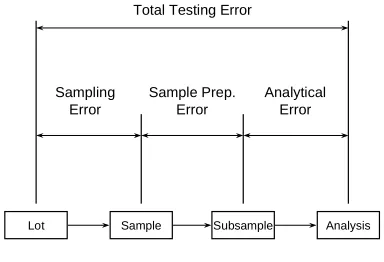
Figure 1-1 shows the relationships between the three major components of the
total variation associated with testing shelled corn for aflatoxin: sampling, sample
preparation, and analysis.
Lot Sample Subsample Analysis
Sampling Error
Sample Prep. Error
Analytical Error Total Testing Error
Figure 1-1: Total Variance partitioned into sample, sample preparation, and analytical components.
A statistical model of the aflatoxin test result, Co, can be represented by:
Equation 1-4
o
C= + +µ S SS +A
whereµ= the true aflatoxin concentration in the lot being tested, S = random deviations
of sample concentrations about the true lot concentration with expected value equal to
zero and variance σC s2o( )
comminuted sample concentration with expected value equal to zero and variance σC sso2( ),
and A = random deviations of analytical assay results about subsample concentration with
the expected value zero and variance σC a2o( ). If independence among the random
deviations in Equation 1-4 is assumed, the model for variance can be obtained:
Equation 1-5
σC to( ) σC so( ) σC sso( ) σC ao( )
2 = 2 + 2 + 2
where σC t2o( )
is the total variance associated with the aflatoxin test statistic Co. Total variance σC to2( )
is the estimate of the variance among samples within the
same lot of shelled corn, which is specific to mill type, subsample size, number of
aliquots, and analytical procedure.
Variance components, σC s2o( )
and σC ss2o( )
cannot be measured directly because of the
nested design. However, σC to2( ), σC ssa2o( ), and σC a2o( ) can be measured directly where σC ssao2( )
is the combination of sample preparation and analytical variances as shown in Equation
1-6.
Equation 1-6
σC ssao( ) σC sso( ) σC ao( )
2 = 2 + 2
Then sampling and sample preparation variances can be calculated by subtraction.
Equation 1-7
σC so( ) σC to( ) σC ssao( ) 2 = 2 − 2
σC sso( ) σC ssao( ) σC ao( )
2 = 2 − 2
The sampling variance, σC so2( ), is an estimate of the variability among replicate test
samples within each lot of shelled corn. Sample preparation variance σC ss2o( )
is defined by
the variability among replicate subsamples obtained from the same sample comminuted
in a suitable mill.
Methods
The first experimental design (see Appendix 1) was an unbalanced nested
procedure designed to produce estimates of σC to2( ), σC ssa2o( ), and σC s2o( ). The notation sC2o is
denoted as an estimate of σCo2. A bulk sample weighing approximately 45.4 kg (100 lb)
was divided into 32 test samples of 1.13 kg (2.5 lb). Each sample was comminuted in a
Romer Mill. Using 50 g subsamples, aflatoxin was extracted with methanol-water (75 +
25, v/v) in a 2:1 ratio. To purify the extract (0.5 ml), it was passed through a Mycosep
#224 column (8). The aflatoxins were derivatized using a bromide post-column
derivatization process and quantified using HPLC (9).
Two 50 g subsamples were removed from 16 of the 32 samples and one 50 g
subsample was removed from the remaining 16 samples. All subsamples were analyzed
with a single aliquot per subsample. The unbalanced design was used to keep costs
minimal while still providing enough degrees of freedom for adequate variance
estimation.
A second experiment was designed to obtain estimates of σC a2o( ). Ten subsamples
σC ao( ) 2
is the estimate of the variance among 15 replicate aliquots of extract taken from the
blender after the extraction process from a single subsample. All aliquot testing was
conducted in the same laboratory to produce an analytical variance that reflects within
laboratory variance. The results are recorded in total parts per billion (ppb) and contain
the sum of aflatoxins B1, B2, G1, and G2.
From the unbalanced nested design, the estimated variance components and the
lot aflatoxin concentration associated with each component were determined for each of
the 18 lots using the Nested procedure in SAS (10).
RESULTS AND DISCUSSION
Aflatoxin test results for all 18 lots and 32 samples can be seen in Appendix 2
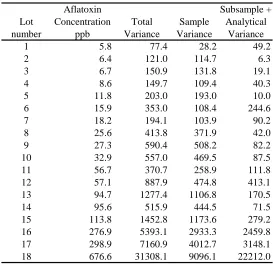
Tables 1-4. Variance estimates were obtained for eighteen lots. Table 1-1 reports
aflatoxin concentration, total variance sC t2o( ), sampling variance sC s2o( ), and combined
sample preparation and analytical variance sC ssa2o( ) values associated with each
contaminated lot of shelled corn. Appendix 3 shows the SAS (10) program used to
estimate the variance components. The 18 lots are ranked by aflatoxin concentration,
which ranged from about 6 to 677 ppb. In general, as the aflatoxin concentration
increases, each variance estimate increases. This reflects the results of similar variance
Table 1-1: Average aflatoxin concentration, sample variance, and combined subsampling and analytical variance
components for all 18 lots of shelled corn. **
Aflatoxin Subsample +
Lot Concentration Total Sample Analytical
number ppb Variance Variance Variance
1 5.8 77.4 28.2 49.2
2 6.4 121.0 114.7 6.3
3 6.7 150.9 131.8 19.1
4 8.6 149.7 109.4 40.3
5 11.8 203.0 193.0 10.0
6 15.9 353.0 108.4 244.6
7 18.2 194.1 103.9 90.2
8 25.6 413.8 371.9 42.0
9 27.3 590.4 508.2 82.2
10 32.9 557.0 469.5 87.5
11 56.7 370.7 258.9 111.8
12 57.1 887.9 474.8 413.1
13 94.7 1277.4 1106.8 170.5
14 95.6 515.9 444.5 71.5
15 113.8 1452.8 1173.6 279.2
16 276.9 5393.1 2933.3 2459.8
17 298.9 7160.9 4012.7 3148.1
18 676.6 31308.1 9096.1 22212.0
**Testing Plan=1.13kg sample, Romer Mill, 50 g subsample, and 1 aliquot quantified by HPLC.
Sampling Variance
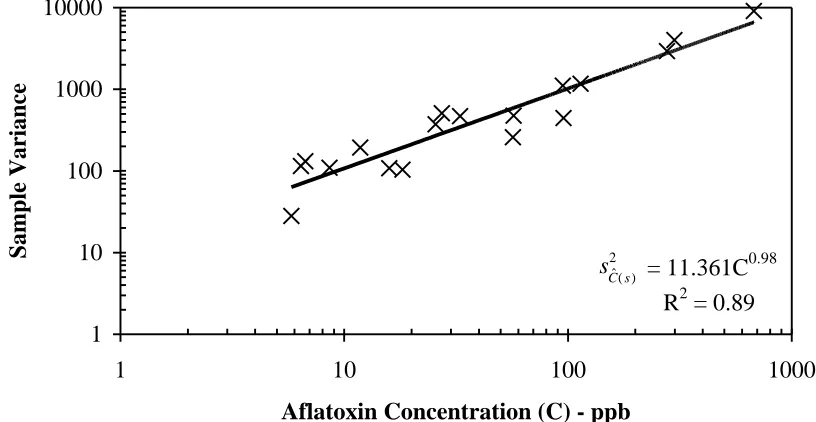
The sampling variance estimates from Table 1-1 show a linear relationship with
the mean aflatoxin concentration when plotted in full log scale (Figure 1-2). Therefore,
sampling variance was modeled by the following mathematical expression.
Equation 1-9
o( ) o C s
b
s2 =aC
where sC s2o( ) is the sample variance component,a and b are constants determined by
Using regression analysis, a relationship between sampling variance and aflatoxin
concentration was developed.
Equation 1-10
sC s2o( ) =11361. Co0 98.
with a coefficient of determination of 0.89 in the full log scale.
= 11.361C0.98 R2= 0.89 1
10 100 1000 10000
1 10 100 1000
Aflatoxin Concentration (C) - ppb
S
a
mp
le
Vari
an
ce
s
C so( ) 2
Figure 1-2: Sampling variance versus aflatoxin concentration for 1.13 kg test samples of shelled corn.
Combined Sample Preparation and Analytical Variance
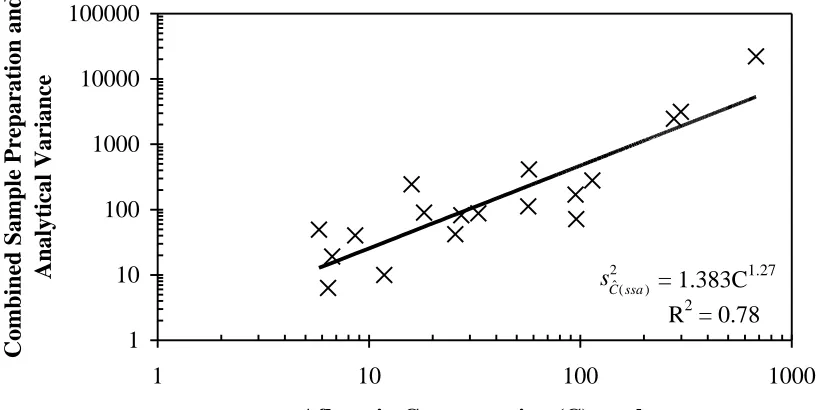
Table 1-1 reports the combined sample preparation and analytical variance
estimatessC ssa2o( )
. Figure 1-3 shows the combined sample preparation and analytical
variance estimates versus aflatoxin concentration plotted in full log scale. Generally,
combined sample preparation and analytical variance estimates increased with an
was developed between the combined sample preparation and analytical variance and
aflatoxin concentration.
Equation 1-11
sC ssa2o( ) =1383. Co1 27.
with a coefficient of determination of 0.78 in the full log scale.
= 1.383C1.27 R2= 0.78 1
10 100 1000 10000 100000
1 10 100 1000
Aflatoxin Concentration (C) - ppb
Combine
d
Sample
Pr
ep
ar
ation
a
nd
Analytical
Variance
s
C ssao( ) 2
Figure 1-3: Combined sample preparation and analytical variance versus aflatoxin concentration for test subsamples of shelled corn using 50 g subsamples comminuted in the Romer mill, 1 aliquot per subsample, and HPLC.
Analytical Variance
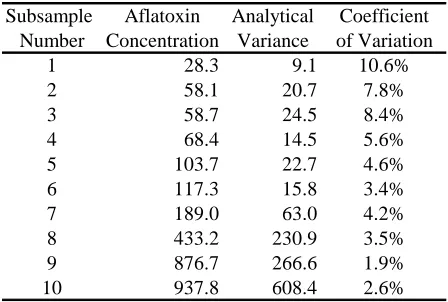
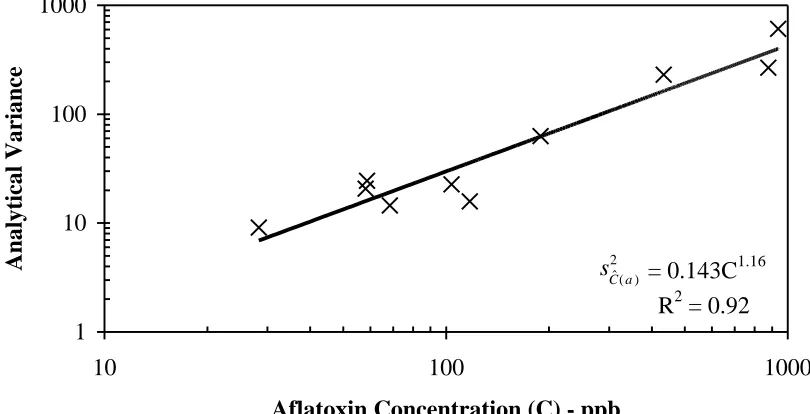
Table 1-2 shows analytical variance estimates sC a2o( ) among the 15 replicated test
results for each of the 10 subsamples analyzed. Generally, as the aflatoxin concentration
between the analytical variance and the aflatoxin concentration when plotted in the full
log scale. Using regression analysis, the following mathematical expression provided a
suitable relationship between the analytical variance and aflatoxin concentration.
Equation 1-12
s C
C ao( )
.
. o
2 1 16
0143
=
with a coefficient of determination of 0.92 in the full log scale.
Table 1-2: Average aflatoxin concentration, analytical variance, and coefficient of variation among replicate aflatoxin test results on 15 aliquots quantified by HPLC.**
Subsample Aflatoxin Analytical Coefficient Number Concentration Variance of Variation
1 28.3 9.1 10.6%
2 58.1 20.7 7.8%
3 58.7 24.5 8.4%
4 68.4 14.5 5.6%
5 103.7 22.7 4.6%
6 117.3 15.8 3.4%
7 189.0 63.0 4.2%
8 433.2 230.9 3.5%
9 876.7 266.6 1.9%
10 937.8 608.4 2.6%
= 0.143C1.16 R2= 0.92 1
10 100 1000
10 100 1000
Aflatoxin Concentration (C) - ppb
Analytical
Variance
s
C ao( ) 2
Figure 1-4: Analytical variance versus aflatoxin concentration for test subsamples of shelled corn using 15 aliquots per subsample and HPLC.
Sample Preparation Variance
Once relationships are developed for s
C ssao( ) 2
and s
C ao( ) 2
, Equation 1-8 can be used to
determine sample preparation variance s
C sso( ) 2
. An equation to estimate sample
preparation variance can be calculated by subtraction of Equation 12 from Equation
1-11.
Equation 1-13
s C C
C sso( )
. .
. o . o
2 1 27 1 16
1383 0143
= −
Equation 1-13 can be simplified by regressing the difference, s
C sso( ) 2
, on aflatoxin
concentration Co. A suitable expression is shown in Equation 1-14.
s C C sso( )
.
. o
2 1 27
1254
=
Application of Results
Equations 1-10 through 1-14 estimate variances associated with testing a lot of
shelled corn for aflatoxin using a 1.13 kg sample, Romer Mill, 50 g subsample, and
HPLC. Reducing one or more of the three variance components, sampling, sample
preparation, or analytical, will reduce the total variance associated with a testing
procedure. Statistical theory indicates that an increase in quantity of material tested will
decrease variance associated with that step of the testing procedure. For example,
increasing sample size or number of sample units can reduce sampling variance;
increasing subsample size or number of subsample units can reduce sample preparation
variance; and increasing the size of the aliquot or number of aliquots taken from the
blender after the extraction process to be quantified by HPLC can reduce analytical
variance.
Equation 1-10 can be modified to predict the sampling variance for a given
sample size.
Equation 1-15
s
ns C
C so( )
. .
. o
2 113 0 98
11361
= ⋅
wherens is the sample size in kg.
The sample preparation variance in Equation 1-14 can be modified to predict the
effect of any size subsample comminuted in the Romer mill.
s
nss C
C sso( )
.
. o
2 50 1 27
1 254
= ⋅
wherenss is the subsample size in g.
A similar expression can be derived for the analytical variance described in
Equation 1-12. Modification of Equation 1-12 shows the effect of any number of
aliquots quantified by HPLC.
Equation 1-17
s
na C
C ao( )
.
. o
2 1 116
0143
= ⋅
wherena is the number of aliquots.
Total variance can be estimated for any sample size, subsample size comminuted
in a Romer Mill and number of aliquots quantified by HPLC by summing Equations 1-15
through 1-17.
Equation 1-18
s
ns C nss C na C
C to( )
. . .
. o . o . o
2 12 95 0 98 62 70 1 27 0143 1 16
= + +
With Equation 1-18, the total variance associated with testing a contaminated lot
of shelled corn for aflatoxin at 20 ppb using a 1.13 kg sample, Romer Mill, 50 g
subsamples, and quantifying 1 aliquot per subsample using HPLC is 274.9 (CV=82.9%).
Sampling, sample preparation, and analytical variances are 214.0 (CV=73.1%), 56.3
(CV=37.5%), and 4.6 (CV=10.7%), respectively and account for 77.8, 20.5, and 1.7 % of
with sample preparation producing the next largest amount, and analytical with the least.
This follows the same pattern observed with other commodities (6, 11-15).
The effect of increasing sample size on reducing testing variability can be
demonstrated with Equation 1-18. Testing a contaminated lot of shelled corn for
aflatoxin at 20 ppb using a 5 kg sample, Romer Mill, 100 g subsamples, and quantifying
1 aliquot per subsample using HPLC produces a total variance value of 81.6
(CV=45.2%). Sampling, sample preparation, and analytical variances are 48.8
(CV=34.9%), 28.2 (CV=26.5%), and 4.6 (CV=10.7%), respectively and account for 59.8,
34.5, and 5.7 % of the total variation.
Assuming that aflatoxin test results from shelled corn follow the theory of
normally distributed variables, a lot with an aflatoxin concentration of 20 ppb and a total
variance of 81.6 implies that aflatoxin test results will fall in the range of 20±18 ppb, or
2-38 ppb, 95% of the time.
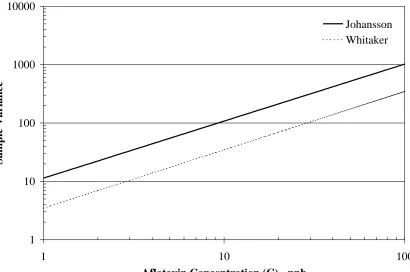
Whitaker's (7) study used similar sampling techniques, but different sample
preparation and analytical methods than this study. Only sampling variances can be
compared between the two studies. Figure 1-5 shows that Whitaker's sampling variance
is considerably less than in this study. This suggests Whitaker's assumption that his
mini-lots were representative of commercial mini-lots may be incorrect. In Figure 1-5, the slopes of
the two lines are almost parallel, which implies that Whitaker's assumption about a linear
1 10 100 1000 10000
1 10 100
Aflatoxin Concentration (C) - ppb
S
a
mp
le
Varian
ce
Johansson Whitaker
Figure 1-5: Comparison of sampling variances for Whitaker's 1979 study to Johansson's 1998 study of variability associated with testing shelled corn for aflatoxin.
The next step would be to calculate which theoretical distribution describes the
sample distribution of shelled corn data in this study.
SUMMARY
Eighteen lots of shelled corn were tested for aflatoxin using an unbalanced nested
design. Estimates of the total variability associated with testing shelled corn for aflatoxin
were shown to increase as aflatoxin concentration increased. This also held true for each
step of the test procedure: sampling, sample preparation, and analytical variability. Using
regression analysis, mathematical expressions were developed to model all three variance
components. The expressions were used to estimate the variance for any sample size,
example, testing a lot with 20 parts per billion (ppb) aflatoxin using a 2.5 lb sample,
Romer mill and 50 g subsample, and HPLC analysis, the total, sampling, sample
preparation, and analytical variances are 274.9 (CV=82.9%), 214.0 (CV=73.1%), 56.3
(CV=37.5%), and 4.6 (CV=10.7%), respectively. The percentage of the total variance for
sampling, sample preparation, and analytical is 77.8, 20.5, and 1.7 %, respectively. As
with testing of aflatoxins in other commodities, sampling variance contributes the most
variability followed by sample preparation and then analytical variability.
REFERENCES
1. Rodricks, J. V., and Roberts, H. R. 1977. Mycotoxin Regulation in the United States. Pages 753-757 in Mycotoxins: In Human and Animal Health. Rodricks, J. V., Hesseltine, C. W., Mehlman, M. A. (eds). Illinois: Pathotox.
2. Diener, U. L., R. E. Pettit, and R. J. Cole. 1982. Chapter 13: Aflatoxins and Other Mycotoxins in Peanuts in Peanut Science and Technology. H. E. Pattee, and C. T. Young (eds). Yoakum, Texas: American Peanut Research and Education Society, Inc.
3. Anonymous. 1997. Worldwide regulations for mycotoxins 1995. FAO Food and
Nutrition Paper 64. FAO Viale della Terme di Caracalla. 00100 Rome, Italy.
4. Marshall, J. W. 1992. U. S. Department of Agriculture Federal Grain Inspection Service Aflatoxin Handbook. Sec. 4.2-4.8.
5. Cucullu, A. F., L. S. Lee, R. Y. Mayne, and L. A. Goldblatt. 1966. Determination of
aflatoxins in individual peanuts and peanut sections. Journal of American Oil
Chemists' Society 43(2):89-92.
6. Whitaker, T. B., F. E. Dowell, W. M. Hagler, Jr., F. G. Giesbrecht, and J. Wu. 1994. Variability Associated with Sampling, Sample Preparation, and Chemical Testing for
Aflatoxin in Farmer’s Stock Peanuts. Journal of AOAC International. 77:107-116.
7. Whitaker, T. B., J. W. Dickens, and R. J. Monroe. 1979. Variability Associated with
Testing Corn for Aflatoxin. Journal of the American Oil Chemists’ Society.
56:789-794.
aflatoxins B1, B2, G1, and G2 in corn, almonds, Brazil nuts, peanuts, and pistachio
nuts. Journal of AOAC International. 77:1512-1521.
9. Traag, W. A., J. M. P. Van Trijp, L. G. M. Th. Tuinstra, and W. Th. Kok. 1987. Sample clean-up and post-column derivatization for the determination of aflatoxin B1
in feedstuffs by liquid chromatography. J. Chromatogr. 396:389-394.
10. Statistical Analysis System Institute, Inc. 1996. SAS Program 6.12. Cary, NC 27513.
11. Whitaker, T. B., W. Horwitz, R. Albert, and S. Nesheim. 1996. Variability Associated with Analytical Methods Used to Measure Aflatoxin in Agricultural
Commodities. Journal of AOAC International. 79:476-485.
12. Cambell, A. D., T. B. Whitaker, A. E. Pohland, J. W. Dickens, and D. L. Park. 1986. Sampling, sample preparation, and sampling plans for foodstuffs for mycotoxin
analysis. Pure and Appl. Chem. Vol. 58, pp. 305-314.
13. Whitaker, T. B., M. E. Whiten, and R. J. Monroe. 1976. Variability Associated with
Testing Cottonseed for Aflatoxin. Journal of the American Oil Chemists’ Society.
Vol. 53, No. 7, pp. 502-505.
14. Whitaker, T. B., J. W. Dorner, F. E. Dowell, and F. G. Giesbrecht. 1992. Variability Associated with Chemical Testing Screened Farmer’s Stock Peanuts for Aflatoxin.
Peanut Science. 19:88-91.
15. Whitaker, T. B., J. W. Dickens, and R. J. Monroe. 1974. Variability of Aflatoxin
CHAPTER 2.
DETERMINATION OF A SUITABLE
STATISTICAL MODEL TO SIMULATE OBSERVED
DISTRIBUTIONS OF AFLATOXIN TEST RESULTS IN
SHELLED CORN
ABSTRACT
Suitability of several theoretical distributions to predict the observed distribution
of aflatoxin test results in shelled corn is investigated in this study. Fifteen positively
skewed distributions were each fitted to 18 empirical distributions of aflatoxin test results
for shelled corn. The compound gamma distribution was selected to model the sample
aflatoxin test results for shelled corn. The method of moments technique was chosen to
estimate the parameters of the compound gamma distribution. Mathematical expressions
were developed to calculate the parameters of the compound gamma distribution for any
lot aflatoxin concentration and test procedure. Observed acceptance probabilities were
compared to operating characteristic curves predicted from the compound gamma
distribution and all 18 observed acceptance probabilities were found to lie within a 95%
confidence band.
The parameters of compound gamma were used to calculate the fraction of
aflatoxin-contaminated kernels in a lot at 20 ppb, which was estimated to be about six in
10,000.
INTRODUCTION
Regulatory guidelines that define the maximum concentration of aflatoxin
parts per billion (ppb) for foods destined for human consumption. To ensure that
consumer-ready products meet FDA aflatoxin guidelines, commodity industries and
manufacturers use aflatoxin-sampling plans or sample acceptance schemes to either
accept or reject a bulk lot based on the lot’s estimated aflatoxin concentration. A
sampling plan is defined as an aflatoxin test procedure combined with a sample
acceptance limit. The test procedure consists of sampling, sample preparation, and the
analytical steps. The sample acceptance limit is a threshold concentration that may or
may not be equal to the regulatory guideline. If the sample test result is less than or equal
to the sample acceptance limit, the bulk lot is accepted; otherwise, it is rejected.
Risks
Ideally, a lot with aflatoxin concentration,C, greater than a defined guideline, Cg,
should be rejected from entering the food chain, and a lot withC less than or equal to Cg
should be accepted. In reality, the lot aflatoxin concentrationC is estimated by
quantifying the aflatoxin C in a sample taken from the lot. The values ofo C for ao
specified lot will differ fromC because of random variation associated with sampling
(only a sample of kernels is tested), sample preparation and the analytical procedure
(2-7). The discrepancy betweenC and C lead to some lots being misclassified.o
Normally lots of shelled corn are inspected with an aflatoxin-sampling plan and
are classified either as unacceptable when the sample test result, C is greater than theo
sample acceptance limitCa, or acceptable when C is less than or equal to the sampleo
In a sampling plan, two types of misclassification can occur. The first type of
misclassification, a false positive, occurs when C > Co aand the lot is rejected when in
reality,C≤Cgor the lot is acceptable. This is also called the seller’s risk because a good
lot would be diverted from the food chain at an expense to the seller. The second type of
misclassification, a false negative occurs when Co ≤Caand the lot is accepted when in
realityC > Cgthat is, the lot is not acceptable. This misclassification is known as a
buyer’s risk because a bad lot may require additional cleaning and processing to lower
the lot aflatoxin concentration level. Also, if the unacceptable lot goes undetected, the lot
enters the food chain and becomes a potential health risk to the consumer. The frequency
of these two misclassifications occurring depends uponCg,Ca, and the design of the
sampling plan. The degree to which these two misclassifications will occur can be
evaluated with the help of an operating characteristic curve.
Operating Characteristic Curve
LetP{C} be the probability that a lot of shelled corn with an aflatoxin
concentrationC will be accepted by a specified sampling plan. Clearly, any reasonable
sampling plan will give a large probability of accepting a lot with a smallC and a small
(hopefully zero) probability of accepting a lot with a largeC. An operating characteristic
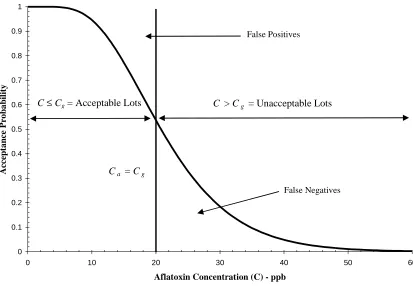
(OC) curve is simply a plot ofP{C} versus C. Figure 2-1 shows a typical OC curve. An
OC curve is uniquely defined by a specific testing plan and sample acceptance limit (6,
0 0.1 0.2 0.3 0.4 0.5 0.6 0.7 0.8 0.9 1
0 10 20 30 40 50 60
Aflatoxin Concentration (C) - ppb
Accepta
nce
P
ro
ba
bility
False Positives
False Negatives
C > Cg = Unacceptable Lots
C≤Cg= Acceptable Lots
Ca = Cg
Figure 2-1: Typical operating characteristic curve showing the performance of an aflatoxin sampling plan when testing lots with aflatoxin concentration C.
Knowing the percentage of lots with a given lot concentrationC that will be
accepted and rejected by the specified sampling plan gives an indication of the
misclassification errors associated with the sampling plan. The ability to evaluate the
performance of an aflatoxin-sampling plan will provide a method to estimate the costs
involved with different sampling plans and help identify the most efficient plan for the
resources available.
Theoretical Distribution
In order to determine an OC curve, the observed distribution of sample aflatoxin
test results must either be measured or adequately described by a theoretical distribution.
distribution should be able to (1) accurately describe the observed distribution of
aflatoxin test results for a specific test procedure over a wide range of aflatoxin
concentrations, (2) contain parameters that are easily computed from experimental data
and (3) be able to be applied to practical situations.
The distribution of sample aflatoxin test results for different commodities has
been studied by several different scientists (3, 8, 15-29). Shelled corn, cottonseed, and
pistachio nuts have been investigated, but the majority of studies have been on peanuts.
These studies have shown similar characteristics about the observed distribution
of sample aflatoxin test results for the above commodities: (a) aflatoxin sample test
results taken from contaminated lots were positively skewed (>50% of sample test results
were below the lot concentration); (b) for a given lot concentration, the range between
minimum and maximum sample test results is large which indicates a large variance
associated with the test procedure; (c) the range between minimum and maximum
increases as aflatoxin concentration increases which suggests that the variance associated
with sample test results increases with aflatoxin concentration; and (d) as aflatoxin
concentration increases, the distribution of sample test results becomes less skewed and
more like the normal distribution (6).
The following distributions have been investigated as possible models of observed
distributions of sample aflatoxin test results: negative binomial (6, 15, 21, 22), compound
gamma (21-23), log normal (23, 24), truncated normal (23), Waibel (25), and
three-parameter Weibull (26-28).
suitability of several theoretical distributions to accurately predict observed distributions
of sample aflatoxin test results for shelled corn, (2) develop methods to estimate the
parameters of the theoretical distribution and (3) compare observed and predicted OC
curves to evaluate how accurately OC curves can be determined from theoretical models.
METHODS
Theoretical Distributions
Four distributions were evaluated: the compound gamma, negative binomial,
three-parameter log normal and truncated normal. See Appendix 4 for the probability
density functions associated with each distribution. Several cases of the compound
gamma distribution were evaluated where the shape parameterαwas unrestricted (CG),
set equal to 0.5 (CG0.5), 1 (CG1), 1.5 (CG1.5), 2 (CG2), and 2.5 (CG2.5). The
compound gamma, negative binomial, and truncated normal have parameters that relate
to a sample size term in the density function to allow the distribution to be adjusted for
different sample sizes (i.e. different test procedures). The three-parameter log normal
density function does not contain a sample size term, but was considered because of its
ability to fit positively skewed data.
Parameter Estimation Methods
Method of moments (MM) and maximum likelihood (ML) are the two parameter
estimation methods used in this study. The MM technique provides an easy and intuitive
method of estimation, but does not always lead to the best estimators of distributional
parameters. The ML method tends to produce good estimators, but these often can be
The ML method was used to estimate the parameters for all distributions. For
comparison, the method of moments was also used to estimate parameters of the
compound gamma and negative binomial distributions. SAS (31) procedures were used
to calculate estimates under both methods (See Appendix 5).
Goodness of Fit
The power divergence (PD) (32) test statistic was selected as the criterion to
evaluate the goodness of fit (GOF) of the theoretical distributions to the observed
distributions. The PD statistic was selected because this test is generally found to have
reasonable power against a broad range of alternatives (32). The test statistic is actually
very similar to the familiar chi-square goodness of fit test statistic. The fit was
considered acceptable if the test statistic failed to exceed the 95% critical value. The test
statistic was converted to a GOF probability where the lower the GOF probability, the
better the fit.
Observed Distribution
Bulk samples weighing approximately 45.4 kg (100 lb) were taken from each of 18
lots of shelled corn suspected of aflatoxin contamination. Each bulk sample was divided
in 32 test samples of 1.13 kg (2.5 lb) and comminuted in the Romer Mill. A 50 g
subsample was removed from each comminuted sample. Each subsample was analyzed
using high performance liquid chromatography (HPLC) (7). This provided 18 observed
distributions with 32 sample test results per distribution (See Appendix 6). An observed
RESULTS
Goodness of Fit
Table 2-1 shows the frequency that each theoretical distribution acceptably fit the
18 observed distributions. The three-parameter log normal and six cases of the
compound gamma distribution gave acceptable fits 100% of the time. The compound
gamma fit all 18 observed distributions using both the MM and ML parameter estimation
methods. Using the MM technique, the compound gamma distribution provided 100%
acceptable fits for CG1MM (compound gamma distribution withα= 1 using method of
moments), CG1.5MM, CG2MM, and CG2.5MM. When using the ML technique, the
compound gamma distribution produced 100% acceptable fits for the CG2ML
(compound gamma distribution withα= 2 using maximum likelihood) and CG2.5ML.
Table 2-1: The number of times each theoretical distribution provided an acceptable fit to the 18 observed distributions of sample test results using the power divergence test.
Parameter Estimation Acceptable Fitc
Distributiona Methodb Number %
Three-Parameter Log Normal ML 18 100%
CG1 MM 18 100%
CG1.5 MM 18 100%
CG2 MM 18 100%
CG2.5 MM 18 100%
CG2 ML 18 100%
CG2.5 ML 18 100%
CG1 ML 17 94%
CG1.5 ML 17 94%
CG ML 17 94%
Truncated Normal ML 15 83%
CG0.5 MM 14 78%
CG0.5 ML 14 78%
Negative Binomial ML 10 56%
Negative Binomial MM 6 33%
a
CG = compound-gamma;
CG0.5 = special case of the compound-gamma where shape parameter = 0.5; CG1 = special case of the compound-gamma where shape parameter = 1; CG1.5 = special case of the compound-gamma where shape parameter = 1.5; CG2 = special case of the compound-gamma where shape parameter = 2; CG2.5 = special case of the compound-gamma where shape parameter = 2.5;
b
ML = maximum likelihood MM = method of momemnts
c
Acceptable Fit = null hypothesis not rejected at the 5% confidence level.
The negative binomial distribution has a problem predicting the percent zero
aflatoxin sample values when a lot contains a high percentage of zero sample values. The
negative binomial distribution does however model the positive aflatoxin test results
adequately. The compound gamma and the three-parameter log normal distributions
were able to model the positively skewed distributions with high percent zero aflatoxin
sample values.
The three-parameter log normal cannot be statistically modified to predict the
parameters change as the sample size is varied. Statistically incorporating a sample size
term into the log normal distribution was investigated, but no acceptable results were
found. The remaining theoretical distributions investigated in this study can be modified
to predict the distribution of sample test results for sample sizes other than that used in
this study (15, 23).
In Table 2-1, four out of the six compound gamma distributions that acceptably fit
all 18 observed distributions were fitted using the MM as the parameter estimation
technique. Only these four theoretical distributions were considered since the MM
provides GOF results equivalent to the ML technique and has simpler computational
formulas to adjust for changes in testing procedure.
The four compound gamma distributions (CG1MM, CG1.5MM, CG2MM and
CG2.5MM) where parameters were estimated using the MM technique were evaluated to
determine which of these four distributions had the most best fits. A best fit is defined as
the theoretical distribution that fit an observed distribution with the lowest GOF
probability. Table 2-2 shows the percentage of best fits each of the theoretical
distributions produced. The CG2.5MM tied with CG2MM with the highest number of
Table 2-2: Number of times each theoretical distribution provided a best fit to the 18 observed distributions of sample test results when using the power divergence test.
Parameter Estimation Best Fitc
Distributiona Methodb Numberd %
CG2.5 MM 10 56%
CG2 MM 10 56%
CG1.5 MM 8 44%
CG1 MM 7 39%
a
CG1 = special case of the compound-gamma where shape parameter = 1; CG1.5 = special case of the compound-gamma where shape parameter = 1.5; CG2 = special case of the compound-gamma where shape parameter = 2; CG2.5 = special case of the compound-gamma where shape parameter = 2.5;
b
MM = method of momemnts
c
Best Fit = theoretical distribution with lowest GOF probability.
d
Sum of Number of Best Fits > 18 due to ties
Table 2-3 shows the average GOF probability for each distribution. Averaging
the GOF probability compares how well a theoretical distribution fit all observed
distributions as a group. A better fit would entail a lower average GOF probability. The
CG2.5MM produced the lowest average GOF probability followed by CG2MM,
CG1.5MM and CG1MM respectively.
Table 2-3: Average of all 18 power divergence test results for each theoretical distribution.
Parameter Estimation Average
Distributiona Methodb GOF Testsc
CG2.5 MM 0.51
CG2 MM 0.52
CG1.5 MM 0.57
CG1 MM 0.63
a
CG1 = special case of the compound-gamma where shape parameter = 1; CG1.5 = special case of the compound-gamma where shape parameter = 1.5; CG2 = special case of the compound-gamma where shape parameter = 2; CG2.5 = special case of the compound-gamma where shape parameter = 2.5;
b
MM = method of momemnts
c
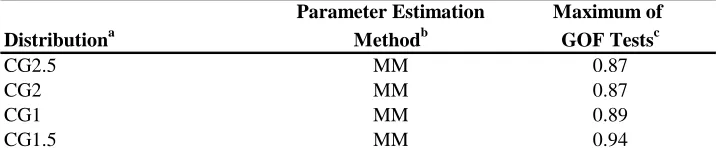
Average of GOF test = average of the GOF probabilities for all 18 distributional fits.
a theoretical distribution is. The CG2.5MM and CG2MM tied with the lowest maximum
GOF probability value of 0.87.
Table 2-4: Maximum value of the power divergence test for each theoretical distribution.
Parameter Estimation Maximum of
Distributiona Methodb GOF Testsc
CG2.5 MM 0.87
CG2 MM 0.87
CG1 MM 0.89
CG1.5 MM 0.94
a
CG = compound-gamma;
CG0.5 = special case of the compound-gamma where shape parameter = 0.5; CG1 = special case of the compound-gamma where shape parameter = 1; CG1.5 = special case of the compound-gamma where shape parameter = 1.5; CG2 = special case of the compound-gamma where shape parameter = 2; CG2.5 = special case of the compound-gamma where shape parameter = 2.5;
b
MM = method of momemnts
c
Maximum of GOF Tests = maximum GOF probability that a theoretical distribution produced.
Table 2-5 summarizes results of Tables 2-1 through 2-4 to help determine which
of the four theoretical distributions would best model sample test results of shelled corn
for aflatoxin. Each theoretical distribution acceptably fit all 18 observed distributions.
The percentage of best fits is tied between CG2.5MM and CG2MM with 56% each. The
CG2.5MM distribution has the lowest average GOF probability (0.51) while CG2.5MM
Table 2-5: Summary comparison for each of the theoretical distributions. Percentage of acceptable fits, percentage of best fits, average of GOF tests, and maximum values of GOF tests are included.
CG2.5MMa CG2MMb CG1.5MMc CG1MMd
Acceptable Fitse 100% 100% 100% 100%
Best Fitsf 56% 56% 44% 39%
Average of GOF testsg 0.51 0.52 0.57 0.63
Maximum of GOF testh 0.87 0.87 0.89 0.94
a
CG2.5MM = special case of the compound-gamma where shape parameter = 2.5 and method of moments is the parameter estimation technique.
b
CG2MM = special case of the compound-gamma where shape parameter = 2 and method of moments is the parameter estimation technique.
c
CG1.5MM = special case of the compound-gamma where shape parameter = 1.5 and method of moments is the parameter estimation technique.
d
CG1MM = special case of the compound-gamma where shape parameter = 1 and method of moments is the parameter estimation technique.
e
Acceptable Fit = null hypothesis not rejected at the 5% confidence level.
f
Best Fit = theoretical distribution with GOF acceptance probability.
g
Average of GOF tests = sum of the GOF probabilities for all 18 distributional fits.
h
Maximum of GOF Tests = maximum GOF probability that a theoretical distribution produced. Distribution
The CG2.5MM was chosen to model the observed distribution of aflatoxin sample
test results for shelled corn. Table 2-6 shows for each lot, the three compound gamma
distribution parameters determined by the method of moments and GOF probability
results as determined by the power-divergence test. Figure 2-2 shows an example of the
CG2.5MM theoretical distribution compared to the observed distribution for lot 10. Very
little difference between the two distributions can be noted (See Table 2-6, lot 10, PD test