Scholarship at UWindsor
Scholarship at UWindsor
Electronic Theses and Dissertations Theses, Dissertations, and Major Papers
9-6-2019
Learning Embeddings for Academic Papers
Learning Embeddings for Academic Papers
Yi Zhang
University of Windsor
Follow this and additional works at: https://scholar.uwindsor.ca/etd
Recommended Citation Recommended Citation
Zhang, Yi, "Learning Embeddings for Academic Papers" (2019). Electronic Theses and Dissertations. 7855.
https://scholar.uwindsor.ca/etd/7855
This online database contains the full-text of PhD dissertations and Masters’ theses of University of Windsor students from 1954 forward. These documents are made available for personal study and research purposes only, in accordance with the Canadian Copyright Act and the Creative Commons license—CC BY-NC-ND (Attribution, Non-Commercial, No Derivative Works). Under this license, works must always be attributed to the copyright holder (original author), cannot be used for any commercial purposes, and may not be altered. Any other use would require the permission of the copyright holder. Students may inquire about withdrawing their dissertation and/or thesis from this database. For additional inquiries, please contact the repository administrator via email
By
Yi Zhang
A Dissertation
Submitted to the Faculty of Graduate Studies through the School of Computer Science in Partial Fulfillment of the Requirements for
the Degree of Doctor of Philosophy at the University of Windsor
Windsor, Ontario, Canada
2019
c
by
Yi Zhang
APPROVED BY:
Y. Zou, External Examiner Queen’s University
J. Wu
Department of Electrical and Computer Engineering
M. Kargar
School of Computer Science
D. Wu
School of Computer Science
J. Lu, Advisor School of Computer Science
I. Co-Authorship
I hereby certify that this dissertation incorporates material that is the result of joint
re-search, as follows: My research was conducted under the supervision of my advisor Prof.
Jianguo Lu. Parts of Chapter 3 of the thesis was co-authored with Dr. Ofer Shai under
the supervision of my advisor Prof. Jianguo Lu. Chapter 3, 4, 5, and 6 were co-authored
with Fen Zhao under the supervision of my advisor Prof. Jianguo Lu. In all cases, the
key ideas, primary contributions, experimental designs, data analysis, interpretation, and
writing were performed by the author, and the contribution of co-authors was primarily
through the discussion of technical content, data pre-processing, and proofreading of the
published manuscripts.
I am aware of the University of Windsor Senate Policy on Authorship and I certify that
I have properly acknowledged the contribution of other researchers to my thesis, and have
obtained written permission from each of the co-author(s) to include the above material(s)
in my thesis.
I certify that, with the above qualification, this thesis, and the research to which it
refers, is the product of my own work.
II. Previous Publications
This dissertation includes the extended or original version of the papers that have been
previously published/submitted for publication in peer reviewed conferences and journals,
as follows:
• Yi Zhang, Jianguo Lu, Ofer Shai. 2018. Improve Network Embeddings with
Reg-ularization. In Proceedings of the 27th ACM International Conference on Informa-tion and Knowledge Management (CIKM ’18). ACM, New York, NY, USA, pp. 1643-1646. doi:10.1145/3269206.3269320 The data and code are publicly available at
http://zhang18f.myweb.cs.uwindsor.ca/n2v_r(Chapter 3).
• Yi Zhang, Fen Zhao, Jianguo Lu. 2019. ShortWalk: Long Random Walks Considered
Harmful for Network Embeddings on Directed Graphs. The 3rd Workshop of Het-erogeneous Information Network Analysis and Applications, CIKM 2019 Workshop.
Accepted. The data and code are publicly available athttp://zhang18f.myweb.cs.
are publicly available athttp://zhang18f.myweb.cs.uwindsor.ca/p2v(Chapter 3, 5 and 6).
• Fen Zhao, Yi Zhang, Jianguo Lu, Ofer Shai. 2019. Measuring academic influence
us-ing heterogeneous author-citation networks. Scientometrics, 118(3):1119–1140. ISSN 1588-2861. doi: 10.1007/s11192-019-03010-5. The data and code are publicly
avail-able athttp://zhang18f.myweb.cs.uwindsor.ca/apn (Chapter 6).
• Fen Zhao, Yi Zhang, Jianguo Lu. 2019. Author Embeddings on Heterogeneous
Networks. The 3rd Workshop of Heterogeneous Information Network Analysis and Applications, CIKM 2019 Workshop. Accepted. The data is publicly available at
http://zhang18f.myweb.cs.uwindsor.ca/a2v(Chapter 6).
I certify that I have obtained a written permission from the copyright owner(s) to include
the above published material(s) in my thesis. I certify that the above material describes
work completed during my registration as a graduate student at the University of Windsor.
III. General
I declare that, to the best of my knowledge, my thesis does not infringe upon anyone’s
copyright nor violate any proprietary rights and that any ideas, techniques, quotations,
or any other material from the work of other people included in my thesis, published or
otherwise, are fully acknowledged in accordance with the standard referencing practices.
Furthermore, to the extent that I have included copyrighted material that surpasses the
bounds of fair dealing within the meaning of the Canada Copyright Act, I certify that I
have obtained a written permission from the copyright owner(s) to include such material(s)
in my thesis. I declare that this is a true copy of my thesis, including any final revisions,
as approved by my thesis committee and the Graduate Studies office, and that this thesis
Academic papers contain both text and citation links. Representing such data is crucial
for many downstream tasks, such as classification, disambiguation, duplicates detection,
recommendation and influence prediction. The success of Skip-gram with Negative
Sam-pling model (hereafter SGNS) has inspired many algorithms to learn embeddings for words,
documents, and networks. However, there is limited research on learning the representation
of linked documents such as academic papers.
This dissertation first studies the norm convergence issue in SGNS and propose to use
an L2 regularization to fix the problem. Our experiments show that our method improves
SGNS and its variants on different types of data. We observe improvements upto 17.47% for
word embeddings, 1.85% for document embeddings, and 46.41% for network embeddings.
To learn the embeddings for academic papers, we propose several neural network based
algorithms that can learn high-quality embeddings from different types of data. The
algo-rithms we proposed are N2V (network2vector) for networks, D2V (document2vector) for
documents, and P2V (paper2vector) for academic papers. Experiments show that our
mod-els outperform traditional algorithms and the state-of-the-art neural network methods on
various datasets under different machine learning tasks.
With the high quality embeddings, we design and present four applications on real-world
datasets, i.e., academic paper and author search engines, author name disambiguation, and
I would like to express my deepest gratitude to my supervisor, Dr. Jianguo Lu, for his
valuable assistance, useful guidance, insightful comments, and considerable encouragements
to complete this thesis.
I also would like to express my appreciation to Dr. Ying Zou, Dr. Jonathan Wu, Dr.
Dan Wu, and Dr. Mehdi Kargar. Thank you all for your valuable comments and suggestions
to this thesis.
Meanwhile, I would like to thank Dr. Ofer Shai for his precious assistance, scholarly
knowledge and enthusiasm. Great deals appreciated go to the contribution of Mr. Zeeshan
Mansoor for the efforts he made on retrofitting model and Mr. Ziyang Tian for collecting
the data for experiments.
In addition, I want to send my appreciation to the school of Computer Science and
Meta Team from Chan Zuckerberg Initiative for supporting my work through my advisor’s
grants.
Last but not least, I owe special thanks to my wife, Fen Zhao, for her infinite love and
support. It is also my privilege to thank my parents, my parents-in-law, my brother and
DECLARATION OF CO-AUTHORSHIP/PREVIOUS PUBLICATION III
ABSTRACT V
ACKNOWLEDGEMENTS VI
LIST OF TABLES X
LIST OF FIGURES XII
1 Introduction 1
1.1 Introduction . . . 1
1.2 Challenges . . . 3
1.3 Contributions . . . 4
1.4 The structure of the dissertation . . . 6
2 Background and Related Works 8 2.1 Word embeddings . . . 8
2.1.1 Co-occurrence matrix . . . 9
2.1.2 Word2vec . . . 11
2.1.3 Implementation details of SGNS . . . 21
2.1.4 GloVe . . . 26
2.2 Document embeddings . . . 27
2.2.1 Traditional methods . . . 27
2.2.2 Paragraph Vector . . . 28
2.2.3 Other approaches . . . 29
2.3 Network embeddings . . . 30
2.3.1 DeepWalk . . . 31
2.3.2 Node2vec . . . 32
2.3.3 LINE . . . 33
2.3.4 Other approaches . . . 34
2.4 Linked document embeddings . . . 35
2.4.1 TADW . . . 36
2.4.2 LDE . . . 37
2.4.3 Paper2vec . . . 38
2.5 Summary . . . 39
3 Network Embeddings 40 3.1 ShortW alk – Directed graph embeddings . . . 40
3.1.1 The Dilemma . . . 41
3.1.2 Our method . . . 43
3.1.3 Experiments . . . 45
3.1.4 Conclusion . . . 51
3.2 Norm convergence issue . . . 52
3.2.1 Performance degeneration over iteration . . . 53
3.3 N2V . . . 58
3.3.1 Scalability issue . . . 58
3.3.2 Our method . . . 61
3.3.3 Compare with existing methods . . . 64
3.4 Experiments . . . 65
3.4.1 Datasets . . . 65
3.4.2 Experiment setup . . . 69
3.4.3 Classification task . . . 70
3.4.4 Link prediction task . . . 75
3.4.5 Optimum number of training pairs . . . 78
3.4.6 Analysis . . . 79
3.5 L2 regularization on word and document embeddings . . . 82
3.5.1 Word embeddings . . . 82
3.5.2 Document embeddings . . . 88
3.6 Summary . . . 94
4 Document Embeddings 95 4.1 Introduction . . . 95
4.2 Related works . . . 96
4.3 Our method . . . 97
4.4 Experiments . . . 101
4.4.1 Experiment setup . . . 103
4.4.2 Results and analysis . . . 104
4.4.3 Impact of weight . . . 106
4.5 Case study . . . 107
4.6 Summary . . . 110
5 Paper Embeddings 111 5.1 Introduction . . . 111
5.2 Our method . . . 112
5.2.1 Weight of components . . . 115
5.2.2 Regularization and optimization . . . 117
5.2.3 Compare with existing works . . . 120
5.2.4 Other approaches . . . 122
5.3 Experiments . . . 124
5.3.1 Datasets . . . 124
5.3.2 Text only . . . 125
5.3.3 Link only . . . 128
5.3.4 Linked text . . . 132
5.4 Compare with concatenation . . . 136
5.5 Impact of weight . . . 136
5.6 Paper clustering . . . 139
5.7 Analysis . . . 142
6.1.1 Introduction . . . 145
6.1.2 Heterogeneous Author Paper Network . . . 146
6.1.3 Datasets . . . 148
6.1.4 Author Embeddings . . . 149
6.1.5 Author Search Engine . . . 156
6.1.6 Conclusions . . . 156
6.2 Author name disambiguation . . . 157
6.2.1 Introduction . . . 157
6.2.2 Experiment setup . . . 158
6.2.3 Experiment and results . . . 160
6.3 Similar paper search engine . . . 160
6.3.1 Introduction . . . 160
6.3.2 Experiment . . . 162
6.3.3 Compare with Google Scholar and Semantic Scholar . . . 163
6.4 Paper influence prediction . . . 165
6.5 Summary . . . 167
7 Conclusions and Future Directions 168 7.1 Discussions and conclusions . . . 168
7.2 Future directions . . . 169
REFERENCES 172
2.1 Summary of the notations. . . 9
2.2 The word-context co-occurrence matrix retrieved from Figure 2.1. Row i
denotes word wi and column j is context cj. Each entry Mi,j is the
co-occurrence between wordwi and contextcj, which is the count of wi and cj
appears in the same sliding window. . . 10
2.3 The word-context co-occurrence for w5 retrieved from Figure 2.2. . . 12
3.1 Top visited webpages in WebGoogle. Webpages are sorted by their
occur-rence in DeepWalk100. . . . 41
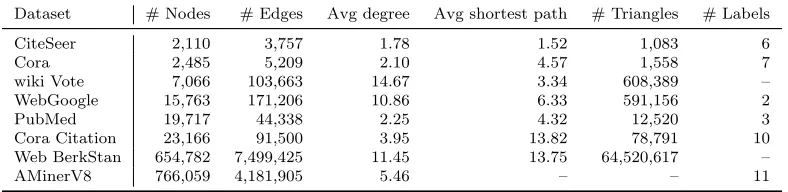
3.2 Statistics of datasets. We also list average shortest paths and number of
tri-angles for smaller graphs to understand their structure. The average shortest
path and number of triangles are not reported for AMinerV8 due to its large
size. . . 47
3.3 Performance of classification task. Scores are averaged from 5 models. Each
model produce one micro F1 score by 10-fold cross validation. . . 48
3.4 AUC score of link prediction. 10-fold cross-validation. 5 embeddings per
dataset per method. . . 50
3.5 Statistics of 33 networks. . . 69
3.6 Micro-F1 on classification task, training ratio is 8% for Flickr and YouTube
and 80% for the resets. . . 71
3.7 Macro-F1 on classification task, training ratio is 8% for Flickr and YouTube
and 80% for the resets. . . 71
3.8 Statistics of 4 Groups in different datasets. . . 74
3.9 Statistics of the corpora for word embeddings. |Voc|is the vocabulary size. 82
3.10 Summary of similarity test cases. . . 83
3.11 Comparison of W2V and W2VR on Text8, News2010 and Wikipedia. The
performance is obtained when the iteration is 50 for Text8, 10 for News2010,
and 2 for Wikipedia. Each data cell is an average of five independent runs. 85
tion task. . . 92
4.1 Best weight hyper-parameters for D2V. . . 104
4.2 F1 scores in the document classification task. . . 104
5.1 The number of training samples per iteration. Window size is 5. . . 115
5.2 Statistics of datasets. . . 125
5.3 Best parameters for D2V. . . 126
5.4 Micro-F1 of paper classification – Text only task. LDA and LSA do not scale to MAG dataset so we can not report the performance. . . 126
5.5 Best parameters for N2V. . . 130
5.6 Micro-F1 of paper classification – Link only task. . . 130
5.7 Best parameters for P2V, pis walk probability. . . 133
5.8 Micro-F1 of paper classification – Linked text task. . . 133
5.9 Information of the highlighted papers in Figure 5.14. . . 136
5.10 Statistics of the labels in the paper clustering task. . . 140
5.11 Best parameters for P2V in clustering task,pis walk probability. . . 142
6.1 Statistics of AMiner and Health datasets. . . 149
6.2 Statistics of ACM fellows, Turing Award Winners, and Nobel Prize Winners. 149 6.3 Average F1 scores of binary classification for ACM Fellows on different net-works. . . 151
6.4 F1 scores of author name disambiguation. It also shows the improvement of P2V against LDE. . . 159
6.5 Comparison with Google Scholar and Semantic Scholar. . . 163
6.6 Top 5 similar papers to Support Vector Networks in AMinerV10. The high-lighted paper is irrelevant to SVM. Citation count is retrieved via Google Scholar on Sept 2018. . . 164
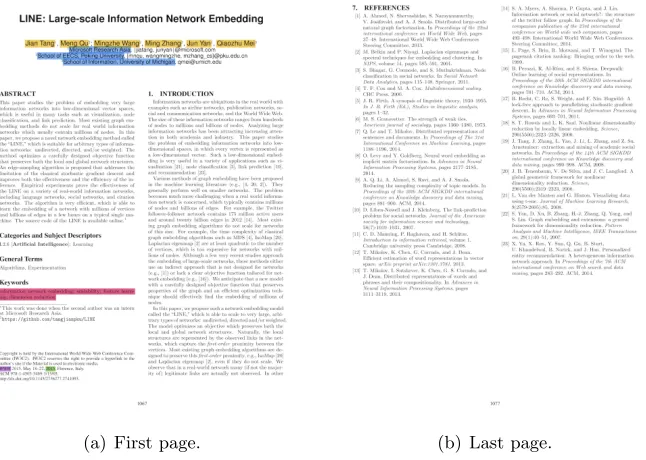
1.1 A screenshot of an academic paper. The first page in Panel (a) has multiple
entities marked in different colors. Here authors are yellow, institutions are
blue, keywords are red, venue is purple and publication year is green. This
paper also links to other related papers via citation links as illustrated in
Panel (b). . . 2
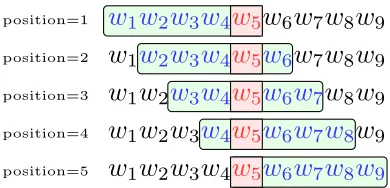
2.1 An example of a basic sliding window when capturing word-context
co-occurrence information. The corpus is a set of words in a specific order.
Suppose window size C = 5, the window moves from left to right and
cap-tures 5 words at each time. Every two words appeare in that window count
as one co-occurrence. We can record the co-occurrence count in a matrix
listed in Table 2.2. . . 10
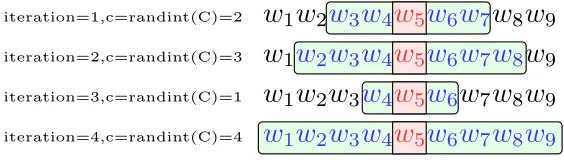
2.2 An example of skip-gram window in word2vec. The corpus is a set of words in
a specific order. LetC = 4 be the window size,w5be the center word, which is
the target word we want to learn the embedding for in this example. Function
randint(C) returns a random integer in a range of (0, C). In each iteration,
we generate a window size c = randint(C) and collect the (word,context)
pairs within the window. For example, in the third iteration, cis 1, we take
1 neighbor left and right to the center word w5. The (word,context) pairs
generated in this step is (w5, c4),(w5, c6). . . 12
2.3 CBOW as Neural Network with one hidden layer. . . 13
2.4 Comparison between Softmax and Hierarchical Softmax. Panel (a) illustrates
the multi-class classification using Softmax. Panel (b) shows the Hierarchical
Softmax. It solves the multi-class classification problem via multiple binary
classifiers where labels are the binary code of the target on the Huffman tree.
In this example,w5 is the target word and the corresponding binary code on
the Huffman tree is (1,0,0). . . 14
the multi-class classification using Softmax. Panel (b) shows the Negative
Sampling in which the negative samples are retrieved randomly via noise
distribution. . . 16
2.7 Preprocessing Subsampling of the raw text. . . 23
2.8 An example of preprocessing. The sentence is retrieved from Text8 dataset. 25
2.9 A snapshot of embeddings in Text8 during the training. Panel (a) is the
snapshot after initialization. We can see that words randomly assigned in
the vector space. Panel (b) is the snapshot token after 5×10⁴ samples been
trained. “zero” has been pushed to the left and “british” is moving to the
right towards “american”. Panel(c) is the snapshot after 105 samples been
trained. Words are separated into two groups by their semantic meanings. 26
2.10 Random walk in DeepWalk. . . 31
2.11 An example of biased random walk probability in node2vec. . . 32
2.12 An example of academic papers. . . 35
2.13 The structure of TADW. Mis the DeepWalk co-occurrence matrix. WT is
embedding matrix, T is the text information matrix. Hconnects W and T. 36
3.1 Distribution of occurrence by differentl in DeepWalk. . . 42
3.2 Comparison of SGNS and pair-wise combination. The Pearson’s Correlation
Coefficient between them is 1−2×10⁻⁶. . . . 45
3.3 Performance of classification task. Each model produce one micro F1 score
by 10-fold cross validation. Panel(a) reports the F1 score averaged from 5
models. The shaded area indicate the standard deviation. Panel(b) shows
the corresponding improvement using DeepWalk as the baseline. . so the
traces should not be very different from ShortWalk. . . 48
3.4 Performance of Link Prediction task. Each model produce one AUC score
by 10-fold cross validation. Then the reported AUC score is averaged from
5 models. Panel(a) shows the AUC score of ShortWalk and DeepWalk. The
shaded area indicate the standard deviation. Panel(b) shows the
correspond-ing improvement uscorrespond-ing DeepWalk5 as the baseline. . . . 50
3.7 2D plot of PubMed. . . 52
3.8 Performance degeneration on network embedding algorithms. . . 53
3.9 L2-norm of vectors – BlogCatalog. . . 55
3.10 Sigmoid function. The output is in range of (0,1) . . . 57
3.11 Norms of the vectors in network embeddings – L2 regularization on embed-ding vectors only. . . 58
3.12 Norms of the vectors in network embeddings – L2 regularization on embed-ding vectors and output vectors. . . 59
3.13 An example of random walk based network embedding algorithms. It uses a walker to generate the walking paths. Training pairs are captured by a skip-gram window, and are learned by SGNS. . . 59
3.14 An example of LINE. It uses random edge sampling to generate the training samples. . . 61
3.15 An example of N2V sampling. The red node represents the start node. Blue line is the visited path. Red lines represent the current walking path and the dashed line represents the random jump. . . 62
3.16 Comparison between different sampling strategies in Karate Club. Panel(a) shows the original network with ground true labels. Panel (b) to (u) show the training sample pairs generated for different target nodes by different sampling strategies. The red node indicates the training target ( the input node ). The green nodes are the corresponding neighbors. The color and size reflect the probability that a green node is selected as an output of the red node. . . 66
3.17 Pearson’s correlation coeefficiant of different sampling strategies. . . 67
3.18 Degree distribution of 33 networks. . . 68
3.19 Comparison between walking probability in N2V and window size in DeepWalk. 70 3.20 Micro-F1 and Macro-F1 of node classification task. First row shows the performance, Second row is the improvement. . . 72
the improvement for small nodes and Panel (b) is for large nodes. . . 75
3.23 AUC of Link prediction task – Hadamard operator. . . 77
3.24 AUC of Link prediction task – average operator. . . 78
3.25 Optimum training examples for different datasets. . . 79
3.26 Visualization on Cora. Red dots represent papers inGenetic Algorithms. . . 80
3.27 Visualization on PubMed. . . 81
3.28 Word frequency distribution of Text8, News2010, and Wikipedia. . . 82
3.29 An example of analogy test. The figures use the relation of ‘Beijing’ is the capital of ‘China’ to infer the capital for ‘Japan’. . . 85
3.30 Comparison of W2V and W2VR on similarity and analogy task. Training data is Text8. . . 86
3.31 Comparison of W2V and W2VR. Examples are traken randomly from Google Analogy test case – Country-capital. . . 87
3.32 L2-norm of the word and context embeddings during the training on News2010 and Wikipedia. . . 88
3.33 Document length distribution and word frequency distribution of different datasets. . . 89
3.34 Comparison between PV-DBOW and PV-DBOWR on document classifica-tion task. . . 92
3.35 An example of mis-classified documents in IMDB. Left plot shows embed-dings generated by PV-DBOW and right is for PV-DBOWR. We use t-SNE to reduce 100 dimensional embeddings into 2 dimensions. . . 93
3.36 The content of IMDB document with id 40906 corresponding to Figure 3.35. This document is classified as a positive review in PV-DBOW but correctly identified by PV-DBOWR. . . 94
4.1 The structure of D2V. . . 98
smaller α is, the less weight learned from the word-word pairs. The red dot
indicates the best hyper-parameter. The green triangle is the performance
of D2V eqweighted. The blue diamond represents the D2V unweighted model.106
4.4 Document embeddings in arXiv2019. We use PCA to reduce the dimension of
document embeddings from 100 to 2. Documents are split into three groups.
Each color represents a group. . . 107
4.5 Pair-wised cosine similarity of seven documents in arXiv2019. . . 108
4.6 Word embeddings in arXiv2019. We use PCA to reduce the dimension of
words embeddings from 100 to 2. Words are split into three groups. Each
color represents a group. . . 109
4.7 Pair-wised cosine similarity of seven words in arXiv2019. . . 109
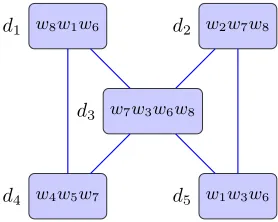
5.1 An example of three components in academic papers. Panel (a) shows
an example of academic papers. Five papers connected by citation links.
{d1, d2, ..., d5} are papers; {w1, w2, ..., w8} are corpus in the papers. Papers
contain words and connect to others by citation links. Panel (b) shows
train-ing samples retrieved from three components. . . 113
5.2 P2V as Neural Networks. Panel (a) (b) and (c) illustrate the learning
pro-cedure of sample (w3, w8), (d3, w3), and (d3, d5) respectively. The training
samples are derived from Figure 5.1. . . 116
5.3 Norm convergence issue on Cora dataset. Panel (a) shows the performance
of embeddings during the training. Panel(b) shows the mean of vectors’ L2
norms in each group. Each group contains 25 samples. 100 samples in total. 117
5.4 Norm and performance with L2 regularization on Cora. The plots are
gen-erated under the same strategy as Figure 5.3. . . 120
5.5 The structure of LDE. Panel (a) is LDE-doc and Panel (b) shows LDE-link. 121
5.6 An example of vector concatenation. . . 123
5.7 An example of retrofitting. Papers connect to each other through links. Each
paperdi is associated with its document embeddings ˆvi retrieved from D2V
and a paper embedding vi. In this example, we learn the paper embedding
the overall performance. Panel (b) compares D2V with LDE-Doc,
PV-DBOW, and PV-DM. Panel (c) illustrates the effect of weight in D2V models.127
5.9 2D plot of Cora for text-only task. The dimension of embeddings is reduced
from 100 to 2 by t-SNE. . . 129
5.10 Performance on Link only task corresponding to Table 5.6. Panel (a) shows the overall performance of each method. Panel (b) compares the N2V with random walk based methods. Panel (c) compares the performance between N2V and random edge based methods. . . 131
5.11 2D plot of network embeddings on Cora. The dimension of embeddings are reduced from 100 to 2 by t-SNE. . . 132
5.12 Performance on Linked Text task corresponding to Table 5.8. Panel (a) shows the overall performance. Panel (b) compares P2V with LDE, Retrofitting and Concatenation methods. Panel (c) illustrates the effect of weight in P2V. . 134
5.13 2D plots of paper embeddings on Cora. The dimension of embeddings are reduced from 100 to 2 by t-SNE. . . 135
5.14 An example of mis-classified papers in AminerV10. Embeddings are gener-ated by D2V, N2V, Concatenation and P2V. We use t-SNE to reduce 100 dimensional embeddings into 2 dimension. The orange dots represent pa-pers published in ICSE. Blue dots are VLDB papa-pers. Red and blue dots are papers misclassified by D2V and Concatenation. . . 137
5.15 Impact ofα,β, and γ on Cora. . . 137
5.16 Impact ofα,β, and γ on arXiv title. . . 138
5.17 Normalized Mutual Information of the paper clustering task. . . 140
5.18 Nine papers retrieved from P2V and LDE. The dimension of vectors is reduce from 100 to 2 via PCA. Nine papers are split into four groups manually according to the research topic. Each color represents a group of papers. . 143
5 papers and 8 authors. Panel(b), (c), and (d) are the corresponding APN,
ACN, and ACCN, respectively. . . 147
6.2 Performance of classification on different networks. . . 150
6.3 2D plot of ACM Fellows. . . 152
6.4 NMI of clustering for 60 Turing Award Winners. . . 153
6.5 Dendrogram and the corresponding heatmaps for 60 Turing Award Winners. 154 6.6 2D plot of Nobel Prize Winners. We use t-SNE to reduce the dimension of embeddings from 100 to 2. . . 155
6.7 A screenshot of Similar Author Search Engine . . . 156
6.8 F1 scores of author name disambiguation. . . 159
6.9 A screenshot of Similarity Search Engine. It shows the most similar papers to [Mikolov et al., 2013b] retrieved by P2V. The paper introduces “word2vec” algorithm . User can also search similar papers by D2V and N2V for com-parison. . . 161
6.10 The precision atk on GIST dataset. . . 162
6.11 Comparison with Google Scholar and Semantic Scholar. . . 163
6.12 Paper influence prediction workflow. Blue data represents the snapshot of 2015, green data represents the snapshot of 2016, and red is the snapshot of 2017. . . 165
Introduction
Academic papers contain rich information and attract increasing attention from industry
and academia. The size of academic papers is large in real-world, making it challenging to
study and analyze. In the past few years, embeddings techniques become a popular method
to represent different types of data such as words [Mikolov et al., 2013b, Pennington et al.,
2014], documents [Le and Mikolov, 2014] and networks [Perozzi et al., 2014, Tang et al.,
2015b, Grover and Leskovec, 2016]. It has been proven effective for many downstream tasks
such as classification [Zhou et al., 2016], clustering [Viegas et al., 2019] etc. This dissertation
focuses on how to learn high quality embeddings from academic papers. This chapter first
gives an overview of the research topic in this dissertation. It outlines the main challenges in
learning embeddings for academic papers. Then, the main contributions of this dissertation
are summarized and the structure of the remaining chapters will be introduced.
1.1
Introduction
Scientific publications, especially academic papers, have become crucial resources in both
academia and industry. In addition to text content, academic papers also link to each
other via citation links. Meanwhile, there are other entities in a paper, such as keyword(s),
author(s), institution(s), publication year, and venue etc. Figure 1.1 shows a screenshot of
a paper. There are multiple entities on the first page as shown in Panel (a). After the main
content, including text, figures, and tables, the paper cites existing works as illustrated in
Panel (b). Thus, academic papers are more complex than pure documents with plain text
(a) First page. (b) Last page.
FIGURE 1.1: A screenshot of an academic paper. The first page in Panel (a) has multiple entities marked in different colors. Here authors are yellow, institutions are blue, keywords are red, venue is purple and publication year is green. This paper also links to other related papers via citation links as illustrated in Panel (b).
The complex structure of academic papers contains rich information. By studying
aca-demic papers, we can develop tools such as search engine to help scientists improve the
quality and productivity of their academic research. In fact, the industry has developed
services such as Google Scholar1 and Semantic Scholar2. Measuring the similarity between
authors and papers can also be very useful. By checking the similarity between authors,
we can design a search engine to help researchers find potential collaborators in the same
research field. The similar paper search engine can also be used to help researchers search
related works. Meanwhile, we can predict the influential researches by mining the scholarly
data, which can be used to help institutions and governments to follow the trend of the
science and technology and allocate the research fundings.
There are substantial works [Yang et al., 2018, M¨uller, 2017] using machine learning
techniques to extracting information from academic papers. Unlike humans, computers can
not understand the words, authors, or citations naturally. Therefore, we need to represent
the text and links in a way that computers can understand, which are vectors. This
dure is commonly known as data representation [Goodfellow et al., 2016]. Taking words as
an example, word representation is traditionally dealt with bag of words model [Manning
et al., 2010]. The bag of words model treats every word independently so that the similarity
between every two words are the same. Suppose we have three words ‘cat’, ‘dog’, and
‘com-puter’ in the vocabulary. The bag of words model uses binary vector to represent them. Let
the vector representations for them be (1,0,0), (0,1,0), and (0,0,1), respectively. Then for
any two words, the Euclidean distance between their representations is √2 and the cosine
similarity is 0. In natural language, words have semantic meanings. Thus, we can improve
the performance of Neural Language Models (NLM) by giving similar words similar
rep-resentations. It can be done by learning word embeddings using word2vec [Mikolov et al.,
2013b] algorithms. Different from the long sparse vectors, embeddings are short dense
vec-tors. They can be obtained by applying dimensionality reduction algorithms on the sparse
vectors [Yang et al., 2015, Zhang et al., 2016], or learned by embedding algorithms such as
word2vec [Mikolov et al., 2013b] for words, Paragraph Vector [Le and Mikolov, 2014] for
documents, or DeepWalk for networks [Perozzi et al., 2014].
1.2
Challenges
Representing academic papers is challenging. One issue is the large size of scholarly data.
It was estimated that there are hundreds of millions of academic papers [Khabsa and Giles,
2014], and at least 6,000 more are added to the stack everyday [Gibney, 2014]. As of the
end of 2018, ArnetMiner [Tang et al., 2008] contains 2.7 million papers in the domain of
Computer Science with 25 million citations. There are 46 million papers and 528 million
citation links in MAG (Microsoft Academic Graph) [Sinha et al., 2015]. The Health data,
which are provided by our industry parter 3, have 46 million papers, 13 million authors,
and 479 million citation links. Traditional methods are often computational expensive and
can not scale to large datasets. Therefore, an efficient method is needed to represent such
data.
The second challenge is that academic papers are complicated. They contain not only
plain text, such as titles and abstracts, but also link to each other through citations.
Repre-senting text has been widely studied in the past. Traditional techniques, such as n-grams and
Term Frequency-Inverse Document Frequency (TF-IDF) [Rajaraman and Ullman, 2011],
are widely used. However, these methods suffer from the high dimensionality problem. To
reduce the dimension of these representations, researchers have proposed various models,
such as Latent Dirichlet Allocation (LDA) [Blei et al., 2003] and Latent Semantic Analysis
(LSA) [Dumais, 2005]. However, these methods are computationally expensive [Cai et al.,
2008] and can not scale to large datasets. In 2013, Mikolov et al. [2013b] proposed skip-gram
with negative sampling model (hereafter SGNS) that can efficiently learn high-quality word
embeddings from a large corpus. It has the state-of-the-art performance and inspires many
algorithms to learn embeddings from different types of data. Le and Mikolov [2014] extend
word2vecto learn document embeddings and propose Paragraph Vector (PV). Meanwhile,
researchers apply different sampling strategies on SGNS to learn node representations from
networks, such as DeepWalk [Perozzi et al., 2014], LINE [Tang et al., 2015b], andnode2vec
[Grover and Leskovec, 2016].
Academic papers are more complicated than plain text or networks. Utilizing link
infor-mation in document representation has been studied in several ways. A naive method is to
train document embeddings from text and network embeddings from links independently,
then concatenate them together. Yang et al. [2015] propose Text-Associated DeepWalk
(TADW) that generates paper embeddings by factorizing the DeepWalk matrix with
TF-IDF matrix. Another approach treats texts and links equally by forming the data into a
heterogeneous network, then applies network embedding algorithms to retrieve the paper
embeddings [Wang et al., 2018, Ganguly and Pudi, 2017]. In 2016, Wang et al. [2016b]
propose LDE, a supervised model that can learn the embeddings from labeled linked
docu-ments. They split the data into three components and design the objective function for each
component. Then they optimize these multiple objectives together to get the embeddings
for labeled linked documents.
1.3
Contributions
This dissertation aims to learn high quality embeddings from academic papers. We
sum-marize our main contributions from five aspects:
• Norm convergence issue of SGNS: SGNS is the state-of-the-art word embedding
from different types of data such as networks [Perozzi et al., 2014, Tang et al., 2015b,
Grover and Leskovec, 2016], documents. We observed that the performance of SGNS
based network embedding algorithms degenerates over iteration. By monitoring the
training process of SGNS based network embedding algorithms, we show that SGNS
and its variants suffer from the norm convergence issue. This problem can be fixed
by adding a L2 regularization. We also verify our method on words and documents.
• Fast implementation for SGNS-based models: Our proposed methods are built
on top of SGNS. We re-implement the SGSN model from scratch using Python, Cython
and Basic Linear Algebra Subprograms (BLAS). Our implementation is optimized
for modern CPUs and is faster than most existing implementations [Mikolov et al.,
2013b, ˇReh˚uˇrek and Sojka, 2010, Ji et al., 2019]. The source code is available on
our webpagehttp://zhang18f.myweb.cs.uwindsor.ca/p2v.
• Network Embeddings: Most of the data in real-world are in the form of networks.
Thus, network embeddings algorithms are also covered in this dissertation. We
de-signed an author paper network (APN) to learn the embeddings for authors. Existing
methods are designed for undirected graphs. This dissertation addresses the problems
and solutions for directed graphs. We also propose a new network embedding
algo-rithm called N2V (network2vector). Experiment shows that N2V improves existing
methods and has state-of-the-art performance in many tasks.
• Document Embeddings: PV-DBOW (Paragraph Vector – Distributed
Bag-of-words) [Le and Mikolov, 2014] is one of the most widely used document embedding
algorithm. However, it does not capture word semantics directly in the training
pro-cess. Existing work suggests using pre-trained SGNS model can improve the quality
of document embeddings. We propose a novel method called D2V (document2vector)
to improve PV-DBOW with word semantics. In D2V, the word semantic relations
and document embeddings are learned simultaneously. The weights of words are
con-trolled by a hyper-parameter to suit different datasets. Experimental results show
that D2V can improve PV-DBOW on the classification task. We also show that word
meanings have different impacts on different types of datasets by examining the weight
• Paper Embeddings: There is limited research on learning the representation of linked documents such as academic papers. In this dissertation, we propose a new
neural network based algorithm, called P2V (paper2vector), to learn high-quality
embeddings for academic papers on large-scale datasets. We compare our model with
traditional non-neural network based algorithms and state-of-the-art neural network
methods on datasets of various sizes. The largest dataset we used contains 46.64
million papers and 528.68 million citation links. Experimental results show that P2V
achieves state-of-the-art performance in many tasks such as paper classification, paper
similarity, and paper influence prediction task.
• Applications: Academic papers contains rich information. In this dissertation, we
build four applications using embeddings techniques. We first propose author paper
network to learn embeddings for authors. Then we build a website to search similar
authors in Computer Science, where scientists can use our website to find the
poten-tial collaborators. The second application we build is a paper search engine for the
domain of Computer Science. Our search engine can find the most similar papers
in term of content and citations. Experimental results suggest our search engine has
higher accuracy than existing services such as Google Scholar and Semantic Scholar.
Embeddings generated from academic papers can be used as the input of subsequence
tasks. Therefore, we demonstrate how to use paper embeddings to solve real-world
problem such as author name disambiguation and paper influence prediction.
1.4
The structure of the dissertation
The rest of this dissertation is organized as follows. We first review the existing literature
in Chapter 2. It covers the related works and background knowledge from four aspects. 1)
Word embeddings. 2) Document embeddings. 3) Network embeddings. 4) Linked document
embeddings. Our proposed methods are based on SGNS model. Hence, we also introduce
the implementation details of SGNS.
Chapter 3 first proposes ShortWalk that improves DeepWalk in directed graphs. Then
it addresses the norm convergence issue in SGNS, which can be fixed by L2
regulariza-tion. Furthermore, it presents a new method N2V for network embeddings. Extensive
After that, we present a new document embedding method D2V in Chapter 4. Our D2V
improves PV-DBOW with word semantics and achieves the state-of-the-art performance in
most datasets.
The focus of this dissertation is learning embeddings for academic papers. In Chapter
5, we present P2V by combining D2V and N2V. We validate our model on seven datasets
with various sizes, where the largest one contains 46.6 million papers. Four applications are
proposed and discussed in Chapter 6, including author search engine, similar paper search
engine, author name disambiguation, and paper influence prediction. The conclusions of
Background and Related Works
This chapter discusses the background knowledge of embeddings. We first start with word
embeddings in Section 2.1. Then we introduce document embedding algorithms in Section
2.2. Section 2.3 and Section 2.4 review existing works for network and linked document
embeddings. The summary is in Section 2.5. Before going into the details, we summary
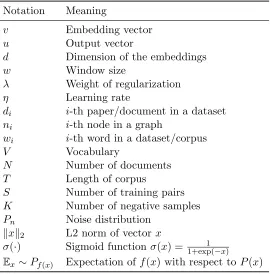
the notations used throughout this dissertation in Table 2.1.
2.1
Word embeddings
Representing words has been studied for many years. The most straightforward method
is to encode a word into a one-hot vector, where 1 indicates the index of the word in the
vocabulary. This method treats every word equally but ignores the relation between words.
However, word has semantic meanings which computers can not understand naturally. In
1996, Lund and Burgess [1996] found that the context of a word can reflect its semantic
meaning. Therefore, they propose to use the word-context co-occurrence matrix to represent
words. Recently, Mikolov et al. [2013b] propose word2vec that can learn word embeddings
from a large corpus. They capture the word-context co-occurrence information via a sliding
window where the closer context will have more weight than the further ones. Word2vec
learns the embeddings via a shallow neural network. It has two models – Continuous
Bag-of-Words Model (CBOW) and Skip-gram with negative sampling Model (SGNS). CBOW
takes the average of context words representations to predict the center word, while SGNS
takes the embedding of a word to predict its context. The experiments show that word2vec
TABLE 2.1: Summary of the notations.
Notation Meaning
v Embedding vector
u Output vector
d Dimension of the embeddings
w Window size
λ Weight of regularization
η Learning rate
di i-th paper/document in a dataset
ni i-th node in a graph
wi i-th word in a dataset/corpus
V Vocabulary
N Number of documents
T Length of corpus
S Number of training pairs
K Number of negative samples
Pn Noise distribution
kxk2 L2 norm of vectorx
σ(·) Sigmoid function σ(x) =1+exp(1 −x)
Ex∼Pf(x) Expectation of f(x) with respect toP(x)
from word2vec, Pennington et al. [2014] propose Global Vectors for Word Representation
(GloVe), which generates word embeddings by factorizing the word-word co-occurrence
matrix. These works are proved as a variant of factorization over a specific matrix [Levy
and Goldberg, 2014], i.e., SGNS is implicitly factorizing a shifted weighted Pointwise Mutual
Information matrix (PMI), and GloVe is factorizing the biased word-context co-occurrence
count matrix. Experiments [Baroni et al., 2014, Levy et al., 2015] show that the
predict-based models such as SGNS are superior to the count-predict-based model (GloVe).
2.1.1 Co-occurrence matrix
Word co-occurrence has been widely applied for capturing the word semantic meanings in
word representation. The simplest way is to use the raw count of the word co-occurrence.
Figure 2.1 and Table 2.2 show an example. Suppose we have a corpus that consists a set
of words in a specific order {w1, w2, w3, w4, w5, w6, w7, w8, w9}, when the window size is 5,
we move the window from left to right over the corpus. The window captures five words
at each time. For every pair of the words occurred in that window, we add the count for
w
1w
2w
3w
4w
5w
6w
7w
8w
9position=1
w
1w2w
3w
4w
5w
6w7w
8w
9position=2
w
1w
2w
3w
4w
5w
6w
7w
8w
9position=3
w
1w
2w
3w4w
5w
6w
7w
8w9position=4
w
1w
2w
3w
4w
5w
6w
7w
8w
9 position=5FIGURE 2.1: An example of a basic sliding window when capturing word-context co-occurrence information. The corpus is a set of words in a specific order. Suppose window
sizeC= 5, the window moves from left to right and captures 5 words at each time. Every
two words appeare in that window count as one occurrence. We can record the co-occurrence count in a matrix listed in Table 2.2.
c1 c2 c3 c4 c5 c6 c7 c8 c9
w1 0 1 1 1 1 0 0 0 0
w2 1 0 2 2 2 1 0 0 0
w3 1 2 0 3 3 2 1 0 0
w4 1 2 3 0 4 3 2 1 0
w5 1 2 3 4 0 4 3 2 1
w6 0 1 2 3 4 0 3 2 1
w7 0 0 1 2 3 3 0 2 1
w8 0 0 0 1 2 2 2 0 1
w9 0 0 0 0 1 1 1 1 0
TABLE 2.2: The word-context co-occurrence matrix retrieved from Figure 2.1. Row i
denotes word wi and columnj is context cj. Each entry Mi,j is the co-occurrence between
wordwi and contextcj, which is the count ofwi andcj appears in the same sliding window.
each row i corresponds to word wi and each column j represent a context cj. When the
window reaches to the end of the corpus, we will have a word-context co-occurrence matrix
M. Each entryMi,j is the frequency ofwi andcj appears in the sliding window.
This method and its variants are widely applied to capture the word semantic meanings.
For example, in Hyperspace Analogue to Language (HAL) [Lund and Burgess, 1996], the
authors move a sliding window on the corpus and calculate the weighted count of each word
pair presented in that window. They test the similarities between the word representations
by analyzing the nearest neighbors of a set of words. They also visualize the embeddings
and demonstrate the words categories. However, HAL uses the raw count of the words in
the co-occurrence matrix so that the weight of the words is generally large. COALS [Rohde
et al., 2006] further improves HAL by replacing the raw count with Pearson’s correlation
test COALS on 17 datasets and observed significant improvement (overall 148.92%) over
HAL.
The existing works give us a good overview of the effectiveness of word co-occurrence
matrix [Lund and Burgess, 1996, Jarmasz and Szpakowicz, 2004, Rohde et al., 2006]. Yet,
the efficiency of generating such representation remains an issue. In a real-world dataset,
the corpus is usually large, resulting to a large vocabulary. In the co-occurrence matrix, each
row represents a word in that vocabulary. Therefore, the size of the co-occurrence matrix
will be huge. Despite the matrix is sparse, building such a matrix is still computationally
expensive. The dimension of the word representation is also large, making it hard to apply to
downstream applications such as classification, clustering, recommendation etc. Therefore,
it is common to see researchers such as Rohde et al. [2006] to apply dimensional reduction
techniques such as SVD (Singular Value Decomposition) [Manning et al., 2010] to transform
the long sparse representation into short dense vectors – embeddings.
2.1.2 Word2vec
Word2vec is a set of models proposed by Mikolov et al. [2013b]. It has two models –
Contin-ues Bag-of-words (CBOW) and Skip-Gram with Negative Sampling (SGNS). Embeddings
generated by word2vec have many advantages compared to traditional methods [Mikolov
et al., 2013a] and can easily scale to large corpus with billions of words. These algorithms
take a large corpus as input and produces dense d-dimensional vectors where each word is
assigned to a unique vector in that vector space. The similarity between two words can be
measured by cosine similarity defined as
similarity(A,B) = A·B
kAkkBk =
n P i=1
AiBi
s n P i=1
A2
i s
n P i=1
B2
i
, (2.1)
whereAi and Bi are elements of n-dimensional vectorsA and B. In word2vec, the spatial
distance between two embeddings corresponds to the word similarity. For example, the
similarity between embeddings of Canada and China is larger than the similarity between
embeddings of Canada and cheese. Moreover, the displacement between two words
rep-resents the word relationship. For example, the distance between Canada and China is
w
1w
2w
3w
4w
5w
6w
7w
8w
9iteration=1,c=randint(C)=2
w
1w
2w
3w
4w
5w
6w
7w
8w
9iteration=2,c=randint(C)=3
w
1w
2w
3w
4w
5w
6w
7w
8w
9iteration=3,c=randint(C)=1
w
1w
2w
3w
4w
5w
6w
7w
8w
9iteration=4,c=randint(C)=4
FIGURE 2.2: An example of skip-gram window in word2vec. The corpus is a set of words
in a specific order. Let C = 4 be the window size, w5 be the center word, which is the
target word we want to learn the embedding for in this example. Function randint(C)
returns a random integer in a range of (0, C). In each iteration, we generate a window size
c = randint(C) and collect the (word,context) pairs within the window. For example, in
the third iteration, c is 1, we take 1 neighbor left and right to the center word w5. The
(word,context) pairs generated in this step is (w5, c4),(w5, c6).
w1 w2 w3 w4 w5 w6 w7 w8 w9
w5 1 2 3 4 0 4 3 2 1
TABLE 2.3: The word-context co-occurrence for w5 retrieved from Figure 2.2.
the words. For instance, when knowing the capital of China is Beijing, we can infer the
capital of Canada by calculating the most similar word embeddings to Beijing - China +
Canada.
Skip-gram window
The semantic meaning of a word relates to its neighbors in the corpus, also known as
context. Context with further distance is usually less related to the current word. Based on
this assumption, word2vec captures the word-context co-occurrence using a sliding window
c, wherecis a random integer in a range of (0, C) [Mikolov et al., 2013a]. Figure 2.2 shows an
example of this process. Suppose we have a corpus {w1, w2, w3, w4, w5, w6, w7, w8, w9} and
the window sizeCis 5, our goal is to capture the context for wordw5. In the first iteration,
the skip-gram window size c is 2, so we take two context left tow5, and two context right
tow5. The window size is generated randomly in each iteration. After four iterations, the
word-context co-occurrence information for w5 is (1,2,3,4,0,4,3,2,1) as shown in Table
w
1w
2w
3w
4w
5w
6w
7w
8w
9(a) Capture context for wordw5.
w
5, w
3, w
4, w
6, w
7(b) Training sample derived from (a).
Input Layer
Hidden Layer
Output Layer
w1 0
w2 0
w3 1
w4 1
w5 0
w6 1
w7 1
w8 0
w9 0
h1
h2
hd
...
w1 0.10 0
w2 0.05 0
w3 0.11 0
w4 0.20 0
w5 0.95 1
w6 0.24 0
w7 0.14 0
w8 0.05 0
w9 0.20 0
predict
label labeltrue
error Back Propagation
(c) Training procedure.
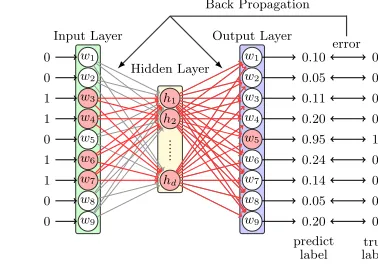
FIGURE 2.3: CBOW as Neural Network with one hidden layer.
Continues Bag-of-words (CBOW)
The first model proposed in word2vec is Continues Bag-of-words, also known as CBOW.
Given a corpus, the context of a word provides the information that defines the semantic
meaning of this word. For example, in the sentence “a cat sits on the mat”, the semantic
meaning of “sit” is defined by its context “a, cat, on, the, mat”. Based on this assumption,
word2vec learns embeddings by using the average/summation of the context representations
to predict the missing word. The authors name this model as Continues Bag-of-words, also
known as CBOW. Figure 2.3 shows an example. For each word in the corpus, w5 for
ex-ample, CBOW uses skip-gram window to capture the context (w3, w4, w6, w7) as illustrated
in Panel (a). Then it generates the training sample as shown in Panel (b). CBOW can be
explained as a shallow neural network with one hidden layer as illustrated in Panel (c). It
averages or sums the contexts’ embeddings into the hidden layer. In our example, the
in-put is (0,0,1,1,0,1,1,0,0), which sums the embeddings of context (w3, w4, w6, w7) into the
hidden layer. Then the model predicts the missing wordw5 with softmax function. For
ex-ample, the predict label from output layer is (0.10,0.05,0.11,0.2,0.95,0.24,0.14,0.05,0.20),
where each element is the probability of the corresponding word as the output. We can
see that there is an error between the predicted label and true label. Then we update
Neural Network weights using this error via back propagation algorithm. After optimizing
w1 0
w2 0
w3 0
w4 0
w5 1
.... w9
0
(a) Softmax
θ1
θ2
θ3
w2
w4 w6 w5 w3
w1 w9 w7 w8
(b) Hierarchical Softmax
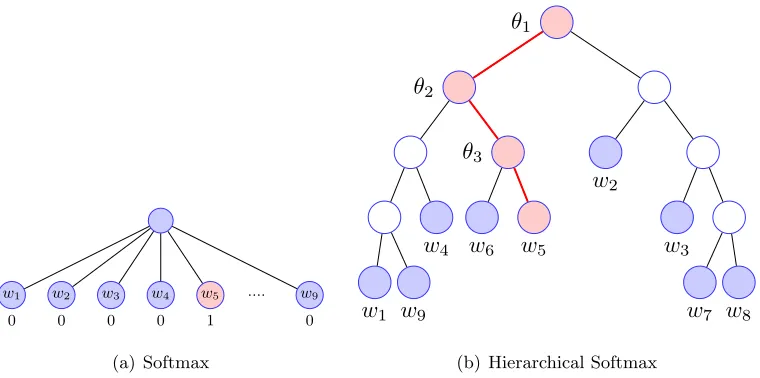
FIGURE 2.4: Comparison between Softmax and Hierarchical Softmax. Panel (a) illustrates the multi-class classification using Softmax. Panel (b) shows the Hierarchical Softmax. It solves the multi-class classification problem via multiple binary classifiers where labels are
the binary code of the target on the Huffman tree. In this example, w5 is the target word
and the corresponding binary code on the Huffman tree is (1,0,0).
embeddings. More formally, the objective function of CBOW is
O =1
T T X
i=1
logp(wi|wi−c, ..., wi+c), (2.2)
whereT is the length of the corpus,cis the window size,p(wj|wi−c, ..., wi+c) is the
probabil-ity of giving the average/summation of a set of words (wi−c, ..., wi+c) that observes context
wi. It is defined by the softmax function:
p(u|v) = PVexp(u·v)
n=1exp(u·v)
, (2.3)
where V is the size of the vocabulary. v is the embedding of the input word and u is the
output vector of the context.
However, calculating the softmax function directly is not practical due to the large
vocabulary size V. For example, the smallest dataset we have is Text81 [Mahoney, 2011].
The corpus size is 17,005,207 and the vocabulary size is 253,854. Such a small dataset
will generate about 17 million training samples. Applying softmax function will need to
calculate exp(u·v) 17,005,207×253,854 = 4.3×10¹² times per iteration. To reduce
1
w
1w
2w
3w
4w
5w
6w
7w
8w
9(a) Capture context for wordw5.
w5, w3
w5, w4
w5, w6
w5, w7
(b) Training sample derived from (a).
Input Layer
Hidden Layer
Output Layer
w1
0
w2
0
w3
0
w4
0
w5
1
w6
0
w7
0
w8
0
w9
0
h1
h2
hd
...
w1 0.10 0
w2 0.05 0
w3 0.11 0
w4 0.95 1
w5 0.21 0
w6 0.24 0
w7 0.14 0
w8 0.05 0
w9 0.20 0
predict
label labeltrue
error Back Propagation
(c) Training procedure.
FIGURE 2.5: SGNS as Neural Network with one hidden layer.
the computation time, the authors use Hierarchical Softmax (HS) proposed by Mnih and
Hinton [2009] to replace softmax. More specifically, the output layer in Figure 2.3 Panel(c)
is replaced as a binary Huffman tree. The tree is built based on the word frequency, where
each leaf represents a word. In this binary Huffman tree, the more frequent a word is, the
faster we can reach it. Then, we can convert the multi-class classification problem into a
multiple binary classification problem where the output is the binary code of the target as
demonstrated in Figure 2.4. In this example, we use vectorvto predictw5. Panel (a) treats
this procedure as a multi-class classification problem that has nine outputs, wherew5 is 1
and others are 0. In Panel (b), HS treats it as three binary classification problems. The
expected outputs are (1,0,0), which are the Huffman binary code from root to w5. More
specifically, HS trains three binary classifiers. Each classifier has its own parameters. For
example, the root classifier has parameter θ1 and the expected output is 1. The second
classifier has parameterθ2and the expected output is 0. HS reduces the time complexity of
Softmax function exponentially – fromO(n) toO(log2n). The difference is more significant
in NLP tasks where the vocabulary size is usually large.
Skip-gram with Negative Sampling (SGNS)
Another model proposed in word2vec is Skip-gram with Negative Sampling, also known as
SGNS. It has the state-of-the-art performance [Baroni et al., 2014]. It first captures the
word-co-occurrence information as word-context pairs. Figure 2.5 is an example. Panel
w1
0
w2
0
w3
0
w4
1
w5
0
.... w9
0
(a) Softmax
w1
0
w2 w3
0
w4
1
w5 .... w9
(b) Negative Sampling
FIGURE 2.6: Comparison between Softmax and Negative Sampling. Panel (a) illustrates the multi-class classification using Softmax. Panel (b) shows the Negative Sampling in which the negative samples are retrieved randomly via noise distribution.
we first capture the context for w5 with skip-gram window introduced in Section 2.1.2.
The corresponding training samples are [(w5, w3),(w5, w4),(w5, w6),(w5, w7)]. Panel (c)
shows the training process. For training sample (w5, w4), we take the embedding of w5
to predict the context representation of w4. More formally, given a sequence of training
corpus{w1, w2, ..., wT}, the objective function is maximizing the average log probability of
all observed (word,context) pairs:
O= 1
S T X
i=1
X
−c≤j≤c,j6=0
logp(wi+j|wi), (2.4)
where S is the total number of observed training pairs, T is the length of the corpus, c is
the window size. p(wj|wi) is the probability of giving a word wi that observes context wj,
which is defined using softmax function:
p(wj|wi) = PVexp(uwj·vwi)
n=1exp(uwn·vwi)
. (2.5)
Herewj is the context andwi is the word,vwi is the vector representation ofwi and uwj is
the vector representation of contextwj,V is the size of the vocabulary.
To reduce the computation time, the authors propose Negative Sampling (NS) to replace
the softmax function. Instead of calculating over the entire vocabulary, NS drawsknegative
samples according to a noise distribution Pn. Figure 2.6 shows a comparison between
Softmax and NS. Panel (a) is the softmax multi-class classification. It takes one vector as
the input and produces multiple output values. Each value represents the probability of the
input, NS in Panel (b) has only one output. Additional to the true labelw5 provided in the
training sample, NS also drawsknegative samples via a noise distributionPn, which arew1
andw3 in this example. Then the model can learn from these negative samples by treating
them as false labels. Intuitively, NS simplifies the multi-class classification problem into a
binary classification problem on a small sample. It uses the embedding of the observed word
to distinguish the observed context (true) and knegative samples (false) drawn according
the noise distribution Pn. The authors choose the word frequency raises to 34 as the noise
distribution:
Pn(w) = U(w)
3/4
Z (2.6)
whereU(w) denotes unigram distribution of wordw,Z =P
w∈V U(w)3/4 denotes the
nor-malization term. This noise distribution reduces the possibility of choosing a frequent word
as the negative sample, and is used in most related works and implementations [Mikolov
et al., 2013a,b, ˇReh˚uˇrek and Sojka, 2010]. Therefore, the local objective function for an
observed training pair (wi, wj) is:
logσ(uwj ·vwi) +
K X
k=1
Ewk∼Pnlogσ(−uwk ·vwi). (2.7)
Here,σ(x) = 1+exp(1 −x) is the sigmoid function. K is the number of negative samples. v is
the embedding vector and u is the context vector.
Existing works use Stochastic Gradient Descent (SGD) to optimize the local objective
function for each observed training pair [Mikolov et al., 2013b]. The gradient is calculated by
Back propagation, which is commonly used by the gradient descent optimization algorithm
to adjust the weight by calculating the gradient of the loss function [Goodfellow et al., 2016].
Given a specific training pair (wi, wj), the derivative of Eq 2.7 regarding to the word vector
vwi is:
∂O(wi, wj)
∂wi
=∂{logσ(uwj·vwi) +
PK
k=1Ewk∼Pn[logσ(−uwk·vwi)]}
∂vwi
=∂logσ(uwj ·vwi)
∂vwi
+
K X
k=1
Ewk∼Pn
∂logσ(−uwk ·vwi)
∂vwi
It can be rewritten into
∂O(wi, wj)
∂wi
=∂logσ(uwj·vwi)
∂σ(uwj·vwi)
·∂σ∂u(uwj·vwi)
wj·vwi
·∂uw∂vj·vwi
wi
+
K X
k=1
Ewk∼Pn
∂logσ(−uwk·vwi)
∂σ(−uwk·vwi) ·
∂σ(−uwk·vwi)
∂−uwk·vwi ·
∂−uwk·vwi
∂vwi
(2.9)
Since ∂log(∂xx) = x1, ∂σ∂x(x) =σ(x)·(1−σ(x)), and ∂a∂x·x =a, the above formula falls into
∂O(wi, wj)
∂wi
= 1
σ(uwj·vwi)
·σ(uwj ·vwi)(1−σ(uwj·vwi))·uwj
+
K X
k=1
Ewk∼F req(u)
1
σ(−uwk·vwi)
·σ(−uwk·vwi)(1−σ(−uwk·vwi))· −uwk
(2.10)
We can simplify it into
∂O(wi, wj)
∂wi
=(1−σ(uwj ·vwi))·uwj +
K X
k=1
Ewk∼Pn−(1−σ(−uwk·vwi))·uwk
=(1−σ(uwj ·vwi))·uwj +
K X
k=1
Ewk∼Pn−(1−(1−σ(uwk·vwi)))·uwk
=(1−σ(uwj ·vwi))·uwj +
K X
k=1
Ewk∼Pn−σ(uwk ·vwi)·uwk
(2.11)
Similarly, for a specific observed pair (wi, wj), the derivative of Eq2.7 regarding to the
context word wj is:
∂O(wi, wj)
∂wj
=∂{logσ(uwj·vwi) +
PK
k=1Ewk∼Pn(w)[logσ(−uwk·vwi)]}
∂uwi
=∂logσ(uwj·vwi)
∂uwj
=∂logσ(uwj·vwi)
∂σ(uwj ·vwi)
·∂σ(uwj·vwi)
∂uwj·vwi
·∂uwj·vwi
∂uwj
= 1
σ(uwj·vwi)
·σ(uwj·vwi)(1−σ(uwj·vwi))·vwi
=(1−σ(uwj ·vwi))·vwi
For a specific observed pair (wi, wj), the derivative of Eq2.7 regarding a negative sampling
context word wk is:
∂O(wi, wj)
∂wk
=∂{logσ(uwj·vwi) +
PK
k=1Ewk∼Pn(w)[logσ(−uwk·vwi)]}
∂uwk
=∂logσ(−uwk ·vwi)
∂uwk
=∂logσ(−uwk ·vwi)
∂σ(−uwk·vwi)
·∂σ(−uwk ·vwi)
∂−uwk·vwi
·∂−uwk·vwi
∂uwk
= 1
σ(−uwk·vwi) ·σ(−uwk·vwi)(1−σ(−uwk·vwi))· −vwi
=(1−(1−σ(uwk·vwi)))· −vwi
=−σ(uwk·vwi)·vwi
(2.13)
Moreover, we can summarize the derivative of context wj and negative samplewk into
(t−σ(uwj·vwi))·vwi (2.14)
wheret= 1 whenwj is a context andt= 0 whenwj is a negative sample. Thus, the update
equations for SGNS model are:
vwi ←vwi+η[(1−σ(uwj·vwi))·uwj+
K X
k=1
Ewk∼Pn−σ(uwk·vwi)·uwk]
uwj ←uwj +η[t−σ(uwj·vwi)·vwi],
(2.15)
where t = 1 when wj is a context word, and t = 0 when wj is a negative sample. η is
the learning rate, which decays linearly from 0.025 to 0.0001 in most related works and
implementations [ ˇReh˚uˇrek and Sojka, 2010, Mikolov et al., 2013b, Tang et al., 2015b,
Goyal and Ferrara, 2018].
In theory, Levy and Goldberg [2014] proved SGNS implicitly factorizes a weighted shifted
word-context PMI (Pointwise Mutual Information) matrix M. In this matrix, row i
cor-responds to word wi and column j corresponds to context cj. Each entry of Mi,j is the
Pointwise word-context co-occurrence log P(wi,cj)
of an item, then we have:
#(w) = X
c∈Vc
#(w, c)
#(c) = X
w∈Vw
#(w, c)
(2.16)
We first begin with rewriting SGNS into:
X
w∈Vw
X
c∈Vc
#(w, c) [logσ(w~·~c) +k·EcN∼Pnlogσ(−w~·~cN)]
= X
w∈Vw
X
c∈Vc
#(w, c) logσ(w~ ·~c) + X
w∈Vw X
c∈Vc
#(w, c) [k·EcN∼Pnlogσ(−w~ ·~cN)]
(2.17)
w is word, c is context, w~ and ~c is the corresponding vector representation, Vw and Vc is
the word context vocabulary respectively
According to Eq 2.16, it equals to:
X
w∈Vw X
c∈Vc
#(w, c) logσ(w~·~c) + X
w∈Vw
#(w) [k·EcN∼Pnlogσ(−w~ ·~cN)] (2.18)
When using unigram distribution as the noise distribution, we can write the negative
sampling part into
EcN∼Pnlogσ(−w~·~cN)
= X
cN∈Vc
#(cN)
T logσ(−w~·~cN)
=#(c)
T logσ(−w~·~c) +
X
cN∈Vc\{c}
#(cN)
T logσ(−w~·~cN)
(2.19)
here T is the size of corpus. Combining Eq 2.18 and 2.19, then the local objective for a
specific (w, c) pair is
#(w, c)·logσ(w~·~c) +k·#(w)·#(c)
To optimize the objective, we definex= (w~ ·~c) and take the derivative of Eq 2.20
#(w, c)·σ(−x)−k·#(w)·#(c)
T ·σ(x) (2.21)
Let the derivative equals to zero, we will have
e2x− #(w, c)
k·#(w)·#(Tc) −1
!
ex− #(w, c)
k·#(w)·#(Tc) = 0 (2.22)
And the only valid solution is
x=w~ ·~c= log
#(w, c)·T
#(w)·#(c)
−logk
= log
#(w,c)
T
#(w)
T ·
#(c)
T !
−logk
= log P(w, c)
P(w)·P(c) −logk
(2.23)
Thus, SGNS factorizes this matrixMinto embeddings matrixV|V|×dand context matrix
U|V|×d, e.g.
M⇒V×U>
2.1.3 Implementation details of SGNS
SGNS has the state-of-the-art performance and can easily adopts to large datasets. This
dissertation focuses on learning embeddings for different types of data. Therefore, it is
necessary to have an efficiency and accuracy implementation of SGNS. In this work, we
reimplemented SGNS from scratch using Python, Cython and Basic Linear Algebra
Sub-programs (BLAS). Python is an interpreted, high-level, general-purpose programming
lan-guage. Benefit from the rich third-party libraries, it is widely used for researchers and
scientists to quickly develop, verify and analyze their ideas. Cython is an optimizing static
compiler for both the Python programming language and the extended Cython
program-ming language. It allows users to write C/C++ extensions for Python for better
perfor-mance. Optimizing SGNS requires extensive vector computation. BLAS provides common
linear algebra operations such as dot production, matrix multiplication. These functions
Algorithm 1 SGNS
1: functionSGNS(corpusT, window sizeC, learning rateη, number of negative samplesK, embeddings
dimensiond, word min countmin, subsampling thresholdt)
2: Generate the vocabularyV fromT
3: Calculate the word distributionP fromT
4: TrimV with word min countmin
5: forwordwi in vocabularyV do
6: Initializevwi←uniform(−
0.5 d ,
0.5
d ) for each dimension ofvwi
7: Initializeuwi←0 for each dimension ofuwi
8: Calculate subsampling probabilitypwi =max(0,1−
q
t P(wi))
9: Calculate noise distributionPn(wi) = P(wi)
0.75 P
wj∈VP(wj)0.75
10: end for
11: foreach iterationdo
12: fornext wordwi in corpusT do
13: Windowc←random integer∈(0, C)
14: foreach contextwjcaptured by windowcdo
15: if pwi<uniform(0,1)then
16: Update context vectoruwj according to Eq. 2.15
17: Drawk negative samples according to noise distributionPn.
18: foreach negative samplewkdo
19: Update context vectoruwk according to Eq. 2.15
20: end for
21: Update embedding vectorvwi according to Eq. 2.15
22: Decay learning rateη
23: end if
24: end for
25: end for
26: end for
27: returnembeddingsv