ISSN(Online) : 2320-9801
ISSN (Print) : 2320-9798
I
nternational
J
ournal of
I
nnovative
R
esearch in
C
omputer
and
C
ommunication
E
ngineering
(An ISO 3297: 2007 Certified Organization)
Vol. 4, Issue 4, April 2016
A Study on Wireless Sensor Network’s
Applications, Architecture and Protocols
I.Nikila1, E. Edwin Lawrence2, S. Meenakshi3
Research Scholar, Department of Computer Science, JP College of Arts and Science, Tenkasi, India1
Asst. Professor, JP College of Arts and Science, Tenkasi, India2
Asst. Professor, JP College of Arts and Science, Tenkasi, India3
ABSTRACT: Wireless Sensor Networks (WSNs) have attracted much attention in recent years. The potential applications of WSNs are immense. They are used for collecting, storing and sharing sensed data. A sensor network consists of multiple detection stations called sensor nodes, each of which is small, lightweight and portable. Every sensor node is equipped with a microcomputer, transceiver and power source. WSNs have been used for various applications including habitat monitoring, agriculture, nuclear reactor control, security and tactical surveillance. The architecture of a WSN system comprises of a set of sensor nodes and a base station that communicate with each other and gather local information to make global decisions about the physical environment. In this paper a study is made on the Applications, Architecture and protocols of Wireless sensor networks.
KEYWORDS: Wireless sensor network, Protocols, Sensor network services, Bluetooth
I. INTRODUCTION
Wireless sensor networks (WSN), sometimes called wireless sensor and actuator networks (WSAN), are spatially distributed autonomous sensors to monitor physical or environmental conditions, such as temperature,sound,pressure, etc. and to cooperatively pass their data through the network to a main location [1]. The modern networks are bi-directional, also enabling control of sensor activity. The development of wireless sensor networks was motivated by military applications such as battlefield surveillance; today such networks are used in many industrial and consumer applications, such as industrial process monitoring and control, machine health monitoring, and so on.
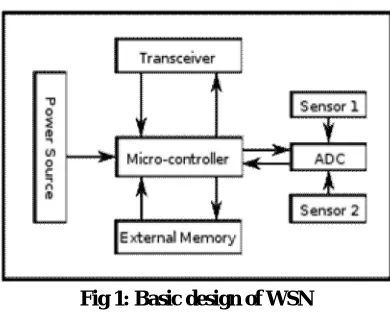
The WSN is built of "nodes" – from a few to several hundreds or even thousands, where each node is connected to one (or sometimes several) sensors. Each such sensor network node has typically several parts: a radio transceiver with an internal antenna or connection to an external antenna, a microcontroller, an electronic circuit for interfacing with the sensors and an energy source, usually a battery or an embedded form of energy harvesting. A sensor node might vary in size from that of a shoebox down to the size of a grain of dust, although functioning "motes" of genuine microscopic dimensions have yet to be created. The cost of sensor nodes is similarly variable, ranging from a few to hundreds of dollars, depending on the complexity of the individual sensor nodes. Size and cost constraints on sensor nodes result in corresponding constraints on resources such as energy, memory, computational speed and communications bandwidth.
ISSN(Online) : 2320-9801
ISSN (Print) : 2320-9798
I
nternational
J
ournal of
I
nnovative
R
esearch in
C
omputer
and
C
ommunication
E
ngineering
(An ISO 3297: 2007 Certified Organization)
Vol. 4, Issue 4, April 2016
II. APPLICATION OF WIRELESS SENSOR NETWORK
Wireless Sensor Networks are closely application-dependent. Recent WSN research has focused increasingly on the solutions that can hold the diversity of various sensor applications by integrating the application knowledge with management architectures in WSNs. Here are some examples:
A. Military Applications: Wireless sensor networks can be an integral part of military command, control, communication, computing, intelligence, surveillance and targeting (C4ISRT) systems. The rap id deployment, fault tolerance and self organization characteristics of sensor networks make the m a very promising sensing technique for military (C4ISRT). Since sensor networks are based on dens e deployment of disposable and low cost sensor nodes, destruction of some nodes by hostile actions does not affect military applications as much as the destruction of traditional sensor, which makes sensor networks concept a better approach for battlefield. Various military applications of sensor networks are monitoring friendly forces, equipments and ammunition; biological and chemical (NBC) attack detection and reconnaissance.
B. Environmental Applications: Some environmental applications of sensor network include tracking the movement of birds , small animals and insects, monitoring environmental conditions that affect crops and livestock , irrigation; macro instruments for large scale earth monitoring and planetary exploration, chemical/bio logical detection; precision agriculture, biological, Earth and environmental monitoring in marine, soil and atmospheric contexts forest fire detection and meteorological an d geophysical research; flood detection; bio complexity mapping of the environment and pollution study.
C. Health Application: Some of the applications are providing interfaces for the disabled, integrated patient monitoring, diagnostics, drug administration in hospital, monitoring the movements and internal process of insects or other s mall animals, telemonitoring of human physiological data and tracking and monitoring doctors and patients inside a hospital.
D. Home Applications: Home automation as technology advances, smart sensor nodes and actuators can be buried appliances, such as vacuum cleaners, micro wave ovens, refrigerators and VCRs[2]. These sensor nodes inside the domestic devices can interact with each other and with a external network via the internet or satellite. They allow end users to manage home devices locally and remotely more easily.
III. TECHNICAL CHALLENGES
Sensors networks in general pose considerable technical problems in data processing, communication, and sensor management (some of these were identified and researched in the first DSN program). Because of potentially harsh, uncertain, and dynamic environments, along with energy and bandwidth constraints, wireless ad hoc networks pose additional technical challenges in network discovery, network control and routing, collaborative information processing, querying, and tasking.
A. Ad Hoc Network Discovery
ISSN(Online) : 2320-9801
ISSN (Print) : 2320-9798
I
nternational
J
ournal of
I
nnovative
R
esearch in
C
omputer
and
C
ommunication
E
ngineering
(An ISO 3297: 2007 Certified Organization)
Vol. 4, Issue 4, April 2016
B. Network Control and Routing
The network must deal with resources—energy, bandwidth, and the processing power—that are dynamically changing, and the system should operate autonomously, changing its configuration as required. Since there is no planned connectivity in ad hoc networks, connectivity must emerge as needed from the algorithms and software. Since communication links are unreliable and shadow fading may eliminate links, the software and system design should generate the required reliability[10]. This requires research into issues such as network size or the number of links and nodes needed to provide adequate redundancy. Also, for networks on the ground, RF transmission degrades with distance much faster than in free space, which means that communication distance and energy must be well managed. Protocols must be internalized in design and not require operator intervention.
C. Collaborative Signal and Information Processing
The nodes in an ad hoc sensor network collaborate to collect and process data to generate useful information. Collaborative signal and information processing over a network is a new area of research and is related to distributed information fusion. Important technical issues include the degree of information sharing between nodes and how nodes fuse the information from other nodes. Processing data from more sensors generally results in better performance but also requires more communication resources.
D. Power and Energy
A mobile device is generally handy, small in size, and dedicated to perform a certain set of functions; its power source may not be able to deliver power as much as the one installed in a fixed device. When a device is allowed to move freely, it would generally be hard to receive a continuous supply of power. To conserve energy, a mobile device should be able to operate in an effective and efficient manner. To be specific, it should be able to transmit and receive in an intelligent manner so as to minimize the number of transmissions and receptions for certain communication operations
E. Security
Since the sensor network may operate in a hostile environment, security should be built into the design and not as an afterthought. Network techniques are needed to provide low-latency, survivable, and secure networks. Low probability of detection communication is needed for networks because sensors are being envisioned for use behind enemy lines. For the same reasons, the network should be protected again intrusion and spoofing.
IV. ARCHITECTURE DESIGN
ISSN(Online) : 2320-9801
ISSN (Print) : 2320-9798
I
nternational
J
ournal of
I
nnovative
R
esearch in
C
omputer
and
C
ommunication
E
ngineering
(An ISO 3297: 2007 Certified Organization)
Vol. 4, Issue 4, April 2016
Fig 1: Basic design of WSN
V. ARCHITECTURE DESIGN ISSUES
A. Network dynamics: There are three main components in a sensor network. These are the sensor nodes , s ink and monitored events . A side from the very few setups that utilize mobile sensor , most of the network architecture assumes that sensor nodes are stationary. On the other hand supporting the mobility of s ink or cluster heads.
B. Node Deployment: Another consideration is the topological deployment of the nodes which is Application dependent and affects the performance of the routing protocol. The deployment is either deterministic or self organizing. In deterministic situations, the sensors are manually placed and data is routed through pre determined paths.
C. Energy Consideration: During the creation of an infrastructure, the processes of setting up the routes are greatly influenced by energy considerations . Since the trans miss ion power of a wireless radio is proportional to the distance squared or even higher order in the presence of obstacles , multi hop routing will consume less energy than direct communication. However, multi hop routing introduces significant overhead topology management and medium access control.
D. Data Delivery Models: Depending on the application of the sensor network, the data delivery model to the s ink can be continuous, event- driven, query-driven and hybrid[8]. In continuous delivery model, each sensor sends data periodically. In event driven and query driven models, the transmission of data is triggered when an event occurs or a query is generated by the s ink. Some network applies a hybrid network using a combination of continuous, event driven and query driven data delivery.
VI. ROUTING PROTOCOLS
ISSN(Online) : 2320-9801
ISSN (Print) : 2320-9798
I
nternational
J
ournal of
I
nnovative
R
esearch in
C
omputer
and
C
ommunication
E
ngineering
(An ISO 3297: 2007 Certified Organization)
Vol. 4, Issue 4, April 2016
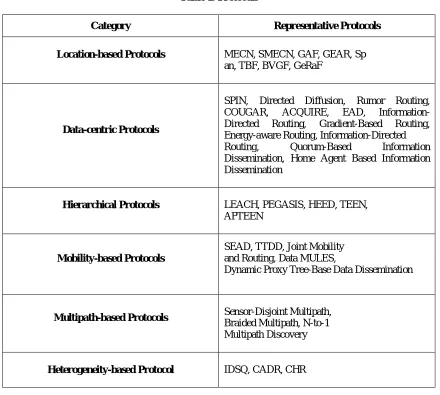
Table 1: Protocols
Category Representative Protocols
Location-based Protocols MECN, SMECN, GAF, GEAR, Sp
an, TBF, BVGF, GeRaF
Data-centric Protocols
SPIN, Directed Diffusion, Rumor Routing,
COUGAR, ACQUIRE, EAD,
Information-Directed Routing, Gradient-Based Routing,
Energy-aware Routing, Information-Directed
Routing, Quorum-Based Information
Dissemination, Home Agent Based Information Dissemination
Hierarchical Protocols LEACH, PEGASIS, HEED, TEEN,
APTEEN
Mobility-based Protocols
SEAD, TTDD, Joint Mobility and Routing, Data MULES,
Dynamic Proxy Tree-Base Data Dissemination
Multipath-based Protocols Sensor-Disjoint Multipath,
Braided Multipath, N-to-1 Multipath Discovery
Heterogeneity-based Protocol IDSQ, CADR, CHR
VII. PROTOCOL DESIGN ISSUES
A. Fault Tolerance: Some sensor nodes may fail or be blocked due to lack of power, have physical damage or environmental interference. The failure of the sensor node should not affect the task of wireless sensor networks.This is the reliability. Fault tolerance is the ability to sustain sensor network functionalities without any interruption due to sensor node failures [4].
B. Scalability: The number of sensor nodes deployed in the sensing area may be in the order of hundreds, thousands or more and routing schemes must be scalable enough to respond to events.
ISSN(Online) : 2320-9801
ISSN (Print) : 2320-9798
I
nternational
J
ournal of
I
nnovative
R
esearch in
C
omputer
and
C
ommunication
E
ngineering
(An ISO 3297: 2007 Certified Organization)
Vol. 4, Issue 4, April 2016
D. Operating Environment: We can set up sensor network in the interior of large machinery, at the bottom of an ocean, in a biologically or chemically contaminated field, in a battle field beyond the enemy lines, in a home or a large building, in a large warehouse, attached to animals, attached to fast moving vehicles, in forest area for habitat monitoring etc.
E. Power Consumption: Since the transmission power of a wireless radio is proportional to distance squared or even higher order in the presence of obstacles, multi-hop routing will consume less energy than direct communication. However, multi-hop routing introduces significant overhead for topology management and medium access control[7].
F. Data Delivery Models: Data delivery models determine when the data collected by the node has to be delivered. Depending on the of the sensor network, the data delivery model to the sink can be Continuous, Event-driven, Query-driven and Hybrid. In the continuous delivery model, each sensor sends data periodically. In event-Query-driven models, the transmission of data is triggered when an event occurs. In query driven models, the transmission of data is triggered when query is generated by the sink. Some networks apply a hybrid model using a combination of continuous, event-driven and query-event-driven data delivery.
G. Quality of Service (QoS): The quality of service means the quality service required by the application, it could be the length of life time, the data reliable, energy efficiency, and location-awareness, collaborative-processing. These factors will affect the selection of routing protocols for a particular application. In some applications (e.g. some military applications) the data should be delivered within a certain period of time from the moment it is sensed.
H. Data Latency And Overhead: These are considered as the important factors that influence routing protocol design. Data aggregation and multi-hop relays cause data latency[6]. In addition, some routing protocols create excessive overheads to implement their algorithms, which are not suitable for serious energy constrained networks.
VIII. CONCLUSION
This paper identifies and describes the various research issues and challenges available in the wireless domain. the popularity of wireless networks growing at a exponential rate, the data rate enhancements, minimizing size, cost, low power networking, user security and the best requirement to obtain the required QoS problems becomes more challenging.
ACKNOWLEDGEMENT
We would like to express our deep and sincere gratitude to Rev.Sr. Francisca, Administrator, JP Group of Institutions and to Dr.A.J.A.Ranjitsingh, Principal, JP College of Arts and Science for giving us the opportunity to do research in JP Campus. We extend our heartfelt thanks to Dr. M. Suresh, Research Head, JP College of Arts and Science for his acceptance and patience during the discussion we had with him on research work.
REFERENCES
1. D. J. Cook and S. K. Das, “Smart environments: technologies, protocols and applications,” New York: John Wiley, pp. 13-15, 2004.
2. K.Sohraby, D.Minoli, and T. Znati, “Wireless sensor networks: technology, protocols and applications,” New Jersey: John Wiley, pp.38-71, 2007.
3. Y. E. M. Hamouda and C. Phillips, “Biological task mapping and scheduling in wireless sensor networks,” in Proceedings of ICCTA, pp.914-919, 2009.
4. T. Camilo, R. Oscar, and L. Carlos, “Biomedical signal monitoring using wireless sensor networks,” IEEE Latin-American Conf. on Communciations, pp.1-6, 2009.
5. Lawrence, E. Edwin, and R. Latha. "A Comparative Study of Routing Protocols for Mobile Ad-Hoc Networks." International Journal of Computer Science and Mobile Computing (IJCSMC) 3.11 (2014): 46-53.
ISSN(Online) : 2320-9801
ISSN (Print) : 2320-9798
I
nternational
J
ournal of
I
nnovative
R
esearch in
C
omputer
and
C
ommunication
E
ngineering
(An ISO 3297: 2007 Certified Organization)
Vol. 4, Issue 4, April 2016
7. W. Zhang, L. Feng, and Z. Wen, “Research on home networking with Zigbee,” Journal of Hefei University of Technology, vol. 28, pp. 755- 759, 2005.
8. Y. Wang and G. Shen, “ZigbeeWireless Sensor Network Technology and Application,” Ship Electronic Engineering, 10th ed, vol. 28, pp. 32-34, 2008.
9. E. Edwin Lawrence, R. Latha, E. Varsha Lawrence, “Fundamentals of Mobile Ad hoc Network”, Bonfring Publication, 2016, ISBN: 9789385477614.