Big Data Analysis Using Fuzzy Clustering
Algorithms Implemented on Spark
Framework
Divyashree. V1, Deepika. N2
M. Tech Student, Department of Computer Science and Engineering, New Horizon College of Engineering, Outer Ring
Road, Panathur Post, Kadubisanahalli, Bangalore, India
Senior Assistant Professor, Department of Computer Science and Engineering, New Horizon College of Engineering, Outer
Ring Road, Panathur Post, Kadubisanahalli,, Bangalore, India
ABSTRACT: A huge amount of data containing useful information, called Big Data, is generated on a daily basis. For processing such tremendous volume of data, there is a need of Big Data frameworks such as Hadoop MapReduce, Apache Spark etc. Among these, Apache Spark performs up to 100 times faster than conventional frameworks like Hadoop Mapreduce. we focus on the design of partitional clustering algorithm and its implementation on Apache Spark. In this paper, we propose a partitional based clustering algorithm called Scalable Random Sampling with Iterative Optimization Fuzzy c-Means algorithm (SRSIO-FCM) which is implemented on Apache Spark to handle the challenges associated with Big Data Clustering. Experimentation is performed on several big datasets to show the effectiveness of SRSIO-FCM in comparison with a proposed scalable version of the Literal Fuzzy c-Means (LFCM) called SLFCM implemented on Apache Spark.
KEYWORDS: Apache Spark, Big Data, SRSIO-FCM, LFCM, SLFCM.
I. INTRODUCTION
A Huge amount of data gets collected everyday due to the increasing involvement of humans in the digital space. We share, store and manage our work and lives online. For example, Facebook stores more than 30 Petabytes of data, and Walmart’s databases contain more than 2.5 petabytes of data. Such huge amount of data containing useful information is called Big Data. It is becoming increasingly popular to mine such big data in order to gain insights the valuable information that can be of great use in scientific and business applications. Clustering is the promising data mining technique that is widely adopted for mining valuable information underlining unlabeled data. Over the past decades, different clustering algorithms have been developed based on various theories and applications. Among them, partitional algorithms are widely adopted due to their low computational requirements; they are more suited for clustering large datasets. We propose Scalable Random Sampling with Iterative Optimization Fuzzy c-Means algorithm (SRSIO-FCM) implemented on Apache Spark to tackle the challenges associated with fuzzy clustering for handling big data. The proposed approach works by partitioning the data into various subsets and then performs clustering on each subset.
II. LITERATURE SURVEY
incremental bunching methodologies are proposed. The key thought behind these methodologies is to discover delegates (centroids or medoids) to speak to every bunch in every information lump, which is a parcel of the information, and last information investigation is done in light of those recognized agents from every one of the pieces. In this paper, we propose another incremental bunching approach called incremental numerous medoids-based fluffy grouping (IMMFC) to handle complex examples that are not reduced and very much isolated. We might want to research whether IMMFC is a decent contrasting option to catching the hidden information structure all the more precisely. In the year of 2010, the authors Y. Bu, B. Howe, M. Balazinska, and M. D. Ernst. revealed a paper titled "Haloop: efficient iterative data processing on large clusters" and describe into the paper such as the developing interest for extensive scale information mining and information investigation applications has driven both industry and the scholarly world to outline new sorts of exceedingly adaptable information escalated figuring stages. The point by point issue definition, overhauling rules determination, and the top to bottom investigation of the proposed IMMFC are given. Trial examines on a few huge datasets that incorporate genuine malware datasets have been led. IMMFC outflanks existing incremental fluffy bunching approaches as far as grouping exactness and power to the request of information. These outcomes show the colossal capability of IMMFC for huge information examination.
III. A NEW PROPOSAL FOR FEATURE SELECTION
We propose Scalable Random Sampling with Iterative Optimization Fuzzy c-Means algorithm (SRSIO-FCM) implemented on Apache Spark to tackle the challenges associated with fuzzy clustering for handling big data. The proposed approach works by partitioning the data into various subsets and then perform clustering on each subset. Apache Spark performs up to 100 times faster than conventional frameworks like Hadoop Mapreduce. MapReduce's processing style can be just fine if your data operations and reporting requirements are mostly static and you can wait for batch-mode processing. But if you need to do analytics on streaming data, like from sensors on a factory floor, or have applications that require multiple operations, you probably want to go with Spark. Most machine-learning algorithms, for example, require multiple operations. Common applications for Spark include real-time marketing campaigns, online product recommendations, cyber security analytics and machine log monitoring.
IV. APACHE SPARK
Apache spark is originally developed at UC Berkeley in 2009, it is a powerful open source processing engine built for sophisticated data analysis. It has quickly become one of the most well recognized tools, giving tough competition to Hadoop MapReduce. It was adopted by IT giants such as Yahoo, Baidu and Tencent eagerly deployed Spark on a massive scale. They collectively process petabytes of data on their Spark clusters.MapReduce's processing style can be just fine if your data operations and reporting requirements are mostly static and you can wait for batch-mode processing. But if you need to do analytics on streaming data, like from sensors on a factory floor, or have applications that require multiple operations, you probably want to go with Spark. Most machine-learning algorithms, for example, require multiple operations. Common applications for Spark include real-time marketing campaigns, online product recommendations, cyber security analytics and machine log monitoring. It require numerous operations, you most likely need to run with Spark. Most machine-learning calculations, for instance, require various operations. Basic applications for Spark incorporate constant showcasing effort, online item proposals, digital security examination and machine log observing. Spark cluster consists of many machines, each of which is referred to as a node. There are two main components of Spark: Master and Workers. There is only one master node and it assigns jobs to the slave nodes. However, there can be any number of slave nodes. Data can be stored in HDFS or in local machine.
V. EXISTING SYSTEM
Disadvantages
1. suffer from overlapping cluster centers
VI. PROPOSED SYSTEM
We propose Scalable Random Sampling with Iterative Optimization Fuzzy c-Means algorithm (SRSIO-FCM) implemented on Apache Spark to tackle the challenges associated with fuzzy clustering for handling big data. The proposed approach works by partitioning the data into various subsets and then performs clustering on each subset. Advantages
1.
Apache Spark performs up to 100 times faster than conventional frameworks like Hadoop Mapreduce.VII. SLFCM ANALYSIS
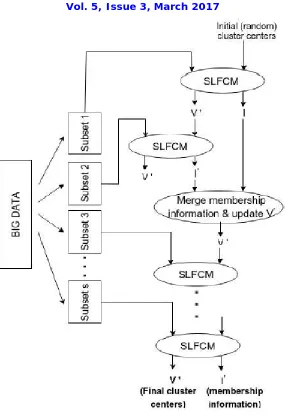
The SLFCM algorithm is implemented on Apache Spark. In SLFCM, we perform the calculation of cluster membership degree in parallel on various worker nodes thus reducing the run-time as compared to linear execution on a single machine. The membership degrees are then aggregated on master node and cluster centre values are computed. This process is repeated until no significant difference is observed in the values of cluster centres. The workflow of SLFCM and the internal working of SLFCM is done on Apache Spark.
A. SRSIO-FCM
It partitions the data into equal sized subsets where in each subset the data points are chosen at random from big data without replacement. Initial cluster centers for the first subset are chosen randomly. SFCM, like RSIO-FCM, computes cluster centers (V 1 ) and membership information (I 1 ) for the first subset and feeds V 1 as input to the second subset. It then finds the cluster centers (V 2 ) and membership information (I 2 ) for the second subset. The motivation for using the final cluster centers of one subset to initialize the cluster centers for the next subset comes from the observation that the cluster centers for the two subsets are nearer to each other. Thus, the algorithm will converge to optimal cluster centers faster as compared to the case when the cluster centers are initialized randomly.
VIII. SYSTEM ARCHITECTURE
Fig 1. System Design
XI. EXPERIMENT DESCRIPTION
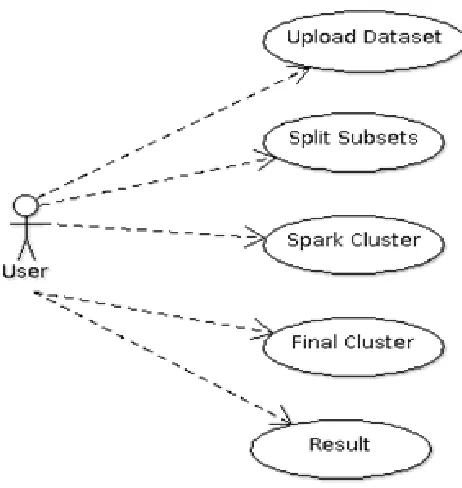
Fig 2. Use Case Module
X. SIMULATION RESULTS
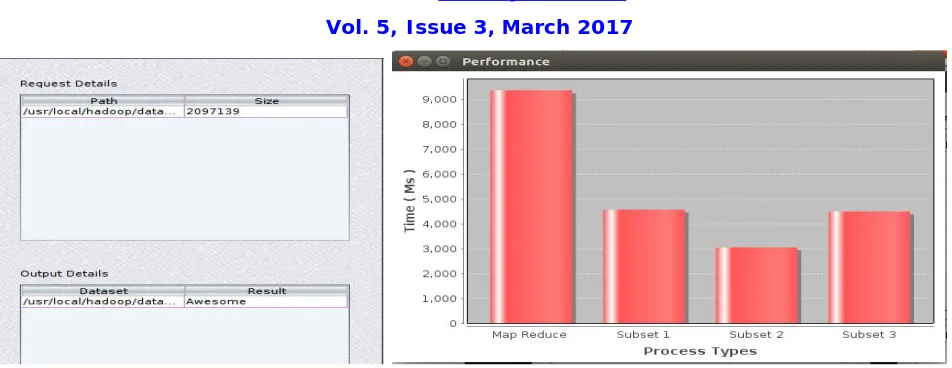
The experiments were run on a Spark cluster with nodes. Each node has the following configuration: Intel Core I3(r) CPU ES-1607 v3 @ 3.10GHz x 4, 32GB RAM and 2TB storage. The algorithms were implemented in Java and tested over Hadoop version 2.4 with Apache Spark version 1.4.0. We used HDFS for storing data across the cluster and YARN for resource management. We compare the performance of SRSIO-FCM, SLFCM and SrseFCM algorithm on data sets. We implemented SRSIO-FCM on both Hadoop Mapreduce and Spark to show that Spark framework is faster than Hadoop in processing Bigdata.
Fig 4. Performance comparison between Hadoop Mapreduce and Spark
XI. CONCLUSION
We have projected an additional Scalable Random Sampling with Iterative Optimization Fuzzy c-Means approach called SRSIO-FCM for Big Data examination. SRSIO-FCM forms Big Data piece by lump. One particular normal for SRSIO-FCM is that it takes out the issue of sudden increment in the quantity of cycles that happen amid the grouping of any subset because of the sustaining of profoundly veered off bunch focuses, created from the past subset, as a contribution for the bunching of current subset. We implemented SRSIO-FCM on both Hadoop Mapreduce and Spark to show that Spark framework is faster than Hadoop in processing Bigdata.
REFERENCES
[1] J. Manyika, M. Chui, B. Brown, J. Bughin, R. Dobbs, C. Roxburgh, and A. H. Byers, “Big data: The next frontier for innovation, competition, and productivity,” pp. 1–137, 2011.
[2] M. Filippone, F. Camastra, F. Masulli, and S. Rovetta, “A survey of kernel and spectral methods for clustering,” Pattern recognition, vol. 41, no. 1, pp. 176–190, 2008.
[3] A. K. Jain, “Data clustering: 50 years beyond k-means,” Pattern recognition letters, vol. 31, no. 8, pp. 651–666, 2010.
[4] A. K. Jain, M. N. Murty, and P. J. Flynn, “Data clustering: a review,” ACM computingsurveys (CSUR), vol. 31, no. 3, pp. 264–323, 1999. [5] R. O. Duda, P. E. Hart et al., Pattern classification and scene analysis. Wiley New York, 1973, vol. 3.
[6] M. Steinbach, G. Karypis, V. Kumar et al., “A comparison of document clustering techniques,” in KDD workshop on text mining, vol. 400, no. 1. Boston, 2000, pp. 525–526.
[7] J. C. Bezdek, Pattern recognition with fuzzy objective function algorithms. Springer Science & Business Media, 2013.
[8] T. C. Havens, J. C. Bezdek, C. Leckie, L. O. Hall, and M. Palaniswami, “Fuzzy c-means algorithms for very large data,” IEEE Transactions on Fuzzy Systems, vol. 20, no. 6, pp. 1130–1146, 2012.
[9] P. Hore, L. O. Hall, and D. B. Goldgof, “Single pass fuzzy c means,” in Proc. IEEE International Conference on Fuzzy Systems (FUZZIEEE). 2007, pp. 1–7.
[10] P. Hore, L. O. Hall, D. B. Goldgof, Y. Gu, A. A. Maudsley, and A. Darkazanli, “A scalable framework for segmenting magnetic resonance images,” Journal of signal processing systems, vol. 54, no. 1-3, pp. 183–203, 2009.
BIOGRAPHY
Ms. Divyashree. V1, MTech Student, Department of Computer Science and Engineering, New Horizon College of Engineering, Outer Ring Road, Panathur Post, Kadubisanahalli,, Bangalore - 560087.