ABSTRACT
LAU, MEI YING. Driving Performance, Adaptation and Cognitive Workload Costs of Logo Sign Panel Detection as Mediated by Driver Age. (Under the direction of Dr. David B. Kaber).
Prior research has found that driver crash involvement is highest for teenage drivers and decreases steadily with driver age until 60-69 years at which point rates increase slightly for older drivers (Tefft, 2012). On this basis, young and elderly drivers have been identified as being more prone to crashes. Elderly drivers are increasingly more common among the U.S. population and are a particularly concerning group due to age-related declines in cognitive and motor abilities and associated vulnerability to accidents. Unfortunately, prior research has not explained how driver mental workload translates to driving performance costs and how age may mediate this relationship, particularly during visual target
identification tasks while driving.
The objective of this study was to investigate the driving performance and mental workload costs of successful visual sign identification for three age groups. The study also sought to quantify driver adaptive behavior when exposed to business logo signs during freeway driving. Participants were sorted into one of three age groups (young: ≤ 22 years; middle-aged: 23-64 years; elderly: 65+ years) based on crash data and statistics from 1995-2010 (Tefft, 2012). Participants were asked to drive through eight different simulated
highway scenarios (the primary task) using a driving simulator with an embedded secondary task of business logo sign identification. A food chain logo target was presented to
Driver performance, including speed deviation (adaptation measure) and lane deviation (performance decrement indicator) was measured during each scenario. Driver blink duration (mental workload measure) was collected via an eye tracking device. In order to determine the penalty costs of sign use, only data from successful target identification trials were analyzed.
Study result revealed that nine logos sign configuration did not pose a significantly greater cost in terms of driving behavior when drivers were required to detect familiar targets; however, there were significant cost differences of successful sign detection among age groups. Both elderly and young drivers demonstrate significantly higher cognitive workload in response to the secondary task in comparison to middle-aged drivers. Furthermore, elderly drivers exhibited significantly greater adaptation behaviors (higher speed reduction from posted limits) and performance degradations (higher lane deviation) during target identification than drivers of other age groups. Related to this, the rate at which elderly drivers correctly identified business targets was lower than any other age group at around 54-57% (Zahabi et al., 2016). Positive correlations were found between adaptation behavior and performance degradation and between the absolute blink duration ratio and lane deviation. As cognitive workload of drivers increased, performance degradations (lane deviation) also increased. However, no correlation was discovered between adaptation behavior and cognitive workload.
taken in terms of roadway facilities design in order to further ensure safety for elderly
Driving Performance, Adaptation and Cognitive Workload Costs of Logo Sign Panel Detection as Mediated by Driver Age
by Mei Ying Lau
A thesis submitted to the Graduate Faculty of North Carolina State University
in partial fulfillment of the requirements for the degree of
Master
Industrial and Systems Engineering
Raleigh, North Carolina 2016
APPROVED BY:
_______________________________ _______________________________
Dr. David Kaber Dr. Jing Feng
Committee Chair
ii
BIOGRAPHY
iii
ACKNOWLEDGEMENT
There are a number of individuals who offered me the support and help necessary to write this thesis. I would like to express my appreciation and sincere thanks to all of them.
I would first like to express my gratitude to my advisor Dr. David Kaber for his constant support and guidance throughout my research. There were multiple times where I made mistakes or had a question about my research or writing and he always managed to steer me in the right direction whenever necessary. In addition, I would like to thank Dr. Jing Feng and Dr. Chang Nam for serving on my committee.
I would also like to thank National Institute for Occupational Safety and Health (NIOSH) for providing me the needed financial support through NIOSH fellowship. Thanks go to North Carolina Department of Transportation (NCDOT) who funded the initial research project and made this possible. Thanks to all participants participated in this research for their time and efforts. Special thanks to the professors and team of fellow graduate students that are involved in that research project.
iv
TABLE OF CONTENTS
LIST OF TABLES ... vi
LIST OF FIGURES ... vii
1. Introduction ... 1
1.1 Aging and Driving ... 1
1.2 Elderly Drivers and On-Road Risks ... 3
1.3 Studies of Age Effects on Driving Performance ... 4
1.4 Driving Measures ... 6
1.5 Mental Workload Measures ... 7
1.6 Eye Activity Measures ... 8
1.7 Motivation ... 10
1.8 Hypotheses ... 10
2. Methodology ... 11
2.1 Prior Study... 11
2.2 Apparatus ... 13
2.3 Task Description ... 16
2.4 Participants ... 17
2.5 Independent variables ... 18
2.6 Dependent variables ... 18
2.7 Experimental design ... 20
2.8 Procedures ... 20
2.8.1 Demographic Questionnaire ... 20
2.8.2 Simulator Sickness Questionnaire ... 21
2.8.3 Training Scenario ... 21
2.8.4 Experiment... 22
2.9 Statistical Data Analyses ... 24
3. Result ... 26
3.1 Adaptation Behavior ... 27
3.2 Driving Performance ... 28
v
3.4 Correlation Analysis ... 31
4. Discussion ... 32
5. Conclusion ... 35
6. References ... 38
APPENDICES ... 45
Appendix A Scenario Setup ... 46
vi
LIST OF TABLES
vii
LIST OF FIGURES
Figure 1: Driving Simulator Setup...15
Figure 2: Eye Tracking System Hardware...15
Figure 3: Example Sign Imagery in Scenario from Driver’s Perspective...16
Figure 4: Example Six and Nine Panel Specific Service Signs...18
Figure 5: Observation Period within Scenarios...23
Figure 6: Dunkin’ Donut Target...23
Figure 7: Effect of Age Group on Speed Deviation...28
Figure 8: Effect of Age Group on Lane Deviation...29
1
1.
Introduction
1.1 Aging and Driving
Age has long been known to impact driving performance. Elderly drivers have been identified as having the greatest degree of individual performance inconsistency (Bunce, Young, Blane & Khugputh, 2012). While age itself does not lead to accidents; age-related declines in attentional, perceptual, cognitive and psychomotor abilities have been found to significantly contribute to unsafe driving incidents (McKnight & McKnight, 1999). A study of historical accident data by Stamatiadis and Deacon (1995) indicated that middle-aged drivers are safer than younger drivers who, in turn, are safer than older drivers. Across driver behavior studies (from different periods of time), crash involvement rates for young and older drivers have been found to be consistently above average (Ryan, Legge & Rosman, 1998; Dissanayake, 2004; Tefft, 2012). Crash statistics for 1995-2010 (Tefft, 2012) revealed that crash involvement rates were highest for teenage drivers, decreased steadily with
increasing driver age until 60-69 years, but increased for ages greater than 69 years. All of these results indicate that young and elderly driver groups are critical groups from a crash perspective and may require special considerations from a highway design and safety perspective.
High rates of driving infractions among young drivers including collisions and speeding can be largely accounted by inexperience (Kass, Cole & Stanny, 2007). The
2
through training and increased driving experience as well as driver safety education. On the other hand, elderly drivers are particularly at risk due to possible age-related changes in information processing and motor capabilities, which cannot simply be addressed through training and education (Bunce et al., 2012; McKnight & McKnight, 1999). Highway designs and operations need to be developed to account for elderly drivers. Unfortunately, most contemporary highway designs have been developed based on physiological and
psychological abilities of younger and middle-aged drivers and such designs may not be suitable for elderly drivers.
A study of driver age and visual contrast sensitivity by Evans and Ginsburg (1985) found that drivers over 55 years of age had significantly lower contrast sensitivity and required a significantly larger sign symbol for successful target identification. Hummer (1989) also conducted an on-road signage study demonstrating that drivers 50 years or older require the greatest decrease in speed and greatest sign proximity for target identification and recognition, as compared to the middle-aged and young drivers. Driving study by Ho,
Scialfa, Caird and Graw (2001) indicates that older adults were less accurate, require more time and need more eye movements (fixations) to acquire signs than their younger
3
current roadway conditions/highway systems designs pose high cognitive workload for elderly drivers and in turn, increasing the potential for crashes.
1.2 Elderly Drivers and On-Road Risks
Due to potential age-related declines in various abilities, elderly drivers may be more vulnerable to accidents and prone to crash involvement by comparison with other segments of the driving population. Crash fatality data for 2013 revealed that while crash fatalities commonly decreased among all age groups under 55 years rates actually increased in the 55+ year old community (NHTSA, 2014). Furthermore, the elderly group of 65+ years was estimated to account for about 40% of the increase in all crash involvement (Lyman,
Ferguson, Braver & Williams, 2002). The same research projected that drivers 65 years and older would account for as much as 25% of total driver fatalities by 2030 (Lyman et al., 2002). The researchers concluded that drivers 65+ years of age represent a high-risk
population with special needs that current driving policies and conditions may not necessarily meet. The odds of motor vehicle crash-related injuries, such as serious head and extremity injuries, has been found to increase with age. Furthermore, serious chest injuries in
automobile crashes have been found to markedly increase after 60 years of age (Newgard, 2008). Like Newgard (2008), Janicak (2003) conducted a trend analysis on relative risks for vehicle operators in fatal motor-vehicle accident situations and found that age had a
4
elderly driver detection/perception capabilities and to reduce crash rates and the severity of driver injuries.
Unfortunately, the public may not be well aware of the risks for elderly drivers as well as the need to adapt highway system designs accordingly to elderly capabilities. An example of the lack of awareness of these problems was revealed through a Canadian public opinion poll survey conducted by Robertson and Vanlaar (2008). The authors found that when considering traffic management challenges and issues, the public is relatively
unconcerned with elderly drivers. In addition, the study also found that elderly drivers were not supportive of the idea of training requirements for maintaining driving privileges over a certain age. These results indicate a lack of appropriate public awareness regarding age-related declines in individual cognitive and motor abilities and the potential for associated driving and traffic challenges. More studies are need on age-related driving complications in order to draw public attention and to facilitate additional elderly driver education.
1.3 Studies of Age Effects on Driving Performance
Keyword searches on the terms “driver”, “age”, and “performance” using databases, including Web of Science (Science Direct) and Transport Research International
Documentation (TRID) revealed a number of studies focused on the impact of driver age on performance. The majority of studies have addressed distraction in driving performance or effects of specific driver physiological conditions, such as sleep, alcohol use and
5
navigation system use, cell phone calls, radio use, or entertainment device use (Horberry, Anderson, Regan, Triggs & Brown, 2006; Platten, Milicic, Schwalm & Krems, 2013).
6 1.4 Driving Measures
Speed deviation is often used as a performance indicator in driving studies. However, this is a measure that can be heavily influenced by individual driving styles, a factor that is often impacted by age. As drivers age, their physiological and/or cognitive abilities often decline. Elderly drivers are often aware of such limitations and exhibit dramatic speed control and avoidance maneuvers in difficult driving situations (Ball et al., 1998). Such avoidance maneuvers generally represent a conservative driving style and include adopting longer headway distances in lead-car following, driving slower than average (Andrews & Westerman, 2012; Horberry et al., 2006; Zhang & Kaber, 2013), or slowing down to compensate for an increase in reaction time to external stimuli (Trick, Toxopeus & Wilson, 2010; Kaber, Zhang, Jin, Mosaly & Garner, 2012; Platten et al., 2013). In the face of driving challenges, elderly drivers may also compensate for age-related deficits by de-emphasizing non-driving related secondary tasks in the interests of safety (i.e., ignoring information signs). In summary, vehicle speed control is actually not a good indicator for assessing the impact of driver age on driving performance because slower speeds may not indicate impaired driving performance but rather driver safety precautions or personal habits in response to complicated driving situations. In particular, in this study, driver reductions in vehicle speed under workload is considered as a degree of adaptation/compensation rather than a performance decrement indicator.
7
successfully demonstrated differences in standard deviation of lateral positions in driving study of various age groups (Fofanova & Vollrath, 2011). In addition, the use of navigation tasks with landmarks has been found to contribute to significantly larger lane deviations (Trick et al., 2010). This research indicated sensitivity of lane deviation measures to
navigational target identification tasks. In the present research, lane deviation was selected as a driver performance decrement indicator when exposed to external driving distractions. 1.5 Mental Workload Measures
Studies typically assess mental workload based on means of secondary task performance, subjective measures, and/or physiological measures. Secondary tasks for assessing driver cognitive workload are often artificial, examples include reaction time to auditory stimuli (Cantin et al., 2009), mental calculations (Makishita & Matsunaga, 2008; Wood, Chaparro & Hickson, 2009), delayed digit-recall tasks (Reimer, Mehler, Wang & Coughlin, 2012). Problems with these types of measures is that the tasks are artificial and do not represent real demands that drivers would encounter in normal driving. Thus, the results of such analysis have limited real-life application. It should also be noted that task
performance can be influenced by other factors such as individual expertise in math and may not accurately reflect driver mental workload. Secondary tasks should be embedded in normal driving, or closely related to driving tasks, for the most accurate assessment of driver workload.
8
measures due to objectivity. However, processes for measuring physiological responses, such as heart rate, inter-beat-interval (IBI) and EEG may be intrusive to performance. On the basis of this brief review, remote eye-tracking was selected as a general method of workload measurement due to its non-distracting, non-obtrusive, and objective nature.
1.6 Eye Activity Measures
Eye activity measures include blinks, fixations, saccades, and pupil dilation. All of these measures have been used extensively in previous studies as estimates of driver mental workload (Marquart, Cabrall & de Winter, 2015). Van Orden, Limbert, Makeig and Jung (2001) studied workload in target tracking and identification in a mock anti-air-warfare task. They found that blink frequency, blink duration, and mean pupil diameter systematically change in response to target density. Additional nonlinear regression analyses revealed blink frequency, fixation frequency, and pupil diameter, in particular, to be measures most
predictive of mental workload in tasks in relation to target density. In addition, blink rate, duration and pupil size have often been selected as measures of cognitive workload associated with secondary task performance in driving studies (Tsai, Viirre, Strychacz, Chase, & Jung, 2007; Niezgoda, Tarnowski, Kruszewski, & Kamiński, 2015; Recarte et al., 2008; Benedetto et al., 2011).
In general, cognitive workload increases are marked by increases in pupil diameter and decreases in blink duration (i.e., the time the eyes are closed). There have been mixed results on blink rate with some studies showing greater blinks under higher task workload conditions (Marquart et al., 2015). Although some sensitivity of blink rate to mental
9
also be influenced by external factors, such as user state (drowsiness) or visual demands. Visual demand and mental workload have opposite effects on blink rate: the former leads to blink-rate inhibition with processing of visual stimuli and the latter leads to blink-rate increases in memory tasks (Recarte et al., 2008; Benedetto et al., 2011; Marquart et al., 2015). As demand for visual attention increases, blink rate may decrease in order to capture and process additional visual stimuli. Consequently, in research manipulating visual demands to infer cognitive workload, such as the present work, blink rate would not be an ideal
measure of workload. Pupil dilation is said to be more sensitive for measuring changes in cognitive demand than blink rate (Niezgoda et al., 2015), however, it is an eye measure that can only be collected under certain constraints. For example, reflections of light on the surface of participant glasses can interfere with pupil detection when using an eye-tracking system. This measure was not applied in the present study as over half of the participants made use of visual prosthetics and data collection would have been compromised.
10 1.7 Motivation
With the potential for age-related declines in cognitive and motor capabilities for elderly drivers, the present work sought to assess the costs of successful identification of targets in a fast-paced freeway environment. The main research question was whether any costs to workload or driver performance would vary among elderly, middle-aged and
younger drivers. Driver ability to maintain vehicle control while correctly identifying targets is essential for successfully reaching a destination and ensuring driver safety. Vehicle speed control and lane maintenance are especially important in the highway environment in which drastic changes in speed or lane position can yield life-threatening consequences. It is possible that elderly drivers may require more time to locate a visual target through glances than younger drivers. Therefore, the “penalty” cost associated with successful freeway target detection in terms of driving performance and cognitive workload may be greater for elderly and is of practical interest. From a highway design perspective, it is important that the drivers of all ages are able to identify targets without losing vehicle control.
1.8 Hypotheses
11
young age groups in comparison to middle-aged drivers. In specific, we hypothesized that elderly drivers would demonstrate higher mental workload (Hypothesis 4), greater adaptation behavior (Hypothesis 5), and driving performance degradations (Hypothesis 6) during
successful target detection relative to middle-aged drivers and possibly comparable to young drivers.
2. Methodology
2.1 Prior Study
A prior freeway driving simulation study was conducted on the driver distraction and performance effects of roadway sign familiarity (familiar vs. unfamiliar), logo format
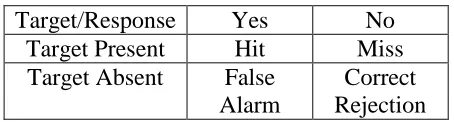
(pictorial vs. text) and panel structure (6 vs. 9). The present study exploited data collected during the course of that investigation (Zahabi et al., 2016). In the Zahabi et al. (2016) study, driver responses to roadway signage were characterized by using signal detection theory outcomes (see Table 1) and analyzed. Contingency analyses on driver detection of food business targets on specific service signs revealed a highly significant effect of target
12
Table 1: Signal Detection Theory Classification
Target/Response Yes No
Target Present Hit Miss
Target Absent False Alarm
Correct Rejection
Table 2: Counts by Target Familiarity (Zahabi et al., 2016)
Familiarity Hit Correct
Rejection Miss
False Alarm Overall Accuracy Accuracy: Target Present Accuracy: Target Absent
Familiar 198 476 41 1 94.13% 82.85% 99.79%
Unfamiliar 151 429 75 21 85.80% 66.81% 95.33%
Table 3: Familiar Target Counts by Logo Count within Age Group (Zahabi et al., 2016)
Age Group
Logo Count Hit
Correct
Rejection Miss
False Alarm Overall Accuracy Accuracy: Target Present Accuracy: Target Absent
Young 6 50 102 1 0 99.35% 98.04% 100.00%
9 36 72 0 0 100.00% 100.00% 100.00%
Middle 6 34 74 3 0 97.30% 91.89% 100.00%
9 35 76 3 0 97.37% 92.11% 100.00%
Elderly 6 19 69 16 0 84.62% 54.29% 100.00%
9 24 83 18 1 84.92% 57.14% 98.81%
In the prior study, logo panels were classified as familiar if they presented a common US chain business. Logos were classified as unfamiliar if they presented an
independent/local business. The participants in the prior study experience eight test trials per driver (in random order) with both familiar and unfamiliar target detection conditions. While the familiar target remained consistent (familiar food target was ‘Dunkin’ Donuts’) across trials, unfamiliar logos varied and were presented only once throughout the entire
13
with specific targets.) This approach was taken in order to eliminate any potential confounding factors in assessment of the driver workload and performance costs of
successful target identification with using roadway signage. Consequently, only four of the eight trials completed by each participant in the Zahabi et al. (2016) study were considered in this investigation. Related to this, incorrect target identifications in the Zahabi et al. (2016) study could have indicated that participants did not pay attention to roadway signs as
instructed and, thus, such trials would “underestimate” any workload and performance costs associated with individual interaction with the off-road signage. Based on this possibility, in order to focus on penalty costs associated with successful target identification, driver
workload and performance measures were only analyzed for the trials in which drivers successfully detected a target in a sign (a “hit”) or successfully rejected a sign absent of a target (a “correct rejection”). Here, it is important to note that eye-tracking based measures of driver cognitive workload, which were not analyzed by Zahabi et al. (2016), were a focus of this study. Furthermore, the speed deviation measure analyzed in the prior study included deviations both above and below the post speed limit, and was used as a performance indicator. In the present study, only deviations below the posted limit were analyzed and the response measure served as an indicator of driver adaptation behavior.
2.2 Apparatus
14
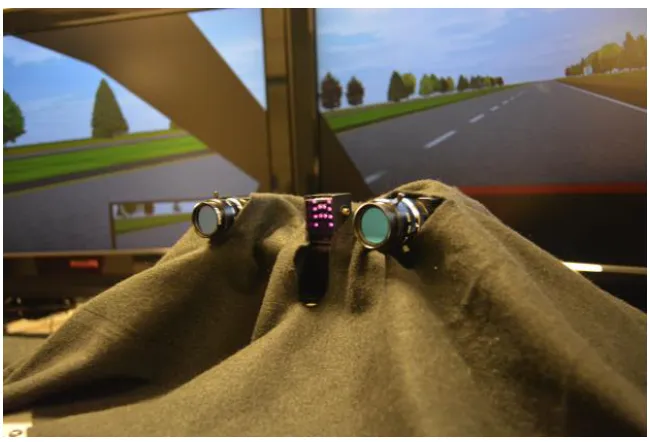
HDTV screens, audio speakers and a realistic cab in order to present simulated driving scenarios to participants (see Fig. 1). A FaceLAB 5.1 eye tracking system, developed by Seeing Machines (Australia), integrated two cameras and was used in the study to collect real-time data on blink rates and pupil diameter (see Fig. 2). Eye movements were recorded at 60 HZ with an accuracy of 0.5º to 1º of rotational error. Eye Works Record software, developed by Eye Tracking Inc, was used to integrate the eye movement data from the FaceLAB system with the visual imagery shown on the screens of the simulator.
15
Figure 1: Driving Simulator Setup
16 2.3 Task Description
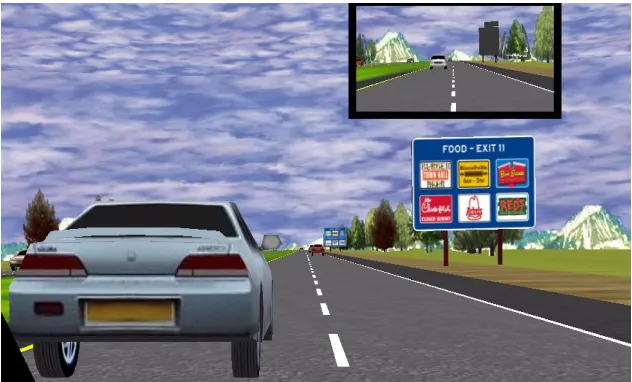
Participants were assigned the primary task of freeway driving. As previously stated, secondary tasks should be embedded in normal driving, or closely related to driving, for the most accurate assessment of driver workload. A driving study posing four different types of secondary tasks revealed that tasks requiring visual attention and psychomotor coordination deteriorated driving performance to the greatest extent (Rodrick, Bhise, & Jothi, 2013). Based on these characteristics, identification of target logo panels in freeway specific service signs was selected as the embedded visual secondary task for analysis of associated driver workload and performance costs. The number of logos on the panel (6 or 9) was used as a workload manipulation. Participants were instructed to maintain a speed of 65 mph at all times and remain in the right lane of the highway and to not utilize any exit ramps. As participants drove through the scenario, they were asked to verbally indicate whether the target business logo (Dunkin Donuts) was present whenever passing specific service signs located adjacent to the simulated interstate (see Fig. 3).
17 2.4 Participants
As stated in the Introduction section, a number of studies have been conducted on the impact of driver age on workload and performance response and have concluded that age has a significant effect on potential crash involvement (Stamatiadis & Deacon 1995; Ryan et al., 1998; Dissanayake, 2004; Tefft, 2012). There are, however, different definitions of age groups used by various studies. Furthermore, some investigation fail to report age group selection criteria. In order to provide a solid basis for distinguishing among age groups, a statistical analysis was conducted on crash data from 1995-2010 (Tefft, 2012). Results of this analysis revealed three distinct age groups. Drivers under 23 years of age or above 64 years of age exhibited significantly higher crash rates than those who were between 23 and 64 years of age. Given these results, three groups were defined for the present study, including Young drivers (equal or less than 22 years of age), Middle-aged drivers (between 23 and 64 years of age), and Elderly drivers (65 years of age and above).
18
experiment. Each of the three age groups contained 20 participants with 10 males and 10 females in each group. Each participant was compensated at a rate of $20.00 per hour spent. The experiment lasted approximately 4.5 hours for each driver.
2.5 Independent variables
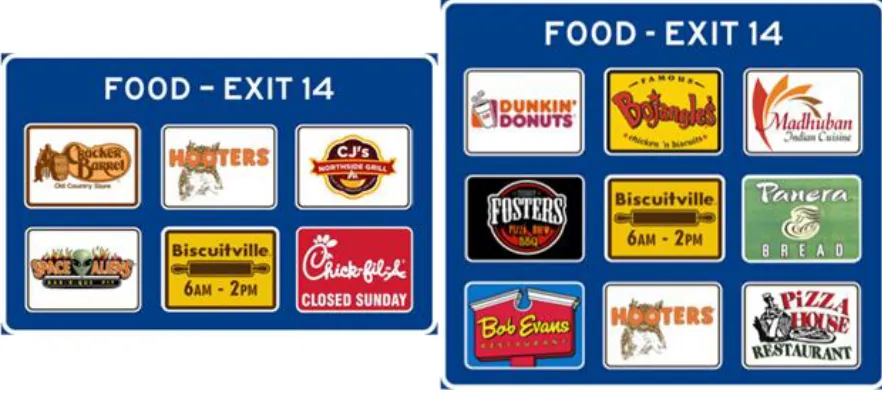
Two controlled manipulations were assessed in the present study, including: age group and driver visual workload. Age groups were classified as young, middle-aged, and elderly (as described above). The logo sign configuration as part of the embedded secondary task (i.e., 6 vs. 9 panels) was used as the manipulation of visual workload (see Fig. 4).
Figure 4: Example 6- and 9-Panel Logo Signs
2.6 Dependent variables
19
Similarly, participants were instructed to maintain the same lane throughout experiment trials. The absolute lane deviation from the center of the lane was recorded as an indicator of driver performance decrements due to the workload manipulation. Blink duration was used as indicator of mental workload across the primary driving task and secondary logo sign detection task (given the signage manipulation).
The physiological response measure of blink duration was normalized in order to account for individual differences in blinking behavior. The blink duration measures collected during signage exposure were normalized for each participant by using the following equation:
Normalized Blink Duration (ratio) =𝑂𝑏𝑠𝑒𝑟𝑣𝑒𝑑 𝐷𝑢𝑟𝑎𝑡𝑖𝑜𝑛 −𝑀𝑎𝑥 𝐼𝑛𝑑𝑖𝑣𝑖𝑑𝑢𝑎𝑙 𝐷𝑢𝑟𝑎𝑡𝑖𝑜𝑛
𝑀𝑎𝑥 𝐼𝑛𝑑𝑖𝑣𝑖𝑑𝑢𝑎𝑙 𝐷𝑢𝑟𝑎𝑡𝑖𝑜𝑛
Within each of the eight test trials, segments of roadway were identified in which drivers were not exposed to on-road signage or any other factors influential in driving
performance, such as curves. Driver maximum blink duration was identified for each of these segments and the max of the maximum durations was found across all eight test trials. This value was used as the normalization factor in the above equation for each individual driver. After normalization and removal of abnormal data points, as described below in the
20 2.7 Experimental design
The present study followed a 3 x 2 mixed experiment design with one between- and one within-subject factor. Age group served as a grouping variable and visual workload was the within-subject factor. In Zahabi et al. (2016) study, each participant completed one training scenario and eight test trials. As mentioned above, for the purpose of this study, only four trials from each participant were used for analysis. All participants were exposed to both levels of workload and each specific workload condition was replicated (i.e., the 6- and 9-panel logo sign configurations) for a participant. The test trial order for each participant was randomized. The statistical model for the present study is as follows:
Yijklrm = µ + αi + βj + δk(i) + (αβ)ij + (βδ)jk(i) +eijklr
where µ= Grand mean; m= Dependent variable (1..3); αi= Age Group effect (i=1...3); βj= Workload effect (j=1...2); δ= Participant nested in Age Group (k=1…60); (αβ)ij= Main interaction effect; (βδ)jk(i)= interaction effect; r= replication (1, 2); eijklr= error term
2.8 Procedures
2.8.1 Demographic Questionnaire
The participants were presented with a consent form at the beginning of the experiment. Once they agreed to participate, a brief demographic questionnaire was
21
2.8.2 Simulator Sickness Questionnaire
After the demographic questionnaire was completed, a simulator sickness questionnaire (SSQ; Kennedy et al., 1993), covering 16 different symptoms was administered. Participants were asked to provide ratings from 0 to 4 for each one of the symptoms, where 0 represented no symptom and 4 represented severe symptoms at the specific moment. This questionnaire was repeatedly administered during the course of experiment between every two test trials. In case a participant presented simulator sickness symptoms that exceeded their baseline responses, a 20-minute break was provided. If the symptoms persisted, his or her participation was terminated and the participant was compensated for any time provided.
2.8.3 Training Scenario
22
2.8.4 Experiment
Once participants passed the training session, the experiment trials began. Before each trial, food and attraction business targets were presented to drivers. An example of a Dunkin’ Donuts business panel is shown below in Figure 5. The experiment scenarios presented a rural Interstate with three interchanges spaced 3 miles from each other. Before each interchange, there were three logos panel signs (lodging, food, and gas/attraction). Each target presented to a participant was unique and only appeared once within the particular scenario; that is, the target logo was only present at one interchange but not at the two other interchanges in the scenario. However, participants were not informed of this scenario manipulation in advance of test trials; the participants were informed that they might
encounter the business target more than once in order to keep them focused throughout a test trial, regardless of target placement.
Participants were asked to drive each scenario and verbally indicate whether the target logo was present in the specific service signs adjacent to the interstate. Three responses were gathered for each target within every scenario (i.e., a “present” or “absent” response at each interchange). Similar to the training scenario, participants were instructed to maintain 65 mph and stay in the right lane of the freeway without using any exits, even when a target was spotted.
23
the simulated vehicle began to obstruct the sign) (Zhang et al., 2013). An illustration of an observation period is presented below in Figure 5. Based on this information, the period of driver performance observation or data collection window was dependent on vehicle location and not based on trial time. During the 538 feet of observation, participant driving
performance measures (speed and lane position) and eye-tracking were recorded. As
mentioned above in the prior study and experimental design sections, the Zahabi et al. (2016) study included eight trials for each participant but for the purpose of this study, only four trials presenting a familiar pictorial food logo (Dunkin’ Donuts) were analyzed.
Figure 5: Observation Period within Scenarios
24 2.9 Statistical Data Analyses
As mentioned above, only those experiment trials presenting familiar food panels for which drivers were successful in target detection were analyzed as part of the present study. This was necessary to ensure that any workload or performance response measures actually reflected the cost of driver effective use of specific service signs. After extraction and
exclusion of incomplete trial results and trials that did not fit the aforementioned criteria, 635 observation periods were available for analysis. Outliers and abnormal data were removed prior to data analysis. Only observations with speed deviations below the 65 mph posted limit were examined in order to ensure that the response measure reflected adaptive driver behavior. Out of the three dependent measures, abnormal data points in both speed and lane deviation were identified and removed by application of Cook’s D Method. The first step as part of this method involves highly influential point identification. Data points were
identified as being highly influential if the Cook’s D value were above 4/n, where n is the number of observations. These influential points were further examined. Influential points of speed deviation were removed if values were above 10 mph (n=5). Lane deviation influential points were removed if values were above 3 ft (n=8).
25
tracker or participant failure to follow instructions and lack of attention to roadway signage. Since each specific target appeared only once among three similar specific service signs presented during each trial, it is possible that individual participants managed to make correct responses in the absence of a target without actually visually scanning a sign, as instructed.
For ease of reader understanding and formatting of graphs, the absolute value of the blink duration ratio was used for presentation of results. Therefore, the final form of the measure had a scale from 0 to 1. The value of 1 indicated that a participant did not blink during the target observation time period and a value of 0 indicated that drivers were very relaxed during the target observation period (low workload exposure). In general, the higher the blink duration ratio value, the higher the cognitive demand.
After removal of outliers, diagnostics were conducted on all dependent variables to ensure analysis of variance (ANOVA) assumptions of homoscedasticity and residual normality were satisfied by the data sets. Variance homoscedasticity was examined using Bartlett’s tests and residual normality was assessed by inspection of normal probability plots and the Shapiro-Wilk normality test.
Mixed between- and within-subject ANOVA models (as shown above) were
26
Duncan's Multiple Range Test (MRT) was conducted to identify differences among the levels of any significant effects.
Among all three types of initial responses, only the lane deviation measure met the parametric test assumptions. Both speed deviation and normalized blink duration ratio required transformation to meet the ANOVA assumptions. Both sets of data were subjected to exponential transformation to the power of lambda, as identified in the Box-Cox method. Transformation of the speed deviation response to the power of 0.3 was successful. The transformed normalized blink duration ratio data set failed to meet the parametric test assumptions and was further subjected to average rank transformation. Finally, correlation analyses were conducted to identify any relationship between driving performance, driver adaptation behavior and cognitive workload. Due to the fact that two-out-of-three raw responses failed to meet the normality criteria, nonparametric Spearman’s Rank correlation analyses were conducted. A significance level of p ≤ 0.05 was set as the significance criterion for the study.
3. Result
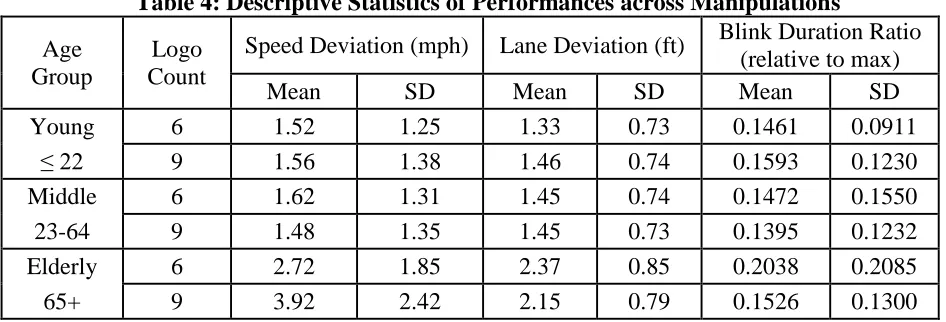
Table 4 presents the descriptive statistics of the three dependent measures across the independent variables of age group and logo count. Outliers were removed prior to
27
Table 4: Descriptive Statistics of Performances across Manipulations Age
Group
Logo Count
Speed Deviation (mph) Lane Deviation (ft) Blink Duration Ratio (relative to max)
Mean SD Mean SD Mean SD
Young 6 1.52 1.25 1.33 0.73 0.1461 0.0911
≤ 22 9 1.56 1.38 1.46 0.74 0.1593 0.1230
Middle 6 1.62 1.31 1.45 0.74 0.1472 0.1550
23-64 9 1.48 1.35 1.45 0.73 0.1395 0.1232
Elderly 6 2.72 1.85 2.37 0.85 0.2038 0.2085
65+ 9 3.92 2.42 2.15 0.79 0.1526 0.1300
3.1 Adaptation Behavior
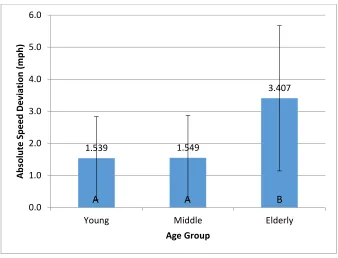
As mentioned above, the speed deviation response was subjected to exponential transformation to the power of 0.3 before conforming to the assumptions of the ANOVA model. Trial number was not significant in effect with p>0.05 and the term subsequently removed from the statistical model. The main effect of logo panel count (F(1,378)=0.0615, p=0.8043, β=0.0570) and its interaction with age group (F(2, 378)=1.8673, p=0.1560, 1-β=0.3882) were both found to be insignificant. The main effect of age group, on the other hand, was found to be significant (F(2, 378)=43.3069, p<0.0001, 1-β=1.00). Duncan’s MRT was conducted on the age group effect. Results revealed middle-aged and young drivers to exhibit similar speed deviations, while elderly drivers exhibited significantly greater
28
Figure 7: Effect of Age Group on Speed Deviation 3.2 Driving Performance
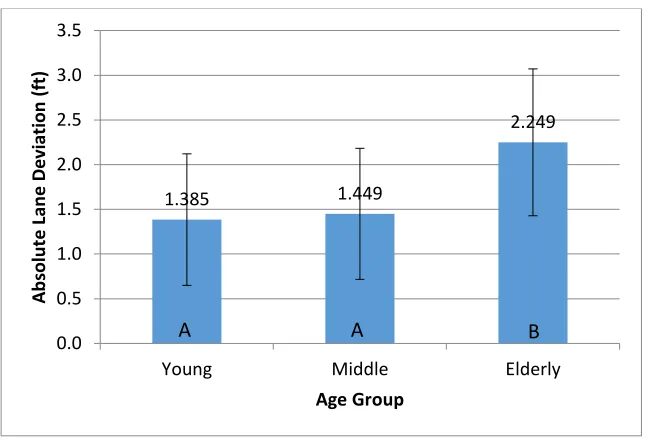
The trial number effect was found to be significant in the model for lane deviation (F(1,567)=14.1517, p=0.0002, 1-β=0.9637) while the main effect of logo panel count (F(1, 567)=0.0039, p=0.9504, 1-β=0.0504) and its interaction with age group (F(2, 567)=0.2019, p=0.8173, 1-β=0.0815) were insignificant. It is possible that driver vehicle lateral control may have continued to improve through the course of the experiment test trials following the training session. The main effect of age group was the only effect of interest that was found to be significant (F(2, 567)=74.3759, p<0.0001, 1-β=1.00). Duncan’s MRT was conducted on the age group effect. Result revealed middle-aged and young driver performance to be similar, while elderly drivers exhibited significantly worse lane deviations. Figure 8 presents the trend of the response measure across age groups. Elderly drivers demonstrated
1.539 1.549 3.407 0.0 1.0 2.0 3.0 4.0 5.0 6.0
Young Middle Elderly
29
significantly worse vehicle control when visual search of off-road targets was required; that is, the performance cost of successful signage use was greater for this age group.
Figure 8: Effect of Age Group on Lane Deviation 3.3 Cognitive Workload
The normalized blink duration ratio was the only dataset that required rank averaged transformation. As described above, the absolute value of blink duration was analyzed in this study as a basis for generating workload results. Due to this transformation, although
cognitive workload has been indicated by a decrease in blink duration, an increase in the blink duration ratio measure is indicative of an increase in driver cognitive load. The trial number effect was found to be significant in the model (F(1,491)=12.8791, p=0.0004, β=0.9476) while the main effect of logo panel count (F(1, 491)=0.1103, p=0.7400,
1-β=0.0627) and its interaction with age group (F(2, 491)=0.2677, p=0.7653, 1-β=0.0923) were found to be insignificant. It is possible that driver experience of cognitive workload from target identification task may have continued to decrease through the course of the
1.385 1.449 2.249 0.0 0.5 1.0 1.5 2.0 2.5 3.0 3.5
Young Middle Elderly
30
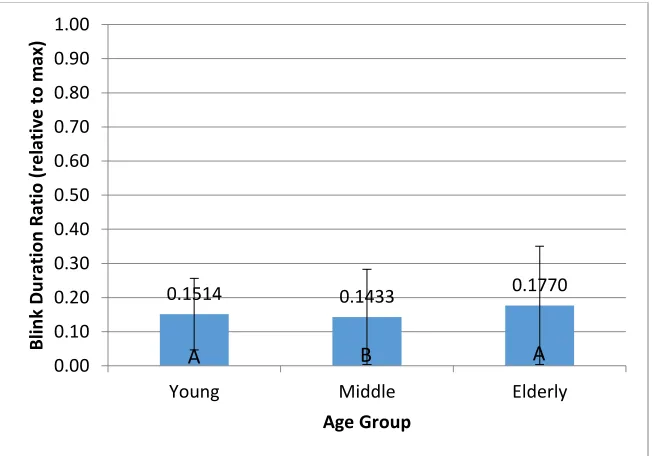
experiment test trials following the training session. The main effect of age group was the only effect of interest that was found to be significant (F(2, 491)=3.6559, p=0.0265, 1-β=0.6730). Duncan’s MRT was conducted on age group effect. Results indicated that blink duration ratios for elderly and young driver were both significantly higher than for middle-aged drivers. That is, the elderly and young driver age groups exhibited signs of significantly higher cognitive workload in response to target identification (higher blink duration ratio) than middle-aged drivers. Illustration of response trend across age group is provided in Figure 9. Although the difference between the age groups may not seem very large in numerical terms, the nature of the response measure (a ratio relative to individual max blink duration during normal driving without additional roadway distraction) was of a limited range (0 to 1) and the large deviation within age group should be taken into account in interpretation of the results.
Figure 9: Effect of Age Group on Absolute Normalized Blink Duration Ratio
0.1514 0.1433 0.1770
0.00 0.10 0.20 0.30 0.40 0.50 0.60 0.70 0.80 0.90 1.00
Young Middle Elderly
31 3.4 Correlation Analysis
Since the majority of the dependent variable datasets did not meet parametric test assumptions, nonparametric Spearman correlation analyses were used to identify any relations among the response measures. Regarding driving performance and adaptation behavior, lane deviation had a positive relationship with speed deviation (Spearman p=0.1925, p<.0001), as expected. In general, as driving performance degrades, drivers exhibit greater adaptation behavior. A positive correlation was also found between blink duration ratio and lane deviation. Higher cognitive workload (higher blink duration ratio value) was correlated with greater performance degradation (greater lane deviation) (Spearman p=0.1066, p=0.0129). However, no correlation was found between cognitive workload and adaptation behavior (p>0.05).
One possible explanation for the absence of a relation between cognitive load and adaptation behavior is the fact that there was no apparent effect of the logo count
32
4. Discussion
Returning to the expectations of this research study, Hypotheses 1-3 were all centered on the notion that greater density of external visual information on a freeway would increase driver task difficulty and compromise performance. It was hypothesized that more logo panels in freeway specific service signs, would lead to increases in mental workload (Hypothesis 1), driver adaptation behavior (Hypothesis 2), and performance degradations (Hypothesis 3) across all age groups. It was also expected that such effects would be most pronounced for elderly and younger drivers in comparison to the middle-aged group.
Surprisingly, these particular expectations were not supported by the study results. There was no main effect of logo panel count on all three statistical models of driver performance, adaptation and workload. However, a similar trend was observed in the prior study by Zahabi et al. (2016) where accuracy of signal detection responses only marginally decreased (~1%) from 6 to 9 logo panels when drivers attempted to detect familiar targets. The 9-panel specific service sign configuration does not appear to have a significant effect on driving behaviors when drivers are simultaneously driving and performing familiar target detection. The experimental workload manipulation may not have been sufficient to cause changes in visual attention for drivers. In the case of elderly drivers, it is also possible that no
differences were observed between six and nine panels as a result of drivers already being attentionally challenged by six panels.
33
group and possibly comparable outcomes to younger drivers. Hypotheses 4, 5, and 6 were all supported by the study results. The elderly drivers were observed to have comparable
cognitive workload to young drivers during target identification on freeways. Result revealed young and elderly drivers to exhibit significantly higher cognitive workload (higher blink duration ratio) in comparison to middle-aged drivers (see Fig. 9). Elderly drivers exhibited significantly greater adaptation behaviors (highest speed deviations), performance
degradations (highest lane deviations) during target identification in comparison to the other age groups. Graphical interpretation of Figure 7 and 8 indicated that adaptation behavior increased (greater speed reduction) and vehicle control degraded (higher lane deviations) as age increased.
Based on the correlation analyses, it was discovered that as the cognitive workload of drivers increased, performance degradations (lane deviation) also increased. No previous study has examined the correlation between driver cognitive workload, based on real-time eye activity measures in the use of on-road signage, and lane deviations. However, a previous driving study that involved navigational challenges (search for off-road signs or landmarks, such as service station) and measured the standard deviation of lane position, revealed similar results (Trick et al., 2010). The addition of the navigation challenge (which increased driver cognitive workload) led to significantly larger lane deviations than trials in which
participants were not asked to find their way. Another driving study by Cooper, Medeiros-Ward, and Strayer (2013) revealed contradictory findings, specifically an increase in driver cognitive workload, induced by a non-visual secondary task (i.e., digit
34
vehicle position. This contradiction of results, as pointed out by the authors, was attributed to the application of a secondary task that did not include a visual component. Additional driving research is recommended to explore the relationship between visual attentional demands and vehicle control variability. In general, the previous research suggests that higher driver cognitive workload impacts lateral vehicle position deviation in some way.
The relationship of driver cognitive load and vehicle control is intriguing when considered with the ANOVA findings of the present study. Although drivers were not sensitive to visual workload manipulations, it is possible that the cumulative workload of primary and secondary tasks might have contributed to performance issues. Young and elderly drivers both experienced significantly higher cognitive workload than middle-aged drivers, yet, elderly drivers were the only age group that demonstrated significantly worse driving performance during target identification. The young drivers did not exhibit
significantly greater vehicle control degradations as one might expect. This phenomenon suggests that either young drivers are more resilient to cognitive workload demands induced by secondary driving tasks or that elderly drivers are more susceptible to the negative effects of high cognitive workload. Middle-aged drivers appear to be robust to both cognitive workload induced by multitasking and the associated performance cost.
35
findings of the Zahabi et al. (2016) study, as summarized in Table 3. That study
demonstrated high overall target detection and rejection accuracy for young and middle-aged drivers. Elderly drivers showed signal detection accuracies about 10-15% less than the other age groups. However, for the condition in which a logo target was present on a specific service sign, the rate of elderly driver correct identification was only 54-57%. That is to say that nearly half of the elderly licensed drivers in the Zahabi et al. (2016) study could not identify targets on freeway signs even with extra response time gained through adaptive control behaviors. Although the adaptation behaviors and performance degradations of elderly drivers observed during this study (i.e., successful target detections) were
significantly higher than drivers of other ages, the differences between age groups were not as extreme as one might predict. Considering the present set of results, and the large
differences in target detection accuracy identified by Zahabi et al. (2016), the data strongly suggest that elderly drivers are much more likely to abandon secondary task goals (e.g., target search) in order to focus on primary driving goals, including vehicle control, as compared with other age groups.
5. Conclusion
36
negative impact on driver behavior and workload when performing familiar target detection. Although the signage manipulation did not lead to changes in driver performance and workload, there were age-related differences among these measures. Elderly drivers aged 65 years and above appear to require additional time to effectively monitor the roadway
environment due to age-related declines in various abilities. They exhibit significantly greater adaptive vehicle control behaviors than younger drivers. Although young and elderly drivers both experience significantly higher cognitive workload than middle-aged drivers, elderly drivers demonstrated significantly worse performance than all other age groups when attempting to detect familiar sign targets. Related to this, the rate at which elderly drivers correctly identify targets on six logo panels, even when adapting vehicle control, is as low as 54.29%. These findings raise concerns about the design of existing highway systems for accommodation of elderly driver capabilities. Additional driving simulator studies should be conducted on elderly driver target information acquisition under normal roadway conditions in order to determine if accuracy levels are in line with the present results.
37
38
6. References
Andrews, E., & Westerman, S. (2012). Age differences in simulated driving performance: Compensatory processes. Accident Analysis & Prevention, 45, 660-668.
doi:10.1016/j.aap.2011.09.047
Ball, K., Owsley, C., Stalvey, B., Roenker, D. L., Sloane, M. E., & Graves, M. (1998). Driving avoidance and functional impairment in older drivers. Accident Analysis & Prevention, 30(3), 313-322.
Benedetto, S., Pedrotti, M., Minin, L., Baccino, T., Re, A., & Montanari, R. (2011). Driver workload and eye blink duration. Transportation Research Part F: Traffic
Psychology and Behaviour, 14(3), 199-208. doi:10.1016/j.trf.2010.12.001
Bunce, D., Young, M. S., Blane, A., & Khugputh, P. (2012). Age and inconsistency in driving performance. Accident Analysis & Prevention, 49, 293-299.
doi:10.1016/j.aap.2012.01.001
Cantin, V., Lavallière, M., Simoneau, M., & Teasdale, N. (2009). Mental workload when driving in a simulator: Effects of age and driving complexity. Accident Analysis & Prevention, 41(4), 763-771. doi:10.1016/j.aap.2009.03.019
Cooper, J. M., Medeiros-Ward, N., & Strayer, D. L. (2013). The Impact of Eye Movements and Cognitive Workload on Lateral Position Variability in Driving. Human Factors: The Journal of the Human Factors and Ergonomics Society, 55(5), 1001-1014.
39
Dagnall, E.E., Katz, B.J., Bertola, M.A., and Shurbutt, J. (2013). Business logo signing evaluation of the number of logo panels on specific service signs. Transportation Research Record, 2365, 82-89.
Dissanayake, S. (2004). Comparison Of Severity Affecting Factors Between Young And Older Drivers Involved In Single Vehicle Crashes. IATSS Research, 28(2), 48-54. doi:10.1016/s0386-1112(14)60108-4
Evans, D. W., & Ginsburg, A. P. (1985). Contrast Sensitivity Predicts Age-Related
Differences in Highway-Sign Discriminability. Human Factors: The Journal of the Human Factors and Ergonomics Society, 27(6), 637-642.
(FHWA) Federal Highway Administration. (2009). Manual on Uniform Traffic Control Devices for Streets and Highways (MUTCD), 2009 Edition. U.S. Department of
Transportation, Washington, DC.
Fofanova, J., & Vollrath, M. (2011). Distraction while driving: The case of older drivers. Transportation Research Part F: Traffic Psychology and Behaviour, 14(6), 638-648.
Ho, G., Scialfa, C. T., Caird, J. K., & Graw, T. (2001). Visual Search for Traffic Signs: The Effects of Clutter, Luminance, and Aging. Human Factors: The Journal of the Human Factors and Ergonomics Society, 43(2), 194-207.
doi:10.1518/001872001775900922
Horberry, T., Anderson, J., Regan, M. A., Triggs, T. J., & Brown, J. (2006). Driver
40
Horrey, W. J. & Wickens, C. D. (2004). Driving and side task performance: the effects of display clutter, separation, and modality. Human Factors, 46(4), 611-624.
Hummer, J.E. (1989). Supplemental interchange signing and driver control behavior. Transportation Research Record, 1213, 56-63.
Janicak, C. A. (2003). Differences in relative risks for fatal occupational highway transportation accidents. Journal of Safety Research, 34(5), 539-545. doi:10.1016/j.jsr.2003.05.005
Kaber, D., Zhang, Y., Jin, S., Mosaly, P., and Garner, M. (2012). Effects of hazard exposure and roadway complexity on young and older driver situation awareness and
performance. Transportation Research Part F, 15, 600-611.
Kaber, D., Pankok, Jr., C., Corbett, B., Ma, W., Hummer, J., and Rasdorf, W. (2015). Driver behavior in use of guide and logo signs under distraction and complex roadway conditions. Applied Ergonomics, 47, 99-106.
Kass, S. J., Cole, K. S., & Stanny, C. J. (2007). Effects of distraction and experience on situation awareness and simulated driving. Transportation Research Part F: Traffic Psychology and Behaviour, 10(4), 321-329.
Kennedy, R. S., Lane, N. E., Berbaum, K. S., and Lilienthal, M. G. (1993). Simulator Sickness Questionnaire: An Enhanced Method for Quantifying Simulator Sickness. The International Journal of Aviation Psychology, 3(3), 203-220.
Lyman, S., Ferguson, S. A., Braver, E. R., & Williams, A. F. (2002). Older driver
41
Makishita, H., & Matsunaga, K. (2008). Differences of drivers’ reaction times according to age and mental workload. Accident Analysis & Prevention, 40(2), 567-575.
doi:10.1016/j.aap.2007.08.012
Marquart, G., Cabrall, C., & Winter, J. D. (2015). Review of Eye-related Measures of Drivers’ Mental Workload. Procedia Manufacturing, 3, 2854-2861.
doi:10.1016/j.promfg.2015.07.783
Mcknight, A., & Mcknight, A. (1999). Multivariate analysis of age-related driver ability and performance deficits. Accident Analysis & Prevention, 31(5), 445-454.
doi:10.1016/s0001-4575(98)00082-7
Newgard, C. D. (2008). Defining the “older” crash victim: The relationship between age and serious injury in motor vehicle crashes. Accident Analysis & Prevention, 40(4), 1498-1505. doi:10.1016/j.aap.2008.03.010
(NHTSA) National Highway Traffic Safety Administration. (2014, December). 2013 motor vehicle crashes: Overview (Rep. No. DOT HS 812 101). Retrieved from http://www-nrd.nhtsa.dot.gov/Pubs/812101.pdf.
Niezgoda, M., Tarnowski, A., Kruszewski, M., & Kamiński, T. (2015). Towards testing auditory–vocal interfaces and detecting distraction while driving: A comparison of eye-movement measures in the assessment of cognitive workload. Transportation Research Part F: Traffic Psychology and Behaviour, 32, 23-34.
42
Ortman, J. M., Velkoff, V. A., & Hogan, H. (2014, May 6). An Aging Nation: The Older Population in the United States (Rep. No. P25-1140). Retrieved
http://www.census.gov/library/publications/2014/demo/p25-1140.html
Platten, F., Milicic, N., Schwalm, M., & Krems, J. (2013). Using an infotainment system while driving – A continuous analysis of behavior adaptations. Transportation Research Part F: Traffic Psychology and Behaviour, 21, 103-112.
doi:10.1016/j.trf.2013.09.012
Recarte, M. A., Perez, E., & Nunes, L. M. (2008). Mental Workload and Visual Impairment: Differences between Pupil, Blink, and Subjective Rating. The Spanish Journal of Psychology, 11(2), 374-385.
Reimer, B., Mehler, B., Wang, Y., & Coughlin, J. F. (2012). A Field Study on the Impact of Variations in Short-Term Memory Demands on Drivers' Visual Attention and Driving Performance Across Three Age Groups. Human Factors: The Journal of the Human Factors and Ergonomics Society, 54(3), 454-468. doi:10.1177/0018720812437274
Robertson, R., & Vanlaar, W. (2008). Elderly drivers: Future challenges? Accident Analysis & Prevention, 40(6), 1982-1986. doi:10.1016/j.aap.2008.08.012
Rodrick, D., Bhise, V., & Jothi, V. (2013). Effects of Driver and Secondary Task
Characteristics on Lane Change Test Performance. Human Factors and Ergonomics in Manufacturing & Service Industries Hum. Factors Man., 23(6), 560-572.
43
Stamatiadis, N., & Deacon, J. A. (1995). Trends in highway safety: Effects of an aging population on accident propensity. Accident Analysis & Prevention, 27(4), 443-459. doi:10.1016/0001-4575(94)00086-2
Tefft, B. C. (2012, November). Motor Vehicle Crashes, Injuries, and Deaths in Relation to Driver Age: United States, 1995 – 2010 (Rep.). Retrieved
https://www.aaafoundation.org/sites/default/files/OlderDriverRisk FINAL.pdf Trick, L. M., Toxopeus, R., & Wilson, D. (2010). The effects of visibility conditions, traffic
density, and navigational challenge on speed compensation and driving performance in older adults. Accident Analysis & Prevention, 42(6), 1661-1671.
doi:10.1016/j.aap.2010.04.005
Tsai, Y., Virre, E., Strychacz, C., Chase, B., & Jung, T. (2007). Task Performance and Eye Activity: Predicting Behavior Relating to Cognitive Workload. Aviation, Space, and Environmental Medicine, 78, B176-B185(10).
Van Orden, K. F., Limbert, W., Makeig, S., & Jung, T. (2001). Eye Activity Correlates of Workload during a Visuospatial Memory Task. Human Factors: The Journal of the Human Factors and Ergonomics Society, 43(1), 111-121.
Veltman, J., & Gaillard, A. (1996). Physiological indices of workload in a simulated flight task. Biological Psychology, 42(3), 323-342. doi:10.1016/0301-0511(95)05165-1 Verster, J. C., & Roth, T. (2013). Effects of central nervous system drugs on driving: Speed
44
Wood, J., Chaparro, A., & Hickson, L. (2009). Interaction between visual status, driver age and distracters on daytime driving performance. Vision Research, 49(17), 2225-2231. doi:10.1016/j.visres.2009.06.017
Zahabi, M., Machado, P., Pankok Jr, C., Lau, M., Liao, Y., Hummer, J., Rasdorf, W., Kaber, D.B. (in review). The Effects of Age, Number, Familiarity, and Format of Specific Service Sign Panels on Driver Performance and Attention Allocation. To appear in Applied Ergonomics Journal.
Zhang, Y., Harris, E., Rogers, M., Kaber, D., Hummer, J., Rasdorf, W., and Hu, J. (2013). Driver distraction and performance effects of highway logo sign design. Applied Ergonomics, 44, 472-479.
45
46
Appendix A Scenario Setup
Signs before Interchange
3 Logo Signs per interchange o Lodging (100% familiar) o Food (33% unfamiliar and 67%
familiar)
o Gas (100% familiar) /Attraction (100% unfamiliar)
2 Advance Guide Signs per interchange o 1 mile before exit ramp
o ½ mile before exit ramp 1 Exit Direction Guide Signs per
interchange
o Directly before exit ramp
Signs after Interchange
4 signs after each interchange o Merge Sign
47
Appendix B Demographic Questionnaire Driver Background Questionnaire (DBQ)
Please check one box only (for multiple choice questions) unless otherwise indicated. Section A: Demographic
1. Name (e.g., first last): _______________ ________________ 2. Please write your age in years: _________________________
3. Please select your gender: Male ☐ Female ☐ 4. Please write your current corrected vision (e.g., 20/20):
Left __________ Right ___________
Section B: Driving Experiences
5. Please write the year when you obtained your full license? __________ 6. About how many days per week do you drive nowadays?
a. 1-2 days per week ☐ b. 3-4 days per week ☐ c. 5-6 days per week ☐
d. Everyday ☐
7. Estimate roughly how many miles you personally have driven in the past year: a. Less than 5,000 miles ☐
b. 5,000-10,000 miles ☐ c. 10,000 – 15,000 miles ☐ d. 15,000 – 20,000 miles ☐ e. Over 20,000 miles ☐
8. Please state which of these types of road you use frequently (check one or more boxes as appropriate):
48
b. Other main roads ☐
c. City streets ☐
d. Country two-lane roads ☐
9. During the last three years, how many minor road accidents have you been involved in?
(A minor accident is one in which no-one required medical treatment, AND cost of damage to vehicles and property were $1,000 or less).
Number of minor accidents ____ (if none, write 0)
10.During the last three years, how many major road accidents have you been involved in?
(A major accident is one in which EITHER someone required medical treatment, OR costs of damage to vehicles and property were greater than $1,000, or both).
Number of major accidents ____ (if none, write 0)
11.During the last three years, have you ever been convicted of DRIVING UNDER INFLUENCE OF ALCOHOL OR DRUGS?
Yes ☐ No ☐
a. If yes, how many times did this occur? ______________
12.During the last three years, have you received a ticket for CARELESS OR DANGEROUS DRIVING?
Yes ☐ No ☐
a. If yes, how many times did this occur? ______________
49 Yes ☐ No ☐
a. If yes, how many times did this occur? ______________
14.During the last three years, have you received a ticket for OTHER MOVING VIOLATION?
Yes ☐ No ☐
a. If yes, please specify ____________
b. If yes, how many times did this occur? ______________
Section C: Video Game Experience
15.How many hours per week do you play video games? _________________ hours per week.