Dynamic Crack Analysis of Anisotropic Solids Under Impact Loading
Ch. Zhang 1), A. Savaidis 2) and G. Savaidis 3)
1) Department of Civil Engineering, Hochschule Zittau/GSrlitz, University of Applied Sciences, D-02763 Zittau, Germany
2) Department of Mechanics, National Technical University of Athens, GR-15773 Athens, Greece
3) Department for Fatigue and Testing of Materials and Components (TEB), MAN Commercial Vehicles, D-80995 Munich, Germany
A B S T R A C T
Transient dynamic crack analysis of anisotropic solids is performed by using a two-dimensional (2-D) time-domain boundary integral equation method (BIEM). An infinite, homogeneous, anisotropic and linearly elastic solid con- taining a finite crack under an impact crack-face loading is considered. A numerical solution procedure is presented for solving the hypersingular time-domain traction BIEs. A convolution quadrature formula for temporal approxi- mation and a Galerkin m e t h o d for spatial discretization are applied. T h e efficiency and the accuracy of the present time-domain B I E M are verified numerically by test examples.
I N T R O D U C T I O N
Transient d y n a m i c crack analysis of anisotropic solids is of particular interest to fracture mechanics and quantitative non-destructive testing. D u e to the mathematical complexity involved, most of previous investigations on the subject were limited to transversely isotropic or orthotropic solids. In this paper, transient d y n a m i c crack analysis for gener- ally anisotropic elastic solids is presented. A finite crack in an infinite, homogeneous, anisotropic and linearly elastic solid subjected to an impact crack-face loading is considered. Two-dimensional plane strain or plane stress condition is assumed. Following the procedure applied in [I] and [2], the initial-boundary value problem is formulated as a set of hypersingualr time-domain traction b o u n d a r y integral equations (BIEs) with the crack-opening-displacements ( C O D s ) as u n k n o w n quantities. T h e hypersingular integrals are understood as H a d a m a r d finite-part integrals. A numerical solution procedure is developed for solving the hypersingular time-domain traction BIEs. T h e m e t h o d uses a convolution quadrature formula of Lubich [3] for approximating temporal convolution and a Galerkin m e t h o d for spatial discretization of the time-domain BIEs.
A special feature of the present time-domain B I E M is that it uses the Laplace-domain instead of the m o r e complex time-domain Green's functions which are c o m m o n l y applied in the conventional time-domain b o u n d a r y element m e t h o d ( B E M ) . Thus, an explicit expression of the time-domain Green's functions is not required in the present method. T h e required Laplace-domain Green's functions are expressed as Fourier integrals. T h e u n k n o w n C O D s are e x p a n d e d into a series of C h e b y s h e v polynomials of second kind, and the local behavior of the C O D s at crack-tips is described properly in the method. B y applying the convolution quadrature formula of Lubich [3] for temporal and a Galerkin m e t h o d for spatial discretization, a system of linear algebraic equations is obtained which can be solved numerically time-step by time-step. T h e arising system matrices are symmetric, real-valued, and can be c o m p u t e d very efficiently by using Fast Fourier Transform (FFT). N o special technique is needed in the m e t h o d for evaluating hypersingular integrals. D y n a m i c stress intensity factors can be c o m p u t e d very accurately from the numerically calculated C O D s . T h e m e t h o d is highly accurate and efficient. Special attention of the analysis is devoted to the numerical computation of time-dependent d y n a m i c stress intensity factors.
T i m e - d o m a i n B E M / B I E M analysis of anisotropic solids has been presented by Albuqerque et al. ([4]-[6]), KSgl and Gaul [7] using dual reciprocity B E M and static Green's functions, Nishimura et al. [8], W a n g et al. [9], and Hirose et al. [10] using time-domain Green's functions [11], and Zhang ([11, [21) using Laplace-domain Green's functions.
P R O B L E M F O R M U L A T I O N A N D T I M E - D O M A I N B I E S
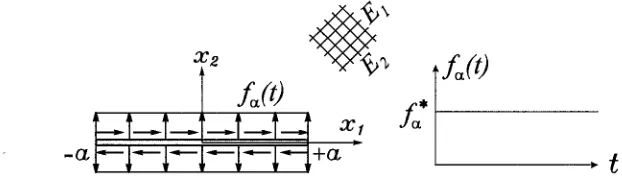
W e consider a finite crack of length 2a in an infinite, homogeneous, anisotropic and linearly elastic solid as s h o w n in Fig. I. A n impact crack-face loading is applied, and generalized 2-D plane strain or plane stress is assumed. W i t h o u t b o d y forces, the cracked anisotropic solid satisfies the equations of motion
SMiRT 16, Washington DC, August 2001 Paper # 1981
- a
X2
X!
- - + a
L(O
Fig. 1: A finite crack in an infinite anisotropic solid
- t
the Hooke's law
the initial conditions
{ 11} [Cll c12 ClO]{ }
.0"22 -- C21 C22 C22 (22 ,
O"12 C16 C26 C66 2(~12
~ ( x , t) - % (x, t) - o,
(2)
t - O , (3)
and the traction boundary conditions on the crack-faces
~ 9 (x, t)~e (x) - f~ (x, t),
x e r e . (4)Here, crsZ, e~Z a n d us denote the stress, the strain a n d the displacement c o m p o n e n t s , p is the m a s s density,
Cij
(i, j - I, 2, 6) is the elasticity matrix, fs(x, t) is the traction vector, nz is the unit n o r m a l vector, a n d Fc - Fc + + F c are the upper a n d the lower crack-faces, respectively. T h r o u g h o u t the analysis, a c o m m a after a quantity stands for partial derivatives with respect to spatial variables, superscript dots represent temporal derivatives with respect to time, the conventional s u m m a t i o n rule over double indices is implied, a n d G r e e k indices take the values 1 a n d 2.T h e displacements can be represented by a b o u n d a r y integral as
a s Z ~ • A u s n z d s ,
F + c
x ¢ rc + , (5)
where o crsZ ~ are time-domain stress Green's functions, A u s ( y , z) are the crack-opening-displacements (CODs) defined
by
Aus (y, T) -- Uc~ (y e Fc +, T) -- Us (y e F~-, T), (6)
and a n , stands for Riemann convolution
t
g(x, t) • h(x, t) - / g(x, t - T)h(x, T)dT.
o
(7)
Substituting Eq. (5) into Hooke's law (2), taking the limit process x --+ F + and considering the traction boundary conditions (4), time-domain traction BIEs are obtained as
~ z ( x ) f T.ysZ (x , y; t, T) * AuT(y, a T ) d s -- f s ( x , t),
F+ c
x e rc + , (8)
where T~s ~ are time-domain traction Green's functions. a
It should be remarked here that the time-domain traction BIEs (8) are hypersingular. The hypersingular integrals in (8) exist only in the sense of Hadamard finite-part integrals. The present time-domain BIEM applies a Galerkin method for spatial discretization of the hypersingular time-domain BIEs and does not require any special technique for computing the arising hypersingular integrals.
N U M E R I C A L
S O L U T I O N P R O C E D U R E
To solve the hypersingular time-domain traction BIEs (8), the convolution quadrature formula of Lubich [3] is applied for temporal approximation of the convolution integrals, while a Galerkin method is adopted for spatial discretization
of the time-domain BIEs (8). The unknown CODs Au~(y~, r) are expanded into an infinite series as
O0
A u ~ ( y l , 7) -- v i a 2 - y2 E c~;k(T)Uk-1 ( y l / a ) ,
k = l
(9)
where %;k(r) are unknown time-dependent expansion coefficients and g k - l ( y l / a ) are Chebyshev polynomials of
second kind. Substituting Eq. (9) into Eq. (8), multiplying both sides by v / a 2 - x~Ul_~ ( x l / a ) , and integrating with respect to Xl from - a to +a, time-domain Galerkin traction BIEs are obtained as
+ a + a
c o
l
-~--a
- -
f
f o z ( X l ' t ) ~ a 2 -- x 2 V l - l ( x l / a ) d x l ,- - a
1 - 1 , 2 , . . . , c x z . (10)
The application of the convolution quadrature formula of Lubich [3]
t Tb
f ( t ) - g(t) • h(t) - f g ( t - r ) h ( r ) d r ~ f ( n A t ) - E c z ~ _ j ( A t ) h ( j A t ) , (11)
0 j = 0
to Eq. (I0) results in a system of linear algebraic equations for the expanssion coefficients as
n c o
E E A~a;~lc~; k " j - f ~ ; l' ( n - 0 , 1 , . , .. N ; / - 1 , 2 , . . ., c~), (12)
j = O k = l
where the time-variable t is devided into N equal time-steps At, and the superscript indices stand for the time-steps. The system matrix in Eq. (12) corresponds to the integration weights w~_j(At) of the convolution quadrature formula (11). The system matrix A~;3kl and the right-hand side f~;l of Eq. (12) are given by
. r_(n_j) M - 1
= M
m---O
+ a
{ 7ra 2
f~;~ ( - 1 ) ~
I~(x~,n/xt)
2 x21U~_~(x~/a)dXl - ( - 1 ) ~ f 2
x --2--'- - a 0 ,
/ - 1 ,
l # l .
(14)
where
(1-
- , ~ m - - r e 2 ; r i ' m / M(15)
P'~ - At ' 3 "
j - - 1
In this analysis, M - N and r N - v/~ are chosen with e being the numerical error arised in the computation of the
Laplace-domain system matrix -A~;kt(P,~). The Laplace-domain system matrix A~;kg(P,~) can be obtained from Eq. (10)as
-Jr-a + a
, - - T . r ~ 2 ( x l , Y l ; P m ) l a 2 - y~Uk-1 ( y l / a ) d y l d X l .
- - a - - a
(16)
Unlike the conventional time-domain B E M , the present time-domain B I E M applies Laplace-domain instead of time-domain Green's functions. Hence, no explicit expressions of time-domain Green's functions are needed here. T h e Laplace-domain Green's functions ^G T~a¢~ can be expressed as Fourier integrals as given in the Appendix. T h e evaluation of Eq. (13) can be performed very efficiently by using the Fast Fourier Transform (FFT).
B y using the zero initial conditions (3), a time-stepping scheme is obtained from the system of linear algebraic equations (12) as
in which (A°a;k/) -1
be computed numerically from Eq. (17) time-step by time-step.
Substituting the Laplace-domain traction Green's functions ^a T~az, i.e., Eq.
relations
1
f x/1 - ~U~_l (~)P~,d~ - i k-~ ~ J~ (~),
c~-1
the Laplace-domain system matrix fi~;~t(p,~) can be evaluated as
[
n ~ 0 --i
c~;k - (A~;kz)
f~;z-
A~-J cj
( n - 1 2
N)
(17)/=1 j = l "= ~oL;li ~;iJ ' ~ ''"~
T~
represents the inverse matrix of A ° ~a;kl at the time-step n=0. The expansion coefficients c~; k can
(40), into Eq.
J k ( - ~ ) --(--1)kJk(~),
(16) and using the
(~8)
O0
/
1
A~;m(p,~) -
-(Tca)2(kl)i 3(k+l) a.y~(~,p,~)-~Jk(~a)Jt(~a)d{
- - 0 0
(19)
where Jk(') is the Bessel function of first kind and k-th order, and
2
GTa - E F~2;j +
Aj F~2
+ + ;j, (20)j = l
in which
F~2;j
+ and A + are given in the Appendix.For ~ ~ oc, the integrand in Eq. (19) behaves as 1/~ 2 due to the following asymptotics
2
J~(~) ~
~ ,
I~ -~ o~,
I~I ~ Ikl;
G ~ ( ~ , p m ) ~ d ~ , ~ ~ ~ ,(21)
The slow convergency rate 1/~ 2 of the integrand in Eq. (19) is inefficient for numerically computing the Laplace- domain system matrix. To get a better convergency, Eq. (19) is recast into
ftz~;kt - -(7ca)2(kl)i 3(k+l)
G.y~(~,
- - 0 0
1 1
Jk(~a)Jl(~a)d~ + G,,/a [1 + ( - 1 ) k+/+l] k + 1 " (22)
It can be shown that for ~ -+ oc the integrand in Eq. (22) converges much more faster than the corresponding integral of Eq. (19) does, which is numerically advantageous for computing the Laplace-domain system matrix Aza;m(p,~). The infinite integral of (22) is computed numerically by using an adaptive Romberg quadrature method in conjunction with the truncation method.
The Laplace-domain system matrix
fi-y~.kz(P,~)
is symmetric and complex-valued, while the time-domain systemmatrix A~;k t is also symmetric but real-valued. An especially attractive feature of the present time-domain BIEM is that it involves only a single integral to be computed, though the application of a Galerkin method for spatial discretization.
D Y N A M I C S T R E S S I N T E N S I T Y F A C T O R S
For anisotropic solids, the d y n a m i c stress intensity factors are related to the C O D s by [13]
Ki:J:i(t) 4 A H21 H i 2 Xl -''~4-a ~/a ::~ Xl mlt2(Xl, t)
w h e r e K I a n d K I I are m o d e I a n d m o d e II d y n a m i c stress intensity factors, " + " stands for the crack-tips at xl = + a a n d xl = -a, a n d
-i
1
- , A - H l l H 2 2
-
H12H21 ,
(24)H21
/-/22
ITs( ~tlq2-~2ql
) ~ t l
--~t2
ZT/~( ~2pl -~lp2
) ~ t l
--~t2
in which #~ are the complex roots of the material characteristic equation
bi~# 4 - 2b~6# a + (2b12 + 566)# 2 - 2b26# + b22 = 0, (25)
with bij (i, j = 1, 2, 6) being the material compliance matrix, and
Substitution of Eq. (9) into Eq. (23) and the use of the identity [12]
Uk-1 (+1) = (+1) a - l k (27)
yield a relation between the dynamic stress intensity factors and the expansion coefficients cT;k(t) as
K ~ ( t ) - 2 A
H21 H22
k=lE(-+-l)k-1]~
C 2 k ( t ) " (28) For the purpose of convenience, normalized d y n a m i c stress intensity factors/~/:k a n d / ( ~ are introduced asK ~ ( t ) - K ~ ( t ) / K ] t , K S ( t ) - K S ( t ) / K ] } , (29)
with K]t and K]} being the corresponding static stress intensity factors for a finite crack of length 2a in an infinite st and st
anisotropic solid subjec to static crack-face loadings cr22 o-12
( 3 0 )
- , - .
N U M E R I C A L
R E S U L T S
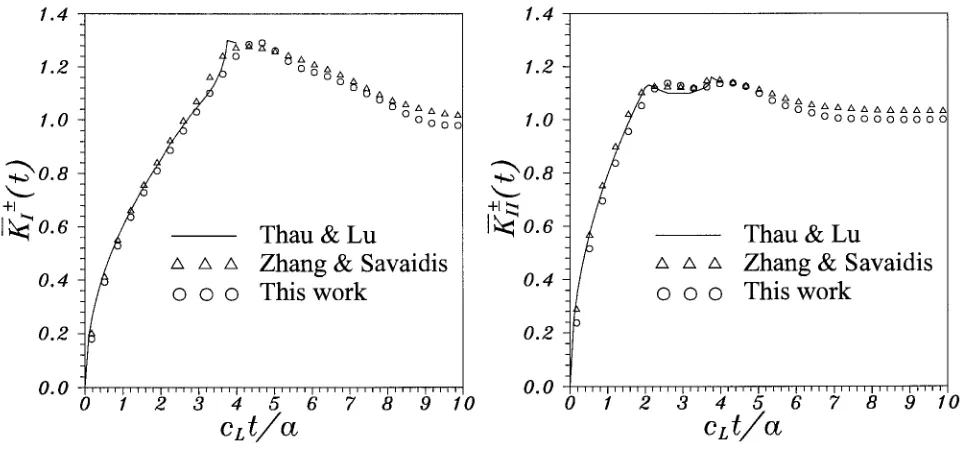
T o verify the present t i m e - d o m a i n traction B I E M , w e first consider an infinite, isotropic a n d linearly elastic solid with a finite crack of length 2a subject to an impact crack-face loading as s h o w n in Fig. I. N u m e r i c a l results for the normalized m o d e I a n d m o d e II d y n a m i c stress intesnity factors are s h o w n in Fig. 2, versus the dimensionless time eLi~a, w h e r e CL -- V / ( N + #)/p is the longitudinal w a v e velocity, with/~ a n d # being L a m b ' s elastic constants. N u m e r i c a l calculations have been carried out for plane strain a n d a Poisson's ratio y=0.25. For k a n d l, 20 terms in the Galerkin-ansatz (9) have been used, a n d a time-step of c w t / a -- 0.I is chosen, w h e r e c W -- v ~ / P is the transverse w a v e velocity. T h e error p a r a m e t e r used in the c o m p u t a t i o n of the t i m e - d o m a i n system matrix A n
7~;kl
defined by Eq. (13) is selected as c = i0 -12. A c o m p a r i s o n b e t w e e n the numerical results obtained by the present t i m e - d o m a i n B I E M , the analytical results of T h a u a n d L u [14], a n d the numerical results of Z h a n g a n d Savaidis [15] s h o w s very g o o d agreements. Z h a n g a n d Savaidis [15] used a hypersingular t i m e - d o m a i n traction B E M by applying t i m e - d o m a i n Green's functions a n d the s a m e time-step.1.4 .~ ~ £,~ ] 1.4
1.0 Ooo 1.0 " O o o o o o o o o o
o.8
o.8
+'
1~0"6 ~ /~
~
T h a u & L u
I
o.6 ~ ~
~
T h a u & L u
~
zx zx zx Zhang & Savaidis /
~/
zx zx zx Zhang & Savaidis
0 . 4 • 0 . 4 •
0 . 2 0 . 2
0 . 0 0 . 0
0 I 2 3 4 5 6 7 8 9 10 0 1 2 3 4 5 6 7 8 9 10
c L t / a
c L t / a
Fig. 2: Normalized dynamic stress intensity factors
1.4
1.2
1.0
~ 0 . 8
+1
o e
0 . 4
0 . 2
1.4
I
This work
I I I J I I I I I I I I I I I I I J I J I I I I I I I I I * I ~ I I I I I ] I I
1 2 3 4 5 6 7 8
c r t / a
] . 0 ~ O W ~ o --c,"--~,
~ 0 . 8 -H
I~
o.e
0 . 4
0 . 2
Kassir & Bandyopadhyay
This work
0 . 0 0 . 0 . . . . , . . . . , . . . . , . . . . , . . . . , . . . . , . . . . , . . . .
0 0 1 2 3 4 5 6 7 8
crt/a
Fig. 3: Normalized d y n a m i c stress intensity factors
C O N C L U S I O N S
R E R E R E N C E S
[10]
[111
[12]
[131
[14]
[15]
[16]
[17]
[1] Zhang, Ch., "Transient Elastodynamic Antiplane Crack Analysis in Anisotropic Solids", Int. J. Solids Struct.,
Vol. 37, 2000, pp. 6107-6130.
[2] Zhang, Ch., "A 2-D Time-Domain BIEM for Dynamic Analysis of Cracked Orthotropic Solids", Computer
Modeling in Engineering & Sciences, to appear, 2001.
[3] Lubich, C., "Convolution Quadrature and Discretized Operational Calculus. I", Numerische Mathematik, Vol. 52, 1988, pp. 129-145.
[4] Albuquerque, E.L., Sollero, P. and Aliabadi, M.H., "The Dual Boundary Element Method Applied to Dynamic Fracture Mechanics in Anisotropic Solids", Boundary Element Techniques, Aliabadi, M.H. (Editor), pp. 23-29, Queen Mary and Westfield College, University of London, UK, 1999.
[5] Albuquerque, E.L., Sollero, P. and Aliabadi, M.H., "The Boundary Element Method Applied to Time Depen- dent Problems in Anisotropic Materials", Int. J. Solids Struct., submitted for publication, 2000.
[6] Albuquerque, E.L., Sollero, P. and Fedelinsky, P., "Analysis of Anisotropic Dynamic Crack Problems Using the Dual Reciprocity Boundary Element Method in Laplace Domain", Computers & Structures, submitted for publication, 2000.
[7] KSgl, M. and Gaul, L., "A 3-D Boundary Element Method for Dynamic Analysis of Anisotropic Elastic Solids",
Computer Modeling in Engineering & Sciences, Vol. 1, 2000, pp. 27-43.
[8] Nishimura, N., Kobayashi, S. and Kishima, T., "A BIE Analysis for Wave Propagation in Anisotropic Media",
Boundary Elements VIII, Tanaka, M. and Brebbia, C.A. (Editors), pp. 425-434, Springer-Verlag, 1986.
[9] Wang, C.-Y., Achenbach, J.D. and Hirose, S., "Two-Dimensional Time Domain BEM for Scattering of Elastic Waves in Solids of General Anisotropy", Int. J. Solids Struct., Vol. 33, 1996, pp. 3843-3864.
Hirose, S., Wang, C.-Y. and Achenbach, J.D., "Boundary Element Method for Elastic Wave Scattering by a Crack in an Anisotropic Solid", 20th Int. Congress Theoret. Appl. Mech. I C T A M 2000, Chicago, USA, 27 August- 2 September 2000.
Wang, C.-Y. and Achenbach, J.D., "Elastodynamic Fundamental Solutions for Anisotropic Solids", Geophys.
J. Int., Vol. 118, 1994, pp. 384-392.
Abramowitz, M. and Stegun, I.A., Handbook of Mathematical Functions, Dover Publications, New York, 1972. Sih, G.C., Paris, P.C. and Irwin, G.R., "On Cracks in Rectlinearly Anisotropic Bodies", Int. J. Fract., Vol. 1, 1965, pp. 189-203.
Thau, S.A. and Lu, T.H., "Transient Stress Intensity Factors for a Finite Crack in an Elastic Solid Caused by a Dilatational Wave", Int. J. Solids Struct., Vol. 7, 1971, pp. 731-750.
Zhang, Ch. and Savaidis, A., "Time-Domain BEM for Dynamic Crack Analysis", Mathematics and Computers
in Simulation, Vol. 50, 1999, pp. 351-362.
Kassir, M.K. and Bandyopadhyay, K.K., "Impact Response of a Cracked Orthotropic Medium", A S M E J.
Appl. Mech., Vol. 50, 1983, pp. 630-636.
Mattsson, J., Modeling of Scattering by Cracks in Anisotropic Solids - Application to Ultrasonic Detection.
Ph.D. Thesis, Div. Mech., Chalmers University of Technology, GSteborg, Sweden, 1996.
A P P E N D I X :
L A P L A C E D O M A I N G R E E N ' S F U N C T I O N S
The Laplace-domain Green's functions satisfy the following partial differential equations
^ G 2 ^ G _
creme~, ~ - pp uc~ ~ - 6 c ~ 6 ( x - y), (31)
where p is a complex transform parameter, and 6(.) is the Dirac delta function. The Laplace-domain displacement Green's functions can be expressed as a Fourier integral of the form [17]
cxD 2
~ ( - ~ - ) c~,,/ = / E D o~;j Aj D'y;J e~ x - Q- Q- -4- " ( 1 Yl ) - - ' T f l X 2 - Y~ld~ '
J
- o o j = l
(32)
D i • are defined by where "+" stands for x2 > y2 and x2 < y2, c~;3
D + c~;j -- - E~;y
E ± 1;j
--
C16 ~2 -Jr- (C12+
C 6 6 ) { ~--
C26 (")/9=) 2and 77 are the complex roots of the dispersion relation
E + 2;] - _pp2 _ Cll ~2 T 2C1 . ± + C66 ( F ) 2 , (34)
[__pp2
ClI~2 :[:: 2C16i~"y? + C66 (,.)/2.±)21
[_pp2
C66~2 :~: 2C26i~,.)/~l: _it_ C22 (~?)2]
-- [ - C 1 6 ~ 2 ::F: (C12 -Jr- C 6 6 ) i ~ / f z -]- C26 (~'J=)2] 2 - 0 ,
(3s)
with R e ( 7 ~ ) >_ O. The unknown complex functions A~ are determined by the continuity conditions of displacement
~a(±)
Green's functions ~a~ at x - y
D + n + ~+ 1;1~_..1;1~1 -J- D r 2 D1;2A2 - D~; 1D~;1 + + A - ~ - D ~ 2 D ~ 2 A ~ , - 0
D~I D2; xA 1 n t- D + + + 1;2 D2;2A2 + + -- D~; 1D2; 1 A 1 - D ~ 2 D ~ 2 A ~ - 0
D + 2;1D2;1 + A + + D2;2D2;2A2 - D2",I D~I + + + A - f - D ~ 2 D ~ 2 A ~ - 0 (36)
and the unit point-load conditions at x - y
2
+ (C26D;j C66D A ; ] = 61o,
[(C26D2+j + C66D~j) %+. D~;jA + + , + [.,j) 7-f D~;j 2re'
j = l 2
Z
+c v j)V
D~;jAj + + +(C V;j
, + ~j) 7 ; D ; ; jA;]
= 2re "j = l
(37)
Substitution of Eq. (32) into Hooke's law (2) yields the Laplace-domain stress Green's functions
oo 2
~.G(+) _ /
o~o, -
F__ ~ ; j A~ Do,;j
F+
+ ei((xl-yl)-,y~
x2-y21d~--oo j--1
(3s)
in which
F + ll;j C l l C12 C16 - i ~ D ~ j
F + ~Z;j -- F, + 22;j - C21 C22 C26 ::kT) D2;j + + . (39)
F "+-
12;j
C1
6C26
C66--~--,]/~D
+ - i~D~j 1;j ,Laplace-domain traction Green's functions can be obtained by substituting the displacement representation integral into Hooke's law (2) as
oo 2
a3---- --nS(y) F ~ ; j A ~ : F +o~z;je't~(xl-yl)-')'j:k[
2--Y2ld~
. ( 4 0 )f ,