VOT 71746
DEVELOPMENT OF A PC-BASED ELECTROPALATOGRAPH SYSTEM FOR SPEECH THERAPY
(PEMBANGUNAN SISTEM ELEKTROPALATOGRAF UNTUK TERAPI PERTUTURAN BERASASKAN KOMPUTER)
RUBITA SUDIRMAN JASMY YUNUS
NASRUL HUMAIMI MAHMOOD
RESEARCH VOTE NO: 71746
Jabatan Elektronik Fakulti Kejuruteraan Elektrik Universiti Teknologi Malaysia
ii
Acknowledgement
The researchers want to thanks the Universiti Teknologi Malaysia for funding the
reseach study titled ’Development of a PC-Based Electropalatograph System for
Speech Therapy’. The gratitude also goes to all staff in FKE who directly or
iii
DEVELOPMENT OF A PC-BASED ELECTROPALATOGRAPH SYSTEM FOR SPEECH THERAPY
(Keywords: speech therapy, electropalatograph, contact pattern, word pronunciation)
People who have difficulties with speech can learn to pronounce word
more clearly by using electropalatograph (EPG). The EPG is a device that uses an
artificial palate worn against the roof of the mouth, which is able to detect tongue
contact and enable the analysis of these contact patterns. The tongue contact is
displayed on PC screen in tongue-palate contact pattern. By watching the tongue
contact and comparing it with standard tongue positions, people with impaired
speech can learn how to shape different sounds.
Thus, the aim of this study is to investigate the tongue-palate contact
pattern of alphabets pronunciations in Malay. The patterns are then analyzed to
classify the patterns obtained from the experiment. The tongue-palate contact
patterns are modeled using 62 touch sensors which represent the contact points
on the mouth palate (roof). The outcome of the work is applicable for individuals
with speech difficulties. Results showed that the pattern can be acquired and
compared using fast computing devices like the PC to display the contact
patterns.
Key Researchers: Dr Rubita Sudirman PM Dr Jasmy Yunus Nasrul Humaimi Mahmood
iv
PEMBANGUNAN SISTEM ELEKTROPALATOGRAF UNTUK TERAPI PERTUTURAN BERASASKAN KOMPUTER
(Kata kunci:terapi petuturan, elektropalatograf, corak sentuhan,sebutan perkataan)
Orang yang mempunyai kesulitan untuk bertutur boleh belajar menyebut
perkataan dengan lebih jelas menggunakan elektropalatograf (EPG). EPG adalah
satu alat/peranti yang menggunakan plat gunaan yang dilekatkan di lelangit,
dimana ia boleh mengesan sentuhan lidah. Ini membolehkan analisis dibuat ke
atas corak sentuhan tersebut. Corak sentuhan lidah-lelangit pula dipaparkan
dia atas skrin computer. Dengan melihat corak sentuhan lidah dan
membandingkannya dengan kedudukan sentuhan lidah yang normal, seseorang
yang bermasaalah bertutur boleh mempelajari bagaimana untuk membentuk
bunyi yang berlainan.
Oleh itu, matlamat penyelidikan ini adalah untuk mengenalpasti corak
sentuhan lidah-lelangit dalam konteks sebutan alphabet Melayu. Corak-corak
sentuhan yang diperoleh dari eksperimen kemudian dianalisa untuk
mengkelaskan corak-corak sentuhan tersebut. Corak sentuhan lidah-lelangit
tersebut dimodelkan menggunakan 62 pengesan sesentuh yang mewakili titik
sentuhan pada lelangit. Hasil dari penyelidikan ini boleh diaplikasikan untuk
individu-individu dengan masaalah pertuturan. Keputusan menunjukkan corak
sentuhan boleh diperolehi dan dibandingkan menggunakan peralatan canggih
v
List of Figures
Figure 1 The zones of an artificial palate 3
Figure 2 Block diagram of EPG model system 12
Figure 3 Output from touch sensors 13
Figure 4 Patterns of word ‘tactics’ 13
Figure 5 Flow process in EPG system 14
vi
TABLE OF CONTENTS
Acknowledgement ii
Abstract iii
Abstrak iv
List of Figures v
Chapter 1 Introduction 1
1.0 Introduction 1
1.1 The Tongue 3
1.2 The Palate 4
1.3 The EPG 5
1.4 Objective of the Study 6
1.5 The Scopes of the Study 6
Chapter 2 Paper Published 7
Chapter 3 Conclusion and Recommendation 17
Chapter 1
Introduction
1.0 Introduction
Speech station is used by the speech therapist in rehabilitation of a range of communication disorders. It is the combination of three types of speech therapy devices which are Laryngograph (also known as electroglottograph (EGG)), Nasal Airflow System and Electropalatograph (EPG). These devices used different concepts to detect and analyze the speech abnormalities of the speech difficulties patients. Laryngograph detect the vibration of the vocal fold as well as the simple movement of the glottis, nasal airflow measures both nasal and oral airflow, while EPG detect the contact pattern between the tongue and palate during speech. In assistance of the speech station, the effectiveness of speech therapy is much more improved.
2 by enabling appropriate targeting during therapy, provides visual feedback which assists in therapy and can be extremely motivating for both therapist and patient.
The main applications of EPG are:
i- training a person with articulation handicaps which might due to auditory and other sensory deficit,
ii- due to motor coordination problems,
iii- due to functional articulation difficulties, or iv- due to structural abnormalities of the tongue
Besides that, this study is also as a basic phonetic research into lingual articulatory motions and configurations. Both the therapist and patient can use the EPG. The general strategy in using the technique for diagnosis is to compare the patterns of tongue contact for a pathological speaker with the normal pattern.
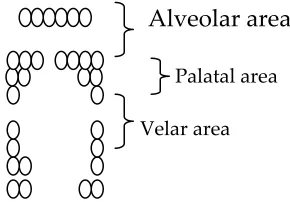
The EPG used a series of electrodes as the sensors, i.e. when the tongue touches an electrode it completes an electrical circuit and a very low current flow. The grid of electrodes records the position of the tongue 100 times per second. This information is passed to a computer which displays the series of grids that match the arrangement of the electrodes and shows how consonantal stop and fricative articulations develop in time. The contact pattern also can be shown by the number of contacts at a particular area of the palate during the production of speech.
fricative, or lateral approximant articulations in the alveolar region very clearly, as well as palatal and velar articulations. The contact patterns can be shown by the number of the contacts in a particular area of the palate as a function of time.
Alveolar area
Palatal area
Velar area
Figure 1 The zones of an artificial palate
1.1 The Tongue
4 The tongue acts together with the lips, teeth and hard palate to form word sounds. Different sounds require different tongue configurations. By altering tongue position and shape, the size of the oral cavity and therefore its resonating characteristics are changed. It is the most versatile of the articulators being involved in the production of all vowels and the vast majority of consonants.
The versatility of the tongue allows:
i. horizontal anterior/posterior movement of the body, blade and tip ii. vertical superior/inferior movement of the body blade and tip iii. transverse concave/convex movement
iv. spread/tapered contrast in the tongue blade and tip v. degree of central grooving
1.2 The Palate
The palate is the roof of the mouth, separating the mouth from the nasal cavities. The palate consists of two portions: the hard palate in front and the soft palate behind. The hard palate is formed of periosteum, a bony plate covered by mucous membrane and arches over to meet the gums in front and on either side. The soft palate is a movable fold of mucous membrane enclosing muscular fibers.
1.3 The EPG
EPG is a device that uses an artificial palate applied to the hard palate to detect and display the dynamic motions of the tongue. Electropalatography is an instrumental technique for determining tongue/palate contact pattern during speech. EPG is extremely useful additional tool when used in conjunction with conventional therapy techniques. Electropalatography allows objective assessment and enabling appropriate targeting of therapy. It provides visual feedback, which assists in therapy and can be extremely motivating for therapist and patient. Besides, it gives an objective measurement of outcome, which is an increasingly important consideration for therapist.
6 1.4 Objectives of the Study
The objectives of the study to develop a model of EPG system and design a software that will display the tongue-palate contact pattern on PC screen.
1.5 The Scopes of the Study
Chapter 2
Paper Published
(International Conference on Instrumentations and Mechatronics, 28-29 May 2007)
Modeling of Electropalatograph System for Speech Therapy
Rubita Sudirman Jasmy Yunus Cheau Sheau Wei
Department of Electronics Faculty of Electrical Engineering
Universiti Teknologi Malaysia, 81310 Skudai, Johore, Malaysia Tel.: 607-5535738, Fax: 607-5535430
email: [email protected]
Abstract
8 1. Introduction
Speech station is used by the speech therapist in rehabilitation of a range of communication disorders. It is the combination of three types of speech therapy devices which are Laryngograph (also known as electroglottograph (EGG)), Nasal Airflow System and Electropalatograph (EPG). These devices used different concepts to detect and analyze the speech abnormalities of the speech difficulties patients. Laryngograph detect the vibration of the vocal fold as well as the simple movement of the glottis, nasal airflow measures both nasal and oral airflow, while EPG detect the contact pattern between the tongue and palate during speech. In assistance of the speech station, the effectiveness of speech therapy is much more improved.
Electropalatograph system detects and displays the dynamic motion of the tongue by using an artificial palate applied on the roof of the mouth. The tongue contacts are displayed in terms of tongue-palate contact patterns. EPG is an instrumental technique for determining tongue/palate contact pattern during speech which is an extremely useful tool when used in conjunction with conventional techniques for speech therapy. It also allows objective assessment by enabling appropriate targeting during therapy, provides visual feedback which assists in therapy and can be extremely motivating for both therapist and patient.
The main applications of EPG are:
i. training a person with articulation handicaps which might due to auditory and other sensory deficit,
iii. due to functional articulation difficulties, or iv. structural abnormalities (e.g.: cleft palate).
Besides that, this study is also as a basic phonetic research into lingual articulatory motions and configurations. Both the therapist and patient can use the EPG. The general strategy in using the technique for diagnosis is to compare the patterns of tongue contact for a pathological speaker with
The EPG used a series of electrodes as the sensors, i.e. when the tongue touches an electrode it completes an electrical circuit and a very low current flow. The grid of electrodes records the position of the tongue 100 times per second. This information is passed to a computer which displays the series of grids that match the arrangement of the electrodes and shows how consonantal stop and fricative articulations develop in time. The contact pattern also can be shown by the number of contacts at a particular area of the palate during the production of speech.
10
Alveolar area
Palatal area
Velar area
Figure 1 The zones of an artificial palate
2. Approach and Methods
When the tongue touches an electrode, it completes an electrical circuit and a very low current flow. The grid of electrodes records the position of the tongue 100 times per second. This information is passed to a computer which displays the series of grids that match the arrangement of the electrodes and shows how consonantal stop and fricative articulations develop in time. The contact pattern also can be shown by the number of contacts at a particular area of the palate during the production of speech.
In this work, the artificial palate is replaced with 62 touch sensors made of a conductor material which mapped to 62 points on the palate model as illustrated in Figure 2. The result of the contact pattern is also displayed on the computer screen and analyzed to recognize the pattern generated. Actual artificial palate is studded with 62 small electrodes in which each one is 1-2mm. The electrodes are arranged as in or touch sensor model.
shell that are applied using conductive paint. The conductive paint is then connected internally to the touch sensing circuitry. The internal circuitry generates a 30 Hz square wave that is present on the conductive paint pad.
The D-latch in Figure 2 control the touch sensor and LED that represents the equivalent position of the sensor on the LED display. The display is arranged so that when the user touches the left-hand-side of the palate, LEDs on the right-hand-side of the display light up.
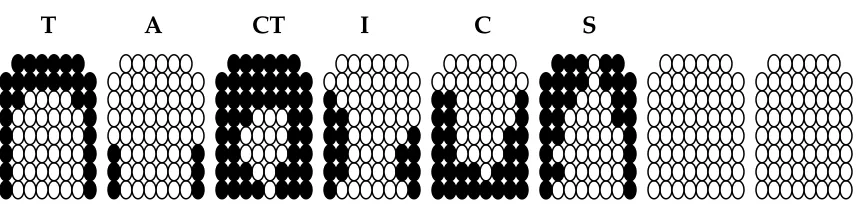
Some data files that contain the contact data for the tongue-palate contact patterns when alphabet is pronounced are created. The program read the data and compared them with the contact pattern acquired from the palate model. In this preliminary experiment, the contact patterns are created for alphabet ‘a’, ‘c’, ‘t’, ‘s’, and ‘i’. Their contact patterns are stored individually. However, when the user of the system pronounces these alphabets continuously, the program will also display each contact pattern continuously. These illustrate the dynamic motions of the tongue movements. There are only 8 palates displayed on the screen, if there were 10 contact patterns generated, the first 8 patterns will be displayed on the first screen and the remaining 2 are displayed on the second screen.
3. Experiment Setup
12 In this preliminary experiment, the contact patterns are created for alphabet ‘a’, ‘c’, ‘t’, ‘s’, and ‘i’. Their contact patterns are stored individually. However, when the user of the system pronounces these alphabets continuously, the program will also display each contact pattern continuously. These illustrate the dynamic motions of the tongue movements. There are only 8 palates displayed on the screen, if there were 10 contact patterns generated, the first 8 patterns will be displayed on the first screen and the remaining 2 are displayed on the second screen.
Figure 2 Block diagram of EPG model system
4. Results and Discussion
The expectation of this work is that when the touch sensors are pressed, the same pattern is displayed on the computer screen. This indicates that the circuit connections are working correctly and the interface between the model and GUI is properly established. In our experiment, the display is only for a touch pattern at a time. The same patterns are obtained from the experiments.
D latch
Power supply Voltage
regulator
62 touch sensors (palate)
Hence, our modeling has successfully developed. An example of pattern obtained from our experiment is shown in Figure 3.
Palate LED display
Figure 3 Output from touch sensors
T A CT I C S
Figure 4 Patterns of word ‘tactics’
14 pattern to the pattern being compared. The ‘correction’ function made suggestion on the contact points that has to be trained and corrected.
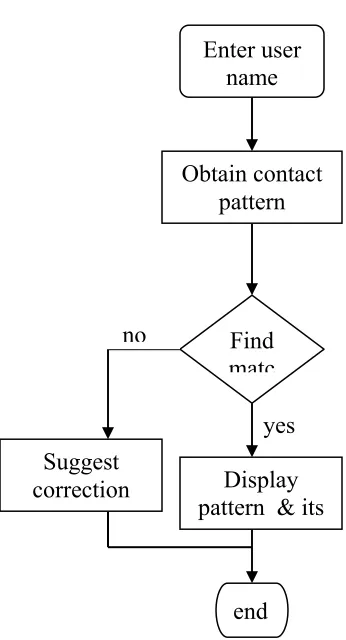
The contact patterns of word ‘TACTICS’ are displayed in Figure 4. This example is obtained from a simulation using the software system. The expected result from our experiments does not have any similarity to these patterns because the modeling only use touch sensors. A brief process flow in the EPG software is shown in Figure 5.
Figure 5 Flow process in EPG system Enter user
name
Obtain contact pattern
Find matc
Suggest
correction Display pattern & its
end no
The EPG software system is designed to aid the therapies in selecting the right points of articulation to be corrected. The correction is done through training sessions with the therapist and parents as well.
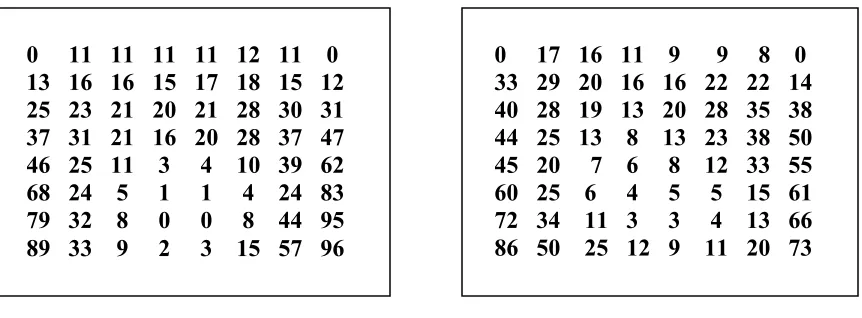
The number of contacts for a given time is also recorded by the EPG system. It is called as the contact frequency. In Figure 6, the contact frequency of two speakers is shown to show that different speaker have different style of pronouncing a particular word in a particular given time. The number describes the number of contacts made at each contact points. This contact frequency is measured for a given period of time. If contact is obtained for single alphabet, then contact frequency only show a ‘1’s on the contacts.
Speaker A Speaker B
Figure 6 Contact frequency for Speaker A and B 0 11 11 11 11 12 11 0
13 16 16 15 17 18 15 12 25 23 21 20 21 28 30 31 37 31 21 16 20 28 37 47 46 25 11 3 4 10 39 62 68 24 5 1 1 4 24 83 79 32 8 0 0 8 44 95 89 33 9 2 3 15 57 96
16 5. Conclusion
Contact pattern depends highly on the articulator movements of the tongue. Studies of speech abnormality due to the tongue can be carried out using an integrated EPG system. Indeed the system can identify where the abnormalities occur and suggests the correction to be made so that the therapist can easily know how to train her patient speak correctly. Pronunciation of ‘a’, ‘c’, ‘t’, ‘s’, and ‘i’ individually produced the same contact patterns as when they are pronounced continuously. This research successfully designed the EPG system using the touch sensors and interfaced to the EPG software system.
6. Acknowledgement
The authors would like to thank the Universiti Teknologi Malaysia, Vot 71746 for funding this project.
7. References
[1] Tocci, R.J. Digital Systems Principles and Application, 6th ed. Prentice Hall International, 1995.
[2] Floyd, T.L. Electronics Devices, 5th ed. New Jersey: Prentice Hall International, 1996.
[3] Lafore, R. Object- Oriented Programming in Turbo C++, New Jersey: Waite Group Press, 1991.
[4] Bristow, G. Electronics Speech Recognition, London, U.K.: Collins Professional and Technical Books, 1986.
[5] Rowden, C. Speech Processing, London. U.K.: McGraw- Hill Book Company, 1992.
Chapter 3
Conclusion and Recommendation
3.1 Conclusion
The EPG model system is divided into two parts, which are hardware and software. The hardware part detects the human contacts and displayed the pattern on the LED display. The software part reads the contact data from data file and displayed them on the PC screen. In conclusion, the study has able to display the tongue-palate contact pattern on the PC screen for comparison and analysis.
3.2 Recommendation
18 analyzing the tongue-palate contact pattern can be added to the software’s GUI to make the system more user friendly.
References
1. Tocci, R.J. Digital Systems Principles and Application, 6th ed. Prentice Hall International, 1995.
2. Floyd, T.L. Electronics Devices, 5th ed. New Jersey: Prentice Hall International, 1996.
3. Lafore, R. Object- Oriented Programming in Turbo C++, New Jersey: Waite Group Press, 1991.
4. Bristow, G. Electronics Speech Recognition, London, U.K.: Collins Professional and Technical Books, 1986.
5. Rowden, C. Speech Processing, London. U.K.: McGraw- Hill Book Company, 1992.
6. Carr, J.J. and J.M. Brown. Introduction to Biomedical Equipment Technology, 3rd Edition. New Jersey: Prentice Hall International, 1988