Development of Computational Tools for
Metabolic Engineering
Saurabh Sindhu, Divya Sindhu*
Lecturer, Department of Computer Sciences, CRM Jat College, Hisar, India Project Fellow, Haryana Space Application Centre, Hisar, India *
ABSTRACT: Metabolic engineering involves construction and optimization of biosynthetic pathways to maximize yields of desired products for various biochemical applications. The fundamental engineering principles in synthetic biology include the development of tools and techniques for understanding and modification of the DNA, RNA and proteins. Genetic circuits, composed of complex networks of interacting molecular machines, enable living systems to sense their dynamic environments, perform computation on the inputs and formulate appropriate outputs. Novel genetic circuits with useful applications have been constructed through rational design and forward engineering by the synthetic biologists. Diverse paradigms have emerged for designing, modeling, constructing and characterizing of artificial genetic systems. The utilization of databases and computational tools may predict the designs to achieve the desired product in metabolic engineering. Moreover, bottom-up engineering of synthetic microbial consortia with novel functions is also becoming an attractive alternative to the engineering of single-species systems. This paper focuses on computational tools and models used in metabolic engineering and synthetic biology for designing of genomes, microbial strains and/or cellular functions.
KEYWORDS: Metabolic engineering; Genetic circuits; Genome-scale modeling; Genome databases; Softwares; Synthetic biology; Computational tools
1. INTRODUCTION
Biological system of living cells is composed of large number of molecular components including nucleic acids (DNA and RNA), proteins, carbohydrates and lipids. Computer scientists along with molecular biologists are exploring the potential for computation of DNA molecule and biological databases from different available genomes [1-3]. Metabolic engineering utilizes biological information to genetically modify the cellular function for production of a targeted chemical or protein product. Successful metabolic engineering results are based on directed designs built upon biological databases or combinatorial screening that uses high-throughput experimental techniques. Computational tools have been developed to utilize biological data in the analysis and design of microbial strains for metabolic engineering [4]. These tools began with genome-scale metabolic models that aid in the analysis and prediction of whole cell function and have expanded to include tools for predicting the function of specific DNA sequences.
Integrated and extensible biological design cycles enable engineers/researchers to develop high-level conceptual designs, translate these designs into potential circuit implementations using libraries of well-characterized model/devices, construct the designs in an automated fashion and modulate the resulting constructs for proper operation [5]. Continuous feedback between multiple stages in the design cycle is needed to enhance their performance and integration. Usually, the ability to model the stochastic and dynamic behavior of synthetic designs is limited to small-scale circuits. Ellis et al. [6] demonstrated that detailed models coupled with diversified promoter libraries can guide predictive synthetic circuit design for straightforward feed-forward loops. However, using current techniques, researchers would need significant experimental data and computational resources to scale these models to account for all chassis-circuit interactions and larger circuit designs to achieve accuracy and utility.
computational tools that can be applied in metabolic engineering. Specific developments in synthetic biology associated with transcriptional and translational control will also be discussed within the context of genome-scale modeling and metabolic engineering. This review will provide updated recent advances in synthetic biology by focusing on selected steps in the biological design cycles and their application in metabolic engineering [13,14].
II. ENGINEERING OF GENOMES AND CONSTRUCTION OF METABOLIC MODELS
Synthetic biology includes the creation of artificial life within the laboratory [2] and a broader challenge in synthetic biology is to engineer existing genomes for bio-manufacturing or to decipher the principles that govern the operation of biological systems [5,14]. The sequencing of whole genome and genomics technologies are used to develop methods for utilizing genomic information to understand and predict phenotypic function. The rapid improvements in DNA synthesis and enhanced assembly techniques enabled the construction of entire genomes. Recently, synthesis capabilities have progressed from a Mycoplasma genome of 582,970 base pairs [1] to a 1.08-mega-base-pair
Mycoplasma genome transplanted into a recipient cell lacking a genome [15]. Dymond et al. [16] reported the remarkable synthesis of the right arm of chromosome IX in yeast and a portion of chromosome VI. Although the sequences are relatively short (90,000 and 30,000 base pairs, respectively), they are the largest pieces of eukaryotic DNA synthesized. These genomes were integrated into yeast cells with minimal phenotypic variation in growth and gene expression. This work provides a valuable method of studying the yeast genome and adapting yeast to specific applications such as biosynthesis.
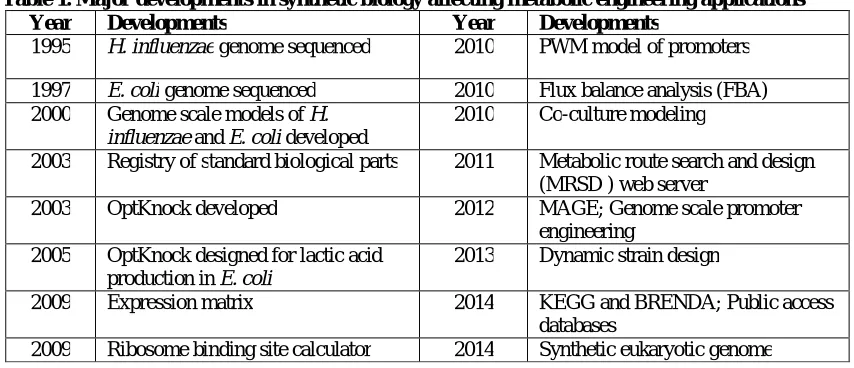
The constraint-based modeling approach was implemented to generate genome-scale metabolic models of some of the first organisms with genome sequences [17,18]. The initial genome-scale models were constructed based upon genomic data (DNA sequence information) and biochemical data (reaction stoichiometry) in conjunction with linear programming to apply mass balancing principles to a whole-cell system. These models range from understanding the underlying structure of networks by using model-building approaches [19] and progressively more cellular details including transcriptional regulation [20,21] and signaling pathways [22]. All of these models have contributed to improve the predictive capability and accuracy of genome-scale metabolic models and can be used to study a variety of aspects of cellular systems. Some of the existing computational tools and softwares applied in metabolic engineering is provided in Table 1.
Table 1. Major developments in synthetic biology affecting metabolic engineering applications
Year Developments Year Developments
1995 H. influenzae genome sequenced 2010 PWM model of promoters 1997 E. coli genome sequenced 2010 Flux balance analysis (FBA) 2000 Genome scale models of H.
influenzae and E. coli developed
2010 Co-culture modeling
2003 Registry of standard biological parts 2011 Metabolic route search and design (MRSD ) web server
2003 OptKnock developed 2012 MAGE; Genome scale promoter engineering
2005 OptKnock designed for lactic acid production in E. coli
2013 Dynamic strain design
2009 Expression matrix 2014 KEGG and BRENDA; Public access databases
2009 Ribosome binding site calculator 2014 Synthetic eukaryotic genome
III. EXPRESSION CONTROL OF GENES IN GENETIC ENGINEERING
be designed and implemented [21]. Designed expression control for individual genes typically occurs either at the transcription or translation levels.
3.1. Transcription
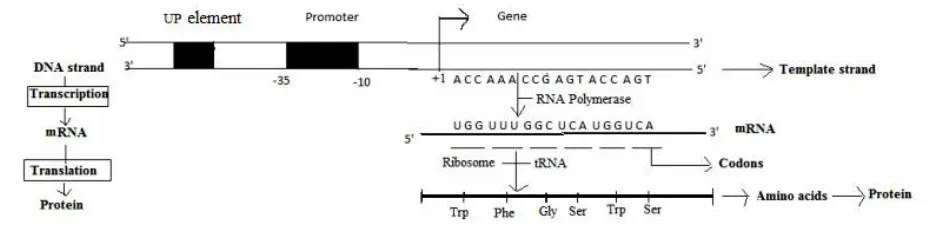
The first level of functional control for specific genes occurs during transcription. The transcriptional process involves a binding of RNA polymerase on a DNA sequence (promoter) to initiate biosynthesis of mRNA (Fig. 1). The analysis of naturally occurring promoter sequences showed the occurrence of conserved sequence motifs that physically bind to the sigma subunit of the RNA polymerase. Sequence variation in the promoter was found to affect transcriptional strength. In the early stages of the development of synthetic biology, transcriptional DNA parts were created and catalogued allowing the use of genetic variants for transcriptional control [25]. Base-by-base changes in promoter (or UP element) sequences could be accurately synthesized and rapidly tested in synthetic DNA constructs.
Controlled sequence-to-function relationships could then be extrapolated using mathematical correlation methods such as a position weight matrix (PWM). PWMs were initially applied to biological systems as a quantitative means of investigating conserved DNA sequences [26]. Recently, PWMs have been used to quantitatively describe the sequence-to-function relationship for promoters in E. coli [27]. By dividing promoter sequences into 6 motifs (− 35, spacer, − 10, disc start, initial transcribed region), 60 different promoter sequences were characterized for promoter strength and used to evaluate the influence of specific genetic changes on function. This approach was also applied to a class of transcriptional modulating sequences called UP elements [28], which occur upstream of core promoter sequences. In these cases, PWMs were used to mathematically model the relationship between sequence and function. Recently, synthetic promoters have been designed to produce a desired level of transcriptional strength with the recent modeling developments.
3.2. Translation
During translation, mRNA is translated into proteins. Translation initiates when a ribosome interacts with a ribosome binding site (RBS) and facilitates the subsequent tRNA binding to mRNA codons to produce polypeptides by the addition of amino acids. Translation involves three steps: Initiation, elongation and termination. Of these three steps, translation initiation is the rate-limiting step and different rates of translation initiation are found due to variation in the DNA sequence of the RBS within each cell. Recently, a computational approach has been developed to predict translation initiation rates for all start codons in a given DNA sequence based upon a thermodynamic calculation of Gibbs free energy [10]. This calculation specifically considers the interaction of the 30S ribosomal subunit with a specific mRNA sequence. This “Ribosome Binding Site Calculator” can be used not only to predict translation initiation rates for existing sequences, but also to design de novo RBS sequences for synthetically controlling translated protein levels. Synthetic biology has now developed a complement of experimental and computational tools to design and control individual gene expression levels at both the transcriptional and translational levels [29]. These tools enable a finer level of design control for biological systems and can be implemented for metabolic engineering applications.
IV. COMPUTATIONAL TOOLS AND SOFTWARES USED IN METABOLIC ENGINEERING MODELS
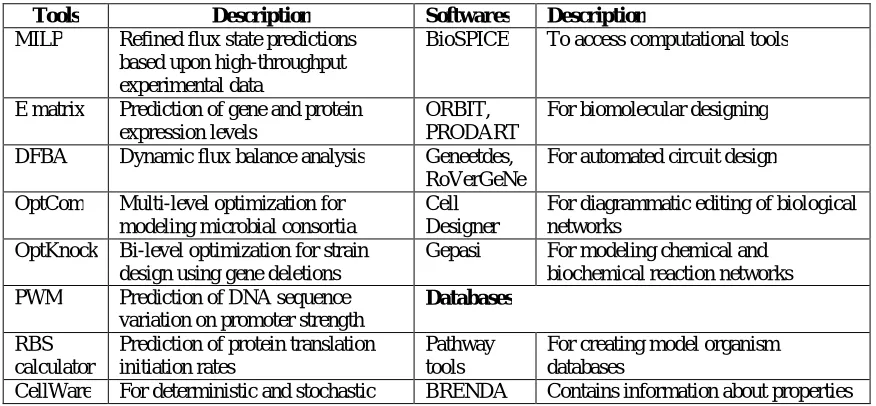
Using the natural ability of genome-scale metabolic models to simulate the behaviour of cellular metabolism, cellular designs for maximizing chemical production can be predicted. Metabolic engineering goals of identifying and modifying pathway fluxes to optimize the production of a desired chemical product align well with the pathway-level predictions that are generated from a genome-scale model. A genome-scale model of Escherichia coli was demonstrated to predict strain designs for the over-production of lactic acid [30], which set the stage for genome-scale models as powerful computational tools for strain design (Table 2). The first iterations of combining computer-aided strain design with experimental implementation relied on strain designs that incorporated gene deletions. This approach was computationally achievable through the removal of pathways associated with genes and could be achieved experimentally with established methods for targeted gene deletions using homologous recombination [31].
By utilizing transcriptomic data of the experimental strain, algorithmic analysis predicted areas of metabolism with the largest difference between the theoretical and experimental function [32]. This analysis predicted specific genes to be targeted for synthetic regulation of gene increased or decreased expression. To improve the accuracy of these models to predict cellular phenotypes, new methodologies and analyses continue to be developed. One major consideration for genome-scale metabolic models is that the mathematical representation for a biological system is underdetermined and thus the same cellular phenotype can be reproduced from different underlying flux states/pathway usage. Therefore, knowledge of the starting in vivo flux state is important for pathway-specific metabolic engineering design. The initial formulation approach involving a combination of high-throughput experimental data and computational algorithms used transcriptomic or proteomic data with a human metabolic model to identify tissue-specific metabolic differences [33]. In this approach, the experimental data was translated to a binary present/absent scoring for each individual transcript/protein. The scored experimental data was then algorithmically integrated with the metabolic model framework using mixed integer linear programming (MILP) to calculate a flux state that is in concurrence with the experimental data.
The formulation of the Expression matrix or E matrix was major conceptual advances in the constraint-based modeling methodology in E. coli [34]. The stoichiometric matrix provided the basis for all simulations utilizing flux balance analysis (FBA). The E matrix represents a major advancement in prediction as it explicitly accounts for all mechanisms required for transcription, translation and modification of each gene product. Based upon the stoichiometric matrix, dynamic flux balance analysis (DFBA) was initially developed [35] considering two different approaches to explicitly integrate kinetics into FBA simulations. The concept of DFBA has been expanded to include Michaelis–Menten kinetics for processes where reasonable rate parameters could be found and used as a basis for modeling microbial consortia.
Table 2. Computational tools softwares and databases used in synthetic biology
Tools Description Softwares Description
MILP Refined flux state predictions based upon high-throughput experimental data
BioSPICE To access computational tools
E matrix Prediction of gene and protein expression levels
ORBIT, PRODART
For biomolecular designing DFBA Dynamic flux balance analysis Geneetdes,
RoVerGeNe
For automated circuit design OptCom Multi-level optimization for
modeling microbial consortia
Cell Designer
For diagrammatic editing of biological networks
OptKnock Bi-level optimization for strain design using gene deletions
Gepasi For modeling chemical and biochemical reaction networks PWM Prediction of DNA sequence
variation on promoter strength
Databases
RBS calculator
Prediction of protein translation initiation rates
Pathway tools
For creating model organism databases
cellular events and function of enzymes Dynetica To study kinetic model of dynamic
network
KEGG Contains information about gene function
Virtual Cell
For modeling and testing biological networks
BioSilico Integrated web-based system for studying metabolic process and pathways
BioJake Visualization tools for
manipulating metabolic pathways
MetaCyc Contains information about metabolic pathway of model organism
COPASI For simulation of biochemical events
BioModels Contains published quantitative models
A multi-level optimization computational framework known as OptCom was developed as a general and scalable means of studying microbial communities and the interactions within those communities [36]. The OptCom framework considers the community by splitting optimization between individual organism fitness considerations and the overall community fitness as a secondary optimization. To facilitate the design process, a growing number of algorithms have been developed that expand the predictive capabilities of genome-scale models to simulate different strain design parameters. One of the first strain design algorithms to be developed for use with genome-scale metabolic models was OptKnock [37] that formulated a bi-level optimization where gene deletions were considered to increase the production of a desired chemical while maintaining cellular growth. Underlying the algorithm development was the premise that secretion of a target chemical could be stoichiometrically coupled to growth such that the faster a cell grew the faster the chemical would be produced.
The software bridges the gap between the kind of instructions biological designers would like to use for designing a synthetically biological compound. Public access databases such as KEGG [38], MetaCyc [39] and RHEA [40] were found useful for the designing of metabolic pathways. A database containing molecular and biochemical data of enzymes, BRENDA can be useful to select the core pathway capable to produce the metabolite of interest [41]. Web servers, such as From-Metabolite-To-Metabolite (FMM) [42] and Metabolic Route Search and Design (MRSD) [43] can also be used for designing synthetic and unique metabolic pathways in cell-free systems. To calculate the relative contribution of each enzymatic step in the pathway when optimization of particular objective function is required, Flux Balance Analysis (FBA) is commonly used [44].
V. DNA LOGIC GATES AND DIGITAL SYNTHETIC GENE CIRCUITS
Logic gates are a vital part of computer that carries out the commanded functions. These gates convert binary code moving through the computer into a series of signals that the computer uses to perform operations. In DNA computers, these DNA logic gates rely on DNA code, instead of using electrical signals to perform logical operations [45]. These gates are actually tiny DNA processing centers that detect specific fragments of the genetic blueprint as input and then splice together the fragments to form a single output. For example, a genetic gate called the ‘And gate’ links two DNA inputs by chemically binding them so they are locked in an end-to-end structure. Ogihara and Ray [46] suggested that these logic gates might be combined with DNA microchips to create a breakthrough in DNA computation.
Recently, there have been a wide variety of synthetic digital logic circuits implemented at the DNA, RNA and the protein level in both prokaryotic and eukaryotic hosts. Techniques often employed to tune transfer functions to exhibit digital behaviour, which often involve exploiting positive cooperativity and positive feedback loops [47,48]. One of the first synthetic gene circuits built was a toggle switch in E. coli that employed two mutually repressing genes to inhibit the expression of one other, resulting in a bi-stable memory circuit [49]. The state attained by the toggle switch system can be switched by adding small inducer molecules that regulate the activity of the genes involved and several variations of the bi-stable circuit have been built [50, 51].
enabled by synthetic ribozymes and ribo-switches that trigger catalytic RNA cleavage in a programmable fashion [56]. Approaches have been developed to build synthetic switch circuits at the protein level which operate at faster time scales compared with their transcriptional and RNA-based counterparts [57,58]. Larger, multi-input logic gates, such as a 4-input AND gate, have been built by inter-connecting smaller, two- and three-input AND gates within individual cells [59].
VI. APPLICATIONS OF METABOLIC ENGINEERING IN PRODUCT IMPROVEMENT
Metabolic engineering has focused on improving product titer, yield and productivity through the tuning of metabolic flux or the introduction of heterologous genes. Synthetic biologists interested in engineering the microbiome to inducibly produce therapeutic small molecules or degrade toxic metabolites depends heavily on pathway optimization and the suite of tools metabolic engineers have developed for performing a particular function. Incorporation of transcriptional dynamics has enabled finer tuning of flux profiles by suggesting optimal times for activation or repression of a given metabolic pathway over the time course of a batch culture. This “ON–OFF” approach to optimize production may be important when gene knockouts to increase yield cause notable growth impairment, decreasing productivity. Anesiadis et al. [60] explored this approach for ethanol production in E. coli by utilizing a quorum sensing (QS) module for density-dependent repression (via a toggle switch) of phosphotransacetylase (pta), which leads to inactivation of a competing acetate-production pathway. Their synthetic circuit increased productivity but decreased yield and differed in behavior from predictive models that did not account for the timescale of repression and protein degradation [61].
Synthetic circuits have also been applied to mitigate deleterious host effects due to the toxicity of intermediates. Zhang et al. [62] engineered a control system comprising an engineered fatty acid/acyl-CoA sensor to regulate the production of fatty acid ethyl ester, a biofuel. Fatty acid ethyl ester is synthesized by the enzyme wax-ester synthase using substrates ethanol and fatty acyl-CoA. Both ethanol production and synthesis of wax-ester synthase enzyme are inhibited by fatty acid/acyl-CoA sensor in the absence of fatty acid. By reducing imbalances in the metabolic pathway, the yield of their strain was enhanced three times. In situations where well characterized sensors are not available, a systems biology approach can identify promoters responsive to toxic intermediate buildup that can then be strategically employed to reduce host burden [63].
Genome engineers have expanded directed evolution approaches to multiple sites within the genome via the development of technologies such as multiplex automated genome engineering (MAGE), which relies on incorporation of multiple single-strand oligonucleotides introduced via electroporation into daughter cell genomes [64-66]. MAGE, coupled with co-selection, can reach incorporation efficiencies of greater than 70% and has been applied to increase, by four to fivefold, the production of lycopene as well as aromatic amino acid derivatives [12,65]. Fluorescent read-outs can easily be sorted in a high-throughput manner via fluorescence-activated cell sorting in circuits comprising biosensors. This mutagenesis combined with the fluorescence-activated cell sorting approach was used to select for higher productivity of amino acid synthesis in the industrial microbe Corynebacterium glutamicum via circuits incorporating endogenous amino acid-mediated regulatory devices for biosensing purposes [67].
Chen et al. [68] recently demonstrated the construction of a consortium of two strains of E. coli capable of undergoing genetic oscillations only when mutually present via the coupling of two QS systems. The development of synthetic communities may have implications for metabolic engineering; for instance, complex metabolites may be more amenable for multi-stage production using communities of engineered strains to offset the per-cell metabolic load. Zhang et al. [69] investigated this possibility in B. subtilis by constructing a circuit composed of the heterologous Auto-Inducing-Peptide QS system which allows for sender–receiver communication but without affecting other aspects of the receiver's physiology. Their results suggested that in comparison to the synthetic variant, wild-type strains demonstrated synergistic coupling of extracellular matrix production and QS which may allow receiving cells to be more responsive to global cell density.
Firmicutes [76]. Synthetic biologists have developed a toolkit amenable for engineering of the commensal Bacteroides
thetaiotamicron comprising characterized promoters, RBS, inducible systems and the CRISPRi platform [77].
Synthetic biology may also enable the discovery of novel biomaterials and the cell-based synthesis of useful biomaterials by manipulating genetically the sequence and structure of biomaterials. Furthermore, the diversity of biological processes is a large source of new biomaterials with properties that can outperform synthetic materials. For example, bacterial biofilms have greater resistance to wetting by water as compared with Teflon [78]. Widmaier et al. [79] engineered the Salmonella type III secretion system along with codon-optimized versions of silk proteins to create a microbial silk-production system.
Metabolic engineering has the potential to engineer novel diagnostic and therapeutic strategies for relatively intractable medical conditions such as cancer and infectious diseases. A critical shortcoming in cancer treatments has been their inability to distinguish between cancerous and normal cells, but one reliable signature of tumor growth is hypoxia. Anderson et al. [80] engineered Escherichia coli to invade mammalian cells selectively in hypoxic environments. Recently, Wright et al. [81] employed similar principles to link enzymatic activity to a cancer marker of hypoxia. HIF-1a is a hypoxia-inducible factor selectively found in cancer cells. The activity of a segment from p300, a binding partner of HIF-1a, was coupled to the activity of cytosine deaminase, an enzyme that converts the relatively benign prodrug 5-fluorocytosine to the chemotherapeutic 5-fluorouracil. This enabled selective activity of the drug within cancer cells, which could result in significant improvement in the side effects typical of chemotherapy.
The rise of antibiotic resistance and properties such as biofilm formation and persistence has made microbial infections increasingly difficult to treat. The rapid development of antibiotic resistance in pathogens often necessitates treatment with potent antibiotics, which may generate undesired and significant perturbations in the human microbiome by non-specifically killing of non-pathogenic bacteria. Selective targeting of pathogens may avoid this side effect. Synthetic biology also enables the design of new treatment methods to target bacterial biofilms [82], potentiate current antibiotics [83] and engineer new treatment vehicles. Saeidi et al. [84] engineered E. coli to sense Pseudomonas aeruginosa, a bacterium causing infections in the lung, urinary tract, gastrointestinal tract and skin. Quorum sensing was linked to expression of genes for pyocin (a bacteriocin) and a lysis protein E7. When grown in the presence of P. aeruginosa, the engineered E. coli accumulated intracellular pyocin and E7. The sufficient levels of E7 protein lysed the cell and release of pyocin killed the pathogen, and inhibited formation of biofilm.
VII. CONCLUSIONS
In metabolic engineering, major components of metabolism could be completely redesigned for more efficient utilization of resource pools to minimize material drains. It often incorporates the most recent biological database and tools at all levels of biological organization and function within a cell. Using genome-scale models and optimization of algorithms, metabolic network analysis and designs can be achieved [85]. Designed tools coupled with rapid DNA synthesis and assembly technologies have accelerated the prototyping, tuning and deployment of synthetic biological systems for various applications [86]. Depending upon the specific strain design, experimental implementation can involve the combinations of gene deletions, gene additions, gene knockdown or gene over-expression. Moreover, synthetic DNA construct could be transferred in a microbial strain/living cell and these designed DNA sequences could provide desired levels of transcription and translation to achieve enhanced protein production [21,29]. Synthetic feedback loops or embedded biosensors can also be used as built-in control mechanisms for monitoring or triggering cellular processes. Novel genetic circuits with useful applications have been constructed through rational design and forward engineering by the synthetic biologists and efficient strategies have been described for rapidly identifying and correcting causes of failure and fine-tuning circuit characteristics [87]. In future, predictive computational models need to be developed that could be validated by experimentation and applicable across many host organisms.
REFERENCES
[1] Gibson, D.G., Benders, G.A., Andrews-Pfannkoch, C., Denisova, E.A. and Baden-Tillson H, et al.,“Complete chemical synthesis, assembly, and cloning of a Mycoplasma genitalium genome”, Science, Vol. 319, pp. 1215–1220, 2008.
[2] Elowitz, M. and Lim, W.A., “Build life to understand it”, Nature, Vol. 468, pp. 889–890, 2010.
[3] Sindhu, D. and Sindhu, S., “Biological computers: Their application in gene mining and protein engineering”, International Journal of Technical Research, Vol. 4, issue 3, pp. 15-21, 2015.
[5] Duschak, V.G., “Synthetic biology: Computational modeling bridging the gap between in vitro and in vivo reactions”, Current Synthetic and Systems Biology, Vol. 3, Issue 2, pp. 127-142, (2015).
[6] Ellis, T., Wang, X. and Collins, J.J., "Diversity-based, model-guided construction of synthetic gene networks with predicted functions”, Natural Biotechnology,Vol. 27, pp. 465-471, 2009.
[7] Zhang, F., Rodriguez, S. and Keasling, J.D., “Metabolic engineering of microbial pathways for advanced biofuels production”, Current Opinion in Biotechnology, Vol. 22, pp. 775-783, 2011.
[8] Robertson, D.E., Jacobson, S.A., Morgan, F., Berry, D., Church, G.M. and Afeyan, N.B., “A new dawn for industrial photosynthesis”, Photosynthesis Research, Vol. 107, pp. 269-277, 2011.
[9] Tyo, K.E., Nevoigt, E. and Stephanopoulos, G., “Directed evolution of promoters and tandem gene arrays for customizing RNA synthesis rates and regulation”, Methods in Enzymology, Vol. 497, pp. 135-155, 2011.
[10] Salis, H.M., Mirsky, E.A. and Voigt, C.A., “Automated design of synthetic ribosome binding sites to control protein expression”, Natural Biotechnology,Vol. 27, pp. 946-950, 2009.
[11] Dueber, J.E. and Wu, G.C., Malmirchegini, G.R., Moon, T.S. and Petzold, C.J. et al., “Synthetic protein scaffolds provide modular control over metabolic flux”, Natural Biotechnology, Vol. 27, pp. 753-759, 2009.
[12] Wang, H.H., Isaacs, F.J., Carr, P.A., Sun, Z.Z. and Xu, G. et al., “Programming cells by multiplex genome engineering and accelerated evolution”, Nature, Vol. 460, pp. 894-898, 2009.
[13] Purnick, P.E. and Weiss, R., “The second wave of synthetic biology: from modules to systems”, Natural Review Molecular Cell Biology, Vol. 10, pp. 410–422, 2009.
[14] Nandagopal, N. and Elowitz, M.B., “Synthetic biology: integrated gene circuits”, Science,Vol. 33, pp. 1244-1248, 2011.
[15] Gibson, D.G., Glass, J.I., Lartigue, C., Noskov, V.N. and Chuang, R.Y. et al., “Creation of a bacterial cell controlled by a chemically synthesized genome”, Science, Vol. 329, pp. 52–56, 2010.
[16] Dymond, J.S., Richardson, S.M., Coombes, C.E., Babatz, T. and Muller, H. et al., “Synthetic chromosome arms function in yeast and generate phenotypic diversity by design”, Nature, Vol. 477, pp. 471-476, 2011.
[17] Schilling, C.H. and Palsson, B.O., “Assessment of the metabolic capabilities of Haemophilus influenzae Rd through a genome-scale pathway analysis”, Journal of Theoretical Biology, Vol. 203, pp. 249-283, 2000.
[18] Edwards, J.S. and Palsson, B.O., “The Escherichia coli MG1655 in silico metabolic genotype: its definition, characteristics, and capabilities”, Proceedings of National Academy of Sciences, USA, Vol. 97, pp. 5528-5533, 2000.
[19] Henry, C.S., DeJongh, M., Best, A.A., Frybarger, P.M. and Linsay, B., “High-throughput generation, optimization and analysis of genome-scale metabolic models”, Natural Biotechnology, Vol. 28, pp. 977-982, 2010.
[20] Covert, M.W., Schilling, C.H. and Palsson, B.O., “Regulation of gene expression in flux balance models of metabolism”, Journal of Theoretical Biology, Vol. 213, pp. 738-810, 2001.
[21] Covert, M.W. and Palsson, B.O., “Transcriptional regulation in constraints-based metabolic models of Escherichia coli”, Journal of Biological Chemistry, Vol. 277, pp. 28058-28064, 2002.
[22] Papin, J.A. and Palsson B.O., “The JAK-STAT signaling network in the human B-cell: an extreme signaling pathway analysis”, Biophysics Journal, Vol. 87, pp. 37-46, 2004.
[23] Gibson, D.G., Young, L., Chuang, R.Y., Venter, J.C. and Hutchison, C.A., “Enzymatic assembly of DNA molecules up to several hundred kilobases”, Natural Methods, Vol. 6, pp. 343-345, 2009.
[24] Annaluru, N., Muller, H., Mitchell, L.A., Ramalingam, S. and Stracquadanio, G., “Total synthesis of a functional designer eukaryotic chromosome”, Science, Vol. 344, pp. 55-58, 2014.
[25] Kelly, J.R., Rubin, A.J., Davis, J.H., Ajo-Franklin, C.M. and Cumbers, J., “Measuring the activity of BioBrick promoters using an in vivo
reference standard”, Journal of Biological Engineering, Vol. 3, pp. 4, 2009.
[26] Stormo, G.D., Schneider, T.D., Gold, L. and Ehrenfeucht, A., “Use of the Perceptron algorithm to distinguish translational initiation sites in E. coli”,Nucleic Acids Research, Vol. 10, pp. 2997-3011, 1982.
[27] Rhodius, V.A. and Mutalik, V.K., “Predicting strength and function for promoters of the Escherichia coli alternative sigma factor σE”, Proceedings of National Academy of Sciences, USA, Vol. 107, pp. 2854-2859, 2010.
[28] Rhodius, V.A., Mutalik, V.K. and Gross, C.A., “Predicting the strength of UP-elements and full-length E. coli σE promoters”, Nucleic Acids Research, Vol. 40, pp. 2907-2924, 2012.
[29] Mutalik, V.K., Guimaraes, J.C.Cambray, G., Lam, C. and Christoffersen, M.J., “Precise and reliable gene expression via standard transcription and translation initiation elements”, Natural Methods, Vol. 10, pp. 354-360, 2013.
[30] Fong, S.S., Burgard, A.P., Herring, C.D., Knight, E.M. and Blattner, F.R., “In silico design and adaptive evolution of Escherichia coli for production of lactic acid”, Biotechnology and Bioengineering, Vol. 91, pp. 643-648, 2005.
[31] Datsenko, K.A. and Wanner, B.L., “One-step inactivation of chromosomal genes in Escherichia coli K-12 using PCR products”, Proceedings of National Academy of Sciences, USA, Vol. 97, pp. 6640-6645, 2000.
[32] Herrgård, M.J. Fong, S.S. and Palsson, B.O., “Identification of genome-scale metabolic network models using experimentally measured flux profiles”, PLoS Computation Biology, Vol. 2, pp. e72, 2006.
[33] Shlomi, T., Cabili, M.N., Herrgård, M.J., Palsson, B.O. and Ruppin, E., “Network-based prediction of human tissue-specific metabolism”, Natural Biotechnology, Vol. 26, pp. 1003-1010, 2008.
[34] Thiele, I., Jamshidi, N., Fleming, R.M.T. and Palsson, B.O., “Genome-scale reconstruction of Escherichia coli's transcriptional and translational machinery: a knowledge base, its mathematical formulation and its functional characterization”, PLoS Computational Biology, Vol. 5, pp. e1000312, 2009.
[35] Mahadevan, R., Edwards, J.S. and Doyle, F.J., “Dynamic flux balance analysis of diauxic growth in Escherichia coli”, Biophysics Journal, Vol. 83, pp. 1331-1340, 2002.
[37] Burgard, A.P., Pharkya, P. and Maranas, C.D., “Optknock: a bilevel programming framework for identifying gene knockout strategies for microbial strain optimization”, Biotechnology and Bioengineering, Vol. 84, pp. 647-657, 2003.
[38] Kanehisa, M., Goto, S., Sato, Y., Kawashima, M. and Furumichi, M. et al., “Data, information, knowledge and principle: back to metabolism in KEGG”, Nucleic Acids Research, Vol. 42, pp. D199-D205, 2014.
[39] Caspi, R., Altman, T., Billington, R., Dreher, K. and Foerster, H. et al., “The MetaCyc database of metabolic pathways and enzymes and the BioCyc collection of pathway/genome databases”, Nucleic Acids Research, Vol. 42, pp. D459-D471, 2014.
[40] Alcantara, R., Axelsen, K.B., Morgat, A., Belda, E. and Coudert, E. et al., “RHEA manually curated resource of biochemical reactions”, Nucleic Acids Research, Vol. 40, pp. D754- D760, 2012.
[41] Schomburg, I., Chang, A., Placzek, S., Sohngen, C. and Rother, M. et al., “BRENDA in 2013: integrated reactions, kinetic data, enzyme function data, improved disease classification: new options and contents in BRENDA”, Nucleic Acids Research, Vol. 41, pp. D764-D772, 2013.
[42]. Chou, C.H., Chang, W.C., Chiu, C.M., Huang, C.C. and Huang, H.D., “FMM: a web server for metabolic pathway reconstruction and comparative analysis”, Nucleic Acids Research, Vol. 37, pp. W129-W134, 2009.
[43] Xia, D., Zheng, H., Liu, Z., Li, G. and Li, J. et al., “MRSD: a web server for metabolic route search and design”, Bioinformatics, Vol. 27, 1581-1582, 2011.
[44] Orth, J.D., Thiele, I. and Palsson, B.O., “What is flux balance analysis”? Natural Biotechnology, Vol. 28, pp. 245-248, 2010.
[45] Sindhu, S. and Sindhu, D., “DNA based computers: Molecular programming and perspectives”, International Journal of New Innovations in Engineering and Technology, Vol. 4, Issue 4, pp. 19-28, 2016.
[46] Ogihara, M. and Ray, A., “DNA computation on a chip”, Nature, Vol. 403, pp. 143–144, 2000.
[47] Becskei, A., Séraphin, B. and Serrano, L., “Positive feedback in eukaryotic gene networks: cell differentiation by graded to binary response conversion”. EMBO Journal, Vol. 20, pp. 2528-2535, 2001.
[48] Khalil, A.S., Lu, T.K., Bashor C.J., Ramirez, C.L., Pyenson, N.C. and Joung, J.K. et al., “A synthetic biology framework for programming eukaryotic transcription functions”, Cell, Vol. 150, pp. 647-658, 2012.
[49] Gardner, T.S., Cantor, C.R. and Collins, J.J., “Construction of a genetic toggle switch in Escherichia coli”,Nature, Vol. 403, pp. 339–342, 2000. [50] Atkinson, M.R., Savageau, M.A., Myers, J.T. and Ninfa, A.J., “Development of genetic circuitry exhibiting toggle switch or oscillatory behavior
in Escherichia coli”, Cell, Vol. 113, pp. 597-607, 2003.
[51] Kobayashi, H., Kærn, M., Araki, M., Chung, K., Gardner T.S. and Cantor, C.R. et al., “Programmable cells: interfacing natural and engineered gene networks”, Proceedings of National Academy of Sciences, USA, Vol. 101, pp. 8414-8419, 2004.
[52] Friedland, A.E., Lu, T.K., Wang, X., Shi, D., Church, G. and Collins, J.J., “Synthetic gene networks that count”, Science, Vol. 324, pp. 1199-1202, 2009
[53] Siuti, P., Yazbek, J. and Lu, T.K., “Synthetic circuits integrating logic and memory in living cells”, Natural Biotechnology, Vol. 31, pp. 448-452, 2013.
[54] Bonnet, J., Yin, P., Ortiz, M.E., Subsoontorn, P. and Endy, D., “Amplifying genetic logic gates”, Science, Vol. 340, pp. 599-603, 2013. [55] Nielsen, A.A. and Voigt, C.A., “Multi-input CRISPR/Cas genetic circuits that interface host regulatory networks’, Molecular System Biology,
Vol. 10, pp. 24-32, 2014.
[56] Win, M.N. and Smolke, C.D., “Higher-order cellular information processing with synthetic RNA devices”, Science, Vol. 322, pp. 456-460, 2008.
[57] Dueber, J.E., Yeh, B.J., Chak, K. and Lim, W.A., “Reprogramming control of an allosteric signaling switch through modular recombination”, Science, Vol. 301, pp. 1904-1908, 2003.
[58] Bashor, C.J., Helman, N.C., Yan, S. and Lim, W.A., “Using engineered scaffold interactions to reshape MAP kinase pathway signaling dynamics”, Science, 319, pp. 1539-1543, 2008.
[59] Moon, T.S., Lou, C., Tamsir, A., Stanton, B.C. and Voigt, C.A., “Genetic programs constructed from layered logic gates in single cells”, Nature, Vol. 491, pp. 249-253, 2012.
[60] Anesiadis, N., Cluett, W.R. and Mahadevan, R., “Dynamic metabolic engineering for increasing bioprocess productivity”, Metabolic Engineering, Vol. 10, pp. 255-266, 2008.
[61] Anesiadis, N., Kobayashi, H., Cluett, W.R. and Mahadevan, R., “Analysis and design of a genetic circuit for dynamic metabolic engineering”, ACS Synthetic Biology, Vol. 2, pp. 442-452, 2013.
[62] Zhang, F., Carothers, J.M. and Keasling, J.D., “Design of a dynamic sensor-regulator system for production of chemicals and fuels derived from fatty acids”, Natural Biotechnology, Vol. 30, pp. 354-359, 2012.
[63] Dahl, R.H., Zhang, F., Alonso-Gutierrez, J., Baidoo, E., Batth, T.S. and Redding-Johanson, A.M. et al., “Engineering dynamic pathway regulation using stress-response promoters”, Natural Biotechnology, Vol. 31, pp. 1039-1046, 2013.
[64] Isaacs, F.J., Carr, P.A., Wang, H.H., Lajoie, M.J., Sterling, B. and and Kraal, L. et al., “Precise manipulation of chromosomes in vivo enables genome-wide codon replacement”, Science, Vol. 333, pp. 348-353, 2011.
[65] Wang, H.H., Kim, H., Cong, L., Jeong, J., Bang, D. and Church, G.M., “Genome-scale promoter engineering by coselection MAGE”, Natural Methods, Vol. 9, pp. 591-593, 2012.
[66] Gallagher, R.R., Li, Z., Lewis, A.O. and Isaacs, F.J., “Rapid editing and evolution of bacterial genomes using libraries of synthetic DNA”, Natural Protocols, Vol. 9, pp. 2301-2316, 2014.
[67] Mustafi, N., Grunberger, A., Kohlheyer, D., Bott, M. and Frunzke, J., “The development and application of a single-cell biosensor for the detection of l-methionine and branched chain amino acids”, Metabolic Engineering, Vol. 14, pp. 449-457, 2012.
[68] Chen, Y., Kim, J.K., Hirning, A.J., Josic, K.and Bennett, M.R., “Synthetic Biology. Emergent genetic oscillations in a synthetic microbial consortium”, Science, Vol. 349, pp. 986-989, 2015.
[69] Zhang, F., Kwan, A., Xu, A. and Suel, G.M., “A synthetic quorum sensing system reveals a potential private benefit for public good production in a biofilm”, PLoS ONE, Vol. 10, pp. e0132948, 2015.
[71] Hsiao, E.Y., McBride, S.W., Hsien, S., Sharon, G., Hyde, E.R. and McCue, T. et al., “Microbiota modulate behavioral and physiological abnormalities associated with neuron-developmental disorders”, Cell, Vol. 155, pp. 1451-1463, 2013.
[72] Tillisch, K., Labus, J., Kilpatrick, L., Jiang, Z., Stains, J. and Ebrat, B. et al., “Consumption of fermented milk product with probiotic modulates brain activity”, Gastroenterology, Vol. 144, pp. 1394-1401, 2013.
[73] Swanson, H.I., “Drug metabolism by the host and gut microbiota: a partnership or rivalry? Drug Metabolism and Disposal, Vol. 43, pp. 1499-1504, 2015.
[74] Tai, N., Wong, F.S. and Wen, L., “The role of gut microbiota in the development of type 1, type 2 diabetes mellitus and obesity”, Review Endocrine Metabolism Disorders, Vol. 16, pp. 55-65, 2015.
[75] Kotula, J.W., Kerns, S.J., Shaket, L.A., Siraj, L., Collins, J.J. and Way, J.C. et al., “Programmable bacteria detect and record an environmental signal in the mammalian gut”, Proceedings of National Academy of Sciences, USA, Vol. 111, pp. 4838-4843, 2014.
[76] Qin, J., Li, R., Raes, J., Arumugam, M., Burgdorf, K.S. and Manichanh, C. et al., “A human gut microbial gene catalogue established by metagenomic sequencing”, Nature, Vol. 464, pp. 59-65, 2010.
[77] Mimee, M., Tucker, A.C., Voigt, C.A. and Lu, T.K., “Programming a human commensal bacterium, Bacteroides thetaiotaomicron, to sense and respond to stimuli in the murine gut microbiota”, Cell System, Vol. 1, pp. 62-71, 2015.
[78] Epstein, A.K., Pokroy, B., Seminara, A. and Aizenberg, J., “Bacterial biofilm shows persistent resistance to liquid wetting and gas penetration”, Proceedings of National Academy of Sciences, USA,Vol. 108, pp. 995-1000, 2011.
[79] Widmaier, D.M., Tullman-Ercek, D., Mirsky, E.A., Hill, R. and Govindarajan, S. et al., “Engineering the Salmonella type III secretion system to export spider silk monomers”, Molecular System Biology, Vol. 5, pp. 309-314, 2009.
[80] Anderson, J.C., Clarke, E.J., Arkin, A.P. and Voigt, C.A., “Environmentally controlled invasion of cancer cells by engineered bacteria”, Journal of Molecular Biology, Vol. 355, pp. 619-627, 2006.
[81] Wright, C.M., Wright, R.C., Eshleman, J.R. and Ostermeier, M., "A protein therapeutic modality founded on molecular regulation”, Proceedings of National Academy of Sciences, USA, Vol. 108, Issue, 39, pp. 16206-16211, 2011.
[82] Lu, T.K. and Collins, J.J., “Dispersing biofilms with engineered enzymatic bacteriophage”, Proceedings of National Academy of Sciences, USA, Vol. 104, pp. 11197-11202, 2007.
[83] Lu, T.K. and Collins, J.J., “Engineered bacteriophage targeting gene networks as adjuvants for antibiotic therapy”, Proceedings of National Academy of Sciences, USA, Vol. 106, pp. 4629-4634, 2009.
[84] Saeidi, N., Wong, C.K., Lo, T.M., Nguyen, H.X. and Ling, H. et al., “Engineering microbes to sense and eradicate Pseudomonas aeruginosa, a human pathogen”, Molecular System Biology, Vol. 7, pp. 521-528, 2011.
[85] Farasat, I.. Kushwaha, M., Collens, J., Easterbrook. M. and Guido, M., “Efficient search, mapping, and optimization of multi-protein genetic systems in diverse bacteria”, Molecular System Biology, Vol. 10, pp. 731-736, 2014.
[86] Sindhu, D. and Sindhu, S., “Computational programming for product designing in synthetic biology”, International Journal of Innovative Research in Science, Engineering and Technology, Vol. 5, Issue, 5, pp. 8095-8103, 2016.