COMMON CONTRACTUAL ISSUES FACED BY MALAYSIAN
CONTRACTORS OPERATING IN MIDDLE EAST USING FIDIC FORM OF
CONTRACTS
AHMED ABUBAKER A. SALEH
COMMON CONTRACTUAL ISSUES FACED BY MALAYSIAN CONTRACTORS OPERATING IN MIDDLE EAST USING FIDIC FORM OF
CONTRACTS
AHMED ABUBAKER A. SALEH
A project report submitted in partial fulfilment of the requirements for the award of the degree of Master of Science (Construction Contract
Management)
FACULTY OF BUILT ENVIRONMENT UNIVERSITY TECHNOLOGY MALAYSIA
iii DED ICA TIO N
To Fatima my mother, Shadiya my aunt, Merima my wife, Amani my sister, Sumaya my aunt, and my little sisters Marwa and Isra.
Thank you, ladies for the help, support, guidance, patience and good deeds.
To Abubaker my late father, Anas, Osama, Hussam, Jihad, Majed, Abadi, Khalid my brothers.
iv ACK NOWLEDG EM EN T
First of all, I would like to express my deepest gratitude to Almighty God, Alhamdulillah, for granting me with extreme patience, tolerance and intellectual capacity throughout my life and this study. Thank God for everything.
Then comes, my family including my parents, wife, who taught me a new meaning of sharing and unconditional love, my aunts, brothers and sisters, for the support and encouragements.
Not forgetting, my Supervisor Assoc. Prof. Dr. Rosli AbdulRashid for his timeless effort, understanding, knowledge, mentoring, guidance, inspirations, and never ending friendship. Much respect and deep appreciation to him and to Dr. Shadiya Mohammed S. Baqutayan who guided me on the use of SPSS and statistical analysis methods appropriate for my study.
I would also like to thank my lecturers, Dr. Maizon and Mr. Jamal, for the great knowledge I acquired from them as well as other lecturers and staff of the honorable University Technology Malaysia who made my study pleasant and beneficial.
v AB STRAC T
vi AB STRAK
Projek pembinaan dipanggil antarabangsa apabila pihak-pihak dari pelbagai
negara membuat suatu perjanjian untuk menjalankan kerja. Biasanya, pihak
perjanjian menggunakan FIDIC sebagai borang kontrak, kerana ia digunakan secara
meluas di peringkat global bagi projek-projek antarabangsa yang kompleks. Semasa
pembinaan, secara amnya, masalah berbangkit di antara pihak-pihak kontrak apabila
salah satu daripada pihak kontrak berpendapat bahawa walaupun kebiasaannya
bahasa kontrak ditafsir secara harfiah, dan digunakan di dalam keadaan seperti yang
tertera didalam kontrak, ada juga kes-kes dan keadaan dimana bahasa kontrak ini
ditafsir secara berbeza oleh pihak kontrak yang lain. Berikutan demikian, keadaan ini
akan mengelirukan pihak-pihak kontrak berkenaan apa yang sepatutnya berlaku,
seperti kekeliruan tugas dan kekeliruan yang paling kerap berlaku adalah kekeliruan
berkaitan kos. Oleh itu, kajian ini telah diambil untuk mengkaji semula isu-isu
kontrak pembinaan antarabangsa seperti FIDIC, dari pengalaman dan sudut
pandangan kontraktor Malaysia yang bekerja di Timur Tengah, khususnya, Arab
Saudi dan Emiriah Arab Bersatu. Metodologi kajian termasuk penyelidikan meluas
dan kajian, yang direka dengan sewajarnya, termasuk dengan penyertaan ahli
profesional Malaysia yang mempunyai pengetahuan yang luas dan terlibat secara
langsung dalam projek pembinaan di UAE dan Arab Saudi. Hasil kajian ini dikenal
pasti dan dikategorikan kepada isu, memberi tumpuan kepada isu-isu utama; dan
menentukan bahawa sistem undang-undang/undang-undang yang mengawal, bahasa,
vii TAB LE O F CONT EN TS
DECLARATION ii
DEDICATION iii
ACKNOWLEDGEMENT iv
ABSTRACT v
ABSTRAK vi
Table of Contents vii
LIST OF TABLES x
LIST OF FIGURES xi
1 INTRODUCTION 1
1.1 Background 1
1.2 Problem Statement 4
1.3 Aim 5
1.4 Objectives 6
1.5 Scope 6
1.6 Research methodology 7
1.6.1 Literature review 7
1.6.2 Data collection 7
1.6.3 Data analysis 8
1.6.4 conclusion and recommendations 8
2 LITERATURE REVIEW 10
2.1 Introduction 10
2.2 Fédération Internationale des Ingénieurs-Conseils (FIDIC) 11
2.2.1 The Red Book: 12
2.2.2 The Yellow Book: 12
2.2.3 The Silver Book: 13
2.2.4 The Green Book: 14
2.3 Issues 15
2.3.1 Interpretation, ambiguity and Language related Issues 15
viii
2.3.2.1 Common law 21
2.3.2.2 Civil law 23
2.3.2.3 Differences between common law and civil law 24
2.3.2.4 Shariah law 27
2.3.3 Contractual Claims and Disputes 30
2.3.4 Variation 36
2.3.5 Delayed Payment 38
2.3.6 Risk Allocation and liabilities 39
2.3.7 Delay Damages (Liquidated Damages v. Penalty) 44
2.4 Construction Industries of Saudi Arabia and United Arab Emirates 46
2.4.1 Saudi Arabia 47
2.4.1.1 Introduction 47
2.4.1.2 Contracts, Procurement and Finance 48
2.4.1.3 Restrictions on International Contractors and Labors 49
2.4.2 United Arab Emirates 50
2.4.2.1 Introduction 50
2.4.2.2 Procurement 51
3 DATA COLLECTION 53
3.1 Introduction 53
3.2 Questionnaire survey 54
3.3 Respondents 55
4 DATA ANALYSIS 56
4.1 Introduction 56
4.2 Overall results of questionnaire distribution 57
4.2.1 Part 1: Background of the project: 57
4.2.2 Part 2: Issues and causing factors 60
4.2.3 Part 3: Extras (optional) 63
4.3 Causes of issues 67
4.3.1 FIDIC 67
4.3.2 Language 68
4.3.3 Governing law / legal system 69
4.4 Level of Significance 70
4.4.1 High significance issues 70
4.4.2 Medium significance issues 70
4.4.3 Low significance issues 71
4.5 Important key issues to the unwary 72
4.5.1 Amendment of FIDIC clauses 72
ix
4.5.3 Delayed payment 73
4.5.4 Risk and liability 74
4.5.5 Delay damages 75
5 CONCLUSION AND RECOMMENDATION 76
5.1 Introduction 76
5.2 Conclusion 77
5.3 Recommendations 79
REFERENCES 81
x LIS T OF TAB L ES
Table 2. 1: Some of the terminologies' differences between common law and civil
law ...25
Table 2. 2: Contractors claims. ...32
Table 2. 3: Employers Claims ...33
Table 4. 4: Result of part 2 of the questionnaire describing the relationship between issues and causing factor ...62
Table 4. 5: Causes of Issues ...67
Table 4. 6: High significance issues ...70
Table 4. 7: Medium significance issues ...71
xi LIS T OF FIGU RES
Figure 1: Research Methodology... 9
Figure 2: Location of projects ...58
Figure 3: The governing law of the contract ...58
Figure 4: Procedural law ...58
Figure 5: Language of the contract ...59
Figure 6: procurement (FIDIC book) ...59
Figure 7: Amendment of FIDIC provisions ...63
Figure 8: Disputes avoidance ...64
Figure 9: Notice of claim in UAE...64
Figure 10: Disputes resolution in KSA ...64
Figure 11: Interest entitlement...65
Figure 12: Additional Risk ...65
Figure 13: liability for death and \ or injury of construction worker(s) ...65
Figure 14: Decennial liability ...66
1 CHAPTE R 1
1 INT RODU CT IO N
1.1 Background
The trend of internationalization of construction companies has been rising throughout the world. Going international has accelerated the flow of information and resource allocation, bringing people, organizations and countries closer1.
However, in international construction business, it is essential for construction companies to know when to enter a newly opened country market. Entering a foreign market is a critical strategic decision that requires, extensive environmental scanning to determine how well the company can succeed in the international market; and appropriate matching of the strengths of the company with the international market opportunities.2
1
Wong, P. (2007), Winds Of Change: Ensuring Malaysian Builders Win In The Global Race, Master Builder Association, Malaysia.
2
2 Construction projects became more complex and multi-dimensional, demanding more disciplines and skills. Therefore, construction projects, nowadays, in developing countries are often carried out in joint ventures with construction companies from developed countries. International collaboration can be of particular benefit to all parties of projects. Trans-global economic developments offer an opportunity to develop products using the most up-to-date expertise and knowledge in a cost-effective manner.3
FIDIC Fédération Internationale Des Ingénieurs – Conseils (from French, the International Federation of Consulting Engineers) was initiated in 1913 as a global representative for the consulting engineering industry, to ensure successful international collaboration. Thus, FIDIC, today, is well known for the standard form Conditions of Contract for the worldwide construction industry, particularly in the context of higher value international construction projects, and is endorsed by many multilateral development banks (“MDBs”).
Malaysian construction contractors have been progressively involved and continuously encouraged to undertake construction projects along side with multinational participants from diverse political, legal, economic, and cultural backgrounds. To search new geographical presence; To seize the opportunities brought by the global economy’s needs for higher standard of efficiency and quality;
To increase global Market Share; To gain political power.
Excellent performance of Malaysian contractors in the construction of many mega projects within the local industry has nurtured the competencies and capabilities of their expertise. However, the very competitive and saturated of local market has driven many Malaysian contractors to make significant appearance in the global market as a mean to effectively capitalize on special expertise.
Malaysian construction companies has reported successful completion of international projects to Construction Industry Development Board’s CIDB
3
3 (Malaysian government agency under the Ministry of Works which appointed as a professional body to promote, stimulate and assist the development of Malaysian construction industry). And that was comprehensively published in CIDB’s newsletter, issue 02 December 2012, as the latest update on international construction ventures.
From 1987 to 31 Dec 2012, 115 Malaysian contractors have participated in a total of 691 construction projects worth about US$30 billion (RM102.2 billion) in 50 countries abroad. Out of these projects have completed 617 projects worth USD 19 billion (RM65.5 billion) worldwide, while another 74 projects worth USD 10.8 billion (RM36.7 billion) are still ongoing. The most number of international construction projects have been secured in the Middle East – 41 %, followed by South Asia at 21 %, ASEAN 14%, Africa 12% and other regions 21 %. There are 115 Malaysian contractors currently doing construction work in 50 countries around the globe.
Recently, Middle East has proven to be one of the most attractive construction markets in the world as it continues to present significant opportunities for international contractors including Malaysian ones.4 According to CIDB newsletter, issued 01 & 02 June 2013. The biggest projects received by Malaysian contractors in terms of value are from the Middle East. Malaysian contractors’ contribution is obvious in countries such as the UAE, Saudi Arabia, and other Middle Eastern countries where Malaysian companies participated in iconic construction projects such as the Burj Khalifa in Dubai and Capital Gate in Abu Dhabi. Construction groups like Muhibbah Engineering, Setia Group, Gamuda Bhd, Road Builder Holdings (M) Bhd, UEM Construction Sdn Bhd, IJM Corporation and Bina Puri Holdings Bhd had exported their expertise to the Middle East.
However, in today’s complex world of construction, it is almost impossible to
complete a project without issues arising during the process. In order to understand how and why these issues arise, they must be placed into proper perspective.
4
Raymont, M. (2010, March). THE EMERGENCE OF ASIAN CONSTRUCTION CONTRACTORS IN THE MIDDLE EAST. www.cmguide.org. Retrieved December 27, 2013, from
4 What is the scenario of international construction process? What are the issues arising from working in different country? Under different legal system than the one practiced in home country, Malaysia? How did they (Malaysian contractors) overcome the language differences? How to implement FIDIC? Are the terms and conditions of FIDIC compatible with the legal system of that country? How was FIDIC interpreted by the parties of different backgrounds? How well is the FIDIC contract amended and drafted using words (apart from the drawings) to express in the light of events and circumstances in prospects? In general, what are the issues faced by other contractors working in the same host country? In case of disputes, how were they avoided/resolved? And many other questions triggered this research.
1.2 Problem Statement
According to the CIDB Malaysian Construction Industry Master Plan, 2007, it is stated that some of the main challenges and difficulties facing Malaysian contractor in international project ventures are as follows:
Opportunities – availability of projects. Chances of securing projects.
Business environment–Legal system, language and others. Funding – whether the projects are government funded,
multilateral agency funded or privately funded.
Level of risk ranging from security risk to infrastructure risk. Ease of entry/exit – existence of trade and non-trade barriers
and ease of repatriating profits.
5 study to analyze different legal system’s (Common Law in Malaysia, Civil law in UAE and Shari’ah Law in Saudi) interpretations, and examine the effect of different
languages used for communication, in relation with the issues arising from the application of international construction contract (FIDIC).
1.3 Aim
6 1.4 Objectives
1) To identify and categorise the issues arising from the use of FIDIC in the Middle East.
2) To determine the effect of the factors (legal systems, language and application of FIDIC) on the issues.
3) To determine the key issues arising from working in UAE and Saudi Arabia.
1.5 Scope
This study focuses on the responses and data’s obtained from the Malaysian
7 1.6 Research methodology
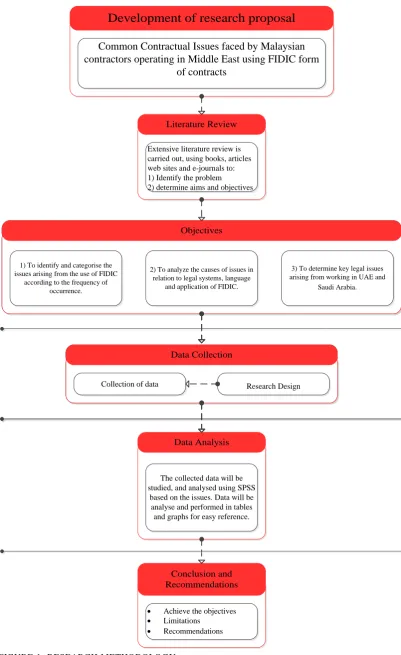
The methodology adopted in this research is sub divided into several stages, viz.; identifying the research issues, literature review, data collection, data analysis, conclusion and recommendation. Refer to Error! Reference source not found. below.
1.6.1 Literature review
Extensive literature review is carried out, using books, articles web sites and e-journals to produce and evaluate models.
1.6.2 Data collection
Questionnaires sent to Malaysian contractor companies and personnels. Names and addresses of these companies are extracted from the Construction Industry Development Board (CIDB) web-based database list of contractors’ companies to enquire about their opinions, issues they overcame and strategies they followed to ensure success of their projects in the Middle Eastern countries by responding to the questionnaire.
8 1.6.3 Data analysis
The collected data will be studied, and analyzed using SPSS based on the issues. Data will be analyze and performed in tables and graphs for easy reference.
1.6.4 conclusion and recommendations
9 Development of research proposal
Literature Review Objectives Data Collection Data Analysis Conclusion and Recommendations Objectives Data Collection Objectives Data Collection
Common Contractual Issues faced by Malaysian contractors operating in Middle East using FIDIC form
of contracts
Research Design
The collected data will be studied, and analysed using SPSS
based on the issues. Data will be analyse and performed in tables and graphs for easy reference.
Achieve the objectives Limitations
Recommendations
Extensive literature review is carried out, using books, articles web sites and e-journals to: 1) Identify the problem 2) determine aims and objectives
Collection of data
3) To determine key legal issues arising from working in UAE and
Saudi Arabia. 1) To identify and categorise the
issues arising from the use of FIDIC according to the frequency of
occurrence.
2) To analyze the causes of issues in relation to legal systems, language
and application of FIDIC.
81 REFER ENC ES
AlJallaf, E. (2013). The Enforceability of FIDIC Sub Clause 20.1: Contractor’s Claims in the Legal Systems (Common Law and UAE Federal Law).
www.uaesocietyofengineers.com. Retrieved April 1, 2014, from
http://www.uaesocietyofengineers.com/(S(4e4xxlugryg33wzkgkrlllqe))/magazineCu rrentIssuemore.aspx?id=122
Arabic Translation of FIDIC Contracts Available. (2014). Retrieved February 6, 2014, from http://fidic.org/node/1716#activities3
Brown, M. (2013). Saudi Arabia. Construction & Engineering London Legal Update. Construction & Engineering Group. 65, 10-11.
Bueno, J. C. (1989). The Projects and construction review. Law Business research ltd, London.
Bunni, N. G. (2005). The FIDIC forms of contract : the fourth edition of the Red Book, 1992, the 1996 Supplement, the 1999 Red Book, the 1999 Yellow Book, the 1999 Silver Book, Blackwell, UK.
Bunni, Nael G.(2005). The FIDIC forms of contract, 3rd edition, Blackwell, UK.
Clark, H., and Ip, A. (1999). The Peifan-Lucky Star—A car for China. Design Manage. J., Fall, 21–28.
Common law. (2014). Retrieved February 26, 2014, from
http://en.wikipedia.org/wiki/Common_law#cite_note-1
Cowling, B. and Hudson, D. (2013). Construction in Saudi Arabia: Decennial liability. www.clydeco.com. Retrieved April 9, 2014, from
http://www.clydeco.com/insight/updates/construction-in-saudi-arabia-decennial-liability
Dikmen, I. and Birgonul M. T. (2004), Neural Network Model to Support International Market Entry Decisions, Journal of Construction Engineering and Management, Vol. 130 (1), 59-66.
Fahy, M. (2014). Analysis: Saudi Arabia's contracting market. www.constructionweekonline.com. Retrieved February 27, 2014, from
82 Godwin, W. (2013). International Construction Contracts: A Handbook, Wiley-blackwell, UK.
Gorgenl, V. (2011). A Strategic Analysis of the Construction Industry in the United Arab Emirates: Opportunities and Threats in the Construction Business,
Diplomica Verlag.
Hewitt, A. (2011). Construction Claims and Responses effective writing and presentation. Wiley-Blackwell , London.
Hughes, G. A. (1983). building and civil engineering claims in perspective, Construction Press, London and New York.
Husein, Amgad T. (2013, July). Construction and projects in Saudi Arabia: overview. Retrieved January 11, 2014, from http://uk.practicallaw.com/resource/2-534-0319
Jaeger, A. and Hok, G (2010). FIDIC - A Guide for Practitioners, Springer, Germany.
Kerr, M. and Ryburn, D. and McLaren, B. and Zehra (2013). Construction and projects in United Arab Emirates: overview. www.practicallaw.com. Retrieved January 19, 2014, from http://www.practicallaw.com/1-519-3663
Knutson, R. (2005). FIDIC: An Analysis Of International Construction Contracts, Kluwer Law, Netherland.
KSA government owes contractors over $26bn - FIDIC. (2013). Retrieved Aughust 19, 2013, from
http://www.constructionweekonline.com/article-23855-ksa-government-owes-contractors-over-26bn--fidic/#.U0LJ06iSzRg
MIDDLE EAST CONSTRUCTION HANDBOOK. (2013). Retrieved March 11, 2014, from
http://www.aecom.com/deployedfiles/Internet/Geographies/Middle%20East/2013%2 0ME%20Handbook_9%20June%202013%20FINAL%20w%20cover.pdf
Owen, G. (2003, June). THE WORKING OF THE DISPUTEADJUDICATION
BOARD (DAB) UNDER NEW FIDIC 1999 (NEW RED BOOK).
www.gwynowen.com. Retrieved Febrauary 11, 2014, from
http://www.gwynowen.com/DAB.pdf.
Paldi, C. (2013, June). Understanding Riba (Interest) and Gharar (Uncertainty) in Islamic Finance. http://www.academia.edu. Retrieved on March 06, 2014, from
http://www.academia.edu/2468903/Understanding_Riba_Interest_and_Gharar_Unce rtainty_in_Islamic_Finance_Presented_at_the_2013_International_Symposium_for_
Business_and_Management_in_Kitakyushu_Japan_.PDF
83 Rajoo, S. & Singh. H. K. S. (2011). Construction Law in Malaysia. Sweet &
Maxwell Asia, Malaysia.
Raymont, M. (2010, March). THE EMERGENCE OF ASIAN CONSTRUCTION CONTRACTORS IN THE MIDDLE EAST. www.cmguide.org. Retrieved
December 27, 2013, from http://www.cmguide.org/archives/2151.
Robinson, M. D. (2011). A Contractor’s Guide to the FIDIC Conditi ons of Contract, Wiley-blackwell, UK.
Robinson, M. D. (2013). An Employer's and Engineer's Guide to the FIDIC Conditi ons of Contract, Wiley-blackwell, UK.
Savage, D. (2012). The top 10 things you need to know about FIDIC. www.charlesrussell.co.uk. Retrieved January 15, 2014, from
http://www.charlesrussell.co.uk/userfiles/file/pdf/Bahrain/FIDIC.pdf
Thomas, R. (2001). Construction Contract Claims 2nd edition, Palgrave, New York.
Totterdill, B. W. (2006). FIDIC users’ guide a practical guide to 1999 red and yellow books. Thomas Telford, London.