University of Windsor University of Windsor
Scholarship at UWindsor
Scholarship at UWindsor
Electronic Theses and Dissertations Theses, Dissertations, and Major Papers
7-30-2018
Stein-rules and Testing in Generalized Mean Reverting Processes
Stein-rules and Testing in Generalized Mean Reverting Processes
with Multiple Change-points
with Multiple Change-points
Kang Fu
University of Windsor
Follow this and additional works at: https://scholar.uwindsor.ca/etd
Recommended Citation Recommended Citation
Fu, Kang, "Stein-rules and Testing in Generalized Mean Reverting Processes with Multiple Change-points" (2018). Electronic Theses and Dissertations. 7521.
https://scholar.uwindsor.ca/etd/7521
Stein-rules and Testing in Generalized Mean Reverting
Processes with Multiple Change-points
by
Kang Fu
A Thesis
Submitted to the Faculty of Graduate Studies
through the Department of Mathematics and Statistics
in Partial Fulfillment of the Requirements for
the Degree of Master of Science
at the University of Windsor
Windsor, Ontario, Canada
2018
Stein-rules and Testing in Generalized Mean Reverting
Processes with Multiple Change-points
by
Kang Fu
APPROVED BY:
D. Li
Department of Economics
M. Hlynka
Department of Mathematics and Statistics
S. Nkurunziza, Advisor
Department of Mathematics and Statistics
DECLARATION OF
CO-AUTHORSHIP / PREVIOUS
PUBLICATION
I. Co-Authorship
I hereby declare that this thesis incorporates material that is result of joint
research, as follows: some parts of Chapters 3, 4, 5, 6, 7 and 8 of the thesis were
co-authored with professor S´ev´erien Nkurunziza. In all cases, the primary
contribu-tions, simulation, data analysis, interpretation, and writing were performed by the
author, and the contribution of co-authors was primarily through the provision of
some theoretical results.
I am aware of the University of Windsor Senate Policy on Authorship and I
certify that I have properly acknowledged the contribution of other researchers to my
thesis, and have obtained written permission from each of the co-author(s) to include
the above material(s) in my thesis.
I certify that, with the above qualification, this thesis, and the research to
which it refers, is the product of my own work
This thesis includes one original paper that has been previously published/submitted
for publication in peer reviewed journals, as follows:
Thesis Publication title/full citation Publication
Chapter status*
some parts of Nkurunziza, S., and Fu, K., (2018). Improved Under
Chapters 3, 4, 5, inference in generalized mean-reverting processes review
6, 7 and 8 with multiple change-points. Electronic Journal of Statistics (Submitted).
I certify that I have obtained a written permission from the copyright owner(s)
to include the above published material(s) in my thesis. I certify that the above
material describes work completed during my registration as a graduate student at
the University of Windsor.
III. General
I declare that, to the best of my knowledge, my thesis does not infringe upon
anyone’s copyright nor violate any proprietary rights and that any ideas, techniques,
quotations, or any other material from the work of other people included in my
thesis, published or otherwise, are fully acknowledged in accordance with the standard
referencing practices. Furthermore, to the extent that I have included copyrighted
material that surpasses the bounds of fair dealing within the meaning of the Canada
Copyright Act, I certify that I have obtained a written permission from the copyright
owner(s) to include such material(s) in my thesis.
I declare that this is a true copy of my thesis, including any final revisions, as
ABSTRACT
In this thesis, we consider inference problems about the drift parameter vector
in generalized mean reverting processes with multiple and unknown change-points.
In particular, we study the case where the parameter may satisfy uncertain
restric-tions. As compared to the results in the literature, we generalize some findings in
five ways. First, we consider a statistical model which incorporates uncertain prior
information and the uncertain restriction includes as a special case the nonexistence
of the change-points. Second, we derive the unrestricted estimator (UE) and the
restricted estimator (RE), and we study their asymptotic properties. Specifically, in
the context of a known number of change-points, we derive the joint asymptotic
nor-mality of the UE and the RE, under the set of local alternative hypotheses. Third,
we derive a test for testing the hypothesized restriction and we derive its asymptotic
local power. We also prove that the proposed test is consistent. Fourth, we construct
a class of shrinkage type estimators (SEs) which includes as special cases the UE,
RE, and classical SEs. Fifth, we derive the relative risk dominance of the proposed
estimators. More precisely, we prove that the SEs dominate the UE. The novelty of
the derived results consists in the fact that the dimensions of the proposed estimators
are random variables. Finally, we present some simulation results which corroborate
ACKNOWLEDGEMENTS
I would like to express my profound gratitude to whom supported and assisted
me to finish this thesis during my master’s study.
First, I would like to express my sincerest gratitude to my supervisor Dr. S´ev´erien
Nkurunziza. He guided me patiently as I encountered problems. His serious attitude
and precision taught me how to be an excellent scholar. His humor released the stress
of work. As I was ill this winter, his encouragement and concern helped
psychologi-cally.
I would also express my gratitude to the department reader, Dr. Myron Hlynka,
and the external reader, Dr. Dingding Li. I am thankful for their patient reading.
Their valuable advice made a huge contribution in accomplishing this thesis. Also, I
would like to thank to all the staff in the department. They helped me directly and
indirectly during my master’s study.
I would like to thank to my parents. They support me financially and
psycho-logically in my study and daily life. I would like also to thank my girlfriend, my
cousin and my aunt who accompanied me in my two years’ graduate study. I will
never forget their encouragement and assistence. Finally, I would like to thank to my
co-worker and good friend, Lei Shen, who could always help me to find the key point
CONTENTS
DECLARATION OF CO-AUTHORSHIP / PREVIOUS
PUBLICA-TION iii
ABSTRACT v
ACKNOWLEDGEMENTS vi
LIST OF TABLES x
LIST OF FIGURES xi
1 Introduction and contributions 1
1.1 Main contributions . . . 2
1.2 Organization of the thesis . . . 3
2 Statistical model and regularity conditions 4 3 Estimation in the case of known change points 11
3.1 The unrestricted estimator . . . 11
3.1.1 The UMLE ˆθ(φ, m) . . . 11
3.2 The restricted estimator . . . 14
3.2.1 Asymptotic normality of the RMLE ˜θ(φ, m) . . . 15
3.3 Joint asymptotic normality of ˆθ(φ, m) and ˜θ(φ, m) . . . 16
4 Estimation in the case of unknown change points 23 4.1 The unrestricted estimator . . . 23
4.1.1 Asmptotic normality of the UE ˆθ( ˆφ, m) . . . 31
4.2 The restricted estimator . . . 33
4.2.1 Asymptotic normality of the RE ˜θ( ˆφ, m) . . . 34
4.3 Joint asymptotic normality of ˆθ( ˆφ, m) and ˜θ( ˆφ, m) . . . 35
5 The case of an unknown number of change points 42 5.1 Estimating the number of change points . . . 42
5.2 Computational algorithms . . . 44
5.3 Asymptotic properties of the UE and the RE . . . 46
6 Shrinkage estimators 48 6.1 Testing the restriction . . . 48
6.2 A class of shrinkage estimators . . . 52
7 Comparison between estimators 53 7.1 Asymptotic distributional risk . . . 53
7.2 Risk Analysis . . . 59
8 Numerical study 65 8.1 Simulation study . . . 65
9 Conclusion 77
APPENDIX A 79
A Theoretical Background 80
A.1 Identities in Shrinkage method . . . 82
APPENDIX B 84
B Some Technical Results and Proofs 85
BIBLIOGRAPHY 120
LIST OF TABLES
8.1 Two change points (φ1 = 0.35, φ2 = 0.7) . . . 66
8.2 Three change points (φ1 = 0.25, φ2 = 0.5, φ3 = 0.75) . . . 67
8.3 Cumulative frequency and relative frequency of 500 iterations . . . . 67
8.4 Mean of estimates ofφ1,φ2 (m= 2) . . . 68
LIST OF FIGURES
8.1 Histogram of estimates of ˆφ, m= 2, T = (20,35,50), φ = (0.35,0.7) . 69
8.2 Histogram of estimates of ˆφ,m = 3,T = (20,35,50), φ= (0.25,0.5,0.75) 70
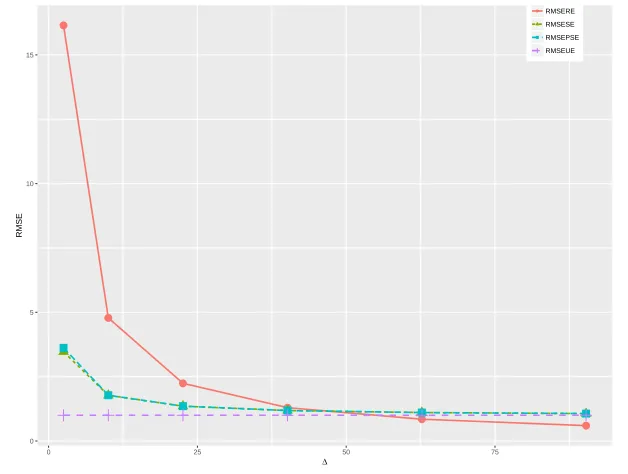
8.3 RMSE of UE, RE, SE, PSE versus ∆ (m= 2, T = 20) . . . 71
8.4 RMSE of UE, RE, SE, PSE versus ∆ (m= 2, T = 50) . . . 72
8.5 RMSE of UMLE, RMLE, SE, PSE versus ∆ (m= 3, T = 20) . . . . 72
8.6 RMSE of UMLE, RMLE, SE, PSE versus ∆ (m= 3, T = 50) . . . . 73
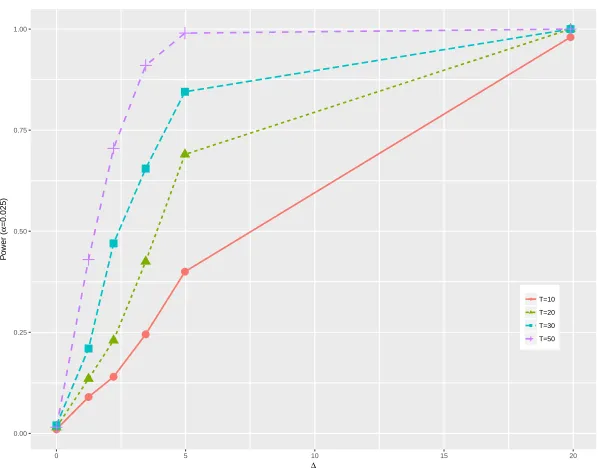
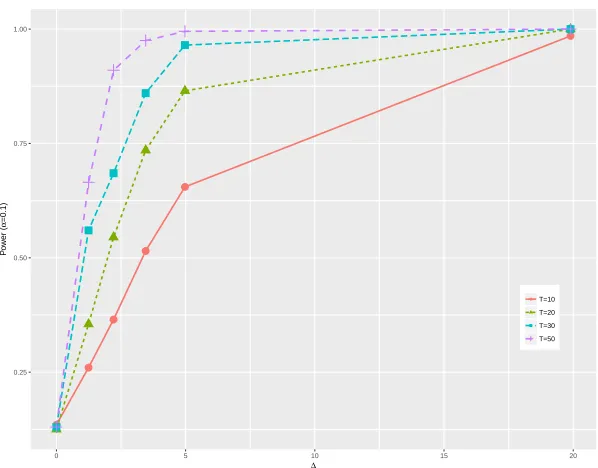
8.7 The empirical power of the test versus ∆ andT (m= 2) . . . 74
8.8 The empirical power of the test versus ∆ andT (m= 2) . . . 74
8.9 The empirical power of the test versus ∆ andT (m= 2) . . . 75
8.10 The empirical power of the test versus ∆ and T (m= 3) . . . 75
8.11 The empirical power of the test versus ∆ and T (m= 3) . . . 76
Chapter 1
Introduction and contributions
Nowadays, Ornstein-Uhlenbeck (O-U) processes are applied in different fields, such
as physical sciences (Lansky and Sacerdote (2001)) and biology (Rohlfset al.(2010)). The O-U process is also called the mean reverting process since the mean reverting
level is the component which has large effect on it. For the classical O-U processes,
the mean reverting level is constant. However, the classical O-U processes do not fit
well to data whose mean reverting level may change with the time. This is
partic-ularly the case for some phenomena which heavily depend on factors which change
with the time. For instance, government policy is one factor which affects the stock
price. Thus, if the government policies are changed in different time periods, the
mean reverting level of the stock price may change. As a result, the stock price is
changed. To overcome such a problem, Dehling et al. (2010) proposed a stochas-tic process which has a time-dependent periodic mean reverting function. This is
the so called generalized Ornstein-Uhlenbeck process. Further, to take into account
a closely related reference, we quote Chen et al. (2017) who proposed a method for detecting multiple change-points in generalized O-U process. In this thesis, we study
the inference problem in generalized O-U processes with multiple unknown
change-points where the drift parameter is suspected to satisfy some restrictions. We also
revisit the conditions for the main results in Chen et al. (2017) to hold. In particu-lar, we show that the results in Chen et al. (2017) hold without their Assumption 2. Nevertheless, the authors of the quoted paper omitted an important condition about
the initial value of the SDE for their main results to hold. In the subsequent section,
we highlight the main contribution of this thesis.
1.1
Main contributions
In this section, we present the main contributions of this thesis. Briefly, we generalize
the methods in Chen et al. (2017) as well as that in Nkurunziza and Zhang (2018). In particular, the proposed method generalizes the work of Chen et al. (2017) in five ways.
1. We consider a statistical model which incorporates the uncertain prior
knowl-edge.
2. We derive the unrestricted estimator (UE) and the restricted estimator (RE)
for the drift parameter.
3. For a known number of change-points, we derive the joint asymptotic normality
of the UE and the RE under the set of local alternative hypotheses.
4. We derive a test for testing the hypothesized restriction and we derive its
points.
5. We construct a class of shrinkage estimators (SEs) which includes as a special
case the UE, the RE and classical SEs. The proposed SEs are expected to be
robust with respect to the restriction.
The novelty of the derived results consists in the fact that the dimensions of the
proposed estimators are random variables. To overcome the difficulty due to the
randomness of the dimension, we establish two asymptotic results which are of interest
on their own.
1.2
Organization of the thesis
The remainder of this thesis is organized as follows. In Chapter 2, we introduce
the statistical model and assumptions. In Chapter 3, we study the joint asymptotic
normality of the UE and the RE in the case of known change-points. In Chapter
4, we study the joint asymptotic normality of the UE and the RE in the case of
unknown change-points. In Chapter 5, we present inference methods in the case of
unknown change-points and unknown number of change-points. In Chapter 6, we
construct a class of SEs and test the restriction. In Chapter 7, we compare the
relative performance between estimators. In Chapter 8, we present some simulation
results, and Chapter 9 gives some concluding remarks. Finally, for the convenience
Chapter 2
Statistical model and regularity
conditions
In this section, we present the statistical model of the generalized Ornstein-Uhlenbeck
process which is mainly studied in this thesis. Two assumptions are presented.
Un-der these assumptions, we Un-derive the log-likelihood function. In Chapter 3 and 4, we
use this log-likelihood function to derive the Maximum Likelihood Estimator (MLE) without restriction and with restriction.
The inference problem studied in this thesis was mainly inspired by the work in
Chen et al. (2017) where the authors proposed a method for detecting multiple change-points in generalized O-U processes. To give some other references about
inference problem in generalized O-U processes, we quote Dehling et al. (2010), Dehling et al. (2014), Nkurunziza and Zhang (2018). To introduce some notation, let {Wt;t ≥ 0} be a one-dimensional standard Brownian motion (Wiener process)
defined on some probability space (Ω,F, P) and let σ > 0. The change points are
τ0 = 0 and τm+1 = T to simplify the notation. Let > denote the transpose of a
matrix, let θ = (θ>1, . . . , θm>+1)> with θj = (µ1,j, . . . , µp,j, aj)> for τj−1 < t ≤ τj
where, for j = 1, . . . , m+ 1 and k = 1, . . . , p, µk,j is real value and aj > 0. Let
ϕ(t) = (ϕ1(t), ϕ2(t), . . . , ϕp(t)). Let I{.} be an indicator function, and let Ip be the
p-dimensional identity matrix. As in Chen et al. (2017), we consider the stochastic differential equation (SDE) given by
dXt =S(θ, t, Xt)dt+σdWt, 0≤t ≤T (2.1)
where the drift coefficient, S(θ, t, Xt), is as follows
S(θ, t, Xt) =
m+1
X
j=1
p X
k=1
µk,jϕk(t)−ajXt !
I{τj−1<t≤τj}. (2.2)
In the SDE given in (2.1) and (2.2), m represents the number of unknown
change-points (m≥1), while τ1, τ2, . . . , τm are the locations of change-points. In this thesis,
the parameter of interest is θ while m, τ1, τ2, . . ., τm are the unknown nuisance
pa-rameters.
Sometimes, there exists a prior knowledge, calledprior information, so that we might use both the non-sample information and the sample information to estimate the parameters. In this thesis, the prior information is considered as a form of a linear
constraint on θ for a given m, τ1, τ2, . . ., τm. Then, when τ1, τ2, . . ., τm and m are
known, the maximum likelihood estimator, which is derived based on linear
restric-tions, is called theRestricted Maximum Likelihood Estimator (RMLE). In particular, we consider the scenario where the target parameter may satisfy the restriction
H0 :Bθ =r (2.3)
to the hypothesis testing problem
H0 :Bθ =r vs H1 :Bθ 6=r. (2.4)
Particularly, if we choose r= 0 and
B =
Ip+1 −Ip+1 0 . . . 0 0
0 Ip+1 −Ip+1 . . . 0 0
..
. ... ... . .. ... ...
0 0 0 . . . Ip+1 −Ip+1
=B0,
the restriction in (2.3) corresponds to the case where there are no change points.
Thus, the testing problem in (2.4) includes as a special case testing the absence of
change points.
Assumption 1. The distribution of the initial value, X0, of the SDE in (2.1) does
not depend on the drift parameter θ. Further, X0 is independent of {Wt:t≥0} and
E[|X0| d
]<∞, for some d≥2.
Assumption 2. For anyT >0, the basis functions{ϕk(t), k= 1, ..., p}are
Riemann-integrable on [0, T] and satisfy
(1) Periodicity: ϕ(t+v) = ϕ(t) where v is the period in the data. (2) Orthogonality in L2([0, v]1
vdλ):
Z v
0
ϕ(t)ϕ>(t)dt =vIP.
Remark 1. Assumption 2 corresponds to a similar assumption in Chen et al. (2017). Assumption 1 is not explicitly given in Chen et al. (2017), but their results require the Assumption 1 to hold. For example, if E[|X0|2] =∞, the relation (3.8) in Chen et al.
(2017) does not hold. Further, if the distribution ofX0 depends onθ, by Theorem 1.12
Since, for k= 1, ..., p, ϕk(t) is bounded on [0, T] and is periodic, this implies that
ϕk(t) is bounded on R+. Without loss of generality, as in Chen et al. (2017), we
assume that v = 1.
The following proposition shows that the SDE (2.5) admits a strong and unique
solution.
Proposition 2.1. The SDE
dXt=
m+1
X
j=1
p X
k=1
µk,jϕk(t)−ajXt !
I{τj−1<t≤τj}dt+σdWt (2.5)
0≤t≤T admits a strong and unique solution that is L2-bounded on [0, T], i.e.,
sup
0≤t≤T
E[X2
t]<∞.
Proof. It suffices to check whether the coefficients of SDE satisfy both space-variable Lipschitz condition and the spatial growth condition. For more details, see the proof
of Proposition 3.2 in Chen et al. (2017).
Lemma 2.1. The solution of SDE in (2.5) has the explicit representation
Xt =
m+1
X
j=1
Xj(t)I(τj−1<t≤τj), Xj(t) =e
−ajtX
0 +hj(t) +zj(t), (2.6)
where
hj(t) =e−ajt p X
k=1
µk,j
Z t
0
eajsϕ
k(s)ds, zj(t) =σe−ajt
Z t
0
eajsdW
s. (2.7)
Further, sup
t≥0
E[|Xt|2]<∞.
The proof is given in Appendix B.
Note that process{Xt}{τj−1<t≤τj} is not stationary. Because of that we cannot apply
We define, for τj−1 < t≤τj, j = 1, ..., m+ 1,
˜
Xj(t) = ˜hj(t) + ˜zj(t) (2.8)
where
˜
hj(t) =e−ajt p X
k=1
µk,j
Z t
−∞
eajsϕ
k(s)ds, z˜j(t) = σe−ajt
Z t
−∞
eajsdB˜
s, (2.9)
where {B˜s}s∈R denotes a bilateral Brownian motion. i.e.
˜
Bs=BsIR+(s) + ¯B−sIR−(s)
with {Bs}s≥0 and {B¯−s}s≥0 being two independent standard Brownian motions.
Let Σj be a (p+ 1)×(p+ 1) non-random matrix as, forj = 1, ..., m+ 1,
Σj =
IP Λj
ΛT
j ωj
(2.10)
where
Λj =−
Z 1
0
˜
hj(t)ϕ(t)dt, ωj =
Z 1
0
˜
h2j(t)dt+ σ
2
2aj
,
with the function ˜hj(t) : [0,∞]→R
˜
hj(t) =e−ajt p X
k=1
µk,j
Z t
−∞
eajsϕ
k(s)ds.
Proposition 2.2. Suppose that Assumptions 1-2 hold, then, for k = 0,1, . . ., (1) E[ ˜Xj(t+k)] = ˜hj(t);
(2) Cov( ˜Xj(t),X˜j(t+k)) =e−ajk
σ2
2aj
.
The proof is given in Appendix B. From Proposition 2.2, we derive the following
Lemma 2.2. For t ∈ [0,1], for j = 1,2, . . . , m, the sequence of random variables
{X˜j(k+t)}k∈N0 is stationary and ergodic.
The proof is given in Appendix B.
Remark 2. From Proposition 2.1, we have P
Z T
0
S2(θ, t, Xt)dt <∞
= 1, for all
0 < T < ∞ and elements θj of θ involved in S(θ, t, Xt) given by equation (2.1). In
passing, it should be noticed that this condition is given as a required assumption in Chen et al. (2017, Assumption 2). Thus, here we show that the results in Chen et al. (2017) hold without their Assumption 2.
This condition is useful in deriving the likelihood function of the SDE in (2.1).
Proposition 2.3. If Assumption 1-2 hold, then the log likelihood function is
logL(θ, Xt) =
1
σ2
m+1
X
j=1
θ>j r˜(τj−1,τj)−
1 2σ2
m+1
X
j=1
θ>j Q(τj−1,τj)θj (2.11)
where
˜
r(τj−1,τj) =
Z τj
τj−1
ϕ1(t)dXt, ...,
Z τj
τj−1
ϕp(t)dXt,−
Z τj
τj−1
XtdXt !>
(2.12)
and
Q(τj−1,τj) =
Z τj
τj−1
ϕ21(t)dt . . .
Z τj
τj−1
ϕ1(t)ϕp(t)dt −
Z τj
τj−1
ϕ1Xtdt
..
. ... ... ...
−
Z τj
τj−1
ϕ1Xtdt . . . −
Z τj
τj−1
ϕpXtdt
Z τj
τj−1
Xt2dt
. (2.13)
The proof is given in Appendix B. The following proposition shows that the matrix
the UMLE for θ. To introduce some notation, let φ= (φ1, . . . , φm)>. Let
˜
R(φ, m) = (˜r(0,τ1), ...,r˜(τm,T)) >
, Q(φ, m) =
Q(0,τ1) 0 . . . 0
0 Q(τ1,τ2) . . . 0
..
. ... . .. ...
0 0 . . . Q(τm,T)
. (2.14)
Proposition 2.4. Suppose that Assumption 1-2 holds. Then, if
T ≥ 1
(φj−φj−1)
, Q(τj−1,τj) is positive definite for j = 1, . . . , m+ 1. Further, if
T ≥ 1
min
1≤j≤m+1(φj −φj−1)
, Q(φ, m) is a positive definite matrix.
The proof of this proposition is similar to that of Proposition 3.2 of Shen (2018, p. 32).
Chapter 3
Estimation in the case of known
change points
3.1
The unrestricted estimator
In this chapter, we assume that the change point τj = φjT is known, j = 1, ..., m.
Then, some preliminary results related to theMaximum Likelihood Estimator (MLE) of drift parameter are developed. In this chapter, all the estimation problems are
studied on the basis of the sample information. Hence, the derived MLE is called the
Unrestricted Maximum Likelihood estimator (UMLE). We also derive the asymptotic normality of the UMLE.
3.1.1
The UMLE
θ
ˆ
(
φ, m
)
The UMLE ˆθ(φ, m) is derived based on Proposition 2.3 along with the positive
By relation (2.11) in Proposition 2.3, we have
logL(θ, Xt) =
1
σ2θ
>˜
R(φ, m)− 1
2σ2θ >
Q(φ, m)θ. (3.1)
Next, from Proposition 2.4, we derive the UMLE which is given in the following
lemma.
Lemma 3.1. Suppose that Assumptions 1-2 hold, and let R˜(φ, m)and Q(φ, m) be as defined in (2.14). Then the UMLE of θ is
ˆ
θ(φ, m) = Q−1(φ, m) ˜R(φ, m).
.
The proof is given in Appendix B. Let
R(φ, m) = (r(0,τ1), ..., r(τm,T)) >
(3.2)
and
r(a, b) =
Z b
a
ϕ1(t)dWt, ...,
Z b
a
ϕp(t)dWt,−
Z b
a
XtdWt !>
for 0 ≤ a < b ≤ T, and Q(φ, m) defined in (2.14). From Lemma 3.1, we derive
the following proposition which is useful in deriving the asymptotic normality of the
UMLE.
Proposition 3.1. Suppose that Assumptions 1-2 hold. The UMLE of θ can be rewritten as
ˆ
θ(φ, m) =θ+σQ−1(φ, m)R(φ, m). (3.3)
The proof is given in Appendix B.
By Lemma 3.1, we can rewrite the UMLE of the drift parameter
ˆ
θ=Q−1(φ, m) ˜R(φ, m) = T Q−1(φ, m)1
T
˜
R(φ, m) = (1
TQ(φ, m))
−11
T
˜
Thus, in order to study the convergence of ˆθ(φ, m), we study first the convergence of
(1
TQ(φ, m))
−1. To introduce some notation, let −−−→P
T→∞ ,
d
−−−→
T→∞ ,
Lp
−−−→
T→∞ ,
a.s.
−−−→
T→∞ denote
convergence in probability, in distribution , inLp-space and almost surely respectively,
as T tends to infinity.
Proposition 3.2. If Assumption 2 holds, then, for 0≤φj−1 < φj ≤1,
j = 1, ..., m+ 1, 1
T
Z φjT
φj−1T
ϕ(t)ϕ>(t)dt−−−→a.s.
T→∞ (φj−φj−1)IP.
The proof is given in Appendix B.
Proposition 3.3. Suppose that Assumptions 1-2 hold. Then, 0 ≤ φj−1 < φj ≤ 1
where j = 1, ..., m+ 1,
1
T
Z φjT
φj−1T
Xtϕ(t)dt P
−−−→
T→∞ (φj −φj−1)
Z 1
0
˜
hj(t)ϕ(t)dt.
The proof is given in Appendix B.
Proposition 3.4. Suppose that Assumptions 1-2 hold. Then, 0 ≤ φj−1 < φj ≤ 1,
j = 1, ..., m+ 1,
1
T
Z φjT
φj−1T
Xt2dt −−−→P
T→∞ (φj −φj−1)
"
Z 1
0
(˜hj(t))2dt+
σ2
2aj #
.
The proof is given in Appendix B. Let
Σ =
φ1Σ1 0 . . . 0
0 (φ2−φ1)Σ2 . . . 0
..
. ... . .. ...
0 0 . . . (1−φm)Σm+1
.
Proposition 3.5. Suppose that Assumption 2 holds. Then, Σj is a positive definite
The proof is given in Appendix B. By combining Propositions 3.2-3.4, we derive
the following proposition.
Proposition 3.6. If Assumptions 1-2 hold, then, for 0 ≤ φj−1 < φj ≤ 1, j =
1, ..., m+ 1, T Q−(τ1
j−1,τj) P
−−−→
T→∞
1
φj −φj−1
(Σj)−1. Further, T Q−1(φ, m) P
−−−→
T→∞ Σ
−1.
The proof is given in Appendix B. It should be noticed that in Nkurunziza and
Fu (2018), we prove a stronger result. Indeed, we prove that the above convergences
hold almost surely.
3.1.2
Asymptotic normality of the UMLE
θ
ˆ
(
φ, m
)
In this subsection, we study the convergence of √1
TR(φ, m). Then, based on that
convergence, we establish the asymptotic normality of the UMLE ˆθ(φ, m).
The following proposition gives the limiting distribution of √1
TR(φ, m).
Proposition 3.7. Suppose that Assumptions 1-2 hold. Then,
1
√
TR(φ, m)
d
−−−→
T→∞ r
∗ ∼ N
(m+1)(p+1)(0,Σ).
The proof is given in Appendix B. From Proposition 3.7, we derive below a
proposition which gives the asymptotic normality of the UMLE. To simplify some
mathematical expressions, let ρT(φ, m) =
√
T(ˆθ(φ, m)−θ).
Proposition 3.8. Suppose that Assumptions 1-2 hold. Then, the UMLE ˆθ(φ, m) is asymptotically normal, i.e., ρT(φ, m)
d
−−−→
T→∞ ρ∼ N(m+1)(p+1)(0, σ
2Σ−1).
The proof is given in Appendix B.
3.2
The restricted estimator
Proposition 3.9. Suppose that Assumptions 1-2 hold along with (2.3) and let
G=Q−1(φ, m)B>(BQ−1(φ, m)B>)−1. Then, the RMLE of θ is
˜
θ(φ, m) = ˆθ(φ, m)−G(Bθˆ(φ, m)−r). (3.5)
The proof is given in Appendix B.
3.2.1
Asymptotic normality of the RMLE
θ
˜
(
φ, m
)
In this subsection, we study the asymptotic property of the RMLE ˜θ(φ, m) based on
the asymptotic normality of the UMLE ˆθ(φ, m). Based on Proposition 3.9, we have
√
T(˜θ(φ, m)−θ) = √T[Gr+ (I(m+1)(p+1)−GB)ˆθ(φ, m)−θ]
=√T(Gr−θ) +√T(I(m+1)(p+1)−GB)ˆθ(φ, m).
This gives
√
T(˜θ(φ, m)−θ) = (I(m+1)(p+1)−GB)
√
T(ˆθ(φ, m)−θ)−√T G(Bθ−r).
Now, we defineζT(φ, m) =
√
T(˜θ(φ, m)−θ). We have
ζT(φ, m) = (I(m+1)(p+1)−GB)
√
T(ˆθ(φ, m)−θ)−√T G(Bθ−r). (3.6)
Consider a continuous functiong(X) = XB>(BXB>)−1whereXis a positive definite
matrix. We have
g(T Q−1(φ, m)) =G=T Q−1(φ, m)B>(BT Q−1(φ, m)B>)−1.
By combining Proposition 3.6, and the continuous mapping theorem,
G−−−→P
T→∞ G
∗
and
I(m+1)(p+1)−GB P
−−−→
T→∞ I(m+1)(p+1)−G
∗
B. (3.7)
To study the asymptotic normality of the RMLE ˜θ(φ, m), we consider the following
set of local alternative restrictions,
Ha,T :Bθ−r =
r0
√
T, T >0 (3.8)
where r0 is a fixedq-column vector. Then,
√
T G(Bθ−r) = √T G√r0
T =Gr0
P
−−−→
T→∞ G
∗r
0. (3.9)
Proposition 3.10. Suppose that Assumptions 1-2 hold along with the set of local alternatives in (3.8). Then RMLE ˜θ(φ, m) given in (3.5) is asymptotically normal, i.e., ζT(φ, m)
d
−−−→
T→∞ ζ ∼ N(m+1)(p+1) −G
∗
r0, σ2(Σ−1 −G∗BΣ−1)
.
The proof is given in Appendix B.
3.3
Joint asymptotic normality of
θ
ˆ
(
φ, m
)
and
θ
˜
(
φ, m
)
In this section, we establish the joint asymptotic normality of UMLE ˆθ(φ, m) and
RMLE ˜θ(φ, m). This property is the foundation of developing a test for the testing
problem in (2.4) as well as its power. The established result is also useful in
construct-ing shrinkage estimators and their asymptotic efficiency. The followconstruct-ing proposition
presents the asymptotic property of
(ρ>T(φ, m), ζT>(φ, m))> =√T(ˆθ(φ, m)−θ)>,(˜θ(φ, m)−θ)>
>
.
alternatives in (3.8). Then, (ρ>T(φ, m), ζT>(φ, m))>−−−→d
T→∞ (ρ
>, ζ>)>, where ρ ζ
∼ N2(m+1)(p+1)
0
−G∗r 0 , σ 2
Σ−1 Σ−1−G∗BΣ−1
Σ−1−G∗BΣ−1 Σ−1−G∗BΣ−1
.
Proof. We observe that
√
T(ˆθ(φ, m)−θ)
√
T(˜θ(φ, m)−θ)
= √
T(ˆθ(φ, m)−θ)
(I(m+1)(p+1)−GB)
√
T(ˆθ(φ, m)−θ)−√T G(Bθ−r)
=
I(m+1)(p+1)
I(m+1)(p+1)−GB
√
T(ˆθ(φ, m)−θ) +
0 −Gr0 .
From (3.7), we get
I(m+1)(p+1)
I(m+1)(p+1)−GB P −−−→ T→∞
I(m+1)(p+1)
I(m+1)(p+1)−G∗B
(3.10)
where all the elements in (3.10) are non-random. Similarly, by (3.9), we have
0 −Gr0 P −−−→ T→∞ 0
−G∗r 0
. (3.11)
Then, by combining Proposition 3.8 and the relations (3.10) and (3.11) along with
Slutsky’s Theorem,
√
T(ˆθ(φ, m)−θ)
√
T(˜θ(φ, m)−θ)
d −−−→ T→∞
I(m+1)(p+1)
I(m+1)(p+1)−G∗B ρ+ 0
−G∗r 0 = ρ ζ .
Then, by Proposition A.2 in Appendix A, (ρ>T(φ, m), ζT>(φ, m))> −−−→d
T→∞ (ρ
>, ζ>)>with
ρ ζ
∼ N2(m+1)(p+1)
0
−G∗r 0 , σ 2
I(m+1)(p+1)
I(m+1)(p+1)−G∗B Σ −1
I(m+1)(p+1)
Note that
σ2
I(m+1)(p+1)
I(m+1)(p+1)−G∗B Σ −1
I(m+1)(p+1)
I(m+1)(p+1)−G∗B
>
=σ2
Σ−1 Σ−1−Σ−1B>G∗>
Σ−1−G∗BΣ−1 Σ−1−Σ−1B>G∗>−G∗BΣ−1+G∗BΣ−1B>G∗>
.
By the proof of Proposition 3.10, we know
G∗BΣ−1B>G∗> = Σ−1B>G∗>, (3.12)
and, since G∗ = Σ−1B>(BΣ−1B>)−1,
Σ−1B>G∗> = Σ−1B>(BΣ−1B>)−1BΣ−1 =G∗BΣ−1. (3.13)
Therefore, by (3.12) and (3.13),
σ2
I(m+1)(p+1)
I(m+1)(p+1)−G∗B Σ −1
I(m+1)(p+1)
I(m+1)(p+1)−G∗B
>
=σ2
Σ−1 Σ−1−G∗BΣ−1
Σ−1−G∗BΣ−1 Σ−1−G∗BΣ−1
.
Finally, we have (ρ>T(φ, m), ζT>(φ, m))> −−−→d
T→∞ (ρ
>, ζ>)>, where
ρ ζ
∼ N2(m+1)(p+1)
0
−G∗r 0 , σ 2
Σ−1 Σ−1−G∗BΣ−1
Σ−1−G∗BΣ−1 Σ−1−G∗BΣ−1 .
This completes the proof.
Now, we define ξT(φ, m) =
√
T(ˆθ(φ, m)−θ˜(φ, m)). Next, we study the asymptotic
distribution of (ρ>T(φ, m), ξT>(φ, m))> =√T
(ˆθ(φ, m)−θ)>,(ˆθ(φ, m)−θ˜(φ, m))>
>
Proposition 3.12. Suppose that Assumptions 1-2 hold along with the set of local alternatives in (3.8). Then, (ρ>T(φ, m), ξT>(φ, m))> −−−→d
T→∞ (ρ
>, ξ>)>, where ρ ξ
∼ N2(m+1)(p+1)
0
G∗r0 , σ 2
Σ−1 G∗BΣ−1
G∗BΣ−1 G∗BΣ−1 .
Proof. We have
√
T(ˆθ(φ, m)−θ)
√
T(ˆθ(φ, m)−θ˜(φ, m))
=
I(m+1)(p+1) 0
I(m+1)(p+1) −I(m+1)(p+1) √
T(ˆθ(φ, m)−θ)
√
T(˜θ(φ, m)−θ)
. We know
I(m+1)(p+1) 0
I(m+1)(p+1) −I(m+1)(p+1) P −−−→ T→∞
I(m+1)(p+1) 0
I(m+1)(p+1) −I(m+1)(p+1)
,
and, by Proposition 3.11 and Slutsky’s Theorem, we have
√
T(ˆθ(φ, m)−θ)
√
T(ˆθ(φ, m)−θ˜(φ, m))
=
I(m+1)(p+1) 0
I(m+1)(p+1) −I(m+1)(p+1) √
T(ˆθ(φ, m)−θ)
√
T(˜θ(φ, m)−θ)
d −−−→ T→∞
I(m+1)(p+1) 0
I(m+1)(p+1) −I(m+1)(p+1) ρ ζ = ρ ξ . Note that
I(m+1)(p+1) 0
I(m+1)(p+1) −I(m+1)(p+1) 0
−G∗r 0 = 0
G∗r0
and
I(m+1)(p+1) 0
I(m+1)(p+1) −I(m+1)(p+1) σ 2
Σ−1 Σ−1−G∗BΣ−1
Σ−1 −G∗BΣ−1 Σ−1−G∗BΣ−1 ×
I(m+1)(p+1) I(m+1)(p+1)
0 −I(m+1)(p+1)
=σ2
Σ−1 Σ−1−G∗BΣ−1
G∗BΣ−1 0
I(m+1)(p+1) I(m+1)(p+1)
0 −I(m+1)(p+1)
=σ2
Σ−1 G∗BΣ−1
G∗BΣ−1 G∗BΣ−1
.
Therefore, by Proposition A.2 in Appendix A,
ρT(φ, m)
ξT(φ, m) d −−−→ T→∞ ρ ξ
∼ N2(m+1)(p+1)
0
G∗r0 , σ 2
Σ−1 G∗BΣ−1
G∗BΣ−1 G∗BΣ−1 ,
this completes the proof.
From Proposition 3.12, we have following corollary.
Corollary 3.1. Suppose that Assumptions 1-2 hold along with the set of local alter-natives in (3.8). Then, ξT(φ, m)
d
−−−→
T→∞ ξ∼ N(m+1)(p+1)(G
∗r
0, σ2G∗BΣ−1).
The proof follows directly from Proposition 3.12. Further, we study the asymptotic
property of (ζT>(φ, m), ξT>(φ, m))>=√T(˜θ(φ, m)−θ)>,(ˆθ(φ, m)−θ˜(φ, m))>
>
.
Proposition 3.13. Suppose that Assumptions 1-2 hold along with the set of local alternatives in (3.8). Then, (ζT>(φ, m), ξT>(φ, m))> −−−→d
T→∞ (ζ
>, ξ>)>, where ζ ξ
∼ N2(m+1)(p+1)
−G∗r 0
G∗r0 , σ 2
Σ−1 −G∗BΣ−1 0
0 G∗BΣ−1
Proof. We observe that
√
T(˜θ(φ, m)−θ)
√
T(ˆθ(φ, m)−θ˜(φ, m))
=
0 I(m+1)(p+1)
I(m+1)(p+1) −I(m+1)(p+1) √
T(ˆθ(φ, m)−θ)
√
T(˜θ(φ, m)−θ)
. (3.14) Further,
0 I(m+1)(p+1)
I(m+1)(p+1) −I(m+1)(p+1) P −−−→ T→∞
0 I(m+1)(p+1)
I(m+1)(p+1) −I(m+1)(p+1) , and
ρT(φ, m)
ζT(φ, m) d −−−→ T→∞ ρ ζ
∼ N2(m+1)(p+1) 0
−G∗r 0 , σ 2
Σ−1 Σ−1−G∗BΣ−1
Σ−1−G∗BΣ−1 Σ−1−G∗BΣ−1
. (3.15)
Then, by combining (3.14) and (3.15) and Slutsky’s Theorem, we get
ζT(φ, m)
ξT(φ, m) d −−−→ T→∞
0 I(m+1)(p+1)
I(m+1)(p+1) −I(m+1)(p+1) ρ ζ = ζ ξ . Note that
0 I(m+1)(p+1)
I(m+1)(p+1) −I(m+1)(p+1) 0
−G∗r 0 =
−G∗r 0
G∗r0
and
0 I(m+1)(p+1)
I(m+1)(p+1) −I(m+1)(p+1)
σ
2
Σ−1 Σ−1−G∗BΣ−1
Σ−1−G∗BΣ−1 Σ−1−G∗BΣ−1
×
0 I(m+1)(p+1)
I(m+1)(p+1) −I(m+1)(p+1)
=σ2
Σ−1−G∗BΣ−1 Σ−1−G∗BΣ−1
G∗BΣ−1 0
0 I(m+1)(p+1)
I(m+1)(p+1) −I(m+1)(p+1)
=σ2
Σ−1−G∗BΣ−1 0
0 G∗BΣ−1
.
Therefore, by Proposition A.2 in Appendix A, (ζT>(φ, m), ξT>(φ, m))> −−−→d
T→∞ (ζ
>, ξ>)>
with
ζ
ξ
∼ N2(m+1)(p+1)
−G∗r 0
G∗r0
, σ
2
Σ−1 −G∗BΣ−1 0
0 G∗BΣ−1
.
Chapter 4
Estimation in the case of unknown
change points
4.1
The unrestricted estimator
In the previous chapter, the locations of change-points, τ = (τ1, . . . , τm)>, and the
number of change points, m, are assumed to be known. Nevertheless, in practice,
the change points are also unknown. Thus, the change points have to be estimated
from the data. In this chapter, we assume that the number of change points, m, is
known but the locations of change points are unknown. We show that the asymptotic
property, in the case of known change points, holds when we replace change points
by their consistent estimators. Let ˆφj be a consistent estimator of the parameter φj,
j = 1, ..., m, and for convenience, let ˆφ0 = 0 and ˆφm+1 = 1. Let ˆφ = ( ˆφ1,φˆ2, . . . ,φˆm)>.
First, for estimating the locations of change points, we recall the least sum of squared
∆t = ti+1 −ti, are exactly the same for i = 0, ..., n−1. Moreover, we define Yi =
Xti+1−Xti and zi = (ϕ1(ti), ..., ϕp(ti),−Xti)∆t.
The exact value of the drift parameters θ may be different with the value of their
MLE because of the uncertain location of estimated change points. For instance, if
ˆ
τj > τj, then for all ti ∈ (τj,τˆj], it is obvious that the corresponding true value of
the drift parameters is θ(j+1). However, in the same condition, the MLE of the drift
parameters is ˆθ(j) for all t
i ∈ (τj,τˆj]. Therefore, we let θi =
Pm+1
j=1 θjI{τj−1<ti≤τj} be
the true value of the drift parameter at ti. Also, ˆθi =
Pm+1
j=1 θˆjI{ˆτj−1<ti≤τˆj} , where
ˆ
θj = Q−(ˆτ1j−1,ˆτj)r˜(ˆτj−1,τˆj) for j = 1, ..., m+ 1, is set up to be the MLE of the drift
parameters at ti. By the Euler-Maruyama discretisation method, we have
Yi =ziθi+i, i= 1, ..., n (4.1)
wherei is the error termσ
√
∆tωi, andωiis theith independent draw from a standard
normal variable. From (4.1), the estimators for the m change points, τ, are given by
ˆ
τ = arg min
τ SSE([0, T], τ,
ˆ
θ(τ)) (4.2)
where
SSE([0, T], τ,θˆ(τ)) = X
ti∈[0,T]
(Yi−ziθˆi)T(Yi−ziθˆi) (4.3)
Assumption 3. For every j = 1, ..., m, there exists an L0 > 0 such that for all
L > L0 the minimum eigenvalues of
1
L
X
ti∈(τj,τj+L]
ziTzi and of
1
L
X
ti∈(τj−L,τj]
ziTzi as
well as their respective continuous-time versions 1
LQ(τj,τj+L) and
1
LQ(τj−L,τj), are all
bounded away from 0.
Remark 3. For the estimators of φj, we can directly obtain φˆj =
ˆ
τj
T,
B. Clearly, the estimator φˆj is FT-measurable and φˆj ∈ [0,1] for j = 1, ..., m+ 1.
Further, there exists δ0 >0 such that φˆj −φj =OP(T−δ0) for j = 1, ..., m.
We introduce another method to estimate the locations of the change points. This
is based on the Maximum log-likelihood. By Theorem 7.6 of Lipster and Shiryaev
(2001), the log-likelihood function is given by
logL(τ, θ) = 1
σ2
Z T
0
S(θ, t, Xt)dXt−
1 2σ2
Z T
0
S2(θ, t, Xt)dt,
where τ = (τ1, τ2, . . . , τm). Note that, by (B.16),
1
σ2
Z T
0
S(θ, t, Xt)dXt=
1 σ2 Z T 0 m+1 X j=1 p X k=1
µk,jϕk(t)−ajXt !
I{τj−1<t≤τj}dXt
= 1 σ2 m+1 X j=1 Z T 0 p X k=1
µk,jϕk(t)−ajXt !
I{τj−1<t≤τj}dXt.
This gives
1
σ2
Z T
0
S(θ, t, Xt)dXt=
1
σ2
m+1
X
j=1
Z τj
τj−1
p X
k=1
µk,jϕk(t)−ajXt !
dXt.
Further, by the proof of Proposition 2.3,
1 2σ2
Z T
0
S2(θ, t, Xt)dt =
1 2σ2
Z T
0
"m+1 X
j=1
p X
k=1
µk,jϕk(t)−ajXt !
I{τj−1<t≤τj}
#2
dt
= 1
2σ2
Z T 0 m+1 X j=1 p X k=1
µk,jϕk(t)−ajXt
!2
I{τj−1<t≤τj}dt
= 1
2σ2
m+1 X j=1 Z T 0 p X k=1
µk,jϕk(t)−ajXt
!2
I{τj−1<t≤τj}dt.
This gives
1 2σ2
Z T
0
S2(θ, t, Xt)dt=
1 2σ2
m+1
X
j=1
Z τj
τj−1
p X
k=1
µk,jϕk(t)−ajXt
!2
Therefore, for the change points τ1, . . . , τm, the log-likelihood function for SDE (2.1)
is given by
logL(τ, θ) = 1
σ2
m+1
X
j=1
Z τj
τj−1
S(θj, t, Xt)dXt−
1 2σ2
m+1
X
j=1
Z τj
τj−1
S(θj, t, Xt)2dt (4.4)
where S(θj, t, Xt) = p X
k=1
µk,jϕk(t)−ajXt. From (4.4), when the number of change
point, m, is known, the estimator of τ is
ˆ
τ = arg max
τ logL(τ,
ˆ
θ(τ)) (4.5)
where ˆθ(τ) is the MLE ofθby using the given change pointsτ. Auger and Lawrence (1989)
introduced a numerical method to approximate the integrals inside the log-likelihood
function. In this case, we use this method to calculate logL(τ,θˆ(τ)) in (4.5). Divide
[0, T] into n parts, i.e. 0 = t∗0 <· · ·< t∗n = T with ∆∗t = t∗i+1−t∗i. By the Riemann
sum, the log-likelihood function in (4.5) is approximated as
logL∗([0, T], τ,θˆ(τ)) = 1
σ2
m+1
X
j=1
X
t∗
i∈(τj−1,τj]
ˆ
θ>j V(t∗i)(Xt∗i+1−Xt∗i)
− 1
2σ2
m+1
X
j=1
X
t∗i∈(τj−1,τj]
ˆ
θ>j V(t∗i)2∆∗t (4.6)
where V(t) = (ϕ1(t), . . . , ϕp(t),−Xt)>. Then, the estimator of τ is given by
ˆ
τ = arg max
τ logL
∗
([0, T], τ,θˆ(τ)). (4.7)
For convenience, let ˆφ0 = 0 and ˆφm+1 = 1. In order to study the asymptotic properties
of the estimators of θ, we derive first the following preliminary results.
Lemma 4.1. Let {Yt, t ≥ 0} be a stochastic process {Ft, t ≥ 0}-adapted and L2
-bounded. Suppose that φˆj and φˆj−1 are FT-measurable and consistent estimators for
φj and φj−1 respectively, j = 1, ..., m+ 1, and 0≤φˆ1 < ... <φˆm ≤1 a.s.. Then,
1
T
Z φˆjT
ˆ
φj−1T
Ytdt−
1
T
Z φjT
φj−1T
Ytdt
L1
−−−→
The proof is given in Appendix B.
Lemma 4.2. Let {Yt, t ≥ 0} be a Rp-valued deterministic and bounded function.
Suppose that φˆj and φˆj−1 are FT-measurable and consistent estimators for φj and
φj−1 respectively, j = 1, ..., m+ 1, and 0≤φˆ1 < ... <φˆm≤1 a.s.. Then,
1
√ T
Z φˆjT
ˆ
φj−1T
YtdWt−
1
√ T
Z φjT
φj−1T
YtdWt
L2
−−−→
T→∞ 0.
The proof is given in Appendix B. By using Lemma 4.1, we establish
Proposi-tions 4.1 and 4.2.
Proposition 4.1. If Assumptions 1-3 hold, then,0≤φj−1 < φj ≤1, j = 1, ..., m+ 1,
1
T
Z φˆjT
ˆ
φj−1T
ϕ(t)ϕ>(t)dt −−−→P
T→∞ (φj −φj−1)IP.
The proof is given in Appendix B.
Proposition 4.2. Suppose that Assumptions 1-3 hold. Then, 0 ≤ φj−1 < φj ≤ 1,
j = 1, ..., m+ 1, (i) 1
T
Z φˆjT
ˆ
φj−1T
Xtϕ(t)dt−
1
T
Z φˆjT
ˆ
φj−1T
˜
Xtϕ(t)dt P
−−−→
T→∞ 0;
(ii) 1
T
Z φˆjT
ˆ
φj−1T
Xt2dt− 1 T
Z φˆjT
ˆ
φj−1T
˜
Xt2dt −−−→P
T→∞ 0.
The proof is given in Appendix B. By using Proposition 4.2, we derive
Proposi-tions 4.3 and 4.4.
Proposition 4.3. Suppose that Assumptions 1-3 hold. Then, for0≤φj−1 < φj ≤1,
j = 1, ..., m+ 1, 1
T
Z φˆjT
ˆ
φj−1T
Xtϕ(t)dt P
−−−→
T→∞ (φj−φj−1)
Z 1
0
˜
Proof. We have 1
T
Z φˆjT
ˆ
φj−1T
Xtϕ(t)dt =
1
T
Z φˆjT
ˆ
φj−1T
Xtϕ(t)dt−
1
T
Z φˆjT
ˆ
φj−1T
˜
Xtϕ(t)dt !
+ 1
T
Z φˆjT
ˆ
φj−1T
˜
Xtϕ(t)dt−
1
T
Z φjT
φj−1T
˜
Xtϕ(t)dt !
+ 1
T
Z φjT
φj−1T
˜
Xtϕ(t)dt−
1
T
Z φjT
φj−1T
Xtϕ(t)dt !
+ 1
T
Z φjT
φj−1T
Xtϕ(t)dt.
By Proposition 4.2
1
T
Z φˆjT
ˆ
φj−1T
Xtϕ(t)dt−
1
T
Z φˆjT
ˆ
φj−1T
˜
Xtϕ(t)dt P
−−−→
T→∞ 0. (4.8)
By Lemma 4.1,
1
T
Z φˆjT
ˆ
φj−1T
˜
Xtϕ(t)dt−
1
T
Z φjT
φj−1T
˜
Xtϕ(t)dt
L1
−−−→
T→∞ 0,
which implies that
1
T
Z φˆjT
ˆ
φj−1T
˜
Xtϕ(t)dt−
1
T
Z φjT
φj−1T
˜
Xtϕ(t)dt P
−−−→
T→∞ 0. (4.9)
As in the proof of Proposition 3.3, we have
1
T
Z φjT
φj−1T
˜
Xtϕ(t)dt−
1
T
Z φjT
φj−1T
Xtϕ(t)dt P
−−−→
T→∞ 0. (4.10)
By Proposition 3.3,
1
T
Z φjT
φj−1T
Xtϕ(t)dt P
−−−→
T→∞ (φj −φj−1)
Z 1
0
˜
hj(t)ϕ(t)dt. (4.11)
Finally, combining (4.8), (4.9), (4.10) and (4.11),
1
T
Z φˆjT
ˆ
φj−1T
Xtϕ(t)dt P
−−−→
T→∞ (φj −φj−1)
Z 1
0
˜
hj(t)ϕ(t)dt,
Proposition 4.4. Suppose that Assumptions 1-3 hold. Then, for0≤φj−1 < φj ≤1,
j = 1, ..., m+ 1, 1
T
Z φˆjT
ˆ
φj−1T
Xt2dt −−−→P
T→∞ (φj −φj−1)
"
Z 1
0
(˜hj(t))2dt+
σ2
2aj #
.
Proof. We have 1
T
Z φˆjT
ˆ
φj−1T
Xt2dt = 1
T
Z φˆjT
ˆ
φj−1T
Xt2dt− 1 T
Z φˆjT
ˆ
φj−1T
˜
Xt2dt
!
+ 1
T
Z φˆjT
ˆ
φj−1T
˜
Xt2dt− 1 T
Z φjT
φj−1T
˜
Xt2dt
!
+ 1
T
Z φjT
φj−1T
˜
Xt2dt− 1 T
Z φjT
φj−1T
Xt2dt
!
+ 1
T
Z φjT
φj−1T
Xt2dt.
By Proposition 4.2
1
T
Z φˆjT
ˆ
φj−1T
Xt2dt− 1 T
Z φˆjT
ˆ
φj−1T
˜
Xt2dt−−−→P
T→∞ 0. (4.12)
By Lemma 4.1,
1
T
Z φˆjT
ˆ
φj−1T
˜
Xt2dt− 1 T
Z φjT
φj−1T
˜
Xt2dt−−−→L1
T→∞ 0,
which implies that
1
T
Z φˆjT
ˆ
φj−1T
˜
Xt2dt− 1 T
Z φjT
φj−1T
˜
Xt2dt−−−→P
T→∞ 0. (4.13)
As in the proof of Proposition 3.4, we have
1
T
Z φjT
φj−1T
˜
Xt2dt− 1 T
Z φjT
φj−1T
Xt2dt−−−→P
T→∞ 0. (4.14)
By Proposition 3.4,
1
T
Z φjT
φj−1T
Xt2dt −−−→P
T→∞ (φj −φj−1)
"
Z 1
0
(˜hj(t))2dt+
σ2
2aj #
. (4.15)
Finally, combining (4.12), (4.13), (4.14) and (4.15),
1
T
Z φˆjT
ˆ
φj−1T
Xt2dt −−−→P
T→∞ (φj −φj−1)
"
Z 1
0
(˜hj(t))2dt+
σ2
2aj #
By combining Proposition 4.1, Proposition 4.3 and Proposition 4.4, we derive the
following propositions which give the same results as in Proposition 3.6 in case the
change points φj and φj−1 are replaced by their consistent estimators ˆφj and ˆφj−1
respectively.
First, we define
Q(ˆτj−1,ˆτj) =
Z τˆj
ˆ
τj−1
ϕ21(t)dt . . .
Z τˆj
ˆ
τj−1
ϕ1(t)ϕp(t)dt − Z τˆj
ˆ
τj−1
ϕ1Xtdt
..
. ... ... ...
−
Z τˆj
ˆ
τj−1
ϕ1Xtdt . . . − Z τˆj
ˆ
τj−1
ϕpXtdt
Z τˆj
ˆ
τj−1
Xt2dt
(4.16)
where ˆτj = ˆφjT, ˆτj−1 = ˆφj−1T for j = 1, ..., m+ 1.
Proposition 4.5. Suppose that Assumptions 1-3 hold. Then, for0≤φj−1 < φj ≤1,
j = 1, ..., m+ 1, T Q−(ˆτ1
j−1,τˆj) P
−−−→
T→∞
1
φj−φj−1
(Σj)−1.
Proof. By Proposition 4.1, Proposition 4.3 and Proposition 4.4, we have 1
TQ(ˆτj−1,τˆj) P
−−−→
T→∞ (φj −φj−1)Σj, j = 1, ..., m+ 1.
By combining Propositions 2.4, 3.5, and the continuous mapping theorem, we get
T Q−(ˆτ1
j−1,ˆτj) P
−−−→
T→∞
1
φj −φj−1
(Σj)−1. This completes the proof.
Now, we define
Q( ˆφ, m) =
Q(0,τˆ1) 0 . . . 0
0 Q(ˆτ1,τˆ2) . . . 0
..
. ... . .. ...
0 0 . . . Q(ˆτm,T)
Proposition 4.6. Suppose Assumptions 1-3 hold. Then, for 0 ≤ φj−1 < φj ≤ 1,
j = 1, ..., m+ 1, T Q−1( ˆφ, m)−−−→P
T→∞ Σ
−1.
The proof is given in Appendix B.
Next, we derive some results which generalize Proposition 3.7 and Proposition 3.8.
The results show that similar propositions hold with the change-points replaced by
their consistent estimators. Let ˆτj = ˆφjT, j = 1, ..., m+ 1, and let
R( ˆφ, m) = (r(0,τˆ1), ..., r(ˆτm,T)) >
, (4.18)
r(a, b) =
Z b
a
ϕ1(t)dWt, ...,
Z b
a
ϕp(t)dWt,−
Z b
a
XtdWt !>
,
for 0≤a < b≤T.
4.1.1
Asmptotic normality of the UE
θ
ˆ
( ˆ
φ, m
)
In deriving the asymptotic normality of the UE, we use the following lemma.
Lemma 4.3. Let {Yt, t≥0} be a solution of SDE
dYt =
m+1
X
k=1
f(µk, Yt)I{τj−1<t≤τj}dt+σdWt, 0≤t≤T (4.19)
where f(θ, x) is a real-valued function such that the processes {Yt, t ≥0} and
{f(θ, Yt), t ≥ 0} are L2-bounded. Suppose that φˆj and φˆj−1 are FT-measurable and
consistent estimators for φj and φj−1 respectively, j = 1, ..., m+ 1, and
max
1≤j≤m(|
ˆ
φj −φj|) =OP(T−δ0). Then, for 0≤φj−1 < φj ≤1,
j = 1, . . . , m+ 1, √1 T
Z φˆjT
ˆ
φj−1T
YtdWt−
1
√ T
Z φjT
φj−1T
YtdWt P
−−−→
T→∞ 0.
The proof is given in Appendix B. Lemma 4.3 yields Lemma 3.3 in Nkurunziza
and Zhang (2018) for whichm = 1.
Proposition 4.7. Suppose that Assumptions 1-3 hold. Then, for0≤φj−1 < φj ≤1,
j = 1, ..., m+ 1, √1 T
R( ˆφ, m)−R(φ, m)
P
−−−→
T→∞ 0, whereR( ˆφ, m)is defined in (4.18)
and R(φ, m) is defined in (3.2).
The proof is given in Appendix B. By using Proposition 4.7, we derive the following
proposition which shows the limiting distribution of √1
TR( ˆφ, m).
Proposition 4.8. If the conditions in Proposition 4.7 hold, then, for
0≤φj−1 < φj ≤1, j = 1, ..., m+ 1,
1
√
TR( ˆφ, m)
d
−−−→
T→∞ r
∗ ∼ N
(m+1)(p+1)(0,Σ).
Proof. By Proposition 3.7 and Proposition 4.7, we have 1
√
TR(φ, m)
d
−−−→
T→∞ r
∗ ∼ N
(m+1)(p+1)(0,Σ)
and
1
√ T
R( ˆφ, m)−R(φ, m)−−−→P
T→∞ 0.
Hence, by Slutsky’s Theorem,
1
√
TR( ˆφ, m) =
1
√ T
R( ˆφ, m)−R(φ, m)+√1
TR(φ, m)
d
−−−→
T→∞ r
∗ ∼
N(m+1)(p+1)(0,Σ).
This completes the proof.
Now, let ˆτj = ˆφjT, j = 1, ..., m+ 1, and
˜
R( ˆφ, m) = (˜r(0,ˆτ1), ...,(˜r(ˆτm,T)) >
˜
r(a, b) =
Z b
a
ϕ1(t)dXt, ...,
Z b
a
ϕp(t)dXt,−
Z b
a
XtdXt !>
,
for 0≤a < b≤T.
Further, let ˆθ( ˆφ, m) = Q−1( ˆφ, m) ˜R( ˆφ, m) be the plug-in estimator whereQ( ˆφ, m) and
˜
R( ˆφ, m) are defined in (4.17) and (4.20). Now, we defineρT( ˆφ, m) =
√
T(ˆθ( ˆφ, m)−θ).
By combining Propositions 4.6 and 4.8, we derive the asymptotic normality of UE
ˆ
θ( ˆφ, m) in the following proposition.
Corollary 4.1. Suppose that the conditions in Proposition 4.7 hold. Then,
ρT( ˆφ, m) d
−−−→
T→∞ ρ∼ N(m+1)(p+1)(0, σ
2Σ−1).
The proof is given in Appendix B.
4.2
The restricted estimator
In the previous chapter, we studied the asymptotic property of the Restricted Es-timator (RE) in context of known multiple change points. In this section, we give the Restricted Estimator (RE) in context of unknown multiple change-points. The estimator of the rate of change point ˆφj, which is consistent, will be involved instead
of the known rate of change point φj, j = 1, ..., m.
Proposition 4.9. Suppose that Assumptions 1-3 hold along with (2.3) and let
J =Q−1( ˆφ, m)B>(BQ−1( ˆφ, m)B>)−1. Then, the RE of θ is
˜
θ( ˆφ, m) = ˆθ( ˆφ, m)−J(Bθˆ( ˆφ, m)−r). (4.21)
This proof follows from the similar steps of the proof of Proposition 3.9. Since we
consider the case of unknown change points, we just replace ˜R(φ, m) andQ(φ, m) by
4.2.1
Asymptotic normality of the RE
θ
˜
( ˆ
φ, m
)
In this section, we derive the asymptotic normality of the RE ˜θ( ˆφ, m) based on the
asymptotic normality of the Unrestricted Estimator (UE) ˆθ( ˆφ, m). We show that the RE ˜θ( ˆφ, m) has the same limiting distribution as the RMLE ˜θ(φ, m). The established
result is similar to that in Perron and Qu (2006), Chen and Nkurunziza (2015),
Nkurunziza and Zhang (2018) among others.
Based on Proposition 4.9, we have
√
T(˜θ( ˆφ, m)−θ) =√T[J r+ (I(m+1)(p+1)−J B)ˆθ( ˆφ, m)−θ]
=√T(J r−θ) +√T(I(m+1)(p+1)−J B)ˆθ( ˆφ, m),
this gives
√
T(˜θ( ˆφ, m)−θ) = (I(m+1)(p+1)−J B)
√
T(ˆθ( ˆφ, m)−θ)−√T J(Bθ−r).
Now, we defineζT( ˆφ, m) =
√
T(˜θ( ˆφ, m)−θ). Then,
√
T(˜θ( ˆφ, m)−θ) = (I(m+1)(p+1)−J B)
√
T(ˆθ( ˆφ, m)−θ)−√T J(Bθ−r). (4.22)
Consider a continuous functiong(X) = XB>(BXB>)−1whereXis a positive definite
matrix. We have g(T Q−1( ˆφ, m)) =J =T Q−1( ˆφ, m)B>(BT Q−1( ˆφ, m)B>)−1.
By combining Proposition 4.6 and the continuous mapping theorem, we get
J =T Q−1( ˆφ, m)B>(BT Q−1( ˆφ, m)B>)−1 −−−→P
T→∞ Σ
−1
B>(BΣ−1B>)−1 =G∗,
and
I(m+1)(p+1)−J B P
−−−→
T→∞ I(m+1)(p+1)−G
∗
B. (4.23)
Under the set of local alternatives in (3.8), we have
√
T J(Bθ−r) =√T J√r0
T =J r0
P
−−−→
T→∞ G
∗
Corollary 4.2 which shows the asymptotic normality of the RE ˜θ( ˆφ, m) is given in the
next section.
4.3
Joint asymptotic normality of
θ
ˆ
( ˆ
φ, m
)
and
θ
˜
( ˆ
φ, m
)
In this section, we present the joint asymptotic normality of UE ˆθ( ˆφ, m) and RE
˜
θ( ˆφ, m). First, we study the asymptotic distribution of
(ρ>T( ˆφ, m), ζT>( ˆφ, m))> =√T(ˆθ( ˆφ, m)−θ)>,(˜θ( ˆφ, m)−θ)>
>
.
Proposition 4.10. Suppose that Assumptions 1-3 hold along with the set of local alternatives in (3.8). Then, if r0 6= 0, (ρ>T( ˆφ, m), ζ
>
T( ˆφ, m))
> −−−→d
T→∞ (ρ
>, ζ>)> and if
r0 = 0, (ρ>T( ˆφ, m), ζ >
T( ˆφ, m))
> −−−→d
T→∞ (ρ
>
0, ζ
>
0 )
>, where ρ ζ
∼ N2(m+1)(p+1)
0
−G∗r 0 , σ 2
Σ−1 Σ−1−G∗BΣ−1
Σ−1−G∗BΣ−1 Σ−1−G∗BΣ−1
, ρ0 ζ0
∼ N2(m+1)(p+1)
0 0 , σ 2
Σ−1 Σ−1−G∗BΣ−1
Σ−1−G∗BΣ−1 Σ−1−G∗BΣ−1 .
Proof. We can observe that
√
T(ˆθ( ˆφ, m)−θ)
√
T(˜θ( ˆφ, m)−θ)
= √
T(ˆθ( ˆφ, m)−θ)
(I(m+1)(p+1)−J B)
√
T(ˆθ( ˆφ, m)−θ)−√T J(Bθ−r)
= √
T(ˆθ( ˆφ, m)−θ)
(I(m+1)(p+1)−J B)
√
T(ˆθ( ˆφ, m)−θ)−J r0 =
I(m+1)(p+1)
I(m+1)(p+1)−J B
√
T(ˆθ( ˆφ, m)−θ) +
0
−J r0
.
By (4.23), we know
Then,
I(m+1)(p+1)
I(m+1)(p+1)−J B P −−−→ T→∞
I(m+1)(p+1)
I(m+1)(p+1)−G∗B
(4.25)
where all the elements in (4.25) are non-random. Similarly, by (4.24), we have
0
−J r0 P −−−→ T→∞ 0
−G∗r 0
. (4.26)
By combining Corollary 4.1 and the relations (4.25), (4.26) along with Slutsky’s
Theorem,
ρT( ˆφ, m)
ζT( ˆφ, m) =
I(m+1)(p+1)
I(m+1)(p+1)−J B
√
T(ˆθ( ˆφ, m)−θ) +
0
−J r0 d −−−→ T→∞
I(m+1)(p+1)
I(m+1)(p+1)−G∗B ρ+ 0
−G∗r 0 = ρ ζ
Then, by Proposition A.2 in Appendix A,
√
T(ˆθ( ˆφ, m)−θ)
√
T(˜θ( ˆφ, m)−θ)
d −−−→ T→∞ ρ ζ
∼ N2(m+1)(p+1) 0
−G∗r 0 , σ 2
I(m+1)(p+1)
I(m+1)(p+1)−G∗B Σ −1
I(m+1)(p+1)
I(m+1)(p+1)−G∗B > .
Note that, from the proof of Proposition 3.11, we get
√
T(ˆθ( ˆφ, m)−θ)
√
T(˜θ( ˆφ, m)−θ)
d −−−→ T→∞ ρ ζ
∼ N2(m+1)(p+1) 0
−G∗r 0 , σ 2
Σ−1 Σ−1−G∗BΣ−1
Σ−1 −G∗BΣ−1 Σ−1−G∗BΣ−1 ,